


prEN IEC 61111:2025
(Main)Live working - Electrical insulating matting
Live working - Electrical insulating matting
Arbeiten unter Spannung - Elektrisch isolierende Matten
Travaux sous tension - Tapis isolants électriques
Delo pod napetostjo - Podloge iz izolacijskega materiala za uporabo v elektrotehniki
General Information
- Status
- Not Published
- Publication Date
- 12-Oct-2026
- Technical Committee
- CLC/TC 78 - Equipment and tools for live working
- Current Stage
- 4060 - Enquiry results established and sent to TC, SR, BTTF - Enquiry
- Start Date
- 13-Jun-2025
- Completion Date
- 13-Jun-2025
Relations
- Effective Date
- 23-Jul-2024
Overview
prEN IEC 61111:2025 (IEC 61111 ED3) is the international standard for live working - electrical insulating matting. It specifies requirements and type-test procedures for flexible insulating matting used as a surface covering to protect workers on electrical installations. The document (third edition, technical revision of the 2009 edition) covers matting intended for use up to 36 000 V AC (AC use) and for AC/DC use up to 36 000 V AC and 54 000 V DC. The standard is aimed at manufacturers, test laboratories, utilities and safety professionals involved in selection, manufacture, testing and in-service maintenance of insulating mats.
Key Topics and Requirements
The standard defines technical and conformity requirements, including:
- Scope and electrical classification
- Classification of matting by electrical performance and maximum use voltage (see Clause 4.2 and Table 1).
- Physical requirements
- Composition, shape, dimensions, tolerances, thickness limits and workmanship (Clauses 4.3 and related tables).
- Mechanical, climatic and environmental requirements
- Puncture resistance, slip resistance, and other mechanical tests (Clause 4.4, 5.5).
- Dielectric and electrical tests
- Voltage proof/withstand tests, electrode arrangements, test voltages and procedures (Clauses 4.5, 5.6 and related figures/tables).
- Ageing and thermal tests
- Ageing, flame retardance, low and extremely low temperature folding tests (Clause 5.7–5.8).
- Chemical resistance
- Acid and oil resistance tests (Clauses 5.9–5.10 and Annex E).
- Marking, packaging and instructions
- Mandatory marking, durability of marking, packaging and user instructions (Clauses 4.6–4.8, 5.3–5.4).
- Type testing and production checks
- Comprehensive type-test sequence, alternative tests for production-phase matting, defect classification and in-service testing guidance (Clauses 5, 6–7 and Annexes D, F, C).
Applications and Who Uses It
This standard is practical for:
- Manufacturers designing and certifying insulating matting.
- Testing laboratories performing type and periodic tests (dielectric, mechanical, ageing).
- Electrical utilities, contractors and maintenance teams selecting matting for live working and ensuring in-service safety.
- Procurement and compliance officers specifying matting that meets recognized international safety requirements.
- Regulators and safety auditors assessing conformity and labeling.
Practical benefits include improved worker protection, standardized test methods for procurement and quality control, and clear guidance on selection, marking and periodic inspection.
Related Standards
- IEC 61112 (insulating blankets) - related product family
- IEC 61477 (live working requirements) - referenced for live working practices
- IEC 60060‑1 / IEC 60060‑2 (high-voltage test techniques)
- IEC 60068‑1 (environmental testing)
- IEC 61318:2021 (referenced in test updates)
Keywords: live working, electrical insulating matting, IEC 61111, insulating mats, dielectric tests, slip resistance, puncture resistance, electrical safety matting.

Get Certified
Connect with accredited certification bodies for this standard

Intertek Testing Services NA Inc.
Intertek certification services in North America.

NSF International
Global independent organization facilitating standards development and certification.

UL Solutions
Global safety science company with testing, inspection and certification.
Sponsored listings
Frequently Asked Questions
prEN IEC 61111:2025 is a draft published by CLC. Its full title is "Live working - Electrical insulating matting". This standard covers: Live working - Electrical insulating matting
Live working - Electrical insulating matting
prEN IEC 61111:2025 is classified under the following ICS (International Classification for Standards) categories: 13.260 - Protection against electric shock. Live working; 29.240.20 - Power transmission and distribution lines; 29.260.99 - Other electrical equipment for working in special conditions. The ICS classification helps identify the subject area and facilitates finding related standards.
prEN IEC 61111:2025 has the following relationships with other standards: It is inter standard links to EN 61111:2009. Understanding these relationships helps ensure you are using the most current and applicable version of the standard.
prEN IEC 61111:2025 is available in PDF format for immediate download after purchase. The document can be added to your cart and obtained through the secure checkout process. Digital delivery ensures instant access to the complete standard document.
Standards Content (Sample)
SLOVENSKI STANDARD
01-maj-2025
Delo pod napetostjo - Podloge iz izolacijskega materiala za uporabo v
elektrotehniki
Live working - Electrical insulating matting
Arbeiten unter Spannung - Elektrisch isolierende Matten
Travaux sous tension - Tapis isolants électriques
Ta slovenski standard je istoveten z: prEN IEC 61111:2025
ICS:
13.260 Varstvo pred električnim Protection against electric
udarom. Delo pod napetostjo shock. Live working
2003-01.Slovenski inštitut za standardizacijo. Razmnoževanje celote ali delov tega standarda ni dovoljeno.
78/1510/CDV
COMMITTEE DRAFT FOR VOTE (CDV)
PROJECT NUMBER:
IEC 61111 ED3
DATE OF CIRCULATION: CLOSING DATE FOR VOTING:
2025-03-21 2025-06-13
SUPERSEDES DOCUMENTS:
78/1473/CD, 78/1495A/CC
IEC TC 78 : LIVE WORKING
SECRETARIAT: SECRETARY:
France Mr Jonathan HIRTZ
OF INTEREST TO THE FOLLOWING COMMITTEES: HORIZONTAL FUNCTION(S):
ASPECTS CONCERNED:
Electricity transmission and distribution,Safety
SUBMITTED FOR CENELEC PARALLEL VOTING NOT SUBMITTED FOR CENELEC PARALLEL VOTING
Attention IEC-CENELEC parallel voting
The attention of IEC National Committees, members of
CENELEC, is drawn to the fact that this Committee Draft
for Vote (CDV) is submitted for parallel voting.
The CENELEC members are invited to vote through the
CENELEC online voting system.
This document is still under study and subject to change. It should not be used for reference purposes.
Recipients of this document are invited to submit, with their comments, notification of any relevant patent rights of
which they are aware and to provide supporting documentation.
Recipients of this document are invited to submit, with their comments, notification of any relevant “In Some
Countries” clauses to be included should this proposal proceed. Recipients are reminded that the CDV stage is
the final stage for submitting ISC clauses. (SEE AC/22/2007 OR NEW GUIDANCE DOC).
TITLE:
Live working - Electrical insulating matting
PROPOSED STABILITY DATE: 2029
NOTE FROM TC/SC OFFICERS:
electronic file, to make a copy and to print out the content for the sole purpose of preparing National Committee positions.
You may not copy or "mirror" the file or printed version of the document, or any part of it, for any other purpose without
permission in writing from IEC.
78/1510/CDV IEC CDV 61111 © IEC 2025
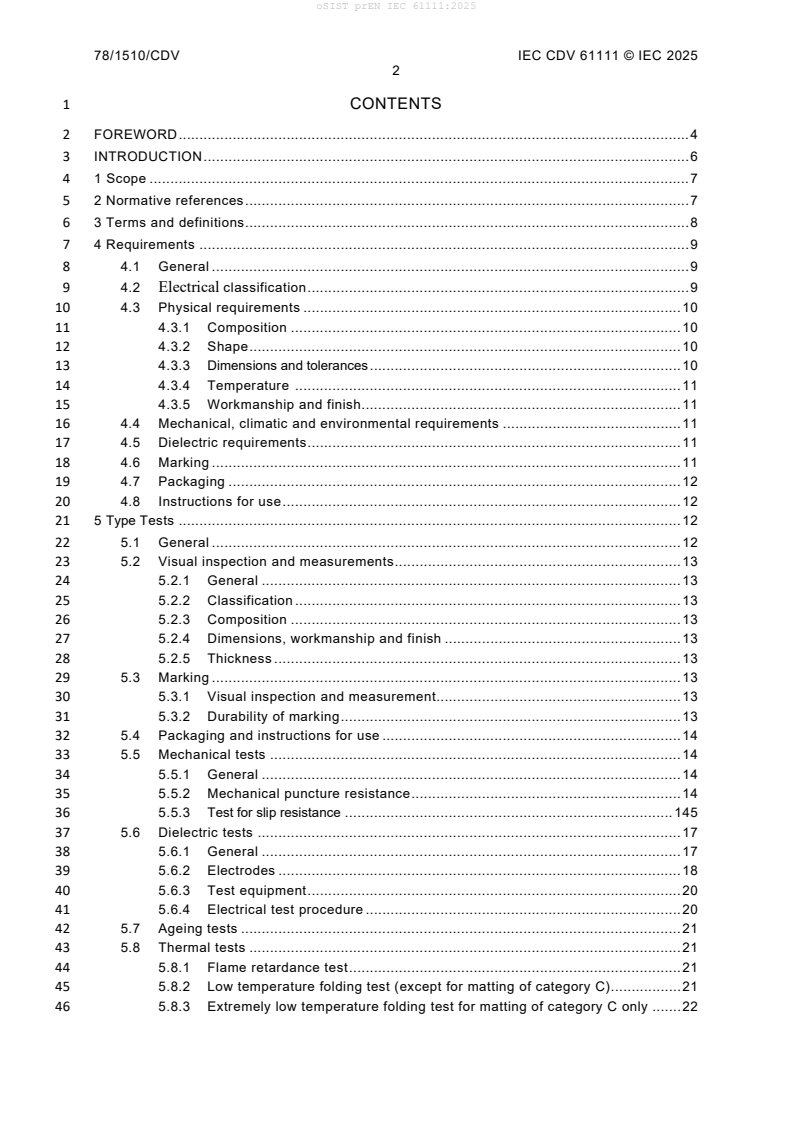
1 CONTENTS
2 FOREWORD . 4
3 INTRODUCTION . 6
4 1 Scope . 7
5 2 Normative references . 7
6 3 Terms and definitions . 8
7 4 Requirements . 9
8 4.1 General . 9
9 4.2 Electrical classification . 9
10 4.3 Physical requirements . 10
11 4.3.1 Composition . 10
12 4.3.2 Shape . 10
13 4.3.3 Dimensions and tolerances . 10
14 4.3.4 Temperature . 11
15 4.3.5 Workmanship and finish. 11
16 4.4 Mechanical, climatic and environmental requirements . 11
17 4.5 Dielectric requirements . 11
18 4.6 Marking . 11
19 4.7 Packaging . 12
20 4.8 Instructions for use . 12
21 5 Type Tests . 12
22 5.1 General . 12
23 5.2 Visual inspection and measurements . 13
24 5.2.1 General . 13
25 5.2.2 Classification . 13
26 5.2.3 Composition . 13
27 5.2.4 Dimensions, workmanship and finish . 13
28 5.2.5 Thickness . 13
29 5.3 Marking . 13
30 5.3.1 Visual inspection and measurement. 13
31 5.3.2 Durability of marking . 13
32 5.4 Packaging and instructions for use . 14
33 5.5 Mechanical tests . 14
34 5.5.1 General . 14
35 5.5.2 Mechanical puncture resistance . 14
36 5.5.3 Test for slip resistance . 145
37 5.6 Dielectric tests . 17
38 5.6.1 General . 17
39 5.6.2 Electrodes . 18
40 5.6.3 Test equipment . 20
41 5.6.4 Electrical test procedure . 20
42 5.7 Ageing tests . 21
43 5.8 Thermal tests . 21
44 5.8.1 Flame retardance test . 21
45 5.8.2 Low temperature folding test (except for matting of category C) . 21
46 5.8.3 Extremely low temperature folding test for matting of category C only . 22
78/1510/CDV IEC CDV 61111 © IEC 2025
47 5.9 Acid resistance . 23
48 5.10 Oil resistance . 23
49 6 Alternative test in case of electrical insulating matting having completed the
50 production phase . 23
51 7 Method of assessment of defects and verification of performance applicable to
52 electrical insulating matting having completed the production phase . 23
53 8 Modifications . 244
54 Annex A (informative) Guidelines for the selection of the class of electrical insulating
55 matting in relation to nominal voltage of a system . 255
56 Annex B (normative) Suitable for live working; double triangle (IEC 60417–5216
57 (2002-10)) . 26
58 Annex C (informative) In-service care and testing . 27
59 Annex D (normative) General type test procedure . 31
60 Annex E (normative) Oil for tests for oil resistance . 33
61 Annex F (normative) Classification of defects and tests to be allocated . 3334
62 Annex G (informative) Rationale for the classification of defects . 35
63 Bibliography . 36
65 Figure 1 – Test plates and needle for resistance to mechanical puncture . 15
66 Figure 2 – Test for slip resistance . 187
67 Figure 3 – Test set-up for voltage proof test of electrical insulating matting with
68 standard type of electrodes . 18
69 Figure 4 – Test set-up for voltage withstand test . 19
70 Figure 5 – Test set-up for low and extremely low temperature folding tests . 22
71 Figure 6 – Example of test set-up for testing the entire length of each roll . 24
72 Table 1 – Classes and maximum use voltages for electrical insulating matting . 9
73 Table 2 – Maximum thickness for electrical insulating matting . 10
74 Table 3 – Maximum electrode clearance for proof tests. 19
75 Table 4 – Test voltages . 20
76 Table C.1 – Guide for periodic inspection and testing of mattings . 28
77 Table C.2 – Voltage values for periodical proof testing . 30
78 Table D.1 – List and chronological order of type tests . 31
79 Table E.1 – Characteristics of oil no. 1 . 33
80 Table F.1 – Classification of defects and associated requirements and tests. 334
81 Table G.1 – Justification for the type of defect . 35
78/1510/CDV IEC CDV 61111 © IEC 2025
87 INTERNATIONAL ELECTROTECHNICAL COMMISSION
88 ____________
90 LIVE WORKING –
91 ELECTRICAL INSULATING MATTING
94 FOREWORD
95 1) The International Electrotechnical Commission (IEC) is a worldwide organization for standardization comprising
96 all national electrotechnical committees (IEC National Committees). The object of IEC is to promote international
97 co-operation on all questions concerning standardization in the electrical and electronic fields. To this end and
98 in addition to other activities, IEC publishes International Standards, Technical Specifications, Technical Reports,
99 Publicly Available Specifications (PAS) and Guides (hereafter referred to as “IEC Publication(s)”). Their
100 preparation is entrusted to technical committees; any IEC National Committee interested in the subject dealt with
101 may participate in this preparatory work. International, governmental and non-governmental organizations liaising
102 with the IEC also participate in this preparation. IEC collaborates closely with the International Organization for
103 Standardization (ISO) in accordance with conditions determined by agreement between the two organizations.
104 2) The formal decisions or agreements of IEC on technical matters express, as nearly as possible, an international
105 consensus of opinion on the relevant subjects since each technical committee has representation from all
106 interested IEC National Committees.
107 3) IEC Publications have the form of recommendations for international use and are accepted by IEC National
108 Committees in that sense. While all reasonable efforts are made to ensure that the technical content of IEC
109 Publications is accurate, IEC cannot be held responsible for the way in which they are used or for any
110 misinterpretation by any end user.
111 4) In order to promote international uniformity, IEC National Committees undertake to apply IEC Publications
112 transparently to the maximum extent possible in their national and regional publications. Any divergence between
113 any IEC Publication and the corresponding national or regional publication shall be clearly indicated in the latter.
114 5) IEC provides no marking procedure to indicate its approval and cannot be rendered responsible for any equipment
115 declared to be in conformity with an IEC Publication.
116 6) All users should ensure that they have the latest edition of this publication.
117 7) No liability shall attach to IEC or its directors, employees, servants or agents including individual experts and
118 members of its technical committees and IEC National Committees for any personal injury, property damage or
119 other damage of any nature whatsoever, whether direct or indirect, or for costs (including legal fees) and
120 expenses arising out of the publication, use of, or reliance upon, this IEC Publication or any other IEC
121 Publications.
122 8) Attention is drawn to the Normative references cited in this publication. Use of the referenced publications is
123 indispensable for the correct application of this publication.
124 9) Attention is drawn to the possibility that some of the elements of this IEC Publication may be the subject of patent
125 rights. IEC shall not be held responsible for identifying any or all such patent rights.
126 International Standard IEC 61111 has been prepared by IEC technical committee 78: Live
127 Working.
128 This third edition cancels and replaces the second edition published in 2009. This edition
129 constitutes a technical revision.
130 It includes the following significant technical changes with regard to the previous edition:
131 • review of the scope;
132 • introduction of AC/DC use and AC use only;
133 • verification of dated referenced standards;
134 • improvement of the marking;
135 • rewriting of the test for slip resistance;
136 • updating the use of IEC 61318:2021;
137 • creation of an alternative test;
78/1510/CDV IEC CDV 61111 © IEC 2025
138 • revision and updating of Annexes A, B and D to H.
139 The text of this standard is based on the following documents:
FDIS Report on voting
78/XXXX/FDIS 78/XXXX/RVD
141 Full information on the voting for the approval of this standard can be found in the report on
142 voting indicated in the above table.
143 This publication has been drafted in accordance with the ISO/IEC Directives, Part 2.
144 The committee has decided that the contents of this publication will remain unchanged until the
145 maintenance result date indicated on the IEC web site under "http://webstore.iec.ch" in the data
146 related to the specific publication. At this date, the publication will be:
147 • reconfirmed,
148 • withdrawn,
149 • replaced by a revised edition, or
150 • amended.
78/1510/CDV IEC CDV 61111 © IEC 2025
152 INTRODUCTION
153 This document has been prepared according to the requirements of IEC 61477:2009 where
154 applicable.
155 The product covered by this standard may have an impact on the environment during some or
156 all stages of its life cycle. These impacts can range from slight to significant, be of short-term
157 or long-term, and occur at the global, regional or local level.
158 Except for a disposal statement in the instructions for use, this standard does not include
159 requirements and test provisions for the manufacturers of the product, or recommendations to
160 the users of the product for environmental improvement. However, all parties intervening in its
161 design, manufacture, packaging, distribution, use, maintenance, repair, reuse, recovery and
162 disposal are invited to take account of environmental considerations.
78/1510/CDV IEC CDV 61111 © IEC 2025
164 LIVE WORKING –
165 ELECTRICAL INSULATING MATTING
168 1 Scope
169 This document is applicable to electrical insulating matting made of flexible insulating material
170 for use as a covering of the surface on which the worker is positioned and for worker´s electrical
171 protection on electrical installations up to 36 000 V AC for AC use or 36 000 V AC and 54 000
172 V DC for AC/DC use.
173 NOTE 1 The electric potential of the surface on which the worker is positioned is usually that of earth.
174 NOTE 2 See Clause 4.2 for maximum use voltage.
175 NOTE 3 DC only rated matting is not specified in this document.
176 NOTE 4 This document does not cover the use of insulating blankets (see IEC 61112)
177 2 Normative references
178 The following referenced documents are indispensable for the application of this document. For
179 dated references, only the edition cited applies. For undated references, the latest edition of
180 the referenced document (including any amendments) applies.
181 IEC 60060-1:2010, High-voltage test techniques – Part 1: General definitions and test requirements
182 IEC 60060-2:2010, High-voltage test techniques – Part 2: Measuring systems
183 IEC 60068-1:2013, Environmental testing – Part 1: General and guidance
184 IEC 60212:2010, Standard conditions for use prior to and during the testing of solid electrical
185 insulating materials
186 IEC 61318:2021, Live Working - Methods for assessment of defects and verification of performance
187 applicable to tools, devices and equipment
188 IEC 61477:2009, Live working – Minimum requirements for the utilization of tools, devices and
189 equipment
190 ISO 2592:2017, Petroleum and Related Products - Determination of flash and fire points –
191 Cleveland open cup method
192 ISO 2977:1997, Petroleum products and hydrocarbon solvents – Determination of aniline point
193 and mixed aniline point
194 ISO 3104:2020, Petroleum products – Transparent and opaque liquids – Determination of
195 kinematic viscosity and calculation of dynamic viscosity
196 ISO 23529:2016, Rubber - General procedures for preparing and conditioning test pieces for
197 physical test methods
198 ISO 4649:2017, Rubber, vulcanized or thermoplastic - Determination of abrasion resistance
199 using a rotating cylindrical drum device
200 3 Terms and definitions
201 For the purposes of this document, the terms and definitions given in IEC 61318:2021 and the
202 following apply.
203 ISO and IEC maintain terminological databases for use in standardization at the following
204 addresses:
78/1510/CDV IEC CDV 61111 © IEC 2025
205 • ISO Online browsing platform: available at https://www.iso.org/obp
206 • IEC Electropedia: available at http://www.electropedia.org/
207 3.1
208 disruptive discharge
209 passage of an electric arc following electric breakdown
210 Note 1 to entry: The term “sparkover” (in French “amorçage”) is used when a disruptive discharge occurs in a
211 gaseous or liquid dielectric.
212 Note 2 to entry: The term “flashover” (in French “contournement”) is used when a disruptive discharge occurs at
213 least partly along the surface of a solid dielectric surrounded by a gaseous or liquid medium.
214 Note 3 to entry: The term “puncture” (in French “perforation”) is used when a disruptive discharge occurs through
215 a solid dielectric producing permanent damage.
216 [SOURCE: IEC 60050-212:2010, 212-11-46]
217 3.2
218 elastomer
219 macromolecular material which returns after substantial deformation by a weak stress and
220 release of the stress rapidly to approximately its initial dimensions and shape
221 Note 1 to entry: The definition applies to room temperature test conditions.
222 Note 2 to entry: Elastomer is a generic term that includes rubber, latex and elastomeric compounds that may be
223 natural or synthetic or a mixture or a combination of both. It also includes thermoplastic elastomer (TPE) material.
224 [SOURCE: IEC 60050-212:2010, 212-14-05, modified by adding Note 2 to entry.]
225 3.3
226 electrical insulating matting
227 flat protective cover made of flexible insulating material, used to provide electrical insulation
228 between the feet of the worker and the surface on which the worker is standing
229 Note 1 to entry: The electric potential of the surface on which the worker is standing is usually that of earth.
230 [SOURCE: IEC 60050-651:2014, 651-22-13]
231 3.4
233 international rubber hardness degree
234 IRHD
235 measure of hardness, the magnitude of which is derived from the depth of penetration of a
236 specified indentor into a test piece under specified conditions
237 Note 1 to entry: The IRHD scale is such that 0 degrees represents a material showing no measurable resistance to indentation
238 and 100 degrees represents a material showing no measurable indentation. The scale is described fully in ISO 48.
240 [SOURCE: ISO 1382:2020, 3.264]
241 3.5
242 nominal voltage of a system
243 suitable approximate value of voltage used to designate or identify a system
244 [SOURCE: IEC 60050-601:1985, 601-01-21]
245 3.6
246 proof test
247 test to demonstrate the safety of the equipment for work by evaluating of
248 the capability of the insulating material or product under prescribed test conditions to conform
249 with applicable rating
250 Note 1 to entry: An AC proof test typically involves applying a voltage corresponding to a temporary overvoltage
251 higher than the equipment's nominal operating voltage for a specified period.
78/1510/CDV IEC CDV 61111 © IEC 2025
252 3.7
253 proof test voltage
254 specified voltage that is applied to a device or test piece for the time defined under specified
255 conditions to assure that the electrical strength of the insulation is above a specified value
256 3.8
257 withstand test
258 test on insulating material and/or product made by applying a high voltage
259 across the insulation to determine the adequacy of the dielectric strength
260 Note 1 to entry: The dielectric strength includes the material integrity.
261 Note 2 to entry: An AC withstand test typically involves applying a high voltage stress corresponding to a switching
262 overvoltage.
263 3.9
264 withstand test voltage
265 voltage that a test piece is required to withstand without disruptive discharge or other electric
266 failure when voltage is applied under specified conditions
267 4 Requirements
268 4.1 General
269 Electrical insulating matting shall be designed and manufactured to contribute to the safety of
270 the users provided they are used by skilled persons, in accordance with safe methods of work
271 and the instructions for use.
272 4.2 Electrical classification
273 The electrical insulating matting covered by this document shall be designated as follows:
274 - by electrical class as given in Table 1.
275 Table 1 – Classes and maximum use voltages for electrical insulating matting
Class Maximum use voltages Maximum use voltage
for AC/DC used matting for AC only used matting
0 1 000 V AC / 1 500 V DC 1 000 V
1 7 500 V AC / 11 250 V DC 7 500 V
2 17 000 V AC / 25 500 V DC 17 000 V
3 26 500 V AC / 39 750 V DC 26 500 V
4 36 000 V AC / 54 000 V DC 36 000 V
277 - by adding the suffix “C” to the class designation, in case of category C matting
278 (resistance to extremely low temperature).
279 Guidance for the selection of class (AC and DC) is given in Annex A.
280 4.3 Physical requirements
281 4.3.1 Composition
282 The electrical insulating matting shall be manufactured of flexible insulating material such as
283 elastomer.
284 Both sides of the electrical insulating matting shall be slip resistant. The slip resistance may be
285 achieved with surface such as corrugated or diamond design.
78/1510/CDV IEC CDV 61111 © IEC 2025
286 Any insert shall not adversely affect the dielectric characteristics of the electrical insulating
287 matting.
288 4.3.2 Shape
289 There is no requirement for the shape of the electrical insulating matting.
290 Electrical insulating matting may be supplied in either portable style or stationary style (in roll)
291 to be cut for individual applications.
292 4.3.3 Dimensions and tolerances
293 4.3.3.1 Length and width
294 Electrical insulating matting of class 0,1 and 2 shall not have length and width less than 600 mm.
295 Electrical insulating matting of class 3 and 4 shall not have length and width less than 914 mm.
296 Manufacturers shall provide the dimensions of the matting length and width. These dimensions
297 for each matting shall be within a tolerance up to ± 2 % of the stated dimensions.
298 Portable matting shall have maximum dimensions of (width x length) less or equal to 1220 x
299 2000 mm.
300 Stationary matting shall have longitudinal length above 2000 mm.
301 4.3.3.2 Maximum thickness
302 The maximum thickness of matting shall be as given in Table 2 in order to obtain appropriate
303 flexibility.
304 Table 2 – Maximum thickness for electrical insulating matting
Class mm
0 6,0
1 6,0
2 8,0
3 11,0
4 14,0
306 When corrugations or diamonds are present, measurements shall be made over the
307 corrugations or diamonds. The corrugations shall not be more than 3 mm deep. The
308 corrugations of the matting on one side of the matting do not line up with corrugations on the
309 other surface of the matting.The diamonds shall not be higher than 2 mm.
310 4.3.3.3 Minimum thickness
311 The minimum thickness shall be determined only by the ability to pass the tests defined in
312 Clause 5.
313 4.3.4 Temperature
314 Standard electrical insulating matting shall be designed to be used in applications having
315 ambient temperatures between – 25 °C and + 55 °C and category C matting in ambient
316 temperatures between – 40 °C and + 55 °C.
317 4.3.5 Workmanship and finish
318 Electrical insulating matting shall be free from harmful physical irregularities on both surfaces
319 that can be detected by thorough test and/or inspection.
320 Harmful physical irregularities are those defined as any feature that disrupts the uniform,
321 smooth surface contour, such as pinholes, cracks, blisters, cuts, conductive embedded foreign
78/1510/CDV IEC CDV 61111 © IEC 2025
322 matter, creases, pinch marks, voids (entrapped air), prominent ripples and prominent molded
323 marks shall not be acceptable.
324 Non-harmful physical irregularities are those defined as surface irregularities present on either
325 surface of the matting due to imperfections on forms or molds or other imperfections inherent
326 to the manufacturing process and are acceptable provided that:
327 a) the thickness at any irregularity conforms to the thickness requirements. Surface design
328 to improve slip resistance shall not be considered as an irregularity;
329 b) the indentations, protuberances or mold marks blend into a smooth slope upon
330 stretching of the material mechanical, climatic and environmental requirements.
331 Any additions to the matting for marking / traceability e.g. identification tags or microchips can
332 be considered as non-harmful irregularities as long the matting fulfils the dielectric and
333 mechanical requirements contained in subclauses 4.1 through 4.3.4 and 4.5
334 4.4. Mechanical, climatic and environmental requirements
335 Electrical insulating matting shall support the mechanical, climatic and environmental stresses
336 occurring during normal working conditions.
337 All electrical insulating matting shall be resistant to acid, oil, and low temperature.
338 Category C electrical insulating matting shall be resistant to extremely low temperature.
339 4.5 Dielectric requirements
340 Electrical insulating matting shall be capable of withstanding the corresponding electrical
341 stresses according to its electrical class.
342 4.6 Marking
343 Electrical insulating matting complying with the requirements of this standard shall be marked
344 on the product with the following items of marking:
345 • name, trademark or identification of the manufacturer;
346 • symbol IEC 60417-5216 (2002-10) – Suitable for live working; double triangle (see
347 Annex B);
348 NOTE: The exact ratio of the height of the figure to the base of the triangle is 1,43. For the purpose of
349 convenience, this ratio can be between the values of 1,4 and 1,5.
350 • number of the relevant IEC standard immediately adjacent to the symbol, with year of
351 publication (4 digits);
352 • month and year of manufacture;
353 • category C if applicable;
354 • class designation;
355 • AC/DC, or AC;
356 • In the case of matting in rolls, these items of marking shall appear at least every 0,6 meter;
357 Any additional item of marking shall be subject to agreement between the manufacturer and the
358 customer.
359 The marking shall be clearly identifiable by persons with normal or corrected sight without
360 further magnification; be clearly visible, durable and shall not impair the quality of the electrical
361 insulating matting.
362 When a colour code for labels or space is used, the marking shall correspond to the following
363 code:
78/1510/CDV IEC CDV 61111 © IEC 2025
365 Class 0 – red
366 Class 1 – white
367 Class 2 – yellow
368 Class 3 – green
369 Class 4 – orange
370 4.7 Packaging
371 Electrical insulating matting shall be supplied in suitable packaging for shipping and initial
372 storage to provide protection until it is opened for use.
373 The outside of the container or package shall be marked with at least the following information:
374 • product name and reference or catalog number for example;
375 number of the relevant IEC standard immediately adjacent to the symbol with year of
376 publication (4 digits);
377 • class designation;
378 • AC/DC or AC;
379 • dimensions (length and width) of the product.
380 4.8 Instructions for use
381 The manufacturer shall provide written instructions for use with each consignment of electrical
382 insulating matting covered by this standard.
383 These instructions shall be prepared in accordance with the general provisions of
384 IEC 61477:2009.
385 The instructions for use shall include as a minimum, information such as storage, handling,
386 disposal and periodic testing.
387 The instructions for use shall inform the users about critical hazards the manufacturer is aware
388 of and offer relevant recommendations, but without intruding into the area of work procedures
389 (for example, recommendation in case of overlapping matting). Additional information is given
390 in Annex C - In service care and testing.
391 5 Type tests
392 5.1 General
393 The present standard provides testing provisions to demonstrate compliance of the product to
394 the requirements of Clause 4. These testing provisions are primarily intended to be used as
395 type tests for validation of the design input.
396 The allocation of the electrical insulating matting into various test groups, the quantity required
397 and the order in which the type tests are carried out are given in Annex D.
398 The test location conditions shall be in accordance with IEC 60068-1:2013:
399 – ambient temperature: 15 °C to 35 °C;
400 – relative humidity: 25 % to 75 %;
401 – atmospheric pressure: 86 kPa to 106 kPa.
402 For type tests, unless otherwise specified, electrical insulating matting or test pieces shall be
403 conditioned for a period of 2 h ± 0,5 h at a temperature of 23 °C ± 2 °C and relative humidity of
404 50 % ± 5 % according to IEC 60212:2010 standard atmosphere B.
405 Unless otherwise specified, the tolerances for any measured value shall be ± 5 %.
78/1510/CDV IEC CDV 61111 © IEC 2025
406 5.2 Visual inspection and measurements
407 5.2.1 General
408 Visual inspection shall be carried out by persons with normal or corrected sight without further
409 magnification.
410 5.2.2 Classification
411 The matting shall be checked by visual inspection to ensure that the requirements of 4.2 are
412 fulfilled.
413 5.2.3 Composition
414 The matting shall be checked by visual inspection to ensure that the requirements of 4.3.1 are
415 fulfilled.
416 5.2.4 Dimensions, workmanship and finish
417 The product length and width provided by the manufacturer shall be verified with the electrical
418 insulating matting in a flattened condition.
419 The test shall be considered as passed if the requirements of 4.3.3.1 are satisfied.
420 The workmanship and finish shall be verified by visual inspection. Where matting is supplied in
421 a roll, a length of 2 m shall be submitted for inspection.
422 The inspection shall be considered as passed if the requirements of 4.3.5 are satisfied.
423 5.2.5 Thickness
424 Thickness measurements shall be made at five points approximately uniformly distributed over
425 the total area of the electrical insulating matting. Where matting is supplied in a roll, a length of
426 2 m shall be submitted to test.
427 Measurements shall be made with a commercial device designed for use on flexible materials
428 and that measures the maximum thickness with an accuracy of 0,03 mm. Sufficient support
429 shall be given to the matting so that it will present an unstressed flat surface at the measurement
430 point.
431 According to ISO 23529:2016, the pressure exerted by the presser foot of the measuring device
432 shall be (22 ± 5) kPa for matting material having a hardness equal to or greater than 35 IRHD,
433 and (10 ± 2) kPa for matting material having a hardness less than 35 IRHD.
434 The test shall be considered as passed if the requirements of 4.3.3.2. are satisfied.
435 5.3 Marking
436 5.3.1 Visual inspection and measurement
437 The marking requirements of 4.6 shall be verified by visual inspection. Where matting is
438 supplied in a roll, a length of 2 m shall be submitted to inspection.
439 5.3.2 Durability of marking
440 The durability of the items marked on the electrical insulating matting shall be checked by
441 rubbing vigorously for 15 s with a piece of lint-free cloth soaked in soapy water and then rubbing
442 it for a further 15 s with a piece of lint-free cloth soaked in isopropanol (CH -CH(OH)-CH ).
3 3
443 NOTE: It is the employer’s duty to ensure that any relevant legislation and any specific safety instructions regarding
444 the use of this chemical are fully observed.
445 The test shall be considered as passed if the items of marking remain legible and the letters do
446 not smear.
447 For marking produced by an engraving or moulding process the test for durability is not needed.
78/1510/CDV IEC CDV 61111 © IEC 2025
448 5.4 Packaging and instructions for use
449 The packaging and complete supply of the information required in 4.7 and 4.8 shall be verified
450 by visual inspection.
451 5.5 Mechanical tests
452 5.5.1 General
453 All mechanical tests shall be performed on test pieces which have been conditioned by storing
454 each separately in a flat, horizontal position for at least 24 h at a temperature of 23 °C ± 2 °C
455 and relative humidity of 50 % ± 5 % according to IEC 60212:2010 standard atmosphere B.
456 Where matting is supplied in rolls, the material taken from the roll needed to prepare the test
457 pieces shall be cut before conditioning.
458 NOTE: The properties of vulcanized elastomeric material change continuously with time, these changes being
459 particularly rapid in the period immediately following vulcanization.
460 5.5.2 Mechanical puncture resistance
461 This test shall be carried out on both sides of the matting.
462 Two circular test pieces 50 mm in diameter shall be cut from the electrical insulating matting
463 and each shall be clamped between two flat 50 mm diameter test plates such that one test piece
464 is perforated from one side and the other test piece is perforated from the other side. The top
465 plate shall have a circular opening 6 mm in diameter and the bottom plate a 25 mm diameter
466 circular opening. The edges of both openings shall be rounded to a radius of 0,8 mm (see
467 Figure 1).
468 A needle shall be produced from a 5 mm diameter metallic rod and one end shall be machined
469 to produce a taper with an included angle of 12° and with the tip rounded to a radius of 0,8 mm
470 (see Figure 1). The needle shall be clean at time of use.
471 The needle shall be positioned perpendicularly above the test piece (clamped between the
472 plates) and shall be driven into and through the specimen. The rate of traverse shall be
473 500 mm/min ± 50 mm/min. The force required to perform the puncture shall be measured and
474 registered.
475 The test shall be considered as passed if the puncture resistance is greater than 70 N.
78/1510/CDV IEC CDV 61111 © IEC 2025
477 Dimensions in millimetres except for angles
∅6
R = 0,8
∅50
R = 0,8
∅25
∅50
12°
R = 0,8
IEC 451/09
479 Key
1 Top plate
2 Bottom plate
3 Needle
480 Figure 1 – Test plates and needle for resistance to mechanical puncture
481 5.5.3 Test for slip resistance
482 5.5.3.1 General
483 The test shall be carried out on one test piece of insulating electrical matting of 600 mm x 600 mm.
484 5.5.3.2 Test apparatus
485 A suitable test apparatus is shown in Figure 2. The construction of the test apparatus is left to the
486 initiative of the person carrying out the test.
∅5
78/1510/CDV IEC CDV 61111 © IEC 2025
488 5.5.3.3 Friction piece
489 A suitable friction piece is composed of a cuboid metal block and an elastomeric pad stuck together:
490 - bearing-surface area: 100 mm x 100 mm with a tolerance of ± 1 mm;
491 - material of the bearing-surface area: stainless steel for general use (such as martensitic), with
492 a minimum chromium (Cr) content of 12 % (to avoid oxidation);
493 - the elastomeric pad to be used under the friction piece shall be made in accordance with the
494 standardized rubber defined in B.2 of Annex B of ISO 4649:2017 with dimensions of:
495 - 98 mm ± 1 mm in diameter;
496 - maximum of 8 mm and a minimum of 2 mm in thickness
497 - chamfer 45° machined on the pad
498 - mass of the total friction piece: 5 kg ± 5 g.
499 5.5.3.4 Pulling cord
500 The pulling cord shall be made of stainless-steel wire rope grade 304 (or 316) with a diameter of 5 mm
501 with 6 strands of 7 wires.
502 The pulling cord shall be attached at 1/3 of the height of the friction piece, centered vertically to the
503 friction piece as shown in Figure 2.
504 The pulling cord length shall be between 1000 mm and 4000 mm at the starting point of the test.
505 5.5.3.5 Substrate
506 The test piece shall lay on a horizontal substrate larger that the test piece. The test piece shall be held
507 in place by a device that prevents it from slipping on the substrate. As an example, the device should
508 be masses or clamps but at the corners of the test piece.
509 5.5.3.6 Testing
510 Before testing, both surfaces of the test piece shall be cleaned with isopropanol and allowed to
511 dry completely before continuing the test;
512 - the test shall be carried out along both directions on each side of the test piece;
513 - the speed of the friction piece during test shall be 150 mm/min ± 5 %;
514 - the pulling force F direction shall be horizontal with a 0/+ 5° angle tolerance as shown
515 in Figure 2;
516 - the pulling track length L shall be 300 mm min.
517 The test shall be considered as passed if tensile force F for both direction on each side of the test piece
518 is higher than 50 N over the pulling length, after the measures relating to the first 50 mm of the pulling
519 length have been discarded.
78/1510/CDV IEC CDV 61111 © IEC 2025
522 Key
1 Pulley if needed
2 Steel cord
3 Substrate
4 Test piece
5 Friction piece
6 Pulling cord length at starting point of the test
L Pulling track length
H Height of the friction piece
F Pulling force
𝛼𝛼 Angle
523 Figure 2 - Test for slip resistance
524 5.6 Dielectric tests
525 5.6.1 General
526 Dielectric testing shall be carried out using the following tests:
527 • AC and DC voltage proof and withstand tests for AC / DC use matting
528 • AC voltage proof and withstand tests for AC use matting only
529 The peak (crest) or RMS value of the AC voltage and average value or AVG value of DC voltage
530 shall be measured with a maximum error in accordance with IEC 60060-2:2010.
531 The matting for AC dielectric testing, including test pieces from rolls, shall be conditioned for
532 moisture absorption by total immersion in a bath of tap water with a resistivity of (100 ± 15) Ω·m
533 at room temperature (as specified in 5.1) for a period of 16 h ± 0,5 h. After the conditioning they
534 shall be wiped dry and immediately submitted to the dielectric test.
535 The matting for DC dielectric testing shall not be conditioned for moisture absorption.
536 NOTE: Insulating compounds used in the finishing process (e.g. paraffin and talcum powder) can be removed with
537 suitable solvents defined by manufacturer before the test is commenced.
----------------------
...
Questions, Comments and Discussion
Ask us and Technical Secretary will try to provide an answer. You can facilitate discussion about the standard in here.
Loading comments...