

prEN IEC 63640:2026
(Main)Horticultural lighting - LED modules for horticultural lighting - Safety
- Status
- Not Published
- Publication Date
- 08-Nov-2027
- Technical Committee
- CLC/TC 34 - 'Lamps and related equipment
- Current Stage
- 4060 - Enquiry results established and sent to TC, SR, BTTF - Enquiry
- Start Date
- 10-Jul-2026
- Completion Date
- 10-Jul-2026

prEN IEC 63640:2026 is a CLC/IEC draft standard for the safety of LED modules used in horticultural lighting. It specifies electrical, thermal, mechanical and photobiological safety requirements for built-in LED modules operated on DC supplies up to 1 500 V or AC supplies up to 1 000 V, for manufacturers, test laboratories, certification bodies and specifiers checking product safety.
What does prEN IEC 63640:2026 specify?
prEN IEC 63640:2026 specifies safety requirements for LED modules for horticultural lighting purposes. It focuses on safety, not on lighting performance, so it is the document to use when the question is whether a module is electrically and physically safe for its intended use.
The scope excludes LED packages, LED lamps and OLED light sources. In this document, the term LED module means a built-in LED module for horticultural lighting purposes, and independent LED modules are treated as luminaires with LED module(s) as an integral component.
The document is organized into clauses on scope, normative references, terms and definitions, classification, general requirements, general conditions for tests, marking, electrical safety, thermal safety, mechanical safety, photobiological safety, fault conditions and abnormal conditions.
What are the key requirements of prEN IEC 63640:2026?
prEN IEC 63640:2026 builds on IEC 62031 and then adds horticultural-lighting-specific classification, marking and photobiological safety provisions. In practice, that means most core safety requirements are taken from the LED module base standard, while this document adds how horticultural modules are identified and assessed.
Classification and intended use
Clause 4 applies the IEC 62031 classification and adds a further split by intended use: without restriction for use and industrial or professional use. The practical effect is that suppliers must declare how the module is meant to be used, because the safety assessment and marking can depend on that choice.
Modules classified for industrial or professional use are intended to be supervised by instructed or skilled persons and are normally not user-replaceable. That matters for installation, maintenance planning and who is allowed to handle the module.
General safety, testing and marking
Clauses 5 and 6 refer to IEC 62031 for general requirements and test conditions, and clause 7 does the same for marking. This keeps the basic safety evaluation aligned with the general LED module rules.
Clause 7 adds photobiological hazard-related marking rules when the limits in IEC 62031 clause 11 are exceeded. It also requires corresponding information in the technical literature, so users and integrators can see when special precautions are needed.
Electrical, thermal and mechanical safety
Clauses 8, 9 and 10 apply IEC 62031 for electrical safety, thermal safety and mechanical safety. For a manufacturer or buyer, this means the horticultural use case does not replace the standard LED module safety checks for insulation, temperature and mechanical robustness.
Photobiological safety
Clause 11 is the most distinctive part of the document. Photobiological hazards are assessed according to IEC 62031 clause 11, but for industrial or professional use the document adds special rules if the module does not already comply.
Controls intended to interrupt emission, such as motion sensors or presence detectors, must be bypassed or disabled during photobiological assessment so the module runs continuously. That makes the hazard evaluation representative of worst-case emission.
If an industrial or professional module does not comply with IEC 62031 clause 11, it is assessed under IEC 62471 with all photobiological risks considered, and it is classified into risk groups. The assessment distance is 200 mm, which is important for setting up the test correctly.
Fault and abnormal conditions
Clauses 12 and 13 apply IEC 62031 for fault conditions and abnormal conditions. In practice, the module must remain acceptably safe when something goes wrong or when it operates outside normal conditions.
What terms does prEN IEC 63640:2026 define?
- LED module - In this document, this means a built-in LED module for horticultural lighting purposes.
- Independent LED module - A module of this type is treated as part of a luminaire rather than as a standalone replaceable light source.
- Without restriction for use - This classification is for modules intended for general use without the additional supervision expected for industrial or professional use.
- Industrial or professional use - This is for modules intended to be supervised by instructed or skilled persons and usually not user-replaceable.
- Photobiological hazard - This is the risk from optical radiation to eyes or skin that must be assessed for horticultural LED modules.
- Risk group - Under IEC 62471, this is the hazard class used when a module is assessed for photobiological risk.
Who uses prEN IEC 63640:2026?
prEN IEC 63640:2026 is used by manufacturers of horticultural LED modules, lighting design teams, test laboratories and certification bodies. It is also relevant to quality managers, compliance teams and buyers who need to confirm that a module is the right safety standard for horticultural use.
Installers and integrators use it when selecting modules for systems intended for industrial or professional supervision. For them, the intended-use classification and photobiological marking are especially important.
What changed in prEN IEC 63640:2026 from the previous edition?
prEN IEC 63640:2026 supersedes 34/1306/RVN and 34/1404/CD.
Which standards are used with prEN IEC 63640:2026?
- IEC 62471:2006 - Provides the photobiological safety assessment method and risk group classification used when IEC 62031 clause 11 is not sufficient.
- IEC 62031:202x - Provides the base safety requirements, terms and definitions, classification, general test conditions, marking, electrical safety, thermal safety, mechanical safety, fault conditions and abnormal conditions.
- IEC 63545:202x - Provides the horticultural lighting luminaire safety reference used for marking and technical literature when photobiological limits are exceeded.
What does the prEN IEC 63640:2026 document contain?
The document contains clauses for classification, general requirements, test conditions, marking and the main safety domains for LED modules: electrical, thermal, mechanical and photobiological safety. It also includes fault condition and abnormal condition requirements, so the safety review covers both normal operation and foreseeable misuse or failure.
Clause 11 is the most specialized part because it distinguishes between modules without restriction for use and those for industrial or professional use. The document relies on IEC 62031 for the underlying test framework and on IEC 62471 where a fuller photobiological assessment is needed.
Get Certified
Connect with accredited certification bodies for this standard

IMQ S.p.A. (Certification)
Italian electrical product certification.

SLG Prüf- und Zertifizierungs GmbH
German testing and certification body.

UL Solutions
Global safety science company with testing, inspection and certification.
Sponsored listings
Frequently Asked Questions
prEN IEC 63640:2026 is a draft published by CLC. Its full title is "Horticultural lighting - LED modules for horticultural lighting - Safety". This standard covers: Horticultural lighting - LED modules for horticultural lighting - Safety
Horticultural lighting - LED modules for horticultural lighting - Safety
prEN IEC 63640:2026 is classified under the following ICS (International Classification for Standards) categories: 29.140.01 - Lamps in general; 29.140.99 - Other standards related to lamps. The ICS classification helps identify the subject area and facilitates finding related standards.
prEN IEC 63640:2026 is available in PDF format for immediate download after purchase. The document can be added to your cart and obtained through the secure checkout process. Digital delivery ensures instant access to the complete standard document.
Standards Content (Sample)
SLOVENSKI STANDARD
01-julij-2026
Vrtnarska razsvetljava - LED-moduli za vrtnarsko razsvetljavo - Varnost
Horticultural lighting - LED modules for horticultural lighting - Safety
Ta slovenski standard je istoveten z: prEN IEC 63640:2026
ICS:
29.140.99 Drugi standardi v zvezi z Other standards related to
žarnicami lamps
65.060.70 Vrtnarska oprema Horticultural equipment
2003-01.Slovenski inštitut za standardizacijo. Razmnoževanje celote ali delov tega standarda ni dovoljeno.
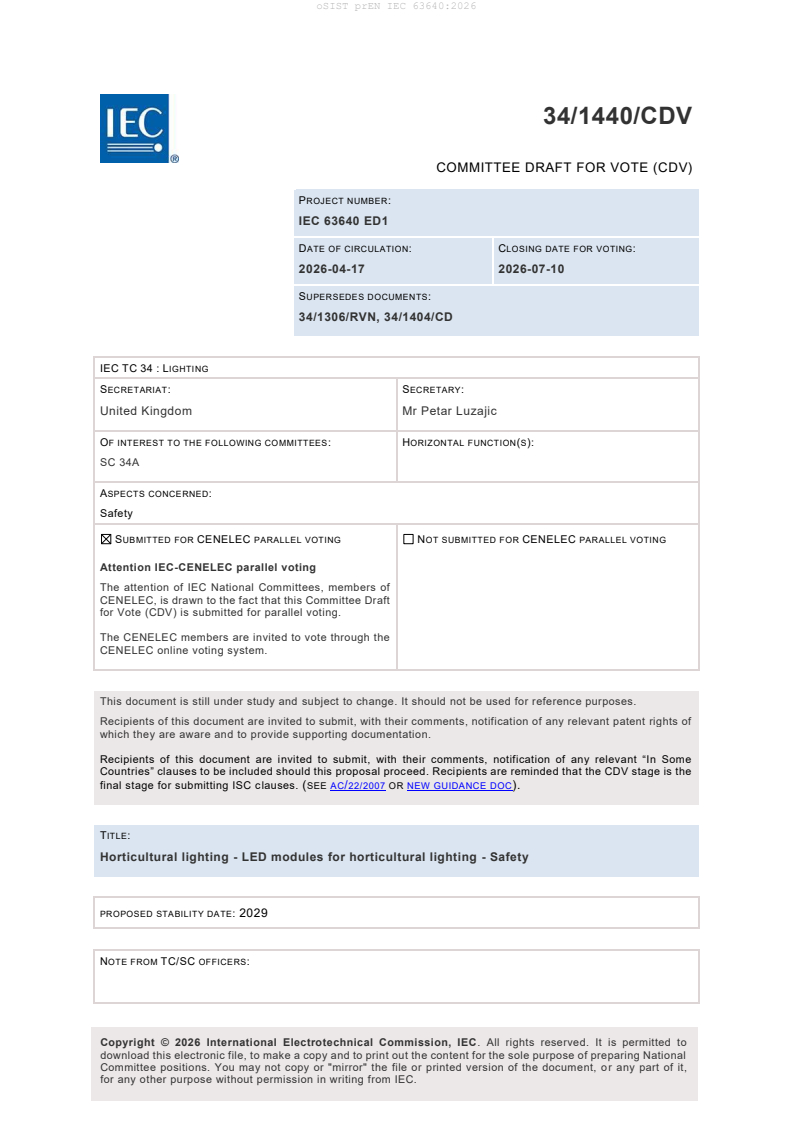
34/1440/CDV
COMMITTEE DRAFT FOR VOTE (CDV)
PROJECT NUMBER:
IEC 63640 ED1
DATE OF CIRCULATION: CLOSING DATE FOR VOTING:
2026-04-17 2026-07-10
SUPERSEDES DOCUMENTS:
34/1306/RVN, 34/1404/CD
IEC TC 34 : LIGHTING
SECRETARIAT: SECRETARY:
United Kingdom Mr Petar Luzajic
OF INTEREST TO THE FOLLOWING COMMITTEES: HORIZONTAL FUNCTION(S):
SC 34A
ASPECTS CONCERNED:
Safety
SUBMITTED FOR CENELEC PARALLEL VOTING NOT SUBMITTED FOR CENELEC PARALLEL VOTING
Attention IEC-CENELEC parallel voting
The attention of IEC National Committees, members of
CENELEC, is drawn to the fact that this Committee Draft
for Vote (CDV) is submitted for parallel voting.
The CENELEC members are invited to vote through the
CENELEC online voting system.
This document is still under study and subject to change. It should not be used for reference purposes.
Recipients of this document are invited to submit, with their comments, notification of any relevant patent rights of
which they are aware and to provide supporting documentation.
Recipients of this document are invited to submit, with their comments, notification of any relevant “In Some
Countries” clauses to be included should this proposal proceed. Recipients are reminded that the CDV stage is the
final stage for submitting ISC clauses. (SEE AC/22/2007 OR NEW GUIDANCE DOC).
TITLE:
Horticultural lighting - LED modules for horticultural lighting - Safety
PROPOSED STABILITY DATE: 2029
NOTE FROM TC/SC OFFICERS:
download this electronic file, to make a copy and to print out the content for the sole purpose of preparing National
Committee positions. You may not copy or "mirror" the file or printed version of the document, o r any part of it,
for any other purpose without permission in writing from IEC.
IEC CDV 63640 © IEC 2026
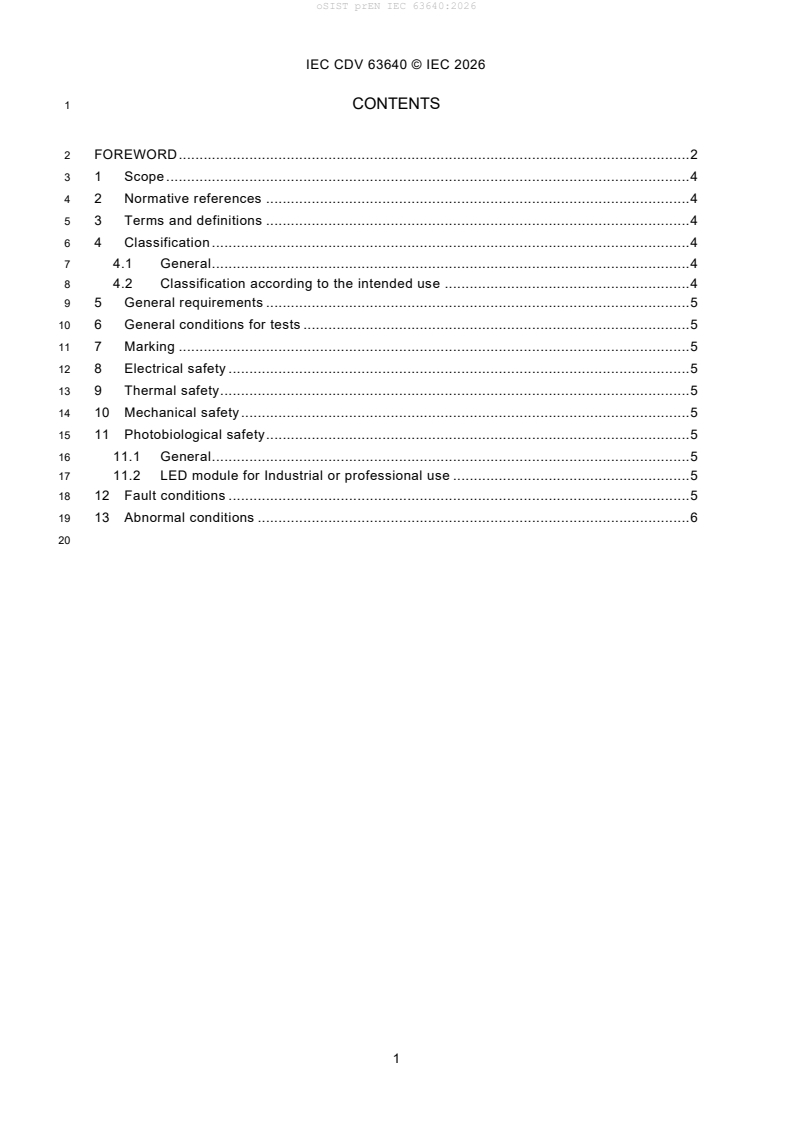
1 CONTENTS
2 FOREWORD . 2
3 1 Scope . 4
4 2 Normative references . 4
5 3 Terms and definitions . 4
6 4 Classification . 4
7 4.1 General . 4
8 4.2 Classification according to the intended use . 4
9 5 General requirements . 5
10 6 General conditions for tests . 5
11 7 Marking . 5
12 8 Electrical safety . 5
13 9 Thermal safety . 5
14 10 Mechanical safety . 5
15 11 Photobiological safety . 5
16 11.1 General . 5
17 11.2 LED module for Industrial or professional use . 5
18 12 Fault conditions . 5
19 13 Abnormal conditions . 6
IEC CDV 63640 © IEC 2026
21 INTERNATIONAL ELECTROTECHNICAL COMMISSION
22 ____________
23 Horticultural lighting – LED modules for horticultural lighting - Safety
26 FOREWORD
27 1) The International Electrotechnical Commission (IEC) is a worldwide organization for standardization comprising
28 all national electrotechnical committees (IEC National Committees). The object of IEC is to promote international
29 co-operation on all questions concerning standardization in the electrical and electronic fields. To this end and
30 in addition to other activities, IEC publishes International Standards, Technical Specifications, Technical Reports,
31 Publicly Available Specifications (PAS) and Guides (hereafter referred to as “IEC Publication(s)”). Their
32 preparation is entrusted to technical committees; any IEC National Committee interested in the subject dealt with
33 may participate in this preparatory work. International, governmental and non-governmental organizations liaising
34 with the IEC also participate in this preparation. IEC collaborates closely with the International Organization for
35 Standardization (ISO) in accordance with conditions determined by agreement between the two organizations.
36 2) The formal decisions or agreements of IEC on technical matters express, as nearly as possible, an international
37 consensus of opinion on the relevant subjects since each technical committee has representation from all
38 interested IEC National Committees.
39 3) IEC Publications have the form of recommendations for international use and are accepted by IEC National
40 Committees in that sense. While all reasonable efforts are made to ensure that the technical content of IEC
41 Publications is accurate, IEC cannot be held responsible for the way in which they are used or for any
42 misinterpretation by any end user.
43 4) In order to promote international uniformity, IEC National Committees undertake to apply IEC Publications
44 transparently to the maximum extent possible in their national and regional publications. Any divergence between
45 any IEC Publication and the corresponding national or regional publication shall be clearly indicated in the latter.
46 5) IEC itself does not provide any attestation of conformity. Independent certification bodies pro
...