


EN 50642:2018
(Main)Cable management systems - Test method for content of halogens
General Information
- Abstract
This European Standard specifies a method for the determination of the content of halogens in Cable Management System (CMS) components or products made of polymeric material(s). The determination is made by combustion and subsequent analysis of the combustion product by Ion Chromatography. This standard specifies how CMS components or products can be declared as halogen free. This European Standard is for environmental performance only. Compliance with this standard does not imply the absence of toxicity, corrosivity or opacity of produced smoke, or other reaction to fire characteristics. If any of these characteristics are to be evaluated, the appropriate standards can be used. The detection limit of this test method is typically 0,025 g of halogen per kg (0,002 5 %). Halides insoluble in aqueous solution present in the original sample or produced during the combustion step are not determined by this method.
- Status
- Withdrawn
- Publication Date
- 17-May-2018
- Withdrawal Date
- 25-Mar-2021
- Technical Committee
- CLC/TC 213 - Cable management systems
- Drafting Committee
- CLC/TC 213 - Cable management systems
- Current Stage
- 9960 - Withdrawal effective - Withdrawal
- Start Date
- 17-Aug-2025
- Completion Date
- 17-Aug-2025

Relations
- Effective Date
- 06-Sep-2022
- Effective Date
- 26-May-2020
Get Certified
Connect with accredited certification bodies for this standard

IMQ S.p.A. (Certification)
Italian electrical product certification.

SLG Prüf- und Zertifizierungs GmbH
German testing and certification body.

UL Solutions
Global safety science company with testing, inspection and certification.
Sponsored listings
Frequently Asked Questions
EN 50642:2018 is a standard published by CLC. Its full title is "Cable management systems - Test method for content of halogens". This standard covers: This European Standard specifies a method for the determination of the content of halogens in Cable Management System (CMS) components or products made of polymeric material(s). The determination is made by combustion and subsequent analysis of the combustion product by Ion Chromatography. This standard specifies how CMS components or products can be declared as halogen free. This European Standard is for environmental performance only. Compliance with this standard does not imply the absence of toxicity, corrosivity or opacity of produced smoke, or other reaction to fire characteristics. If any of these characteristics are to be evaluated, the appropriate standards can be used. The detection limit of this test method is typically 0,025 g of halogen per kg (0,002 5 %). Halides insoluble in aqueous solution present in the original sample or produced during the combustion step are not determined by this method.
This European Standard specifies a method for the determination of the content of halogens in Cable Management System (CMS) components or products made of polymeric material(s). The determination is made by combustion and subsequent analysis of the combustion product by Ion Chromatography. This standard specifies how CMS components or products can be declared as halogen free. This European Standard is for environmental performance only. Compliance with this standard does not imply the absence of toxicity, corrosivity or opacity of produced smoke, or other reaction to fire characteristics. If any of these characteristics are to be evaluated, the appropriate standards can be used. The detection limit of this test method is typically 0,025 g of halogen per kg (0,002 5 %). Halides insoluble in aqueous solution present in the original sample or produced during the combustion step are not determined by this method.
EN 50642:2018 is classified under the following ICS (International Classification for Standards) categories: 29.120.10 - Conduits for electrical purposes. The ICS classification helps identify the subject area and facilitates finding related standards.
EN 50642:2018 has the following relationships with other standards: It is inter standard links to EN IEC 63355:2022, EN 50642:2018/A1:2022. Understanding these relationships helps ensure you are using the most current and applicable version of the standard.
EN 50642:2018 is available in PDF format for immediate download after purchase. The document can be added to your cart and obtained through the secure checkout process. Digital delivery ensures instant access to the complete standard document.
Standards Content (Sample)
SLOVENSKI STANDARD
01-julij-2018
Sistemi za urejanje okablenja - Metoda za preskušanje vsebnosti halogenov
Cable management systems - Test method for content of halogens
Systèmes de gestion de câblage - Méthode d'essai relative à la teneur en halogènes
Ta slovenski standard je istoveten z: EN 50642:2018
ICS:
29.060.20 Kabli Cables
2003-01.Slovenski inštitut za standardizacijo. Razmnoževanje celote ali delov tega standarda ni dovoljeno.
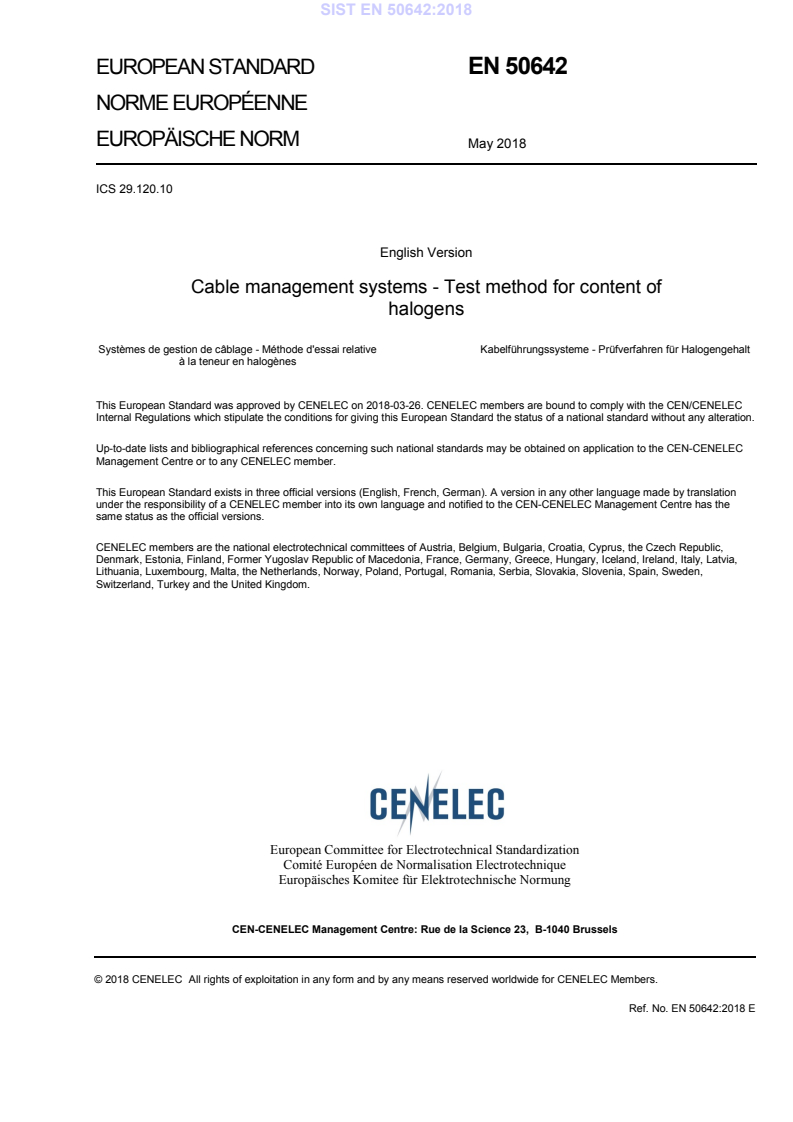
EUROPEAN STANDARD EN 50642
NORME EUROPÉENNE
EUROPÄISCHE NORM
May 2018
ICS 29.120.10
English Version
Cable management systems - Test method for content of
halogens
Systèmes de gestion de câblage - Méthode d'essai relative Kabelführungssysteme - Prüfverfahren für Halogengehalt
à la teneur en halogènes
This European Standard was approved by CENELEC on 2018-03-26. CENELEC members are bound to comply with the CEN/CENELEC
Internal Regulations which stipulate the conditions for giving this European Standard the status of a national standard without any alteration.
Up-to-date lists and bibliographical references concerning such national standards may be obtained on application to the CEN-CENELEC
Management Centre or to any CENELEC member.
This European Standard exists in three official versions (English, French, German). A version in any other language made by translation
under the responsibility of a CENELEC member into its own language and notified to the CEN-CENELEC Management Centre has the
same status as the official versions.
CENELEC members are the national electrotechnical committees of Austria, Belgium, Bulgaria, Croatia, Cyprus, the Czech Republic,
Denmark, Estonia, Finland, Former Yugoslav Republic of Macedonia, France, Germany, Greece, Hungary, Iceland, Ireland, Italy, Latvia,
Lithuania, Luxembourg, Malta, the Netherlands, Norway, Poland, Portugal, Romania, Serbia, Slovakia, Slovenia, Spain, Sweden,
Switzerland, Turkey and the United Kingdom.
European Committee for Electrotechnical Standardization
Comité Européen de Normalisation Electrotechnique
Europäisches Komitee für Elektrotechnische Normung
CEN-CENELEC Management Centre: Rue de la Science 23, B-1040 Brussels
© 2018 CENELEC All rights of exploitation in any form and by any means reserved worldwide for CENELEC Members.
Ref. No. EN 50642:2018 E
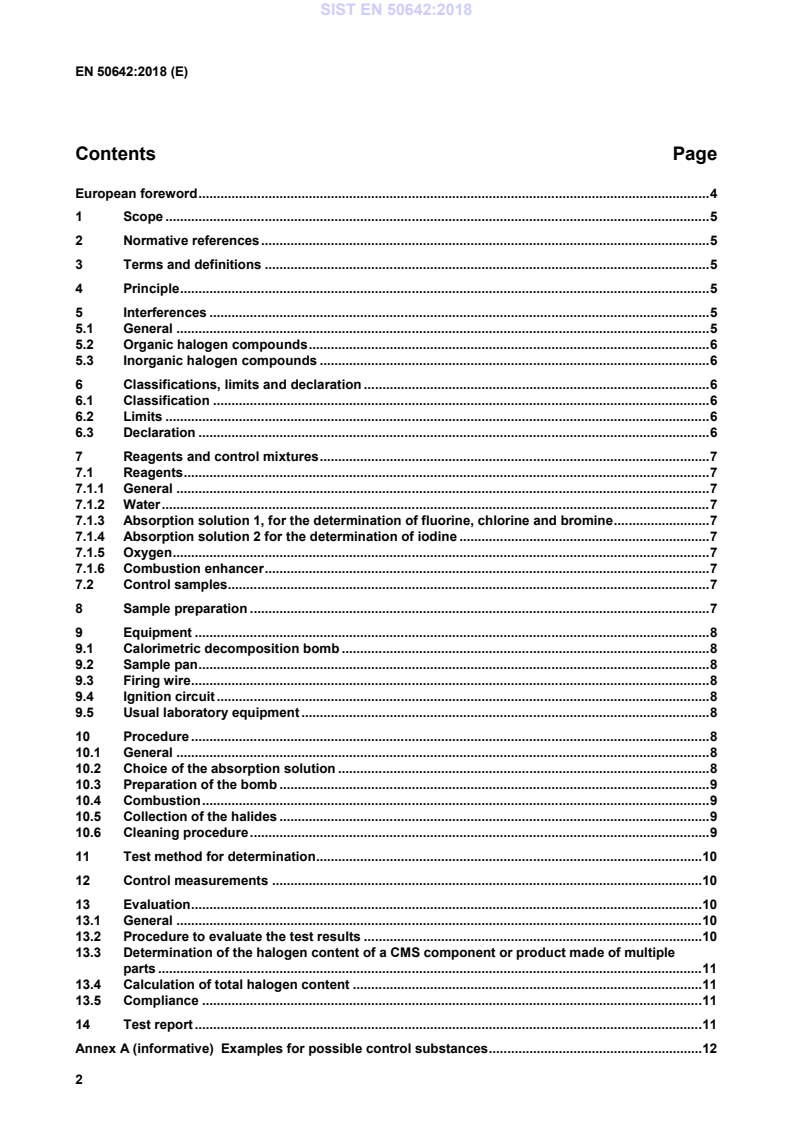
Contents Page
European foreword . 4
1 Scope . 5
2 Normative references . 5
3 Terms and definitions . 5
4 Principle . 5
5 Interferences . 5
5.1 General . 5
5.2 Organic halogen compounds . 6
5.3 Inorganic halogen compounds . 6
6 Classifications, limits and declaration . 6
6.1 Classification . 6
6.2 Limits . 6
6.3 Declaration . 6
7 Reagents and control mixtures . 7
7.1 Reagents . 7
7.1.1 General . 7
7.1.2 Water . 7
7.1.3 Absorption solution 1, for the determination of fluorine, chlorine and bromine . 7
7.1.4 Absorption solution 2 for the determination of iodine . 7
7.1.5 Oxygen . 7
7.1.6 Combustion enhancer . 7
7.2 Control samples . 7
8 Sample preparation . 7
9 Equipment . 8
9.1 Calorimetric decomposition bomb . 8
9.2 Sample pan . 8
9.3 Firing wire . 8
9.4 Ignition circuit . 8
9.5 Usual laboratory equipment . 8
10 Procedure . 8
10.1 General . 8
10.2 Choice of the absorption solution . 8
10.3 Preparation of the bomb . 9
10.4 Combustion . 9
10.5 Collection of the halides . 9
10.6 Cleaning procedure . 9
11 Test method for determination . 10
12 Control measurements . 10
13 Evaluation . 10
13.1 General . 10
13.2 Procedure to evaluate the test results . 10
13.3 Determination of the halogen content of a CMS component or product made of multiple
parts . 11
13.4 Calculation of total halogen content . 11
13.5 Compliance . 11
14 Test report . 11
Annex A (informative) Examples for possible control substances . 12
Table A.1 — Examples for possible control substances . 12
Bibliography . 13
European foreword
This document (EN 50642:2018) has been prepared by CLC/TC 213 “Cable management systems”.
The following dates are fixed:
• latest date by which this document has (dop) 2019-03-26
to be implemented at national level by
publication of an identical national
standard or by endorsement
• latest date by which the national (dow) 2021-03-26
standards conflicting with this document
have to be withdrawn
Attention is drawn to the possibility that some of the elements of this document may be the subject of patent
rights. CENELEC shall not be held responsible for identifying any or all such patent rights.
1 Scope
This European Standard specifies a method for the determination of the content of halogens in Cable
Management System (CMS) components or products made of polymeric material(s). The determination is
made by combustion and subsequent analysis of the combustion product by Ion Chromatography. This
standard specifies how CMS components or products can be declared as halogen free.
This European Standard is for environmental performance only.
Compliance with this standard does not imply the absence of toxicity, corrosivity or opacity of produced smoke,
or other reaction to fire characteristics. If any of these characteristics are to be evaluated, the appropriate
standards can be used.
The detection limit of this test method is typically 0,025 g of halogen per kg (0,002 5 %).
Halides insoluble in aqueous solution present in the original sample or produced during the combustion step
are not determined by this method.
2 Normative references
The following documents are referred to in the text in such a way that some or all of their content constitutes
requirements of this document. For dated references, only the edition cited applies. For undated references,
the latest edition of the referenced document (including any amendments) applies.
EN ISO 3696, Water for analytical laboratory use - Specification and test methods (ISO 3696)
3 Terms and definitions
For the purposes of this document, the following terms and definitions apply.
ISO and IEC maintain terminological databases for use in standardization at the following addresses:
— IEC Electropedia: available at http://www.electropedia.org/
— ISO Online browsing platform: available at http://www.iso.org/obp
3.1
halogen content
content of fluorine, chlorine, bromine and iodine as organic and inorganic compounds that can be converted
to halides (fluoride, chloride, bromide, iodide) by combustion and then absorbed or dissolved in an aqueous
solution
Note 1 to entry: The above definition is valid for this European Standard only and does not strictly comply with scientific
definition of halogen content.
4 Principle
The test sample is oxidized by combustion in a closed system containing oxygen under pressure using a
calorimetric decomposition bomb (bomb).
Nearly all of the halogens in compounds are converted to halides (fluoride, chloride, bromide and iodide), and
nearly all of these (see Clause 5) are dissolved in an absorption solution.
The detection limit of this test method is typically 0,025 g of halogen per kg (0,002 5 %). It may be used for
poorly burning samples, therefore a combustion enhancer may be used.
5 Interferences
5.1 General
Inorganic halides insoluble in aqueous solution present in the original samples or produced during the
combustion step are not determined by the method described here. 5.2 and 5.3 show the differences that
occur between the determination of the content of organic halogenated compounds and inorganic halogen
compounds. The inorganic halogen compounds in the material can have its origin as an additive deliberately
added to the material or as an impurity.
5.2 Organic halogen compounds
Organic compounds containing halogens are known under several names. Different expressions are used like
organohalogens, halogenated compounds, halocarbons or organic halides. They are all substances in which
one or more carbon atoms are linked by covalent bonds to one or more halogen atoms.
Among the organohalogens, some of them are efficient flame retardants. Chlorinated, brominated and
fluorinated organohalogens are used separately or in combination. Organohalogens will be converted into
inorganic halides by combustion and will then be absorbed or dissolved in an aqueous solution. This allows
the subsequent analysis of halogen content.
5.3 Inorganic halogen compounds
Inorganic compounds containing halogens are known as inorganic halides. Inorganic halides used as additives
are salts between a halogen and a metal linked together with an ionic bond, for example magnesium chloride
(MgCl2), potassium bromide (KBr) or sodium fluoride (NaF). These salts may have varying degrees of solubility
in water.
However, this limitation is considered as not significant as no example has been found where inorganic halides
have been used in CMS products.
Impurities containing inorganic halides will occur in several additives used in polymers. They can occur as
impurities in, for example, fillers (like CaCl2 in CaCO3), pigments (like TiCl4 in TiO2) or other inorganic additives
(like AlCl3 in Al(OH)3). These inorganic halides can have more or less solubility in water, but they will only be
measured if they dissolve in the aqueous solution. Investigations have shown that the content of each halogen
in impurities in inorganic additives for CMS products is low and therefore does not significantly contribute to
the total content of each halogen. Insoluble inorganic halides will not be considered and will not be measured
by the method described here. Examples of insoluble inorganic halides are halide salts of silver and barium
(AgCl, AgBr and BaCl2). Soluble inorganic halides will be dissolved in the aqueous solution and will be
measured together with halides coming from the combustion of the
...