


EN 60320-2-1:1987
(Main)Appliance couplers for household and similar general purposes - Part 2: Sewing machine couplers
General Information
- Abstract
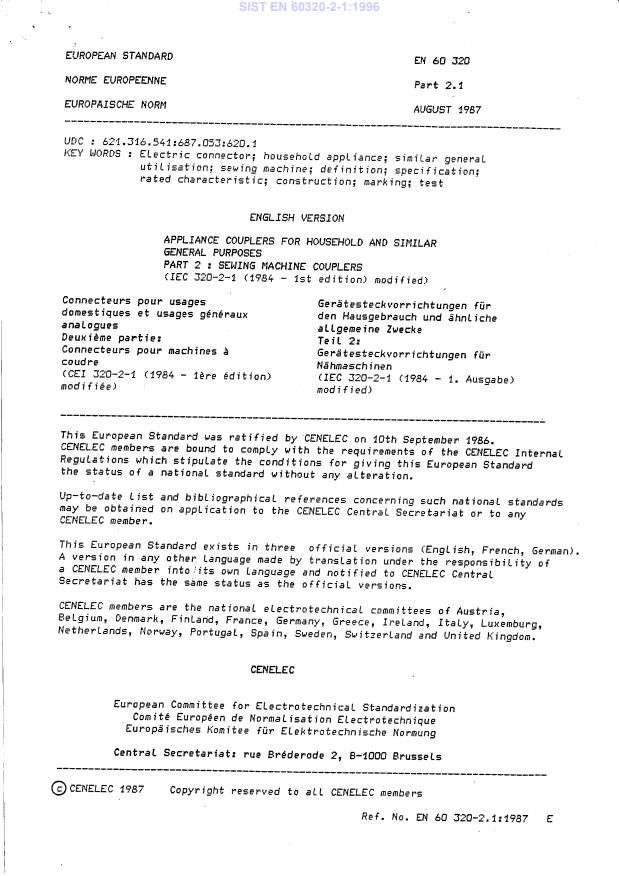
This clause of EN 60 320 Part 1 is replaced as follows: This standard is applicable to special purpose appliance couplers for household sewing machines. These sewing machine couplers are for a.c. only and have a rated voltage not exceeding 250 V and a rated current not exceeding 2.5 A. The sewing machine couplers may include two or more contacts depending on the control components or circuitry required to operate the sewing machine and may be with or without earthing contact.
- Status
- Withdrawn
- Publication Date
- 26-Aug-1987
- Withdrawal Date
- 14-Sep-1988
- Technical Committee
- CLC/SR 23G - Appliance couplers
- Drafting Committee
- IEC/SC 23G - IEC_SC_23G
- Parallel Committee
- IEC/SC 23G - IEC_SC_23G
- Current Stage
- 9960 - Withdrawal effective - Withdrawal
- Start Date
- 01-Sep-2003
- Completion Date
- 01-Sep-2003
- Directive
- Not Harmonized2006/95/EC - Directive 2006/95/EC of the European Parliament and of the Council of 12 December 2006 on the harmonisation of the laws of Member States relating to electrical equipment designed for use within certain voltage limits (codified version)OJ Ref: C, C 60 OJ Date: 14-Mar-2003
Not Harmonized73/23/EEC - Electrical equipment designed for use within certain voltage limitsOJ Ref: C 60

Relations
- Effective Date
- 28-Jan-2023
Frequently Asked Questions
EN 60320-2-1:1987 is a standard published by CLC. Its full title is "Appliance couplers for household and similar general purposes - Part 2: Sewing machine couplers". This standard covers: This clause of EN 60 320 Part 1 is replaced as follows: This standard is applicable to special purpose appliance couplers for household sewing machines. These sewing machine couplers are for a.c. only and have a rated voltage not exceeding 250 V and a rated current not exceeding 2.5 A. The sewing machine couplers may include two or more contacts depending on the control components or circuitry required to operate the sewing machine and may be with or without earthing contact.
This clause of EN 60 320 Part 1 is replaced as follows: This standard is applicable to special purpose appliance couplers for household sewing machines. These sewing machine couplers are for a.c. only and have a rated voltage not exceeding 250 V and a rated current not exceeding 2.5 A. The sewing machine couplers may include two or more contacts depending on the control components or circuitry required to operate the sewing machine and may be with or without earthing contact.
EN 60320-2-1:1987 has the following relationships with other standards: It is inter standard links to EN 60320-2-1:2000. Understanding these relationships helps ensure you are using the most current and applicable version of the standard.
EN 60320-2-1:1987 is associated with the following European legislation: EU Directives/Regulations: 2006/95/EC, 73/23/EEC. When a standard is cited in the Official Journal of the European Union, products manufactured in conformity with it benefit from a presumption of conformity with the essential requirements of the corresponding EU directive or regulation.
EN 60320-2-1:1987 is available in PDF format for immediate download after purchase. The document can be added to your cart and obtained through the secure checkout process. Digital delivery ensures instant access to the complete standard document.
Standards Content (Sample)
2003-01.Slovenski inštitut za standardizacijo. Razmnoževanje celote ali delov tega standarda ni dovoljeno.Appliance couplers for household and similar general purposes - Part 1: Sewing machine couplers (IEC 320-2-1:1984, modified)Gerätesteckvorrichtungen für den Hausgebrauch und ähnliche allgemeine Zwecke -- Teil 2: Gerätesteckvorrichtungen für NähmaschinenConnecteurs pour usages domestiques et usages généraux analogues -- Partie 2: Connecteurs pour machines à coudreAppliance couplers for household and similar general purposes -- Part 2: Sewing m
...