

EN 50343:2024
(Main)Railway applications - Rolling stock - Rules for installation of cabling
General Information
- Abstract
This document specifies requirements for the installation of cabling on railway vehicles and within electrical enclosures on railway vehicles, including magnetic levitation trains and trolley buses. NOTE With respect to trolley buses, this document applies to the whole electric traction system, including current collecting circuits, power converters and the respective control circuits. The installation of other circuits is covered by street vehicle standards for example those for combustion driven buses. This document covers cabling for making electrical connections between items of electrical equipment, including cables, busbars, terminals and plug/socket devices. It does not cover special effect conductors like fibre optic cables or hollow conductors (waveguides). The material selection criteria given here are applicable to cables with copper conductors. This document is not applicable to the following: - special purpose vehicles, such as track-laying machines, ballast cleaners and personnel carriers; - vehicles used for entertainment on fairgrounds; - vehicles used in mining; - electric cars; - funicular railways. As the field of cabling in rolling stock is also dealt with in the cable makers’ standard, references are made to EN 50264 series, EN 50306 series, EN 50382 series and EN 50355. This document applies in conjunction with the relevant product and installation standards and describes minimum requirements.
- Status
- Published
- Publication Date
- 17-Oct-2024
- Technical Committee
- CLC/TC 9X - Electrical and electronic applications for railways
- Drafting Committee
- CLC/SC 9XB - Electromechanical material on board rolling stock
- Current Stage
- 6060 - Document made available - Publishing
- Start Date
- 18-Oct-2024
- Due Date
- 27-Dec-2023
- Completion Date
- 18-Oct-2024

Overview
EN 50343:2024 - Railway applications - Rolling stock - Rules for installation of cabling - is a CLC/CENELEC standard that defines minimum requirements for installing electrical cabling on railway vehicles, including maglev trains and trolley buses (traction systems only). The standard covers cables, busbars, terminals and plug/socket devices used to make electrical connections on board rolling stock. It is applicable together with relevant product and installation standards and is primarily targeted at cables with copper conductors. Some vehicle types (e.g., track-laying machines, mining vehicles, electric cars, funiculars) are excluded.
Key topics and technical requirements
EN 50343:2024 organizes practical rules and tests addressing:
- Technical requirements: cable selection, sizing and material selection criteria for copper conductors.
- Mechanical aspects: bending radii, flexibility, bundling, fixing and conduits.
- Electrical terminations: terminals, plug/socket devices, busbar connections and re-termination practices.
- Separation and clearances: creepage distances, separation of different voltage levels and safety-related segregation.
- Fire and safety: requirements for cable behaviour in fire, provisions for refurbishment and maintenance, and fire-related marking/testing (references EN 45545 series).
- EMC: cable categories, screening, return conductors, separation rules and use of conductive structures.
- Marking and identification: labelling of cables, terminals and heat-shrinkable sleeves.
- Testing and verification: electrical insulation tests, and normative/ informative annexes for cable sizing under short-time currents, temperature classes, lifetime expectation (Arrhenius considerations), termination methods and marking tests.
The standard includes normative annexes for cable sizing and lifetime calculations, and informative annexes on terminations, earth connections, electrochemical potential differences and recommended locations on board.
Applications and who uses it
EN 50343:2024 is intended for:
- Rolling stock designers and OEMs specifying on-board electrical systems
- Electrical installation engineers and fitters installing cabling and busbars
- Maintenance teams and depot engineers planning refurbishment, inspection and repairs
- Cable manufacturers and suppliers aligning product selection to rolling stock requirements
- Certification bodies and safety assessors verifying compliance with railway installation rules
Practical uses include specifying cable type and cross-section, defining routing and fixation methods, ensuring EMC and fire-safety compliance, and setting marking and testing procedures for safety and maintainability.
Related standards
EN 50343:2024 is to be used alongside product/installation standards such as:
- EN 45545 series (fire protection)
- EN 50121 series (EMC)
- EN 50124-1 (clearances & creepage)
- EN 50264, EN 50306, EN 50382, EN 50355 (railway cable standards)
- EN 50467, EN 50553 (connectors, running capability in fire)
Keywords: EN 50343:2024, railway cabling, rolling stock cabling, cable installation rules, cable sizing, EMC requirements, fire protection, busbars, terminal marking.
Relations
- Effective Date
- 07-Jun-2022
- Replaces
EN 50343:2014/A1:2017 - Railway applications - Rolling stock - Rules for installation of cabling - Effective Date
- 31-Aug-2021
- Effective Date
- 22-Jul-2026
- Effective Date
- 09-Feb-2026
- Effective Date
- 09-Feb-2026
- Effective Date
- 09-Feb-2026
- Effective Date
- 09-Feb-2026
- Effective Date
- 09-Feb-2026
- Effective Date
- 09-Feb-2026
- Effective Date
- 09-Feb-2026
- Refers
EN 45545-1:2013 - Railway applications - Fire protection on railway vehicles - Part 1: General - Effective Date
- 09-Feb-2026
- Effective Date
- 03-Feb-2026
- Effective Date
- 03-Feb-2026
- Effective Date
- 03-Feb-2026
- Effective Date
- 03-Feb-2026
Get Certified
Connect with accredited certification bodies for this standard

IRIS Certification (UNIFE)
International Railway Industry Standard certification.

TÜV SÜD Rail GmbH
TÜV SÜD railway certification services.

Bureau Veritas Railway Certification
Railway and transportation certification.
Sponsored listings
Frequently Asked Questions
EN 50343:2024 is a standard published by CLC. Its full title is "Railway applications - Rolling stock - Rules for installation of cabling". This standard covers: This document specifies requirements for the installation of cabling on railway vehicles and within electrical enclosures on railway vehicles, including magnetic levitation trains and trolley buses. NOTE With respect to trolley buses, this document applies to the whole electric traction system, including current collecting circuits, power converters and the respective control circuits. The installation of other circuits is covered by street vehicle standards for example those for combustion driven buses. This document covers cabling for making electrical connections between items of electrical equipment, including cables, busbars, terminals and plug/socket devices. It does not cover special effect conductors like fibre optic cables or hollow conductors (waveguides). The material selection criteria given here are applicable to cables with copper conductors. This document is not applicable to the following: - special purpose vehicles, such as track-laying machines, ballast cleaners and personnel carriers; - vehicles used for entertainment on fairgrounds; - vehicles used in mining; - electric cars; - funicular railways. As the field of cabling in rolling stock is also dealt with in the cable makers’ standard, references are made to EN 50264 series, EN 50306 series, EN 50382 series and EN 50355. This document applies in conjunction with the relevant product and installation standards and describes minimum requirements.
This document specifies requirements for the installation of cabling on railway vehicles and within electrical enclosures on railway vehicles, including magnetic levitation trains and trolley buses. NOTE With respect to trolley buses, this document applies to the whole electric traction system, including current collecting circuits, power converters and the respective control circuits. The installation of other circuits is covered by street vehicle standards for example those for combustion driven buses. This document covers cabling for making electrical connections between items of electrical equipment, including cables, busbars, terminals and plug/socket devices. It does not cover special effect conductors like fibre optic cables or hollow conductors (waveguides). The material selection criteria given here are applicable to cables with copper conductors. This document is not applicable to the following: - special purpose vehicles, such as track-laying machines, ballast cleaners and personnel carriers; - vehicles used for entertainment on fairgrounds; - vehicles used in mining; - electric cars; - funicular railways. As the field of cabling in rolling stock is also dealt with in the cable makers’ standard, references are made to EN 50264 series, EN 50306 series, EN 50382 series and EN 50355. This document applies in conjunction with the relevant product and installation standards and describes minimum requirements.
EN 50343:2024 is classified under the following ICS (International Classification for Standards) categories: 45.060.01 - Railway rolling stock in general. The ICS classification helps identify the subject area and facilitates finding related standards.
EN 50343:2024 has the following relationships with other standards: It is inter standard links to EN 50343:2014, EN 50343:2014/A1:2017, EN 45545-6:2024+A1:2026, EN 45545-3:2024, EN 45545-4:2024, EN 45545-4:2013, EN 45545-6:2024, EN 45545-2:2020+A1:2023, EN 45545-7:2013, EN 45545-6:2013, EN 45545-1:2013, EN 50125-1:2014, EN 50355:2013, EN 61180:2016, EN 50153:2014. Understanding these relationships helps ensure you are using the most current and applicable version of the standard.
EN 50343:2024 is associated with the following European legislation: EU Directives/Regulations: 2016/797/EU, 2016/797/EU, 2016/797/EU, 2016/797/EU, 2016/797/EU, 2016/797/EU, 2016/797/EU, 2016/797/EU, 2016/797/EU, 2016/797/EU, 2016/797/EU; Standardization Mandates: M/483, M/591. When a standard is cited in the Official Journal of the European Union, products manufactured in conformity with it benefit from a presumption of conformity with the essential requirements of the corresponding EU directive or regulation.
EN 50343:2024 is available in PDF format for immediate download after purchase. The document can be added to your cart and obtained through the secure checkout process. Digital delivery ensures instant access to the complete standard document.
Standards Content (Sample)
SLOVENSKI STANDARD
01-maj-2025
Nadomešča:
SIST EN 50343:2014
Železniške naprave - Vozna sredstva - Pravila za inštaliranje kablov
Railway applications - Rolling stock - Rules for installation of cabling
Bahnanwendungen - Fahrzeuge - Regeln für die Installation von elektrischen Leitungen
Applications ferroviaires - Matériel roulant - Règles d'installation du câblage
Ta slovenski standard je istoveten z: EN 50343:2024
ICS:
45.060.01 Železniška vozila na splošno Railway rolling stock in
general
2003-01.Slovenski inštitut za standardizacijo. Razmnoževanje celote ali delov tega standarda ni dovoljeno.
EUROPEAN STANDARD EN 50343
NORME EUROPÉENNE
EUROPÄISCHE NORM October 2024
ICS 45.060.01 Supersedes EN 50343:2014; EN 50343:2014/A1:2017
English Version
Railway applications - Rolling stock - Rules for installation of
cabling
Applications ferroviaires - Matériel roulant - Règles Bahnanwendungen - Fahrzeuge - Regeln für die Installation
d'installation du câblage von elektrischen Leitungen
This European Standard was approved by CENELEC on 2024-08-12. CENELEC members are bound to comply with the CEN/CENELEC
Internal Regulations which stipulate the conditions for giving this European Standard the status of a national standard without any alteration.
Up-to-date lists and bibliographical references concerning such national standards may be obtained on application to the CEN-CENELEC
Management Centre or to any CENELEC member.
This European Standard exists in three official versions (English, French, German). A version in any other language made by translation
under the responsibility of a CENELEC member into its own language and notified to the CEN-CENELEC Management Centre has the
same status as the official versions.
CENELEC members are the national electrotechnical committees of Austria, Belgium, Bulgaria, Croatia, Cyprus, the Czech Republic,
Denmark, Estonia, Finland, France, Germany, Greece, Hungary, Iceland, Ireland, Italy, Latvia, Lithuania, Luxembourg, Malta, the
Netherlands, Norway, Poland, Portugal, Republic of North Macedonia, Romania, Serbia, Slovakia, Slovenia, Spain, Sweden, Switzerland,
Türkiye and the United Kingdom.
European Committee for Electrotechnical Standardization
Comité Européen de Normalisation Electrotechnique
Europäisches Komitee für Elektrotechnische Normung
CEN-CENELEC Management Centre: Rue de la Science 23, B-1040 Brussels
© 2024 CENELEC All rights of exploitation in any form and by any means reserved worldwide for CENELEC Members.
Ref. No. EN 50343:2024 E
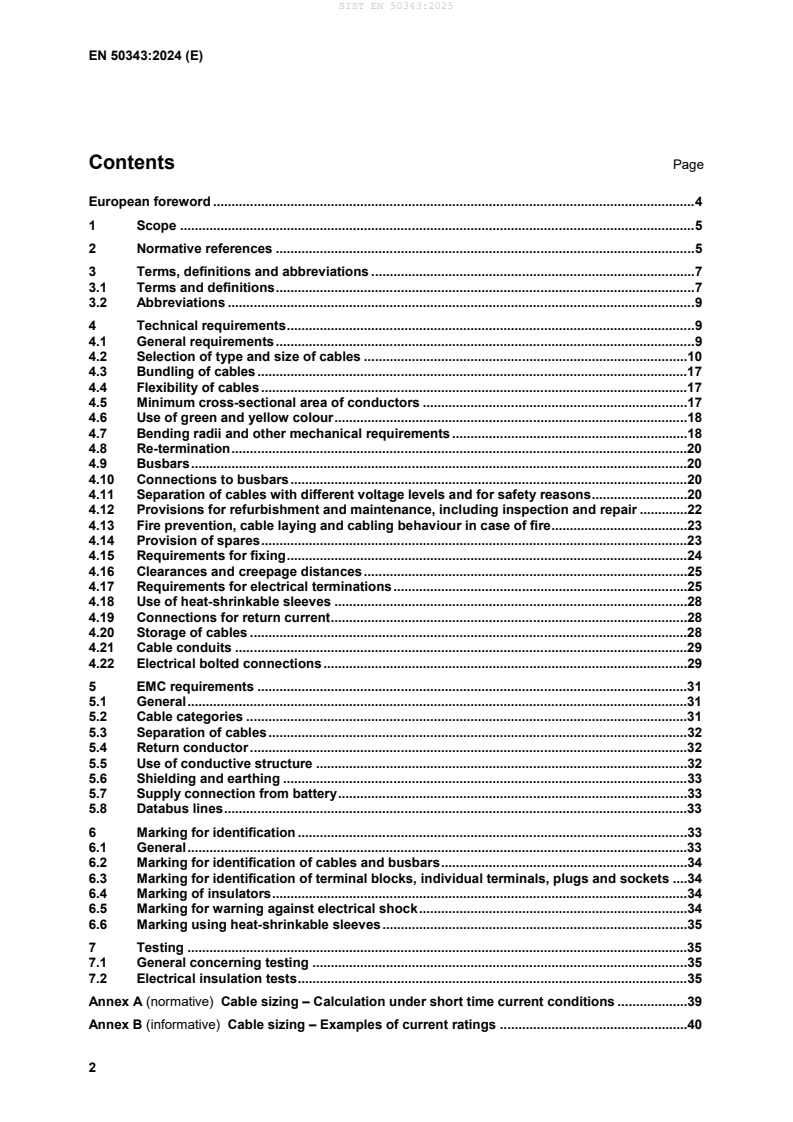
Contents Page
European foreword . 4
1 Scope . 5
2 Normative references . 5
3 Terms, definitions and abbreviations . 7
3.1 Terms and definitions . 7
3.2 Abbreviations . 9
4 Technical requirements . 9
4.1 General requirements . 9
4.2 Selection of type and size of cables .10
4.3 Bundling of cables .17
4.4 Flexibility of cables .17
4.5 Minimum cross-sectional area of conductors .17
4.6 Use of green and yellow colour .18
4.7 Bending radii and other mechanical requirements .18
4.8 Re-termination .20
4.9 Busbars .20
4.10 Connections to busbars .20
4.11 Separation of cables with different voltage levels and for safety reasons .20
4.12 Provisions for refurbishment and maintenance, including inspection and repair .22
4.13 Fire prevention, cable laying and cabling behaviour in case of fire .23
4.14 Provision of spares .23
4.15 Requirements for fixing .24
4.16 Clearances and creepage distances .25
4.17 Requirements for electrical terminations .25
4.18 Use of heat-shrinkable sleeves .28
4.19 Connections for return current .28
4.20 Storage of cables .28
4.21 Cable conduits .29
4.22 Electrical bolted connections .29
5 EMC requirements .31
5.1 General .31
5.2 Cable categories .31
5.3 Separation of cables .32
5.4 Return conductor .32
5.5 Use of conductive structure .32
5.6 Shielding and earthing .33
5.7 Supply connection from battery .33
5.8 Databus lines .33
6 Marking for identification .33
6.1 General .33
6.2 Marking for identification of cables and busbars .34
6.3 Marking for identification of terminal blocks, individual terminals, plugs and sockets .34
6.4 Marking of insulators .34
6.5 Marking for warning against electrical shock .34
6.6 Marking using heat-shrinkable sleeves .35
7 Testing .35
7.1 General concerning testing .35
7.2 Electrical insulation tests .35
Annex A (normative) Cable sizing – Calculation under short time current conditions .39
Annex B (informative) Cable sizing – Examples of current ratings .40
Annex C (normative) Cable sizing — Calculating current ratings for temperature classes other than
90 °C .42
Annex D (informative) Cable sizing – Correction factor k for expected ambient temperature .43
Annex E (normative) Cable sizing — Cable lifetime expectation .44
E.1 General cable lifetime considerations .44
E.2 Reducing cable lifetime .45
E.3 Increasing cable lifetime .45
Annex F (informative) Cable sizing — Calculation examples .46
F.1 Cables sizing calculation examples .46
F.2 Cables sizing calculation recommendation .48
Annex G (informative) Terminations .50
G.1 Methods of terminating cables .50
G.2 Tensile strength test values .57
Annex H (normative) Tests on marking when using heat-shrinkable sleeves .59
H.1 General .59
H.2 Preparation of specimens .59
H.3 Testing of specimens .59
H.4 Result of test .60
Annex I (informative) Effects of the number of earth connections to a cable screen .61
Annex J (informative) Differences of electrochemical potentials between some conductive
materials .62
Annex K (informative) Locations on board rolling stock to be distinguished .64
Annex L (informative) Information about comparison between fire behaviour of cables in
EN 45545-2 and IEC 62995 .67
Bibliography .69
European foreword
This document (EN 50343:2024) has been prepared by CLC/SC 9XB “Electromechanical material on
board rolling stock”.
The following dates are fixed:
• latest date by which this document has to be (dop) 2025-08-12
implemented at national level by publication of
an identical national standard or by
endorsement
• latest date by which the national standards (dow) 2027-08-12
conflicting with this document have to be
withdrawn
This document supersedes EN 50343:2014 and all of its amendments and corrigenda (if any).
— references to EN standards updated and harmonized;
— modification based on IEC 62995;
— mechanical aspects detailed;
— cable lifetime considerations in accordance with Arrhenius.
Attention is drawn to the possibility that some of the elements of this document may be the subject of
patent rights. CENELEC shall not be held responsible for identifying any or all such patent rights.
This document has been prepared under a standardization request addressed to CENELEC by the
European Commission. The Standing Committee of the EFTA States subsequently approves these
requests for its Member States.
Any feedback and questions on this document should be directed to the users’ national committee. A
complete listing of these bodies can be found on the CENELEC website.
1 Scope
This document specifies requirements for the installation of cabling on railway vehicles and within
electrical enclosures on railway vehicles, including magnetic levitation trains and trolley buses.
NOTE With respect to trolley buses, this document applies to the whole electric traction system, including current
collecting circuits, power converters and the respective control circuits. The installation of other circuits is covered by
street vehicle standards for example those for combustion driven buses.
This document covers cabling for making electrical connections between items of electrical equipment,
including cables, busbars, terminals and plug/socket devices. It does not cover special effect conductors
like fibre optic cables or hollow conductors (waveguides).
The material selection criteria given here are applicable to cables with copper conductors.
This document is not applicable to the following:
— special purpose vehicles, such as track-laying machines, ballast cleaners and personnel carriers;
— vehicles used for entertainment on fairgrounds;
— vehicles used in mining;
— electric cars;
— funicular railways.
As the field of cabling in rolling stock is also dealt with in the cable makers’ standard, references are made
to EN 50264 series, EN 50306 series, EN 50382 series and EN 50355.
This document applies in conjunction with the relevant product and installation standards and describes
minimum requirements.
2 Normative references
The following documents are referred to in the text in such a way that some or all of their content
constitutes requirements of this document. For dated references, only the edition cited applies. For
undated references, the latest edition of the referenced document (including any amendments) applies.
EN 45545 (all parts), Railway applications — Fire protection on railway vehicles
EN 45545-1, Railway applications — Fire protection on railway vehicles — Part 1: General
EN 45545-2, Railway applications — Fire protection on railway vehicles — Part 2: Requirements for fire
behaviour of materials and components
EN 45545-5:2013+A1:2015, Railway applications - Fire protection on railway vehicles — Part 5: Fire
safety requirements for electrical equipment including that of trolley buses, track guided buses and
magnetic levitation vehicles
EN 50121-3-1, Railway applications — Electromagnetic compatibility — Part 3-1: Rolling stock — Train
and complete vehicle
EN 50121-3-2, Railway applications — Electromagnetic compatibility — Part 3-2: Rolling stock —
Apparatus
EN 50124-1, Railway applications — Insulation coordination — Part 1: Basic requirements — Clearances
and creepage distances for all electrical and electronic equipment
EN 50125-1, Railway applications — Environmental conditions for equipment — Part 1: Rolling stock and
on-board equipment
EN 50153, Railway applications — Rolling stock — Protective provisions relating to electrical hazards
EN 50264 (all parts), Railway applications — Railway rolling stock power and control cables having special
fire performance
EN 50306 (all parts), Railway applications — Railway rolling stock cables having special fire performance
— Thin wall
EN 50355:2013, Railway applications — Railway rolling stock cables having special fire performance —
Guide to use
EN 50382 (all parts), Railway applications — Railway rolling stock high temperature power cables having
special fire performance
EN 50467:2011, Railway applications — Rolling stock - Electrical connectors, requirements and test
methods
EN 50553, Railway applications — Requirements for running capability in case of fire on board of rolling
stock
EN 60228, Conductors of insulated cables (IEC 60228)
EN 60423, Conduit systems for cable management - Outside diameters of conduits for electrical
installations and threads for conduits and fittings (IEC 60423)
EN 60684-3-212, Flexible insulating sleeving — Part 3: Specifications for individual types of sleeving —
Sheet 212: Heat-shrinkable polyolefin sleevings (IEC 60684-3-212)
EN 60684-3-271, Flexible insulating sleeving — Part 3: Specifications for individual types of sleeving —
Sheet 271: Heat-shrinkable elastomer sleevings, flame retarded, fluid resistant, shrink ratio 2:1 (IEC
60684-3-271)
EN 61180, High-voltage test techniques for low-voltage equipment — Definitions, test and procedure
requirements, test equipment (IEC 61180)
EN 61386-1, Conduit systems for cable management — Part 1: General requirements (IEC 61386-1)
EN IEC 60331-1, Tests for electric cables under fire conditions - Circuit integrity - Part 1: Test method for
fire with shock at a temperature of at least 830°C for cables of rated voltage up to and including 0,6/1,0
kV and with an overall diameter exceeding 20 mm (IEC 60331-1)
EN IEC 60684-3-216, Flexible insulating sleeving — Part 3: Specifications for individual types of sleeving
— Sheet 216: Heat-shrinkable, flame- retarded, limited-fire-hazard sleeving (IEC 60684-3-216)
IEC 60331-2, Tests for electric cable under fire conditions — Circuit integrity — Part 2: Test method for
fire with shock at a temperature of at least 830 °C for cables of rated voltage up to and including 0,6/1,0 kV
and with an overall diameter not exceeding 20 mm
HD 60364-5-54:2011 , Low-voltage electrical installations — Part 5-54: Selection and erection of electrical
equipment — Earthing arrangements and protective conductors (IEC 60364-5-54:2011)
As impacted by HD 60364-5-54:2011/A1:2022.
3 Terms, definitions and abbreviations
For the purposes of this document, the following terms and definitions apply.
ISO and IEC maintain terminology databases for use in standardization at the following addresses:
— ISO Online browsing platform: available at https://www.iso.org/obp/
— IEC Electropedia: available at https://www.electropedia.org/
3.1 Terms and definitions
3.1.1
cable
assembly consisting of
— one or more cores (screened or unscreened);
— their individual covering(s) (if any);
— assembly protection (if any);
— screen(s) (if any);
— sheath (if any)
[SOURCE: IEC 60050-461:2008, 461-06-01, modified - “insulated” has been removed from the term.
“(screened or unscreened)”, “screen(s) (if any)” and “sheath (if any)” have been added, “protective
covering(s) (if any)” has been removed. Note 1 to entry has been omitted.]
3.1.2
conductor
part of a cable which has the specific function of carrying current
[SOURCE: IEC 60050-461:2008, 461-01-01]
3.1.3
core
assembly comprising a conductor with its own insulation (and screens if any)
[SOURCE: IEC 60050-461:2008, 461-04-04, modified – Note 1 to entry has been omitted.]
3.1.4
solid conductor
conductor consisting of a single wire
[SOURCE: IEC 60050-461:2008, 461-01-06, modified – Note 1 to entry has been omitted.]
3.1.5
stranded conductor
conductor consisting of a number of individual wires or strands all or some of which generally have a
helical form
[SOURCE: IEC 60050-461:2008, 461-01-07, modified – Notes 1 and 2 to entry have been omitted.]
3.1.6
busbar
conductor consisting of a rigid metal profile
3.1.7
screen
conducting layer(s) having the function of control of the electro magnetic field within the cable
and/or to protect the cable from external electro magnetic influences
[SOURCE: IEC 60050-461:2008, 461-03-01, modified – “or assembly of conducting layers” has been
removed. “electric field within the insulation” has been replaced with “electromagnetic field within the cable
and/or to protect the cable from external electromagnetic influences”. Note 1 to entry has been omitted.]
3.1.8
bundle
group of cables tied together
3.1.9
bolted connection
connection in which the pressure to the conductor is applied by bolting
[SOURCE: IEC 60050-461:2008, 461-19-05]
3.1.10
connector
device providing connection and disconnection to a suitable mating component
Note 1 to entry: A connector has one or more contact elements
Note 2 to entry: Connectors covered by this document are not intended to be connected and disconnected under
electrical load
[SOURCE: IEC 60050-581:2008, 581-26-01, modified – Note 2 to entry has been added.]
3.1.11
crimp
cable termination in which a permanent connection is made by applying pressure, inducing the
deformation or reshaping of a barrel part of the termination around the conductor
[SOURCE: IEC 60050-461:2008, 461-19-01, modified.]
3.1.12
spring-clamp connection
terminal connection in which the pressure between the conductor and terminal is applied by a spring
3.1.13
penetration
terminal connection in which the contact with the conductor is achieved by jaws which
penetrate the insulation
3.1.14
plug
connector intended to be coupled at the free end of an insulated conductor or
cable, to be inserted into a matching socket, or readily removed when required
3.1.15
socket
connector intended to be mounted on a rigid surface and to hold a matching plug, such that the conductors
contained within the socket make electrical contact individually with those in the plug
3.1.16
heat-shrinkable sleeve
tube that on exposure to heat during installation, will at a critical temperature, permanently reduce in
diameter, while increasing in wall thickness
3.1.17
manufacturer
organisation that has the responsibility for the supply of vehicle(s), equipment or groups of equipment to
the purchaser
3.1.18
purchaser
organisation that orders the vehicle or equipment or groups of equipment and has the responsibility for
direct negotiations with the manufacturer
3.1.19
cable tie
mechanical construction needed for either keeping cables or assemblies of cables together, or for
attaching them in a defined place
3.1.20
short time current
certain operation case where an electrical circuit carries a current that will introduce an amount of heat
into the electrical circuit, which in general will increase its temperature
Note 1 to entry: “Short time” means that the heat exchange against the surrounding material is not significant.
3.2 Abbreviations
For the purposes of this document, the following abbreviations apply.
CSA cross sectional area
EMC electromagnetic compatibility
IP ingress protection
RMS root mean square
UV ultraviolet
4 Technical requirements
4.1 General requirements
Cables and installation materials shall be type tested, selected for size and installed so as to be suitable
for their function under their operating conditions. Size and installation of cables (including busbars and
bare conductors) shall take into account the particular stresses to be expected in rolling stock. The
materials used and methods of cabling shall be such as to prevent strain or chafing and excessive lengths
of unsupported cable shall be avoided.
Cables on rolling stock shall not be used for any purpose other than for transmission, distribution and
collection of electrical energy, electrical controls or monitoring systems. All components of cabling shall
be selected, installed, protected, used and maintained so as to prevent danger (e.g. electrical or fire
hazard, EMC problems).
The electrical connections shall be made in such a way that they cannot be unintentionally disconnected
or interrupted during service.
Effects that have impact on electrical connections and should be considered are at least:
— the thermal effects;
— the dynamic loads, as shock, vibration, car-body motions; and
— the material creepage.
The working conditions of the connections, and especially electrical characteristics and maximum
temperatures, shall be considered to define cables and their installation and usage (peak currents, etc.).
For consideration of environmental conditions, EN 50125-1 shall apply.
When considering operating conditions and environmental conditions, the locations as presented in
Annex K (informative) should be taken into account.
Conductors and cables shall be installed in such way that any humidity or water flowing along them shall
not be able to reach any cable entry (connector, cable gland, etc.) into the sealed cabinet.
For correct use of connectors, EN 50467:2011 shall apply.
For protection against electrical hazards, the cabling installed shall be in accordance with EN 50153.
4.2 Selection of type and size of cables
4.2.1 General
When selecting cables or busbars, the expected operating conditions should be taken into account. These
should include, but are not limited to, the following parameters:
— voltage;
— current;
— higher harmonics by electronical converters (skin-effect);
— overload current;
— short time current;
— voltage drop;
— short-circuit current;
— shape and frequency of current;
— fusing characteristic of the protection device;
— grouping of cables;
— ambient temperature and temperature due to load current;
— methods of installation;
— predicted cable lifetime;
— presence of rain or steam or snow, or accumulation of condensing water;
— presence of corrosive, polluting or damaging substances;
— mechanical stresses;
— radiation such as sunlight.
Consideration should be given to the expected lifetime of the cabling compared with the expected lifetime
of the vehicle.
The cable type (i.e. cable family) shall be selected in accordance with EN 50264 series, EN 50382 series
or EN 50306 series, as applicable.
Once the cable type has been selected, the selection of conductor size for normal load shall be determined
based on the methods specified in 4.2.2. up to 4.2.6. For cables intended for power distribution two
methods are available: the selection of conductor size if the cable is intended for power distribution shall
be based on either load current and current carrying capacity calculated in accordance with 4.2.3 or based
on protection device size in accordance with 4.2.4.
The conductor size shall also be checked in relation to short-circuit conditions and overload conditions.
These should be checked with respect to the fusing characteristic of the protection device and the
resistance of the chosen cable. See the example in Figure 1.
The switching level of the protection device shall be below the short time current carrying capacity of the
cable (see 4.2.7).
Figure 1 — Example of short-circuit condition where cable size will have influence on protection
device behaviour
The cross-sectional area of any conductor shall be not less than the value specified in 4.5.
Cables and cabling shall be conform to the fire safety requirements specified in EN 45545-2.
The number of different types of cables installed on any one type of vehicle should be minimized for
practical reasons.
4.2.2 Selection of cable size for control cables
Control cables, which are intended to carry control and data signals only, shall have a minimum conductor
cross-sectional area as specified in 4.5. This is also valid if the load current would make a smaller cross-
sectional area possible.
The cable sizes are selected on the general basis of a nominal current rating of 5 A/mm of conductor;
therefore it is not necessary for the conductor size of these cables to be selected according to 4.2.3.
4.2.3 Selection of cable size for cables for power distribution, on the basis of continuous load
current
This subclause specifies a method for calculation of continuous maximum load current, of time duration
longer than 5 s, of different cable sizes dependent on their method of installation and ambient temperature,
to enable cables to be selected so as to ensure that the predicted lifetime is achieved.
For short time current, up to 5 s, see 4.2.7.
Correction factors from cable manufacturers should not be combined with correction factors given in this
document, in order to avoid miscalculation or oversizing.
The continuous maximum conductor temperature for the cable types defined in the various parts of the
EN 50264 series, the EN 50306 series and the EN 50382 series is 90 °C, 105 °C, 120 °C or 150 °C. This
is based either on proven experience and reliability over many years or, in the case of newer, less well
defined insulations, upon an acceptance test, using long-term thermal endurance ageing to demonstrate
a lifetime of at least 20 000 h at 110 °C, 125 °C, 140 °C or 170 °C respectively (i.e. 20 °C above the
continuous rating). Data from this thermal testing can, with care, be extrapolated to the conductor
temperature to provide a predicted lifetime of the cable when continuously loaded. This predicted lifetime
may be used in conjunction with the known duty cycle of the vehicle, and its predicted time out of service,
to estimate the ability of the cable to function reliably for the predicted lifetime of the whole vehicle.
NOTE 1 Because the cable standards allow a variety of solutions for insulation type, it is important to confirm
lifetime extrapolations with the cable manufacturer.
NOTE 2 A predicted lifetime of cable of 100 000 h is used as a theoretical basis value for cables according to the
EN 50264 series, the EN 50306 series or the EN 50382 series and their specific maximum conductor temperature at
continuous operation.
This subclause only deals with thermal degradation of insulation material and it should be noted that
mechanical stresses (bending, wear, etc.) and other environmental factors (for example the presence of
fluids such as cleaning detergents or aggressive atmosphere) may be the limiting factor determining
predicted cable lifetime.
For cables intended for power distribution, the cable size shall be selected on the basis of the load current
and the current carrying capacity in accordance with the following procedure (i.e. the three steps a), b)
and c)).
a) The load current
The load current Iload, in amperes (A), which a cable has to carry for sustained periods during normal
service, shall be a basic value for cable sizing.
When the circuit(s) being supplied by the cable is in continuous or sustained cyclic operation, Iload shall
be calculated according to the following formula:
I ∫i dt
load
t
where
t1 is the duration of a typical duty cycle during service, in minutes (min);
i is the instantaneous current, including overload, if any, in amperes (A).
NOTE 3 For continuous direct current operation, the above formula has the simple form Iload = i.
When operation is not continuous or sustained cyclic, I shall be calculated according to Annex A.
load
b) The current carrying capacity
The permissible continuous current carrying capacity I in amperes (A) of a single-core cable or a single
cable
core within a multi-core cable being operated in free air shall be another basic value for cable sizing. A
particular value of I is valid for a particular reference ambient temperature Tref and for a particular
cable
maximum conductor temperature in service, Tc(max).
I within the reference values Tref and Tc(max), shall be those provided by the cable manufacturer.
cable
Examples for I for single-core cables are presented in Annex B.
cable
I for maximum conductor temperatures other than Tc(max) = 90 °C shall be calculated according to
cable
Annex C.
The current carrying capacity of the cable in service, I , in amperes (A), shall be calculated from I
corr cable
using correction factors k , k , k , k , k , in accordance with the following formula:
1 2 3 4 5
I I ××kk×k×k×k
corr cable 1 2 3 4 5
where
k1 is a correction factor for the expected ambient temperature. It shall be calculated according to the
following formula:
=
=
TT−
c max
( )
k =
TT−
ref
c max
( )
where
T is the maximum conductor temperature, in degrees Celsius (°C), in service, which will allow
c(max)
the predicted lifetime of the cable to be achieved;
T is the estimated value of the actual ambient temperature, in degrees Celsius (°C) during
operation, on the outside of the bundle or of the tube – if any. T is an average value;
T is the reference ambient temperature, in degrees Celsius (°C), for which the I value is
ref cable
valid.
Examples of k values are given in Table D.1.
k is a correction factor for installation type (grouping and installation conditions).
Values for k given in Table 2 shall be used. Interpolation between the different number of cables in
Table 2 is allowed.
k is a correction factor to allow for a decrease in predicted cable lifetime, calculated according to the
formula in Annex E. In all cases where the standard predicted cable lifetime shall be used, the value of k3
shall be 1,0.
k is a correction factor to take into account short time current when operation is not continuous, calculated
shall be 1,0.
according to the procedure in Annex A. When operation is continuous, the value of k4
k is a correction factor for multi-core cables; the correction factor k is applicable for each individual core
5 5
are given in Table 1. Interpolation between the different number of
within a multi-core cable. Values for k5
shall be 1,0. If
loaded cores in Table 1 is allowed. When single-core cables are used, the value of k5
single-core cables and multi-core cables are lying together on the same cable tray, open or close, by the
, different values for I are obtained for single-core cables and multi-core cables.
correction factor k5 corr
Table 1 — Modification factor k for individual cores within a multi-core cable; number of cores
are simultaneously loaded
2 3 4 5 7 9 12 19
Number of loaded cores
Correction factor k5 0,91 0,78 0,63 0,59 0,51 0,46 0,41 0,38
NOTE Extrapolation to higher number of loaded cores could be negotiated with the cable
manufacturer.
c) Selection of cable size
The cable size shall be selected such that the current carrying capacity of the cable in service, calculated
in accordance with item b) above, is greater than or equal to the predicted load current, calculated in
accordance with item a), i.e.:
Iload ≤ Icorr
The minimum cross-sectional area of the conductor shall be as specified in 4.5.
NOTE 4 Combining the formulae from 4.2.3 a) and b) and c), would lead to the following formula:
I
load
I ≥
cable
kk× ××k k ×k
12 3 4 5
This formula will in practice be easier to use, because in cases with defined cable type and defined load
conditions, the last term is constant and so it is easy to find the right cable size via Icable in the current
ratings table (see examples in Table B.1).
For a calculation example, refer to Annex F.
Table 2 — Modification factor k for installation type (grouping and installation conditions)
Number of cables Installation type
being
Cable Cables Cables Cables Cables Cables Cables in Cables in a
simultaneously
in free on on on trays, on the on a a closed closed
loaded
air trays, trays, in in floor or ceiling or tube, tube or
in one two several on a wall under conduit conduit,
layer layers layers floor or tray thermally
insulated
Type a) Type b) Type c) Type d) Type e) Type f) Type g)
1 single cable 1,0 1,0 1,0 1,0 1,0 0,95 0,95 0,76
2 cables together - 0,87 0,85 0,81 0,80 0,61
3 cables together - 0,83 0,83 0,79 0,72 0,70 0,53
4 cables together - 0,78 0,71 0,71 0,75 0,68 0,65 0,49
8 cables together - 0,74 0,59 0,52 0,75 0,62 0,52 0,40
12 cables together - 0,73 0,54 0,45 0,75 0,61 0,45 0,34
16 cables together - 0,72 0,51 0,41 0,75 0,61 0,41 0,31
20 cables and more - 0,71 0,47 0,38 0,75 0,61 0,38 0,29
together
Details of installation types are as follows:
Type a): One single cable in free air with heat dissipation into the surrounding air ensured by all the following
measures:
– distance between the cable and adjacent walls over, under or beside: at least equal to the cable diameter;
– distance between the cable and any other cable lying beside it in any direction: at least equal to the sum of its
own cable diameter and the adjacent cable diameters;
– cable lying in an open tray or ladder support with perforations, the total area A in Figure 2 of the perforations
being at least 15 % of the total supporting area in case of metallic tray or support with good thermal contact
to car-body (otherwise at least 30 %), and without any cover.
Type b): Cables lying in one layer, touching each other, on an open tray or ladder support, with perforations as
for type a).
Type c): As for type b) but cables in several layers over each other.
Type f): Cables lying in bundles in closed tubes, closed trays or boxes without significant air flow.
Type g): As for type f), but for thermally completely insulated closed tubes, closed trays or boxes.
Current flowing through the screen (e.g. motor cables and brake resistors) should be calculated as an additional
conductor.
NOTE Installation types a), b), c), d), e), f) and g) are illustrated in Figure 2.
Key
a) cable in free air
b) cables on trays, in one layer
c) cables on trays, in several layers
d) cables on the floor or on a wall
e) cables on a ceiling or under floor
f) cables in a closed tube, conduit or tray
g) cables in a closed tube or conduit, thermally insulated
Figure 2 — Cable grouping and installation conditions
4.2.4 Selection of cable size for cables for power distribution, on the basis of rating of
protection device
In cases where the load current Iload is not exactly defined, the rating of the protection device may be
chosen according to the maximum load current that can be expected. The conductor size shall then be
selected according to the rating of protection device in accordance with Table 3. This applies to all cable
types with Tc(max) of at least 90 °C, at an ambient temperature of maximum 45 °C.
NOTE This method is simple but has disadvantages (weight, required space and costs of cables can increase).
Table 3 — Selection of cable conductor size on the basis of rating of protection device
Rating of protection Nominal cross-sectional area
device of conductor
A mm
Up to 4-core cables, Up to 4 cables in a
or bundles of max. 4 closed tube
cables, on open trays
or in free air
6 1,0 1,0
10 1,0 1,5
16 1,5 2,5
20 2,5 4,0
25 4,0 6,0
4.2.5 Motor cables
Traction motor cables shall be sized according to the procedure specified in 4.2.3. For cables in motion
during operation, higher flexibility of cables should be considered when selecting cable type (i.e. class 6
in accordance with EN 60228).
4.2.6 Cables for protective bonding
Cables for protective bonding shall be sized and installed according to the rules described in
HD 60364-5-54:2011, Clause 543. This standard deals with general rules for electrical equipment. The
requirements of EN 50153 shall be fulfilled.
In HD 60364-5-54:2011, 543.1.2, a formula for minimum cross-sectional areas of protective conductors
applicable for disconnecting times not exceeding 5 s is given.
4.2.7 Cables used under short time current (below 5 s)
For cables loaded with a short time current (below 5 s), CSA shall be sized such that the end temperature
does not exceed a temperature of 20 °C over the conductor operating temperature of the insulation as
defined in EN 50355. Lifetime, in this case, is reduced to at least 20 000 h of cumulated operation.
For dimensioning of cables for short time current within the scope of this document, the formula given in
HD 60364-5-54:2011, 543.1.2, should also be used.
EXAMPLE Conductors for thermal engine starters.
k factors for bare conductors are given in HD 60364-5-54:2011, Table A.54.6.
k factors and short-circuit ratings for rolling stock cables are given in EN 50355.
For any other material of the conductor, the insulation and other parts, and the initial and final
temperatures, the k factor shall be calculated or be given by the cable manufacturer.
For calculation of k, see Annex A in HD 60364-5-54:2011.
NOTE The k factor referred to in the formula in HD 60364-5-54:2011, 543.1.2, and in EN 50355 have a different
meaning than k factors used in EN 50343.
For a calculation example in EN 50343, refer to Annex F.
4.3 Bundling of cables
If several cables are to be laid together as a bundle, the following factors shall at least be taken into
consideration:
— thermal requirements (see 4.2.3);
— EMC requirements (see 5.2);
— rated voltages (see 4.11);
— mechanical aspects, such as strength of bundle, weight of bundle, available space, relative movement
and tension forces;
— fixing points (see 4.15).
If cables with different cross-sectional area are to be bundled together, the mechanical stresses should
be considered.
4.4 Flexibility of cables
If high flexibility is required, stranded conductors of class 6 in accordance with EN 60228 should be used.
In all other cases, stranded conductors of class 5 in accordance with EN 60228 shall be used (see also
4.7).
High flexibility is required in case of car-to-car or car-to-bogie cabling, i.e. locations 5, 6 and 7 in Annex K
and for equipment which may have relative cabling movements between internal parts, for example doors,
shoe gears.
Internal connections of, for example, electronic devices, may use single solid conductors of class 1
...