


prEN IEC 60079-10-2:2025
(Main)Explosive atmospheres - Part 10-2: Classification of areas - Explosive dust atmospheres
Explosive atmospheres - Part 10-2: Classification of areas - Explosive dust atmospheres
Explosionsgefährdete Bereiche - Teil 10-2: Einteilung der Bereiche - Staubexplosionsgefährdete Bereiche
Atmosphères explosives - Partie 10-2: Classement des emplacements - Atmosphères explosives poussiéreuses
Eksplozivne atmosfere - 10-2. del: Razvrstitev prostorov - Eksplozivne prašne atmosfere
General Information
- Status
- Not Published
- Publication Date
- 28-Sep-2026
- Current Stage
- 4060 - Enquiry results established and sent to TC, SR, BTTF - Enquiry
- Start Date
- 30-May-2025
- Completion Date
- 30-May-2025
Relations
- Effective Date
- 12-Dec-2023
Overview
prEN IEC 60079-10-2:2025 (IEC 60079-10-2 Ed.3) is the latest committee draft for vote addressing classification of areas for explosive dust atmospheres. It updates the previous (2015) edition and provides guidance for identifying, zoning and documenting locations where combustible dust or dust layers can form explosive atmospheres. The document is a technical revision prepared by IEC SC 31J and is intended for use at standard atmospheric conditions and standard oxidizing media. Note: this CDV is still under study and may change before final publication.
Key topics and requirements
- Area classification procedure: structured steps to identify sources of release, assess likelihood and extent, and assign zones (Zone 20, Zone 21, Zone 22, and Zone NE).
- Definitions and ignition parameters: updated and added definitions such as Minimum Explosible Concentration (MEC), Minimum Ignition Energy (MIE) and Limiting Oxygen Concentration (LOC) to support consistent assessment.
- Sources of release and grading: guidance on identifying dust containment issues, grading release sources and their potential to create hazardous zones.
- Extent of zones and dust layers: criteria for determining the spatial extent of Zone 20/21/22 and consideration of dust layer hazards, housekeeping levels and hot-surface ignition potential.
- Safety and management principles: alignment with IEC 60079-10-1 for safety principles, commissioning/maintenance provisions, management of change, catastrophic failure considerations, and mandatory requirement for competent personnel to perform classifications.
- Annexes and examples: informative annexes with example layouts (bag emptying, cyclones, filters), presentation templates, and guidance on hybrid mixtures and ventilation effects.
- Documentation: recommended drawings, data sheets and hazard classification records for traceability.
Practical applications
This standard is essential for organizations that handle combustible dusts or produce dust layers, including:
- Food processing, grain handling and milling
- Pharmaceuticals and chemical powder production
- Metal powder and additive manufacturing facilities
- Woodworking, textiles, and recycling operations Use cases include:
- Designing electrical installations and selecting explosion-protected equipment for classified zones
- Conducting area classification studies and risk assessments
- Preparing safety documentation, compliance evidence and facility layout drawings
- Defining housekeeping, ventilation and inerting strategies to reduce zone extents
Who should use this standard
- Explosion protection engineers and consultants
- Electrical and process designers working on hazardous-area installations
- Safety managers, facility operators and maintenance planners
- Certification bodies and regulators assessing compliance
Related standards
- IEC 60079-10-1 - Classification of areas: explosive gas atmospheres (harmonizes safety principles)
- IEC 80079-20-2 - Minimum ignition energy guidance
- NFPA 652 - Definitions and guidance for combustible dusts (referenced for MEC)
Keywords: IEC 60079-10-2, explosive atmospheres, explosive dust, area classification, Zone 20, Zone 21, Zone 22, combustible dust, minimum explosible concentration, minimum ignition energy.

Get Certified
Connect with accredited certification bodies for this standard

Intertek Testing Services NA Inc.
Intertek certification services in North America.

UL Solutions
Global safety science company with testing, inspection and certification.

ANCE
Mexican certification and testing association.
Sponsored listings
Frequently Asked Questions
prEN IEC 60079-10-2:2025 is a draft published by CLC. Its full title is "Explosive atmospheres - Part 10-2: Classification of areas - Explosive dust atmospheres". This standard covers: Explosive atmospheres - Part 10-2: Classification of areas - Explosive dust atmospheres
Explosive atmospheres - Part 10-2: Classification of areas - Explosive dust atmospheres
prEN IEC 60079-10-2:2025 is classified under the following ICS (International Classification for Standards) categories: 29.260.20 - Electrical apparatus for explosive atmospheres. The ICS classification helps identify the subject area and facilitates finding related standards.
prEN IEC 60079-10-2:2025 has the following relationships with other standards: It is inter standard links to EN 60079-10-2:2015. Understanding these relationships helps ensure you are using the most current and applicable version of the standard.
prEN IEC 60079-10-2:2025 is available in PDF format for immediate download after purchase. The document can be added to your cart and obtained through the secure checkout process. Digital delivery ensures instant access to the complete standard document.
Standards Content (Sample)
SLOVENSKI STANDARD
01-maj-2025
Eksplozivne atmosfere - 10-2. del: Razvrstitev prostorov - Eksplozivne prašne
atmosfere
Explosive atmospheres - Part 10-2: Classification of areas - Explosive dust atmospheres
Explosionsgefährdete Bereiche - Teil 10-2: Einteilung der Bereiche -
Staubexplosionsgefährdete Bereiche
Atmosphères explosives - Partie 10-2: Classement des emplacements - Atmosphères
explosives poussiéreuses
Ta slovenski standard je istoveten z: prEN IEC 60079-10-2:2025
ICS:
29.260.20 Električni aparati za Electrical apparatus for
eksplozivna ozračja explosive atmospheres
2003-01.Slovenski inštitut za standardizacijo. Razmnoževanje celote ali delov tega standarda ni dovoljeno.
31J/383/CDV
COMMITTEE DRAFT FOR VOTE (CDV)
PROJECT NUMBER:
IEC 60079-10-2 ED3
DATE OF CIRCULATION: CLOSING DATE FOR VOTING:
2025-03-07 2025-05-30
SUPERSEDES DOCUMENTS:
31J/355/CD, 31J/364A/CC
IEC SC 31J : CLASSIFICATION OF HAZARDOUS AREAS AND INSTALLATION REQUIREMENTS
SECRETARIAT: SECRETARY:
Croatia Mr Marino Kelava
OF INTEREST TO THE FOLLOWING COMMITTEES: HORIZONTAL FUNCTION(S):
TC 18
ASPECTS CONCERNED:
Environment,Safety
SUBMITTED FOR CENELEC PARALLEL VOTING NOT SUBMITTED FOR CENELEC PARALLEL VOTING
Attention IEC-CENELEC parallel voting
The attention of IEC National Committees, members of
CENELEC, is drawn to the fact that this Committee Draft
for Vote (CDV) is submitted for parallel voting.
The CENELEC members are invited to vote through the
CENELEC online voting system.
This document is still under study and subject to change. It should not be used for reference purposes.
Recipients of this document are invited to submit, with their comments, notification of any relevant patent rights of which they
are aware and to provide supporting documentation.
Recipients of this document are invited to submit, with their comments, notification of any relevant “In Some Countries” clau ses
to be included should this proposal proceed. Recipients are reminded that the CDV stage is the final stage for submitting ISC
clauses. (SEE AC/22/2007 OR NEW GUIDANCE DOC).
TITLE:
Explosive atmospheres - Part 10-2: Classification of areas - Explosive dust atmospheres
PROPOSED STABILITY DATE: 2031
NOTE FROM TC/SC OFFICERS:
electronic file, to make a copy and to print out the content for the sole purpose of preparing National Committee positions.
You may not copy or "mirror" the file or printed version of the document, or any part of it, for any other purpose without
permission in writing from IEC.
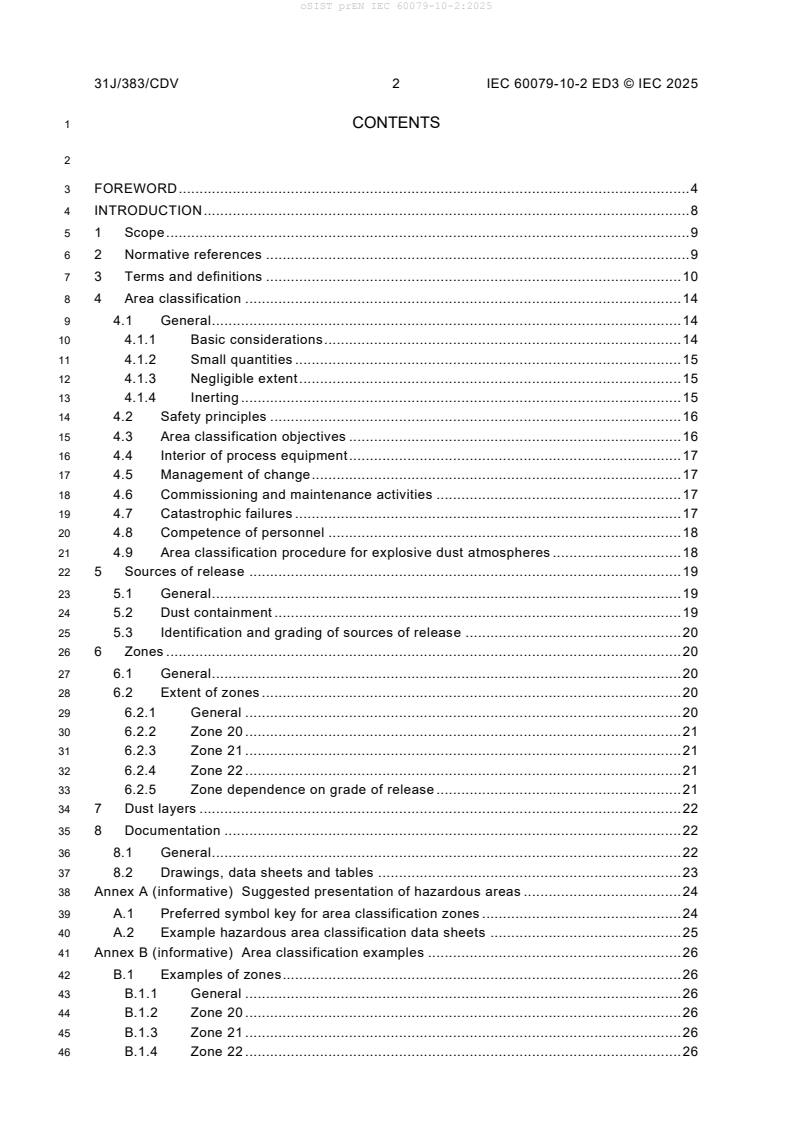
31J/383/CDV 2 IEC 60079-10-2 ED3 © IEC 2025
1 CONTENTS
3 FOREWORD . 4
4 INTRODUCTION . 8
5 1 Scope . 9
6 2 Normative references . 9
7 3 Terms and definitions . 10
8 4 Area classification . 14
9 4.1 General . 14
10 4.1.1 Basic considerations . 14
11 4.1.2 Small quantities . 15
12 4.1.3 Negligible extent . 15
13 4.1.4 Inerting . 15
14 4.2 Safety principles . 16
15 4.3 Area classification objectives . 16
16 4.4 Interior of process equipment . 17
17 4.5 Management of change . 17
18 4.6 Commissioning and maintenance activities . 17
19 4.7 Catastrophic failures . 17
20 4.8 Competence of personnel . 18
21 4.9 Area classification procedure for explosive dust atmospheres . 18
22 5 Sources of release . 19
23 5.1 General . 19
24 5.2 Dust containment . 19
25 5.3 Identification and grading of sources of release . 20
26 6 Zones . 20
27 6.1 General . 20
28 6.2 Extent of zones . 20
29 6.2.1 General . 20
30 6.2.2 Zone 20 . 21
31 6.2.3 Zone 21 . 21
32 6.2.4 Zone 22 . 21
33 6.2.5 Zone dependence on grade of release . 21
34 7 Dust layers . 22
35 8 Documentation . 22
36 8.1 General . 22
37 8.2 Drawings, data sheets and tables . 23
38 Annex A (informative) Suggested presentation of hazardous areas . 24
39 A.1 Preferred symbol key for area classification zones . 24
40 A.2 Example hazardous area classification data sheets . 25
41 Annex B (informative) Area classification examples . 26
42 B.1 Examples of zones . 26
43 B.1.1 General . 26
44 B.1.2 Zone 20 . 26
45 B.1.3 Zone 21 . 26
46 B.1.4 Zone 22 . 26
IEC 60079-10-2 ED3 © IEC 2025 3 31J/383/CDV
47 B.2 Bag emptying station within a building and without exhaust ventilation. 27
48 B.3 Bag emptying station with exhaust ventilation . 28
49 B.4 Cyclone and filter with clean outlet outside building . 29
50 B.5 Drum tipper within a building without exhaust ventilation . 30
51 Annex C (informative) Dust layer hazards . 32
52 C.1 Introductory remarks . 32
53 C.2 Levels of housekeeping . 32
54 C.3 Potential for hot surface ignition . 33
55 Annex D (informative) Hybrid mixtures . 34
56 D.1 General . 34
57 D.2 Ventilation . 34
58 D.3 Explosive limits . 34
59 D.4 Chemical reactions . 34
60 D.5 Minimum ignition parameters . 34
61 D.6 Final classification . 34
62 Bibliography . 35
64 Figure A.1 – Identification of zones on drawings . 24
65 Figure B.1 – Bag emptying station within a building and without exhaust ventilation . 28
66 Figure B.2 – Bag emptying station with exhaust ventilation . 29
67 Figure B.3 – Cyclone and filter with clean outlet outside building . 30
68 Figure B.4 – Drum tipper within a building without exhaust ventilation. Error! Bookmark not
69 defined.
71 Table 1 – Designation of zones depending on presence of dust . 22
72 Table A.1 – Hazardous area classification data sheet – Part I: Flammable substance
73 list and characteristics . 25
74 Table A.2 – Hazardous area classification data sheet – Part II: List of sources of
75 release . 26
31J/383/CDV 4 IEC 60079-10-2 ED3 © IEC 2025
82 INTERNATIONAL ELECTROTECHNICAL COMMISSION
83 ____________
85 EXPLOSIVE ATMOSPHERES –
87 Part 10-2: Classification of areas –
88 Explosive dust atmospheres
90 FOREWORD
91 1) The International Electrotechnical Commission (IEC) is a worldwide organization for standardization comprising
92 all national electrotechnical committees (IEC National Committees). The object of IEC is to promote international
93 co-operation on all questions concerning standardization in the electrical and electronic fields. To this end and
94 in addition to other activities, IEC publishes International Standards, Technical Specifications, Technical Reports,
95 Publicly Available Specifications (PAS) and Guides (hereafter referred to as “IEC Publication(s)”). Their
96 preparation is entrusted to technical committees; any IEC National Committee interested in the subject dealt with
97 may participate in this preparatory work. International, governmental and non-governmental organizations liaising
98 with the IEC also participate in this preparation. IEC collaborates closely with the International Organization for
99 Standardization (ISO) in accordance with conditions determined by agreement between the two organizations.
100 2) The formal decisions or agreements of IEC on technical matters express, as nearly as possible, an international
101 consensus of opinion on the relevant subjects since each technical committee has representation from all
102 interested IEC National Committees.
103 3) IEC Publications have the form of recommendations for international use and are accepted by IEC National
104 Committees in that sense. While all reasonable efforts are made to ensure that the technical content of IEC
105 Publications is accurate, IEC cannot be held responsible for the way in which they are used or for any
106 misinterpretation by any end user.
107 4) In order to promote international uniformity, IEC National Committees undertake to apply IEC Publications
108 transparently to the maximum extent possible in their national and regional publications. Any divergence between
109 any IEC Publication and the corresponding national or regional publication shall be clearly indicated in the latter.
110 5) IEC itself does not provide any attestation of conformity. Independent certification bodies provide conformity
111 assessment services and, in some areas, access to IEC marks of conformity. IEC is not responsible for any
112 services carried out by independent certification bodies.
113 6) All users should ensure that they have the latest edition of this publication.
114 7) No liability shall attach to IEC or its directors, employees, servants or agents including individual experts and
115 members of its technical committees and IEC National Committees for any personal injury, property damage or
116 other damage of any nature whatsoever, whether direct or indirect, or for costs (including legal fees) and
117 expenses arising out of the publication, use of, or reliance upon, this IEC Publication or any other IEC
118 Publications.
119 8) Attention is drawn to the Normative references cited in this publication. Use of the referenced publications is
120 indispensable for the correct application of this publication.
121 9) Attention is drawn to the possibility that some of the elements of this IEC Publication may be the subject of patent
122 rights. IEC shall not be held responsible for identifying any or all such patent rights.
123 International Standard IEC 60079-10-2 has been prepared by subcommittee 31J: Classification
124 of hazardous areas and installation requirements, of IEC technical committee 31: Equipment
125 for explosive atmospheres.
126 This third edition of IEC 60079-10-2 cancels and replaces the second edition of IEC 60079-10-2
127 published in 2015. This edition constitutes a technical revision.
128 Users of this document are advised that interpretation sheets clarifying the interpretation of this
129 document can be published. Interpretation sheets are available from the IEC webstore and can
130 be found in the “history” tab of the page for each document.
131 This edition includes the following significant technical changes with respect to the previous
132 edition:
IEC 60079-10-2 ED3 © IEC 2025 5 31J/383/CDV
Type
Explanation of the significance of the changes Clause Minor and Extension Major
editorial technical
changes changes
Scope 1 X
Revised to clarify that the standard applies at standard
atmospheric conditions and standard oxidizing medium.
Terms and Definitions 3.4 X
Revised the informational note to the combustible dust
definition to correctly point to the proper sieve size for 500
micron material.
Terms and Definitions Formerly X
3.17
The term “extent of zone” was removed as the term
expresses the meaning more clearly than the definition.
Terms and Definitions 3.18 X
Revised the definition of “equipment” to reflect the IEV
defined term.
Terms and Definitions 3.19 X
Added a definition for Minimum Explosible Concentration
based on NFPA 652’s definition.
Terms and Definitions 3.23
Revised the definitions of Zone 20, 21, and 22 and added a
definition of Zone NE to reflect the IEV defined terms.
Terms and Definitions 3.24 X
Added definition of “Rare Malfunction” to align with IEC
60079-10-1 defined term.
Terms and Definitions 3.25 X
Added definition of “Limiting Oxygen Concentration” to align
with EN definition as referenced.
Terms and Definitions 3.26 X
Added definition of “Minimum Ignition Energy” to align with
IEC 80079-20-2 definition.
Area Classification 4.1 X
Revised section editorially based on comments received.
Area Classification 4.1.2 X
Added description of “small quantities” based on IEC 60079-
10-1.
Area Classification 4.1.3 X
Added description of zone of “negligible extent” to better
clarify when such a zone might exist, based on IEC 60079-
10-1.
Area Classification 4.1.4 X
Revised the section to address inerting by inert gas or
mixture with non-combustible dust.
Safety Principles 4.2 X
Existing text was grouped and organized to align with IEC
60079-10-1 and to improve usability.
Area Classification Objectives 4.3 X
Existing text was grouped and organized to align with IEC
60079-10-1 and to improve usability.
Interior of Process Equipment 4.4 X
Existing text was grouped and organized to align with IEC
60079-10-1 and to improve usability.
31J/383/CDV 6 IEC 60079-10-2 ED3 © IEC 2025
Management of Change 4.5 X
Existing text was grouped and organized to align with IEC
60079-10-1 and to improve usability.
Commissioning and Maintenance 4.6 X
Existing text was grouped and organized to align with IEC
60079-10-1 and to improve usability.
Catastrophic Failures 4.7 X
Existing text was grouped and organized to align with IEC
60079-10-1 and to improve usability.
Competence of Personnel 4.8 X
Existing language recommending that competent personnel
conduct the area classification assessment was converted
to mandatory language based on comments received.
Area Classification Procedure for Explosive Dust 4.9 X
Atmospheres
Procedure/section has been cleaned up editorially and
revised based on comments received.
Zone 21 6.2.3 X
Revised the section making the former “Note 1” into
normative text based on comments received.
Zone 22 6.2.4 X
Revised the section making the former “Note” into normative
text based on comments received.
Annex A.1 B.1 X
Preferred symbols previously shown were moved to Annex
A as the annex is informative, not normative.
Annex A.2 B.2 X
Sample table A.1 was added to provide a possible table
format to be used. This is informative and not normative.
Annex C.1 D.1 X
Added language reference to maximum recommended dust
layer thicknesses, beyond which classification or improved
housekeeping should be considered.
Annex C.3 D.3 X
Added language referencing the danger of hot surface
ignition of layers of dust.
IEC 60079-10-2 ED3 © IEC 2025 7 31J/383/CDV
Explanation of the types of significant changes:
– Clarification
– Decrease of technical requirements
1. Minor and editorial changes:
– Minor technical change
– Editorial corrections
These are changes which modify requirements in an editorial or a minor technical way. They include changes of
the wording to clarify technical requirements without any technical change, or a reduction in the level of existing
requirement.
2. Extension: – Addition of technical options
These are changes which add new or modify existing technical requirements, in a way that new options are
given, but without increasing the requirements that are fully compliant with the previous standard. Therefore,
these will not have to be considered for existing area classifications in conformity with the preceding edition.
– Addition of technical requirements
3. Major technical changes:
– Increase of technical requirements
These are changes to technical requirements (addition, increase of the level or removal) made in a way that an
existing area classification in conformity with the preceding edition will not always be able to fulfil the
requirements given in the later edition. These changes have to be considered for existing area classifications in
conformity with the preceding edition.
136 The text of this standard is based on the following documents:
FDIS Report on voting
31J/XXX/FDIS 31J/XXX/RVD
138 Full information on the voting for the approval of this standard can be found in the report on
139 voting indicated in the above table.
140 This publication has been drafted in accordance with the ISO/IEC Directives, Part 2.
141 A list of all parts of the IEC 60079 series, under the general title Explosive atmospheres, can
142 be found on the IEC website.
143 The committee has decided that the contents of this publication will remain unchanged until the
144 stability date indicated on the IEC website under "http://webstore.iec.ch" in the data related to
145 the specific publication. At this date, the publication will be
146 • reconfirmed,
147 • withdrawn,
148 • replaced by a revised edition, or
149 • amended.
31J/383/CDV 8 IEC 60079-10-2 ED3 © IEC 2025
152 INTRODUCTION
153 Dusts, as defined in this standard, are hazardous because when they are dispersed in air by
154 any means they could form explosive atmospheres. Furthermore, layers of dust could ignite and
155 act as ignition sources for an explosive atmosphere.
156 This part of IEC 60079 gives guidance on the identification and classification of areas where
157 such hazards from dust can arise. It sets out the essential criteria against which the ignition
158 hazards can be assessed and gives guidance on the design and control parameters which can
159 be used in order to reduce such a hazard. General and special criteria are given for the process
160 of identification and classification of hazardous areas.
161 This standard contains an informative Annex C giving examples for classifying areas.
IEC 60079-10-2 ED3 © IEC 2025 9 31J/383/CDV
163 EXPLOSIVE ATMOSPHERES –
165 Part 10-2: Classification of areas –
166 Explosive dust atmospheres
170 1 Scope
171 This part of IEC 60079 is concerned with the identification and classification of areas where
172 explosive dust atmospheres and combustible dust layers are present, in standard atmospheric
173 conditions, in order to permit the proper assessment of ignition sources in such areas.
174 In this standard, explosive dust atmospheres and combustible dust layers are treated
175 separately. In Clause 4, area classification for explosive dust clouds is described, with dust
176 layers acting as one of the possible sources of release. InClause 7 other general considerations
177 for dust layers are described.
178 The examples in this standard are based on a system of effective housekeeping being
179 implemented in the plant to prevent dust layers from accumulating. Where effective
180 housekeeping is not present, the area classification includes the possible formation of explosive
181 dust clouds from dust layers.
182 The principles of this standard can also be followed when combustible fibres or flyings might
183 cause a hazard.
184 NOTE 1 Atmospheric conditions include variations in pressure and temperature above and below reference levels
185 of 101,3 kPa (1 013 mbar) and 20 °C (293 K), provided that the variations have a negligible effect on the explosive
186 properties of the combustible material. Air with normal oxygen content, typically a volume fraction of 21 %is assumed.
187 It does not apply to
188 a) underground mining areas;
189 b) dusts of explosives that do not require atmospheric oxygen for combustion such as
190 pyrophoric substances, propellants, pyrotechnics, munitions, peroxides, oxidizers, water-
191 reactive elements or compounds, or other similar materials;
192 c) catastrophic failures or rare malfunctions which are outside the conditions dealt with in this
193 standard;
194 d) rooms used for medical purposes;
195 e) domestic premises;
196 f) where a hazard is due to the presence of flammable gas or vapour, but the principles can
197 be used in the assessment of a hybrid mixture (see also IEC 60079-10-1).
198 NOTE 2 Additional guidance on hybrid mixtures is provided in Annex E.
199 This standard does not consider the effects of consequential damage following a fire or an
200 explosion.
201 2 Normative references
202 For the purposes of this document, the terms and definitions given in IEC 60079-0 and the following
203 apply.
205 ISO and IEC maintain terminological databases for use in standardization at the following addresses:
207 • IEC Electropedia: available at https://www.electropedia.org/
31J/383/CDV 10 IEC 60079-10-2 ED3 © IEC 2025
208 NOTE Additional definitions applicable to explosive atmospheres can be found in the International Electrotechnical Vocabulary
209 (IEV) IEC 60050-426.
211 • ISO Online browsing platform: available at https://www.iso.org/obp/ui
213 IEC 60079-10-1, Explosive atmospheres – Part 10-1: Classification of areas – Explosive gas
214 atmospheres
215 ISO/IEC 80079-20-2, Explosive Atmospheres – Part 20-2: Material Characteristics –
216 Combustible dusts test methods
217 3 Terms and definitions
218 For the purposes of this document, the terms and definitions given in IEC 60079-0 and the
219 following apply.
220 NOTE Additional definitions applicable to explosive atmospheres can be found in IEC 60050-426.
221 3.1
222 area
223 three-dimensional region or space
224 3.2
225 hybrid mixture
226 mixture of a flammable gas or vapour with a dust
227 3.3
228 dust
229 generic term including both combustible dust and combustible flyings
230 3.4
231 combustible dust
232 finely divided solid particles, 500 m or less in nominal size, which may form an explosive
233 mixture with air at atmospheric pressure and normal temperatures
234 Note 1 to entry: The term solid particles is intended to address particles in the solid phase and not the gaseous or
235 liquid phase, but does not preclude a hollow particle.
236 Note 2 to entry: Materials passing a U.S. No. 35 Standard sieve as defined in ASTM E 11 are considered to meet
237 the 500 m criterion.
238 Note 3 to entry: Combustible dust test methods can be found in ISO/IEC 80079-20-2.
239 3.5
240 explosive dust atmosphere
241 mixture with air, under atmospheric conditions, of flammable substances in the form of dust,
242 which, after ignition, permits self-sustaining propagation
243 3.6
244 conductive dust
3 3
245 combustible dust with electrical resistivity equal to or less than 10 Ωm10 µ
246 Note 1 to entry: Conductive dust is classified as Group IIIC.
247 3.7
248 non-conductive dust
3 3
249 combustible dust with electrical resistivity greater than 10 Ωm10 µm
250 Note 1 to entry: Non-conductive dust is classified as Group IIIB.
IEC 60079-10-2 ED3 © IEC 2025 11 31J/383/CDV
251 3.8
252 combustible flyings
253 solid particles including fibers, greater than 500 µm in nominal size, which can form an explosive
254 mixture with air at atmospheric pressure and normal temperatures
255 Note 1 to entry: Examples of flyings include rayon, cotton (including cotton linters and cotton waste) sisal, jute,
256 hemp, cocoa fiber, okum and waste kapok.
257 Note 2 to entry: Combustible flyings are classified as Group IIIA.
258 3.9
259 hazardous area
260 area in which combustible dust, in the form of a cloud is present, or can be expected to
261 be present, in quantities such as to require special precautions for the construction, installation
262 and use of equipment
263 Note 1 to entry: Hazardous areas are divided into zones based upon the frequency and duration of the occurrence
264 of explosive dust atmospheres (see 6.2).
265 Note 2 to entry: The potential of creating an explosive dust cloud from a dust layer also needs to be considered.
266 3.10
267 non-hazardous area
268 area in which combustible dust in the form of a cloud is not expected to be present in
269 quantities such as to require special precautions for the construction, installation and use of
270 equipment
271 3.11
272 dust containment
273 process equipment housing which is intended to handle, process, transport or store materials
274 inside of it, while minimizing the risk of the release of dust to the surrounding atmosphere
275 3.12
276 source of dust release
277 point or location from which dust can be released into the atmosphere
278 Note 1 to entry: The source of dust release can be from a dust containment or from a dust layer.
279 3.13
280 continuous grade of release
281 release which is continuous or is expected to occur frequently or for long periods
282 3.14
283 continuous formation of a dust cloud
284 locations in which a dust cloud can exist continuously, or can be expected to continue for long
285 periods or for short periods which occur frequently
286 3.15
287 primary grade of release
288 release which can be expected to occur periodically or occasionally during normal operation
289 3.16
290 secondary grade of release
291 release which is not expected to occur in normal operation and, if it does occur, is likely to do
292 so only infrequently and for short periods
31J/383/CDV 12 IEC 60079-10-2 ED3 © IEC 2025
293 3.17
294 operation
295 3.17.1
296 normal operation
297 operation of equipment conforming electrically and mechanically with its design specification
298 and used within the limits specified by the manufacturer
299 Note 1 to entry: Minor releases of dust which may form a cloud or layer (for example, releases from filters) can be
300 part of normal operation.
301 3.17.2
302 abnormal operation
303 process-linked malfunctions that occur infrequently
304 3.17.3
305 catastrophic failure
306 occurrence which exceeds the design parameters of the process plant and control system
307 resulting in major release of dust
308 Note 1 to entry: Catastrophic failure in this context is applied, for example, to the rupture of a storage silo or a
309 pneumatic conveyor.
310 3.18
311 equipment
312 apparatus, fittings, devices, and the like used as a part of, or in
313 connection with, an installation
314 Note 1 to entry: Equipment incorporating a Type of Protection can be "Ex Equipment", or an "Ex Component".
315 [SOURCE: IEC 60079-0:202x, 3.33]
316 3.19
317 minimum explosible concentration
318 MEC
319 minimum concentration of a combustible dust suspended in air, measured in mass per unit
320 volume, that will support a deflagration
321 [SOURCE: NFPA 652:2019 3.3.34]
322 3.20
323 minimum ignition temperature of a dust layer
324 layer ignition temperature
325 lowest temperature of a hot surface at which ignition occurs in a dust layer under specified test
326 conditions
327 [SOURCE: ISO/IEC 80079-20-2:2016 3.4]
328 3.21
329 minimum ignition temperature of a dust cloud
330 cloud ignition temperature
331 lowest temperature of a hot surface on which the most ignitible mixture of the dust with air is
332 ignited under specified test conditions
333 [SOURCE: ISO/IEC 80079-20-2:2016 3.5]
334 3.22
335 verification dossier
336 a set of documents showing assurance of conformity of equipment and installations
IEC 60079-10-2 ED3 © IEC 2025 13 31J/383/CDV
337 Note 1 to entry: Requirements for a ‘verification dossier’ are given in IEC 60079-14.
338 [SOURCE: IEC 60079-14:2024, 3.1.2, modified -Note 1 to entry added]
339 3.23
340 ZonesZones
341 3.23.1
342 Zone 20
343 area in which an explosive atmosphere in the form of a cloud of combustible dust in air is
344 present continuously, or for long periods or frequently
345 3.23.2
346 Zone 21
347 area in which an explosive atmosphere in the form of a cloud of combustible dust in air is likely
348 to occur, occasionally, in normal operation
349 3.23.3
350 Zone 22
351 area in which an explosive atmosphere in the form of a cloud of combustible dust in air is not
352 likely to occur in normal operation but, if it does occur, will persist for a short period only
353 Note 1 to entry: The potential of creating an explosive dust cloud from a dust layer also needs to be considered .
354 3.23.4
355 Zone NE
356 zone of negligible extent such that if ignition did occur it would have negligible consequences
357 Note 1 to entry: Zones of negligible extent could be Zone 20 NE, Zone 21 NE, or Zone 22 NE
358 [SOURCE: IEC 60079-10-1:2020, 3.3.8, modified - Note 1 to entry adapted]
359 3.24
360 rare malfunction
361 type of malfunction, that happens, but only in rare instances
362 Note 1 to entry: Rare malfunctions in the context of this standard include failure of separate and independent
363 process controls, that could be either automated or manual, that could trigger a chain of events that would lead to
364 major release of combustible dust.
365 Note 2 to entry: Rare malfunctions could also include unanticipated conditions that are not covered by the plant
366 design such as unexpected corrosion that results in a release. Where releases due to corrosion or similar conditions
367 could reasonably be expected as part of the plant operations then this is not considered as a rare malfunction.
368 [SOURCE: IEC 60079-0:202x, 3.63.2, modified – notes to entry adapted]
369 3.25
370 limiting oxygen concentration
371 LOC
372 maximum oxygen concentration in mixture of a combustible dust and air and an inert gas, in
373 which an explosion will not occur, determined under test conditions
374 Note 1 to entry: Test conditions are specified in EN 14034-4 and ASTM E2931.
375 Note 2 to entry: This also referred to as limiting oxidant concentration.
376 [SOURCE: EN 14034-4: 2004, 3.7]
31J/383/CDV 14 IEC 60079-10-2 ED3 © IEC 2025
377 3.26
378 minimum ignition energy
379 lowest electrical energy stored in a capacitor which upon
380 discharge is sufficient to effect ignition of the most sensitive dust/air mixture under specified
381 test conditions
382 [SOURCE: ISO/IEC 80079-20-2:2016, 3.6]
383 4 Area classification
384 4.1 General
385 4.1.1 Basic considerations
386 This standard adopts the concept, similar to that used for flammable gases and vapour, of using
387 area classification to give an assessment of the likelihood of an explosive dust atmosphere
388 occurring.
389 Dusts form explosive atmospheres only when the concentration is at or above the MEC.
390 Although a cloud with a very high concentration might not be explosive, the danger nevertheless
391 exists that, should the concentration fall, it can enter the explosive range. Depending on the
392 circumstances, not every source of release will necessarily produce an explosive dust
393 atmosphere. Dust clouds are also rarely of uniform density and consideration should be given
394 to possible variances in concentration within a cloud for any condition or release.
395 Airborne dusts that are not removed by artificial ventilation, settle out at a rate depending on
396 properties, such as particle size, into layers or accumulations. A dilute or small continuous
397 source of release, in time, could produce a hazardous dust layer.
398 Dusts with a specific particle density less than 641 kg/m are considered to be fine dust and
399 can drift on air currents for distances considerably further than those dusts with densities
400 greater than 641 kg/m .
401 NOTE 1 The dust density value source is NFPA 499: 2024, section 6.6.2.3. The hazards presented by dusts are as
402 follows:
403 – the formation of a dust cloud from any source of release, including a layer or accumulation, to form an explosive
404 dust atmosphere (see Clause 5);
405 – the formation of dust layers, which are not likely to form a dust cloud, but could ignite due to self-heating or
406 exposure to hot surfaces or thermal flux and cause a fire hazard or over -heating of equipment. The ignited layer
407 could also act as an ignition source for an explosive atmosphere.
408 Where explosive dust clouds or hazardous dust layers could exist, sources of ignition should
409 be avoided.
410 Subsequent to the completion of the area classification, a risk assessment may be carried out
411 to assess whether the consequences of ignition of an explosive atmosphere requires the use
412 of equipment of a higher equipment protection level (EPL) or may justify the use of equipment
413 with a lower equipment protection level than normally required.
414 The EPL requirements should be recorded, as appropriate, on the hazardous area classification
415 documents and drawings to allow proper selection of equipment.
416 NOTE 2 IEC 60079-0 describes EPLs and IEC 60079-14 defines the application of EPLs to an installation.
417 NOTE 3 This document does not define the methodology for carrying out a risk assessment to vary the EPL ratings
418 as specification for any risk assessment methodology is out of the scope of this document.
419 In this document, explosive dust atmospheres and dust layers are treated separately. In this
420 clause, area classification for explosive dust clouds is described, with dust layers acting as one
421 of the possible sources of release. Considerations for dust layers are described in Clause 7.
IEC 60079-10-2 ED3 © IEC 2025 15 31J/383/CDV
422 4.1.2 Small quantities
423 If the quantity of combustible dust available for release is small, whilst a potential explosive
424 condition might exist, it might not be appropriate to classify as a hazardous area.
425 Notwithstanding this general guidance, consideration should always be given to the potential
426 for a release and the ability to adequately avoid combustible conditions, for example by using
427 dust extraction. Small quantities in small spaces might still be a hazard.
428 Factors to be considered in determining whether hazardous area classification is appropriate
429 include all of the following:
430 a) levels of cleanliness,
431 b) industry practice,
432 c) competency and training of personnel handling the combustible dust or flyings,
433 d) other spill or release control measures,
434 e) ventilation,
435 f) health risks and exposure controls, and,
436 g) management of ignition sources by other than the use of Ex equipment.
437 An example of this might include small bakeries where the type of handling is mainly manual
438 and the scale of operation is small and not continuous, such that the potential for significant
439 dust clouds is low.
440 The considerations and factors should be documented, see Clause 8.
441 4.1.3 Zone of Negligible extent (Zone NE)
442 In some cases, a zone of negligible extent could arise and may be treated as non -hazardous.
443 The zone of negligible extent would also imply either a negligible release rate or a negligible
444 release quantity.
445 Such a zone implies that an explosion, if it takes place, will have negligible consequences. The
446 Zone NE concept can be applied irrespective of any other adjustments for risk assessment to
447 determine EPL.
448 The criteria for a Zone NE classification shall be based on all of the following factors:
449 a) Ignition would not result in sufficient pressure to cause harm either due to the limited energy
450 in the pressure wave or due to damage that could cause flying objects or particles, for
451 example, broken glass from windows,
452 b) Ignition would not result in sufficient heat to cause harm or a fire in surrounding materials,
453 c) A release that does not deposit a significant level of dust, which can be indicated by a
454 discernible difference in surface colour between the material and the underlying surface,
455 and,
456 d) Consideration of the potential for ignition of a negligible extent release to create a larger
457 dust cloud due to the presence of dust layers.
458 NOTE Good housekeeping practices which manage the potential for dust layers could support consideration of
459 Zone NE.
460 4.1.4 Inerting
461 A combustible dust can be rendered inert by mixing with non-combustible dust or inert gas. The
462 specific ratio of combustible dust to the inerting material varies widely depending on the
463 chemistry of the fuel and the inertant. Unless specific data is available for the specific mixture,
464 testing according to ISO/IEC 80079-20-2 should be used to determine whether the mixture is a
465 combustible dust.
31J/383/CDV 16 IEC 60079-10-2 ED3 © IEC 2025
466 NOTE Published data is available for some types of coal dust inerted with rock dust. See bibliography entry titled
467 “Influence of Scale on the Inerting of Dust Explosions”.
468 When this concept is applied, it is important that the particle size distribution of the non -
469 combustible dust and the combustible dust are similar and that a cloud of the mixture maintains
470 a similar ratio of combustible to inert dust at all points within the cloud, for example, stratification
471 or separation is not expected.
472 4.2 Safety principles
473 Installations in which dust is handled or stored should be designed, constructed, operated and
474 maintained so that any releases of dust, and consequently the extent of hazardous areas, are
475 kept to a minimum, whether in normal or abnormal operation, with regard to frequency, duration
476 and quantity of a release.
477 It is important to examine those parts of process equipment and systems from which a release
478 of dust might arise and to consider modifying the design to minimize the likelihood and
479 frequency of such releases and the quantity and rate of release of substance.
480 These fundamental considerations should be examined at an early stage of the design
481 development of any process plant and should also receive prime attention in carrying out the
482 area classification study.
483 In the case of activities other than those of normal operation, for example, commissioning or
484 nonroutine maintenance, the area classification might not be valid. It is expected that the
485 activities other than those of normal operation would be dealt with by a safe system of work.
486 The area classification should take into account any routine maintenance.
487 In a situation in which there could be an explosive dust atmosphere at least one of the following
488 items should be controlled so that the likelihood of coincidence is so small as to make the risk
489 negligible:
490 a) the likelihood
...
Questions, Comments and Discussion
Ask us and Technical Secretary will try to provide an answer. You can facilitate discussion about the standard in here.
Loading comments...