


prEN IEC 60695-2-10:2025
(Main)Fire hazard testing - Part 2-10: Glowing/hot-wire based test methods - Glow-wire apparatus and common test procedure
Fire hazard testing - Part 2-10: Glowing/hot-wire based test methods - Glow-wire apparatus and common test procedure
Prüfungen zur Beurteilung der Brandgefahr - Teil 2-10: Prüfverfahren mit dem Glühdraht - Glühdrahtprüfeinrichtung und allgemeines Prüfverfahren
Essais relatifs aux risques du feu - Partie 2-10: Essais au fil incandescent/chauffant - Appareillage et méthode commune d'essai
Preskušanje požarne ogroženosti - 2-10. del: Preskusne metode z žarilno žico - Aparat z žarilno žico in postopek splošnega preskusa
General Information
- Status
- Not Published
- Publication Date
- 31-Aug-2026
- Technical Committee
- CLC/SR 89 - Fire hazard testing
- Current Stage
- 4060 - Enquiry results established and sent to TC, SR, BTTF - Enquiry
- Start Date
- 02-May-2025
- Completion Date
- 02-May-2025
Relations
- Effective Date
- 05-Mar-2024
- Effective Date
- 05-Mar-2024
Overview
prEN IEC 60695-2-10:2025 - Fire hazard testing, Part 2‑10: Glowing/hot‑wire based test methods - Glow‑wire apparatus and common test procedure (IEC TC 89, Edition 4) specifies the equipment, measurements and common procedural elements for glow‑wire testing used to evaluate ignitability and burning behaviour of materials and products in electrical/electronic applications. This international committee draft (CDV) updates the previous edition and adds a normative Annex on the use of pyrometers for glow‑wire temperature measurement.
Key topics and requirements
- Description of the test apparatus: definitions and layout for the glow‑wire, electrical circuit, temperature measuring system, specified layer, test chamber and timing device.
- Verification and calibration: verification procedures for the glow‑wire tip and temperature measurement system, including correlation of heating current to wire temperature.
- Common test procedure: specimen support, application of the glow‑wire, timings, and observation windows for ignitability or flaming events.
- Observation and evaluation criteria: requirements for identifying “ignition” and “flaming” and examples to standardize result interpretation (Annex A).
- Pyrometer guidance (new normative Annex D): requirements, focal/measurable areas, calibration and use of optical pyrometers to measure glow‑wire temperature accurately.
- Supporting informative annexes: guidance on verification charts, timing examples and evaluation schemes (Annexes B and C).
Practical applications
- Product safety testing and flammability testing for electrical and electronic equipment where hot surfaces or glowing conductors are potential ignition sources.
- Development and type‑approval of components and enclosures made from polymers, insulation materials and other construction parts subject to glow‑wire tests.
- Test laboratories, certification bodies, OEM safety and compliance teams, and design engineers use this standard to:
- Verify test apparatus and measurement traceability.
- Apply a harmonized, repeatable glow‑wire test procedure for comparative assessments.
- Interpret ignition and flaming outcomes consistently for safety assessments and regulatory submissions.
Who should use this standard
- Test laboratories and manufacturers in electrical engineering and consumer electronics.
- Compliance engineers, product safety assessors, and certification bodies seeking consistent fire hazard testing methods.
- Standards committees and regulatory agencies aligning national rules with IEC safety publications.
Related standards
- Use in conjunction with other parts of the IEC 60695 series (for example IEC 60695‑2‑11, ‑2‑12, ‑2‑13) and referential alignment with ISO 13943:2017 for fire safety terminology.
Keywords: IEC 60695‑2‑10, glow‑wire apparatus, fire hazard testing, glowing/hot‑wire, pyrometer, ignitability, flammability testing, electrical safety.
Get Certified
Connect with accredited certification bodies for this standard

NSF International
Global independent organization facilitating standards development and certification.

UL Solutions
Global safety science company with testing, inspection and certification.

CEPREI Certification Center (Guangzhou Saibao)
Pioneer of third-party certification, subsidiary of Electronic Fifth Research Institute.
Sponsored listings
Frequently Asked Questions
prEN IEC 60695-2-10:2025 is a draft published by CLC. Its full title is "Fire hazard testing - Part 2-10: Glowing/hot-wire based test methods - Glow-wire apparatus and common test procedure". This standard covers: Fire hazard testing - Part 2-10: Glowing/hot-wire based test methods - Glow-wire apparatus and common test procedure
Fire hazard testing - Part 2-10: Glowing/hot-wire based test methods - Glow-wire apparatus and common test procedure
prEN IEC 60695-2-10:2025 is classified under the following ICS (International Classification for Standards) categories: 13.220.40 - Ignitability and burning behaviour of materials and products; 29.020 - Electrical engineering in general. The ICS classification helps identify the subject area and facilitates finding related standards.
prEN IEC 60695-2-10:2025 has the following relationships with other standards: It is inter standard links to EN IEC 60695-2-10:2021/AC:2024-01, EN IEC 60695-2-10:2021. Understanding these relationships helps ensure you are using the most current and applicable version of the standard.
prEN IEC 60695-2-10:2025 is available in PDF format for immediate download after purchase. The document can be added to your cart and obtained through the secure checkout process. Digital delivery ensures instant access to the complete standard document.
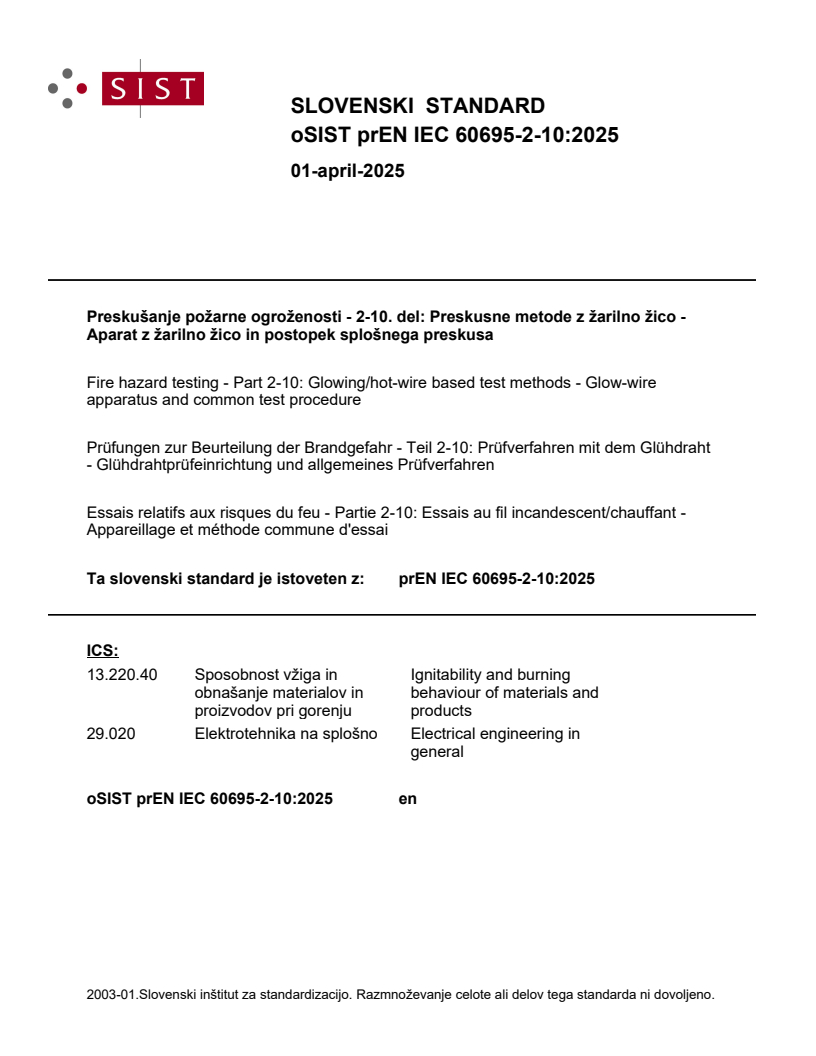
Standards Content (Sample)
SLOVENSKI STANDARD
01-april-2025
Preskušanje požarne ogroženosti - 2-10. del: Preskusne metode z žarilno žico -
Aparat z žarilno žico in postopek splošnega preskusa
Fire hazard testing - Part 2-10: Glowing/hot-wire based test methods - Glow-wire
apparatus and common test procedure
Prüfungen zur Beurteilung der Brandgefahr - Teil 2-10: Prüfverfahren mit dem Glühdraht
- Glühdrahtprüfeinrichtung und allgemeines Prüfverfahren
Essais relatifs aux risques du feu - Partie 2-10: Essais au fil incandescent/chauffant -
Appareillage et méthode commune d'essai
Ta slovenski standard je istoveten z: prEN IEC 60695-2-10:2025
ICS:
13.220.40 Sposobnost vžiga in Ignitability and burning
obnašanje materialov in behaviour of materials and
proizvodov pri gorenju products
29.020 Elektrotehnika na splošno Electrical engineering in
general
2003-01.Slovenski inštitut za standardizacijo. Razmnoževanje celote ali delov tega standarda ni dovoljeno.
89/1601/CDV
COMMITTEE DRAFT FOR VOTE (CDV)
PROJECT NUMBER:
IEC 60695-2-10 ED4
DATE OF CIRCULATION: CLOSING DATE FOR VOTING:
2025-02-07 2025-05-02
SUPERSEDES DOCUMENTS:
89/1575/RR, 89/1586/CD
IEC TC 89 : FIRE HAZARD TESTING
SECRETARIAT: SECRETARY:
Germany Mr Thorsten Ilg
OF INTEREST TO THE FOLLOWING COMMITTEES: HORIZONTAL FUNCTION(S):
TC 89 Horizontal Basic Safety
TC 10,TC 14,TC 20,SC 22F,SC 23A,TC 46,TC
61,SC 86A,TC 99,TC 104,TC 108,TC 112,SC
121A,ACOS
ASPECTS CONCERNED:
Safety
SUBMITTED FOR CENELEC PARALLEL VOTING NOT SUBMITTED FOR CENELEC PARALLEL VOTING
Attention IEC-CENELEC parallel voting
The attention of IEC National Committees, members of
CENELEC, is drawn to the fact that this Committee Draft
for Vote (CDV) is submitted for parallel voting.
The CENELEC members are invited to vote through the
CENELEC online voting system.
This document is still under study and subject to change. It should not be used for reference purposes.
Recipients of this document are invited to submit, with their comments, notification of any relevant patent rights
of which they are aware and to provide supporting documentation.
Recipients of this document are invited to submit, with their comments, notification of any relevant “In Some
Countries” clauses to be included should this proposal proceed. Recipients are reminded that the CDV stage is
the final stage for submitting ISC clauses. (SEE AC/22/2007 OR NEW GUIDANCE DOC).
TITLE:
Fire hazard testing - Part 2-10: Glowing/Hot-wire based test methods - Glow-wire apparatus
and common test procedure
PROPOSED STABILITY DATE: 2030
NOTE FROM TC/SC OFFICERS:
download this electronic file, to make a copy and to print out the content for the sole purpose of preparing National
Committee positions. You may not copy or "mirror" the file or printed version of the document, or any part of it,
for any other purpose without permission in writing from IEC.
IEC CDV 60695-2-10 ED4 © IEC 2024 2 89/1601/CDV
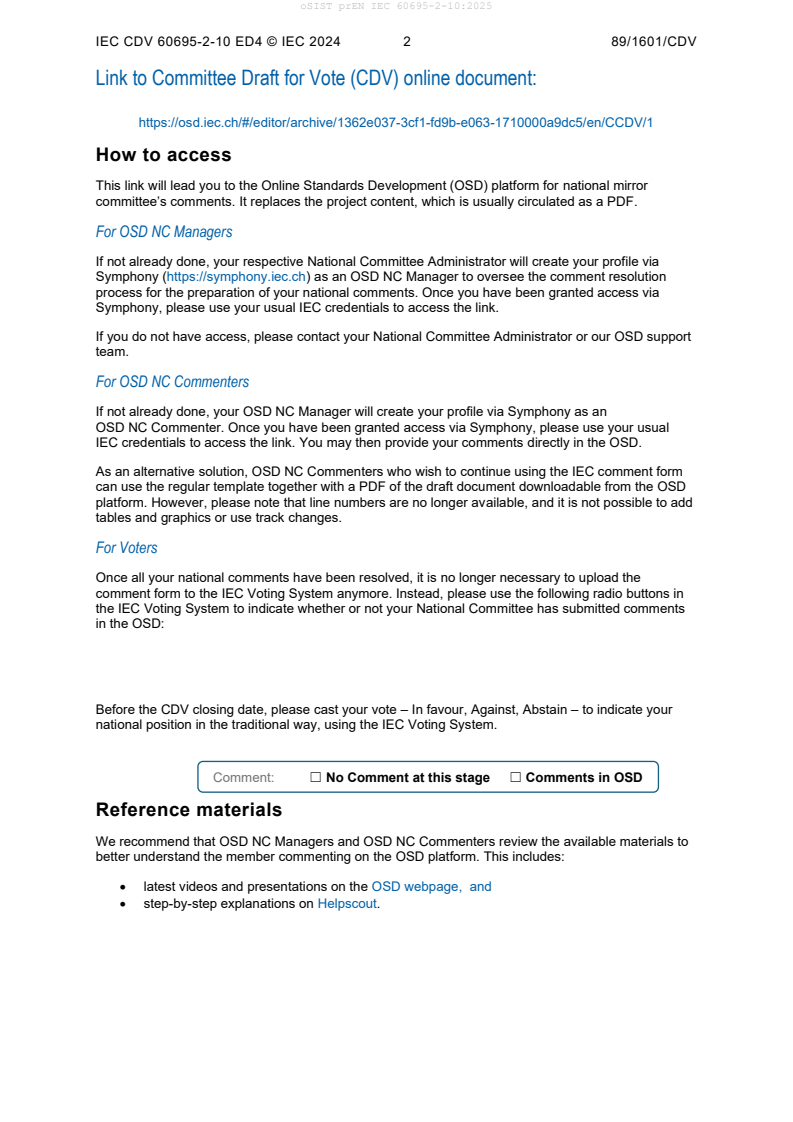
Link to Committee Draft for Vote (CDV) online document:
https://osd.iec.ch/#/editor/archive/1362e037-3cf1-fd9b-e063-1710000a9dc5/en/CCDV/1
How to access
This link will lead you to the Online Standards Development (OSD) platform for national mirror
committee’s comments. It replaces the project content, which is usually circulated as a PDF.
For OSD NC Managers
If not already done, your respective National Committee Administrator will create your profile via
Symphony (https://symphony.iec.ch) as an OSD NC Manager to oversee the comment resolution
process for the preparation of your national comments. Once you have been granted access via
Symphony, please use your usual IEC credentials to access the link.
If you do not have access, please contact your National Committee Administrator or our OSD support
team.
For OSD NC Commenters
If not already done, your OSD NC Manager will create your profile via Symphony as an
OSD NC Commenter. Once you have been granted access via Symphony, please use your usual
IEC credentials to access the link. You may then provide your comments directly in the OSD.
As an alternative solution, OSD NC Commenters who wish to continue using the IEC comment form
can use the regular template together with a PDF of the draft document downloadable from the OSD
platform. However, please note that line numbers are no longer available, and it is not possible to add
tables and graphics or use track changes.
For Voters
Once all your national comments have been resolved, it is no longer necessary to upload the
comment form to the IEC Voting System anymore. Instead, please use the following radio buttons in
the IEC Voting System to indicate whether or not your National Committee has submitted comments
in the OSD:
Before the CDV closing date, please cast your vote – In favour, Against, Abstain – to indicate your
national position in the traditional way, using the IEC Voting System.
Comment: ☐ No Comment at this stage ☐ Comments in OSD
Reference materials
We recommend that OSD NC Managers and OSD NC Commenters review the available materials to
better understand the member commenting on the OSD platform. This includes:
• latest videos and presentations on the OSD webpage, and
• step-by-step explanations on Helpscout.
IEC CDV 60695-2-10 ED4 © IEC 2024 3 89/1601/CDV
How to download PDF file
This link will lead you to the Online Standards Development (OSD) platform where you may download
the PDF file by following the steps shown below.
How to receive the Word file
Should your national mirror committee wish to receive the Word file for translation purposes only,
please contact our OSD support at osd_support@iec.ch.
Translation integration mechanisms for OSD documents are still being studied for development. The
solution above is a temporary measure.
Contact
Should you require any assistance, please contact the OSD project team at osd_support@iec.ch.
IEC CDV 60695-2-10 ED4 © IEC 2024 4 89/1601/CDV
CONTENTS
FOREWORD . 6
INTRODUCTION . 8
1 Scope . 9
2 Normative references . 9
3 Terms and definitions . 9
4 Description of the test apparatus . 12
4.1 Glow-wire . 12
4.2 Electrical circuit of the glow-wire apparatus . 13
4.3 Temperature measuring system . 13
4.4 Specified layer . 14
4.5 Test chamber . 16
4.6 Timing device . 17
5 Verification of the apparatus . 17
5.1 Verification of the glow-wire tip . 17
5.2 Verification of the temperature measuring system. 17
6 Conditioning . 17
7 Common test procedure . 17
7.1 Test specimen support . 17
7.2 Glow-wire temperature . 18
7.3 Application of the glow-wire . 18
8 General test observations and evaluations of test results . 18
Annex A (normative) Requirements for "ignition" and "flaming" observations . 19
A.1 General . 19
A.2 Examples of ignition and non-ignition . 20
Annex B (informative) Guidance on the verification procedure of the glow-wire
temperature measuring system by the heating current . 23
B.1 Objective . 23
B.2 Preparation. 23
B.3 Verification procedure. 23
B.3.1 Observation and measurement . 23
B.3.2 Correlation chart . 23
B.3.3 Frequency of revising the correlation chart . 23
Annex C (informative) Supplement - Times and durations, and examples of
evaluations . 25
C.1 Times and durations (in accordance with Clause 3) . 25
C.2 Examples of evaluations . 25
Annex D (normative) Use of the Pyrometer for Glow-wire test . 27
D.1 General . 27
D.2 Description of the apparatus . 27
D.2.1 General . 27
D.2.2 Focal point . 27
D.2.3 Measurable area . 28
D.2.4 Technical characteristics . 28
D.3 Verification of the apparatus . 29
D.3.1 General . 29
IEC CDV 60695-2-10 ED4 © IEC 2024 5 89/1601/CDV
D.3.2 Single-wavelength pyrometer calibration . 29
D.3.3 Dual-wavelength pyrometer calibration . 30
D.4 Common test procedure . 30
D.4.1 Apparatus setup . 30
D.4.2 Test procedure . 32
Bibliography . 33
Figure 1 – Glow-wire and position of thermocouple. 12
Figure 2 – Electrical circuit of the glow-wire apparatus . 13
Figure 3 – Test apparatus - static glow-wire, moving test specimen (example) . 15
Figure 4 – Test apparatus - moving glow-wire, static test specimen (example) . 16
Figure A.1 – Example of a brightly shining flame . 20
Figure A.2 – Example of a blue corona at the glow-wire tip . 21
Figure A.3 – Example of ionized gases in the form of a tail near the glow wire tip . 22
Figure B.1 – Correlation curve between the heating current and the glow-wire
temperature (example) . 24
Figure C.1 – Times and durations (in accordance with Clause 3) . 25
Figure C.2 – Evaluation scheme with examples . 26
Figure D.1 – Example of optical pyrometer focus areas . 28
Figure D.2 – Example of pyrometer measurable area . 28
Figure D.3 – Pyrometer calibration procedure flowchart . 30
Figure D.4 – Example of pyrometer location (alignment on glow-wire median axe) . 31
Figure D.5 – Example of pyrometer location (distance and measurement angle) . 31
Figure D.6 – Pyrometer measurable area . 32
Table D.1 – Pyrometer technical characteristics . 28
IEC CDV 60695-2-10 ED4 © IEC 2024 6 89/1601/CDV
INTERNATIONAL ELECTROTECHNICAL COMMISSION
____________
Fire hazard testing - Part 2-10: Glowing/Hot-wire based test methods -
Glow-wire apparatus and common test procedure –
FOREWORD
1) The International Electrotechnical Commission (IEC) is a worldwide organization for standardization comprising
all national electrotechnical committees (IEC National Committees). The object of IEC is to promote international
co-operation on all questions concerning standardization in the electrical and electronic fields. To this end and
in addition to other activities, IEC publishes International Standards, Technical Specifications, Technical
Reports, Publicly Available Specifications (PAS) and Guides (hereafter referred to as "IEC Publication(s)").
Their preparation is entrusted to technical committees; any IEC National Committee interested in the subject
dealt with may participate in this preparatory work. International, governmental and non -governmental
organizations liaising with the IEC also participate in this preparation. IEC collaborates closely with the
International Organization for Standardization (ISO) in accordance with conditions determined by agreement
between the two organizations.
2) The formal decisions or agreements of IEC on technical matters express, as nearly as possible, an international
consensus of opinion on the relevant subjects since each technical committee has representation from all
interested IEC National Committees.
3) IEC Publications have the form of recommendations for international use and are accepted by IEC National
Committees in that sense. While all reasonable efforts are made to ensure that the technical content of IEC
Publications is accurate, IEC cannot be held responsible for the way in which they are used or for any
misinterpretation by any end user.
4) In order to promote international uniformity, IEC National Committees undertake to apply IEC Publications
transparently to the maximum extent possible in their national and regional publications. Any divergence
between any IEC Publication and the corresponding national or regional publication shall be clearly indicated
in the latter.
5) IEC itself does not provide any attestation of conformity. Independent certification bodies provide conformity
assessment services and, in some areas, access to IEC marks of conformity. IEC is not responsible for any
services carried out by independent certification bodies.
6) All users should ensure that they have the latest edition of this publication.
7) No liability shall attach to IEC or its directors, employees, servants or agents including individual experts and
members of its technical committees and IEC National Committees for any personal injury, property damage or
other damage of any nature whatsoever, whether direct or indirect, or for costs (including legal fees) and
expenses arising out of the publication, use of, or reliance upon, this IEC Publication or any other IEC
Publications.
8) Attention is drawn to the Normative references cited in this publication. Use of the referenced publications is
indispensable for the correct application of this publication.
9) Attention is drawn to the possibility that some of the elements of this IEC Publication may be the subject of
patent rights. IEC shall not be held responsible for identifying any or all such patent rights.
IEC 60695-2-10 has been prepared by IEC technical committee 89: Fire hazard testing. It is an
International Standard.
This fourth edition cancels and replaces the third edition published in 2021. This edition
constitutes a technical revision.
This edition includes the following significant technical changes with respect to the previous
edition:
– Revision of clause 4.3 to add reference to new Annex D.
– Addition of new Annex D Normative on "Use of pyrometer for glow-wire test".
– Revision of clause 3 references to align with ISO 13943:2017.
The text of this International Standard is based on the following documents:
FDIS Report on voting
89/1535/FDIS 89/1547/RVD
IEC CDV 60695-2-10 ED4 © IEC 2024 7 89/1601/CDV
Full information on the voting for its approval can be found in the report on voting indicated in
the above table.
The language used for the development of this International Standard is English.
This document was drafted in accordance with ISO/IEC Directives, Part 2, and developed in
accordance with ISO/IEC Directives, Part 1 and ISO/IEC Directives, IEC Supplement, available
at www.iec.ch/members_experts/refdocs. The main document types developed by IEC are
described in greater detail at www.iec.ch/standardsdev/publications.
It has the status of a basic safety publication in accordance with IEC Guide 104.
This standard is to be used in conjunction with IEC 60695-2-11, IEC 60695-2-12, and IEC
60695-2-13.
A list of all parts in the IEC 60695 series, published under the general title Fire hazard testing,
can be found on the IEC website.
The committee has decided that the contents of this document will remain unchanged until the
stability date indicated on the IEC website under webstore.iec.ch in the data related to the
specific document. At this date, the document will be
• reconfirmed,
• withdrawn,
• replaced by a revised edition, or
• amended.
The contents of the corrigendum 1 (2024-01) have been included in this copy.
IEC CDV 60695-2-10 ED4 © IEC 2024 8 89/1601/CDV
INTRODUCTION
In the design of any electrotechnical product, the risk of fire and the potential hazards
associated with fire need to be considered. In this respect the objective of component, circuit,
and product design, as well as the choice of materials, is to reduce to acceptable levels the
potential risks of fire during normal operating conditions, reasonably foreseeable abnormal use,
malfunction, and/or failure. IEC 60695-1-10IEC 60695-1-10 [1] was developed, together with
its companion, IEC 60695-1-11IEC 60695-1-11 [2], to provide guidance on how this is to be
accomplished.
The primary aims of IEC 60695-1-10 and IEC 60695-1-11 are to provide guidance on how:
a) to prevent ignition caused by an electrically energized component part; and
b) to confine any resulting fire within the bounds of the enclosure of the electrotechnical
product in the event of ignition.
Secondary aims of these documents include the minimization of any flame spread beyond the
product’s enclosure and the minimization of harmful effects of fire effluents such as heat,
smoke, toxicity and/or corrosivity.
Fires involving electrotechnical products can also be initiated from external non -electrical
sources. Considerations of this nature should be dealt with in the overall fire risk assessment.
In electrotechnical equipment, overheated metal parts can act as ignition sources. In glow -wire
tests, a glowing wire is used to simulate such an ignition source.
This part of IEC 60695 gives recommendations with regard to the glow-wire test apparatus and
describes a common test procedure for tests applicable to end products and materials to be
used with IEC 60695-2-11 which describes a glow-wire flammability test for end products
(GWEPT), IEC 60695-2-12 which describes a glow-wire flammability index test for materials
(GWFI), and IEC 60695-2-13 which describes a glow-wire ignition temperature test method for
materials (GWIT).
Numbers in square brackets refer to the Bibliography.
IEC CDV 60695-2-10 ED4 © IEC 2024 9 89/1601/CDV
Fire hazard testing - Part 2-10: Glowing/Hot-wire based test methods -
Glow-wire apparatus and common test procedure –
1 Scope
This part of IEC 60695 specifies the glow-wire apparatus and common test procedure to
simulate the effects of thermal stresses which may be produced by heat sources such as
glowing elements or overloaded resistors, for short periods, in order to assess the fire hazard
by a simulation technique.
The test procedure described in this document is a common test procedure intended for the
small-scale tests in which a standardized electrically heated wire is used as a source of ignition.
It is a common part of the test procedures applied to end products and to solid electrical
insulating materials or other solid combustible materials.
A detailed description of each particular test procedure is given in IEC 60695-2-11, IEC 60695-
2-12 and IEC 60695-2-13.
This basic safety publication focusing on safety test method(s) is primarily intended for use by
technical committees in the preparation of safety publications in accordance with the principles
laid down in IEC Guide 104 and ISO/IEC Guide 51.
One of the responsibilities of a technical committee is, wherever applicable, to make use of
basic safety publications in the preparation of its publications.
2 Normative references
The following documents are referred to in the text in such a way that some or all of their
content constitutes requirements of this document. For dated references, only the edition cited
applies. For undated references, the latest edition of the referenced document (including any
amendments) applies.
IEC 60584-1, Thermocouples - Part 1: EMF specifications and tolerances
IEC 60695-2-11, Fire hazard testing - Part 2-11: Glowing/hot-wire based test methods - Glow-
wire flammability test method for end products (GWEPT)
IEC 60695-2-12, Fire hazard testing - Part 2-12: Glowing/hot-wire based test methods - Glow-
wire flammability index (GWFI) test method for materials
IEC 60695-2-13, Fire hazard testing - Part 2-13: Glowing/hot-wire based test methods - Glow-
wire ignition temperature (GWIT) test method for materials
ISO 4046-4:2016, Paper, board, pulps and related terms - Vocabulary - Part 4: Paper and board
grades and converted products
ISO 13943:2017, Fire safety — Vocabulary
3 Terms and definitions
For the purposes of this document, the terms and definitions given in , ISO 13943:2017 some
of which are reproduced below for the user’s convenience, and the following apply.
ISO and IEC maintain terminology databases for use in standardization at the following
addresses:
• IEC Electropedia: available at https://www.electropedia.org/
• ISO Online browsing platform: available at https://www.iso.org/obp
IEC CDV 60695-2-10 ED4 © IEC 2024 10 89/1601/CDV
3.1
combustible
capable of being ignited and burned
[SOURCE: ISO 13943:2017, 3.52]
3.2
draught-free environment
space in which the results of experiments are not significantly affected by the local air speed
Note 1 to entry: A qualitative example is a space in which a wax candle flame remains essentially undisturbed.
−1 −1
Quantitative examples are small-scale fire tests in which a maximum air speed of 0,1 m·s or 0,2 m·s is
sometimes specified.
[SOURCE: ISO 13943:2017, 3.83]
3.3
fire hazard
potential for harm associated with fire
Note 1 to entry: Alternatively, fire hazard can be a physical object or condition with a potential for an undesirable
consequence from fire.
[SOURCE: ISO 13943:2017, 3.131]
3.4
fire test
test that measures fire behaviour or exposes an item to the effects of a fire
Note 1 to entry: The results of a fire test can be used to quantify fire severity or determine the fire resistance or
reaction to fire of the test specimen.
[SOURCE: ISO 13943:2017, 3.157]
3.5
flame
rapid, self-sustaining, sub-sonic propagation of combustion in a gaseous medium, usually with
emission of light
[SOURCE: ISO 13943:2017, 3.159]
3.6
flame event
sustained flaming and/or glowing combustion
3.7
flammability
ability of a material or product to burn with a flame under specified conditions
[SOURCE: ISO 13943:2017, 3.178]
3.8
ignition
DEPRECATED: sustained ignition
initiation of combustion
[SOURCE: ISO 13943:2017, 3.217]
3.9
test temperature
temperature to which the tip of the glow-wire is heated and stabilized prior to any contact with
the test specimen
3.10
time of application
t
APP
application time of the glow-wire
IEC CDV 60695-2-10 ED4 © IEC 2024 11 89/1601/CDV
Note 1 to entry: Time of application constitutes the first 30 s of the test.
Note 2 to entry: See Annex C.
3.11
time of observation
t
OBS
observation time of the specimen and/or specified layer, starting immediately after t
APP
Note 1 to entry: Time of observation constitutes the second 30 s of the test.
Note 2 to entry: See Annex C.
3.12
time of ignition
t
I
time (to the nearest 0,5 s), from the start of test, at which the longest persisting flame event
starts
Note 1 to entry: This is a measured value.
Note 2 to entry: See Annex C.
3.13
time of extinguishing
t
E
time (to the nearest 0,5 s), from the start of the test, at which the longest persisting flame event
ends
Note 1 to entry: This is a measured value.
Note 2 to entry: See Annex C.
3.14
total flame event time
t
T
duration of the longest persisting flame event
𝑡 =𝑡 −𝑡 (1)
T E I
Note 1 to entry: This is a calculated value.
Note 2 to entry: See Annex C.
3.15
flame time after removal
t
R
time elapsed after the removal of the glow-wire tip from the test specimen to the end of the
longest persisting flame event
𝑡 =𝑡 −30s (2)
R E
Note 1 to entry: If t is less than 30 s then t is zero.
E R
Note 2 to entry: This is a calculated value.
Note 3 to entry: See Annex C.
3.16
flame time during application
t
B
duration of the longest persisting flame event whilst the glow-wire tip is in contact with the test
specimen
𝑡 =𝑡 −𝑡 (3)
B T R
IEC CDV 60695-2-10 ED4 © IEC 2024 12 89/1601/CDV
Note 1 to entry: This is a calculated value.
Note 2 to entry: See Annex C.
3.17
emissivity
ratio of the radiation emitted by a radiant source to the ratio of radiation that would be emitted
by a black body radiant source at the same temperature
Note 1 to entry: The emissivity is dimensionless
[SOURCE: ISO 13943:2017, definition 3.89]
3.18
focal length
the distance between the center of the pyrometer optic lens and its focal point
3.19
focal point
point where light rays converge
Note 1 to entry: For lens application, the focal point is commonly known as the point where in a captured image,
the subject is clearly visible without blur
4 Description of the test apparatus
4.1 Glow-wire
The glow-wire is formed from nickel/chromium > 77 % Ni/(20 ± 1) % Cr) wire, having an overall
diameter of 4,00 mm ± 0,07 mm (before bending). The dimensions of the glow-wire loop are as
detailed in Figure 1. When forming the glow-wire, ensure that fine cracking at the tip is avoided.
NOTE 1 Annealing is a suitable process for prevention of fine cracking at the tip.
Dimensions in millimetres
1 Glow-wire
2 Thermocouple
3 Stud
Z Enlarged view of Z section
A Overall diameter of the wire after bending See 5.1
Figure 1 – Glow-wire and position of thermocouple
A new glow-wire shall be annealed for a total of at least 10 h by being subjected to a current
of at least 120 A before being used for a test run. The total annealing time may be achieved
cumulatively. To avoid damage, the thermocouple shall not be installed during annealing. At
the end of annealing, the depth of the thermocouple pocket hole shall be verified.
IEC CDV 60695-2-10 ED4 © IEC 2024 13 89/1601/CDV
NOTE 2 The temperature of a new glow-wire which has not been annealed gradually lowers during the first few
hours when subjected to a flow of current. After a period of time the temperature then reaches equilibrium.
The test apparatus shall be designed so that the glow-wire is kept in a horizontal plane and
applies a force of 0,95 N ± 0,10 N to the test specimen during the application of the glow -wire.
The force shall be maintained at this value when the glow-wire or the test specimen is moved
horizontally one towards the other. The penetration of the tip of the glow -wire into and through
the test specimen shall be limited to 7 mm ± 0,5 mm.
The test apparatus shall be designed in such a way that burning or glowing particles falling
from the test specimen are able to fall without obstruction onto the layer as specified in 4.4.
Two typical examples of the test apparatus are shown in Figure 3 and Figure 4.
NOTE 3 The apparatus shown in Figure 4 has been found useful when testing heavy and/or awkwardly shaped test
specimens.
4.2 Electrical circuit of the glow-wire apparatus
The glow-wire shall be heated by an electric circuit. There shall be no feedba
...
Questions, Comments and Discussion
Ask us and Technical Secretary will try to provide an answer. You can facilitate discussion about the standard in here.
Loading comments...