


EN 50130-4:1995
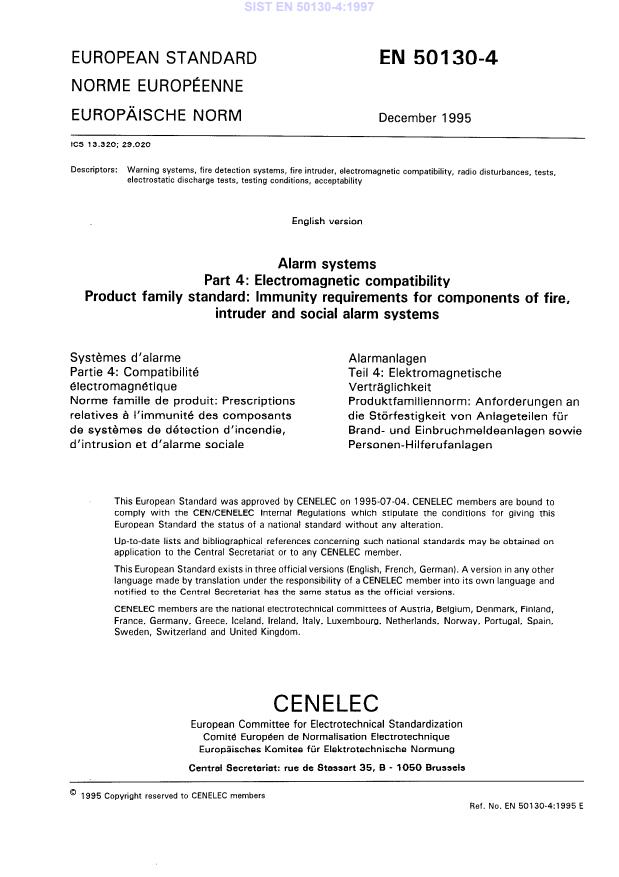
(Main)Alarm systems - Part 4: Electromagnetic compatibility - Product family standard: Immunity requirements for components of fire, intruder and social alarm systems
General Information
- Abstract
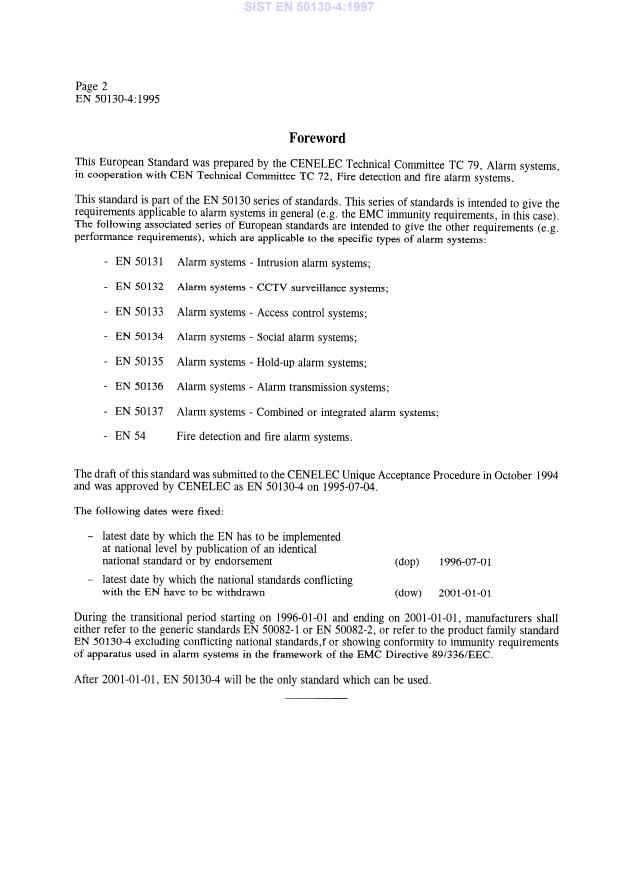
This EMC product-family standard, for immunity requirements, applies to the components of the following alarm systems, intended for use in and around buildings in residential, commercial, light industrial and industrial environments: Intruder alarm systems; Hold-up alarm systems; Fire detection and fire alarm systems; Social alarm systems; CCTV systems, for security applications; Access control systems, for security applications. The tests and severities to be used are the same for indoor and outdoor applications of fixed, movable and portable equipment. The levels do not cover extreme cases, which may occur in any location, but with an extremely low probability of occurrence, or in special locations close to powerful emitters (e.g. radar transmitters). Equipment within the scope of this standard should be designed in order to operate satisfactorily in the environmental electromagnetic conditions of residential, commercial, light industrial and industrial environments. This implies particularly that it should be able to operate correctly within the conditions fixed by the electromagnetic compatibility levels for the various disturbances on the low voltage public supply system as defined by ENV 61000-2-2. The Immunity tests in this standard only concern the most critical disturbance phenomena. For equipment using radio signaling, mains signaling or with connections to the public telephone system, additional requirements, from other standards specific to these signaling media, might apply. For the requirements applicable to radio links, reference should be made to the applicable ETSI standard, in accordance with the agreement between ETSI and CENELEC. This standard does not specify basic safety requirements, such as protection against electrical shocks, unsafe operation, insulation coordination and related dielectric tests. This standard does not cover EMC emission requirements. These are covered by other appropriate standards
- Status
- Withdrawn
- Publication Date
- 04-Dec-1995
- Withdrawal Date
- 31-Dec-2000
- Technical Committee
- CLC/TC 79 - Alarm systems
- Parallel Committee
- IEC/TC 79 - IEC_TC_79
- Current Stage
- 9960 - Withdrawal effective - Withdrawal
- Start Date
- 13-Jun-2014
- Completion Date
- 13-Jun-2014
- Directive
- Not Harmonized2004/108/EC - Directive 2004/108/EC of the European Parliament and of the Council of 15 December 2004 on the approximation of the laws of the Member States relating to electromagnetic compatibility and repealing Directive 89/336/EECOJ Ref: C 53/, C 53/04 OJ Date: 25-Feb-2014
Not Harmonized2004/108/EU - DIRECTIVE 2004/108/EC OF THE EUROPEAN PARLIAMENT AND OF THE COUNCIL of 15 December 2004 on the approximation of the laws of the Member States relating to electromagnetic compatibility and repealing Directive 89/336/EECOJ Ref: C 102/05 OJ Date: 25-Feb-2014
Not Harmonized89/336/EEC - Electromagnetic compatibility (EMC)OJ Ref: C 201/31
- Mandate
- BC/CLC/92-02 - BC/CLC/92-02

Relations
- Effective Date
- 07-Jun-2022
- Effective Date
- 09-Feb-2026
- Effective Date
- 09-Feb-2026
- Effective Date
- 09-Feb-2026
- Effective Date
- 09-Feb-2026
- Referred By
EN 54-20:2006 - Fire detection and fire alarm systems - Part 20: Aspirating smoke detectors - Effective Date
- 09-Feb-2026
- Effective Date
- 09-Feb-2026
- Effective Date
- 09-Feb-2026
- Referred By
EN 54-3:2001 - Fire detection and fire alarm systems - Part 3: Fire alarm devices - Sounders - Effective Date
- 09-Feb-2026
- Effective Date
- 09-Feb-2026
- Referred By
EN 54-2:1997 - Fire detection and fire alarm systems - Part 2: Control and indicating equipment - Effective Date
- 09-Feb-2026
- Effective Date
- 09-Feb-2026
- Effective Date
- 09-Feb-2026
- Referred By
EN 14604:2005 - Smoke alarm devices - Effective Date
- 09-Feb-2026
- Effective Date
- 09-Feb-2026
Get Certified
Connect with accredited certification bodies for this standard

IMQ S.p.A. (Certification)
Italian electrical product certification.

SLG Prüf- und Zertifizierungs GmbH
German testing and certification body.

UL Solutions
Global safety science company with testing, inspection and certification.
Sponsored listings
Frequently Asked Questions
EN 50130-4:1995 is a standard published by CLC. Its full title is "Alarm systems - Part 4: Electromagnetic compatibility - Product family standard: Immunity requirements for components of fire, intruder and social alarm systems". This standard covers: This EMC product-family standard, for immunity requirements, applies to the components of the following alarm systems, intended for use in and around buildings in residential, commercial, light industrial and industrial environments: Intruder alarm systems; Hold-up alarm systems; Fire detection and fire alarm systems; Social alarm systems; CCTV systems, for security applications; Access control systems, for security applications. The tests and severities to be used are the same for indoor and outdoor applications of fixed, movable and portable equipment. The levels do not cover extreme cases, which may occur in any location, but with an extremely low probability of occurrence, or in special locations close to powerful emitters (e.g. radar transmitters). Equipment within the scope of this standard should be designed in order to operate satisfactorily in the environmental electromagnetic conditions of residential, commercial, light industrial and industrial environments. This implies particularly that it should be able to operate correctly within the conditions fixed by the electromagnetic compatibility levels for the various disturbances on the low voltage public supply system as defined by ENV 61000-2-2. The Immunity tests in this standard only concern the most critical disturbance phenomena. For equipment using radio signaling, mains signaling or with connections to the public telephone system, additional requirements, from other standards specific to these signaling media, might apply. For the requirements applicable to radio links, reference should be made to the applicable ETSI standard, in accordance with the agreement between ETSI and CENELEC. This standard does not specify basic safety requirements, such as protection against electrical shocks, unsafe operation, insulation coordination and related dielectric tests. This standard does not cover EMC emission requirements. These are covered by other appropriate standards
This EMC product-family standard, for immunity requirements, applies to the components of the following alarm systems, intended for use in and around buildings in residential, commercial, light industrial and industrial environments: Intruder alarm systems; Hold-up alarm systems; Fire detection and fire alarm systems; Social alarm systems; CCTV systems, for security applications; Access control systems, for security applications. The tests and severities to be used are the same for indoor and outdoor applications of fixed, movable and portable equipment. The levels do not cover extreme cases, which may occur in any location, but with an extremely low probability of occurrence, or in special locations close to powerful emitters (e.g. radar transmitters). Equipment within the scope of this standard should be designed in order to operate satisfactorily in the environmental electromagnetic conditions of residential, commercial, light industrial and industrial environments. This implies particularly that it should be able to operate correctly within the conditions fixed by the electromagnetic compatibility levels for the various disturbances on the low voltage public supply system as defined by ENV 61000-2-2. The Immunity tests in this standard only concern the most critical disturbance phenomena. For equipment using radio signaling, mains signaling or with connections to the public telephone system, additional requirements, from other standards specific to these signaling media, might apply. For the requirements applicable to radio links, reference should be made to the applicable ETSI standard, in accordance with the agreement between ETSI and CENELEC. This standard does not specify basic safety requirements, such as protection against electrical shocks, unsafe operation, insulation coordination and related dielectric tests. This standard does not cover EMC emission requirements. These are covered by other appropriate standards
EN 50130-4:1995 is classified under the following ICS (International Classification for Standards) categories: 13.320 - Alarm and warning systems; 29.020 - Electrical engineering in general. The ICS classification helps identify the subject area and facilitates finding related standards.
EN 50130-4:1995 has the following relationships with other standards: It is inter standard links to EN 50130-4:2011, EN 54-12:2002, EN 54-7:2000, EN 54-16:2008, EN 54-23:2010, EN 54-20:2006, EN 54-17:2005, EN 54-2:1997/A1:2006, EN 54-3:2001, EN 1300:2004+A1:2011, EN 54-2:1997, EN 54-18:2005, EN 54-4:1997, EN 14604:2005, EN 54-11:2001. Understanding these relationships helps ensure you are using the most current and applicable version of the standard.
EN 50130-4:1995 is associated with the following European legislation: EU Directives/Regulations: 2004/108/EC, 2004/108/EU, 89/336/EEC; Standardization Mandates: BC/CLC/92-02, M/404. When a standard is cited in the Official Journal of the European Union, products manufactured in conformity with it benefit from a presumption of conformity with the essential requirements of the corresponding EU directive or regulation.
EN 50130-4:1995 is available in PDF format for immediate download after purchase. The document can be added to your cart and obtained through the secure checkout process. Digital delivery ensures instant access to the complete standard document.
Standards Content (Sample)
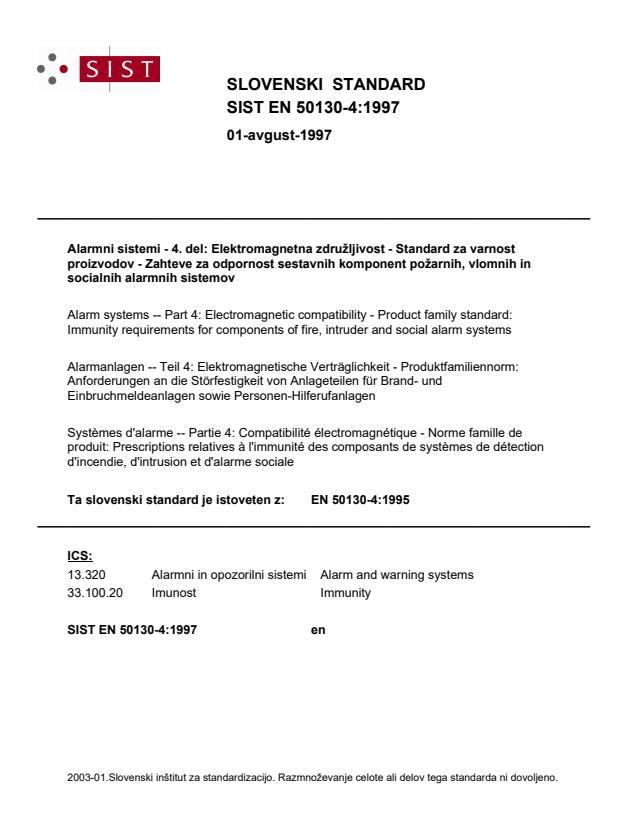
SLOVENSKI STANDARD
01-avgust-1997
Alarmni sistemi - 4. del: Elektromagnetna združljivost - Standard za varnost
proizvodov - Zahteve za odpornost sestavnih komponent požarnih, vlomnih in
socialnih alarmnih sistemov
Alarm systems -- Part 4: Electromagnetic compatibility - Product family standard:
Immunity requirements for components of fire, intruder and social alarm systems
Alarmanlagen -- Teil 4: Elektromagnetische Verträglichkeit - Produktfamiliennorm:
Anforderungen an die Störfestigkeit von Anlageteilen für Brand- und
Einbruchmeldeanlagen sowie Personen-Hilferufanlagen
Systèmes d'alarme -- Partie 4: Compatibilité électromagnétique - Norme famille de
produit: Prescriptions relatives à l'immunité des composants de systèmes de détection
d'incendie, d'intrusion et d'alarme sociale
Ta slovenski standard je istoveten z: EN 50130-4:1995
ICS:
13.320 Alarmni in opozorilni sistemi Alarm and warning systems
33.100.20 Imunost Immunity
2003-01.Slovenski inštitut za standardizacijo. Razmnoževanje celote ali delov tega standarda ni dovoljeno.
...