


prEN IEC 61675-2:2024
(Main)Radionuclide imaging devices - Characteristics and test conditions - Part 2: Gamma cameras for planar, wholebody, and SPECT imaging
Radionuclide imaging devices - Characteristics and test conditions - Part 2: Gamma cameras for planar, wholebody, and SPECT imaging
Bildgebende Systeme in der Nuklearmedizin - Merkmale und Prüfbedingungen - Teil 2: Gammakameras für planare Bildgebung, mit Ganzkörper-Zusatz und Gammakameras zur Einzelphotonen-Emissions-Tomographie (SPECT)
Dispositifs d'imagerie par radionucléides - Caractéristiques et conditions d'essai - Partie 2: Gamma-caméras pour l'imagerie planaire, l'imagerie du corps entier et l'imagerie spect
Naprave za opazovanje radioaktivnih elementov - Karakteristike in preskusni pogoji - 2. del: Gama kamere za planarno slikanje, slikanje celega telesa in slikanje SPECT
General Information
- Status
- Not Published
- Publication Date
- 21-Dec-2025
- Technical Committee
- CLC/TC 62 - Electrical equipment in medical practice
- Current Stage
- 4060 - Enquiry results established and sent to TC, SR, BTTF - Enquiry
- Start Date
- 23-Aug-2024
- Completion Date
- 23-Aug-2024
Relations
- Effective Date
- 23-May-2023
Overview
prEN IEC 61675-2:2024 (IEC 61675‑2 ED3) specifies characteristics and test conditions for gamma cameras used in planar, whole‑body and SPECT (single‑photon emission computed tomography) radionuclide imaging. This third edition consolidates earlier IEC documents, adds support for pixelated semiconductor detectors, introduces whole‑body SPECT and quantitative SPECT accuracy tests, and has been updated and partly aligned with NEMA NU 1‑2018. The document is a Committee Draft for Vote (CDV) and is prepared by IEC SC 62C (equipment for radiotherapy, nuclear medicine and radiation dosimetry).
Key topics and technical requirements
The standard defines test methods, measurement geometries and reporting items for gamma camera performance, including:
- System sensitivity for planar and SPECT modes and normalized volume sensitivity for tomographic imaging
- Spatial resolution measurements (intrinsic, collimator‑dependent; radial/tangential/transverse and axial for SPECT)
- Spatial non‑linearity and non‑uniformity of response, including bad‑pixel reporting and uniformity phantoms
- Energy resolution and multi‑window spatial registration for energy‑dependent imaging
- Count‑rate performance, dead‑time characterization and the rate corresponding to 80% true count rate
- Scatter measurement and scatter fraction evaluation for SPECT and correction accuracy
- Projection geometry tests, centre‑of‑rotation (COR) calibration and detector positioning/tilt assessments
- Tomographic image quality and quantitative accuracy, including phantom methods for image quality, attenuation and scatter correction checks
- Shield leakage and whole‑body scanning constancy checks
- Requirements for reporting general parameters (collimators, field of view, pixel sizes, etc.)
The standard prescribes test phantoms, source arrangements and evaluation metrics but does not replace clinical protocols.
Practical applications
- Design verification and performance validation during gamma camera development
- Factory acceptance testing and quality assurance for manufacturers
- Site acceptance, commissioning and periodic QA in nuclear medicine departments
- Independent performance testing by medical physics laboratories and test houses
- Evidence for regulatory submissions, procurement specifications and conformity assessment
Who should use this standard
- Gamma camera and detector manufacturers
- Medical physicists, clinical engineers and nuclear medicine technologists
- Test laboratories and certification bodies
- Hospital procurement teams and regulatory authorities
Related standards
- NEMA NU 1‑2018 (alignment noted)
- Earlier IEC documents consolidated into this edition (IEC 60789, IEC 61675 series)
Keywords: IEC 61675‑2:2024, gamma camera, SPECT, planar imaging, wholebody imaging, system sensitivity, spatial resolution, energy resolution, count rate performance, nuclear medicine standards.

Get Certified
Connect with accredited certification bodies for this standard

BSI Group
BSI (British Standards Institution) is the business standards company that helps organizations make excellence a habit.

TÜV Rheinland
TÜV Rheinland is a leading international provider of technical services.

TÜV SÜD
TÜV SÜD is a trusted partner of choice for safety, security and sustainability solutions.
Sponsored listings
Frequently Asked Questions
prEN IEC 61675-2:2024 is a draft published by CLC. Its full title is "Radionuclide imaging devices - Characteristics and test conditions - Part 2: Gamma cameras for planar, wholebody, and SPECT imaging". This standard covers: Radionuclide imaging devices - Characteristics and test conditions - Part 2: Gamma cameras for planar, wholebody, and SPECT imaging
Radionuclide imaging devices - Characteristics and test conditions - Part 2: Gamma cameras for planar, wholebody, and SPECT imaging
prEN IEC 61675-2:2024 is classified under the following ICS (International Classification for Standards) categories: 11.040.50 - Radiographic equipment. The ICS classification helps identify the subject area and facilitates finding related standards.
prEN IEC 61675-2:2024 has the following relationships with other standards: It is inter standard links to EN 61675-2:2015. Understanding these relationships helps ensure you are using the most current and applicable version of the standard.
prEN IEC 61675-2:2024 is available in PDF format for immediate download after purchase. The document can be added to your cart and obtained through the secure checkout process. Digital delivery ensures instant access to the complete standard document.
Standards Content (Sample)
SLOVENSKI STANDARD
01-julij-2024
Naprave za opazovanje radioaktivnih elementov - Karakteristike in preskusni
pogoji - 2. del: Gama kamere za planarno slikanje, slikanje celega telesa in slikanje
SPECT
Radionuclide imaging devices - Characteristics and test conditions - Part 2: Gamma
cameras for planar, wholebody, and SPECT imaging
Bildgebende Systeme in der Nuklearmedizin - Merkmale und Prüfbedingungen - Teil 2:
Gammakameras für planare Bildgebung, mit Ganzkörper-Zusatz und Gammakameras
zur Einzelphotonen-Emissions-Tomographie (SPECT)
Dispositifs d'imagerie par radionucléides - Caractéristiques et conditions d'essai - Partie
2: Gamma-caméras pour l'imagerie planaire, l'imagerie du corps entier et l'imagerie
spect
Ta slovenski standard je istoveten z: prEN IEC 61675-2:2024
ICS:
11.040.50 Radiografska oprema Radiographic equipment
2003-01.Slovenski inštitut za standardizacijo. Razmnoževanje celote ali delov tega standarda ni dovoljeno.
62C/912/CDV
COMMITTEE DRAFT FOR VOTE (CDV)
PROJECT NUMBER:
IEC 61675-2 ED3
DATE OF CIRCULATION: CLOSING DATE FOR VOTING:
2024-05-31 2024-08-23
SUPERSEDES DOCUMENTS:
62C/871/CD, 62C/889A/CC
IEC SC 62C : EQUIPMENT FOR RADIOTHERAPY, NUCLEAR MEDICINE AND RADIATION DOSIMETRY
SECRETARIAT: SECRETARY:
Germany Ms Regina Geierhofer
OF INTEREST TO THE FOLLOWING COMMITTEES: PROPOSED HORIZONTAL STANDARD:
Other TC/SCs are requested to indicate their interest, if any, in
this CDV to the secretary.
FUNCTIONS CONCERNED:
EMC ENVIRONMENT QUALITY ASSURANCE SAFETY
SUBMITTED FOR CENELEC PARALLEL VOTING NOT SUBMITTED FOR CENELEC PARALLEL VOTING
Attention IEC-CENELEC parallel voting
The attention of IEC National Committees, members of
CENELEC, is drawn to the fact that this Committee Draft
for Vote (CDV) is submitted for parallel voting.
The CENELEC members are invited to vote through the
CENELEC online voting system.
This document is still under study and subject to change. It should not be used for reference purposes.
Recipients of this document are invited to submit, with their comments, notification of any relevant patent rights of which
they are aware and to provide supporting documentation.
Recipients of this document are invited to submit, with their comments, notification of any relevant “In Some Countries”
clauses to be included should this proposal proceed. Recipients are reminded that the CDV stage is the final stage for
submitting ISC clauses. (SEE AC/22/2007 OR NEW GUIDANCE DOC).
TITLE:
Radionuclide imaging devices - Characteristics and test conditions - Part 2: Gamma cameras for planar,
wholebody, and SPECT imaging
PROPOSED STABILITY DATE: 2031
NOTE FROM TC/SC OFFICERS:
electronic file, to make a copy and to print out the content for the sole purpose of preparing National Committee positions.
You may not copy or "mirror" the file or printed version of the document, or any part of it, for any other purpose without
permission in writing from IEC.
62C/912/CDV – 2 – IEC CDV 61675-2 © IEC 2024
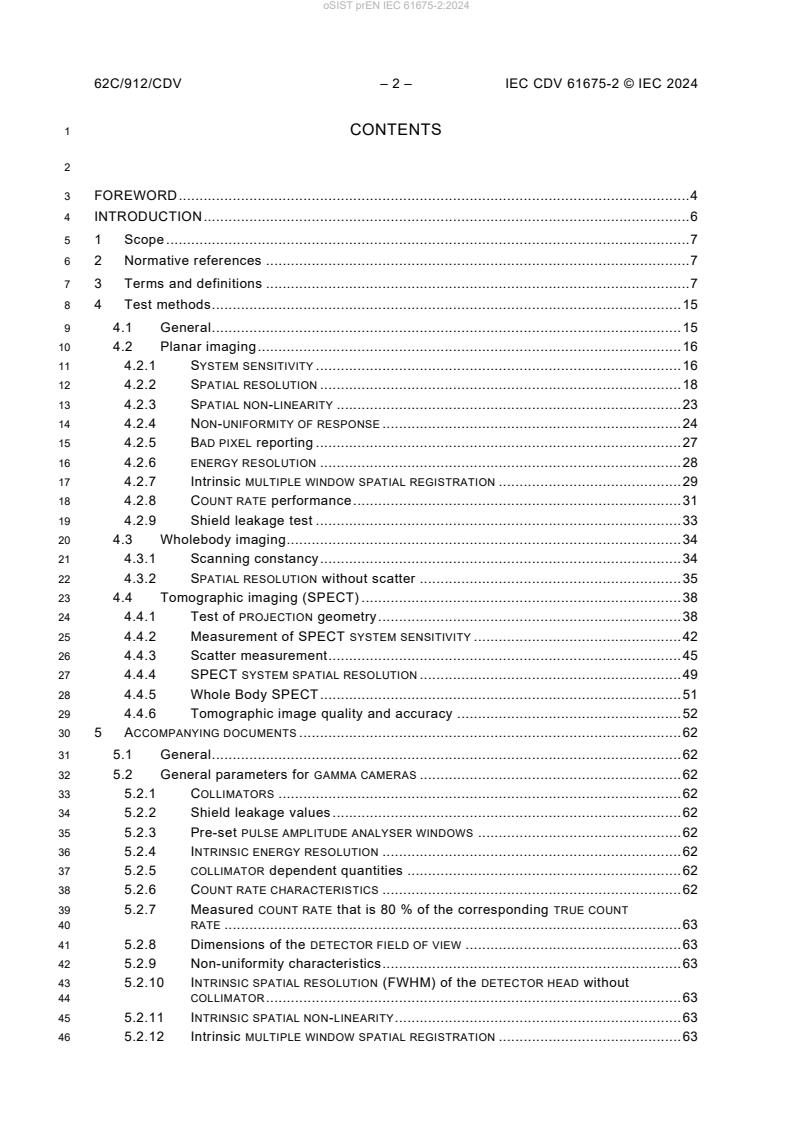
1 CONTENTS
3 FOREWORD . 4
4 INTRODUCTION . 6
5 1 Scope . 7
6 2 Normative references . 7
7 3 Terms and definitions . 7
8 4 Test methods . 15
9 4.1 General . 15
10 4.2 Planar imaging . 16
11 4.2.1 SYSTEM SENSITIVITY . 16
12 4.2.2 SPATIAL RESOLUTION . 18
13 4.2.3 SPATIAL NON-LINEARITY . 23
14 4.2.4 NON-UNIFORMITY OF RESPONSE . 24
15 4.2.5 BAD PIXEL reporting . 27
16 4.2.6 ENERGY RESOLUTION . 28
17 4.2.7 Intrinsic MULTIPLE WINDOW SPATIAL REGISTRATION . 29
18 4.2.8 COUNT RATE performance . 31
19 4.2.9 Shield leakage test . 33
20 4.3 Wholebody imaging . 34
21 4.3.1 Scanning constancy . 34
22 4.3.2 SPATIAL RESOLUTION without scatter . 35
23 4.4 Tomographic imaging (SPECT) . 38
24 4.4.1 Test of PROJECTION geometry . 38
25 4.4.2 Measurement of SPECT SYSTEM SENSITIVITY . 42
26 4.4.3 Scatter measurement . 45
27 4.4.4 SPECT SYSTEM SPATIAL RESOLUTION . 49
28 4.4.5 Whole Body SPECT . 51
29 4.4.6 Tomographic image quality and accuracy . 52
30 5 ACCOMPANYING DOCUMENTS . 62
31 5.1 General . 62
32 5.2 General parameters for GAMMA CAMERAS . 62
33 5.2.1 COLLIMATORS . 62
34 5.2.2 Shield leakage values . 62
35 5.2.3 Pre-set PULSE AMPLITUDE ANALYSER WINDOWS . 62
36 5.2.4 INTRINSIC ENERGY RESOLUTION . 62
37 5.2.5 COLLIMATOR dependent quantities . 62
38 5.2.6 COUNT RATE CHARACTERISTICS . 62
39 5.2.7 Measured COUNT RATE that is 80 % of the corresponding TRUE COUNT
40 RATE . 63
41 5.2.8 Dimensions of the DETECTOR FIELD OF VIEW . 63
42 5.2.9 Non-uniformity characteristics . 63
43 5.2.10 INTRINSIC SPATIAL RESOLUTION (FWHM) of the DETECTOR HEAD without
44 COLLIMATOR . 63
45 5.2.11 INTRINSIC SPATIAL NON-LINEARITY . 63
46 5.2.12 Intrinsic MULTIPLE WINDOW SPATIAL REGISTRATION . 63
IEC CDV 61675-2 © IEC 2024 – 3 – 62C/912/CDV
47 5.3 GAMMA CAMERA based wholebody imaging system. 63
48 5.3.1 Scanning constancy . 63
49 5.3.2 SPATIAL RESOLUTION . 63
50 5.4 SPECT . 63
51 5.4.1 Calibration measurements of COR . 63
52 5.4.2 Measurement of head tilt . 63
53 5.4.3 Measurement of COLLIMATOR hole misalignment . 63
54 5.4.4 TRANSVERSE RESOLUTION (radial and tangential) . 63
55 5.4.5 AXIAL RESOLUTION. 63
56 5.4.6 Axial PIXEL size . 63
57 5.4.7 Transaxial PIXEL size . 64
58 5.4.8 DETECTOR POSITIONING TIME . 64
59 5.4.9 NORMALIZED VOLUME SENSITIVITY . 64
60 5.4.10 SCATTER FRACTIONS SF and SF . 64
i
61 5.4.11 Wholebody SPECT spatial resolution and performance . 64
62 5.4.12 Image Quality Scan set up and phantom ACTIVITY concentration . 64
63 5.4.13 Image quality . 64
64 5.4.14 Accuracy of ATTENUATION correction and scatter correction . 64
65 5.4.15 Accuracy of SPECT and CT image registration . 64
66 5.4.16 Accuracy of quantitation . 64
67 Bibliography . 65
68 Index of defined terms . 66
70 Figure 1 – Geometry of PROJECTIONS . 9
71 Figure 2 – Cylindrical phantom. 14
72 Figure 3 – Container . 17
73 Figure 4 – Slit phantom . 19
74 Figure 5 – Source arrangement for intrinsic measurements . 20
75 Figure 6 – Calculation of FWHM . 22
76 Figure 7 – Uniform source . 25
77 Figure 8 – Small shielded liquid source . 30
78 Figure 9 – Source positions for scanning constancy for wholebody imagingError! Bookmark not defined.
79 Figure 10 – Cylindrical phantom . 44
80 Figure 11 – Phantom insert with holders for the scatter source . 46
81 Figure 12 – Evaluation of scatter fraction . 48
82 Figure 13 – Reporting transverse resolution . 50
83 Figure 14 – Cross-section of body phantom . 53
84 Figure 15 – Phantom insert with hollow spheres . 55
85 Figure 16: Image quality phantom position for data acquisition with masses . 56
86 Figure 17 – Placement of ROIs in the phantom background . 58
87 Figure 18: Placement of quantitative ROIs in phantom background . 59
89 Table 1 – RADIONUCLIDES and ENERGY WINDOWS to be used for performance
90 measurements . 16
62C/912/CDV – 4 – IEC CDV 61675-2 © IEC 2024
92 INTERNATIONAL ELECTROTECHNICAL COMMISSION
93 ____________
95 RADIONUCLIDE IMAGING DEVICES –
96 CHARACTERISTICS AND TEST CONDITIONS –
98 Part 2: Gamma cameras for planar, wholebody, and SPECT imaging
100 FOREWORD
101 1) The International Electrotechnical Commission (IEC) is a worldwide organization for standardization comprising
102 all national electrotechnical committees (IEC National Committees). The object of IEC is to promote
103 international co-operation on all questions concerning standardization in the electrical and electronic fields. To
104 this end and in addition to other activities, IEC publishes International Standards, Technical Specifications,
105 Technical Reports, Publicly Available Specifications (PAS) and Guides (hereafter referred to as “IEC
106 Publication(s)”). Their preparation is entrusted to technical committees; any IEC National Committee interested
107 in the subject dealt with may participate in this preparatory work. International, governmental and non -
108 governmental organizations liaising with the IEC also participate in this preparation. IEC collaborates closely
109 with the International Organization for Standardization (ISO) in accordance with conditions determined by
110 agreement between the two organizations.
111 2) The formal decisions or agreements of IEC on technical matters express, as nearly as possible, an international
112 consensus of opinion on the relevant subjects since each technical committee has representation from all
113 interested IEC National Committees.
114 3) IEC Publications have the form of recommendations for international use and are accepted by IEC National
115 Committees in that sense. While all reasonable efforts are made to ensure that the technical content of IEC
116 Publications is accurate, IEC cannot be held responsible for the way in which they are used or for any
117 misinterpretation by any end user.
118 4) In order to promote international uniformity, IEC National Committees undertake to apply IEC Publications
119 transparently to the maximum extent possible in their national and regional publications. Any divergence
120 between any IEC Publication and the corresponding national or regional publication shall be clearly indicated in
121 the latter.
122 5) IEC itself does not provide any attestation of conformity. Independent certification bodies provide conformity
123 assessment services and, in some areas, access to IEC marks of conformity. IEC is not responsible for any
124 services carried out by independent certification bodies.
125 6) All users should ensure that they have the latest edition of this publication.
126 7) No liability shall attach to IEC or its directors, employees, servants or agents including individual experts and
127 members of its technical committees and IEC National Committees for any personal injury, property damage or
128 other damage of any nature whatsoever, whether direct or indirect, or for costs (including legal fees) and
129 expenses arising out of the publication, use of, or reliance upon, this IEC Publication or any other IEC
130 Publications.
131 8) Attention is drawn to the Normative references cited in this publication. Use of the referenced publications is
132 indispensable for the correct application of this publication.
133 9) IEC draws attention to the possibility that the implementation of this document may involve the use of (a)
134 patent(s). IEC takes no position concerning the evidence, validity or applicability of any claimed patent rights in
135 respect thereof. As of the date of publication of this document, IEC had not received notice of (a) patent(s),
136 which may be required to implement this document. However, implementers are cautioned that this may not
137 represent the latest information, which may be obtained from the patent database available at
138 https://patents.iec.ch. IEC shall not be held responsible for identifying any or all such patent rights.
139 IEC 61675-2 has been prepared by subcommittee 62C: Equipment for radiotherapy, nuclear
140 medicine and radiation dosimetry, of IEC technical committee 62: Medical equipment,
141 software, and systems. It is an International Standard.
142 This third edition cancels and replaces the second edition published in 2015. It combines
143 IEC 60789:1992, IEC 61675-2:1998, IEC 61675-2:1998/AMD1:2004, and IEC 61675-3:1998. It
144 has been modified to address systems based on pixelated semi-conductor detectors. Tests for
145 wholebody SPECT performance and quantitative SPECT image accuracy have been added. It
146 has been reformatted, updated, and partly aligned with NEMA NU 1-2018. Due to the lack of
147 market share of SPECT-systems operated in coincidence mode all such tests have been
148 removed. This edition constitutes a technical revision.
IEC CDV 61675-2 © IEC 2024 – 5 – 62C/912/CDV
149 The text of this International Standard is based on the following documents:
Draft Report on voting
XX/XX/FDIS XX/XX/RVD
151 Full information on the voting for its approval can be found in the report on voting indicated in
152 the above table.
153 The language used for the development of this International Standard is English.
154 This document was drafted in accordance with ISO/IEC Directives, Part 2, and developed in
155 accordance with ISO/IEC Directives, Part 1 and ISO/IEC Directives, IEC Supplement,
156 available at www.iec.ch/members_experts/refdocs. The main document types developed by
157 IEC are described in greater detail at www.iec.ch/publications.
158 In this standard, the following print types are used:
159 – TERMS DEFINED IN CLAUSE 3 OF THIS STANDARD OR LISTED IN THE INDEX OF DEFINED TERMS:
160 SMALL CAPITALS.
161 The requirements are followed by specifications for the relevant tests.
162 The committee has decided that the contents of this document will remain unchanged until the
163 stability date indicated on the IEC website under webstore.iec.ch in the data related to the
164 specific document. At this date, the document will be
165 • reconfirmed,
166 • withdrawn,
167 • replaced by a revised edition, or
168 • amended.
62C/912/CDV – 6 – IEC CDV 61675-2 © IEC 2024
170 INTRODUCTION
171 The test methods specified in this part of IEC 61675 have been selected to reflect as much as
172 possible the clinical use of GAMMA CAMERAS for planar imaging, PLANAR WHOLEBODY IMAGING
173 EQUIPMENT, and SINGLE PHOTON EMISSION COMPUTED TOMOGRAPHY (SPECT). It is intended that
174 the test methods are carried out by manufacturers thereby enabling them to describe the
175 characteristics of the systems on a common basis.
IEC CDV 61675-2 © IEC 2024 – 7 – 62C/912/CDV
177 RADIONUCLIDE IMAGING DEVICES –
178 CHARACTERISTICS AND TEST CONDITIONS –
180 Part 2: Gamma cameras for planar, wholebody, and SPECT imaging
183 1 Scope
184 This part of IEC 61675 specifies terminology and test methods for describing the
185 characteristics of GAMMA CAMERAS equipped with PARALLEL HOLE COLLIMATORS that are capable
186 of planar imaging. Additional tests are specified for those GAMMA CAMERAS that are capable of
187 SINGLE PHOTON EMISSION COMPUTED TOMOGRAPHY (SPECT) or planar wholebody imaging
188 (PLANAR WHOLEBODY IMAGING EQUIPMENT) or SPECT wholebody imaging. SPECT systems may
189 also be equipped with a CT system for hybrid imaging.
190 These GAMMA CAMERAS consist of a gantry, single or multiple DETECTOR HEADS, and a
191 computer for data acquisition, processing, storage, and display. The DETECTOR HEADS may
192 contain single or multiple scintillation crystals or solid state detectors.
193 Novel camera designs with multiple DETECTOR HEADS that are not capable of planar acquisition
194 are not included in the scope of this standard.
195 2 Normative references
196 The following documents are referred to in the text in such a way that some or all of their
197 content constitutes requirements of this document. For dated references, only the edition
198 cited applies. For undated references, the latest edition of the referenced document (including
199 any amendments) applies.
200 IEC TR 60788:2004, Medical electrical equipment – Glossary of defined terms
201 IEC 61675-1:2022, Radionuclide imaging devices – Characteristics and test conditions –
202 Part 1: Positron emission tomographs
203 IEC 63073-1:2020, Dedicated radionuclide imaging devices – Characteristics and test
204 conditions – Part 1: Cardiac SPECT
205 3 Terms and definitions
206 For the purposes of this document the terms and definitions given in IEC TR 60788:2004,
207 IEC 63071-1:2020 and IEC 61675-1:2022 (some of which are repeated here for convenience),
208 and the following terms and definitions apply.
209 ISO and IEC maintain terminology databases for use in standardization at the following
210 addresses:
211 • IEC Electropedia: available at https://www.electropedia.org/
212 • ISO Online browsing platform: available at https://www.iso.org/obp
213 3.1
214 ADDRESS PILE UP
215 false address calculation of an artificial event which passes the ENERGY
216 WINDOW, but is formed from two or more events by the PILE UP EFFECT
62C/912/CDV – 8 – IEC CDV 61675-2 © IEC 2024
217 3.2
218 AXIAL FIELD OF VIEW
219 dimensions of a slice through the TOMOGRAPHIC VOLUME parallel to and including the SYSTEM
220 AXIS
221 Note 1 to entry: In practice it is specified only by its axial dimension given by the distance between the centres of
222 the outermost defined IMAGE PLANES plus the average of the measured AXIAL SLICE WIDTH measured as EQUIVALENT
223 WIDTH (EW).
224 3.3
225 AXIAL RESOLUTION
226 for tomographs with sufficiently fine axial sampling fulfilling the sampling theorem, SPATIAL
227 RESOLUTION along a line parallel to the SYSTEM AXIS
228 3.4
229 BAD PIXEL
230 detector pixel within the DETECTOR FIELD OF VIEW of the detector that has been physically or
231 electronically turned off such that gamma rays which interact in that pixel are not recorded by
232 the camera
233 [SOURCE: IEC 63073-1:2020, 3.2]
234 3.5
235 CENTRE OF ROTATION
236 COR
237 origin of that coordinate system, which describes the PROJECTIONS of a transverse slice with
238 respect to their orientation in space
239 Note 1 to entry: The CENTRE OF ROTATION of a transverse slice is given by the intersection of the SYSTEM AXIS with
240 the mid-plane of the corresponding OBJECT SLICE.
241 Note 2 to entry: The second note to entry concerns the French text only.
242 3.6
243 COLLIMATOR AXIS
244 straight line which passes through the geometrical centre of the exit field and entrance field of
245 the COLLIMATOR
246 3.7
247 COLLIMATOR FRONT FACE
248 surface of the COLLIMATOR which is closest to the object being imaged
249 3.8
250 COORDINATE SYSTEM OF PROJECTION
251 Cartesian system of the IMAGE MATRIX of each two-dimensional PROJECTION with axes X and
p
252 Y
p
253 Note 1 to entry: Axes X and Y are defined by the axes of the IMAGE MATRIX.
p p
254 Note 2 to entry: The Y axis and the PROJECTION of the SYSTEM AXIS onto the COLLIMATOR FRONT FACE have to be
p
255 in parallel.
256 Note 3 to entry: The origin of the COORDINATE SYSTEM OF PROJECTION may be the centre of the IMAGE MATRIX (see
257 Figure 1).
IEC CDV 61675-2 © IEC 2024 – 9 – 62C/912/CDV
Y
Z
X
Y
p
'
X
p
X
p
IEC 151/98
259 NOTE The FIXED COORDINATE SYSTEM X, Y, Z has its origin at the centre of the TOMOGRAPHIC VOLUME (shown as a
260 cylinder), the Z-axis being the SYSTEM AXIS. The COORDINATE SYSTEM OF PROJECTION X , Y is shown for a
p p
261 PROJECTION ANGLE . For each , the one-dimensional PROJECTION of the marked OBJECT SLICE has the address
262 range shown (hatched). Within this range the CENTRE OF ROTATION is projected onto the address X (offset).
p
263 Figure 1 – Geometry of PROJECTIONS
264 3.9
265 COUNT LOSS
266 difference between measured COUNT RATE and TRUE COUNT RATE, which is caused by the finite
267 RESOLVING TIME of the instrument
268 [SOURCE: IEC 61675-1:2022, 3.8.1]
269 3.10
270 COUNT RATE
271 number of counts per unit of time
272 [SOURCE: IEC 61675-1:2022, 3.8.2]
273 3.11
274 COUNT RATE CHARACTERISTIC
275 function giving the relationship between observed COUNT RATE and TRUE COUNT RATE
62C/912/CDV – 10 – IEC CDV 61675-2 © IEC 2024
276 [SOURCE: IEC TR 60788:2004, rm-34-21]
277 3.12
278 DETECTOR FIELD OF VIEW
279 FOV
280 region of the detector within which events are included in the display image, and for which all
281 performance specifications are provided
282 Note 1 to entry: The note to entry regarding the abbreviation concerns the French text only.
283 3.13
284 DETECTOR HEAD TILT
285 deviation of the COLLIMATOR AXIS from orthogonality with the SYSTEM AXIS
286 3.14
287 DETECTOR POSITIONING TIME
288 fraction of the total time spent on an acquisition which is not used in collecting data
289 3.15
290 DETECTOR PIXEL
291 smallest discrete unit of a pixelated DETECTOR HEAD that is able to provide distinct energy,
292 spatial, and timing information about detected photons
293 3.16
294 EMISSION COMPUTED TOMOGRAPHY
295 ECT
296 imaging method for the representation of the spatial distribution of RADIONUCLIDES in selected
297 two-dimensional slices through the object
298 3.17
299 ENERGY WINDOW
300 range defining the energy of the signals accepted by the device for further processing
301 3.18
302 EQUIVALENT WIDTH
303 EW
304 width of that rectangle having the same area and the same height as the response function,
305 e.g., the POINT SPREAD FUNCTION
306 [SOURCE: IEC TR 60788:2004, rm-34-45]
307 3.19
308 FIXED COORDINATE SYSTEM
309 Cartesian system with axes X, Y, and Z
310 Note 1 to entry: Z being the SYSTEM AXIS.
311 Note 2 to entry: The origin of the FIXED COORDINATE SYSTEM is defined by the centre of the TOMOGRAPHIC VOLUME
312 (see Figure 1).
313 Note 3 to entry: The SYSTEM AXIS is orthogonal to all transverse slices.
314 3.20
315 IMAGE MATRIX
316 arrangement of MATRIX ELEMENTS in a preferentially Cartesian coordinate system
317 3.21
318 IMAGE PLANE
319 plane assigned to a plane in the OBJECT SLICE
IEC CDV 61675-2 © IEC 2024 – 11 – 62C/912/CDV
320 Note 1 to entry: Usually the IMAGE PLANE is the mid-plane of the corresponding OBJECT SLICE.
321 3.22
322 INTRINSIC ENERGY RESOLUTION
323 FULL WIDTH AT HALF MAXIMUM of the full energy absorption peak in the INTRINSIC ENERGY
324 SPECTRUM for a specified RADIONUCLIDE
325 3.23
326 INTRINSIC ENERGY SPECTRUM
327 measured histogram of pulse heights for the DETECTOR HEAD without COLLIMATOR
328 Note 1 to entry: The pulse height should be expressed as corresponding energy.
329 3.24
330 INTRINSIC NON-UNIFORMITY OF RESPONSE
331 NON-UNIFORMITY OF RESPONSE of the DETECTOR HEAD without COLLIMATOR
332 3.25
333 INTRINSIC SPATIAL NON-LINEARITY
334 SPATIAL NON-LINEARITY of the DETECTOR HEAD without COLLIMATOR
335 3.26
336 INTRINSIC SPATIAL RESOLUTION
337 SPATIAL RESOLUTION in air for a specified RADIONUCLIDE measured without
338 the COLLIMATOR
339 3.27
340 LINE SOURCE
341 straight RADIOACTIVE SOURCE approximating a -function in two dimensions and being constant
342 (uniform) in the third dimension
343 3.28
344 LOW-ENERGY-TAIL RATIO
345 ratio of the counts measured in an energy window of width 2*EFWHM centred at energy Epeak -
346 2* E divided by the counts measured in an energy window of width 2*E centred at an
FWHM FWHM
347 energy of E , where E is the peak energy of the RADIOISOTOPE being measured and
peak peak
348 EFWHM is the energy resolution of the detector
349 [SOURCE: IEC 63073-1:2020, 3.12]
350 3.29
351 MATRIX ELEMENT
352 smallest unit of an IMAGE MATRIX, which is assigned in location and size to a certain volume
353 element of the object (VOXEL)
354 3.30
355 MULTIPLE WINDOW SPATIAL REGISTRATION
356 measured position of a source as a function of the ENERGY WINDOW setting
357 3.31
358 NORMALIZED VOLUME SENSITIVITY
359 VOLUME SENSITIVITY divided by the AXIAL FIELD OF VIEW of the tomograph or the phantom
360 length, whichever is the smaller
361 3.32
362 OBJECT SLICE
363 slice in the object
62C/912/CDV – 12 – IEC CDV 61675-2 © IEC 2024
364 Note 1 to entry: The physical property of this slice that determines the measured information is displayed in the
365 tomographic image.
366 3.33
367 OFFSET
368 deviation of the position of the PROJECTION of the COR (X' ) from X = 0 (see Figure 1)
p p
369 3.34
370 PARALLEL HOLE COLLIMATOR
371 COLLIMATOR with a number of apertures, the axes of which are parallel
372 3.35
373 PILE UP EFFECT
374 false measurement of the pulse amplitude, due to the absorption of two or more gamma rays,
375 reaching the same radiation detector within the RESOLVING TIME
376 3.36
377 PIXEL
378 MATRIX ELEMENT in a two-dimensional IMAGE MATRIX
379 3.37
380 PLANAR WHOLEBODY IMAGING EQUIPMENT
381 GAMMA CAMERA, with one or two DETECTOR HEAD(S), in which the image of an
382 extended object is formed by moving the DETECTOR HEAD(S) or the object in the axial direction
383 relative to each other
384 3.38
385 POINT SOURCE
386 RADIOACTIVE SOURCE approximating a -function in all three dimensions
387 3.39
388 POINT SPREAD FUNCTION
389 PSF
390 scintigraphic image of a POINT SOURCE
391 3.40
392 PROJECTION
393 transformation of a three-dimensional object into its two-dimensional image or of a two-
394 dimensional object into its one-dimensional image, by integrating the physical property which
395 determines the image along the direction of the PROJECTION BEAM
396 Note 1 to entry: This process is mathematically described by line integrals in the direction of PROJECTION and
397 called the Radon-transform.
398 3.41
399 PROJECTION ANGLE
400 angle at which the PROJECTION is measured or acquired
401 Note 1 to entry: See Figure 1.
402 3.42
403 PROJECTION BEAM
404 determines the smallest possible volume in which the physical property which determines the
405 image is integrated during the measurement process
406 Note 1 to entry: Its shape is limited by the SPATIAL RESOLUTION in all three dimensions and may vary with photon
407 energy and COLLIMATOR design.
408 Note 2 to entry: In SPECT the PROJECTION BEAM usually has the shape of a long thin diverging cone.
IEC CDV 61675-2 © IEC 2024 – 13 – 62C/912/CDV
409 3.43
410 RADIAL RESOLUTION
411 TRANSVERSE RESOLUTION along a line passing through the position of the source and the
412 SYSTEM AXIS
413 [SOURCE: IEC 61675-1:2022, 3.4.1.1]
414 3.44
415 RADIOACTIVE SOURCE
416 quantity of radioactive material having both an ACTIVITY and a specific ACTIVITY above specific
417 levels
418 [SOURCE: IEC TR 60788:2004, rm-20-02]
419 3.45
420 RADIUS OF ROTATION
421 distance between the SYSTEM AXIS and the COLLIMATOR FRONT FACE
422 3.46
423 SCATTER FRACTION
424 SF
425 ratio between the number of scattered photons and the sum of scattered
426 plus unscattered photons for a given experimental set-up which includes a specific ENERGY
427 WINDOW size and position and a specific scattering medium
428 3.47
429 SINGLE PHOTON EMISSION COMPUTED TOMOGRAPHY
430 SPECT
431 EMISSION COMPUTED TOMOGRAPHY utilizing single photon detection of gamma-ray emitting
432 RADIONUCLIDES
433 Note 1 to entry: The note to entry regarding the abbreviation concerns the French version only.
434 3.48
435 SINOGRAM
436 two-dimensional display of all one-dimensional PROJECTIONS of an OBJECT SLICE, as a function
437 of the PROJECTION ANGLE
438 Note 1 to entry: The PROJECTION ANGLE is displayed on the ordinate, the linear PROJECTION coordinate is
439 displayed on the abscissa.
440 [SOURCE: IEC 61675-1:2022, 3.1.1.4]
441 3.49
442 SLICE SENSITIVITY
443 ratio of COUNT RATE as measured on the SINOGRAM to the ACTIVITY concentration in the
444 phantom
445 Note 1 to entry: In SPECT the measured counts are not numerically corrected for scatter by subtracting the
446 SCATTER FRACTION.
447 [SOURCE: IEC 61675-1:2022, 3.6, modified – The note to entry has been changed]
448 3.50
449 SPATIAL NON-LINEARITY
450 deviations of the image of a straight LINE SOURCE from a straight line
62C/912/CDV – 14 – IEC CDV 61675-2 © IEC 2024
451 3.51
452 SPATIAL RESOLUTION
453 ability to concentrate the count density distribution in the image of a POINT
454 SOURCE to a point
455 [SOURCE: IEC 61675-1:2022, 3.4]
456 3.52
457 SYSTEM AXIS
458 axis of symmetry characterized by geometrical and physical properties of the arrangement of
459 the system
460 Note 1 to entry: The SYSTEM AXIS of a GAMMA CAMERA with rotating detectors is the axis of rotation.
461 [SOURCE: IEC 61675-1:2022, 3.1.1.7, modified – The note to entry has been changed]
462 3.53
463 SYSTEM NON-UNIFORMITY OF RESPONSE
464 NON-UNIFORMITY OF RESPONSE of the DETECTOR HEAD with COLLIMATOR
465 3.54
466 SYSTEM SENSITIVITY
467 with a specified COLLIMATOR and ENERGY WINDOW, the ratio of the COUNT
468 RATE of the DETECTOR HEAD to the ACTIVITY of a plane source of specific dimensions and
469 containing a specified RADIONUCLIDE placed perpendicular to and centred on the COLLIMATOR
470 AXIS under specified conditions
471 Note 1 to entry: See also Figure 2.
300 mm
170 mm
Source
COLLIMATOR FRONT FACE (GAMMA CAMERA)
Material: polymethylmethacrylate
IEC 1707/05
473 Figure 2 – Cylindrical phantom showing a source container within a scattering media
474 used in tests for planar system sensitivity and count rate performance. The hashed area
475 indicates the scattering material.
10 mm
20 mm 80 mm
150 mm
d
IEC CDV 61675-2 © IEC 2024 – 15 – 62C/912/CDV
476 3.55
477 SYSTEM SPATIAL RESOLUTION
478 SPATIAL RESOLUTION in a scattering medium for a specified COLLIMATOR, or a
479 specified RADIONUCLIDE, and at a specified distance from the COLLIMATOR FRONT FACE
480 3.56
481 TANGENTIAL RESOLUTION
482 TRANSVERSE RESOLUTION in the direction orthogonal to the direction of RADIAL RESOLUTION
483 [SOURCE: IEC 61675-1:2022, 3.4.1.2]
484 3.57
485 TOMOGRAPHIC VOLUME
486 juxtaposition of all volume elements which contribute to the measured PROJECTIONS for all
487 PROJECTION ANGLES
488 Note 1 to entry: For a rotating GAMMA CAMERA with a circular field of view the TOMOGRAPHIC VOLUME is a sphere
489 provided that the RADIUS OF ROTATION is larger than the radius of the field of view. For a rectangular field of view,
490 the TOMOGRAPHIC VOLUME is a cylinder.
491 [SOURCE: IEC 61675-1:2022, 3.1.1.8, modified – A note to entry has been added.]
492 3.58
493 TRANSVERSE POINT SPREAD FUNCTION
494 reconstructed two-dimensional POINT SPREAD FUNCTION in a tomographic IMAGE PLANE
495 Note 1 to entry: In TOMOGRAPHY, the TRANSVERSE POINT SPREAD FUNCTION can also be obtained from a LINE
496 SOURCE located parallel to the SYSTEM AXIS.
497 [SOURCE: IEC 61675-1:2022, 3.3.3]
498 3.59
499 TRANSVERSE RESOLUTION
500 SPATIAL RESOLUTION in a reconstructed plane perpendicular to the SYSTEM AXIS
501 [SOURCE: IEC 61675-1:2022, 3.4.1]
502 3.60
503 VOLUME SENSITIVITY
504 sum of the individual SLICE SENSITIVITIES
505 [SOURCE: IEC 61675-1:2022, 3.7]
506 3.61
507 VOXEL
508 volume element in the object which is assigned to a MATRIX ELEMENT in a two- or three-
509 dimensional IMAGE MATRIX
510 Note 1 to entry: The dimensions of the VOXEL are determined by the dimensions of the corresponding MATRIX
511 ELEMENT via the appropriate scale factors and by the systems SPATIAL RESOLUTION in all three dimensions.
512 [SOURCE: IEC 61675-1:2022, 3.2.3]
513 4 Test methods
514 4.1 General
515 All measurements shall be performed with the PULSE AMPLITUDE ANALYSER WINDOW set as
516 specified in Table 1. Additional measurements with other settings as specified by the
62C/912/CDV – 16 – IEC CDV 61675-2 © IEC 2024
517 manufacturer can be performed. Before the measurements are performed, the tomographic
518 system shall be adjusted by the procedure normally used by the manufacturer for an installed
519 unit and shall not be adjusted specially for the measurement of specific parameters. If any
520 test cannot be carried out exactly as specified in this document, the reason for the deviation
521 and the exact conditions under which the test was performed shall be stated clearly.
522 Table 1 – RADIONUCLIDES and ENERGY WINDOWS to be used for performance measurements
ENERGY WINDOW
RADIONUCLIDE
keV
99m
Tc 141 ( 10 %)
I 364 ( 10 %)
Ga
93, 184, 300 ( 10 %)
Co
122 ( 10 %)
Lu 113, 208 ( 10 %)
NOTE Because the characteristics of a GAMMA CAMERA may change noticeably
57 99m
between 122 keV ( Co) and 141 keV ( Tc), the former is not included as a suitable
RADIONUCLIDE. However, it may be useful in some circumstances, e.g., for quality
177 67
control. Lu is included as a possible alternative to Ga for assessing multiple
window spatial registration.
524 Unless otherwise specified, each DETECTOR HEAD in the system shall be characterized by a full
525 data set.
526 Unless otherwise specified, planar imaging characterization shall be provided for data
527 acquired with those corrections used in clinical practice.
528 Unless otherwise specified, SPECT characterization shall be provided for an acquisition
529 covering the minimal rotation required to obtain a complete set of data (e.g., 120° for a three-
530 headed system). If the tomograph is specified to operate in a non-circular orbiting mode
531 influencing the performance parameters, test results for the non-circular orbiting mode shall
532 be reported in addition. For SPECT characterization, all corrections that are used for clinical
533 acquisitions are applied unless explicitly stated otherwise.
534 Unless otherwise specified, measurements shall be carried out at COUNT RATES not exceeding
535 40 000 counts per second.
536 4.2 Planar imaging
537 4.2.1 SYSTEM SENSITIVITY
538 4.2.1.1 General
539 SYSTEM SENSITIVITY is a parameter that characterizes the effectiveness of a system to identify
540 the radiation emitted from a RADIOACTIVE SOURCE, i.e., the rate at which events are detected in
541 the presence of a RADIOACTIVE SOURCE with low ACTIVITY where COUNT LOSS is negligible. The
542 measured COUNT RATE for a given ACTIVITY and RADIONUCLIDE depends on many factors,
543 including the detector material, its size and thickness, the size and shape of the RADIOACTIVE
544 SOURCE including its absorption and scatter properties, and instrument’s dead time, energy
545 thresholds and COLLIMATOR.
546 4.2.1.2 Purpose
547 The purpose of this measurement is to determine the detected rate of events per unit of
548 ACTIVITY for a standard volume source of given dimensions and a specified COLLIMATOR.
IEC CDV 61675-2 © IEC 2024 – 17 – 62C/912/CDV
549 4.2.1.3 Method
550 The SYSTEM SENSITIVITY test places a known amount of ACTIVITY of a specified RADIONUCLIDE
551 within the DETECTOR FIELD OF VIEW of the GAMMA CAMERA and observes the resulting COUNT
552 RATE. From these values the SYSTEM SENSITIVITY is calculated. The test is critically dependent
553 upon accurate assays of ACTIVITY as measured in a dose calibrator or well counter. A
554 calibrated dose calibrator or well counter is used. The dose calibrator or well counter is
555 calibrated according to manufacturer recommendations.
556 4.2.1.4 RADIONUCLIDE
557 The RADIONUCLIDE used for this measurement shall be appropriate for the COLLIMATOR energy
558 specification and chosen from Table 1.
559 4.2.1.5 RADIOACTIVE SOURCE distribution
560 The cylindrical phantom of polymethylmethacrylate as specified in Figure 2 shall be used. The
561 source container shown in Figure 3 shall be filled with the appropriate RADIONUCLIDE and shall
562 be placed in the cylindrical hole with the dimensions shown in Figure 2; the remainder of the
563 hole shall then be filled by the cylindrical insert, the dimensions of which are also shown in
564 Figure 2. The phantom, including the source, shall then be placed on the COLLIMATOR FRONT
565 FACE (distance d = 0) and centred on the COLLIMATOR AXIS.
170 mm
150 mm
Source
Material: polymethylmethacrylate
IEC 1706/05
567 Figure 3 – Source Container. Cylindrical container used to hold the radioactivity for
568 sensitivity measurements.
569 NOTE Measurements of SYSTEM SENSITIVITY without scatter, using the source container of Figure 3 placed at a
570 distance of 10 cm from the COLLIMATOR FRONT FACE, may be carried out in addition to this test.
571 4.2.1.6 Data collection
572 With an ENERGY WINDOW setting as specified in Table 1, at least 200 000 counts shall be
573 acquired, and the data acquisition time recorded to calculate the COUNT RATE C for all events
s
574 collected in the image.
575 For pixelated detectors, BAD PIXEL correction should not be applied. If BAD PIXEL correction
576 cannot be deactivated, then this is noted in the report.
577 4.2.1.7 Data processing
578 The ACTIVITY in the phantom shall be corrected for decay to determine the average ACTIVITY,
579 A , during the data acquisition time interval, T , by the following equation
ave acq
T
A T T −T
acq
cal 1/2 cal 0
A = exp ln2 1− exp − ln2
580 (1)
ave
ln2 T T T
acq 1/ 2 1/ 2
10 mm
20 mm
62C/912/CDV – 18 – IEC CDV 61675-2 © IEC 2024
581 where
582 A is the ACTIVITY measured at time T ;
cal cal
583 T is the acquisition start time;
584 T is the RADIOACTIVE HALF-LIFE of the RADIONUCLIDE.
1/2
585 4.2.1.8 Data analysis
586 The SYSTEM SENSITIV
...
Questions, Comments and Discussion
Ask us and Technical Secretary will try to provide an answer. You can facilitate discussion about the standard in here.
Loading comments...