

EN 50576:2022
(Main)Electric cables - Extended application of test results for reaction to fire
General Information
- Abstract
This document describes the procedure and rules for extended application of results of tests carried out according to the test methods described in EN 50399, EN 60332 1 2 and EN 61034 2. The EXAP rules described apply to EN 50399 test results used for classification according to EN 13501 6 in classes B2ca, Cca and Dca, additional smoke production classes s1, s2 and s3 and flaming droplets/particles, to EN 60332 1 2 test results used for classification in classes B2ca, Cca, Dca and Eca and to EN 61034 2 test results used for classification in classes s1a and s1b. No EXAP procedure and rules have been developed in respect to the results of tests carried out according to the test method described in EN 60754 2. As the parameters (pH and conductivity) for each cable in a family are determined based upon calculation using material test results, this is considered as a matter of direct application. Material test results taken from any one sample of finished cable from a family are sufficient to calculate the parameters for each cable in the family. Cables with a diameter of 5,0 mm or less are expected to be tested as bundles according to EN 50399. Cables with a diameter of less than or equal to 5,0 mm are included in the specific and general EXAP rules for single core unsheathed power cables only. The rules apply to circular and non-circular cables provided that they fall within the scope of the relevant test method. A specific EXAP rule has been developed for any of the types of electric cable families as defined in this document. A general EXAP rule has been developed for all electric cable families unless otherwise stated elsewhere in this document. NOTE 1 Multicore power cables are sometimes referred to as control cables with a rated voltage but for the purposes of this document are considered as power cables. For multipair, multitriple and multiquad control cables, either the general EXAP rule or the specific EXAP rule for power cables or the specific EXAP rule for communication cables can be applied. The use of the specific EXAP rule gives benefit in the lower number of cables to be tested for a range of cable constructions (product family). An EXAP is only possible when cables belong to a family as defined in this document. NOTE 2 For the purposes of this document, the term "electric cables" also covers optical fibre cables.
- Status
- Published
- Publication Date
- 22-Dec-2022
- Technical Committee
- CLC/TC 20 - Electric cables
- Drafting Committee
- CLC/TC 20/WG 10 - Fire performance tests for cables
- Current Stage
- 6060 - Document made available - Publishing
- Start Date
- 23-Dec-2022
- Due Date
- 15-Mar-2023
- Completion Date
- 23-Dec-2022



Overview
EN 50576:2022 (CLC) - "Electric cables - Extended application of test results for reaction to fire" defines rules and procedures (EXAP) for extending the application of fire-reaction test results across a family of electric cables. It standardises when and how results from tests performed to EN 50399, EN 60332‑1‑2 and EN 61034‑2 may be applied to other cables of similar construction, supporting consistent classification under EN 13501‑6 (classes B2ca, Cca, Dca, Eca, smoke classes s1/s2/s3, flaming droplets).
Key topics and requirements
- EXAP procedures: Two principal approaches - specific EXAP (uses safety margins and predefined cable parameters for common cable types) and general EXAP (statistical treatment of family test data).
- Product families: EXAP applies only when cables belong to a defined product family (same manufacturer and representative constructions); the document specifies family definitions for power, communication and optical fibre cables.
- Test methods covered: EN 50399 (heat release & smoke), EN 60332‑1‑2 (vertical flame for single wires/cables), EN 61034‑2 (smoke density). No EXAP rules were developed for EN 60754‑2 - pH and conductivity are handled by direct application using material data.
- Small-diameter rules: Cables ≤ 5.0 mm diameter are expected to be tested as bundles under EN 50399; special EXAP provisions exist for single-core unsheathed power cables ≤ 5.0 mm.
- Safety margins and tables: The standard provides safety margin tables and allowed parameter ranges that determine when extended application is permitted.
- Practical guidance: Annexes include flow charts, checklists, numerical rounding rules and worked examples to support compliance and repeatable EXAP assessments.
Applications and users
Who uses EN 50576:2022:
- Cable manufacturers - to reduce testing burden and cost by qualifying families of products for reaction-to-fire classification.
- Testing and certification bodies - to assess whether test results can be extended across product families and to support EN 13501‑6 classification.
- Specifiers, consultants and regulators - to interpret product declarations, verify compliance for building and construction installations, and reference consistent classification rules.
- Construction and electrical contractors - to select cables with appropriate reaction-to-fire performance for installations (fire safety, smoke emission, flaming droplets).
Benefits:
- Fewer destructive tests needed through justified extrapolation of representative test results.
- Harmonised, auditable method to support CE marking / market access and consistent EN 13501‑6 classification.
Related standards
- EN 50399 - heat release and smoke measurement (core test for EXAP)
- EN 60332‑1‑2 - vertical flame propagation for single wires
- EN 61034‑2 - smoke density measurement
- EN 60754‑2 - gases evolved (pH, conductivity) - direct application approach
- EN 13501‑6 - fire classification of cables using reaction-to-fire data
For implementation refer to the normative references and informative annexes in EN 50576:2022 for flow charts, checklists and examples that clarify EXAP application.
Relations
- Replaces
CLC/TS 50576:2016 - Electric cables - Extended application of test results for reaction to fire - Effective Date
- 27-Dec-2022
- Effective Date
- 03-Feb-2026
- Effective Date
- 03-Feb-2026
- Effective Date
- 03-Feb-2026
- Effective Date
- 03-Feb-2026
- Effective Date
- 09-Feb-2026
- Effective Date
- 09-Feb-2026
Get Certified
Connect with accredited certification bodies for this standard

IMQ S.p.A. (Certification)
Italian electrical product certification.

SLG Prüf- und Zertifizierungs GmbH
German testing and certification body.

UL Solutions
Global safety science company with testing, inspection and certification.
Sponsored listings
Frequently Asked Questions
EN 50576:2022 is a standard published by CLC. Its full title is "Electric cables - Extended application of test results for reaction to fire". This standard covers: This document describes the procedure and rules for extended application of results of tests carried out according to the test methods described in EN 50399, EN 60332 1 2 and EN 61034 2. The EXAP rules described apply to EN 50399 test results used for classification according to EN 13501 6 in classes B2ca, Cca and Dca, additional smoke production classes s1, s2 and s3 and flaming droplets/particles, to EN 60332 1 2 test results used for classification in classes B2ca, Cca, Dca and Eca and to EN 61034 2 test results used for classification in classes s1a and s1b. No EXAP procedure and rules have been developed in respect to the results of tests carried out according to the test method described in EN 60754 2. As the parameters (pH and conductivity) for each cable in a family are determined based upon calculation using material test results, this is considered as a matter of direct application. Material test results taken from any one sample of finished cable from a family are sufficient to calculate the parameters for each cable in the family. Cables with a diameter of 5,0 mm or less are expected to be tested as bundles according to EN 50399. Cables with a diameter of less than or equal to 5,0 mm are included in the specific and general EXAP rules for single core unsheathed power cables only. The rules apply to circular and non-circular cables provided that they fall within the scope of the relevant test method. A specific EXAP rule has been developed for any of the types of electric cable families as defined in this document. A general EXAP rule has been developed for all electric cable families unless otherwise stated elsewhere in this document. NOTE 1 Multicore power cables are sometimes referred to as control cables with a rated voltage but for the purposes of this document are considered as power cables. For multipair, multitriple and multiquad control cables, either the general EXAP rule or the specific EXAP rule for power cables or the specific EXAP rule for communication cables can be applied. The use of the specific EXAP rule gives benefit in the lower number of cables to be tested for a range of cable constructions (product family). An EXAP is only possible when cables belong to a family as defined in this document. NOTE 2 For the purposes of this document, the term "electric cables" also covers optical fibre cables.
This document describes the procedure and rules for extended application of results of tests carried out according to the test methods described in EN 50399, EN 60332 1 2 and EN 61034 2. The EXAP rules described apply to EN 50399 test results used for classification according to EN 13501 6 in classes B2ca, Cca and Dca, additional smoke production classes s1, s2 and s3 and flaming droplets/particles, to EN 60332 1 2 test results used for classification in classes B2ca, Cca, Dca and Eca and to EN 61034 2 test results used for classification in classes s1a and s1b. No EXAP procedure and rules have been developed in respect to the results of tests carried out according to the test method described in EN 60754 2. As the parameters (pH and conductivity) for each cable in a family are determined based upon calculation using material test results, this is considered as a matter of direct application. Material test results taken from any one sample of finished cable from a family are sufficient to calculate the parameters for each cable in the family. Cables with a diameter of 5,0 mm or less are expected to be tested as bundles according to EN 50399. Cables with a diameter of less than or equal to 5,0 mm are included in the specific and general EXAP rules for single core unsheathed power cables only. The rules apply to circular and non-circular cables provided that they fall within the scope of the relevant test method. A specific EXAP rule has been developed for any of the types of electric cable families as defined in this document. A general EXAP rule has been developed for all electric cable families unless otherwise stated elsewhere in this document. NOTE 1 Multicore power cables are sometimes referred to as control cables with a rated voltage but for the purposes of this document are considered as power cables. For multipair, multitriple and multiquad control cables, either the general EXAP rule or the specific EXAP rule for power cables or the specific EXAP rule for communication cables can be applied. The use of the specific EXAP rule gives benefit in the lower number of cables to be tested for a range of cable constructions (product family). An EXAP is only possible when cables belong to a family as defined in this document. NOTE 2 For the purposes of this document, the term "electric cables" also covers optical fibre cables.
EN 50576:2022 is classified under the following ICS (International Classification for Standards) categories: 13.220.40 - Ignitability and burning behaviour of materials and products; 29.060.20 - Cables. The ICS classification helps identify the subject area and facilitates finding related standards.
EN 50576:2022 has the following relationships with other standards: It is inter standard links to CLC/TS 50576:2016, EN 61034-2:2005, EN 60754-2:2014, EN 60332-1-2:2004, EN 50399:2022, EN 13501-6:2018+A1:2022, EN 13501-6:2018. Understanding these relationships helps ensure you are using the most current and applicable version of the standard.
EN 50576:2022 is available in PDF format for immediate download after purchase. The document can be added to your cart and obtained through the secure checkout process. Digital delivery ensures instant access to the complete standard document.
Standards Content (Sample)
SLOVENSKI STANDARD
01-februar-2023
Nadomešča:
SIST-TS CLC/TS 50576:2017
Električni kabli - Razširjena uporaba rezultatov preskusov odziva na ogenj
Electric cables - Extended application of test results for reaction to fire
Erweiterte Anwendung von Prüfergebnissen bezüglich Brandverhalten
Câbles électriques - Application étendue des résultats d'essai pour la réaction au feu
Ta slovenski standard je istoveten z: EN 50576:2022
ICS:
13.220.40 Sposobnost vžiga in Ignitability and burning
obnašanje materialov in behaviour of materials and
proizvodov pri gorenju products
29.060.20 Kabli Cables
2003-01.Slovenski inštitut za standardizacijo. Razmnoževanje celote ali delov tega standarda ni dovoljeno.
EUROPEAN STANDARD EN 50576
NORME EUROPÉENNE
EUROPÄISCHE NORM December 2022
ICS 13.220.40; 29.060.20 Supersedes CLC/TS 50576:2016
English Version
Electric cables - Extended application of test results for reaction
to fire
Câbles électriques - Application étendue des résultats Kabel und Leitungen - Erweiterte Anwendung von
d'essai pour la réaction au feu Prüfergebnissen bezüglich Brandverhalten
This European Standard was approved by CENELEC on 2022-12-12. CENELEC members are bound to comply with the CEN/CENELEC
Internal Regulations which stipulate the conditions for giving this European Standard the status of a national standard without any alteration.
Up-to-date lists and bibliographical references concerning such national standards may be obtained on application to the CEN-CENELEC
Management Centre or to any CENELEC member.
This European Standard exists in three official versions (English, French, German). A version in any other language made by translation
under the responsibility of a CENELEC member into its own language and notified to the CEN-CENELEC Management Centre has the
same status as the official versions.
CENELEC members are the national electrotechnical committees of Austria, Belgium, Bulgaria, Croatia, Cyprus, the Czech Republic,
Denmark, Estonia, Finland, France, Germany, Greece, Hungary, Iceland, Ireland, Italy, Latvia, Lithuania, Luxembourg, Malta, the
Netherlands, Norway, Poland, Portugal, Republic of North Macedonia, Romania, Serbia, Slovakia, Slovenia, Spain, Sweden, Switzerland,
Türkiye and the United Kingdom.
European Committee for Electrotechnical Standardization
Comité Européen de Normalisation Electrotechnique
Europäisches Komitee für Elektrotechnische Normung
CEN-CENELEC Management Centre: Rue de la Science 23, B-1040 Brussels
© 2022 CENELEC All rights of exploitation in any form and by any means reserved worldwide for CENELEC Members.
Ref. No. EN 50576:2022 E
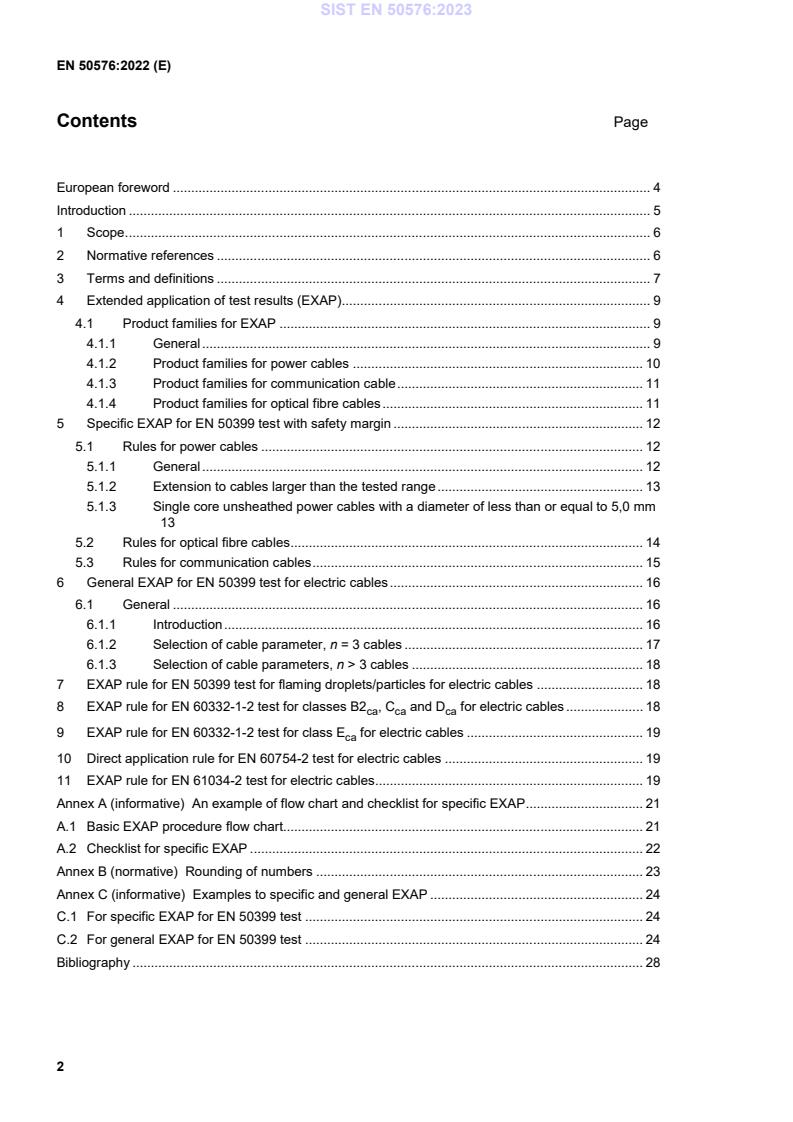
Contents Page
European foreword . 4
Introduction . 5
1 Scope . 6
2 Normative references . 6
3 Terms and definitions . 7
4 Extended application of test results (EXAP) . 9
4.1 Product families for EXAP . 9
4.1.1 General . 9
4.1.2 Product families for power cables . 10
4.1.3 Product families for communication cable . 11
4.1.4 Product families for optical fibre cables . 11
5 Specific EXAP for EN 50399 test with safety margin . 12
5.1 Rules for power cables . 12
5.1.1 General . 12
5.1.2 Extension to cables larger than the tested range . 13
5.1.3 Single core unsheathed power cables with a diameter of less than or equal to 5,0 mm
5.2 Rules for optical fibre cables . 14
5.3 Rules for communication cables . 15
6 General EXAP for EN 50399 test for electric cables . 16
6.1 General . 16
6.1.1 Introduction . 16
6.1.2 Selection of cable parameter, n = 3 cables . 17
6.1.3 Selection of cable parameters, n > 3 cables . 18
7 EXAP rule for EN 50399 test for flaming droplets/particles for electric cables . 18
8 EXAP rule for EN 60332-1-2 test for classes B2 , C and D for electric cables . 18
ca ca ca
9 EXAP rule for EN 60332-1-2 test for class E for electric cables . 19
ca
10 Direct application rule for EN 60754-2 test for electric cables . 19
11 EXAP rule for EN 61034-2 test for electric cables. 19
Annex A (informative) An example of flow chart and checklist for specific EXAP . 21
A.1 Basic EXAP procedure flow chart. 21
A.2 Checklist for specific EXAP . 22
Annex B (normative) Rounding of numbers . 23
Annex C (informative) Examples to specific and general EXAP . 24
C.1 For specific EXAP for EN 50399 test . 24
C.2 For general EXAP for EN 50399 test . 24
Bibliography . 28
Tables
Table 1 — Safety margins v for power cables . 12
sm
Table 2 — Allowed range of cable diameters and cable parameters for using safety margins as
specified in Table 1 . 13
Table 3 — Allowed ranges of d for EXAP applied for larger cables . 13
max
Table 4 — Safety margins v for single core unsheathed power cables with a diameter of less than or
sm
equal to 5,0 mm . 14
Table 5 — Safety margins ν for optical fibre cables . 15
sm
Table 6 — Safety margins ν for communication cables . 16
sm
Figures
Figure A.1 — Flow chart of the EXAP procedure . 21
Figure C.1 — Assessment of ν for the classification parameter TSP (theoretical example) . 24
class
Figure C.2 — FIGRA results for cable family . 25
Figure C.3 — TSP results for cable family . 26
Figure C.4 — TSP results for cable family . 27
European foreword
This document (EN 50576:2022) has been prepared by CLC/TC 20 “Electric cables”.
The following dates are fixed:
• latest date by which this document has to be (dop) 2023-12-12
implemented at national level by publication of
an identical national standard or by
endorsement
• latest date by which the national standards (dow) 2025-12-12
conflicting with this document have to be
withdrawn
This document supersedes CLC/TS 50576:2016 and all of its amendments and corrigenda (if any).
— Inclusion of EXAP rule for single core unsheathed power cables with a diameter of less than or equal to
5,0 mm [8];
— simplification of the choice of samples to the EXAP rule for EN 60332-1-2 for classes B2 , C and D for
ca ca ca
electric cables;
— simplification of the choice of samples due to the changes in the test standard to the EXAP rule for
EN 61034-2;
— implementation of a direct application rule for EN 60754-2;
— improvement of d to the Table 2.
min
Attention is drawn to the possibility that some of the elements of this document may be the subject of patent
rights. CENELEC shall not be held responsible for identifying any or all such patent rights.
This document is read in conjunction with EN 50575 in order to evaluate the reaction to fire performance of
power, control and communication cables.
Any feedback and questions on this document should be directed to the users’ national committee. A complete
listing of these bodies can be found on the CENELEC website.
Introduction
The original project “CEMAC – CE marking of cables” was carried out over a three-year period. It brought
together cable manufacturers, research and testing laboratories, and research establishments in creating the
technical background and developing rules and procedures for extended application of test results (EXAP).
More than 200 tests to EN 50399 on more than 100 cables were carried out as part of the project. The final
report [1] was published in 2010 and the EXAP rules and procedures developed by the CEMAC project have
been used as the basis for this document.
A specific EXAP procedure and rules based on the use of safety margins and a cable parameter derived from
the extensive CEMAC tests was developed for the most common generic types of power cables used in the
European market.
A general EXAP procedure and rules based upon a statistical treatment of the actual test results obtained from
a cable family was also developed for any power cables. However, the use of this general procedure and rules
will generally require more tests to be carried out than the use of the specific procedure and rules.
Since the CEMAC project report was completed in 2010, the project has been extended to further investigate
the performance of optical fibre cables and rules and procedures developed for extended application of test
results for these products. An additional report [2] was published in 2015 and the EXAP rules and procedures
developed by the further CEMAC project work was used as the basis for CLC/TS 50576:2016.
Since 2016, the project has been extended to further investigate the performance of communication cables and
rules and procedures developed for extended application of test results for these products. The work [7] was
published in 2016 and has been included in this document.
In addition, this edition includes editorial improvements and re-arrangements.
General guidance on direct and extended application can be found in CEN/TS 15117 [3].
1 Scope
This document describes the procedure and rules for extended application of results of tests carried out
according to the test methods described in EN 50399, EN 60332-1-2 and EN 61034-2.
The EXAP rules described apply to EN 50399 test results used for classification according to EN 13501-6 in
classes B2 , C and D , additional smoke production classes s1, s2 and s3 and flaming droplets/particles, to
ca ca ca
EN 60332-1-2 test results used for classification in classes B2 , C D and E and to EN 61034-2 test
ca ca, ca ca
results used for classification in classes s1a and s1b.
No EXAP procedure and rules have been developed in respect to the results of tests carried out according to
the test method described in EN 60754-2. As the parameters (pH and conductivity) for each cable in a family
are determined based upon calculation using material test results, this is considered as a matter of direct
application. Material test results taken from any one sample of finished cable from a family are sufficient to
calculate the parameters for each cable in the family.
Cables with a diameter of 5,0 mm or less are expected to be tested as bundles according to EN 50399. Cables
with a diameter of less than or equal to 5,0 mm are included in the specific and general EXAP rules for single
core unsheathed power cables only. The rules apply to circular and non-circular cables provided that they fall
within the scope of the relevant test method.
A specific EXAP rule has been developed for any of the types of electric cable families as defined in this
document. A general EXAP rule has been developed for all electric cable families unless otherwise stated
elsewhere in this document.
NOTE 1 Multicore power cables are sometimes referred to as control cables with a rated voltage but for the purposes of
this document are considered as power cables. For multipair, multitriple and multiquad control cables, either the general
EXAP rule or the specific EXAP rule for power cables or the specific EXAP rule for communication cables can be applied.
The use of the specific EXAP rule gives benefit in the lower number of cables to be tested for a range of cable
constructions (product family).
An EXAP is only possible when cables belong to a family as defined in this document.
NOTE 2 For the purposes of this document, the term “electric cables” also covers optical fibre cables.
2 Normative references
The following documents are referred to in the text in such a way that some or all of their content constitutes
requirements of this document. For dated references, only the edition cited applies. For undated references, the
latest edition of the referenced document (including any amendments) applies.
EN 13501-6, Fire classification of construction products and building elements - Part 6: Classification using data
from reaction to fire tests on power, control and communication cables
EN 50399, Common test methods for cables under fire conditions - Heat release and smoke production
measurement on cables during flame spread test - Test apparatus, procedures, results
EN 60332-1-2, Tests on electric and optical fibre cables under fire conditions - Part 1-2: Test for vertical flame
propagation for a single insulated wire or cable - Procedure for 1 kW pre-mixed flame (IEC 60332-1-2)
EN 60754-2, Test on gases evolved during combustion of materials from cables - Part 2: Determination of acidity
(by pH measurement) and conductivity (IEC 60754-2)
EN 61034-2, Measurement of smoke density of cables burning under defined conditions - Part 2: Test procedure
and requirements (IEC 61034-2)
3 Terms and definitions
For the purposes of this document, the following terms and definitions apply.
ISO and IEC maintain terminological databases for use in standardization at the following addresses:
— ISO Online browsing platform: available at https://www.iso.org/obp/
— IEC Electropedia: available at https://www.electropedia.org/
3.1
classification
process defined in EN 13501-6, whereby the fire performance parameters obtained from the results of one test,
or a set of tests, or from a process of extended application, are compared with limiting values for those
parameters that are set as criteria for achieving a certain classification
3.2
electric cable
all power, control and communication cables, including optical fibre cables and hybrid cables which are a
combination of two or more of these cable types
[SOURCE: EN 50575]
3.3
power cable
assembly comprising one or more insulated conductor(s), together with any coverings and protective layers,
used for the transmission or supply of electrical energy
[SOURCE: EN 50575]
3.4
control cable
assembly comprising insulated conductors, together with any coverings and protective layers, used for the
transmission of control, measuring and indication signals in electric installations
[SOURCE: EN 50575]
3.5
communication cable
assembly of suitably insulated coaxial conductors or twisted pairs of insulated conductors fabricated to meet
transmission, mechanical and environmental requirements, and sufficient to allow conveyance of information
between two points with the minimum of radiation
[SOURCE: EN 50575]
Note 1 to entry: For this document, only communication cables with copper conductors are considered.
3.6
optical fibre cable
assembly comprising one or more optical fibres or fibre bundles inside a common covering designed to protect
them against mechanical stresses and other environmental influences while retaining the transmission quality
of the fibres
[SOURCE: IEV 731-04-01]
3.7
product family
group of products produced by one manufacturer for which the test results for one or more characteristics from
one product within the family are considered to be representative for that same characteristic for all other
products within this family
[SOURCE: EN 50575]
3.8
extended application of test results
EXAP
outcome of a process (involving the application of defined rules that may incorporate calculation procedures)
that attributes, for a cable family, a test result on the basis of one or more test results to the same test standard
3.9
heat release rate
HRR
thermal energy released per unit time by an item during combustion under specified conditions
[SOURCE: EN 50399]
3.10
total heat release
THR
integrated value of the heat release rate over a defined period
[SOURCE: EN 50399]
3.11
smoke production rate
SPR
smoke production per unit time
[SOURCE: EN 50399]
3.12
total smoke production
TSP
integrated value of the smoke production rate over a defined period
[SOURCE: EN 50399]
3.13
flame spread
FS
propagation of a flame front
[SOURCE: EN 50399]
3.14
fire growth rate index
FIGRA
highest value of the quotient between HRR and time
[SOURCE: EN 50399]
3.15
flaming droplet/particle
material separating from the specimen during the test and continuing to flame for a minimum period as described
in the test method
[SOURCE: EN 50399]
3.16
armour
covering consisting of a metal tape(s) or wires, generally used to protect the cable from external mechanical
defects
Note 1 to entry: For the purpose of this document, metallic tape thicker than or equal 0,10 mm thickness is
considered an armour.
Note 2 to entry: Examples for wire coverings are concentric conductors or braids.
[SOURCE: IEV 461-05-06]
3.17
non-circular cable
cable where the measured difference between any two values of the overall diameter of the cable at the same
cross-section exceeds 15 % of the largest overall diameter
Note 1 to entry: So-called figure of 8 cables, consisting of two exactly identical circular cables connected together
with a very small, extruded interconnecting link are considered to be non-circular cables.
[SOURCE: EN 50399]
4 Extended application of test results (EXAP)
4.1 Product families for EXAP
4.1.1 General
4.1.1.1 Introduction
An EXAP is only possible when cables belong to a defined family.
The cable family shall be produced by the same manufacturer using the same materials and the same design
rules (for instance International standard, National standard, Company standard based on National or
International standard), subject to the provisions of 4.1.2 to 4.1.4.
NOTE A common design rule is that the thickness of the design elements (for instance insulation and/or sheath
thickness) increase with conductor size and cable diameter. These cables, using this common design rule, belong to the
same cable family.
The full constructional and material details for the family shall be submitted to the certification body prior to the
EXAP being applied.
4.1.1.2 Colour and marking of design elements
A change to the colour of design elements (for instance insulation, fibre and/or sheath) or to the marking on
insulation and/or sheath does not constitute a different cable family.
4.1.1.3 Centre filler and interstitial fillers
It is common that part of the cables in a product range have a centre filler (depending on number of cores and/or
cross section) and part of the cables in that product range are without centre filler.
If the volume of the centre filler is equal to or less than 10 % of the total non-metallic volume, the cable with
centre filler belongs to the same family as the cables without centre filler (on the condition that all other
requirements of this document are fulfilled).
If the volume of the centre filler is greater than 10 % of the total non-metallic volume, the cable with centre filler
constitutes a different family than the cables without centre filler.
The volume of the centre filler shall in any case be taken into account in the calculation of the cable parameter.
For cables with and without interstitial fillers, other than centre filler and/or filling compound, the cables are
considered to belong to different product families.
4.1.1.4 Tapes
Cables with or without tapes are to be treated as follows:
a) with/without metallic or metallized tape: different families;
b) with/without non-combustible tapes (such as mica tapes and glass tapes): different family;
c) with/without combustible tapes (such as separator tapes like polyester, polypropylene): in case the total
volume of the tape(s) is(are) less than 2 % of the total non-metallic volume, the cables belong to the same
family.
NOTE For the types of tapes that fall under b) and c) it is not possible to mention all different types of materials.
Therefore, only some examples are given.
4.1.1.5 Cable diameter
The nominal tabulated cable diameter, calculated by the producer, shall be used for the selection of the cables
and for classification.
For the tests, the measured cable diameter shall be used.
A difference between the nominal cable diameter calculated by the producer and the measured cable diameter
is acceptable under the condition that the measured cable diameter does not differ more than ± 10 % from this
nominal cable diameter.
NOTE Under this condition, it is acceptable that number of cables in the test is different from the number of cables
calculated on the basis of the nominal diameter.
4.1.1.6 Cable parameter χ
χ is the cable parameter, which shall be rounded to the nearest integer. In case the rounded cable parameter is
the same in all or part of a family, the cables are considered the same and two test samples shall be chosen
according to specific EXAP and at least three according to general EXAP.
The samples to test should be agreed between the manufacturer and the Notified Body and/or testing laboratory.
4.1.2 Product families for power cables
For the application of these EXAP rules and procedures, a cable family shall be defined as follows:
A family of cables is a specific range of products of the same general construction (design elements) and varying
only in conductor size and number of cores.
A change to the conductor construction (rigid or flexible) or form (circular or shaped) or metal (such as copper
or aluminium) shall constitute a different family. EN 60228 Class 1 and Class 2 are rigid conductors and Class 5
and Class 6 are flexible conductors.
An armour or concentric layer shall not be considered solely as a conductor in determining a product family. An
armoured or a concentric construction shall be considered as a different family to a construction without such
armour or concentric layer. An armour and a concentric conductor are different design elements.
If the cable family falls under one of the generic power cable families:
— armoured cables;
— unarmoured multicore cables;
— single core sheathed cables;
— single core unsheathed cables;
the specific EXAP with safety margin as a function of classification parameter and class may be applied.
4.1.3 Product families for communication cables
For the application of these EXAP rules and procedures, a cable family shall be defined as follows:
A family of cables is a specific range of products of the same general construction (design elements) and varying
only in conductor size and number of conductors.
The cable family shall fall under one of the generic communication cable families:
— U/UTP unscreened overall / unscreened twisted pair;
— F/UTP screened overall / unscreened twisted pair;
— SF/UTP metallic braid and screened overall / unscreened twisted pair;
— U/FTP unscreened overall / screened twisted pair;
— F/FTP screened overall / screened twisted pair;
— S/FTP metallic braid overall / screened twisted pair;
— SF/FTP metallic braid and screened overall / screened twisted pair;
The specific EXAP with safety margin as a function of classification parameter and class may be applied.
4.1.4 Product families for optical fibre cables
For the application of these EXAP rules and procedure, a cable family shall be defined as follows:
A family of cables is a specific range of products of the same general construction (design elements) and varying
only in number of optical fibres and number of units.
The following properties are considered to have a negligible influence on the fire behaviour and therefore
differences in these properties only do not mean that the cables belong to different families:
— fibre glass type;
— fibre type (e.g. single mode or multimode);
The specific EXAP with safety margin as a function of classification parameter and class may be applied.
5 Specific EXAP for EN 50399 test with safety margin
5.1 Rules for po
...