


prEN 50125:2025
(Main)Railway applications - Environmental conditions for equipment
Railway applications - Environmental conditions for equipment
This document intends to define environmental conditions within Europe. This document does not specify the test requirements for equipment. The scope of this document covers the definitions and ranges of the following parameters: altitude, temperature, pressure, humidity, air movement, rain, snow, hail, ice, lightning, electromagnetic compatibility, solar radiation, pollution, vibrations and shocks, environmental conditions in tunnels. The scope of this document is to define environmental conditions in railway environment in order to cover the design and the use/service of the following: — equipment for rolling stock and on-board equipment (mechanical, electromechanical, electrical, electronic); — fixed electrical installations for traction power supply and equipment essential to operate a railway; — equipment and any portable equipment for signalling and telecommunications systems (including test, measure, monitoring equipment, etc.). The defined environmental conditions, including the values herein specified, are considered as normal and do not concern extreme conditions or natural disasters (e.g earthquake, nuclear radiation). This document does not apply to cranes, mining vehicles, cable cars, escalators, lifts, fire protection, lighting in tunnels and on platforms, ticket machines, ventilation systems, installations in underground mines, suspended cable cars and funicular railways. The effects of vandalism on the equipment are not considered in this document. Microclimates surrounding components and passenger effects on the equipment and equipment effects on the passengers are not considered in this document.
Bahnanwendungen - Umweltbedingungen für Betriebsmittel
Applications ferroviaires - Conditions d'environnement pour le matériel
L’objet du présent document est de définir les conditions d’environnement en Europe. Le présent document ne précise pas les exigences d’essai pour les équipements. Le domaine d’application du présent document couvre les définitions et les gammes des paramètres suivants : altitude, température, pression, humidité, mouvement d’air, pluie, neige, grêle, glace, foudre, compatibilité électromagnétique, rayonnement solaire, pollution, vibrations et chocs, conditions d’environnement en tunnel. Le domaine d’application du présent document définit les conditions d’environnement en milieu ferroviaire afin de couvrir la conception et l’utilisation/l’opération des éléments suivants : — équipement pour matériel roulant et équipement embarqué (mécanique, électromécanique, électrique, électronique) ; — installations électriques fixes pour l’alimentation en énergie de traction et équipements essentiels au fonctionnement d’un chemin de fer ; — équipements, dont tout équipement portable, pour les systèmes de signalisation et de télécommunications (y compris les équipements d’essai, de mesure, de surveillance, etc.). Les conditions d’environnement définies, y compris les valeurs spécifiées dans le présent document, sont considérées comme normales et ne concernent pas les conditions extrêmes ou les catastrophes naturelles (par exemple, tremblement de terre, radiation nucléaire). Le présent document ne s’applique pas aux grues, véhicules miniers, téléphériques, escaliers mécaniques, ascenseurs, à la protection contre l’incendie, à l’éclairage dans les tunnels et sur les quais, aux distributeurs de billets, systèmes de ventilation, installations dans les mines, téléphériques, télécabines et funiculaires. Les effets du vandalisme sur les équipements ne sont pas traités par le présent document. Les microclimats entourant les composants, es effets des voyageurs sur les équipements et les effets des équipements sur les voyageurs ne sont pas traités par le présent document.
Železniške naprave - Okoljski pogoji za opremo
General Information
- Status
- Not Published
- Publication Date
- 22-Oct-2026
- Technical Committee
- CLC/TC 9X - Electrical and electronic applications for railways
- Drafting Committee
- CLC/TC 9X/WG 33 - Survey group on Climate change adaptation
- Current Stage
- 4599 - Dispatch of FV draft to CMC - Finalization for Vote
- Start Date
- 03-Apr-2026
- Due Date
- 14-Aug-2025
- Completion Date
- 03-Apr-2026

Relations
- Effective Date
- 23-Jan-2024
- Effective Date
- 23-Jan-2024
- Effective Date
- 23-Jan-2024
Overview
prEN 50125:2025 - "Railway applications - Environmental conditions for equipment" (CLC draft) defines the environmental conditions relevant to railway equipment within Europe. It consolidates earlier parts of EN 50125 into a single document and updates climate-related parameters by taking into account near‑term climate change projections. The document defines parameter ranges (altitude, temperature, pressure, humidity, wind, rain, snow, hail, ice, lightning, solar radiation, pollution, EMC, vibrations/shocks and tunnel conditions) used for the design and use/service of on‑board, rolling stock, fixed traction and signalling/telecom equipment. It is a draft European Standard (prEN) submitted for enquiry (March 2025).
Key topics and technical requirements
Scope / Limitations
- Specifies environmental conditions and ranges; does not specify test procedures or extreme natural disasters (e.g. earthquakes, nuclear radiation), nor vandalism, microclimates or passenger effects.
- Not applicable to cranes, mining vehicles, cable cars, lifts, tunnel lighting, ticket machines, ventilation systems, underground mines, funiculars, etc.
Reference climate & future-proofing
- Uses the Copernicus climate database and defines values considering the current situation and the following decade to address climate change impacts.
Altitude / Pressure
- Altitude classes: A1 up to 1 400 m; A2 up to 2 000 m. Above 2 000 m is considered extreme.
Temperature classes
- T1 (Warm temperate): −25 °C to +45 °C
- T2 (Cold): −40 °C to +35 °C
- T3 (Arid/Desert): −10 °C to +50 °C (limited areas)
- T4 (Polar): −50 °C to +30 °C (limited areas)
Humidity
- Relative and absolute humidity ranges aligned with EN IEC 60721‑3‑4 classes (e.g. 4K26 / 4K27). Notes on condensation risk and typical annual behaviour (annual average ≤ 75 % R.H.; up to 30 consecutive days may be 75–95 % R.H.).
Wind & air movement
- Rolling stock standstill wind: assume 35 m/s, exceptional up to 50 m/s. Local rules (EN 1991‑1‑4, EN 14067‑6) apply for infrastructure and cross‑wind.
Precipitation & snow/ice
- Rainfall design: 6–15 mm/min for 2 min, and 50 mm/h for 1 h (covers most situations; flooding requires special study).
- Snow classes S0–S3 defined by height above rail (up to >250–800 mm). Snow load calculation guidance included (density ranges noted).
Other subjects
- Lightning, solar radiation, pollution, EMC, vibrations/shocks and tunnel environments are addressed; Annexes provide further guidance (e.g. trackside temperature, ice loads, tunnel conditions).
Applications / Who uses this standard
- Equipment designers and manufacturers (rolling stock, on‑board systems, fixed traction equipment)
- Signalling & telecommunications vendors and suppliers of portable test/monitoring gear
- Infrastructure owners, system integrators and procurers who specify environmental design envelopes
- Engineering teams performing climatic risk assessments or specifying durability/maintenance regimes
prEN 50125:2025 is used to define the environmental design envelopes that inform component selection, thermal management, corrosion protection, EMC mitigation and mechanical design for railway equipment.
Related standards
- EN 1991‑1‑3, EN 1991‑1‑4 (Eurocode – snow/wind actions)
- EN 50121 (Electromagnetic compatibility)
- EN 61373 (Shock and vibration tests)
- EN ISO 9223 (Atmospheric corrosivity)
Keywords: prEN 50125:2025, Railway applications, Environmental conditions for equipment, CLC, rolling stock, trackside, temperature classes, humidity, wind, rain, snow, tunnels, Copernicus, climate change.
Get Certified
Connect with accredited certification bodies for this standard

IRIS Certification (UNIFE)
International Railway Industry Standard certification.

TÜV SÜD Rail GmbH
TÜV SÜD railway certification services.

Bureau Veritas Railway Certification
Railway and transportation certification.
Sponsored listings
Frequently Asked Questions
prEN 50125:2025 is a draft published by CLC. Its full title is "Railway applications - Environmental conditions for equipment". This standard covers: This document intends to define environmental conditions within Europe. This document does not specify the test requirements for equipment. The scope of this document covers the definitions and ranges of the following parameters: altitude, temperature, pressure, humidity, air movement, rain, snow, hail, ice, lightning, electromagnetic compatibility, solar radiation, pollution, vibrations and shocks, environmental conditions in tunnels. The scope of this document is to define environmental conditions in railway environment in order to cover the design and the use/service of the following: — equipment for rolling stock and on-board equipment (mechanical, electromechanical, electrical, electronic); — fixed electrical installations for traction power supply and equipment essential to operate a railway; — equipment and any portable equipment for signalling and telecommunications systems (including test, measure, monitoring equipment, etc.). The defined environmental conditions, including the values herein specified, are considered as normal and do not concern extreme conditions or natural disasters (e.g earthquake, nuclear radiation). This document does not apply to cranes, mining vehicles, cable cars, escalators, lifts, fire protection, lighting in tunnels and on platforms, ticket machines, ventilation systems, installations in underground mines, suspended cable cars and funicular railways. The effects of vandalism on the equipment are not considered in this document. Microclimates surrounding components and passenger effects on the equipment and equipment effects on the passengers are not considered in this document.
This document intends to define environmental conditions within Europe. This document does not specify the test requirements for equipment. The scope of this document covers the definitions and ranges of the following parameters: altitude, temperature, pressure, humidity, air movement, rain, snow, hail, ice, lightning, electromagnetic compatibility, solar radiation, pollution, vibrations and shocks, environmental conditions in tunnels. The scope of this document is to define environmental conditions in railway environment in order to cover the design and the use/service of the following: — equipment for rolling stock and on-board equipment (mechanical, electromechanical, electrical, electronic); — fixed electrical installations for traction power supply and equipment essential to operate a railway; — equipment and any portable equipment for signalling and telecommunications systems (including test, measure, monitoring equipment, etc.). The defined environmental conditions, including the values herein specified, are considered as normal and do not concern extreme conditions or natural disasters (e.g earthquake, nuclear radiation). This document does not apply to cranes, mining vehicles, cable cars, escalators, lifts, fire protection, lighting in tunnels and on platforms, ticket machines, ventilation systems, installations in underground mines, suspended cable cars and funicular railways. The effects of vandalism on the equipment are not considered in this document. Microclimates surrounding components and passenger effects on the equipment and equipment effects on the passengers are not considered in this document.
prEN 50125:2025 is classified under the following ICS (International Classification for Standards) categories: 45.020 - Railway engineering in general. The ICS classification helps identify the subject area and facilitates finding related standards.
prEN 50125:2025 has the following relationships with other standards: It is inter standard links to EN 50125-2:2002, EN 50125-1:2014, EN 50125-3:2003. Understanding these relationships helps ensure you are using the most current and applicable version of the standard.
prEN 50125:2025 is associated with the following European legislation: EU Directives/Regulations: 2016/797/EU; Standardization Mandates: M/591. When a standard is cited in the Official Journal of the European Union, products manufactured in conformity with it benefit from a presumption of conformity with the essential requirements of the corresponding EU directive or regulation.
prEN 50125:2025 is available in PDF format for immediate download after purchase. The document can be added to your cart and obtained through the secure checkout process. Digital delivery ensures instant access to the complete standard document.
Standards Content (Sample)
SLOVENSKI STANDARD
01-maj-2025
Železniške naprave - Okoljski pogoji za opremo
Railway applications - Environmental conditions for equipment
Bahnanwendungen - Umweltbedingungen für Betriebsmittel
Applications ferroviaires - Conditions d'environnement pour le matériel
Ta slovenski standard je istoveten z: prEN 50125:2025
ICS:
13.020.99 Drugi standardi v zvezi z Other standards related to
varstvom okolja environmental protection
45.020 Železniška tehnika na Railway engineering in
splošno general
2003-01.Slovenski inštitut za standardizacijo. Razmnoževanje celote ali delov tega standarda ni dovoljeno.
EUROPEAN STANDARD DRAFT
prEN 50125
NORME EUROPÉENNE
EUROPÄISCHE NORM
March 2025
ICS 45.020 Will supersede EN 50125-2:2002; EN 50125-3:2003; EN
50125-2:2002/corrigendum Jun. 2010; EN 50125-
3:2003/corrigendum May 2010; EN 50125-1:2014
English Version
Railway applications - Environmental conditions for equipment
Applications ferroviaires - Conditions d'environnement pour Bahnanwendungen - Umweltbedingungen für Betriebsmittel
le matériel
This draft European Standard is submitted to CENELEC members for enquiry.
Deadline for CENELEC: 2025-06-13.
It has been drawn up by CLC/TC 9X.
If this draft becomes a European Standard, CENELEC members are bound to comply with the CEN/CENELEC Internal Regulations which
stipulate the conditions for giving this European Standard the status of a national standard without any alteration.
This draft European Standard was established by CENELEC in three official versions (English, French, German).
A version in any other language made by translation under the responsibility of a CENELEC member into its own language and notified to
the CEN-CENELEC Management Centre has the same status as the official versions.
CENELEC members are the national electrotechnical committees of Austria, Belgium, Bulgaria, Croatia, Cyprus, the Czech Republic,
Denmark, Estonia, Finland, France, Germany, Greece, Hungary, Iceland, Ireland, Italy, Latvia, Lithuania, Luxembourg, Malta, the
Netherlands, Norway, Poland, Portugal, Republic of North Macedonia, Romania, Serbia, Slovakia, Slovenia, Spain, Sweden, Switzerland,
Türkiye and the United Kingdom.
Recipients of this draft are invited to submit, with their comments, notification of any relevant patent rights of which they are aware and to
provide supporting documentation.
Warning : This document is not a European Standard. It is distributed for review and comments. It is subject to change without notice and
shall not be referred to as a European Standard.
European Committee for Electrotechnical Standardization
Comité Européen de Normalisation Electrotechnique
Europäisches Komitee für Elektrotechnische Normung
CEN-CENELEC Management Centre: Rue de la Science 23, B-1040 Brussels
© 2025 CENELEC All rights of exploitation in any form and by any means reserved worldwide for CENELEC Members.
Project: 78566 Ref. No. prEN 50125:2025 E
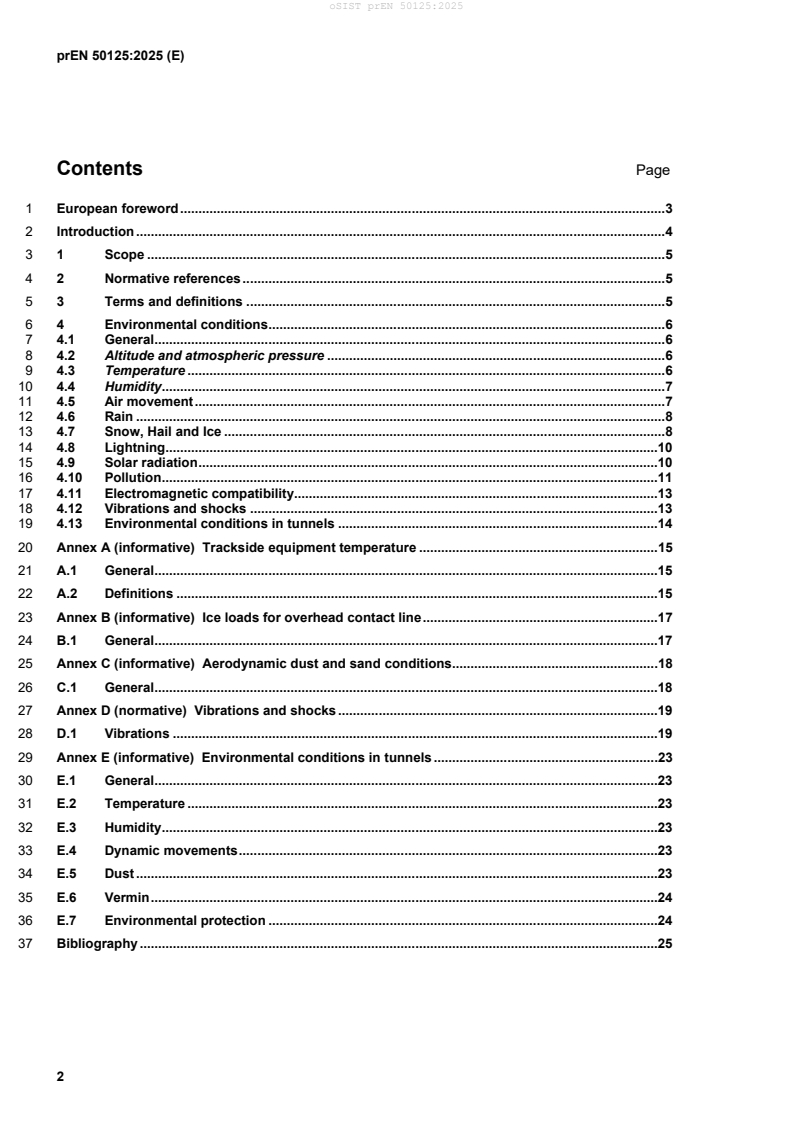
Contents Page
1 European foreword . 3
2 Introduction . 4
3 1 Scope . 5
4 2 Normative references . 5
5 3 Terms and definitions . 5
6 4 Environmental conditions . 6
7 4.1 General . 6
8 4.2 Altitude and atmospheric pressure . 6
9 4.3 Temperature . 6
10 4.4 Humidity. 7
11 4.5 Air movement . 7
12 4.6 Rain . 8
13 4.7 Snow, Hail and Ice . 8
14 4.8 Lightning.10
15 4.9 Solar radiation .10
16 4.10 Pollution .11
17 4.11 Electromagnetic compatibility.13
18 4.12 Vibrations and shocks .13
19 4.13 Environmental conditions in tunnels .14
20 Annex A (informative) Trackside equipment temperature .15
21 A.1 General .15
22 A.2 Definitions .15
23 Annex B (informative) Ice loads for overhead contact line .17
24 B.1 General .17
25 Annex C (informative) Aerodynamic dust and sand conditions .18
26 C.1 General .18
27 Annex D (normative) Vibrations and shocks .19
28 D.1 Vibrations .19
29 Annex E (informative) Environmental conditions in tunnels .23
30 E.1 General .23
31 E.2 Temperature .23
32 E.3 Humidity.23
33 E.4 Dynamic movements .23
34 E.5 Dust .23
35 E.6 Vermin .24
36 E.7 Environmental protection .24
37 Bibliography .25
38 European foreword
39 This document (prEN 50125:2025) has been prepared by CLCTC 9X “Electrical and electronic applications for
40 railways”.
41 This document is currently submitted to the Enquiry.
42 The following dates are proposed:
• latest date by which the existence of this (doa) dav + 6 months
document has to be announced at national
level
• latest date by which this document has to be (dop) dav + 12 months
implemented at national level by publication of
an identical national standard or by
endorsement
• latest date by which the national standards (dow) dav + 36 months
conflicting with this document have to be (to be confirmed or
withdrawn modified when voting)
43 This document will supersede EN 50125-1:2014, EN 50125-2:2002 and EN 50125-3:2003 and all of their
44 amendments and corrigenda (if any).
45 prEN 50125:2025 includes the following significant technical changes with respect to EN 50125-1:2014,
46 EN 50125-2:2002 and EN 50125-3:2003: merging of the three standards into a single one, taking into account
47 possible climate change impacts.
48 This document has been prepared under a standardization request addressed to CENELEC by the European
49 Commission. The Standing Committee of the EFTA States subsequently approves these requests for its
50 Member States.
51 Introduction
52 The aim of this document is to update the environmental and climate topics related to the railway equipment
53 and rolling stock.
54 This update is done by taking into account a possible impact of climate change.
55 This document merges the following documents: EN 50125-1, EN 50125-2 and EN 50125-3.
56 1 Scope
57 This document intends to define environmental conditions within Europe.
58 This document does not specify the test requirements for equipment.
59 The scope of this document covers the definitions and ranges of the following parameters: altitude, temperature,
60 pressure, humidity, air movement, rain, snow, hail, ice, lightning, electromagnetic compatibility, solar radiation,
61 pollution, vibrations and shocks, environmental conditions in tunnels.
62 The scope of this document is to define environmental conditions in railway environment in order to cover the
63 design and the use/service of the following:
64 — equipment for rolling stock and on-board equipment (mechanical, electromechanical, electrical, electronic);
65 — fixed electrical installations for traction power supply and equipment essential to operate a railway;
66 — equipment and any portable equipment for signalling and telecommunications systems (including test,
67 measure, monitoring equipment, etc.).
68 The defined environmental conditions, including the values herein specified, are considered as normal and do
69 not concern extreme conditions or natural disasters (e.g earthquake, nuclear radiation).
70 This document does not apply to cranes, mining vehicles, cable cars, escalators, lifts, fire protection, lighting in
71 tunnels and on platforms, ticket machines, ventilation systems, installations in underground mines, suspended
72 cable cars and funicular railways.
73 The effects of vandalism on the equipment are not considered in this document.
74 Microclimates surrounding components and passenger effects on the equipment and equipment effects on the
75 passengers are not considered in this document.
76 2 Normative references
77 The following documents are referred to in the text in such a way that some or all of their content constitutes
78 requirements of this document. For dated references, only the edition cited applies. For undated references, the
79 latest edition of the referenced document (including any amendments) applies.
80 EN 1991-1-3, Eurocode 1 - Actions on structures - Part 1-3: General actions - Snow loads
81 EN 1991-1-4, Eurocode 1: Actions on structures - Part 1-4: General actions - Wind actions
82 EN 50121 (all parts), Railway applications - Electromagnetic compatibility
83 EN 61373, Railway applications - Rolling stock equipment - Shock and vibration tests
84 EN ISO 9223, Corrosion of metals and alloys - Corrosivity of atmospheres - Classification, determination and
85 estimation (ISO 9223)
86 3 Terms and definitions
87 For the purposes of this document, no terms and definitions are listed.
88 ISO and IEC maintain terminology databases for use in standardization at the following addresses:
89 — ISO Online browsing platform: available at https://www.iso.org/obp/
90 — IEC Electropedia: available at https://www.electropedia.org/
91 4 Environmental conditions
92 4.1 General
93 In the text, normal environmental conditions are considered as being those of Europe. When necessary they
94 are classified with a suffix class 1, 2, 3, etc.
95 The reference climate database is Copernicus.
96 The values shown in this document are defined considering the current situation and the next decade due to
97 the foreseen climate change.
98 Therefore, designing rolling stock and its equipment as well as trackside infrastructures, care shall be taken to
99 allow any updates for different values.
100 4.2 Altitude and atmospheric pressure
101 Altitude is relevant, in particular for air pressure level and its consequence on cooling systems, air conditioning
102 systems, diesel engines, fuel cells and semi-conductors. Principally, variations in atmospheric pressure affect
103 the insulation withstand voltage (see EN 50124-1 for additional information) and the ability to transfer heat of
104 surfaces.
105 The different classes of altitude range relative to sea level are given in Table 1:
106 Table 1 — Altitude classes
Classes Altitude range relative to sea level
A1 Up to 1400 m
A2 Up to 2000 m
107 Altitude above 2000 m shall be considered as extreme conditions.
108 Particular local pressure conditions can exist due to:
109 — Train passing
110 — Train passing in tunnel (see Annex E)
111 — Train crossing.
112 4.3 Temperature
113 The different classes of temperature range are given in Table 2:
114 Table 2 — Temperature classes
a
External ambient Temperature
Classes
°C (Celsius degree)
T1
−25 +45
Warm Temperate
T2
−40 +35
Cold
b
T3
−10 +50
Arid/Desert
b
T4
−50 +30
Polar
a
The ranges are defined considering the average values of the annual
Min and Max values of temperature.
b
The temperature values defined for classes T3 and T4 are considered
as normal in limited areas of Europe.
115 Refer to informative Annex A for further information on trackside equipment temperature.
116 4.4 Humidity
117 The different values of humidity are given in Table 3:
118 Table 3 — Humidity values
a,b
External ambient instantaneous
Classes Humidity
Min Max
Relative R% 4 100
T1 (Warm Temperate)
T3 (Arid)
Absolute A g/m 0,1 30
Relative R% 10 100
T2 (Cold)
T4 (Polar) 3
Absolute A g/m 0,003 25
a
The humidity value for classes T1 and T3 are as per class 4K26 of EN IEC 60721-3-4:2019.
b
The humidity value for classes T2 and T4 are as per class 4K27 of EN IEC 60721-3-4:2019.
119 For all humidity classes:
120 — On cold surfaces, 100 % relative humidity can occur causing condensation on parts of equipment. Sudden
121 changes of the air temperature can cause localized condensation of water on parts of equipment.
122 — On 30 days in the year, continuously, the level of the external ambient relative humidity can be in the range
123 of 75 % to 95 %.
124 — yearly average: ≤ 75 % relative humidity.
125 4.5 Air movement
126 4.5.1 Wind
127 The maximum wind speed of 35 m/s (at standstill for rolling stock) shall be assumed.
128 Exceptionally higher wind speed, up to a maximum of 50 m/s (at standstill for rolling stock), can occur.
129 For rolling stock, the cross-wind assessment of railways is described in EN 14067-6.
130 For infrastructure:
131 — The wind velocities shall be taken from EN 1991-1-4.
132 — The wind velocity (in m/s) shall be referred to a height of 10 m above the ground.
133 Different values of wind velocities are possible and shall be agreed between purchaser and supplier.
134 As far as calculation of wind actions based on specified wind velocities is concerned, reference shall be made
135 to relevant design standards.
136 4.5.2 Surrounding air
137 The relative movement of surrounding air shall be defined where necessary, e.g. for calculating the current
138 capacity of an overhead contact line, three classes of wind velocity shall be adopted as per the following Table 4:
139 Table 4 — Wind velocities classes
Classes Wind velocity
SW 1 (Low) 0,6 m/s
SW 2 (Normal) 1,0 m/s
SW 3 (Heavy) 2,0 m/s
140 Pressure pulses (e.g. due to passing trains) shall be taken into account, where applicable.
141 As far as calculation of pressure pulses is concerned, references shall be made to relevant design standards.
142 4.6 Rain
143 The effect of rain shall be assumed depending on the equipment installation together with wind and vehicle
144 movement.
145 It concerns only rainfall and not the quantity of water collected.
146 It covers the majority of situations but in case of exceptional conditions (extreme), the values shall be reviewed
147 by a precise climatic study.
148 The rainfall rate to be taken into account is:
149 — 6 to 15 mm/min during 2 min.
150 — 50 mm/hour during 1 h.
151 NOTE Considering a significant amount of water accumulated in a short time like during exceptional conditions,
152 flooding can occur.
153 4.7 Snow, Hail and Ice
154 4.7.1 General
155 The following chapters also apply to equipment mounted underneath the vehicle and lineside installations.
156 Snow, hail and ice already deposited on the track can be raised by the air current of the moving vehicle and can
157 impact the equipment.
158 4.7.2 Snow
159 The different classes of snow above the top of the rail are considered according to the Table 5 below:
160 Table 5 — Snow height classes
Classes Height of snow above the top of the rail
S0 Up to 30 mm
S1 > 30 to 150 mm
S2 > 150 to 250 mm
S3 > 250 to 800 mm
161 The snow load calculation for rolling stock and equipment is considered as below:
162 — Snow density (Kg/m3) x Height of snow (m) = Kg/m
163 — The snow density is generally considered to be between 200 Kg/m3 and 600 Kg/m3, depending on the type
164 of snow (fresh or compact) and the amount of humidity in the air.
2 2
165 NOTE 1 Kg/m correspond to 9,80665 N/m
166 The snow load calculation for infrastructure shall be according to EN 1991-1-3.
167 Regarding the snow fall per day, operability shall be adapted regarding the height of snow (snow plough, special
168 maintenance equipment to remove snow, …).
169 4.7.3 Hail
170 The hail effects to be considered are as described below:
171 — Normal conditions with hail diameter up to 15 mm; Falling hail velocity: 16 m/s
172 — Exceptional conditions with hail diameter up to 25 mm; Falling hail velocity: 20 m/s
173 NOTE For impact energy, refer to EN 60721-2-2.
174 The impact energy of hail is related to the falling velocity but also to the possible presence of crosswinds during
175 a hailstorm and the orientation of surfaces. For rolling stock and on-board equipment, it is also related to the
176 speed of the train.
177 The hail load calculation is considered as below:
178 — hail density (Kg/m3) x height of hail (m) = Kg/m
179 NOTE Hail density is assumed to be close to the pure ice: 917 Kg/m3.
180 4.7.4 Ice
181 The ice formation by freezing rain or freezing snow (ice blocks formed by melting) can occur and shall be taken
182 into account.
183 The falling ice from rolling stock or infrastructure shall be taken into account.
184 NOTE The topic is covered by CEN/TR 16251 for equipment to be installed on rolling stock and by EN 50341-1 for the
185 overhead contact line.
186 The ice load calculation is considered as below:
187 — Ice density (Kg/m3) x height of ice (m) = Kg/m
188 NOTE ice de
...