


FprEN IEC 62590-2-1:2025
(Main)Railway applications - Electronic power converters for fixed installations - Part 2-1: DC traction applications - Uncontrolled rectifiers
Railway applications - Electronic power converters for fixed installations - Part 2-1: DC traction applications - Uncontrolled rectifiers
Bahnanwendungen - Leistungselektronische Stromrichter für Ortsfeste Anlagen - Teil 2-1: Anwendungen der Gleichstrom-Zugförderung - Unkontrollierte Gleichrichter
Applications ferroviaires - Convertisseurs électroniques de puissance pour installations fixes - Partie 2-1: Applications de traction en courant continu - Redresseurs non commandés
Železniške naprave - Elektronski elektroenergetski pretvornik za fiksne postroje - 2-1. del: Enosmerni sistemi vleke - Diodni usmerniki
General Information
Standards Content (Sample)
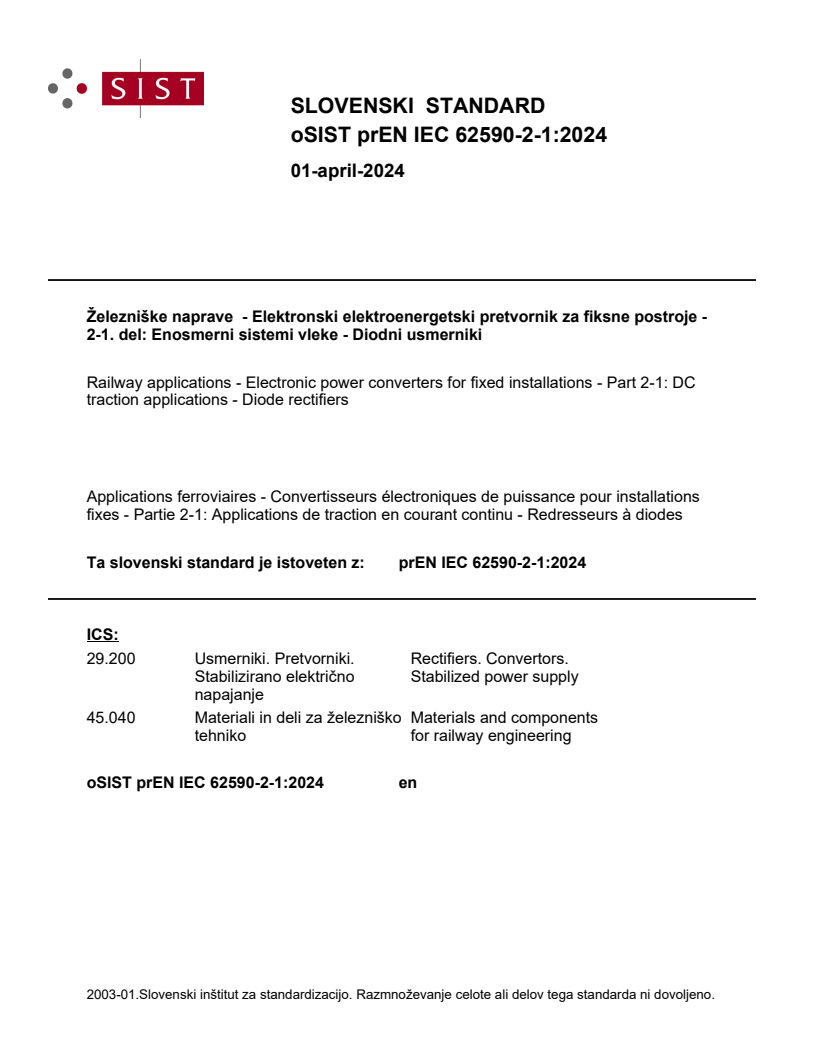
SLOVENSKI STANDARD
oSIST prEN IEC 62590-2-1:2024
01-april-2024
Železniške naprave - Elektronski elektroenergetski pretvornik za fiksne postroje -
2-1. del: Enosmerni sistemi vleke - Diodni usmerniki
Railway applications - Electronic power converters for fixed installations - Part 2-1: DC
traction applications - Diode rectifiers
Applications ferroviaires - Convertisseurs électroniques de puissance pour installations
fixes - Partie 2-1: Applications de traction en courant continu - Redresseurs à diodes
Ta slovenski standard je istoveten z: prEN IEC 62590-2-1:2024
ICS:
29.200 Usmerniki. Pretvorniki. Rectifiers. Convertors.
Stabilizirano električno Stabilized power supply
napajanje
45.040 Materiali in deli za železniško Materials and components
tehniko for railway engineering
oSIST prEN IEC 62590-2-1:2024 en
2003-01.Slovenski inštitut za standardizacijo. Razmnoževanje celote ali delov tega standarda ni dovoljeno.
oSIST prEN IEC 62590-2-1:2024
oSIST prEN IEC 62590-2-1:2024
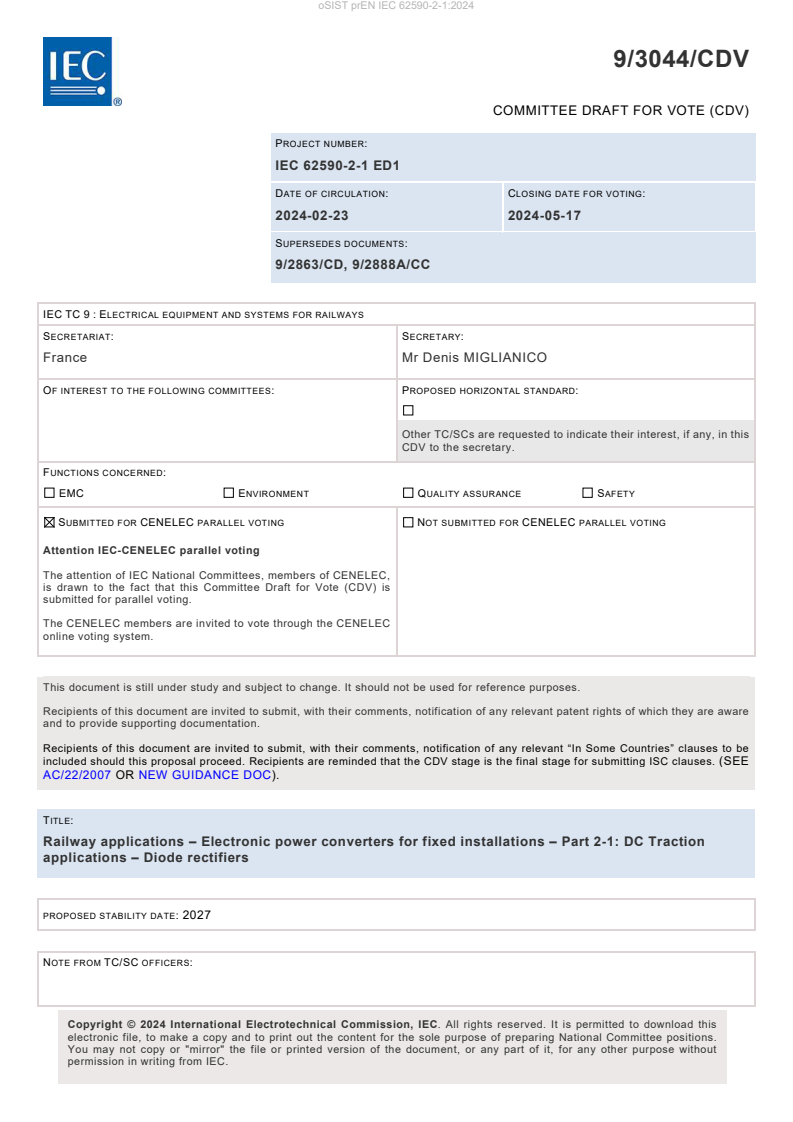
9/3044/CDV
COMMITTEE DRAFT FOR VOTE (CDV)
PROJECT NUMBER:
IEC 62590-2-1 ED1
DATE OF CIRCULATION: CLOSING DATE FOR VOTING:
2024-02-23 2024-05-17
SUPERSEDES DOCUMENTS:
9/2863/CD, 9/2888A/CC
IEC TC 9 : ELECTRICAL EQUIPMENT AND SYSTEMS FOR RAILWAYS
SECRETARIAT: SECRETARY:
France Mr Denis MIGLIANICO
OF INTEREST TO THE FOLLOWING COMMITTEES: PROPOSED HORIZONTAL STANDARD:
Other TC/SCs are requested to indicate their interest, if any, in this
CDV to the secretary.
FUNCTIONS CONCERNED:
EMC ENVIRONMENT QUALITY ASSURANCE SAFETY
SUBMITTED FOR CENELEC PARALLEL VOTING NOT SUBMITTED FOR CENELEC PARALLEL VOTING
Attention IEC-CENELEC parallel voting
The attention of IEC National Committees, members of CENELEC,
is drawn to the fact that this Committee Draft for Vote (CDV) is
submitted for parallel voting.
The CENELEC members are invited to vote through the CENELEC
online voting system.
This document is still under study and subject to change. It should not be used for reference purposes.
Recipients of this document are invited to submit, with their comments, notification of any relevant patent rights of which they are aware
and to provide supporting documentation.
Recipients of this document are invited to submit, with their comments, notification of any relevant “In Some Countries” clauses to be
included should this proposal proceed. Recipients are reminded that the CDV stage is the final stage for submitting ISC clauses. (SEE
AC/22/2007 OR NEW GUIDANCE DOC).
TITLE:
Railway applications – Electronic power converters for fixed installations – Part 2-1: DC Traction
applications – Diode rectifiers
PROPOSED STABILITY DATE: 2027
NOTE FROM TC/SC OFFICERS:
electronic file, to make a copy and to print out the content for the sole purpose of preparing National Committee positions.
You may not copy or "mirror" the file or printed version of the document, or any part of it, for any other purpose without
permission in writing from IEC.
oSIST prEN IEC 62590-2-1:2024
IEC CDV 62590-2-1 IEC 2023 – 1 –
CONTENTS
1 Scope . 6
2 Normative references . 6
3 Terms, definitions, symbols and abbreviated terms . 6
3.1 Terms and definitions . 7
3.2 Symbols . 9
3.3 Abbreviated terms . 10
4 System Configurations and characteristics . 10
4.1 General . 10
4.2 Main interfaces . 10
4.3 Transformer main values . 11
4.3.1 General . 11
4.3.2 Impedance voltages. 11
4.3.3 Coupling factor . 12
4.4 Electrical connections. 13
4.5 Voltage characteristic . 14
4.6 Current characteristic . 15
4.7 Current imbalance . 16
4.8 Short time withstand capability . 16
4.9 Direct voltage harmonic content . 17
4.10 3AC power network harmonic current . 17
5 Design and Integration . 17
5.1 General . 17
5.2 To be defined by user specification . 17
5.2.1 Electrical data . 17
5.2.2 Mechanical requirements . 18
5.3 To be indicated by manufacturer: . 19
5.4 Marking . 19
5.4.1 Rating plate . 19
5.4.2 Main circuit terminals . 20
6 Tests . 20
6.1 General . 20
6.2 Test specifications. 21
6.2.2 Test of accessory and auxiliary components . 21
6.2.3 Insulation test . 21
6.2.4 Checking of the protective functions . 22
6.2.5 Light load functional test . 22
6.2.6 Load test . 22
6.2.7 Inherent voltage drop. 22
6.2.8 Temperature-rise test . 24
6.2.9 Short time withstand current . 25
6.2.10 Power loss determination . 25
6.2.11 Audible sound. 25
6.2.12 Harmonic test . 25
6.2.13 Power factor measurement . 26
oSIST prEN IEC 62590-2-1:2024
– 2 – IEC CDV 62590-2-1 IEC 2023
Annex A (informative) Determination of the voltage drop and the short-circuit currents
of uncontrolled rectifiers . 27
A.1 General . 27
A.2 Description of the method . 28
A.3 Example of a six-pulse rectifier or twelve-pulse rectifier with magnetically not
coupled transformer windings (K ≈ 0) . 33
A.4 Example of a twelve-pulse rectifier with closely coupled secondary windings
of the converter transformer (K ≈ 1) . 35
Annex B (informative) Examples of power factors of uncontrolled rectifiers . 38
B.1 General . 38
B.2 Considerations on the variation of the fundamental current and power factor
in rectifiers . 38
B.2.1 Basic considerations . 38
B.2.2 First working zone . 38
B.2.3 Second working zone . 39
Annex C (informative) Interphase transformer . 40
C.1 General . 40
C.2 Voltage and currents . 40
C.3 Intermittent current conditions . 41
C.4 Current unbalance . 41
Annex D (informative) Example of a protection curve . 42
Figure 1 - General configuration . 10
Figure 2 - Reactances of a rectifier transformer . 11
Figure 3 - Voltage characteristic . 15
Figure 4 - measurement of inherent voltage drop . 24
Table 1 - Connections and calculation factors for uncontrolled rectifiers . 14
Table 2 – Main rectifier design data . 17
Table 3 – Mechanical requirements . 18
Table 4 – Summary of tests . 21
oSIST prEN IEC 62590-2-1:2024
IEC CDV 62590-2-1 IEC 2023 – 3 –
INTERNATIONAL ELECTROTECHNICAL COMMISSION
____________
RAILWAY APPLICATIONS –ELECTRONIC POWER CONVERTERS FOR
FIXED INSTALLATIONS –
PART 2-1: DC TRACTION APPLICATIONS – UNCONTROLLED RECTIFIERS
FOREWORD
1) The International Electrotechnical Commission (IEC) is a worldwide organization for standardization comprising
all national electrotechnical committees (IEC National Committees). The object of IEC is to promote international
co-operation on all questions concerning standardization in the electrical and electronic fields. To this end and
in addition to other activities, IEC publishes International Standards, Technical Specifications, Technical Reports,
Publicly Available Specifications (PAS) and Guides (hereafter referred to as “IEC Publication(s)”). Their
preparation is entrusted to technical committees; any IEC National Committee interested in the subject dealt with
may participate in this preparatory work. International, governmental and non-governmental organizations liaising
with the IEC also participate in this preparation. IEC collaborates closely with the International Organization for
Standardization (ISO) in accordance with conditions determined by agreement between the two organizations.
2) The formal decisions or agreements of IEC on technical matters express, as nearly as possible, an international
consensus of opinion on the relevant subjects since each technical committee has representation from all
interested IEC National Committees.
3) IEC Publications have the form of recommendations for international use and are accepted by IEC National
Committees in that sense. While all reasonable efforts are made to ensure that the technical content of IEC
Publications is accurate, IEC cannot be held responsible for the way in which they are used or for any
misinterpretation by any end user.
4) In order to promote international uniformity, IEC National Committees undertake to apply IEC Publications
transparently to the maximum extent possible in their national and regional publications. Any divergence between
any IEC Publication and the corresponding national or regional publication shall be clearly indicated in the latter.
5) IEC itself does not provide any attestation of conformity. Independent certification bodies provide conformity
assessment services and, in some areas, access to IEC marks of conformity. IEC is not responsible for any
services carried out by independent certification bodies.
6) All users should ensure that they have the latest edition of this publication.
7) No liability shall attach to IEC or its directors, employees, servants or agents including individual experts and
members of its technical committees and IEC National Committees for any personal injury, property damage or
other damage of any nature whatsoever, whether direct or indirect, or for costs (including legal fees) and
expenses arising out of the publication, use of, or reliance upon, this IEC Publication or any other IEC
Publications.
8) Attention is drawn to the Normative references cited in this publication. Use of the referenced publications is
indispensable for the correct application of this publication.
9) Attention is drawn to the possibility that some of the elements of this IEC Publication may be the subject of patent
rights. IEC shall not be held responsible for identifying any or all such patent rights.
International Standard IEC 62590 has been prepared by IEC technical committee 9: Electrical
equipment and systems for railways.
This standard is based on IEC 62590 Ed.2, IEC 62589 and IEC 62695.
The text of this standard is based on the following documents:
FDIS Report on voting
9/xxxx/FDIS 9/xxxx/RVD
Full information on the voting for the approval of this standard can be found in the report on
voting indicated in the above table.
This publication has been drafted in accordance with the ISO/IEC Directives, Part 2.
oSIST prEN IEC 62590-2-1:2024
– 4 – IEC CDV 62590-2-1 IEC 2023
The committee has decided that the contents of this publication will remain unchanged until the
stability date indicated on the IEC web site under "http://webstore.iec.ch" in the data related to
the specific publication. At this date, the publication will be
• reconfirmed,
• withdrawn,
• replaced by a revised edition, or
• amended.
oSIST prEN IEC 62590-2-1:2024
IEC CDV 62590-2-1 IEC 2023 – 5 –
1 INTRODUCTION
2 Electronic power converters for traction power supply differ from other converters for industrial
3 use due to special electrical service conditions and due to the large range of load variation and
4 the peculiar characteristics of the load.
5 For these reasons IEC 60146-1-1 does not fully cover the requirements of railway applications
6 and the decision was taken to have a specific standard for this use.
7 Uncontrolled rectifiers consist of a rectifier diode assembly and a transformer. Both fulfil
8 common requirements. The transformer determines the voltage versus current characteristic.
9 Converter transformers for fixed installations of railway applications are covered by IEC 62695.
10 The series of IEC 62590 consists of the following parts:
11 IEC 62590-1 Railway applications– Electronic Power Converters for fixed installations – Part 1:
12 General requirements
13 IEC 62590-2-1 Railway applications – Electronic Power Converters for fixed installations –
14 Part 2-1: DC traction applications – Uncontrolled rectifiers
15 IEC 62590-2-2 Railway applications – Electronic Power Converters for fixed installations –
16 Part 2-2: DC traction applications – Controlled converters
17 IEC 62590-3-1 Railway applications – Electronic Power Converters for fixed installations –
18 Part 3-1: AC traction applications – Electronic power compensators
19 IEC 62590-3-2 Railway applications – Electronic Power Converters for fixed installations –
20 Part 3-2: AC traction applications – Static frequency converters
oSIST prEN IEC 62590-2-1:2024
– 6 – IEC CDV 62590-2-1 IEC 2023
22 RAILWAY APPLICATIONS –
23 ELECTRONIC POWER CONVERTERS FOR FIXED INSTALLATIONS –
24 PART 2-1: DC TRACTION APPLICATIONS – UNCONTROLLED RECTIFIERS
27 1 Scope
28 This document describes functions and working principles, specifies requirements, interfaces
29 and test methods of uncontrolled rectifiers for DC electric traction systems. Uncontrolled
30 rectifiers connect a 3AC power network with a DC electric traction system with an unidirectional
31 power flow using diode assemblies.
32 The coordination between the transformer and the rectifier diode assembly is included.
33 This document applies to fixed installations of following electric traction systems:
34 • Railway networks
35 • metropolitan transport networks including metros, tramways, trolleybuses and fully
36 automated transport systems, magnetic levitated transport systems, electric road systems.
37 2 Normative references
38 The following documents are referred to in the text in such a way that some or all of their content
39 constitutes requirements of this document. For dated references, only the edition cited applies. For
40 undated references, the latest edition of the referenced document (including any amendments) applies.”
41 IEC/TR 60146-1-2:2019, Semiconductor converters - General requirements and line
42 commutated converters - Part 1-2: Application guide
43 IEC 62695:2014, Railway applications - Fixed installations - Traction transformers
44 IEC 61000-2-12:2003, Electromagnetic compatibility (EMC) - Part 2-12: Environment;
45 Compatibility levels for low-frequency conducted disturbances and signalling in public medium-
46 voltage power supply systems; Basic EMC Publication
47 IEC 62590-1 as soon as published Railway applications – Electronic Power
48 Converters for fixed installations – Part 1: General
49 IEC 60076-1:2011, Power transformers - Part 1: General
50 3 Terms, definitions, symbols and abbreviated terms
51 For the purposes of this document, the following terms and definitions apply.
52 ISO and IEC maintain terminological databases for use in standardization at the following
53 addresses:
54 • IEC Electropedia: available at http://www.electropedia.org/
55 • ISO Online browsing platform: available at http://www.iso.org/obp
oSIST prEN IEC 62590-2-1:2024
IEC CDV 62590-2-1 IEC 2023 – 7 –
56 3.1 Terms and definitions
57 3.1.1
58 semiconductor device
59 device whose essential characteristics are due to the flow of charge carriers within a
60 semiconductor
61 Note 1 to entry: The definition includes devices whose essential characteristics are only in part due to the flow of
62 charge carriers in a semiconductor but that are considered as semiconductor devices for the purpose of specification.
63 [SOURCE: IEC 60050-521:2002, 521-04-01]
64 3.1.2
65 electronic power converter
66 operative unit for electronic power conversion, comprising one or more electronic valve devices,
67 transformers and filters if necessary and auxiliaries if any
68 Note 1 to entry: In English, the two spellings "convertor" and "converter" are in use, and both are correct. In this
69 document, the spelling "converter" is used in order to avoid duplications.
70 [SOURCE: IEC 60050-551:1998 551-12-01, modified – figure not used, and parentheses
71 removed]
72 3.1.3
73 rectifier
74 AC/DC converter for rectification
75 [SOURCE: IEC 60050-551:1998 551-12-07, modified – figure not used]
76 3.1.4
77 rectifier diode assembly
78 valve device assembly for rectification
79 Note 1 to entry: Often the term rectifier is used instead of rectifier diode assembly.
80 3.1.5
81 ideal no-load direct voltage
82 U
di
83 theoretical no-load direct voltage of an AC/DC converter assuming no reduction by phase
84 control, no threshold voltages of electronic valve devices, and no voltage rise at small loads
85 [SOURCE: IEC 60050-551:1998, 551-17-15]
87 3.1.6
88 real no-load direct voltage
89 U
d00
90 actual mean direct voltage at zero direct current
91 [SOURCE: IEC 60050-551:1998, 551-17-29, modified - “the” removed]
92 3.1.7
93 ideal crest no-load voltage
94 U
iM
95 crest value of the voltage, appearing between the end terminals of an arm neglecting internal
96 and external voltage surge and voltage drops in valves, at no load
oSIST prEN IEC 62590-2-1:2024
– 8 – IEC CDV 62590-2-1 IEC 2023
97 3.1.8
98 transition current
99 mean direct current of a converter connection when the direct current(s) of the commutation
100 group(s) become(s) intermittent when decreasing the current
101 [SOURCE: IEC 60050-551:1998, 551-17-20, modified - “the” removed]
102 3.1.9
103 leakage reactance of the primary winding
104 X
p
105 difference between the mean of the short circuit reactance values measured between the
106 primary winding and each secondary winding and one half of the short circuit reactance
107 measured between the two secondary windings
108 3.1.10
109 leakage reactance of each of the secondary windings
110 X , X
S1 S2
111 sum of the half difference of the short circuit reactance values measured between the primary
112 winding and each secondary winding and one half of the short circuit reactance measured
113 between the two secondary windings
114 3.1.11
115 reactance ratio
116 coupling factor < of a three-winding transformer>
117 K
118 ratio between the leakage reactance of the primary winding and the sum of the leakage
119 reactances of the primary and secondary winding
120 Note 1 to entry: In case of a traction transformer with two secondary windings, used for a twelve-pulse reaction
121 converter, the reactance ratio is designed to have the same no-load secondary voltages and the same impedance
122 between the primary and each secondary winding, in order to obtain an even sharing of the current on both bridges
123 in case the DC outputs are paralleled. Then X = X = X and
S1 S2 S
124 K = X / (X + X )
p S p
125 3.1.12
126 interphase transformer
127 electromagnetic device enabling the operation in parallel of two or more phase displaced
128 commutating groups through inductive coupling between the windings placed on the same core
129 [SOURCE: IEC 60050-551:1998, 551-14-16, modified - “an” removed]
130 3.1.13
131 rated 3AC voltage
132 rated voltage of the rectifier on the 3AC power network side
133 3.1.14
134 rated 3AC voltage of a rectifier diode assembly
135 highest value of the transformer traction side no load voltage that a rectifier diode assembly is
136 designed for
137 3.1.15
138 rated load
139 rated current
140 I
Nd
141 value of a DC current a rectifier is designed for.
oSIST prEN IEC 62590-2-1:2024
IEC CDV 62590-2-1 IEC 2023 – 9 –
142 Note 1 to entry: All rated values of the components are derived from this value
143 Note 2 to entry: A rectifier can have a rated continuous load and rated loads in conjunction with a duty class.
144 3.1.16
145 rated power
146 rated direct current multiplied with DC voltage at rated current
147 3.1.17
148 rated short circuit current
149 short circuit withstand current of a rectifier diode assembly for every 3AC connection
150 Note 1 to entry: A 12-pulse parallel connection should have 2 times the rated short circuit current as a total short
151 circuit current.
152 Note 2 to entry: It is an initial short circuit current according to IEC 60909.
154 3.2 Symbols
155 d resistive direct voltage drop of the rectifier related to Udi at rated current
rN
156 d inductive direct voltage drop of the rectifier related to Udi at rated current
xN
157 I maximum current value of the range of linear voltage drop
dlinmax
158 I rated DC current on the traction side of the rectifier
Nd
159 I transformer phase current on the valve side
V
160 K coupling factor
161 U real no-load direct voltage, theoretically resulting from peak value of a symmetrical
d00
162 sinusoidal 3AC voltage U
v0
163 U ideal no-load direct voltage
di
164 U ideal crest no-load voltage
iM
165 u impedance voltage of the transformer
kt
166 u , u impedance voltage of a three-winding transformer with one secondary winding
kt1 kt2
167 shorted for winding 1 respective winding 2
168 DC voltage at rated DC current in V
U
Nd
169 U no-load phase to phase voltage of the transformer valve side
v0
170 X leakage reactance of the primary winding (for three winding transformer)
p
171 X mean value of the leakage reactance of each of the secondary windings (for three
S
172 winding transformer)
173 X X leakage reactance of each of the secondary windings (for transformer with two
S1 S2
174 secondary windings)
175 X short circuit reactance between the primary winding and secondary winding 1
scP/S1
176 (for transformer with two secondary windings)
177 short circuit reactance between the primary winding and secondary winding 2
X
scP/S2
178 (for transformer with two secondary windings)
179 X short circuit reactance between both secondary windings
scS1/S2
180 (for transformer with two secondary windings)
181 X short circuit reactance between the primary winding and both secondary windings
scP/S1S2
182 (for transformer with two secondary windings)
oSIST prEN IEC 62590-2-1:2024
– 10 – IEC CDV 62590-2-1 IEC 2023
183 3.3 Abbreviated terms
184 3AC three phase AC
185 AC alternating current
186 DC direct current
187 RMS root mean square
188 4 System Configurations and characteristics
189 4.1 General
190 DC railway systems are normally fed by a 3AC power network via a rectifier, see Figure 1.
3~
=
DC
Rec
192 Figure 1 - General configuration
193 Diode rectifiers allow for a power flow from 3AC power network to the DC traction system only.
194 The voltage versus current characteristic is determined by the connection and the transformer
195 main data.
196 Rectifier diode assemblies and its transformers can be specified separately if a few parameters
197 are clear:
198 – Load conditions for the transformer and rectifier diode assembly
199 – Short circuit withstand of the rectifier diode assembly
200 – Short circuit current limited by the transformer
201 valve side no-load voltage of transformer
– Maximum UV0
202 The optional interphase transformer for connection No. 9 is considered to be part of the rectifier
203 diode assembly.
204 Protection at 3AC power network side is normally realized by a circuit breaker and a dedicated
205 protection relay. In rare cases a combination of load break switch and fuse may be used.
206 Protection on the DC side is ensured by DC switchgear according to IEC 61992 series.
207 4.2 Main interfaces
208 The interface to the 3AC power network is characterized by:
209 • Rated voltage of the 3AC power network
210 • Short circuit power of the 3AC power network
oSIST prEN IEC 62590-2-1:2024
IEC CDV 62590-2-1 IEC 2023 – 11 –
211 • Voltage Imbalance of the 3AC power network
212 • Harmonic predistortion of the 3AC power network
213 • Current harmonics by the rectification
214 A method to determine the power factor at the 3AC connection of the rectifier is described in
215 Annex B.
217 The interface to the DC traction network is characterized by:
218 • Voltage characteristic of the rectifier
219 • Voltage harmonics by the rectification
220 4.3 Transformer main values
221 4.3.1 General
222 A rectifier transformer is characterized by the following main values:
223 • 3AC power network voltage
224 • Traction side no-load voltage
225 • Impedance voltages
226 • Coupling factor
227 The traction side no-load voltage is a main value for calculation of all other voltages.
228 The impedance voltage is only one value for 2 winding transformers. For three winding
229 transformers there is more than one value for the impedance voltage.
230 For a complete transformer specification other values are necessary, see IEC 62695.
232 4.3.2 Impedance voltages
233 The impedance voltage can be derived from short circuit tests of the transformer. It can also be
234 expressed as an impedance. For practical purpose the reactance is far more important than the
235 resistance as for the interesting power range the X/R ratio is 8 or higher.
237 For connection 8 from Table 1 only one reactance is applicable. Only one test is applicable.
238 For connection 9 and 12 from Table 1 two reactances are applicable, see Figure 2. All of the
239 following 4 tests are applicable.
X
S1
X
P
X
S2
241 Figure 2 - Reactances of a rectifier transformer
243 The different reactances can be determined by measurements.
244 Test 1: application of a voltage on primary side and short circuit on secondary side winding 1
245 XscP/S1 = XP + XS1 is measured. The according impedance voltage is ukt1. For ukt1 50% of the
246 transformer power is applicable.
oSIST prEN IEC 62590-2-1:2024
– 12 – IEC CDV 62590-2-1 IEC 2023
247 Test 2: application of a voltage on primary side and short circuit on secondary side winding 2
248 XscP/S2 = XP + XS2 is measured. The according impedance voltage is u For ukt2 50% of the
kt2.
249 transformer power is applicable.
250 Both values shall almost be the same. For tolerances IEC 62695 shall apply. Otherwise, the
251 transformer is not symmetric and a current imbalance between the two secondary windings and
252 their connected rectifier diode bridges will occur.
253 This measured reactance is determining the linear behaviour of the rectifier from low load to
254 overload.
255 Test 3: application of a voltage on the primary side and short circuit on both secondary windings.
256 XscP/S1S2 = XP + XS/2 is measured. The according impedance voltage is u . For u full
kt kt
257 transformer power is applicable.
258 This reactance is determining the short circuit current of the rectifier in connection No. 9.
259 Test 4: application of a voltage on secondary side winding 1 and short circuit on secondary
260 winding 2 or vice versa. For the resulting impedance voltage 50% of the transformer power is
261 applicable.
262 XscS1/S2 = XS1 + XS2 is measured.
263 More accurate results are possible taking into account the resistances and the short circuit
264 impedance of the feeding 3AC power network. The connection between the transformer and
265 rectifier diode assembly may have an influence.
266 With the measured values the values from the equivalent circuit, see Figure 1, can be
267 calculated. The measurements are redundant.
𝑋𝑋 +𝑋𝑋 𝑋𝑋
scP/S1 scP/S2 scS1/S2
268 𝑋𝑋 = −
𝑝𝑝
2 2
𝑋𝑋 −𝑋𝑋 𝑋𝑋
scP/S1 scP/S2 scS1/S2
269 𝑋𝑋 = +
S1
2 2
𝑋𝑋 −𝑋𝑋 𝑋𝑋
scP/S2 scP/S1 scS1/S2
270 𝑋𝑋 = +
S2
2 2
273 4.3.3 Coupling factor
274 The definition of the coupling factor in 3.1.9 leads to the following equations.
275 K = X / (X + X )
p S p
𝑢𝑢
𝑘𝑘𝑘𝑘
276 𝐾𝐾 = − 1
𝑢𝑢
𝑘𝑘𝑘𝑘1
277 Solving the equations from the former clause the coupling factor can be calculated.
278 The coupling factor can be adjusted by the winding arrangement within the transformer. A
279 closely coupled transformer needs specially integrated low voltage windings and a K around
280 0,9 is possible. To achieve a low coupling factor two separate transformers can be used or a
281 split high voltage winding connected in parallel. Without any special measure the coupling factor
282 can vary in a wide range.
oSIST prEN IEC 62590-2-1:2024
IEC CDV 62590-2-1 IEC 2023 – 13 –
283 4.4 Electrical connections
284 Standard design of uncontrolled rectifiers is based on a 6-pulse bridge connection. Two or more
285 6-pulse bridges can be connected in parallel or series to achieve a 12-pulse or 24-pulse
286 characteristic.
287 Every 6-pulse bridge requires an own 3-phase system on the traction side of the transformer.
288 A 12-pulse behaviour is achieved by a phase shift of 30° which is realized by a star and a delta
289 winding with the same vector group on the 3AC power network side of the transformer.
290 Table 1 gives values of calculation factors for the most used connections of uncontrolled
291 rectifiers. For other connections IEC/TR 60146-1-2 assists.
292 Combination of 6-pulse bridges are made in order to eliminate current harmonics on AC side
293 and voltage harmonics on DC side. 12-pulse and 24-pulse behaviour can be achieved with this
294 combination including a phase shift between the transformer windings. For a 24-pulse behaviour
295 two transformers with a phase shift of +7,5° and -7,5° are used to achieve a phase shift of total
296 15°.
297 IEC/TR 60146-1-2 describes the ideal harmonic behaviour under symmetric and sinusoidal 3AC
298 network conditions as well as a perfect symmetrical transformer. In practice a current or voltage
299 imbalance can be expected, and the perfect elimination of the harmonics cannot be achieved.
300 Current imbalance consequences are described in Clause 4.7.
oSIST prEN IEC 62590-2-1:2024
– 14 – IEC CDV 62590-2-1 IEC 2023
302 Table 1 - Connections and calculation factors for uncontrolled rectifiers
Con- Transformer Current d /u d /u
𝑼𝑼 𝑼𝑼 𝑼𝑼 xN kt1 xN kt
𝒅𝒅𝒅𝒅 𝐝𝐝𝒗𝒗𝒗𝒗 𝐝𝐝𝐢𝐢
nection connection factor on
Valve connection p 𝑼𝑼 𝑼𝑼 𝑼𝑼
𝒗𝒗𝒗𝒗 𝐝𝐝𝐝𝐝 𝐝𝐝𝐝𝐝
no. valve side the AC side
I /I
v d
8 0,816 1,35 1,05 1,05 0,5 0,5
1 or 1
π π
3
3 2
3 2 2
3 3
1 2 3
π
9 0,408 1,35 1,05 1,05 0,5 a
0,26
1 2
π π
6 1
3 2
1 3 5 2 4 6
5 3 4
3 3
π
12 0,816 2,7 1,05 0,524 0,5 a
0,26
1 2
𝜋𝜋
6 2 π
�
6 �
6
5 3 4
1 3 5 2 4 6
π 3
NOTE 1 Connection no. 9 can be used with or without interphase transformer. For high coupling factors an interphase transformer
is normally used. For low coupling factor no interphase transformer is used except for low transition current requirements.
NOTE 2: Additionally to preceding standards d /u is given as it provides a factor independent from the coupling factor.
xtN kt1
NOTE 3: The connection numbers are the same used in IEC 60146-1-1.
a
The factor of 0,26 is given for an ideal coupling. The value may vary between 0,26 and 0,5 depending on the coupling factor.
304 4.5 Voltage characteristic
305 The typical voltage characteristic with its characteristic values is shown in Figure 3. A method
306 to determine the full voltage versus current characteristic is described in Annex A.
307 The basic value is the transformer no-load voltage on the valve side of the rectifier transformer.
308 The ideal no-load voltage can be taken from Table 1.
309 The real no-load voltage is higher than the ideal no-load voltage.
310 The current at which the waveform changes from intermitting to continuous is called transition
311 current. The transition current is depending on the rectifier connection. For connection 8 and
312 12 from Table 1 it is a few Amperes. It depends on the smoothing effect of snubber circuits.
313 For connection 9 from Table 1 the transition current depends on the coupling factor and the
314 application of an interphase transformer. The effect of interphase transformers is described in
315 Annex C.
316 There is no general rule for the choice of the transition current value. Intermittent current
317 increases the resistance borne losses in the rectifier diode assembly and the transformer. This
318 is not important for low current. The total voltage versus current characteristic may be nonlinear.
319 There is a negligible effect on 3AC as well as DC harmonics. A value of transition current < 30%
oSIST prEN IEC 62590-2-1:2024
IEC CDV 62590-2-1 IEC 2023 – 15 –
320 of rated current can be considered as a guideline. A special requirement should be specified
321 by the user.
322 For current higher than the transition current the characteristic is linear up to a value where the
323 current waveshape changes significantly. More details are shown in Annex A. The voltage drop
324 in the linear range is determined by the impedance voltage measured with one traction side
325 winding shorted.
326 𝑑𝑑 = 0,5𝑢𝑢
𝑥𝑥𝑥𝑥 𝑘𝑘𝑘𝑘1
327 At full short circuit the current waveshape of the supply phases is almost sinusoidal. The value
328 of the short circuit current is determined by the impedance voltage with all traction side windings
329 shorted.
Direct voltage
U
d00
U
di
Inherent voltage drop
U
Nd
I
Nd
transition current
332 Figure 3 - Voltage characteristic
334 4.6 Current characteristic
335 The quotient of the RMS value I of the current on the AC side and the direct current I is listed
v d
336 in Table 1 on the assumption of smooth direct current and rectangular waveshape of the
337 alternating currents.
338 This precondition is not given for currents lower than the transition current.
oSIST prEN IEC 62590-2-1:2024
– 16 – IEC CDV 62590-2-1 IEC 2023
339 At short circuits the AC current is almost sinusoidal.
340 4.7 Current imbalance
341 Every deviation of the 3AC power network sinusoidal waveform and symmetry leads to a current
342 imbalance between the arms of the rectifier diode assembly. Disturbances are transferred to
343 the DC side as additional harmonic voltages.
344 Special attention is required for 12-pulse converter in parallel connection (connection No. 9).
345 An unsymmetrical load sharing between the two three-phase bridges of up to ± 5 % of I shall
Nd
346 be considered as normal condition.
347 The following circumstances can cause unsymmetrical load sharing between the two three-
348 phase bridges and should be considered when determining the converter rating:
349 • harmonic distortion of the 3AC power network voltage
350 • different impedance voltages, u and u , of the transformer
kt1 kt2
351 • no-load voltage imbalances in the transformer
352 • different lengths of the cables between transformer and rectifier diode assembly
353 • different cable laying conditions for cables between transformer and rectifier diode assembly
354 • unequal number of converters with different transformer connections in a substation
th th
355 A 5 and 7 voltage harmonic exceeding 1% in the 3AC power network can deviate the current
356 balance significantly. Interphase transformers do not provide mitigation for current imbalance.
357 They may go into saturation. The allowable values are lower than the limits of IEC 61000-2-12.
358 4.8 Short time withstand capability
359 Short circuits on the DC side of the rectifier are more likely than in most other applications. The
360 protection is given by a DC circuit breaker and by a circuit breaker at the 3AC power network
361 side.
362 The rectifier shall withstand a full DC short circuit
363 • After continuous operation at rated current and
364 • for a duration of 150 ms and
365 • with a factor of 1,6 between sustained current and peak current
366 without any loss of function.
367 This includes, that fuses of the diode rectifier assembly, if any, are not melted.
368 NOTE: If it is ensured that a protection device is faster than 150 ms this time requirement can be reduced. The aim
369 of the overall design is to confirm coordination between thermal limits of the converter and delay of activation of
370 protection in order to reduce the time.
371 The short circuit withstand capability of the rectifier is a property of the rectifier diode assembly
372 and is expressed by the rated short circuit current. A type test for this value is described in
373 6.2.9. The impedance of the transformer including the network impedance and the resulting
374 short circuit current on the traction side of the transformer shall be coordinated with the rectifier
375 diode assembly. A calculation demonstrating that the appearing short circuit current is lower
376 than the rated short circuit current is equivalent to a routine test.
377 NOTE: If the network impedance is not available and set to 0 Ω a calculation with only the transformer is sufficient
378 and on the safe side.
379 An example of a protection coordination is given in Annex D.
oSIST prEN IEC 62590-2-1:2024
IEC CDV 62590-2-1 IEC 2023 – 17 –
380 4.9 Direct voltage harmonic content
381 For perfectly balanced supply voltages the frequency of the direct current and direct voltage
382 harmonic content is given by:
f = k× p× f
383 k = integer (1.n)
h,dc N
384 An unbalanced supply voltage causes a negative sequence voltage. The negative sequence
385 voltage produces an additional harmonic component at a frequency 2× f , which cannot be
N
386 cancelled by an appropriate design of the converter unless a large smoothing reactance or DC
387 output filter is added.
388 Refer to IEC/TR 60146-1-2 for more information.
389 4.10 3AC power network harmonic current
390 For perfectly balanced sinusoidal supply voltage the frequency of the 3AC current harmonic
391 content is given by:
392 𝑓𝑓 =𝑘𝑘 ×𝑝𝑝 ×𝑓𝑓 ± 1 k = integer (1.n)
ℎ,𝐴𝐴𝐴𝐴 𝑥𝑥
393 3AC harmonics are well described, see IEC/TR 60146-1-2.
394 5 Design and Integration
395 5.1 General
396 This clause defines design values of the equipment to facilitate the integration to a complete
397 rectifier. Values for the integration in the electrical and mechanical environment are listed.
398 5.2 To be defined by user specification
399 5.2.1 Electrical data
400 A specification should be as functional as possible. The values are specified for the rectifier.
401 Some of the values are directly specifying transformer values or rectifier diode assembly values.
...
Questions, Comments and Discussion
Ask us and Technical Secretary will try to provide an answer. You can facilitate discussion about the standard in here.
Loading comments...