


prEN IEC 63585:2025
(Main)Interpretation of Dissolved Gas Analysis in natural and synthetic esters
Interpretation of Dissolved Gas Analysis in natural and synthetic esters
Interprétation de l'analyse des gaz dissous dans les esters naturels et synthétiques
Tolmačenje analize raztopljenih plinov v naravnih in sintetičnih estrih
General Information
- Status
- Not Published
- Publication Date
- 09-Nov-2026
- Technical Committee
- CLC/SR 10 - Fluids for electrotechnical applications
- Current Stage
- 4060 - Enquiry results established and sent to TC, SR, BTTF - Enquiry
- Start Date
- 11-Jul-2025
- Completion Date
- 11-Jul-2025
Overview
prEN IEC 63585:2025 - "Interpretation of Dissolved Gas Analysis in natural and synthetic esters" is a CLC/IEC committee draft that provides guidance for interpreting Dissolved Gas Analysis (DGA) when vegetable-based (natural) and synthetic esters are used as transformer insulating liquids. The document addresses gas generation mechanisms, interpretation schemes, database use, verification of DGA results, and recommended actions for faulty equipment. Note: this CDV (Committee Draft for Vote) is subject to change.
Key Topics
The standard covers practical and technical topics relevant to transformer condition monitoring and insulating liquids:
- Gas generation mechanisms in ester-filled transformers, including behaviour under dielectric breakdown, thermal stress and thermo-oxidative stray gassing.
- Terms and definitions (fault, failure, partial discharge, disruptive discharge, thermal fault) and chemical nomenclature for gases.
- Interpretation schemes: 90/95 percentiles of gas concentrations, two‑gas ratios, Duval triangles/pentagons analogues for esters, gas increase rates, trend analysis and graphical representations.
- Database interpretation: compilation, uncertainties, and restrictions for natural and synthetic ester databases (annexed data).
- DGA accuracy and verifications: quality assurance for sampling and analytical results.
- Factory Acceptance Tests (FAT): DGA considerations during commissioning and acceptance.
- Recommended actions: decision guidance based on interpreted DGA outcomes.
- Informative annexes: examples of failure cases, trend analyses, solubility behaviour, and notes on mono/blended esters (e.g., IEC 63012 referenced).
Applications
This standard is intended to improve the reliability and consistency of DGA interpretation for ester-filled transformers. Practical uses include:
- Diagnosing faults such as partial discharge (PD), discharge (D) and thermal faults (T) in ester-insulated transformers.
- Supporting asset management and maintenance planning through trend-based condition assessment.
- Informing factory acceptance testing (FAT) and commissioning checks for ester-filled equipment.
- Standardizing interpretation for testing labs, utilities, and transformer manufacturers to reduce misdiagnosis and align corrective actions.
Who Should Use This Standard
- Transformer design and maintenance engineers
- Utilities and grid asset managers
- Testing laboratories performing DGA
- Transformer and insulating liquid manufacturers
- Standards committees and conformity assessors
Related Standards
- IEC 60156 (breakdown testing referenced in gas-generation studies)
- IEC 63012 (blended esters information)
- Existing Duval interpretation methods (triangles/pentagons) adapted for ester liquids
This guidance helps stakeholders apply reliable DGA interpretation for natural and synthetic esters, enabling better fault diagnosis, trend monitoring and asset decision-making.

Frequently Asked Questions
prEN IEC 63585:2025 is a draft published by CLC. Its full title is "Interpretation of Dissolved Gas Analysis in natural and synthetic esters". This standard covers: Interpretation of Dissolved Gas Analysis in natural and synthetic esters
Interpretation of Dissolved Gas Analysis in natural and synthetic esters
prEN IEC 63585:2025 is available in PDF format for immediate download after purchase. The document can be added to your cart and obtained through the secure checkout process. Digital delivery ensures instant access to the complete standard document.
Standards Content (Sample)
SLOVENSKI STANDARD
01-junij-2025
Tolmačenje analize raztopljenih plinov v naravnih in sintetičnih estrih
Interpretation of Dissolved Gas Analysis in natural and synthetic esters
Interprétation de l'analyse des gaz dissous dans les esters naturels et synthétiques
Ta slovenski standard je istoveten z: prEN IEC 63585:2025
ICS:
29.040.20 Izolacijski plini Insulating gases
71.080.70 Estri Esters
2003-01.Slovenski inštitut za standardizacijo. Razmnoževanje celote ali delov tega standarda ni dovoljeno.
10/1261/CDV
COMMITTEE DRAFT FOR VOTE (CDV)
PROJECT NUMBER:
IEC 63585 ED1
DATE OF CIRCULATION: CLOSING DATE FOR VOTING:
2025-04-18 2025-07-11
SUPERSEDES DOCUMENTS:
10/1246/CD, 10/1260/CC
IEC TC 10 : FLUIDS FOR ELECTROTECHNICAL APPLICATIONS
SECRETARIAT: SECRETARY:
Italy Mr Riccardo Maina
OF INTEREST TO THE FOLLOWING COMMITTEES: HORIZONTAL FUNCTION(S):
TC 14,SC 36A,TC 38,TC 112
ASPECTS CONCERNED:
Electricity transmission and distribution
SUBMITTED FOR CENELEC PARALLEL VOTING NOT SUBMITTED FOR CENELEC PARALLEL VOTING
Attention IEC-CENELEC parallel voting
The attention of IEC National Committees, members of
CENELEC, is drawn to the fact that this Committee Draft for
Vote (CDV) is submitted for parallel voting.
The CENELEC members are invited to vote through the
CENELEC online voting system.
This document is still under study and subject to change. It should not be used for reference purposes.
Recipients of this document are invited to submit, with their comments, notification of any relevant patent rights of which
they are aware and to provide supporting documentation.
Recipients of this document are invited to submit, with their comments, notification of any relevant “In Some Countries”
clauses to be included should this proposal proceed. Recipients are reminded that the CDV stage is the final stage for
submitting ISC clauses. (SEE AC/22/2007 OR NEW GUIDANCE DOC).
TITLE:
Interpretation of Dissolved Gas Analysis in natural and synthetic esters
PROPOSED STABILITY DATE: 2028
NOTE FROM TC/SC OFFICERS:
this electronic file, to make a copy and to print out the content for the sole purpose of preparing National Committee
positions. You may not copy or "mirror" the file or printed version of the document, or any part of it, for any other purpose
without permission in writing from IEC.
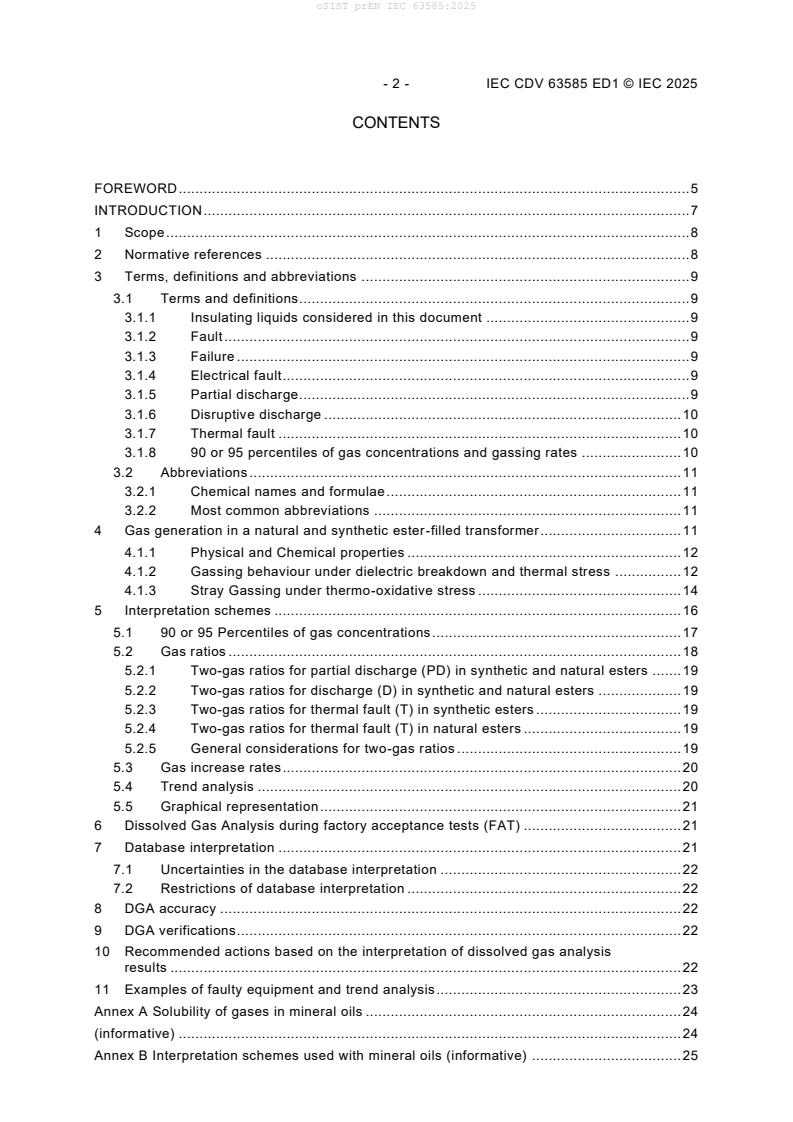
- 2 - IEC CDV 63585 ED1 © IEC 2025
CONTENTS
FOREWORD . 5
INTRODUCTION . 7
1 Scope . 8
2 Normative references . 8
3 Terms, definitions and abbreviations . 9
3.1 Terms and definitions. 9
3.1.1 Insulating liquids considered in this document . 9
3.1.2 Fault . 9
3.1.3 Failure . 9
3.1.4 Electrical fault . 9
3.1.5 Partial discharge . 9
3.1.6 Disruptive discharge . 10
3.1.7 Thermal fault . 10
3.1.8 90 or 95 percentiles of gas concentrations and gassing rates . 10
3.2 Abbreviations . 11
3.2.1 Chemical names and formulae . 11
3.2.2 Most common abbreviations . 11
4 Gas generation in a natural and synthetic ester-filled transformer . 11
4.1.1 Physical and Chemical properties . 12
4.1.2 Gassing behaviour under dielectric breakdown and thermal stress . 12
4.1.3 Stray Gassing under thermo-oxidative stress . 14
5 Interpretation schemes . 16
5.1 90 or 95 Percentiles of gas concentrations . 17
5.2 Gas ratios . 18
5.2.1 Two-gas ratios for partial discharge (PD) in synthetic and natural esters . 19
5.2.2 Two-gas ratios for discharge (D) in synthetic and natural esters . 19
5.2.3 Two-gas ratios for thermal fault (T) in synthetic esters . 19
5.2.4 Two-gas ratios for thermal fault (T) in natural esters . 19
5.2.5 General considerations for two-gas ratios . 19
5.3 Gas increase rates . 20
5.4 Trend analysis . 20
5.5 Graphical representation . 21
6 Dissolved Gas Analysis during factory acceptance tests (FAT) . 21
7 Database interpretation . 21
7.1 Uncertainties in the database interpretation . 22
7.2 Restrictions of database interpretation . 22
8 DGA accuracy . 22
9 DGA verifications . 22
10 Recommended actions based on the interpretation of dissolved gas analysis
results . 22
11 Examples of faulty equipment and trend analysis . 23
Annex A Solubility of gases in mineral oils . 24
(informative) . 24
Annex B Interpretation schemes used with mineral oils (informative) . 25
IEC CDV 63585 ED1 © IEC 2025 - 3 -
Annex C Additional types of faults detectable with the interpretation schemes of
Duval’s Pentagons 3 and Triangles 3 for identifying the further faults in ester
liquids, by analogy with Duval Pentagons 1-2 [16, 17, 18] (informative) . 27
Annex D Results of Database Evaluation (informative) D.1 Database on natural esters
(µl/l) . 29
D.2 Database on synthetic esters (µl/l) . 30
Annex E Examples of failure cases and trend analysis . 31
(informative) . 31
E.1 Corona Partial Discharge (PD) Example . 31
E.1.1 Transformer data . 31
E.1.2 DGA Results (in µl/l) . 31
E1.3 Interpretation Scheme . 31
E1.4 Graphic Representations . 32
E1.5 Transformer Inspection . 33
E.2 Discharge (D) Example . 33
E.2.1 Transformer data . 33
E.2.2 DGA Results (in µl/l) . 33
E.2.3 Interpretation Scheme . 34
E.2.4 Graphic Representations . 34
E.2.5 Transformer Inspection . 35
E.3 Thermal (T) Example . 36
E.3.1 Transformer data . 36
E.3.2 DGA Results (in µl/l) . 36
E.3.3 Interpretation Scheme . 36
E.3.4 Graphic Representations . 37
E.3.5 Transformer Inspection . 37
E.4 Trend development Example 1 . 38
E.4.1 Transformer data . 38
E.4.2 DGA Results (in µl/l) . 38
E.4.3 Interpretation Scheme: . 39
E.4.4 Graphical trend representation . 40
E.4.5 Graphic Representations with the Duval pentagon . 40
E.4.6 Transformer Inspection . 40
E.5 Trend development Example 2 . 41
E.5.1 Transformer data . 41
E.5.2 DGA Results (in µl/l) . 41
E.5.3 Interpretation Scheme . 41
E.5.4 Graphical trend representation . 42
E.5.5 Graphic Representations with the Duval pentagon . 43
E.5.6 Transformer Inspection . 43
Annex F Available information on dissolved gas analysis of mono- and blended esters . 44
(informative) . 44
F.1 Palm fatty acid ester (PFAE) . 44
F.2 Blended esters according to IEC 63012 . 44
Bibliography . 45
Figure 1. Relative gas generation after 100 breakdowns in accordance with IEC 60156
(5s pause between breakdowns without stirring). . 13
- 4 - IEC CDV 63585 ED1 © IEC 2025
Figure 2. Gas generation after ageing at 120°C for 64h on air saturated insulated
liquids . 14
Figure 3a – c. Hydrogen evolvement because of stray gassing of synthetic ester (3a),
natural ester on soybean basis (3b) and uninhibited mineral oil (3c) at 105°C for 48h
under different conditions: air – air saturated, air+Cu air saturated in the presence of
copper, N2 – nitrogen saturated, N2+Cu – nitrogen saturated in the presence of copper . 15
Figure 4a - c. Methane evolvement because of stray gassing of synthetic ester (4a),
natural ester on soybean basis (4b) and uninhibited mineral oil (4c) at 105°C for 48h
under different conditions: air – air saturated, air+Cu air saturated in the presence of
copper, N2 – nitrogen saturated, N2+Cu – nitrogen saturated in the presence of copper . 15
Figure 5a - c. Ethane evolvement because of stray gassing of synthetic ester (5a),
natural ester on soybean basis (5b) and uninhibited mineral oil (5c) at 105°C for 48h
under different conditions: air – air saturated, air+Cu air saturated in the presence of
copper, N – nitrogen saturated, N +Cu – nitrogen saturated in the presence of copper . 15
2 2
Figure 6a - c. Carbon monoxide evolvement because of stray gassing of synthetic
ester (6a), natural ester on soybean basis (6b) and uninhibited mineral oil (6c) at
105°C for 48h under different conditions: air – air saturated, air+Cu air saturated in the
presence of copper, N – nitrogen saturated, N +Cu – nitrogen saturated in the
2 2
presence of copper . 16
Fig. A.1. Schematic representation of the behaviour of the Ostwald solubility
coefficients of mineral oil with temperature [15]. . 24
Table B.1 Two-gas ratios, triangles and pentagons used in different gas-in-oil
evaluating schemes for mineral oils . 25
Table B.2 Gas-in-oil values used as a trigger action in different gas-in-oil evaluating
schemes for mineral oils . 26
IEC CDV 63585 ED1 © IEC 2025 - 5 -
INTERNATIONAL ELECTROTECHNICAL COMMISSION
____________
Interpretation of Dissolved Gas Analysis in natural and synthetic esters
FOREWORD
1) The International Electrotechnical Commission (IEC) is a worldwide organization for standardization comprising
all national electrotechnical committees (IEC National Committees). The object of IEC is to promote international
co-operation on all questions concerning standardization in the electrical and electronic fields. To this end and
in addition to other activities, IEC publishes International Standards, Technical Specifications, Technical Reports,
Publicly Available Specifications (PAS) and Guides (hereafter referred to as “IEC Publication(s)”). Their
preparation is entrusted to technical committees; any IEC National Committee interested in the subject dealt with
may participate in this preparatory work. International, governmental and non-governmental organizations liaising
with the IEC also participate in this preparation. IEC collaborates closely with the International Organization for
Standardization (ISO) in accordance with conditions determined by agreement between the two organizations.
2) The formal decisions or agreements of IEC on technical matters express, as nearly as possible, an international
consensus of opinion on the relevant subjects since each technical committee has representation from all
interested IEC National Committees.
3) IEC Publications have the form of recommendations for international use and are accepted by IEC National
Committees in that sense. While all reasonable efforts are made to ensure that the technical content of IEC
Publications is accurate, IEC cannot be held responsible for the way in which they are used or for any
misinterpretation by any end user.
4) In order to promote international uniformity, IEC National Committees undertake to apply IEC Publications
transparently to the maximum extent possible in their national and regional publications. Any divergence between
any IEC Publication and the corresponding national or regional publication shall be clearly indicated in the latter.
5) IEC itself does not provide any attestation of conformity. Independent certification bodies provide conformity
assessment services and, in some areas, access to IEC marks of conformity. IEC is not responsible for any
services carried out by independent certification bodies.
6) All users should ensure that they have the latest edition of this publication.
7) No liability shall attach to IEC or its directors, employees, servants or agents including individual experts and
members of its technical committees and IEC National Committees for any personal injury, property damage or
other damage of any nature whatsoever, whether direct or indirect, or for costs (including legal fees) and
expenses arising out of the publication, use of, or reliance upon, this IEC Publication or any other IEC
Publications.
8) Attention is drawn to the Normative references cited in this publication. Use of the referenced publications is
indispensable for the correct application of this publication.
9) Attention is drawn to the possibility that some of the elements of this IEC Publication may be the subject of patent
rights. IEC shall not be held responsible for identifying any or all such patent rights.
IEC 6XXXX has been prepared by subcommittee XX: TITLE, of IEC technical committee XX:
TITLE. It is […an International Standard, a Technical Specification: specify document type…].
In the case of a new edition replacing a previous edition, complete the following text. In
the case of a first edition, delete it, as it does not apply.
This edition includes the following significant technical changes with respect to the previous
edition:
a) .;
b)
The text of this […International Standard, Technical Specification: specify document type…] is
based on the following documents:
- 6 - IEC CDV 63585 ED1 © IEC 2025
Draft Report on voting
XX/XX/FDIS XX/XX/RVD
Full information on the voting for its approval can be found in the report on voting indicated in
the above table.
The language used for the development of this […International Standard, Technical
Specification: specify document type…] is English [change language if necessary].
This document was drafted in accordance with ISO/IEC Directives, Part 2, and developed in
accordance with ISO/IEC Directives, Part 1 and ISO/IEC Directives, IEC Supplement, available
at www.iec.ch/members_experts/refdocs. The main document types developed by IEC are
described in greater detail at www.iec.ch/publications.
The committee has decided that the contents of this document will remain unchanged until the
stability date indicated on the IEC website under webstore.iec.ch in the data related to the
specific document. At this date, the document will be
• reconfirmed,
• withdrawn,
• replaced by a revised edition, or
• amended.
IEC CDV 63585 ED1 © IEC 2025 - 7 -
INTRODUCTION
Dissolved gas analysis (DGA) is one of the most widely used diagnostic tools for detecting and
evaluating faults in electrical equipment filled with insulating liquid, independent whether this is
mineral oil, ester or silicone insulating liquid. However, interpretation of DGA results is often
complex and should always be done with care, involving experienced personnel. The standards
for gas-in-oil interpretation are to be understood as a guideline tool. For although there is a
scientific basis for explaining the formation of gases, the interpretation of the data in terms of
cause of failure(s) is not an exact science but derived from empirical evidence from which rules
of interpretation have been deduced.
There are several evaluation schemes for mineral oils in transformers and similar equipment,
such as key gases, quotient formation, Duval's triangle/pentagons which are anchored in
numerous national and international standards, e.g. IEC 60599 or IEEE C57.104. The IEEE
standard C57.155 describes the evaluation of the dissolved gas analysis of esters (mainly
natural esters) based on absolute values.
Ester insulating liquids have been used in electrical equipment since the 70ies. The electrical
energy demand is growing and with it the demand for synthetic and natural esters. Synthetic
and natural esters are used in susceptible environmental areas, they have high flash and fire
points and therefore are preferred insulating liquids at stringent fire requirements. There are
some standards for the maintenance of the liquid itself but few for the interpretation of the
dissolved gas analysis. This document gives a guidance for the interpretation of dissolved gas
analysis in ester filled equipment.
- 8 - IEC CDV 63585 ED1 © IEC 2025
Interpretation of Dissolved Gas Analysis in natural and synthetic esters
1 Scope
The purpose of this guide is to assist the transformer operator in evaluating dissolved gas analysis
(DGA) data obtained from natural ester acc. IEC 62770 and synthetic ester acc. to IEC 61099 liquid
filled transformers and similar equipment. Due to limited information on equipment filled with mono-
and blended esters (IEC 63012) at present they are included in the informative Annex F.
Ester liquids are present in the whole range of applications including transport and distribution
networks, industrial, traction, wind and solar transformers as reflected in the database. Nowadays their
use has been extended to power transformers. Ester liquids are also increasingly used in combination
with tap-changers. Due to insufficient DGA data available, switching equipment is excluded from this
standard.
This guide includes the following:
• Gas generation in a natural and synthetic ester-filled transformer
• DGA Interpretation methods (fault type identification and gas levels and comparison with
those for mineral oils)
• Gas concentration guide values valid for the use of DGA interpretation tools
• Interpretation of the dissolved gas analysis results.
• Recommended actions based on the interpretation of dissolved gas analysis results.
• Examples of faulty equipment
The indications obtained should be viewed only as a guidance and any resulting action should be
taken with a proper engineering judgement.
2 Normative references
IEC 60076-2, Power transformers – Part 2: Temperature rise for liquid-immersed transformers
IEC 60076-3, Power transformers – Part 3: Insulation levels, dielectric tests and external
clearances in air
IEC 60296, Fluids for electrotechnical application – Mineral insulating oils for electrical
equipment
IEC 60475, Method of sampling insulating liquids
IEC 60567, Oil-filled electrical equipment – Sampling of gases and analysis of free and dissolved
gases – Guidance
IEC 60599, Mineral oil-filled electrical equipment in service – Guidance on the interpretation of
dissolved and free gases analysis
IEC 61039, Classification of insulating liquids
IEC 61099, Insulating liquids – Specifications for unused synthetic organic esters for electrical
purposes
IEC 61203, Synthetic organic esters for electrical purposes – Guide for maintenance of transformer
esters in equipment
IEC CDV 63585 ED1 © IEC 2025 - 9 -
IEC 62770, Fluids for electrotechnical applications – Unused natural esters for transformers and
similar electrical equipment
IEC 62975, Natural esters – Guidelines for maintenance and use in electrical equipment
IEC 63012, Insulating liquids – Unused modified or blended esters for electrotechnical applications
IEEE Std C57.104-2008, IEEE Guide for the Interpretation of Gases Generated in Mineral Oil -
Immersed Transformers
IEEE Std C57.104-2019, IEEE Guide for the Interpretation of Gases Generated in Mineral Oil -
Immersed Transformers
IEEE Std C57.155, IEEE Guide for Interpretation of Gases Generated in Natural Ester and Synthetic
Ester-Immersed Transformers
3 Terms, definitions and abbreviations
3.1 Terms and definitions
For the purposes of this document, the following terms and definitions, some of which are based on:
• Electropedia (www.electropedia.org - also available in the standard series IEC 60050), apply
when appropriate.
• Terms more specific to the interpretation of DGA and validated by TC10 experts are also
used.
3.1.1 Insulating liquids considered in this document
The term Natural Ester is used for insulating liquids fulfilling definition and requirements of
standard IEC 62770.
The term Synthetic Ester is used for insulating liquids fulfilling definition and requirements of
standard IEC 61099 (Transformer ester – Type T1).
3.1.2 Fault
Unplanned occurrence or defect in an item which may result in one or more failures of the item
itself or of other associated equipment.
[SOURCE: IEC 60599:2022]
3.1.3 Failure
Loss of ability to perform as required.
Note 1 to entry: In electrical equipment, failure will result from a damage fault or incident necessitating outage, repair
or replacement of the equipment, such as internal breakdown, rupture of tank, fire or explosion.
[SOURCE: Electropedia, 192-03-01 modified and IEC 60599:2022]
3.1.4 Electrical fault
Partial or disruptive discharge through the insulation
3.1.5 Partial discharge
Electric discharge that only partially bridges gaseous, liquid or solid insulation
Note 1 to entry: Corona partial discharges may form in gaseous voids in solid insulation badly impregnated with oil,
or in bubbles of air trapped. Corona partial discharges produce very specific gases - mostly hydrogen - and are
abbreviated by convention in IEC 60599 as “PD or “corona PD”.
- 10 - IEC CDV 63585 ED1 © IEC 2025
As a result of very large numbers of corona PDs, X-wax (polymerized solid from the insulating liquid) may sometimes
be formed. It is often difficult to find by visual inspection.
Note 2 to entry: Scintillations of low energy and “tracking” on the surface of insulating materials, detected during
electrical tests, are often described as partial discharges but should rather be considered as disruptive discharges
of low energy, since they are the result of local dielectric breakdowns of high ionization density, or small arcs
according to the conventions of physics. They are characterized by the formation of acetylene .
[SOURCE: IEC 60599:2022, modified]
3.1.6 Disruptive discharge
Passage of an electric arc following electric breakdown
Note – Depending on the amount of energy contained in the discharge, it will be described as a discharge of low or
high energy based on the maximum current, and the amount of damage to the insulating material .
[SOURCE: Electropedia IEC 60050, 212-11-46]
3.1.7 Thermal fault
Excessive temperature rise in the insulation
Note 1 to entry: typical causes are
– insufficient cooling or lack of circulation of the insulating fluid;
– excessive heat circulating in adjacent metal parts (e. g. as a result of bad contacts),
– losses due to eddy currents, stray losses or leakage flux;
– excessive currents circulating through the insulation (as a result of high dielectric losses), leading to a thermal
runaway;
– overheating of internal winding, selector or bushing connection lead;
– overloading.
[SOURCE: IEC 60599:2022]
3.1.8 90 or 95 percentiles of gas concentrations and gassing rates
Upper gas concentrations found in an arbitrary percentage of equipment in service (e.g.: 90%
or 95% of the population) ranked in gas concentration increasing order
Note 1 to entry: Alternatively other values based on justified utility/user experience can be applied .
Note 2 to entry: Those values will differ in different types of equipment and in different networks, depending on age
of transformer, type and location of the fault, operating practices (load levels, climate, etc.) and will be also dependent
on the available number of equipment and analyses included in the evaluated databases.
Note 3 to entry: 90 or 95 percentiles are not to be intended as thresholds, alert or alarm limit, but are intended to
trigger deeper investigation diagnoses (see also Chapter 5).
IEC CDV 63585 ED1 © IEC 2025 - 11 -
3.2 Abbreviations
3.2.1 Chemical names and formulae
Name Formula
Nitrogen N
Oxygen O
Hydrogen H
Carbon monoxide CO
Carbon dioxide CO
Methane CH
Ethane C H
2 6
Ethylene C H
2 4
Acetylene C H
2 2
NOTE Acetylene and ethyne are both used for C H ; ethylene and ethene are both used for C H
2 2 2 4
3.2.2 Most common abbreviations
DGA dissolved gas analysis (ref. IEC 60567)
µl/l parts per million by volume of gas in oil, equivalent to l(of gas)/l(of oil). See
IEC 60567:2023, 9.7, note 1.
OLTC on load tap changer
PD partial discharges – see 3.1.5
D disruptive discharge – see 3.1.6
T thermal fault – see 3.1.7
Other faults - see Annex C
4 Gas generation in a natural and synthetic ester-filled transformer
4.1 General
Ester insulating liquids (synthetic and natural) exhibit lower environmental impact relative to most
mineral insulating liquids (see IEC 61099, IEC 62770 and IEC 61039) . Esters are also used in
susceptible environmental areas and inland and offshore wind applications. The disposal of esters,
chemicals and sample containers mentioned in this standard, however, can be subject of regulatory
requirements and every precaution should be taken to prevent their release into the environment.
They have high flash and fire points and are preferred insulating liquids at stringent fire requirements.
Nevertheless, they should not be considered as “not flammable”, but only as “less flammable”. Smoke
formation in case of fire is much less than with mineral oils.
The different properties result in different values in the maintenance procedures, e.g. acidity, as
described in IEC 61203 and IEC 62975 and can influence the gassing behaviour of synthetic and
natural esters.
Ester liquids have been already used for many years in electrical equipment. The most common
use is with distribution and industrial (traction and offshore) transformers. Up to now the
experience with medium and power transformers is limited, due to the relative low number
esters used in those. This is reflected in the databases gathered.
- 12 - IEC CDV 63585 ED1 © IEC 2025
Fault gases generated in ester liquids under fault conditions are the same as those
generated in mineral oil, however, the ratios and rates may be different. This can be due
to the differences in their molecular structure in comparison to mineral oils.
As already mentioned in the introduction, interpretation schemes for mineral oil are to be
regarded as a guideline and not as exact rules. They have a lot of ambiguity, e.g. concerning
absolute values to be used as a trigger or gas ratios (see Annex B). Also the solubility and
volatility behaviour of gases with temperature in esters follows similar rules as in mineral oil
(see Fig A.1. Annex A).
4.1.1 Physical and Chemical properties
Natural and synthetic esters exhibit different chemical and physical properties than mineral oils (see
IEC 62770 and IEC 61099). The higher viscosity in comparison to mineral insulating oils may result in
longer arcing times with arc-breaking type OLTCs [1]. For this reason, vacuum-type OLTC are preferred.
Esters can be hydrolysed by water, which may lead to higher acidity and eventually to higher
carbon dioxide concentration. Oxidation in a free breathing equipment in case of synthetic
esters can also lead to a higher carbon dioxide concentration. Natural ester molecules are
composed of long chains of hydrocarbons and can have one or more doble bonds called
unsaturations. Multiple unsaturated double bonds will cause the development of ethane and
hydrogen, especially in the presence of air. This gas formation is mainly due to the decomposition of
some specific poly-unsaturated fatty acids, like of linolenic acid, which are more present in certain types
of esters such as those of soya and rapeseed than those of sunflower.
Unsaturated bonds will facilitate oxidation, therefore natural esters shall be used in equipment closed
from the atmosphere.
Note: some monoesters and blends of monoesters can have lower viscosity, see Annex F.
Note: Compared to mineral oils, esters show different behaviour under dielectric stress LI (e.g.: lightning impulse)
regarding formation and propagation of streamers. streaming propagation, positive and negative polarities in
comparison to mineral oils. Also, their electrostatic charging tendency is different [2, 3].
4.1.2 Gassing behaviour under dielectric breakdown and thermal stress
User experience shows that the main fault manifestations in gas-in-oil analyses is similar to
those of mineral oil. A lot of systematic research on gassing experience and comparison has
been carried out. Results of gas-in-oil behaviour under vacuum extraction of uninhibited mineral
oil (acc. IEC 60296), synthetic ester (acc. IEC 61099) and natural ester on soybean basis (acc.
IEC 62770) under dielectric and thermal conditions are shown below.
4.1.2.1 Example for gas generation under dielectric breakdown conditions [4]
An example for the gas generation under breakdown conditions is shown on Fig. 1.
IEC CDV 63585 ED1 © IEC 2025 - 13 -
H2 C2H2 CH4 C2H4 C2H6
Mineral oil Natural ester Synthetic ester
Figure 1. Relative gas generation after 100 breakdowns in accordance with IEC 60156
(5s pause between breakdowns without stirring).
Note: In this experiment a stray gassing uninhibited mineral oil according to IEC 60296:2020 and natural ester on
soybean base have been used.
4.1.2.2 Example for gas generation under thermal stress conditions [4]
An example for gas generation after ageing at 120°C for 64h on air saturated insulated liquids
[i.e., thermal stray gassing of oil according to the definition of [7]], is shown on Fig.2. At this
temperature a gassing level comparable to stray gassing (see 4.1.3) is expected. However, in
the case of a thermal fault, the amount of methane and ethene produced will be much higher
[5, 6].
Gas content (% vol.)
- 14 - IEC CDV 63585 ED1 © IEC 2025
H2 C2H2 CH4 C2H4 C2H6
Mineral oil Natural ester Synthetic ester
Figure 2. Gas generation after ageing at 120°C for 64h on air saturated insulated
liquids
Note: In this experiment a stray gassing uninhibited mineral oil according to IEC 60296:2020 and natural ester on
soybean base have been used.
Similarity in the gas pattern between ester liquids and mineral oil under corona partial discharge
conditions have been found in other publications [8, 9]. Although the gas patterns of synthetic
and natural esters for partial discharge, discharge and thermal faults are similar to those for
mineral oils, the individual gas concentrations may be different.
Since many ester filled transformers can have paper or aramid insulation (or both), at this
stage it is difficult to evaluate the source of high carbon dioxide concentration.
4.1.3 Stray Gassing under thermo-oxidative stress
Stray gassing investigations on the presence and absence of air, as well as in presence and
absence of copper have been carried out by Cigre WG D1.70 at 105°C for 48h [10]. The results
for synthetic ester (IEC 61099) and for natural ester on soybean base (IEC 62770) compared
to uninhibited mineral oil (IEC 60296) are presented on Fig 3a – 3c (hydrogen), Fig. 4a – 4c
(methane), Fig. 5a – 5c (ethane) and Fig. 6a – 6c (carbon monoxide) respectively. No acetylene
has been generated under these test conditions. The amount of ethylene generated under these
conditions using those insulating liquids was negligeable, therefore not presented in the
graphic. Behaviour of other types of natural esters can be different.
Note: A stray gassing test according to [10] in unused state can give a useful indication on the stray gassing performance of the
corresponding liquid filling
Gas content (% vol.)
IEC CDV 63585 ED1 © IEC 2025 - 15 -
Hydrogen- in µl/l
Avg (AIR) Avg (AIR+Cu) Avg (AIR) Avg (AIR+Cu)
Avg (AIR) Avg (AIR+Cu)
Avg (N2) Avg (N2+Cu) Avg (N2) Avg (N2+Cu)
Avg (N2) Avg (N2+Cu)
800 800
600 600
0 0
3a 3b 3c
Figure 3a – c. Hydrogen evolvement because of stray gassing of synthetic ester (3a),
natural ester on soybean basis (3b) and uninhibited mineral oil (3c) at 105°C for 48h
under different conditions: air – air saturated, air+Cu air saturated in the presence of
copper, N – nitrogen saturated, N +Cu – nitrogen saturated in the presence of copper
2 2
Methane in µl/l
Avg (AIR) Avg (AIR+Cu) Avg (AIR) Avg (AIR+Cu) Avg (AIR) Avg (AIR+Cu)
Avg (N2) Avg (N2+Cu) Avg (N2) Avg (N2+Cu) Avg (N2) Avg (N2+Cu)
200 200
4a 4b 4c
Figure 4a - c. Methane evolvement because of stray gassing of synthetic ester (4a),
natural ester on soybean basis (4b) and uninhibited mineral oil (4c) at 105°C for 48h
under different conditions: air – air saturated, air+Cu air saturated in the presence of
copper, N – nitrogen saturated, N +Cu – nitrogen saturated in the presence of copper
2 2
Ethane in µl/l
Avg (AIR) Avg (AIR+Cu)
Avg (AIR) Avg (AIR+Cu) Avg (AIR) Avg (AIR+Cu)
Avg (N2) Avg (N2+Cu)
Avg (N2) Avg (N2+Cu) Avg (N2) Avg (N2+Cu)
400 400
5a 5b 5c
Figure 5a - c. Ethane evolvement because of stray gassing of synthetic ester (5a),
natural ester on soybean basis (5b) and uninhibited mineral oil (5c) at 105°C for 48h
under different conditions: air – air saturated, air+Cu air saturated in the presence of
copper, N – nitrogen saturated, N +Cu – nitrogen saturated in the presence of copper
2 2
- 16 - IEC CDV 63585 ED1 © IEC 2025
Carbon monoxide in µl/l
Avg (AIR) Avg (AIR+Cu)
Avg (AIR) Avg (AIR+Cu) Avg (AIR) Avg (AIR+Cu)
Avg (N2) Avg (N2+Cu)
Avg (N2) Avg (N2+Cu) Avg (N2) Avg (N2+Cu)
600 600
400 400
200 200
0 0
6a 6b 6c
Figure 6a - c. Carbon monoxide evolvement because of stray gassing of synthetic ester
(6a), natural ester on soybean basis (6b) and uninhibited mineral oil (6c) at 105°C for
48h under different conditions: air – air saturated, air+Cu air saturated in the presence
of copper, N – nitrogen saturated, N +Cu – nitrogen saturated in the presence of
2 2
copper
In natural esters the formation of ethane, hydrogen, carbon monoxide and carbon dioxide increase
with the polyunsaturated content in the base natural oil as shown on Table 1 [11]. Natural esters from
different sources (number of double bonds) may exhibit different gas formations accordingly. This is
most probably due to oxidation processes.
Table 1 – Example for the dependence of dissolved gas formation (µl/l) on the linolenic acid
content of the base natural liquid (at 120°C for 164h) [11]
High oleic sunflower Peanut Soybean Flaxseed
Linolenic acid 0,2 0,2 7 53
content (%)
Hydrogen 357 282 316 708
Methane 21 10 10 17
Ethane 4 26 563 2371
Ethylene 8 16 7 16
Acetylene 0 0 0 0
Carbon monoxide 203 389 408 977
Carbon dioxide 876 2232 1330 3212
Note: Linolenic acid has 3 double bonds in its carbon chain
5 Interpretation schemes
Transformers and liquid filled electrical equipment have different designs and are operated differently.
Gas formation and the proportion of fault gases depend on the type and location of faults, as well as
the volume, age and type of the transformer. Although generally following standards (IEC 60475 and
IEC 60567), sampling and testing of dissolved gases are also subjected to variations depending on
the on-site conditions, methods, and personnel qualification. Therefore, there can be a certain
ambiguity in the measured values. The uncertainty on gas concentrations reported by laboratories and
gas monitors, and therefore the uncertainty on diagnosis provided by interpretation schemes, has
been estimated in IEC 60567. Sampling insulating liquid from transformers shall be done following
standard method IEC 60475 and the sampling method, as well as possible deviations shall be
communicated to the testing laboratory. DGA results obtained with unvalidated in-house sampling
methods shall be used with a lot of caution or discarded. The solubility of gases in oil, related indirectly
to their volatility, is indicated in Annex A.
IEC CDV 63585 ED1 © IEC 2025 - 17 -
Analysis of gases dissolved in insulating liquid in the laboratory or in gas monitors in the case of
insulating liquids other than mineral oils shall be done following standard method IEC 60567, Part 2.
Whenever possible, gas-in-oil standard samples, prepared in-house or purchased commercially, shall
be used to ensure the accuracy of DGA results.
It is necessary to distinguish between gassing and faulty equipment. Identifying fault in an equipment
requires engineering expertise regarding the type and design of the equipment as well as the grid in
which it is operated. Transient effects may take place especially during commissioning, leading to high
gas generation but not necessarily to a fault in the equipment. Reversely, major failures have been
observed in some cases at very low gas generation.
There are several interpretation schemes for mineral oils in transformers and similar equipment, such
as key gases, two-gas ratios, IEC 60599 ratio method, Duval's triangle/pentagons which are used in
several national and international standards, e.g. IEC 60599 or IEEE C57.104.
In Annex B, a short description of different
...
Questions, Comments and Discussion
Ask us and Technical Secretary will try to provide an answer. You can facilitate discussion about the standard in here.
Loading comments...