

EN 50124-1:2017/prA1:2024
(Amendment)Railway applications - Insulation coordination - Part 1: Basic requirements - Clearances and creepage distances for all electrical and electronic equipment
General Information
- Abstract
This European Standard deals with insulation coordination in railways. It applies to equipment for use in signalling, rolling stock and fixed installations. Insulation coordination is concerned with the selection, dimensioning and correlation of insulation both within and between items of equipment. In dimensioning insulation, electrical stresses and environmental conditions are taken into account. For the same conditions and stresses, these dimensions are the same. An objective of insulation coordination is to avoid unnecessary over dimensioning of insulation. This standard specifies: - requirements for clearances and creepage distances for equipment; - general requirements for tests pertaining to insulation coordination. The term equipment relates to a section as defined in 3.3 it may apply to a system, a sub-system, an apparatus, a part of an apparatus, or a physical realization of an equipotential line. This standard does not deal with: - distances through solid or liquid insulation; - distances through gases other than air; - distances through air not at atmospheric pressure; - equipment used under extreme conditions. Product standards should align with this generic standard. However, they may require, with justification, different requirements due to safety and/or reliability reasons, e.g. for signalling, and/or particular operating conditions of the equipment itself, e.g. overhead contact lines which should comply with EN 50119. This standard also gives provisions for dielectric tests (type tests or routine tests) on equipment (see Annex B). NOTE For safety critical systems, specific requirements are needed. These requirements are given in the product specific signalling standard EN 50129.
- Status
- Not Published
- Publication Date
- 16-Jan-2024
- Technical Committee
- CLC/TC 9X - Electrical and electronic applications for railways
- Drafting Committee
- CLC/TC 9X - Electrical and electronic applications for railways
- Current Stage
- 4060 - Enquiry results established and sent to TC, SR, BTTF - Enquiry
- Start Date
- 13-Sep-2024
- Due Date
- 01-Mar-2023
- Completion Date
- 13-Sep-2024

Overview - EN 50124-1:2017/prA1:2024 (Railway insulation coordination)
EN 50124-1:2017/prA1:2024 is a CLC/CENELEC European standard on insulation coordination for railway applications, specifying basic requirements for clearances and creepage distances for all electrical and electronic equipment used in signalling, rolling stock and fixed installations. The amendment prA1:2024 updates Annex ZZ (relationship to EU Directive (EU) 2016/797/TSI) and the bibliography. The standard’s primary objective is to ensure safe, reliable insulation design while avoiding unnecessary over-dimensioning by correlating electrical stresses and environmental conditions.
Key topics and technical requirements
- Scope and applicability: Applies to equipment as a “section” (system, sub‑system, apparatus, part or equipotential line) across rolling stock, signalling and fixed installations within the railway domain.
- Clearances and creepage distances: Specifies how to select and dimension air gaps (clearances) and surface paths (creepage) to withstand electrical stresses under defined environmental conditions.
- Insulation coordination principle: Correlation of insulation levels within and between items so identical stresses and conditions yield consistent insulation dimensions - minimizing over‑engineering.
- Tests and verification: General requirements for dielectric tests (type and routine tests) on equipment (see Annex B), used to demonstrate compliance with insulation coordination.
- Exclusions: Does not cover distances through solid or liquid insulation; gases other than air; air at non‑atmospheric pressure; or equipment used under extreme conditions.
- Regulatory linkage: Annex ZZ maps clauses to Technical Specifications for Interoperability (TSIs) for Rolling Stock and Energy, supporting presumption of conformity when cited in the Official Journal.
Practical applications and users
Who uses EN 50124-1:
- Electrical and mechanical designers of rolling stock and fixed railway equipment
- Signalling and traction system engineers responsible for insulation and safety
- Manufacturers and suppliers defining product clearances and creepage specs
- Test laboratories performing dielectric and routine tests
- Regulatory bodies, certification bodies and infrastructure managers assessing conformity with TSI and EU directives
Why it matters:
- Ensures consistent insulation practices across railway systems
- Reduces risk of electric shock, flashover and equipment failure
- Helps harmonize product standards and supports product certification and interoperability
Related standards
- EN 50129 (signalling safety - safety-critical requirements) - for signalling-specific safety requirements
- EN 50119 (overhead contact lines) - example of product standard requiring specific insulation provisions
- Relevant TSIs and the ERA Reference Document Database (RDD/SRD) for national rules and interoperability guidance
Keywords: EN 50124-1, insulation coordination, clearances and creepage distances, railway, dielectric tests, rolling stock, signalling, fixed installations, TSI, CENELEC.
Relations
- Effective Date
- 19-May-2026
- Effective Date
- 07-Sep-2021
Get Certified
Connect with accredited certification bodies for this standard

IMQ S.p.A. (Certification)
Italian electrical product certification.

SLG Prüf- und Zertifizierungs GmbH
German testing and certification body.

UL Solutions
Global safety science company with testing, inspection and certification.
Sponsored listings
Frequently Asked Questions
EN 50124-1:2017/prA1:2024 is a draft published by CLC. Its full title is "Railway applications - Insulation coordination - Part 1: Basic requirements - Clearances and creepage distances for all electrical and electronic equipment". This standard covers: This European Standard deals with insulation coordination in railways. It applies to equipment for use in signalling, rolling stock and fixed installations. Insulation coordination is concerned with the selection, dimensioning and correlation of insulation both within and between items of equipment. In dimensioning insulation, electrical stresses and environmental conditions are taken into account. For the same conditions and stresses, these dimensions are the same. An objective of insulation coordination is to avoid unnecessary over dimensioning of insulation. This standard specifies: - requirements for clearances and creepage distances for equipment; - general requirements for tests pertaining to insulation coordination. The term equipment relates to a section as defined in 3.3 it may apply to a system, a sub-system, an apparatus, a part of an apparatus, or a physical realization of an equipotential line. This standard does not deal with: - distances through solid or liquid insulation; - distances through gases other than air; - distances through air not at atmospheric pressure; - equipment used under extreme conditions. Product standards should align with this generic standard. However, they may require, with justification, different requirements due to safety and/or reliability reasons, e.g. for signalling, and/or particular operating conditions of the equipment itself, e.g. overhead contact lines which should comply with EN 50119. This standard also gives provisions for dielectric tests (type tests or routine tests) on equipment (see Annex B). NOTE For safety critical systems, specific requirements are needed. These requirements are given in the product specific signalling standard EN 50129.
This European Standard deals with insulation coordination in railways. It applies to equipment for use in signalling, rolling stock and fixed installations. Insulation coordination is concerned with the selection, dimensioning and correlation of insulation both within and between items of equipment. In dimensioning insulation, electrical stresses and environmental conditions are taken into account. For the same conditions and stresses, these dimensions are the same. An objective of insulation coordination is to avoid unnecessary over dimensioning of insulation. This standard specifies: - requirements for clearances and creepage distances for equipment; - general requirements for tests pertaining to insulation coordination. The term equipment relates to a section as defined in 3.3 it may apply to a system, a sub-system, an apparatus, a part of an apparatus, or a physical realization of an equipotential line. This standard does not deal with: - distances through solid or liquid insulation; - distances through gases other than air; - distances through air not at atmospheric pressure; - equipment used under extreme conditions. Product standards should align with this generic standard. However, they may require, with justification, different requirements due to safety and/or reliability reasons, e.g. for signalling, and/or particular operating conditions of the equipment itself, e.g. overhead contact lines which should comply with EN 50119. This standard also gives provisions for dielectric tests (type tests or routine tests) on equipment (see Annex B). NOTE For safety critical systems, specific requirements are needed. These requirements are given in the product specific signalling standard EN 50129.
EN 50124-1:2017/prA1:2024 is classified under the following ICS (International Classification for Standards) categories: 29.080.01 - Electrical insulation in general; 29.280 - Electric traction equipment. The ICS classification helps identify the subject area and facilitates finding related standards.
EN 50124-1:2017/prA1:2024 has the following relationships with other standards: It is inter standard links to CLC/TS 50711:2026, EN 50124-1:2017. Understanding these relationships helps ensure you are using the most current and applicable version of the standard.
EN 50124-1:2017/prA1:2024 is associated with the following European legislation: EU Directives/Regulations: 2016/797/EU, 2016/797/EU, 2016/797/EU, 2016/797/EU, 2016/797/EU, 2016/797/EU, 2016/797/EU, 2016/797/EU, 2016/797/EU, 2016/797/EU, 2016/797/EU, 2016/797/EU; Standardization Mandates: M/483, M/591. When a standard is cited in the Official Journal of the European Union, products manufactured in conformity with it benefit from a presumption of conformity with the essential requirements of the corresponding EU directive or regulation.
EN 50124-1:2017/prA1:2024 is available in PDF format for immediate download after purchase. The document can be added to your cart and obtained through the secure checkout process. Digital delivery ensures instant access to the complete standard document.
Standards Content (Sample)
SLOVENSKI STANDARD
01-september-2024
Železniške naprave - Uskladitev izolacije - 1. del: Osnovne zahteve - Izolacijske in
plazilne razdalje za vso električno in elektronsko opremo - Dopolnilo A1
Railway applications - Insulation coordination - Part 1: Basic requirements - Clearances
and creepage distances for all electrical and electronic equipment
Bahnanwendungen - Isolationskoordination - Teil 1: Grundlegende Anforderungen - Luft-
und Kriechstrecken für alle elektrischen und elektronischen Betriebsmittel
Applications ferroviaires - Coordination de l'isolement - Partie 1: Prescriptions
fondamentales - Distances d'isolement dans l'air et lignes de fuite pour tout matériel
électrique et électronique
Ta slovenski standard je istoveten z: EN 50124-1:2017/prA1:2024
ICS:
29.080.01 Električna izolacija na Electrical insulation in
splošno general
29.280 Električna vlečna oprema Electric traction equipment
2003-01.Slovenski inštitut za standardizacijo. Razmnoževanje celote ali delov tega standarda ni dovoljeno.
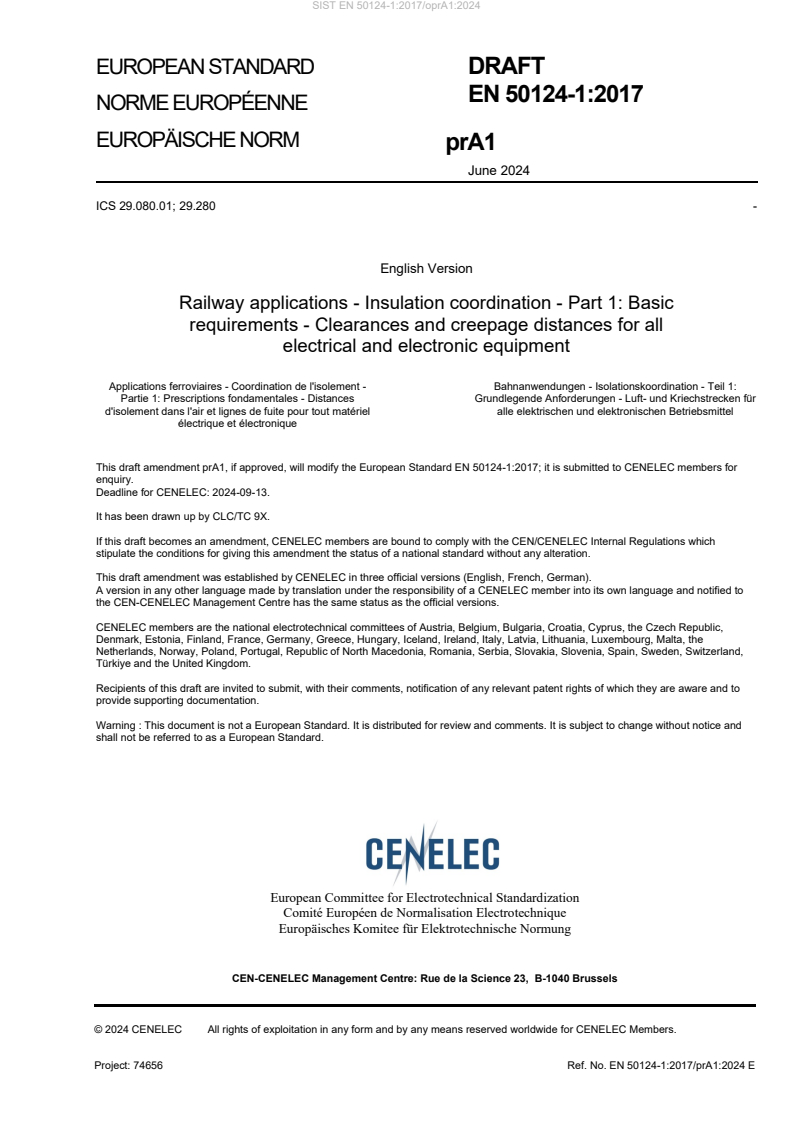
EUROPEAN STANDARD DRAFT
EN 50124-1:2017
NORME EUROPÉENNE
EUROPÄISCHE NORM
prA1
June 2024
ICS 29.080.01; 29.280 -
English Version
Railway applications - Insulation coordination - Part 1: Basic
requirements - Clearances and creepage distances for all
electrical and electronic equipment
Applications ferroviaires - Coordination de l'isolement - Bahnanwendungen - Isolationskoordination - Teil 1:
Partie 1: Prescriptions fondamentales - Distances Grundlegende Anforderungen - Luft- und Kriechstrecken für
d'isolement dans l'air et lignes de fuite pour tout matériel alle elektrischen und elektronischen Betriebsmittel
électrique et électronique
This draft amendment prA1, if approved, will modify the European Standard EN 50124-1:2017; it is submitted to CENELEC members for
enquiry.
Deadline for CENELEC: 2024-09-13.
It has been drawn up by CLC/TC 9X.
If this draft becomes an amendment, CENELEC members are bound to comply with the CEN/CENELEC Internal Regulations which
stipulate the conditions for giving this amendment the status of a national standard without any alteration.
This draft amendment was established by CENELEC in three official versions (English, French, German).
A version in any other language made by translation under the responsibility of a CENELEC member into its own language and notified to
the CEN-CENELEC Management Centre has the same status as the official versions.
CENELEC members are the national electrotechnical committees of Austria, Belgium, Bulgaria, Croatia, Cyprus, the Czech Republic,
Denmark, Estonia, Finland, France, Germany, Greece, Hungary, Iceland, Ireland, Italy, Latvia, Lithuania, Luxembourg, Malta, the
Netherlands, Norway, Poland, Portugal, Republic of North Macedonia, Romania, Serbia, Slovakia, Slovenia, Spain, Sweden, Switzerland,
Türkiye and the United Kingdom.
Recipients of this draft are invited to submit, with their comments, notification of any relevant patent rights of which they are aware and to
provide supporting documentation.
Warning : This document is not a European Standard. It is distributed for review and comments. It is subject to change without notice and
shall not be referred to as a European Standard.
European Committee for Electrotechnical Standardization
Comité Européen de Normalisation Electrotechnique
Europäisches Komitee für Elektrotechnische Normung
CEN-CENELEC Management Centre: Rue de la Science 23, B-1040 Brussels
© 2024 CENELEC All rights of exploitation in any form and by any means reserved worldwide for CENELEC Members.
Project: 74656 Ref. No. EN 50124-1:2017/prA1:2024 E
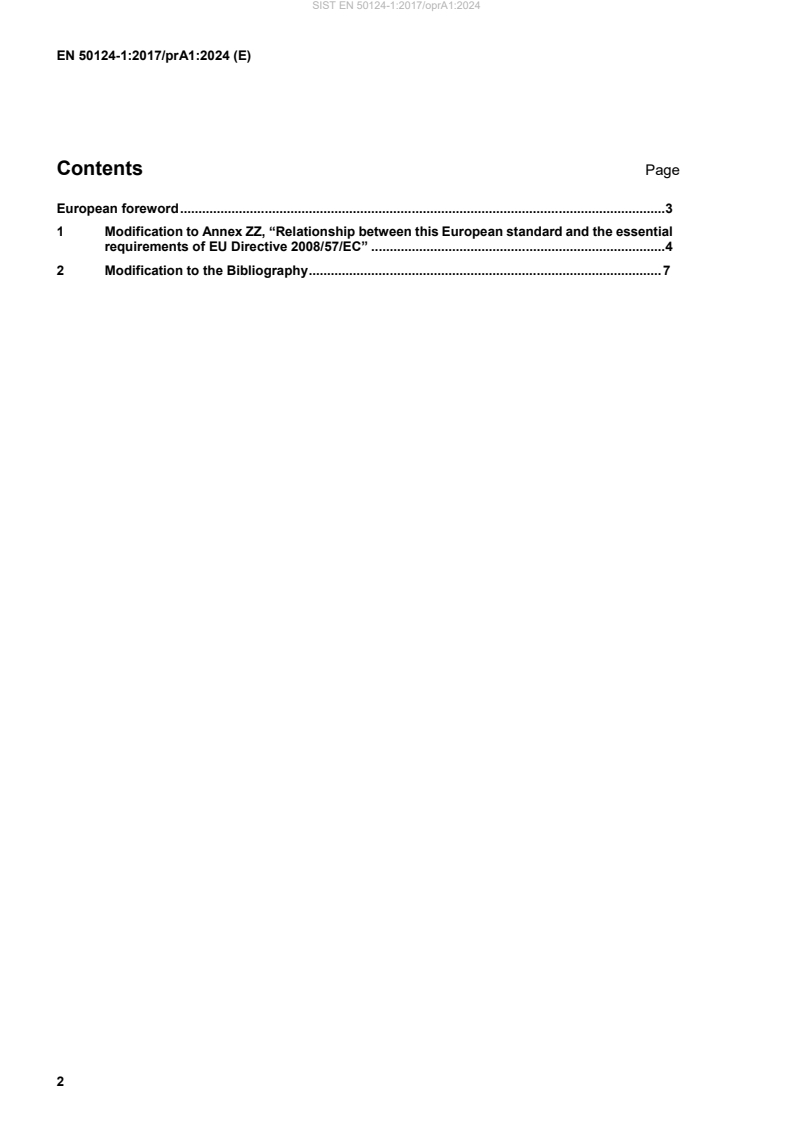
Contents Page
European foreword . 3
1 Modification to Annex ZZ, “Relationship between this European standard and the essential
requirements of EU Directive 2008/57/EC” . 4
2 Modification to the Bibliography . 7
European foreword
This document (EN 50124-1:2017/prA1:2024) has been prepared by CLC/TC 9X “Electrical and electronic
applications for railways”.
This document is currently submitted to the Enquiry.
The following dates are proposed:
• latest date by which the existence of this (doa) dor + 6 months
document has to be announced at national
level
• latest date by which this document has to be (dop) dor + 12 months
implemented at national level by publication of
an identical national standard or by
endorsement
• latest date by which the national standards (dow) dor + 36 months
conflicting with this document have to be (to be confirmed or
withdrawn modified when voting)
This document has been prepared under a standardization request addressed to CENELEC by the European
Commission. The Standing Committee of the EFTA States subsequently approves these requests for its
Member States.
For the relationship with EU Legislation, see informative Annex ZZ, which is an integral part of this document.
...