


prEN IEC 60079-2:2022
(Main)Explosive atmospheres - Part 2: Equipment protection by pressurized enclosure "p"
Explosive atmospheres - Part 2: Equipment protection by pressurized enclosure "p"
Explosionsgefährdete Bereiche - Teil 2: Geräteschutz durch Überdruckkapselung "p"
Atmosphères explosives - Partie 2: Protection du matériel par enveloppe à surpression interne "p"
Eksplozivne atmosfere - 2. del: Zaščita opreme z nadtlakom "p"
General Information
- Status
- Not Published
- Publication Date
- 21-Mar-2024
- Technical Committee
- CLC/TC 31 - Electrical apparatus for explosive atmospheres - General requirements
- Drafting Committee
- IEC/TC 31 - Electrical apparatus for potentially explosive atmospheres
- Current Stage
- 4098 - Decision to drop project - Standstill maintained / released - Enquiry
- Start Date
- 19-Aug-2025
- Completion Date
- 20-Feb-2026
- Mandate
- M/XXX - M/XXX
Relations
- Effective Date
- 10-Nov-2020
- Revises
EN 60079-2:2014 - Explosive atmospheres - Part 2: Equipment protection by pressurized enclosure "p" - Effective Date
- 31-Jul-2018
Overview
prEN IEC 60079-2:2022 - "Explosive atmospheres - Part 2: Equipment protection by pressurized enclosure 'p'" is a CLC/IEC committee draft (CDV) that specifies requirements for protecting electrical and non‑electrical equipment in explosive atmospheres by means of a pressurized enclosure. The document sets out construction, control, testing and marking requirements for pressurized equipment intended for use in hazardous areas (Group I, II and III applications). Note: this edition was circulated as a draft for vote in 2022 (IEC TC 31) with a proposed stability date of 2028.
Key topics and technical requirements
- Levels of protection (pxc / pyb / pzc, etc.) - definitions and application to different equipment protection levels (EPLs).
- Constructional requirements - enclosure strength, materials, doors/covers, partitions and internal compartments for Group I, II and III equipment.
- Pressurization methods - continuous flow pressurization, static pressurization, dilution flow and leakage compensation techniques.
- Protective gas & supply - selection, backup/independent supply arrangements, temperature considerations.
- Safety and control systems - pressurization control systems, safety devices to detect minimum overpressure, door/covers interlocks and safety functions (including requirements when control systems are evaluated as associated Ex equipment).
- Internal sources of release & containment - design for infallible containment systems, limited release concepts and requirements for handling liquids/gases released internally.
- Purging and dilution criteria and tests - purging procedures, acceptance criteria for protective gas being air or inert, and specific test methods.
- Cells and batteries - requirements and warnings for batteries installed within pressurized enclosures (including memory backup cells).
- Type verification, routine tests and marking - overpressure, leakage, purging tests, functional and routine tests, and marking to identify pressurized equipment.
Practical applications
- Design and manufacture of pressurized enclosures for hazardous locations (oil & gas, petrochemical, mining, chemical, pharmaceuticals, utilities).
- Certification and type‑testing by notified bodies and test laboratories for compliance with pressurization protection "p".
- Installation, inspection and maintenance procedures for pressurized equipment and pressurization control systems.
- Risk management where internal sources of release (e.g., liquids, gases, batteries) require containment or dilution strategies.
Who uses this standard
- Equipment designers and OEMs of Ex‑protected enclosures
- Certification bodies, testing laboratories and notified bodies
- Safety and reliability engineers, plant operators and maintenance teams
- Regulatory authorities and compliance officers in hazardous industries
Related standards
- Other parts of the IEC 60079 series (general requirements and alternative protection concepts such as flameproof “d”, increased safety “e”, etc.) and guidance produced by IEC TC 31 on equipment for explosive atmospheres.
Keywords: IEC 60079-2, pressurized enclosure, equipment protection by pressurization, explosive atmospheres, pressurization control, purging, overpressure test, pressurized equipment.


Get Certified
Connect with accredited certification bodies for this standard

Intertek Testing Services NA Inc.
Intertek certification services in North America.

UL Solutions
Global safety science company with testing, inspection and certification.

ANCE
Mexican certification and testing association.
Sponsored listings
Frequently Asked Questions
prEN IEC 60079-2:2022 is a draft published by CLC. Its full title is "Explosive atmospheres - Part 2: Equipment protection by pressurized enclosure "p"". This standard covers: Explosive atmospheres - Part 2: Equipment protection by pressurized enclosure "p"
Explosive atmospheres - Part 2: Equipment protection by pressurized enclosure "p"
prEN IEC 60079-2:2022 is classified under the following ICS (International Classification for Standards) categories: 29.260.20 - Electrical apparatus for explosive atmospheres. The ICS classification helps identify the subject area and facilitates finding related standards.
prEN IEC 60079-2:2022 has the following relationships with other standards: It is inter standard links to EN 60079-2:2014/AC:2015, EN 60079-2:2014. Understanding these relationships helps ensure you are using the most current and applicable version of the standard.
prEN IEC 60079-2:2022 is associated with the following European legislation: EU Directives/Regulations: 2008/68/EC, 2014/34/EU; Standardization Mandates: M/086, M/596, M/TDG, M/XXX. When a standard is cited in the Official Journal of the European Union, products manufactured in conformity with it benefit from a presumption of conformity with the essential requirements of the corresponding EU directive or regulation.
prEN IEC 60079-2:2022 is available in PDF format for immediate download after purchase. The document can be added to your cart and obtained through the secure checkout process. Digital delivery ensures instant access to the complete standard document.
Standards Content (Sample)
SLOVENSKI STANDARD
01-november-2022
Eksplozivne atmosfere - 2. del: Zaščita opreme z nadtlakom "p"
Explosive atmospheres - Part 2: Equipment protection by pressurized enclosure "p"
Explosionsgefährdete Bereiche - Teil 2: Geräteschutz durch Überdruckkapselung "p"
Atmosphères explosives - Partie 2: Protection du matériel par enveloppe à surpression
interne "p"
Ta slovenski standard je istoveten z: prEN IEC 60079-2:2022
ICS:
29.260.20 Električni aparati za Electrical apparatus for
eksplozivna ozračja explosive atmospheres
2003-01.Slovenski inštitut za standardizacijo. Razmnoževanje celote ali delov tega standarda ni dovoljeno.
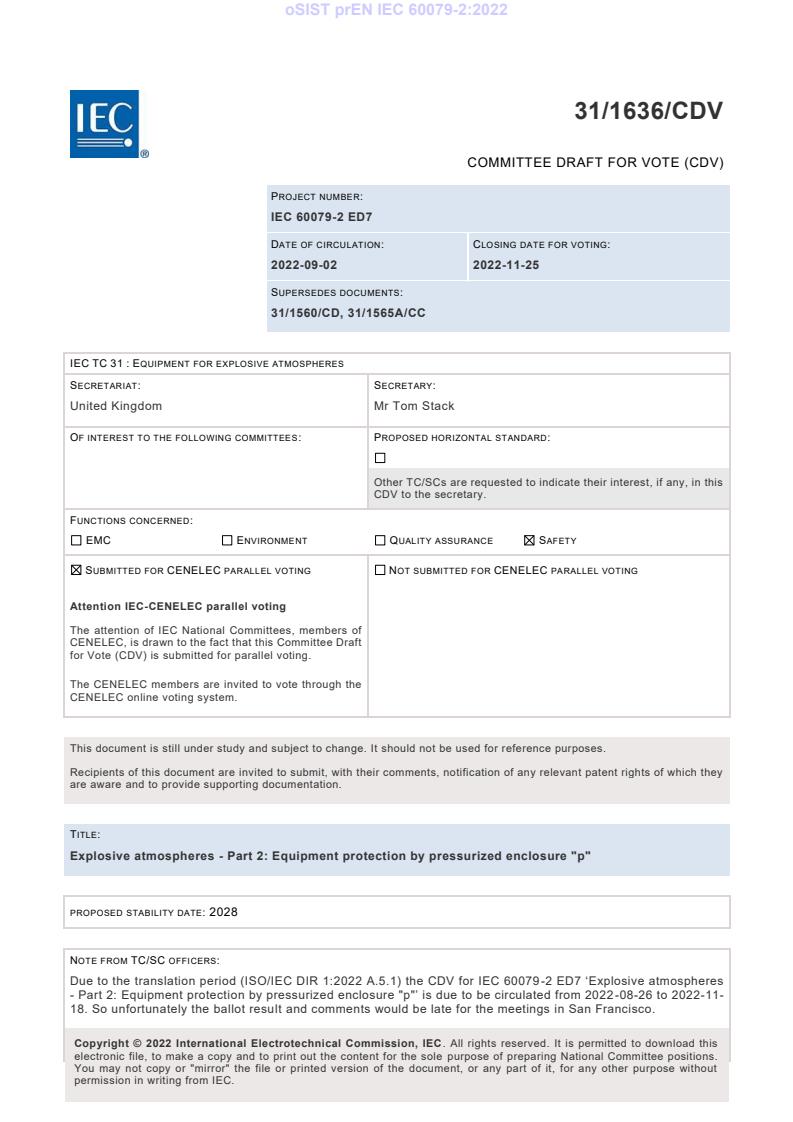
31/1636/CDV
COMMITTEE DRAFT FOR VOTE (CDV)
PROJECT NUMBER:
IEC 60079-2 ED7
DATE OF CIRCULATION: CLOSING DATE FOR VOTING:
2022-09-02 2022-11-25
SUPERSEDES DOCUMENTS:
31/1560/CD, 31/1565A/CC
IEC TC 31 : EQUIPMENT FOR EXPLOSIVE ATMOSPHERES
SECRETARIAT: SECRETARY:
United Kingdom Mr Tom Stack
OF INTEREST TO THE FOLLOWING COMMITTEES: PROPOSED HORIZONTAL STANDARD:
Other TC/SCs are requested to indicate their interest, if any, in this
CDV to the secretary.
FUNCTIONS CONCERNED:
EMC ENVIRONMENT QUALITY ASSURANCE SAFETY
SUBMITTED FOR CENELEC PARALLEL VOTING NOT SUBMITTED FOR CENELEC PARALLEL VOTING
Attention IEC-CENELEC parallel voting
The attention of IEC National Committees, members of
CENELEC, is drawn to the fact that this Committee Draft
for Vote (CDV) is submitted for parallel voting.
The CENELEC members are invited to vote through the
CENELEC online voting system.
This document is still under study and subject to change. It should not be used for reference purposes.
Recipients of this document are invited to submit, with their comments, notification of any relevant patent rights of which they
are aware and to provide supporting documentation.
TITLE:
Explosive atmospheres - Part 2: Equipment protection by pressurized enclosure "p"
PROPOSED STABILITY DATE: 2028
NOTE FROM TC/SC OFFICERS:
Due to the translation period (ISO/IEC DIR 1:2022 A.5.1) the CDV for IEC 60079-2 ED7 ‘Explosive atmospheres
- Part 2: Equipment protection by pressurized enclosure "p"’ is due to be circulated from 2022 -08-26 to 2022-11-
18. So unfortunately the ballot result and comments would be late for the meetings in San Francisco.
electronic file, to make a copy and to print out the content for the sole purpose of preparing National Committee positions.
You may not copy or "mirror" the file or printed version of the document, or any part of it, for any other purpose without
permission in writing from IEC.
31/1636/CDV – 2 – IEC CDV 60079-2 © IEC:2022
It is possible to extract any votes/comments that have been submitted on a ballot prior to it closing so NC's are
encouraged to submit comments before the October meeting if possible. Any comments that have been submitted
on the ballot will be reviewed by MT 60079-2. Note these comments will be anonymised to not indicate actual
voting by an NC.
IEC CDV 60079-2 © IEC:2022 – 3 – 31/1636/CDV
1 CONTENTS
3 FOREWORD . 8
4 INTRODUCTION . 15
5 1 Scope . 16
6 2 Normative references . 26
7 3 Terms and definitions . 26
8 4 Levels of Protection . 29
9 5 Constructional requirements for pressurized enclosures . 32
10 5.1 Enclosure . 32
11 5.1.1 General . 32
12 5.1.2 Level of protection “pyb” . 32
13 5.1.3 Level of protection “pzc” that incorporates EPL Gc equipment. . 32
14 5.2 Materials . 32
15 5.3 Doors and covers . 32
16 5.3.1 General . 32
17 5.3.2 Group I pressurized enclosures . 33
18 5.3.3 Group I pressurized enclosures with static pressurization . 33
19 5.3.4 Group II and Group III pressurized enclosures . 33
20 5.3.5 Group II and Group III pressurized enclosures with static pressurization. 33
21 5.3.6 Group II and Group III Level of Protection “pxb” . 33
22 5.3.7 Group II and Group III Door and Cover warning . 33
23 5.4 Mechanical strength . 33
24 6 Constructional requirements for pressurized equipment . 34
25 6.1 Group I and Group II Apertures, and partitions . 34
26 6.2 Group I and Group II Internal components, compartments, and enclosures . 34
27 6.3 Apertures for Static Pressurization . 35
28 6.4 Insulating materials for Group I equipment . 35
29 6.5 Spark and particle barriers . 35
30 6.6 Thermal Protection Sensors of Electric machines. 35
31 6.7 Bypass or Override function . 35
32 7 Temperature limits . 36
33 7.1 General . 36
34 7.2 For Level of Protection “pxb” or Level of Protection “pyb” . 36
35 7.3 For Level of Protection “pzc” . 37
36 8 Safety devices and safety control functions of pressurization control systems
37 (except for static pressurization) . 37
38 8.1 General . 37
39 8.2 Provider of safety devices . 38
40 8.3 Pressurization Control Systems . 38
41 8.3.1 General . 38
42 8.3.2 For Level of Protection ”pzc”. . 39
43 8.3.3 For Level of Protection ”pyb”. . 39
44 8.3.4 For Level of Protection ”pxb”. . 39
45 8.3.5 Evaluated as Ex associated equipment . 39
46 8.4 Group I and Group II Purging for Level of Protection “pxb” . 40
31/1636/CDV – 4 – IEC CDV 60079-2 © IEC:2022
47 8.5 Group I or Group II − Purging criteria . 40
48 8.6 Group III – Cleaning . 41
49 8.7 Requirements when a minimum flow rate required . 41
50 8.8 Safety devices to detect minimum pressurization overpressure . 42
51 8.9 Value of pressurization overpressure and maximum overpressure . 43
52 8.10 Pressurizing multiple enclosures . 43
53 8.11 Safety devices on doors and covers . 44
54 8.12 Equipment that may remain energized . 44
55 8.13 Equipment permitted within Level of Protection “pyb” . 44
56 9 Safety provisions and safety devices for static pressurization . 44
57 9.1 Suitability of safety devices for hazardous area . 44
58 9.2 Protective gas . 44
59 9.3 Internal sources of release . 44
60 9.4 Group I and Group II Filling procedure . 44
61 9.5 Group III Filling Procedure . 44
62 9.6 Safety devices . 45
63 9.7 Equipment that may remain energized . 45
64 9.8 Overpressure . 45
65 10 Supply of protective gas . 45
66 10.1 Backup supply . 45
67 10.2 Independent supplies . 45
68 10.3 Type of gas . 45
69 10.4 Temperature . 46
70 11 Pressurized equipment with an internal source of release . 46
71 11.1 General . 46
72 11.2 Release conditions . 48
73 11.2.1 No release . 48
74 11.2.2 Limited release of a gas or vapour . 48
75 11.2.3 Limited release of a liquid . 48
76 11.3 Design requirements for the containment system . 48
77 11.3.1 General design requirements . 48
78 11.3.2 Infallible containment system . 49
79 11.3.3 Containment system with a limited release . 49
80 11.4 Protective gas and pressurizing techniques when there is an internal source
81 of release. 50
82 11.4.1 General . 50
83 11.4.2 Pressurization with leakage compensation . 50
84 11.4.3 Pressurization with dilution flow . 51
85 11.4.4 Limited release of a liquid . 51
86 11.5 Ignition-capable equipment . 51
87 11.6 Internal hot surfaces . 52
88 12 Cells and batteries within pressurized equipment. . 52
89 12.1 General Requirements . 52
90 12.2 Cells or Battery used for memory backup applications . 52
91 12.3 Other cell and battery types . 53
92 12.4 Cell and Battery Related Warnings . 53
93 12.4.1 General . 53
94 12.4.2 Relevant to EPL Mb, Gb or Db without other protection . 53
95 12.4.3 Relevant to EPL Gc or Dc without other protection . 53
IEC CDV 60079-2 © IEC:2022 – 5 – 31/1636/CDV
96 12.4.4 Otherwise protected . 53
97 13 Type Verification and Tests . 54
98 13.1 General . 54
99 13.2 Determining the maximum overpressure rating . 54
100 13.3 Maximum overpressure test . 54
101 13.4 Leakage test . 54
102 13.4.1 Other than static pressurization . 54
103 13.4.2 Static pressurization . 55
104 13.5 Purging and dilution flow tests . 55
105 13.5.1 General . 55
106 13.5.2 Criteria for compliance where the protective gas is air . 55
107 13.5.3 Criteria for compliance where the protective gas is inert . 55
108 13.6 Purging test for pressurized equipment with no internal source of release
109 and filling procedure test for static pressurization . 56
110 13.6.1 General . 56
111 13.6.2 Pressurized equipment where the protective gas is air . 56
112 13.6.3 Pressurized equipment where the protective gas is inert . 56
113 13.6.4 Pressurized equipment where the protective gas may be either air or an
114 inert gas with a density equal to air 10 % . 56
115 13.6.5 Filling procedure test for a pressurized equipment protected by static
116 pressurization . 56
117 13.7 Purging and dilution flow tests for a pressurized equipment with an internal
118 source of release . 57
119 13.7.1 Test gas . 57
120 13.7.2 Pressurized equipment where the flammable substance has less than
121 2 % (v/v) oxygen and the protective gas is inert . 57
122 13.7.3 Pressurized equipment with pressurization by continuous flow,
123 containment system with less than 21 % (v/v) oxygen and the protective
124 gas is inert . 57
125 13.7.4 Pressurized equipment where the flammable substance is not a liquid,
126 pressurization by continuous flow and the protective gas is air . 58
127 13.8 Verification of minimum pressurization overpressure . 58
128 13.9 Tests for an infallible containment system . 59
129 13.9.1 Overpressure test . 59
130 13.9.2 Infallibility test . 59
131 13.10 Overpressure test for a containment system with a limited release . 59
132 13.11 Pressurization Control Systems . 59
133 14 Routine tests . 60
134 14.1 Functional test . 60
135 14.2 Leakage test . 60
136 14.3 Tests for an infallible containment system . 60
137 14.4 Test for a containment system with a limited release . 60
138 15 Marking . 60
139 15.1 General . 60
140 15.2 Identifying as pressurized . 60
141 15.3 Supplementary marking . 60
142 15.4 Internal source of release . 61
143 15.5 Static pressurization . 61
144 15.6 Pressurization control systems evaluated as Ex associated equipment . 61
145 15.7 Inert gas . 61
31/1636/CDV – 6 – IEC CDV 60079-2 © IEC:2022
146 15.8 Internal flammable substance . 62
147 15.9 Warning markings . 62
148 16 Schedule Drawings . 63
149 17 Instructions . 63
150 Annex A (informative) Design considerations for pressurized equipment that have
151 containment systems where the flammable material is a liquid. 65
152 A.1 General . 65
153 A.2 Classification of material state . 65
154 A.3 Design recommendations . 65
155 A.3.1 Flashing liquids . 65
156 A.3.2 Pooling liquids . 65
157 A.3.3 Leak Detection . 66
158 A.3.4 Isolation of flammable lines . 66
159 A.3.5 Drain & vent connections . 66
160 A.3.6 Flame detectors . 66
161 A.4 Dilution vs leakage compensation . 66
162 A.5 Information to User . 66
163 Annex B (informative) Examples of functional sequence diagram . 67
164 Annex C (Informative) Examples of the changes in pressure in ducts and enclosures . 69
165 Annex D (informative) Information to be provided to the user . 74
166 D.1 General . 74
167 D.2 Ducting of protective gas . 74
168 D.2.1 Location of inlet . 74
169 D.2.2 Ducting between pressurized equipment and inlet . 74
170 D.2.3 Outlets for protective gas . 74
171 D.2.4 Additional purge time to account for ducting . 75
172 D.2.5 Temperature of protective gas at the inlet . 75
173 D.3 Power for protective gas supply . 75
174 D.4 Static pressurization . 75
175 D.5 Pressurized Equipment with a containment system . 75
176 D.6 Pressurized Equipment maximum overpressure . 75
177 Annex E (normative) Classification of the type of release within pressurized
178 equipment . 76
179 E.1 General . 76
180 E.2 No normal release, no abnormal release . 76
181 E.3 No normal release, limited abnormal release . 76
182 E.4 Limited normal release . 76
183 Annex F (informative) Examples for the use of the dilution volume concept . 78
184 Annex G . 80
185 G.1 Safety device(s) and control function(s) evaluation . 80
186 Bibliography . 83
187 Figure 1 – Determination of Level of Protection . 30
188 Figure 2 - Determination of protection level and protective gas for equipment with
189 internal release . 47
191 Figure B.1 – State diagram of a leakage-compensation pressurization control system . 67
192 Figure C.1 – Protective gas outlet . 70
IEC CDV 60079-2 © IEC:2022 – 7 – 31/1636/CDV
193 Figure C.2 – Pressurized enclosures with leakage compensation, enclosures without
194 moving parts . 71
195 Figure C.3 – Pressurized enclosures with leakage compensation, rotating electrical
196 machine with an internal cooling fan . 72
197 Figure C.4 – Pressurized enclosure with a leakage compensation, rotating electrical
198 machine with an external cooling fan . 73
199 Figure F.1 – Diagram showing the use of the dilution volume concept to simplify the
200 purge and dilution flow test requirements . 78
201 Figure F.2 – Diagram showing the use of the infallible containment system concept to
202 simplify the purging and dilution flow requirements around ICE . 79
203 Figure F.3 – Diagram showing the use of internal partitions around the potential source
204 of release to simplify the purging and dilution flow requirements around ICE located
205 outside the partitions . 79
207 Table 1 - Applicability of specific clauses of IEC 60079-0 . 16
208 Table 2 - Design criteria based upon Level of Protection. 31
209 Table 3 – Internal volumes that do not require purging. . 34
210 Table 4 – Conditions for the determination of maximum surface temperature in electric
211 machines . 36
212 Table 5 – Control functions based upon Level of Protection . 37
213 Table 6 - Purging test requirements . 41
214 Table 7 – Equipment Protection Levels permitted within the dilution area based upon
215 the Level of Protection of the pressurized equipment . 51
216 Table 8 – Text of warning markings . 62
217 Table B.1 – Truth table of a leakage-compensation purge control system . 67
218 Table G.1 – Example of evaluation of pressurization control system elements for
219 control function . 80
31/1636/CDV – 8 – IEC CDV 60079-2 © IEC:2022
223 INTERNATIONAL ELECTROTECHNICAL COMMISSION
224 ____________
226 EXPLOSIVE ATMOSPHERES –
228 Part 2: Equipment protection by pressurization “p”
232 FOREWORD
233 1) The International Electrotechnical Commission (IEC) is a worldwide organization for standardization comprising
234 all national electrotechnical committees (IEC National Committees). The object of IEC is to promote international
235 co-operation on all questions concerning standardization in the electrical and electronic fields . To this end and
236 in addition to other activities, IEC publishes International Standards, Technical Specifications, Technical Reports,
237 Publicly Available Specifications (PAS) and Guides (hereafter referred to as “IEC Publication(s)”). Their
238 preparation is entrusted to technical committees; any IEC National Committee interested in the subject dealt with
239 may participate in this preparatory work. International, governmental and non-governmental organizations liaising
240 with the IEC also participate in this preparation. IEC collaborates closely with the International Organization for
241 Standardization (ISO) in accordance with conditions determined by agreement between the two organizations.
242 2) The formal decisions or agreements of IEC on technical matters express, as nearly as possible, an international
243 consensus of opinion on the relevant subjects since each technical committee has representation from all
244 interested IEC National Committees.
245 3) IEC Publications have the form of recommendations for international use and are accepted by IEC National
246 Committees in that sense. While all reasonable efforts are made to ensure that the technical content of IEC
247 Publications is accurate, IEC cannot be held responsible for the way in which they are used or fo r any
248 misinterpretation by any end user.
249 4) In order to promote international uniformity, IEC National Committees undertake to apply IEC Publications
250 transparently to the maximum extent possible in their national and regional publications. Any divergence b etween
251 any IEC Publication and the corresponding national or regional publication shall be clearly indicated in the latter.
252 5) IEC itself does not provide any attestation of conformity. Independent certification bodies provide conformity
253 assessment services and, in some areas, access to IEC marks of conformity. IEC is not responsible for any
254 services carried out by independent certification bodies.
255 6) All users should ensure that they have the latest edition of this publication.
256 7) No liability shall attach to IEC or its directors, employees, servants or agents including individual experts and
257 members of its technical committees and IEC National Committees for any personal injury, property damage or
258 other damage of any nature whatsoever, whether direct or indirect, or for costs (including legal fees) and
259 expenses arising out of the publication, use of, or reliance upon, this IEC Publication or any other IEC
260 Publications.
261 8) Attention is drawn to the Normative references cited in this publication. Use of the referenced publications is
262 indispensable for the correct application of this publication.
263 9) Attention is drawn to the possibility that some of the elements of this IEC Publication may be the subject of patent
264 rights. IEC shall not be held responsible for identifying any or all such patent rights.
265 IEC 60079-2 has been prepared by maintenance team MT60079-2: Maintenance of IEC 60079-
266 2, of IEC technical committee 31: Explosive atmospheres. It is an International Standard.
267 This seventh edition cancels and replaces the sixth edition published in 2014, This edition
268 constitutes a technical revision.
269 This edition includes the following significant technical changes with respect to the previous
270 edition:
IEC CDV 60079-2 © IEC:2022 – 9 – 31/1636/CDV
Type
Changes Clause in Clause in Minor and Extension Major
th th
6 edition 7 edition Editorial Technical
Changes Changes
Clarification in scope that use of gas detection to eliminate 1 1 x
purging is not within scope of standard.
Added correlation table to 60079-0 1 x
Clarification in scope that other oxidizers present in flammable 1 11 x
material are not covered
Changed term dilution to dilution flow 3.3 3.3 x
Changed term dilution area to dilution volume 3.3 3.4 x
Update to term hermetically sealed device to align with others 3.7 3.7 x
Clarification of what ignition-capable equipment (ICE) is 3.8 3.8 x
Added definition for pressurization overpressure - 0 x
Error!
Added definition for maximum overpressure - x
Reference
source
not
found.
Clarified definition for pressurization control system 3.14 3.14 x
Added definition for pressurized equipment - 3.16 x
Clarification in definition for purging that it applies to the 3.18 3.19 x
pressurized equipment
Various locations clarified based on newly defined terms Whole x
document
Replaced Table 1 and Table 4 with Figure 1 and Figure 2 4 &13.1 4 &11.1 x
Direction on enclosure requirements for “pyb” and “pzc” when - 5.1 C1
IP54 enclosure is required for EPL Gc equipment used
Addition of information for instructions about doors or covers 5.3.1 C2
Moved text found previously in section 5.3.3 about doors opening 5.3.3 5.3 x for C3 for
violently to a general location in 5.3 so it applies to all Groups. Group II Group I
and III
Clarification that safety device if overpressure can occur that 5.4 5.4 x
would cause deformation of enclosure needs to comply with
8.3.1.
Separated part of the clause into new a clause for items that 5.5 to 5.10 6 x
pertain the pressurized equipment, not just the pressurized
enclosure
Added equivalent geometries for vents of internal compartments 5.5.2 6.2 x
as well as clarified that volumes that are protected by another
protection method do not need purged
Clarified that the section on sealing was relevant to conduit and 5.8 Error! x
cable for sealing at installation. Moved to testing section and Reference
instruction section. source
not
found.
13.1
Modified the Specific Condition of Use that if the spark and 5.9 6.5 C4
particle barrier is not included that the protective vent shall
discharge to a non-hazardous area only
Added new section for electric machines 6.6 C5
Added new section for bypass or override function 6.7 C6
31/1636/CDV – 10 – IEC CDV 60079-2 © IEC:2022
Type
Changes Clause in Clause in Minor and Extension Major
th th
6 edition 7 edition Editorial Technical
Changes Changes
Moved detail that originally only applied to “pzc” so it would apply 6.3 7.1 C7
to all levels of protection that the maximum surface temperature
of the pressurized equipment shall account for internal
equipment that has its own explosion protection that may remain
energized
Added new requirements for determining maximum surface 6.2 7.2 C8
temperatures of electric machines in “pxb” and “pyb” including a
new table
Added further details in table to better capture safety devices Table 3 Table 5 x
Removed option for manufacturer of equipment to identify 7.3 8.2 C9
missing safety devices with an “X” and give details in a Specific
Condition of Use
Moved away from term ‘single fault tolerant’ to focus on terms 7.2 8.1 C10
used in association with EPL Gb/Db, “normal use and expected
malfunctions. Based on this, “pxb” has been clarified which
safety devices or control functions need to consider ‘expected
malfunctions’.
Added requirements that the instructions need to give 7.2 8.2 C11
information on the safety devices and control functions, how to
verify proper operation and that verification is needed prior to
putting pressurized equipment into service.
Changed “safety device” to “control function” in many locations Table 3 Table 5 x
including table 5 to cover pressurization control systems that
incorporate a chain of devices to support a safety function
Re-organized section to better capture details applicable to all 7.4 8.3 x
pressurization control systems and those certified as Ex
associated equipment.
Clarification that pressurized equipment shall be supplied with a 8.3.1 x
pressurization control system
Additional marking and instruction requirements for systems with 7.4.1 8.3.1 C12
a regulator that has a failure mode that could cause the
7.4.2
maximum pressure to be exceeded
7.4.3
Incorporated the details on the functional sequence diagram for 7.5 8.3.4 x
“pxb” into the section on “pxb” pressurization control systems
Added requirements for pressurization control systems evaluated 7.4 8.3.5 C13
as Ex associated equipment that they require a “X” following of
the certificate number and additional information required
Identification that the purge requirements in old 7.8, now 8.5 are 7.7 8.4 C14
part of the criteria. Additionally, clarified what aspects need to be
considered for expected malfunctions
Table added to clarify Group I and Group II purging criteria and 7.8 8.5 x
changed requirements and needed warning labels
Added information for pressurization control systems that can 7.8 8.5 X
manage purge time based on total volume
Clarified in requirements and in warning text that after enclosure 7.9 8.6 C15
has been cleaned, pressurization overpressure is required before
power can be applied
Clarification for “pxb” that control function needs to be 7.10 8.7 C16
appropriate for normal operation and expected malfunctions
Clarification that flowmeters used to detect pressurization 7.11 8.8 C17
overpressure in pressurized equipment shall be at the outlet of
the pressurized enclosure unless there are additional provisions.
Also clarified for “pxb” what needs to be appropriate for normal
operation and expected malfunctions
IEC CDV 60079-2 © IEC:2022 – 11 – 31/1636/CDV
Type
Changes Clause in Clause in Minor and Extension Major
th th
6 edition 7 edition Editorial Technical
Changes Changes
Details on what the manufacturer needs to supply in the 7.12 8.9 C18
instructions, and pointing to the type test for maximum
overpressure test
Clarification that the initial enclosure and any additional 7.13 8.10 x
enclosures shall be purged before connecting supply
Combined old clauses10 through 15 under single clause to have
10-15 11 x
a single section on pressurized equipment with internal source of
release
For pressurized equipment with containment systems, the 12.1 11.3.1 C19
instructions shall include the maximum rate of process pressure
change
Changes in wording for Specific Conditions of Use 12.3 11.3.3 C20
Further details and considerations when liquids are released 13.1 11.4.1 C21
Expanded the requirements 13.3.4 11.4.4 C22
Possible further documentation requirements 14 11.5 C23
Clarification on order of tests for Pressurized enclosures and - 13.1 C24
sample requirements
Changes to criteria for passing overpressure test 16.2 13.3 C25
Added clarification on testing pressurized equipment using a 13.6.1 C26
pressurization control system that can manage purge time based
on total volume
Clarification that the minimum purging time specified by the 16.4.2 13.6.2 x
manufacturer shall not be less than the measured purge time
Additional considerations for equipment that has moving parts 16.6 13.8 C27
that can affect internal airflow
Change to pressure increase rate for overpressure test for 16.7.1 13.9.1 C28
containment systems
Added type tests for pressurization control systems 13.11 C29
Added requirement where the warnings shall be placed on the 18.1 15.1 C30
pressurized equipment
added new requirement for start-up and operation instructions of 18.3 15.3 C31
the pressurization control system
Added restriction marking for no additional oxidizers 18.4 15.4 C32
Clarified and add marking requirements for pressurization control 18.6 15.6 C33
systems evaluated as Ex associated equipment
New marking for systems that contain flammable substance 15.815.8 C34
Added new section for documentation with specific requirements - Error! C35
Reference
source
not
found.
Added needed references and new requirements to instruction 19 17 C36
section and further details of what needs to be included in the
instructions
Annex A moved to type test section Annex A 13.5 x
Clarification of figure F.1 Annex F Error! x
Reference
source
not
found.Ann
ex F
Further details in E.3 and E.4 Annex E Annex E x
Cell and battery requirements updated Annex G/H 12 C37
31/1636/CDV – 12 – IEC CDV 60079-2 © IEC:2022
Type
Changes Clause in Clause in Minor and Extension Major
th th
6 edition 7 edition Editorial Technical
Changes Changes
Annex A – informative annex for containment systems with liquid - Error! x
Reference
source
not
found.Ann
ex A
Annex G – new – normative guidance on evaluation of safety Annex G C38
control functions
272 Explanations:
273 A) Definitions
274 Minor and editorial changes clarification decrease of technical requirements minor
275 technical change editorial corrections
276 These are changes which modify requirements in an editorial or a minor technical way. They
277 include changes of the wording to clarify technical requirements without any technical
278 change, or a reduction in level of existing requirement.
279 Extension addition of technical options
280 These are changes which add new or modify existing technical requirements, in a way that
281 new options are given, but without increasing requirements for equipment that was fully
282 compliant with the previous standard. Therefore, these will not have to be considered for
283 products in conformity with the preceding edition. 5.
284 Major technical changes addition of technical requirements increase of technical
285 requirements
286 These are changes to technical requirements (addition, increase of the level or removal)
287 made in a way that a product in conformity with the preceding edition will not always be able
288 to fulfill the requirements given in the later edition. These changes have to be considered
289 for products in conformity with the preceding edition. For these changes additional
290 information is provided in clause B) below
291 B) Information about the background of ‘Major Technical Changes’
292 C1 – major technical change for “pyb” and possibly “pzc” when incorporating EPL Gc
293 equipment that has a Specific Condition of Use that requires a IP54 enclosure to
294 IEC 60079-0 requirements. This additional text clarifies how to handle these
295 requirements when integrating into a pressurized enclosure, where the pressurized
296 enclosure does not meet IP54 due to the pressure relief vent.
297 C2 – major technical change for additional information either in instructions or in marking
298 that now needs to be provided to the user about details on the doors and c
...
Questions, Comments and Discussion
Ask us and Technical Secretary will try to provide an answer. You can facilitate discussion about the standard in here.
Loading comments...