


prEN IEC 60079-10-1:2025
(Main)Explosive atmospheres - Part 10-1: Classification of areas - Explosive gas atmospheres
Explosive atmospheres - Part 10-1: Classification of areas - Explosive gas atmospheres
Explosionsgefährdete Bereiche - Teil 10-1: Einteilung der Bereiche - Gasexplosionsgefährdete Bereiche
Atmosphères explosives - Partie 10-1: Classification des emplacements - Atmosphères explosives gazeuses
Eksplozivne atmosfere - 10-1. del: Razvrstitev prostorov - Eksplozivne plinske atmosfere
General Information
- Status
- Not Published
- Publication Date
- 18-Apr-2027
- Current Stage
- 4060 - Enquiry results established and sent to TC, SR, BTTF - Enquiry
- Start Date
- 19-Dec-2025
- Completion Date
- 19-Dec-2025
Relations
- Effective Date
- 20-Feb-2024
Overview
prEN IEC 60079-10-1:2025, "Explosive atmospheres - Part 10-1: Classification of areas - Explosive gas atmospheres", is the CLC/IEC committee draft (CDV) updating guidance for hazardous area classification for gas/vapour explosive atmospheres. This draft (IEC 60079-10-1 ED4) defines methods to identify, assess and document where explosive gas atmospheres may occur, and how to determine the type and extent of hazardous zones. Note: this CDV is under vote and subject to change; it should not be used as a final reference.
Key Topics
- Hazardous area classification methodology - general principles and specific methods, including the sources-of-release approach and combinations with industry/national codes.
- Release of flammable substances - identification of sources, forms of release (gaseous, vapour, liquid, liquefied gases) and assessment of release rates.
- Ventilation and dilution - guidance on natural and artificial ventilation, dilution criteria, availability of ventilation, and their influence on zone boundaries.
- Type and extent of zone - procedures to determine zone type and spatial extent using dilution, source grade and ventilation data.
- Risk management and lifecycle - safety principles, explosion risk assessment, management of change, commissioning and maintenance considerations.
- Documentation and examples - recommended drawings, data sheets, tables and numerous informative annexes with worked examples, estimation methods, useful equations, mists and hybrid mixtures.
Practical Applications
- Use this standard for planning, design and safety assessment of installations where explosive gas atmospheres may be present - e.g., chemical plants, oil & gas facilities, fuel storage/dispensing, and industrial process areas.
- Apply the ventilation and dilution guidance to size extraction systems or evaluate natural ventilation effectiveness for hazardous area zoning.
- Employ the release estimation and annex worked examples to support hazard studies, permitting, and selection of explosion-protected equipment.
Who Should Use It
- Safety engineers, process engineers and HSE professionals performing hazardous area classification and explosion risk assessments.
- Design engineers and EPC contractors specifying equipment, ventilation, and protective measures for explosive atmospheres.
- Regulatory authorities, inspection bodies and facility operators developing site documentation and compliance records.
Related Standards
- IEC 60079 series (explosion protection) - other parts cover equipment protection concepts and installation requirements.
- National and industry codes referenced for complementary methods and application-specific guidance.
Keywords: IEC 60079-10-1, explosive atmospheres, hazardous area classification, explosive gas atmospheres, zone classification, ventilation, release of flammable substances, explosion risk assessment.


Get Certified
Connect with accredited certification bodies for this standard

Intertek Testing Services NA Inc.
Intertek certification services in North America.

UL Solutions
Global safety science company with testing, inspection and certification.

ANCE
Mexican certification and testing association.
Sponsored listings
Frequently Asked Questions
prEN IEC 60079-10-1:2025 is a draft published by CLC. Its full title is "Explosive atmospheres - Part 10-1: Classification of areas - Explosive gas atmospheres". This standard covers: Explosive atmospheres - Part 10-1: Classification of areas - Explosive gas atmospheres
Explosive atmospheres - Part 10-1: Classification of areas - Explosive gas atmospheres
prEN IEC 60079-10-1:2025 is classified under the following ICS (International Classification for Standards) categories: 29.260.20 - Electrical apparatus for explosive atmospheres. The ICS classification helps identify the subject area and facilitates finding related standards.
prEN IEC 60079-10-1:2025 has the following relationships with other standards: It is inter standard links to EN IEC 60079-10-1:2021. Understanding these relationships helps ensure you are using the most current and applicable version of the standard.
prEN IEC 60079-10-1:2025 is available in PDF format for immediate download after purchase. The document can be added to your cart and obtained through the secure checkout process. Digital delivery ensures instant access to the complete standard document.
Standards Content (Sample)
SLOVENSKI STANDARD
01-december-2025
Eksplozivne atmosfere - 10-1. del: Razvrstitev prostorov - Eksplozivne plinske
atmosfere
Explosive atmospheres - Part 10-1: Classification of areas - Explosive gas atmospheres
Explosionsgefährdete Bereiche - Teil 10-1: Einteilung der Bereiche -
Gasexplosionsgefährdete Bereiche
Atmosphères explosives - Partie 10-1: Classification des emplacements - Atmosphères
explosives gazeuses
Ta slovenski standard je istoveten z: prEN IEC 60079-10-1:2025
ICS:
29.260.20 Električni aparati za Electrical apparatus for
eksplozivna ozračja explosive atmospheres
2003-01.Slovenski inštitut za standardizacijo. Razmnoževanje celote ali delov tega standarda ni dovoljeno.
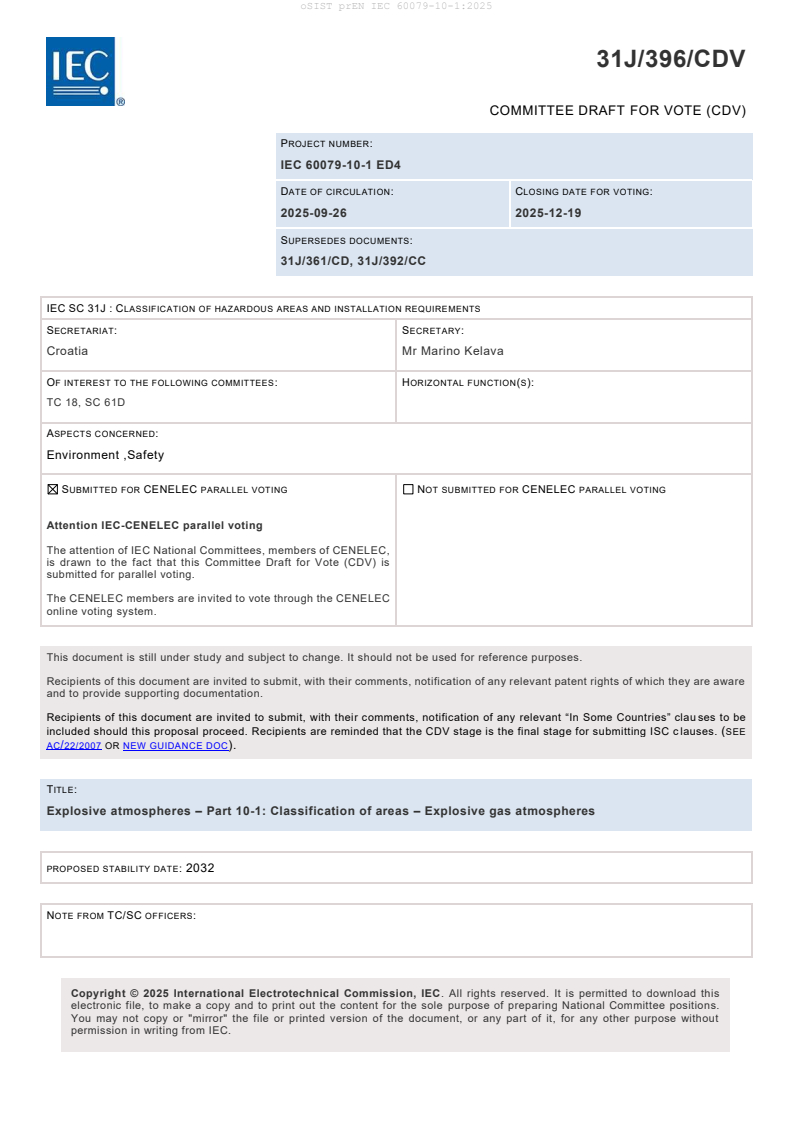
31J/396/CDV
COMMITTEE DRAFT FOR VOTE (CDV)
PROJECT NUMBER:
IEC 60079-10-1 ED4
DATE OF CIRCULATION: CLOSING DATE FOR VOTING:
2025-09-26 2025-12-19
SUPERSEDES DOCUMENTS:
31J/361/CD, 31J/392/CC
IEC SC 31J : CLASSIFICATION OF HAZARDOUS AREAS AND INSTALLATION REQUIREMENTS
SECRETARIAT: SECRETARY:
Croatia Mr Marino Kelava
OF INTEREST TO THE FOLLOWING COMMITTEES: HORIZONTAL FUNCTION(S):
TC 18, SC 61D
ASPECTS CONCERNED:
Environment ,Safety
SUBMITTED FOR CENELEC PARALLEL VOTING NOT SUBMITTED FOR CENELEC PARALLEL VOTING
Attention IEC-CENELEC parallel voting
The attention of IEC National Committees, members of CENELEC,
is drawn to the fact that this Committee Draft for Vote (CDV) is
submitted for parallel voting.
The CENELEC members are invited to vote through the CENELEC
online voting system.
This document is still under study and subject to change. It should not be used for reference purposes.
Recipients of this document are invited to submit, with their comments, notification of any relevant patent rights of which they are aware
and to provide supporting documentation.
Recipients of this document are invited to submit, with their comments, notification of any relevant “In Some Countries” clau ses to be
included should this proposal proceed. Recipients are reminded that the CDV stage is the final stage for submitting ISC c lauses. (SEE
AC/22/2007 OR NEW GUIDANCE DOC).
TITLE:
Explosive atmospheres – Part 10-1: Classification of areas – Explosive gas atmospheres
PROPOSED STABILITY DATE: 2032
NOTE FROM TC/SC OFFICERS:
electronic file, to make a copy and to print out the content for the sole purpose of preparing National Committee positions.
You may not copy or "mirror" the file or printed version of the document, or any part of it, for any other purpose without
permission in writing from IEC.
IEC CDV 60079-10-1 © IEC 2025
CONTENTS
FOREWORD . 5
INTRODUCTION . 17
1 Scope . 18
2 Normative references . 19
3 Terms and definitions . 19
4 General . 24
4.1 Safety principles . 24
4.2 Hazardous area classification objectives . 24
4.3 Management of change . 25
4.4 Commissioning and maintenance activities . 25
4.5 Interior of equipment containing flammable substances . 25
4.6 Explosion risk assessment . 26
4.6.1 General . 26
4.6.2 Zone of negligible extent. 26
4.7 Catastrophic failures . 27
4.8 Competence of personnel . 27
5 Hazardous area classification methodology . 27
5.1 General . 27
5.2 Classification by sources of release method . 28
5.3 Use of industry codes and national standards . 29
5.3.1 General . 29
5.3.2 Fuel gas installations . 29
5.3.3 Simplified methods . 29
5.4 Combination of methods . 30
6 Release of flammable substance . 30
6.1 General . 30
6.2 Sources of release . 30
6.3 Forms of release . 31
6.3.1 General . 31
6.3.2 Gaseous release . 32
6.3.3 Release of gas liquefied under pressure . 32
6.3.4 Release of gas liquefied by refrigeration . 33
6.3.5 Vapours release . 33
6.3.6 Liquid release . 33
7 Ventilation (or air movement) and dilution . 34
7.1 General . 34
7.2 Main types of ventilation . 35
7.2.1 General . 35
7.2.2 Natural ventilation . 35
7.2.3 Artificial ventilation . 35
7.2.4 Degree of dilution . 37
8 Type of zone . 38
8.1 General . 38
8.2 Influence of grade of the source of release . 38
IEC CDV 60079-10-1 © IEC 2025
8.3 Influence of dilution . 39
8.4 Influence of availability of ventilation . 39
9 Extent of zone . 39
10 Documentation . 40
10.1 General . 40
10.2 Drawings, data sheets and tables . 40
Annex A (informative) Suggested presentation of hazardous areas . 42
A.1 Hazardous areas – Preferred symbols for zones . 42
A.2 Hazardous areas – Data sheets examples . 43
A.3 Hazardous areas - Suggested shapes . 45
Annex B (informative) Estimation of sources of release . 49
B.1 Symbols . 49
B.2 Examples of grade of release . 49
B.2.1 General . 49
B.2.2 Sources giving a continuous grade of release . 50
B.2.3 Sources giving a primary grade of release . 50
B.2.4 Sources giving a secondary grade of release . 50
B.3 Assessment of grades of release . 50
B.4 Summation of releases . 51
B.5 Hole size and source radius . 52
B.6 Forms of release . 54
B.7 Release rate . 56
B.7.1 General . 56
B.7.2 Estimation of release rate . 56
B.7.3 Release rate of evaporative pools . 59
B.8 Release from openings in buildings . 61
B.8.1 General . 61
B.8.2 Openings as possible sources of release . 62
B.8.3 Openings classification . 62
Annex C (informative) Ventilation guidance . 64
C.1 Symbols . 64
C.2 General . 65
C.3 Assessment of ventilation and dilution and its influence on hazardous area . 65
C.3.1 General . 65
C.3.2 Effectiveness of ventilation . 66
C.3.3 Criteria for dilution . 66
C.3.4 Assessment of ventilation velocity . 67
C.3.5 Assessment of the degree of dilution . 68
C.3.6 Dilution in a room . 70
C.3.7 Criteria for availability of ventilation . 71
C.4 Examples of ventilation arrangements and assessments . 73
C.4.1 Introduction . 73
C.4.2 Jet release in a large building . 73
C.4.3 Jet release in a small naturally ventilated building . 74
C.4.4 Jet release in a small artificially ventilated building . 74
C.4.5 Low velocity release . 76
C.4.6 Fugitive emissions . 76
IEC CDV 60079-10-1 © IEC 2025
C.4.7 Local extraction ventilation . 76
C.5 Natural ventilation in buildings . 77
C.5.1 General . 77
C.5.2 Wind induced ventilation . 77
C.5.3 Buoyancy induced ventilation . 78
C.5.4 Combination of the natural ventilation induced by wind and buoyancy . 80
Annex D (informative) Estimation of hazardous areas . 82
D.1 General . 82
D.2 Estimating types of the zones . 82
D.3 Estimating the extent of the hazardous area . 83
Annex E (informative) Examples of hazardous area classification . 85
E.1 General . 85
E.2 Examples . 85
E.3 Example case study for hazardous area classification . 101
Annex F (informative) Schematic approach to classification of hazardous areas . 111
F.1 Schematic approach to classification of hazardous areas . 111
F.2 Schematic approach to classification of hazardous areas . 112
F.3 Schematic approach to classification of hazardous areas . 113
F.4 Schematic approach to classification of hazardous areas . 114
Annex G (informative) Mists . 116
Annex H (informative) Hybrid mixtures . 119
H.1 General . 119
H.2 Use of ventilation . 119
H.3 Concentration limits . 119
H.4 Chemical reactions . 119
H.5 Energy/temperature limits . 119
H.6 Zoning requirements . 119
Annex I (informative) Useful equations in support to hazardous area classification . 120
I.1 General . 120
I.2 Dilution with air of a flammable substance release . 120
I.3 Estimate of the time required to dilute a flammable substance release . 121
Bibliography . 122
Figure 1 – Dilution volume . 38
Figure A.1 – Preferred symbols for zones . 42
Figure A.2 – Gas or vapour at low pressure (or at high pressure in case of
unpredictable release direction) . 45
Figure A.3 – Gas or vapour at high pressure . 46
Figure A.4 – Liquefied gas . 47
Figure A.5 – Flammable liquid (non boiling evaporative pool) . 48
Figure A.6 – Heavier than air gas or vapour (released at elevated heights) . 48
Figure A.7 – Heavier than air gas or vapour (released near grade) . 48
Figure B.1 – Forms of release . 55
Figure B.2 – Evaporation rate per unit area of liquid . 61
Figure C.1 – Chart for assessing the degree of dilution . 69
IEC CDV 60079-10-1 © IEC 2025
Figure C.2 – Self diffusion of an unimpeded high velocity jet release . 74
Figure C.3 – Supply only ventilation . 75
Figure C.4 – Supply and extraction ventilation . 75
Figure C.5 – Local extraction ventilation . 77
Figure C.6 – Specific volumetric flow rate of fresh air of equivalent effective opening
area 80
Figure C.7 – Example of opposing ventilation driving forces. 81
Figure D.1 – Chart for estimating hazardous area distances . 84
Figure E.1 – Degree of dilution (Example 1) . 87
Figure E.2 – Hazardous distance (Example 1) . 88
Figure E.3 – Zone classification (Example 1) . 89
Figure E.4 – Degree of dilution (Example 2) . 91
Figure E.5 – Degree of dilution (Example 3) . 93
Figure E.6 – Hazardous distance (Example 3) . 94
Figure E.7 – Zones classification (Example 3) . 95
Figure E.8 – Degree of dilution (Example 4) . 96
Figure E.9 – Hazardous distance (Example 4) . 97
Figure E.10 – Zones classification (Example 4) . 98
Figure E.11 – Degree of dilution (Example 5) . 101
Figure E.12 – Enclosed compressor handling natural gas . 103
Figure E.13 – Example of hazardous area classification for a compressor facility
handling natural gas (elevation) . 109
Figure E.14 – Example of hazardous area classification for a compressor facility
handling natural gas (plan) . 110
Figure F.1 – Schematic approach to classification. 111
Figure F.2 – Schematic approach to classification for continuous grade releases . 112
Figure F.3 – Schematic approach to classification for primary grade releases . 114
Figure F.4 – Schematic approach to classification for secondary grade releases . 115
Table A.1 – Hazardous area classification data sheet example – Part I: Flammable
substance list and characteristics . 43
Table A.2 – Hazardous area classification data sheet example – Part II: List of sources
of release . 44
Table B.1 – Suggested hole cross sections for secondary grade of releases . 53
Table B.2 – Effect of zones on openings as possible sources of release . 63
Table C.1 – Indicative minimum outdoor ventilation velocities (u ) . 68
w
Table D.1 – Zones for grade of release and effectiveness of ventilation . 82
Table E.1 – Compressor facility handling natural gas . 103
Table E.2 – Hazardous area classification data sheet – Part I: Flammable substance
list and characteristics . 106
Table E.3 – Hazardous area classification data sheet – Part II: List of sources of
release . 107
IEC CDV 60079-10-1 © IEC 2025
INTERNATIONAL ELECTROTECHNICAL COMMISSION
____________
EXPLOSIVE ATMOSPHERES –
Part 10-1: Classification of areas –
Explosive gas atmospheres
FOREWORD
1) The International Electrotechnical Commission (IEC) is a worldwide organization for standardization comprising
all national electrotechnical committees (IEC National Committees). The object of IEC is to promote international
co-operation on all questions concerning standardization in the electrical and electronic fields. To this end and
in addition to other activities, IEC publishes International Standards, Technical Specifications, Technical Reports,
Publicly Available Specifications (PAS) and Guides (hereafter referred to as “IEC Publication(s)”). Their
preparation is entrusted to technical committees; any IEC National Committee interested in the subject dealt with
may participate in this preparatory work. International, governmental and non-governmental organizations liaising
with the IEC also participate in this preparation. IEC collaborates closely with the International Organization for
Standardization (ISO) in accordance with conditions determined by agreement between the two organizations.
2) The formal decisions or agreements of IEC on technical matters express, as nearly as possible, an international
consensus of opinion on the relevant subjects since each technical committee has representation from all
interested IEC National Committees.
3) IEC Publications have the form of recommendations for international use and are accepted by IEC National
Committees in that sense. While all reasonable efforts are made to ensure that the technical content of IEC
Publications is accurate, IEC cannot be held responsible for the way in which they are used or for any
misinterpretation by any end user.
4) In order to promote international uniformity, IEC National Committees undertake to apply IEC Publications
transparently to the maximum extent possible in their national and regional publications. Any divergence between
any IEC Publication and the corresponding national or regional publication shall be clearly indicated in the latter.
5) IEC itself does not provide any attestation of conformity. Independent certification bodies provide conformity
assessment services and, in some areas, access to IEC marks of conformity. IEC is not responsible for any
services carried out by independent certification bodies.
6) All users should ensure that they have the latest edition of this publication.
7) No liability shall attach to IEC or its directors, employees, servants or agents including individual experts and
members of its technical committees and IEC National Committees for any personal injury, property damage or
other damage of any nature whatsoever, whether direct or indirect, or for costs (including legal fees) and
expenses arising out of the publication, use of, or reliance upon, this IEC Publication or any other IEC
Publications.
8) Attention is drawn to the Normative references cited in this publication. Use of the referenced publications is
indispensable for the correct application of this publication.
9) Attention is drawn to the possibility that some of the elements of this IEC Publication may be the subject of patent
rights. IEC shall not be held responsible for identifying any or all such patent rights.
International Standard IEC 60079-10-1 has been prepared by subcommittee 31J: Classification
of hazardous areas and installation requirements, of IEC technical committee 31: Equipment
for explosive atmospheres.
This fourth edition of IEC 60079-10-1 cancels and replaces the third edition, published in 2020,
and constitutes a technical revision. The significant technical changes with respect to the
previous edition are as follows:
IEC CDV 60079-10-1 © IEC 2025
Type
Minor and Major
Changes Clause editorial Extension technical
changes changes
‘Should’ has been replaced with ‘shall’ throughout the
X
entire body text where appropriate
‘May’ has been replaced with ‘could’ throughout the
X
entire body text where appropriate
‘vapour’ has been added to ‘gas’ throughout the
X
entire body text where appropriate
‘vol/vol’ replaced with ‘volume fraction’ throughout
X
the entire body text to meet the ISO/IEC directives
‘barg’ has been replaced with ‘bar’ to align with
ISO/IEC 80000-1 and clarified gauge or absolute X
pressures throughout the entire body text
The scope has been aligned with other IEC standards
1 X
of the 60079 series
The sentence ‘For the purpose of this document, an
area is a three-dimensional region or space’ is
1 X
deleted and moved into 3.4.1 as a Note 1 to entry
Note was added to clarify atmospheric or ambient
1 X
conditions
th
In the 4 paragraph, ‘naked flames’ is replaced
1 X
by ’open flames’
Added definition of “Ex Equipment” 3 X
A Note to entry is introduced in 3.4.1: ‘For the
purpose of this document, an area is a three- 3 X
dimensional region or space.
Changed the definition under 3.5.5 by deleting ‘mist’ 3 X
Replaced the definition under 3.7.5 with the definition
3 X
for mist from IEV 426
Added Notes to entry in 3.7.5:
Note 1 to entry: Mists in the flammable range are
also known as aerosols.
3 X
Note 2 to entry: A mist could form an explosive
atmosphere where the mist is associated with a
flammable liquid. Mists due to combustible liquids
could still be ignited but are not dealt with in this
standard. See Annex G
‘Likelihood and duration’ introduced to avoid mixing the
terms like for example: ‘likelihood and frequency of such 4.1 X
releases’ and ‘frequency and duration of such releases’
th
4 paragraph of 4.1 moved to a new subclause
4.1 X
4.4 Commissioning and maintenance activities
Added in NOTE 2 ‘So Far As Is Reasonably
Practicable (SFAIRP) is also recognised as an 4.1 X
equivalent term.’
st
Added ‘auto-‘ to ‘ignition temperature’ in the 1
4.2 X
paragraph
In Note ‘ignition energy’ changed to ‘equipment
group’ and ‘temperature ratings’ changed to 4.2 X
‘temperature class’
Added ‘that could affect the classification’ to ‘The
hazardous area classification should be updated for 4.2 X
any plant or operational changes’
th
New subclause introduced before 4 paragraph of
4.3 X
4.2: 4.3 Management of change
IEC CDV 60079-10-1 © IEC 2025
Type
Minor and Major
Changes Clause editorial Extension technical
changes changes
New subclause introduced: 4.4 Commissioning and
4.4 X
maintenance activities
Because of additional subclauses in 4, all the
4.4 X
subclauses including 4.4 are renumbered up to 4.8
The wording has been aligned with IEV 426; changed
4.5 X
flammable substances to flammable materials
Limiting the oxygen concentration was added as a
4.5 X
specific control measure
Note 2 has been added 4.5 X
Documentation of the specific controls for area
4.5 X
classification has been added
The requirement to provide justification as part of the
documentation for classifying the potentially 4.6.2 X
hazardous area as a Zone NE has been added
Criteria for a Zone NE classification have been more
4.6.2 X
clearly formulated
Note 3 has been added 4.6.2 X
The reliability of the control system as a basis for
5.1 X
reducing risk was emphasized
nd
Set of editorial changes in the bulleted part of the 2
5.2 X
paragraph
Note has been added to refer to the supporting
5.3.1 X
document
st
In the 1 paragraph ‘low pressure’ replaced by ‘low
or medium pressure’
In the NOTE below fixed values of the pressure (100
to 200 kPa) are deleted
5.3.2 C1
nd
The 2 paragraph reworded to: ‘Compliance to the
national gas codes may result in a classification that
is non-hazardous or lead to a zone of negligible
extent.’
The NOTE is reworded to:
Ammonia has an LFL of 15 % by volume and a
release of ammonia will often dissipate rapidly in the
6.1 C2
open air (outdoor). Experience has shown that in
most cases these conditions can result in an
explosive gas atmosphere that is considered of
negligible extent
NOTE 3 and NOTE 4 added to explain the role of Le
6.2 C3
Chatelier’s law in determining LFL
The subclause 6.3.5 is moved to Annex G.
6.3 X
The text edited in respect to the word ‘flammable’ related to
mists.
Because of removing subclause 6.3.5, the subclauses
6.3 X
below 6.3.6 and 6.3.7 are renumbered to 6.3.5 and 6.3.6
For practical applications, it has been added that a gas or
vapor is considered neutrally buoyant at a relative density 6.3.2 X
between 0.8 and 1.2
Former 6.3.5 “Flammable mist release” was deleted,
because mists are not in the scope.
6.3.5 X
The numbering of the following sections has been changed
accordingly
IEC CDV 60079-10-1 © IEC 2025
Type
Minor and Major
Changes Clause editorial Extension technical
changes changes
st
In the 1 paragraph ‘size of the resultant pool’ added
as a factor that influences the size of the vapour 6.3.6 X
cloud
Note added to refer to IEC 60079-1 7.2.3.1 X
The following text is added into the item e):
turbulence and circulating air patterns; the presence
of ventilation “short circuits” where a source of supply
7.2.3.2 X
air is in proximity to ventilation outlet may result in
areas of stagnant air movement outside of the air
stream.
‘Efficiency’ was changed into ‘Effectiveness’ in the
8.4 X
Note
The safety factor was explicitly mentioned to clarify
9 X
the extent of the zone
The safety factor was explained in more detail using
9 X
the LFL
Note 1 has been added to explain lower values for
9 X
gas detection
The requirements for documenting hazardous area
10.1 X
classification have been simplified.
Note 1 regarding section drawings has been added 10.2 X
The requirements for a symbol legend have been
10.2 X
described in more detail
Note 2 added to refer to IEC 60079-13 10.2 X
NOTE 3 regarding additional information on drawings
10.2 X
has been added
Added ‘example’ to the title of the Table A.1 A.1
X
Table A.1
Added ‘NOTE Columns for parameters for the table
A.1
can be added or deleted if desired for the application.
X
For example, CAS number, minimum ignition energy.’
Table A.1
in the bottom of Table A.1
New subclause introduced: A.2 Hazardous areas –
A.2 X
Data sheets examples
Because of introducing new subclause A.2, the former
A.3 X
subclause A.2 is renumbered A.3
Modified the heading of subclause A.3 for uniformity
A.3
with A.1 and A.2
Added Figure A.6 and Figure A.7 for heavier than air
gases or vapour released at elevated heights and A.3 C4
near grade
Vapours added in the definitions for Q and W
B.1 X
g g
‘pressure inside the container’ replaced by ‘absolute
B.1 X
pressure inside the container’
Modified the definition of ∆p from ‘pressure difference
across the opening that leaks in (Pa)’ to ‘pressure
B.1 X
difference across the opening (hole) through which
the fluid is released (Pa)’
Deleted ‘gas or liquid’ from the definition of T B.1 X
IEC CDV 60079-10-1 © IEC 2025
Type
Minor and Major
Changes Clause editorial Extension technical
changes changes
Changed the definition of W from ‘evaporation rate
e
B.1 X
of liquid (kg/s)’ to ‘mass evaporation rate of
flammable vapour (kg/s)’
Subscript ‘l’ as for liquids added to W to make it W
l
and changed the definition from ‘release rate of liquid
B.1 X
(mass per time, kg/s)’ to ‘mass release rate of liquid
(kg/s)
Fugitive emissions added as item c) B.2.2 X
Set of editorial changes in the bulleted part of the
B.2.3 X
paragraph
Modified example b) to read ‘water drainage points
on vessels which contain flammable substances
which could release the flammable substance into the B.2.3 X
atmosphere while draining off water during normal
operation;’
Set of editorial changes in the bulleted part of the
B.2.4 X
paragraph
‘. and overall continuous’ added into the third bullet
B.4 X
th
of the 5 paragraph
rd
Revised the last sentence in the 3 paragraph and
B.5 X
relocated it to be a separate paragraph
Changed ‘Ring type joint connections’ to ‘Ring type B.5
X
joint flanges’ in the Table B.1
Table B.1
Explanation ‘a Expanding/erosion effect can occur at
B.5
gauge pressures higher than 10 bar.’ added in the
X
Table B.1 with changes of other superscripts
Table B.1
accordingly
Changed former note c (now note d) to provide
B.5
additional guidance for pumps and other types of X
Table B.1
compressors; not just reciprocating compressors
‘explosive atmosphere’ replaced by ‘explosive gas
B.7.1 X
atmosphere’ in item d)
st
Changed ‘approximation’ to ‘equation’ in the 1
B.7.2.2 X
sentence
Subscript ‘l’ as for liquids added in Equation (B.1) to
B.7.2.2 X
make it W
l
st
Modified the 1 paragraph for clarity by adding an
B.7.2.3.1 X
example
rd
Deleting ‘inside the gas container’ in the 3
B.7.2.3.1 X
paragraph
In the last paragraph
‘For low to medium pressures, Z =1,0 can be used as
a reasonable approximation. For higher pressures,
e.g. above 50 bar, and where improved accuracy is
required the real compressibility factor should be
B.7.2.3.1 X
applied.’ substituted with:
‘For pressures, for example, below 50 bar, Z = 1 can
be used as a reasonable approximation. For higher
pressures and where improved accuracy is required
the real compressibility factor should be applied’
Equation (B.3) is modified for clarity by moving the
B.7.2.3.2 X
last terms in front of the square root
IEC CDV 60079-10-1 © IEC 2025
Type
Minor and Major
Changes Clause editorial Extension technical
changes changes
The sentence is added after the equation (B.5):
B.7.2.3.3 X
‘The volumetric flow rate can be estimated from the
mass flow rate by applying equation (B.4)’
st
New 1 paragraph added ‘The release rate from
evaporative pools is a complex condition with many
variables that will also change for every situation.
Users should apply a formula or methodology that
B.7.3 C5
can be validated as giving reasonable or
conservative results for the situation concerned. A
methodology that might be used for some situations
is outlined in this section.’
‘NOTE 2 Open vessel is a container with the top
completely open to atmosphere’ added and the
B.7.3 C6
numbering of the following NOTE has been changed
accordingly
nd rd
The 2 paragraph is reworded and the 3 bullet point
rd
of the 3 paragraph removed. Replaced by new
NOTE 9 ‘When determining the area of liquid pools, a
B.7.3 X
nominal pool depth of 1 cm or greater can be
assumed as this is less susceptible to thermodynamic
inputs from the surface than thin surface spills.’
NOTE 2 (now NOTE 3) reworded by adding the
sentence: ‘The equation does not pretend to be the
most accurate of all the simplified approaches B.7.3 X
present in the literature but is reasonably
conservative to deliver safe results
NOTE 5 (now NOTE 6) moved below NOTE 4
B.7.3 X
because they are also valid for equation (B.6)
‘NOTE 7 Equation (B.6) should be considered with
caution at wind speeds below 1 m/s. Its use at wind
B.7.3 C7
speed below 0,15 m/s shall be avoided’ added
‘NOTE 8 The formula is also valid only for liquids at
temperature well below their boiling point or vapour
pressure well below atmospheric pressure (below 80
B.7.3 X
kPa) added’
The numbering of the following NOTE has been
changed accordingly
The equation for p is assigned a formula number
g
B.7.3 X
(B.7) and the subsequent equations (B.7) and (B.8)
are renumbered (B.8) and (B.9)
The paragraph below Figure B.2 is reworded by
B.7.3 X
reference to both equations (B.7) and (B.8)
Left side of the equation (B.9) is written as Q /A
B.7.3 X
e p
Equations (B.7) and (B.8) corrected for the more
B.7.3 C8
accurate value of p = 101325 Pa
a
Q replaced by Q in equations (B.7) and (B.8)
B.7.3 X
g e
The description on the vertical axis of Figure B.2 is B.7.3
modified to Q /A
e p
Figure B.2
The chart in Figure B.2 is modified for the wind speed B.7.3
C9
of u = 1 m/s
w
Figure B.2
The description on the horizontal axis of Figure B.2 is B.7.3
X
modified to p x 10 (Pa)
v
Figure B.2
IEC CDV 60079-10-1 © IEC 2025
Type
Minor and Major
Changes Clause editorial Extension technical
changes changes
Heading of Table B.2 changed from ‘Zone outside of B.8.3
X
opening’ to ‘Zone type of the adjoining area’
Table B.2
C redefined to be equal throughout the whole text C.1 X
Q redefined to be equal throughout the whole text C.1 and
a
X
C.3.6.2
‘likely’ deleted in the first paragraph C.1 X
‘See also 4.6.2’ added at the end of the paragraph C.3.2 X
‘ratio of release rate and LFL in mass units’ replaced
with ‘ratio of volumetric release rate and LFL’ into the C.3.3 X
first bullet
u calculated considering only Q (not ‘volumetric air/gas
a
w
C.3.4 C10
th
mixture’) is stated in 4 paragraaph
th
4 paragraph reworded for clarity
C.3.4 X
The title of the Table C.1 is reworded by adding C.3.4
C11
‘minimum’
Table C.1
‘(relative density < 0,8)’ added in the Table C.1 to C.3.4
X
‘Lighter than air gas/vapour releases’
Table C.1
The NOTE in the bottom cell of Table C.1 is reworded
replacing ‘as fair’ with ‘as good’ and the word
C.3.4
‘meteorological’ in conjunction with C12
Table C.1
the ’meteorological calm conditions’ is deleted
throughout the whole text
‘a jet release in a large room’ replaced with ‘and
C.3.5 X
mass release rate’
‘or if indicated through an assessment based on
th
Figure C.1’ added to ‘’ added at the end of the 4 C.3.5 X
paragraph
‘Figure C.1 is not intended for guidance when
C.3.5 C13
considering releases from large pools.’ deleted
nd
‘at the ambient conditions’ added to the 2 equation
C.3.5 X
below Figure C.1
‘W may be replaced with W in case of evaporation from
g e
C.3.5 C14
an evaporative pool’ added below Figure C.1
NOTE 1 and NOTE 2 are added below Figure C.1
C.3.5 X
The paragraph below the Figure C.1 is reworded for
C.3.5 X
clarity
’flammable volume’ replaced by ‘a cloud with a flammable
C.3.5 X
nd
volume of’ in the 2 paragraph below Figure C.1
nd rd
The 2 and the 3 sentences in the 2nd paragraph
below Figure C.1 are deleted and moved into NOTE 2 C.3.5 X
and NOTE 3 added below Figure C.1
Equation (C.1) modified
C.3.6.2 C15
The equation behind (C.1) is modified and numbered X
C.3.6.2 C16
as (C.2)
All the superseding equations that follow (C.2) are C.3.6.2 and
renumbered the clauses X
behind
‘safety factor’ replaced with ‘ventilation inefficiency
C.3.6.2 X
nd
factor’ in the 2 paragraph below the Equation (C.1)
IEC CDV 60079-10-1 © IEC 2025
Type
Minor and Major
Changes Clause editorial Extension technical
changes changes
Replacing f = 1 with f > 1 (correction of the typo) C.3.6.2 X
‘The degree of dilution should be taken as being low
if the background concentration exceeds 25 % of the
C.3.6.2 X
LFL or if indicated through an assessment based on
Figure C.1’ deleted in the last paragraph
‘It has to be assumed that the higher the difference
between indoor and outdoor temperature applied for
calculation, the lower the level of availability in terms
C.3.6.2 X
th
of diluting an explosive gas atmosphere’ in the 4
paragraph is reworded and changed as NOTE
nd st
The 2 sentence in the 1 paragraph is reworded C.3.7.3 X
st st nd
The 1 paragraph is breaked after the 1 and 2
C.3.7.3 X
sentence
nd
NOTE added after the 2 paragraph C.3.7.3 X
nd
Added a new paragraph and a NOTE after the 2
C.4.1 X
paragraph
Title reworded and C.4.5 reworded accordingly
C.4.5 X
‘instrument panels or instrument weather protection
enclosures, thermally insulated heated enclosures or
enclosed spaces between pipe installations and the
envelope of thermal insulation or similar items with C.4.6 X
nd
higher pressure gas lines’ deleted in the 2
rd
paragraph and moved in the 3 paragraph with
additions
Title reworded and C.4.7 reworded accordingly C.4.7 X
st
The last sentence in the 1 paragraph replaced with
‘Infiltration shall not be taken into account when
...
Questions, Comments and Discussion
Ask us and Technical Secretary will try to provide an answer. You can facilitate discussion about the standard in here.
Loading comments...