


EN 62282-2:2004
(Main)Fuel cell technologies - Part 2: Fuel cell modules
General Information
- Abstract
Provides the minimum requirements for safety and performance of fuel cell modules. Applies to fuel cell modules with the following electrolyte chemistry: alkaline; proton exchange membrane (including direct methanol fuel cells); phosphoric acid; molten carbonate; solid oxide fuel cell modules.
- Status
- Withdrawn
- Publication Date
- 16-Nov-2004
- Withdrawal Date
- 30-Sep-2007
- Technical Committee
- CLC/SR 105 - Fuel cell technologies
- Drafting Committee
- IEC/TC 105 - IEC_TC_105
- Parallel Committee
- IEC/TC 105 - IEC_TC_105
- Current Stage
- 9960 - Withdrawal effective - Withdrawal
- Start Date
- 30-Apr-2015
- Completion Date
- 30-Apr-2015

Relations
- Effective Date
- 29-Jan-2023
- Effective Date
- 10-Feb-2026
- Refers
ISO 188:1998 - Rubber, vulcanized or thermoplastic — Accelerated ageing and heat resistance tests - Effective Date
- 10-Feb-2026
- Effective Date
- 10-Feb-2026
- Effective Date
- 09-Feb-2026
- Effective Date
- 09-Feb-2026
- Effective Date
- 09-Feb-2026
- Effective Date
- 09-Feb-2026
- Effective Date
- 09-Feb-2026
- Effective Date
- 03-Feb-2026
- Effective Date
- 03-Feb-2026
- Effective Date
- 03-Feb-2026
- Effective Date
- 03-Feb-2026
- Effective Date
- 03-Feb-2026
- Effective Date
- 03-Feb-2026
Get Certified
Connect with accredited certification bodies for this standard

DNV
DNV is an independent assurance and risk management provider.

Lloyd's Register
Lloyd's Register is a global professional services organisation specialising in engineering and technology.
DNV Energy Systems
Energy and renewable energy certification.
Sponsored listings
Frequently Asked Questions
EN 62282-2:2004 is a standard published by CLC. Its full title is "Fuel cell technologies - Part 2: Fuel cell modules". This standard covers: Provides the minimum requirements for safety and performance of fuel cell modules. Applies to fuel cell modules with the following electrolyte chemistry: alkaline; proton exchange membrane (including direct methanol fuel cells); phosphoric acid; molten carbonate; solid oxide fuel cell modules.
Provides the minimum requirements for safety and performance of fuel cell modules. Applies to fuel cell modules with the following electrolyte chemistry: alkaline; proton exchange membrane (including direct methanol fuel cells); phosphoric acid; molten carbonate; solid oxide fuel cell modules.
EN 62282-2:2004 is classified under the following ICS (International Classification for Standards) categories: 27.070 - Fuel cells. The ICS classification helps identify the subject area and facilitates finding related standards.
EN 62282-2:2004 has the following relationships with other standards: It is inter standard links to EN 62282-2:2012, ISO 1436-1:2001, ISO 188:1998, ISO 37:1994, EN ISO 1307:1995, EN 594:1995, EN 13592:2003+A1:2007, EN ISO 1402:1996, EN ISO 4672:1999, EN 60079-1:2004, EN 60079-10:2003, HD 485 S1:1987, HD 617 S1:1992, EN 60695-1-30:2002, EN 61508-1:2001. Understanding these relationships helps ensure you are using the most current and applicable version of the standard.
EN 62282-2:2004 is available in PDF format for immediate download after purchase. The document can be added to your cart and obtained through the secure checkout process. Digital delivery ensures instant access to the complete standard document.
Standards Content (Sample)
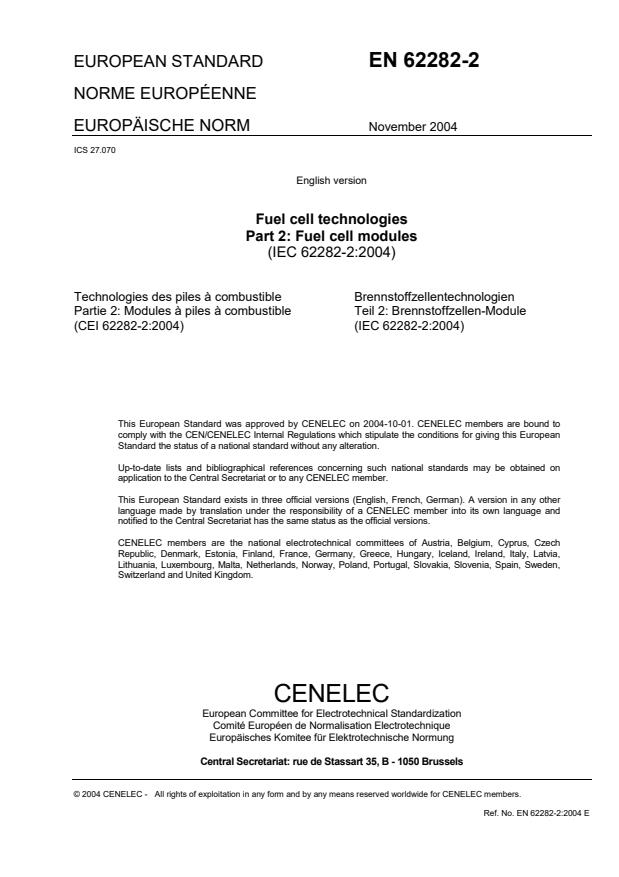
STANDARDTehnologije gorivnih celic – 2. del: Moduli gorivnih celicFuel cell technologies – Part 2: Fuel cell modules©
Standard je založil in izdal Slovenski inštitut za standardizacijo. Razmnoževanje ali kopiranje celote ali delov tega dokumenta ni dovoljenoReferenčna številkaSIST EN 62282-2:2005(en)ICS27.070
EUROPEAN STANDARD
EN 62282-2 NORME EUROPÉENNE EUROPÄISCHE NORM
November 2004 CENELEC European Committee for Electrotechnical Standardization Comité Européen de Normalisation Electrotechnique Europäisches Komitee für Elektrotechnische Normung
Central Secretariat: rue de Stassart 35, B - 1050 Brussels
© 2004 CENELEC - All rights of exploitation in any form and by any means reserved worldwide for CENELEC members.
Ref. No. EN 62282-2:2004 E
ICS 27.070
English version
Fuel cell technologies Part 2: Fuel cell modules (IEC 62282-2:2004)
Technologies des piles à combustible Partie 2: Modules à piles à combustible (CEI 62282-2:2004)
Brennstoffzellentechnologien Teil 2: Brennstoffzellen-Module (IEC 62282-2:2004)
This European Standard was approved by CENELEC on 2004-10-01. CENELEC members are bound to comply with the CEN/CENELEC Internal Regulations which stipulate the conditions for giving this European Standard the status of a national standard without any alteration.
Up-to-date lists and bibliographical references concerning such national standards may be obtained on application to the Central Secretariat or to any CENELEC member.
This European Standard exists in three official versions (English, French, German). A version in any other language made by translation under the responsibility of a CENELEC member into its own language and notified to the Central Secretariat has the same status as the official versions.
CENELEC members are the national electrotechnical committees of Austria, Belgium, Cyprus, Czech Republic, Denmark, Estonia, Finland, France, Germany, Greece, Hungary, Iceland, Ireland, Italy, Latvia, Lithuania, Luxembourg, Malta, Netherlands, Norway, Poland, Portugal, Slovakia, Slovenia, Spain, Sweden, Switzerland and United Kingdom.
at national level by publication of an identical
national standard or by endorsement
(dop)
2005-07-01 – latest date by which the national standards conflicting
with the EN have to be withdrawn
(dow)
2007-10-01 Annex ZA has been added by CENELEC. __________ Endorsement notice The text of the International Standard IEC 62282-2:2004 was approved by CENELEC as a European Standard without any modification. In the official version, for Bibliography, the following notes have to be added for the standards indicated: IEC 60664-1 NOTE Harmonized as EN 60664-1:2003 (not modified). IEC 60112 NOTE Harmonized as EN 60112:2003 (not modified). IEC 60730 NOTE Harmonized in EN 60730 series (not modified). ISO 228-1 NOTE Harmonized as EN ISO 228-1:2003 (not modified). ISO 228-2 NOTE Harmonized as EN ISO 228-2:2003 (not modified). __________
Annex ZA
(normative)
Normative references to international publications
with their corresponding European publications The following referenced documents are indispensable for the application of this document. For dated references, only the edition cited applies. For undated references, the latest edition of the referenced document (including any amendments) applies. NOTE Where an international publication has been modified by common modifications, indicated by (mod), the relevant EN/HD applies. Publication Year Title EN/HD Year IEC 60079 Series Electrical apparatus for explosive gas atmospheres
EN 50014 &
related ENs EN 60079
Series
Series IEC 60079-10 - 1) Part 10: Classification of hazardous areas EN 60079-10 2003 2) IEC 60352 Series Solderless connections
EN 60352 Series IEC 60512-8 - 1) Electromechanical components for electronic equipment; basic testing procedures and measuring methods Part 8: Connector tests (mechanical) and mechanical tests on contacts and terminations
- - IEC 60529 - 1) Degrees of protection provided by enclosures (IP Code)
EN 60529 + corr. May 1991 2)1993 IEC 60617
database Graphical symbols for diagrams
- - IEC 60695 Series Fire hazard testing
EN 60695 Series IEC 60812 - 1) Analysis techniques for system reliability -Procedure for failure mode and effects analysis (FMEA)
HD 485 S1 1987 2) IEC 61025 - 1) Fault tree analysis (FTA)
HD 617 S1 1992 2) IEC 61508 Series Functional safety of electrical/electronic/programmable electronic safety-related systems
EN 61508 Series IEC 61508-1 - 1) Functional safety of electrical/electronic/programmable electronic safety-related systems Part 1: General requirements EN 61508-1 2001 2)
1) Undated reference.
2) Valid edition at date of issue.
- - ISO 188 1998 Rubber, vulcanized or thermoplastic - Accelerated ageing and heat-resistance tests
- - ISO 1307 1992 Rubber and plastics hoses for general-purpose industrial applications - Bore diameters and tolerances, and tolerances on length
EN ISO 1307 1995 ISO 1402 1994 Rubber and plastics hoses and hose assemblies - Hydrostatic testing
EN ISO 1402 1996 ISO 1436-1 2001 Rubber hoses and hose assemblies - Wire-braid-reinforced hydraulic types - Specification Part 1: Oil-based fluid applications
- - ISO 4672 1997 Rubber and plastics hoses - Sub-ambient temperature flexibility tests
EN ISO 4672 1999
Electronic equipment for use in power installations
EN 50178 1997
NORMEINTERNATIONALECEIIECINTERNATIONALSTANDARD62282-2Première éditionFirst edition2004-07Technologies des piles à combustible – Partie 2: Modules à piles à combustible Fuel cell technologies – Part 2: Fuel cell modules Pour prix, voir catalogue en vigueur For price, see current catalogue” IEC 2004
Droits de reproduction réservés
Copyright - all rights reservedAucune partie de cette publication ne peut être reproduite ni utilisée sous quelque forme que ce soit et par aucun procédé, électronique ou mécanique, y compris la photocopie et les microfilms, sans l'accord écrit de l'éditeur. No part of this publication may be reproduced or utilized in any form or by any means, electronic or mechanical, including photocopying and microfilm, without permission in writing from the publisher. International Electrotechnical Commission,
3, rue de Varembé, PO Box 131, CH-1211 Geneva 20, SwitzerlandTelephone: +41 22 919 02 11 Telefax: +41 22 919 03 00 E-mail: inmail@iec.ch
Web: www.iec.ch CODE PRIX PRICE CODE WCommission Electrotechnique InternationaleInternational Electrotechnical Commission
62282-2 ” IEC:2004 – 3 – CONTENTSFOREWORD.5INTRODUCTION.91 Scope.11 2 Normative references.13 3 Terms and definitions.15 4 Requirements.234.1 General safety strategy.23 4.2 Design requirements.25 5 Type tests.35 5.1 Gas leakage test.35 5.2 Normal operation.37 5.3 Allowable working pressure test.39 5.4 Pressure withstanding test of cooling system.41 5.5 Electrical overload test.41 5.6 Overpressure test.41 5.7 Dielectric strength test.41 5.8 Differential pressure test.45 5.9 Gas leakage test (repeat).45 5.10 Normal operation (repeat).45 5.11 Flammable concentration test.45 5.12 Tests of abnormal conditions.47 6 Routine tests.516.1 Gas-tightness test.51 6.2 Dielectric strength withstand test.51 7 Markings and instructions.51 7.1 Nameplate.51 7.2 Marking.53 7.3 Warning label.53 7.4 Documentation.53 Annex A (informative) Additional information for the performance and evaluation
of the tests.61 Bibliography.75 Figure 1 – Fuel cell system components and scope of standard.13 Table 1
Dielectric strength test voltages (derived from EN 50178).43 Table A.1 – Viscosity of gases at one atmosphere.67
62282-2 ” IEC:2004 – 5 – INTERNATIONAL ELECTROTECHNICAL COMMISSION ____________FUEL CELL TECHNOLOGIES –
Part 2: Fuel cell modules FOREWORD1) The International Electrotechnical Commission (IEC) is a worldwide organization for standardization comprising all national electrotechnical committees (IEC National Committees). The object of IEC is to promote international co-operation on all questions concerning standardization in the electrical and electronic fields. To this end and in addition to other activities, IEC publishes International Standards, Technical Specifications, Technical Reports, Publicly Available Specifications (PAS) and Guides (hereafter referred to as “IEC Publication(s)”). Their preparation is entrusted to technical committees; any IEC National Committee interested in the subject dealt with may participate in this preparatory work. International, governmental and non-governmental organizations liaising with the IEC also participate in this preparation. IEC collaborates closely with the International Organization for Standardization (ISO) in accordance with conditions determined by agreement between the two organizations. 2) The formal decisions or agreements of IEC on technical matters express, as nearly as possible, an international consensus of opinion on the relevant subjects since each technical committee has representation from all interested IEC National Committees.
3) IEC Publications have the form of recommendations for international use and are accepted by IEC National Committees in that sense. While all reasonable efforts are made to ensure that the technical content of IEC Publications is accurate, IEC cannot be held responsible for the way in which they are used or for any misinterpretation by any end user. 4) In order to promote international uniformity, IEC National Committees undertake to apply IEC Publications transparently to the maximum extent possible in their national and regional publications. Any divergence between any IEC Publication and the corresponding national or regional publication shall be clearly indicated in the latter. 5) IEC provides no marking procedure to indicate its approval and cannot be rendered responsible for any equipment declared to be in conformity with an IEC Publication. 6) All users should ensure that they have the latest edition of this publication. 7) No liability shall attach to IEC or its directors, employees, servants or agents including individual experts and members of its technical committees and IEC National Committees for any personal injury, property damage or other damage of any nature whatsoever, whether direct or indirect, or for costs (including legal fees) and expenses arising out of the publication, use of, or reliance upon, this IEC Publication or any other IEC Publications.
8) Attention is drawn to the Normative references cited in this publication. Use of the referenced publications is indispensable for the correct application of this publication. 9) Attention is drawn to the possibility that some of the elements of this IEC Publication may be the subject of patent rights. IEC shall not be held responsible for identifying any or all such patent rights. International Standard IEC 62282-2 has been prepared by IEC technical committee 105: Fuel cell technologies. The text of this standard is based on the following documents: FDIS Report on voting 105/73/FDIS 105/77/RVD Full information on the voting for the approval of this standard can be found in the report on voting indicated in the above table. This publication has been drafted in accordance with the ISO/IEC Directives, Part 2.
62282-2 ” IEC:2004 – 7 – IEC 62282 consists of the following parts under the general title Fuel cell technologies:Part 1:
Terminology1Part 2: Fuel cell modules Part 3-1: Stationary fuel cell power plants – Safety1Part 3-2: Stationary fuel cell power plants – Test methods for the performance1Part 3-3:
Stationary fuel cell power plants – Installation1Part 5: Portable fuel cell appliances – Safety requirements1Part 6-1: Micro fuel cell power systems – Safety1Part 6-2: Micro fuel cell power systems – Performance1Part 6-3: Micro fuel cell power systems – Interchangeability1The committee has decided that the contents of this publication will remain unchanged until the maintenance result date indicated on the IEC web site under "http://webstore.iec.ch" in the data related to the specific publication. At this date, the publication will be
• reconfirmed; • withdrawn; • replaced by a revised edition, or • amended. ———————1 Under consideration.
62282-2 ” IEC:2004 – 9 – INTRODUCTIONFuel cell modules, as defined later, are electrochemical devices which convert continuously supplied fuel, such as hydrogen or hydrogen rich gases, alcohols, hydrocarbons, and oxidants to d.c. power, heat, water and other by-products. NOTE The term fuel cell module describes a subassembly that could comprise slightly more than a stack, for example, sensors, enclosure. This assembly is intended to be integrated into an end product by a systems integrator.
62282-2 ” IEC:2004 – 11 – FUEL CELL TECHNOLOGIES –
Part 2: Fuel cell modules 1 Scope This part of IEC 62282 provides the minimum requirements for safety and performance of fuel cell modules. This standard applies to fuel cell modules with the following electrolyte chemistry:
– alkaline;
– proton exchange membrane (including direct methanol fuel cells);
– phosphoric acid;
– molten carbonate;
– solid oxide fuel cell modules. Fuel cell modules might be provided either with or without an enclosure and might be operated at significant pressurization levels or close to ambient pressure. This standard deals with conditions that can yield hazards to persons and damage outside the fuel cell modules only. Protection against damage to the fuel cell modules internals is not addressed in this standard, provided it does not lead to hazards outside the module. These requirements may be superseded by other standards for equipment containing fuel cell modules as required for particular applications. This part of IEC 62282 is not applicable for road vehicle applications. This standard is not intended to limit or inhibit technological advancement. An appliance employing materials or having forms of construction differing from those detailed in the requirements of this standard may be examined and tested according to the intent of these requirements and, if found to be substantially equivalent, may be considered to comply with the standard. The fuel cell modules are components of final products. These products require evaluation to appropriate end-product safety requirements.
62282-2 ” IEC:2004 – 13 – CabinetPower inputs
electrical
thermalUseable heat
mechanicalWaste heatFuelUseable power
electrical
mechanicalOxidantCondensateVentilationInert gasExhaust gasesWaterEMINoiseEMSVibrationVibration,wind, rain,temperatureetc.Fuel cell power system AutomaticVentilationsystemsystemsystemOxidantsystemThermalmanagementFuelprocessingprocessingFuelcellmodulePowerconditioningsystemsystemsystemWatertreatmentsystemInternal powerneedscontrolEnergy toelec./mech.conversionScope IEC
1068/04Figure 1 – Fuel cell system components and scope of standard Unless otherwise specified, the fuel cell module must be capable of operating under the following ambient conditions: a) altitude up to 1 000 m; b) air containing approximately 21 % r 1 % oxygen by volume. This standard covers only up to the d.c. output of the fuel cell module.
This standard does not apply to peripheral devices as illustrated in Figure 1. This standard does not cover the storage and delivery of fuel and oxidant to the fuel cell module.2 Normative references The following referenced documents are indispensable for the application of this document. For dated references, only the edition cited applies. For undated references, the latest edition of the referenced document (including any amendments) applies. IEC 60079 (all parts), Electrical apparatus for explosive gas atmospheres IEC 60079-10, Electrical apparatus for explosive gas atmospheres – Classification of hazardous areas IEC 60352 (all parts), Solderless connectionsIEC 60512-8, Electromechanical components for electronic equipment; basic testing procedures and measuring methods – Part 8: Connector test (mechanical) and mechanical test on contacts and terminations
62282-2 ” IEC:2004 – 15 – IEC 60529, Degrees of protection provided by enclosures (IP code)IEC 60617-DB: 20012,Graphical symbols for diagramsIEC 60695 (all parts), Fire hazard testing IEC 60812, Analysis techniques for system reliability – Procedure for failure mode and effects analysis (FMEA) IEC 61025, Fault tree analysis (FTA) IEC 61508 (all parts), Functional safety of electrical/electronic/programmable electronic safety-related systemsIEC 61508-1, Functional safety of electrical/electronic/programmable electronic safety-related systems – Part 1: General requirements ISO 37:1994, Rubber, vulcanized or thermoplastic – Determination of tensile stress-strain properties ISO 188:1998, Rubber, vulcanized or thermoplastic – Accelerated ageing and heat resistance testsISO 1307:1992, Rubber and plastics hoses for general-purpose industrial applications – Bore diameters and tolerances, and tolerances on lengthISO 1402:1994, Rubber and plastics hoses and hose assemblies – Hydrostatic testingISO 1436-1:2001, Rubber hoses and hose assemblies – Wire-braid-reinforced hydraulic type – Specification – Part 1: Oil-based fluid applications ISO 4672:1997, Rubber and plastics hoses – Sub-ambient temperature flexibility testsEN 50178, Electronic equipment for use in power installations3 Terms and definitions For the purposes of this document, the following terms and definitions apply. 3.1
acceptance test
contractual test to prove to the customer that the item meets certain conditions of its specification [IEV 151-16-23] 3.2
allowable differential working pressure maximum pressure difference between the anode and cathode side specified by the manufacturer which the fuel cell module can withstand without any damage or permanent loss of functional properties ———————2 DB refers to the IEC on-line database.
62282-2 ” IEC:2004 – 17 – 3.3
allowable working pressure maximum gauge pressure specified by the manufacturer which the fuel cell module can withstand without any damage or permanent loss of functional properties NOTE For fuel cell modules incorporating pressure relief devices, this is normally used to define the threshold of the set pressure. 3.4
ambient temperature temperature of the medium surrounding a device, equipment or installation which may affect the performance of the device, equipment or installation 3.5
electrical leakage
See 3.17 “leakage current”.3.6
electrolyte leakage escape of electrolyte from a fuel cell module 3.7
fuel cell electrochemical device that converts fuel, such as hydrogen or hydrogen rich gases, alcohols, hydrocarbons, and oxidants to d.c. power, heat, water and other by-products 3.8
fuel cell stack assembly of two or more fuel cells which are electrically connected 3.9
fuel cell module assembly including afuel cell stack which electrochemically converts chemical energy to electric energy and thermal energy intended to be integrated into a vehicle or power generation system NOTE Fuel cell modules comprise the following main components: – one or more fuel cell stacks;
– piping system for conveying
x fuels, x oxidants, x exhausts; – electrical connections for the power delivered by the stacks. Additionally, fuel cell modules may comprise: – means for monitoring and/or control; – means for conveying additional fluids (for example, cooling media, inert gas); – means for detecting normal and/or abnormal operating conditions; – enclosures or pressure vessels; – ventilation system. 3.10
full load current maximum continuous load current as specified by the fuel cell module manufacturer at which the fuel cell module has been designed to operate
62282-2 ” IEC:2004 – 19 – 3.11
gas crossover leakage between the fuel side and the oxidant side in either direction 3.12
gas leakage sum of all gases leaving the fuel cell module except the intended exhaust gases NOTE Gas leakage may occur from – the fuel cell stack; – associated pressure relief devices; – other gas ducting and flow controlling components. 3.13
general artificial ventilation movement of air and its replacement with fresh air by artificial means, for example fans, and applied to a general area 3.14
hazards physical situation with a potential for human injury, damage to property, damage to the environment, or some combination of these. NOTE Hazards should be recognized and may be eliminated, mitigated, or left to the user. If they are left to the user, the user documentation should make the user fully aware of the extent of the hazard. 3.15
hazardous locations (classified) area or space where combustible dust, ignitable fibres, or flammable, volatile liquids, gases, vapours or mixtures are or may be present in the air in quantities sufficient to produce explosive or ignitable mixtures 3.16heat deflection temperature temperature at which a standard test bar deflects a specified distance under load. It is used to determine short-term heat resistance 3.17leakage current
electric current in an unwanted conductive path other than a short circuit [IEV 151-15-49] 3.18lower flammability limit (LFL) minimum concentration of fuel in a fuel-air mixture where a combustion can be ignited by an ignition source NOTE A fuel-air mixture is flammable when combustion can be started by an ignition source. The main component is the proportions or composition of the fuel-air mixture. A mixture that has less than a critical amount of fuel, known as the lower flammability limit(LFL) or more than a critical amount of fuel, known as the rich or upper flammability limit (UFL), will not be flammable.
62282-2 ” IEC:2004 – 21 – 3.19manifold conduit which supplies gas to or collects from the fuel cell or the fuel cell stack 3.20maximum operating pressure highest pressure for fuel and oxidant, specified by the manufacturer, at which the fuel cell module is designed to operate continuously 3.21minimum voltage lowest continuous voltage that a fuel cell module is able to produce at its rated power or the maximum permissible overload conditions, whichever voltage is lower 3.22natural ventilation movement of air and its replacement with fresh air due to the effects of wind and/or temperature gradient 3.23open-circuit voltage voltage across the terminals of a fuel cell module with fuel and oxidant present, when no external current is flowing NOTE This is the highest voltage attainable from the fuel cell module. 3.24routine test
conformity test made on each individual item during or after manufacture [IEV 151-16-17] NOTE Conformity test [IEV 151-16-15]: test for conformity evaluation. Conformity evaluation [IEV 151-16-14]: systematic examination of the extent to which a product, process or service fulfils specified requirements. 3.25reference conditions arbitrarily chosen conditions for measured volumes of gases when recalculated to a temperature of 15 °C and an absolute pressure of 101,3 kPa 3.26safeguarding
procedure for actions of the controlling system based on monitoring of the technical process in order to avoid process conditions which would be hazardous to personnel, plant, product or environment [IEV 351-18-32] 3.27thermal equilibrium conditions stable temperature conditions indicated by temperature changes of no more than 3 K (5 oF) or 1 % of the absolute operating temperature, whichever is higher between two readings 15 min apart
62282-2 ” IEC:2004 – 23 – 3.28type test
conformity test made on one or more items representative of the production [IEV 151-16-16] NOTE Conformity test [IEV 151-16-15]: test for conformity evaluation. Conformity evaluation [IEV 151-16-14]: systematic examination of the extent to which a product, process or service fulfils specified requirements. 3.29ventilation
See 3.13 and 3.22. 4 Requirements 4.1 General safety strategy This standard deals with conditions that can yield hazards to persons and damage outside the fuel cell modules only. Protection against damage to the fuel cell module internals is not addressed in this standard, provided it does not lead to hazards outside the module. NOTEProvided it is used in accordance with the manufacturer’s specification, protection against internal damage of the fuel cell module itself is the responsibility of the fuel cell module manufacturer. Based on the quantity of fuel and other stored energy (for example, flammable materials, pressurized media, electrical energy, mechanical energy, etc.) in the fuel cell module, there is a need to eliminate potential hazards. The general safety strategy for the fuel cell module shall be established according to the following sequence: a) eliminate hazards outside the fuel cell module, when such energy is released nearly instantaneously, or
b) passively control (for example, burst disks, release valves, thermal cut-off devices) such forms of energy to ensure a release without endangering the ambient, or c) actively control such forms of energy (for example, by electronic control equipment included in the fuel cell module, which enforces adequate counter-measures based on the evaluation of sensor signals). In this case, the remaining risk due to failures in such control equipment shall be investigated in detail. Guidance for safety critical components can be found in IEC 61508. Alternatively, the hazard may be communicated to the fuel cell system integrator, or d) provide appropriate safety markings, concerning the remaining risks of hazards. Using the techniques described above, special care shall be taken to address the following: – mechanical hazards – sharp surfaces, tripping hazards, moving masses and instability, strength of materials, and liquids or gases under pressure; – electrical hazards – contact of persons with live parts, short circuits, high voltage; – EMC hazards – malfunctions of the fuel cell module when exposed to electromagnetic phenomena or malfunctions of other (nearby) equipment due to electromagnetic emissions from the fuel cell module;
62282-2 ” IEC:2004 – 25 – – thermal hazards – hot surfaces, release of high temperature liquids or gases, thermal fatigue;– fire and explosion hazards – flammable gases or liquids, potential for explosive mixtures during normal or abnormal operating conditions, potential for explosive mixtures during faulted conditions; – malfunction hazards – unsafe operation due to failures of software, control circuit or protective/safety components or incorrect manufacturing or mis-operation; – material and substance hazards – material deterioration, corrosion, embrittlement, toxic releases; – waste disposal hazards – disposal of toxic materials, recycling, disposal of flammable liquids or gases; – environmental hazards – unsafe operation in hot/cold environments, rain, flooding, wind, earthquake, external fire, smoke. 4.2 Design requirements The fuel cell module shall be designed in accordance with a risk assessment performed by the fuel cell module manufacturer. Guidance can be found in IEC 60812, IEC 61025, and IEC 61508-1. All parts shall be a) suitable for the range of temperatures, pressures, flow rates, voltages, and currents to which subjected during intended usage, and
b) resistant to the reactions, processes and other conditions to which exposed during intended usage. If the fuel cell module manufacturer provides an enclosure as part of the fuel cell module, that enclosure shall be fit for its purpose in accordance with IEC 60529.
4.2.1 Behaviour at normal and abnormal operating conditions The fuel cell module shall be manufactured in such a way that it withstands all normal operating conditions as defined by the manufacturer’s specification without any damage. In case of foreseeable abnormal operating conditions, the fuel cell module shall be addressed using 4.1. 4.2.2 Leakage Depending on the design, leakage of combustible gases may occur. The gas leakage rate shall be included in the specification document, so that the integrator of the fuel cell systemcan determine the minimum capacity of the required ventilation system (see 5.1). Where a crossover between the anode and the cathode results in a hazardous condition, it shall be monitored continuously by a cell voltage monitoring device or equivalent means which transfers the fuel cell module into a safe state. NOTE For classification of hazardous areas, consider IEC 60079-10. 4.2.3 Pressurized operation If fuel cell module include gastight and pressurized enclosures, these enclosures shall comply with international and national regulations.
62282-2 ” IEC:2004 – 27 – 4.2.3.1 PEM fuel cell modules Pressure is not a significant design factor for the design of a PEM (Proton Exchange Membrane) fuel cell stack. The dimensioning, choice of material and manufacturing rules of a PEM fuel cell stack are based primarily on requirements for sufficient strength, rigidity and stability to meet the static, dynamic, and/or other operational characteristics. For example, a design using coaxial force compression hardware leaks before it breaks. 4.2.3.2 PAFC fuel cell modules The PAFC (Phosphoric Acid Fuel Cell) module usually is operated under atmospheric pressure. 4.2.3.3 MCFC fuel cell modules For a pressurized operation of an MCFC (Molten Carbonate Fuel Cell), the MCFC module shall be integrated into an MCFC system. This MCFC system provides the housing of the MCFC module and shall be designed according to the applicable national and international codes and standards for pressurized systems. A hazard due to pressure associated with an MCFC module can be excluded due to the housing, which is in accordance with the
regulations mentioned. 4.2.3.4 SOFC fuel cell modules For the pressurized operation of an SOFC (Solid Oxide Fuel Cell), the SOFC module will be integrated into the SOFC power system. For that application, the SOFC module shall be enclosed within a pressure vessel designed, manufactured and equipped according to applicable national and international codes and standards for pressurized systems. Operational conditions that could generate hazardous conditions outside of the module shall be identified and the information conveyed to the system integrator. 4.2.4 Fire and ignition The fuel cell module shall be protected by means (for example, ventilation, gas detectors, controlled oxidation, operating temperatures higher than the auto-ignition temperature, etc.) such that leaking gases from or inside the fuel cell module cannot form explosive concentrations. The design criteria for such means (for example required ventilation rate) shall be provided by the fuel cell module manufacturer. The means shall be provided either by the fuel cell module manufacturer or by the fuel cell system manufacturer. Components and materials inside the classified gas explosive atmospheres shall be constructed or shall make use of such materials that propagation of fire and ignition is mitigated. The material flammability shall be such that a sustained fire will not be supported after electrical power and the fuel and oxidant supply have been terminated. This may be demonstrated through the selection of materials meeting FV 0, FV 1 or FV 2 in accordance with IEC 60695. 4.2.4.1 Exemptions Membranes, or other materials within the fuel cell stack volume which comprise less than 10 % of the total fuel cell stack mass, are considered to be of limited quantity and are permissible without flame spread ratings.
62282-2 ” IEC:2004 – 29 – If the actual temperature in any location of the fuel cell module, where a flammable mixture may occur, is higher than the auto-ignition temperature, leakage of fuel gas into the oxidant or vice versa results in immediate oxidation of the flammable gas. Thus, it is obvious that no major concentrations of explosive gases can accumulate.
Whenever this temperature of such high-temperature fuel cells is lower than the auto-ignition temperature, the fuel cell module shall be transferred into a safe state (for example, by purging). 4.2.5 Safeguarding Fuel cell modules designed according to items a) and b) of 4.1 are allowed to be operated without external safeguards. Actively controlled fuel cell modules shall either be protected by an integrated safety system of the fuel cell module, or designed to be properly supervised by the control and safety devices provided by the system integrator. The design of a safety control circuit shall be such that electrical failure of an individual functional part will cause either
a) the component to interrupt the intended function under its control, or
b) the component will allow an operational cycle to complete, but will fail to start or will lock out on the subsequent cycle. 4.2.6 Piping and fittings The piping shall comply dimensionally with the technical requirements, and the materials shall be compatible with the intended fluids and process parameters. Threaded portions shall only be allowed in cases where a leakage does not create a hazard, for example, air supply, cooling circuits. All other joints shall be welded, or at least have fitting connections with a defined sealing area as specified by the manufacturer. Unions, when used in fuel gas or oxygen lines, shall be of the ground-joint type or the flanged-joint type or the compression-joint type having packing resistant to the action of fuel gases. The internal surfaces of piping shall be thoroughly cleaned to remove loose particles, and the ends of piping shall be carefully reamed to remove obstructions and burrs. Flexible piping and associated fittings, when used for conveying gas, shall comply with the following standards: ISO 1307, ISO 37, ISO 188, ISO 4672, ISO 1402, ISO 1436-1. Special consideration shall be applied for hydrogen pipes. NOTE Standards are under preparation, for example, ISO 15916. 4.2.6.1 Non-metallic piping systems Polymeric and elastomeric piping, tubing and components shall be permitted under the following conditions.
62282-2 ” IEC:2004 – 31 – Materials shall be demonstrated to be suitable for the combined maximum operating temperatures and pressures and compatibility with other materials and chemicals they will come in contact within service and during maintenance. Adequate mechanical strength shall be demonstrated through 5.3 and 5.4.
Plastic or elastomeric components shall be protected from mechanical damage within the fuel cell module. Shielding may be used as appropriate to protect components against failure of rotating equipment or other mechanical devices housed within the unit. Any compartment enclosing plastic or elastomeric components used to convey flammable gases shall be protected against the possibility of overheating. A control system shall be provided to terminate fuel flow before temperatures reach a point minimum of 10 K below the lowest heat deflection temperature of the materials used in the fuel conveying components. Plastic or elastomeric materials used in a hazardous location shall be electrically conductive or otherwise designed to avoid static charge build-up. 4.2.6.2 Metallic piping systems Metallic piping systems shall be suitable for the combined maximum operating temperatures and pressures and shall be compatible with other materials and chemicals they will come in contact within service and during maintenance. Metallic piping systems shall be of sufficient mechanical integrity. Adequate mechanical strength shall be demonstrated through 5.3 and 5.4.Metallic piping systems shall be compliant with the leakage requirement according to 5.1. Formed piping bends shall not promote failure caused by the forming process and shall comply with the following: – bends shall be made only with bending equipment and procedures intended for that purpose;– all bends shall be smooth and free from buckling, cracks, or other evidence of mechanical damage;– the longitudinal weld of the pipe shall be near the neutral axis of the bend; – pipes shall not be bent through an arc of more than 90°; – the inside radius of a bend shall be not less than the minimum radius specified by the pipe manufacturer. 4.2.7 Electrical components The suitability of the electrical components for the ambient conditions shall be communicated to the fuel cell system integrator. Where an enclosed fuel cell module, operating below the auto-ignition temperature of the combustible gas, does not comply with the flammable concentration limits described in 5.11, theelectrical components located within the enclosure shall be suitable for the area classification as defined in IEC 60079-10 using a protection technique defined within the IEC 60079 series.
62282-2 ” IEC:2004 – 33 – 4.2.8 Terminals and electrical connections Power connections to external circuitry shall be a) fixed to their mountings with no possibility of self-loosing; b) constructed in such a way that the conductors cannot slip out from their intended location; c) such that proper contact is assured without damage to the conductors that would impair the ability of the conductors to fulfil their function; and d) so secured against turning, twisting or permanently deforming during normal tightening onto the conductor. Connections made directly to the fuel cell shall not be appreciably impaired by conditions occurring in normal service. Compliance is judged by meeting the requirements contained in (IEC 60352 and IEC 60512-8) before and after conditioning. Terminals of the fuel cell module shall comply with IEC 60352 and IEC 60512-8. 4.2.9 Live parts
The manufacturer shall specify in his technical documentation the presence of live parts, especially if there is a hazard due to residual voltage after the system is shut down. The fuel cell system integrator shall be responsible for the protection against electric shock. Protecting live parts on the stack against accidental shorting shall be considered. 4.2.10
Insulating materials, dielectric strength The design of all dielectrics of the fuel cell module, applied between live parts and non-current-carrying metal parts, shall be in accordance with applicable IEC standards for electrical equipment of appropriate voltage class.
The mechanical characteristics of the materials that affect the functional behaviour, for example compressive strength, shall comply with the design criteria at a temperature up to at least 20 K or 5 % (whichever is higher) above the maximum temperature observed under normal operation, but not less than 80 °C. Verification shall be based on the properties and characteristics of the material as defined by the manufacturer of the material. 4.2.11 Bonding Non-current-carrying metal parts shall be bonded to a common point. To ensure good electrical contact, these connections shall be protected against corrosion.
They shall also be designed so that the conductors are secured against loosening and twisting and that contact pressure is maintained. There shall be no electrochemical corrosion between metallic parts, which form a bonding under the expected conditions of use, storage, and transportation. Resistance against electrochemical corrosion may be achieved through appropriate plating or coating processes.
62282-2 ” IEC:2004 – 35 – 4.2.12 Shock and vibration Shock and vibration characteristics for the intended application shall not cause any hazard. Permissible values are given by the fuel cell module manufacturer in the documentation. 4.2.13 Means for monitoring Where required, to ensure that the fuel cell module is not entering an unsafe situation, means for monitoring the following parameters shall be provided: a) stack temperature, and b) stack and/or cell voltage, at locations specified by the fuel cell module manufacturer. The monitoring system is intended for interlocking with and activating of a fuel cell failure warning and shutdown system (see also 4.2.5). NOTE In case that the safe operation of the fuel cell module can be also provided by other means, such means have to provide an equivalent safety level as temperature and voltage monitoring. 5 Type tests The type tests shall be performed in a test facility simulating the anticipated fuel cell system or the fuel cell system itself, in order to obtain the required operating conditions. In particular, the test facility for performing the type tests of normal operation can be the conditioning facility used for the initial start-up of the fuel cell module. It is recommended that the type tests be performed in the order described below. The test of abnormal conditions may be destructive. 5.1 Gas leakage test This test is not applicable for fuel cell module with – operating temperatures higher than the auto-ignition temperature of the combustible gas (see 4.2.4), or – fuel cells within a gastight vessel already proven according to the relevant national regulations. Where it is impractical to use the full stack, a stack with a reduced, but still representative, number of cells can be used. Leakage shall be calculated based on the ratio of cell numbers. The fuel cell module shall be operated until it attains thermal equilibrium conditions at the maximum operating temperature under full load current.
Once these conditions have been achieved, operation is ceased, the fuel cell module may be purged and the gas outlets
closed; the fuel cell module temperature shall be reduced to the lowest specified operating temperature or below. The fuel cell module shall then be pressurized either with the nominal anode gas or helium gradually to the maximum operating pressure and held steady for 1 min. The in
...