

EN 50136-3:2013
(Main)Alarm systems - Alarm transmission systems and equipment - Part 3: Requirements for Receiving Centre Transceiver (RCT)
General Information
- Abstract
This European Standard specifies the minimum equipment requirements for the performance, reliability, resilience, security and safety characteristics of the receiving centre transceiver (RCT) installed in ARC and used in alarm transmission systems. The alarm transmission system requirements and classifications are defined within EN 50136 1. Different types of alarm systems may in addition to alarm messages also send other types of messages, e.g. fault messages and status messages. These messages are also considered to be alarm messages. The term alarm message is used in this broad sense throughout the document. Where application specific standards exist, the RCT should comply with relevant standards called up by that application. The RCT can be either an integrated element of any receiving/annunciation equipment, or a stand-alone device. In either case, the requirements of this European Standard should apply. The function of the RCT is to monitor the ATPs, receive alarm messages, forward alarm messages to one or more AEs and send acknowledgements to the SPTs. Management of the transmission network is not in the scope of this European Standard.
- Status
- Published
- Publication Date
- 29-Aug-2013
- Technical Committee
- CLC/TC 79 - Alarm systems
- Drafting Committee
- CLC/TC 79 - Alarm systems
- Current Stage
- 9093 - Decision to confirm - Review Enquiry
- Start Date
- 20-Apr-2022
- Completion Date
- 25-Aug-2026


Overview
EN 50136-3:2013 - Alarm systems: Alarm transmission systems and equipment - Part 3: Requirements for Receiving Centre Transceiver (RCT) specifies minimum equipment requirements for performance, reliability, resilience, security and safety of Receiving Centre Transceivers installed in Alarm Receiving Centres (ARCs). The RCT’s role is to monitor Supervised Premises Transceivers (SPTs), receive alarm messages (including fault/status messages), forward them to annunciation equipment (AEs), and send acknowledgements to SPTs. Network management is out of scope.
Key Topics and Requirements
- Function & scope: Defines RCT function in alarm transmission systems and classification relative to ATS categories in EN 50136-1.
- Access control: Four logical access levels (view indications; operational/commissioning; maintenance/configuration; software updates/read-only). Personalised accounts required for Levels 2–4; at least 1,000,000 distinct keys; lockout after repeated failed attempts (after 3 attempts, further attempts blocked for ≥90 s).
- Software management: Controlled upload/download of software limited to appropriate access levels.
- Data persistence: Configuration, logs and secured alarm messages must survive power cycles/software restarts; automatic return to normal operation required.
- Monitoring & fault signalling: RCT must monitor ATS and ATPs, report failures to AEs within specified times, and signal interface, network or system faults.
- Interface requirements: AE interfaces must be monitored; reporting time for connection failure is ≤ shorter of highest ATS reporting time or 60 s.
- Event logging: Non-volatile logging for audit/problem resolution (minimum 3-year retention). Logs must include timestamp (resolution ≥1 s, UTC accuracy ±5 s) and, where applicable, user identification. Log optimisation allowed for repeated identical events within 12 hours (record first, last and count).
- Security & redundancy: Remote access requires secure connections and compliance with EN 50136-1 security requirements. RCT redundancy and substitution security are addressed.
Applications - Who Uses This Standard
- Manufacturers designing RCT hardware/software to meet European minimums
- Alarm receiving centre (ARC) operators and system integrators specifying compliant RCTs
- Security consultants / specifiers writing procurement or compliance requirements
- Test houses and certification bodies validating RCTs against ATS categories
- Installers and maintenance teams implementing secure remote access, logging and fault monitoring
Related Standards
- EN 50136-1:2012 - General requirements for alarm transmission systems (classification, ATS)
- EN 50130-4 - EMC immunity for alarm system components
- EN 50130-5 - Environmental test methods
- Other parts of EN 50136 (Part 2 SPT, Part 4 AE, Part 7 guidelines, Part 9 IP protocol) for full-system compliance
EN 50136-3:2013 is essential for ensuring RCTs deliver secure, reliable alarm transmission, traceable event logging and robust access control in professional alarm receiving centre deployments.
Relations
- Referred By
EN 50134-5:2021 - Alarm systems - Social alarm systems - Part 5: Interconnections and communications - Effective Date
- 03-Feb-2026
- Effective Date
- 03-Feb-2026
- Effective Date
- 03-Feb-2026
- Effective Date
- 03-Feb-2026
- Effective Date
- 03-Feb-2026
- Effective Date
- 05-Feb-2019
Get Certified
Connect with accredited certification bodies for this standard

CIS Institut d.o.o.
Personal Protective Equipment (PPE) certification body. Notified Body NB-2890 for EU Regulation 2016/425 PPE.

Kiwa BDA Testing
Building and construction product certification.
Kmetijski inštitut Slovenije
Agricultural Institute of Slovenia. Soil testing, plant health, agricultural product analysis.
Sponsored listings
Frequently Asked Questions
EN 50136-3:2013 is a standard published by CLC. Its full title is "Alarm systems - Alarm transmission systems and equipment - Part 3: Requirements for Receiving Centre Transceiver (RCT)". This standard covers: This European Standard specifies the minimum equipment requirements for the performance, reliability, resilience, security and safety characteristics of the receiving centre transceiver (RCT) installed in ARC and used in alarm transmission systems. The alarm transmission system requirements and classifications are defined within EN 50136 1. Different types of alarm systems may in addition to alarm messages also send other types of messages, e.g. fault messages and status messages. These messages are also considered to be alarm messages. The term alarm message is used in this broad sense throughout the document. Where application specific standards exist, the RCT should comply with relevant standards called up by that application. The RCT can be either an integrated element of any receiving/annunciation equipment, or a stand-alone device. In either case, the requirements of this European Standard should apply. The function of the RCT is to monitor the ATPs, receive alarm messages, forward alarm messages to one or more AEs and send acknowledgements to the SPTs. Management of the transmission network is not in the scope of this European Standard.
This European Standard specifies the minimum equipment requirements for the performance, reliability, resilience, security and safety characteristics of the receiving centre transceiver (RCT) installed in ARC and used in alarm transmission systems. The alarm transmission system requirements and classifications are defined within EN 50136 1. Different types of alarm systems may in addition to alarm messages also send other types of messages, e.g. fault messages and status messages. These messages are also considered to be alarm messages. The term alarm message is used in this broad sense throughout the document. Where application specific standards exist, the RCT should comply with relevant standards called up by that application. The RCT can be either an integrated element of any receiving/annunciation equipment, or a stand-alone device. In either case, the requirements of this European Standard should apply. The function of the RCT is to monitor the ATPs, receive alarm messages, forward alarm messages to one or more AEs and send acknowledgements to the SPTs. Management of the transmission network is not in the scope of this European Standard.
EN 50136-3:2013 is classified under the following ICS (International Classification for Standards) categories: 13.320 - Alarm and warning systems. The ICS classification helps identify the subject area and facilitates finding related standards.
EN 50136-3:2013 has the following relationships with other standards: It is inter standard links to EN 50134-5:2021, EN 50600-2-5:2016, EN 50600-2-5:2021, EN 50134-7:2017, EN 50136-1:2012/A1:2018, EN 50136-3:2013/A1:2021. Understanding these relationships helps ensure you are using the most current and applicable version of the standard.
EN 50136-3:2013 is available in PDF format for immediate download after purchase. The document can be added to your cart and obtained through the secure checkout process. Digital delivery ensures instant access to the complete standard document.
Standards Content (Sample)
SLOVENSKI STANDARD
01-junij-2014
Alarmni sistemi - Sistemi in oprema za prenos alarma - 3. del: Zahteve za oddajnik
sprejemnega centra (RCT)
Alarm systems - Alarm transmission systems and equipment - Part 3: Requirements for
Receiving Centre Transceiver (RCT)
Systèmes d'alarme - Systèmes et équipements de transmission d'alarme - Partie 3:
Exigences pour les transmetteurs du centre de réception (RCT)
Ta slovenski standard je istoveten z: EN 50136-3:2013
ICS:
13.320 Alarmni in opozorilni sistemi Alarm and warning systems
2003-01.Slovenski inštitut za standardizacijo. Razmnoževanje celote ali delov tega standarda ni dovoljeno.
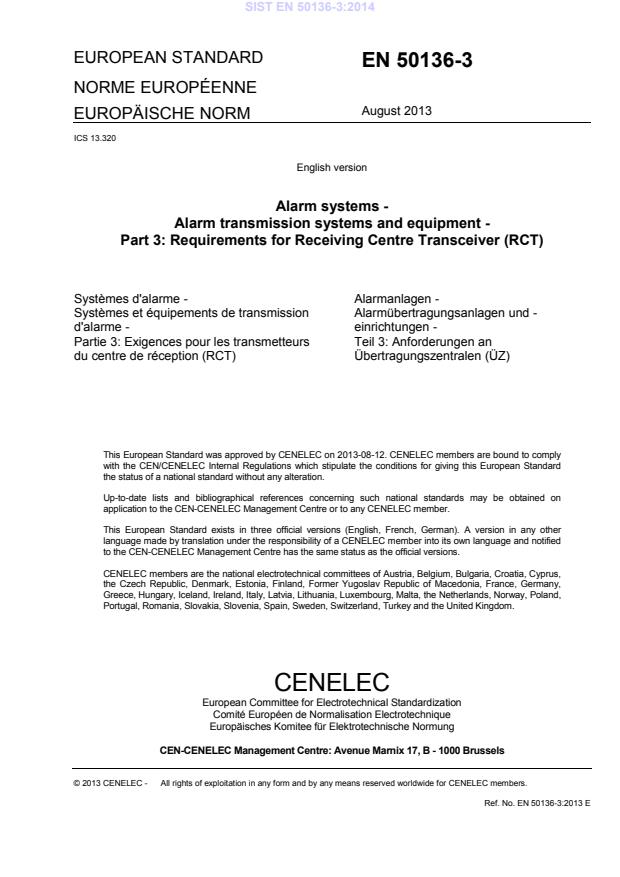
EUROPEAN STANDARD
EN 50136-3
NORME EUROPÉENNE
August 2013
EUROPÄISCHE NORM
ICS 13.320
English version
Alarm systems -
Alarm transmission systems and equipment -
Part 3: Requirements for Receiving Centre Transceiver (RCT)
Systèmes d'alarme - Alarmanlagen -
Systèmes et équipements de transmission Alarmübertragungsanlagen und -
d'alarme - einrichtungen -
Partie 3: Exigences pour les transmetteurs Teil 3: Anforderungen an
du centre de réception (RCT) Übertragungszentralen (ÜZ)
This European Standard was approved by CENELEC on 2013-08-12. CENELEC members are bound to comply
with the CEN/CENELEC Internal Regulations which stipulate the conditions for giving this European Standard
the status of a national standard without any alteration.
Up-to-date lists and bibliographical references concerning such national standards may be obtained on
application to the CEN-CENELEC Management Centre or to any CENELEC member.
This European Standard exists in three official versions (English, French, German). A version in any other
language made by translation under the responsibility of a CENELEC member into its own language and notified
to the CEN-CENELEC Management Centre has the same status as the official versions.
CENELEC members are the national electrotechnical committees of Austria, Belgium, Bulgaria, Croatia, Cyprus,
the Czech Republic, Denmark, Estonia, Finland, Former Yugoslav Republic of Macedonia, France, Germany,
Greece, Hungary, Iceland, Ireland, Italy, Latvia, Lithuania, Luxembourg, Malta, the Netherlands, Norway, Poland,
Portugal, Romania, Slovakia, Slovenia, Spain, Sweden, Switzerland, Turkey and the United Kingdom.
CENELEC
European Committee for Electrotechnical Standardization
Comité Européen de Normalisation Electrotechnique
Europäisches Komitee für Elektrotechnische Normung
CEN-CENELEC Management Centre: Avenue Marnix 17, B - 1000 Brussels
© 2013 CENELEC - All rights of exploitation in any form and by any means reserved worldwide for CENELEC members.
Ref. No. EN 50136-3:2013 E
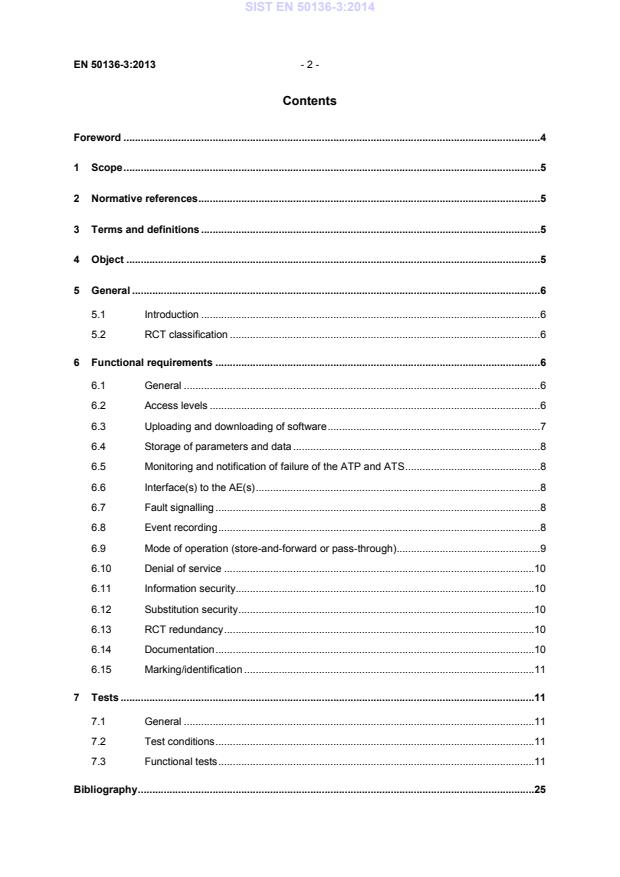
Contents
Foreword . 4
1 Scope . 5
2 Normative references . 5
3 Terms and definitions . 5
4 Object . 5
5 General . 6
5.1 Introduction . 6
5.2 RCT classification . 6
6 Functional requirements . 6
6.1 General . 6
6.2 Access levels . 6
6.3 Uploading and downloading of software . 7
6.4 Storage of parameters and data . 8
6.5 Monitoring and notification of failure of the ATP and ATS . 8
6.6 Interface(s) to the AE(s) . 8
6.7 Fault signalling . 8
6.8 Event recording . 8
6.9 Mode of operation (store-and-forward or pass-through) . 9
6.10 Denial of service .10
6.11 Information security .10
6.12 Substitution security .10
6.13 RCT redundancy .10
6.14 Documentation .10
6.15 Marking/identification .11
7 Tests .11
7.1 General .11
7.2 Test conditions .11
7.3 Functional tests .11
Bibliography .25
- 3 - EN 50136-3:2013
Tables
Table 1 — Access levels – Logical access to functions . 7
Table 2 — Event recording classification – Events to be recorded . 9
Table 4 — Test of access levels . 14
Table 5 — Test of upload and download of software . 15
Table 6 — Test of parameter storage . 16
Table 8 — Fault signalling . 19
Table 9 — Test of event recording . 20
Table 10 — Test of clock resolution and synchronisation . 21
Table 11 — Test of log optimisation . 21
Table 12 — Test of user identification logging . 22
Table 13 — Test of mode of operation . 23
Table 14 — Test of RCT redundancy . 24
Foreword
This document (EN 50136-3:2013) has been prepared by CLC/TC 79 "Alarm systems".
The following dates are proposed:
• latest date by which this document has to be
(dop) 2014-08-12
implemented at national level by publication of
an identical national standard or by
endorsement
• latest date by which the national standards
(dow) 2016-08-12
conflicting with this document have to
be withdrawn
Attention is drawn to the possibility that some of the elements of this document may be the subject of
patent rights. CENELEC [and/or CEN] shall not be held responsible for identifying any or all such
patent rights.
EN 50136 consists of the following parts, under the general title, Alarm systems — Alarm transmission
systems and equipment:
- Part 1: General requirements for alarm transmission systems;
- Part 2: Requirements for Supervised Premises Transceiver (SPT);
- Part 3: Requirements for Receiving Centre Transceiver (RCT);
- Part 4: Annunciation equipment used in alarm receiving centres (Technical Specification);
- Part 7: Application guidelines (Technical Specification);
- Part 9: Requirements for common protocol for alarm transmission using the Internet protocol
(Technical Specification).
- 5 - EN 50136-3:2013
1 Scope
This European Standard specifies the minimum equipment requirements for the performance,
reliability, resilience, security and safety characteristics of the receiving centre transceiver (RCT)
installed in ARC and used in alarm transmission systems.
The alarm transmission system requirements and classifications are defined within EN 50136-1.
Different types of alarm systems may in addition to alarm messages also send other types of
messages, e.g. fault messages and status messages. These messages are also considered to be
alarm messages. The term alarm message is used in this broad sense throughout the document.
Where application specific standards exist, the RCT should comply with relevant standards called up
by that application.
The RCT can be either an integrated element of any receiving/annunciation equipment, or a stand-
alone device. In either case, the requirements of this European Standard should apply.
The function of the RCT is to monitor the ATPs, receive alarm messages, forward alarm messages to
one or more AEs and send acknowledgements to the SPTs.
Management of the transmission network is not in the scope of this European Standard.
2 Normative references
The following documents, in whole or in part, are normatively referenced in this document and are
indispensable for its application. For dated references, only the edition cited applies. For undated
references, the latest edition of the referenced document (including any amendments) applies.
EN 50130-4, Alarm systems — Part 4: Electromagnetic compatibility — Product family standard:
Immunity requirements for components of fire, intruder, hold up, CCTV, access control and social
alarm systems
EN 50130-5, Alarm systems — Part 5: Environmental test methods
EN 50136-1:2012, Alarm systems — Alarm transmission systems and equipment — Part 1: General
requirements for alarm transmission systems
3 Terms and definitions
For the purposes of this document, the terms and definitions given in EN 50136-1:2012 and the
following apply.
3.1
remote access
access to the equipment from any location that is outside the protected premises in which the
equipment is located
4 Object
This European Standard specifies the minimum equipment requirements for the performance,
reliability, resilience, security and safety characteristics of the Receiving Centre Transceiver (RCT)
installed in alarm receiving centres and to define parameters that shall be tested to ensure its
compatibility with ATS categories.
5 General
5.1 Introduction
Where appropriate, equipment shall comply with local, national and European requirements and
regulations for connection and transmission via public or private networks.
Requirements in this European Standard shall be considered as a minimum. As the RCT is used together
with or integrated receiving/annunciation equipment, the requirements of the specific applications or
related standards shall apply.
5.2 RCT classification
This European Standard defines RCT requirements. For the purpose of RCT classification reference is
made to the ATS categories in EN 50136-1. The RCT documentation shall describe for which ATS
categories the RCT complies with the requirements.
6 Functional requirements
6.1 General
The RCT shall provide communication between one or more AEs and one or more SPTs and monitor
the interface(s) to one or more AEs.
The RCT shall monitor the ATSs.
6.2 Access levels
This European Standard specifies four levels of access that categorise the ability of users to access
the RCT functions.
Access levels are defined as following:
- Level 1 Access to indications;
- Level 2 Access to the operational status and commissioning functions;
- Level 3 Maintenance functions, access to affect the RCT configuration including site-specific data
and other operations that directly, or indirectly, may adversely influence the functions of
the RCT;
- Level 4 Access to software updates and read-only parameters.
These access levels apply only for logical access (i.e. not physical access). Access to all functions
shall require authorisation with a key.
Access levels 2, 3 and 4 shall use personalised accounts to achieve traceability.
A level 4 user shall be authorised by a user with level 3 access. This authorisation may be permanent
or time limited.
Access at all levels shall require authorisation with a key. The key mechanism shall be able to provide
at least 1 000 000 different keys.
- 7 - EN 50136-3:2013
Where it is possible to attempt to gain access more than 3 times in a 60-second period the RCT shall
have the ability to delay repeated attempts. After the third attempt, each further attempt shall be
prevented for a minimum of 90 s.
Where factory default keys are provided, it shall not be possible to complete the RCT commissioning
without first, changing these keys during installation.
Remote access shall require a secure connection and meet the data security requirements of
EN 50136-1.
Automatic logout of remote access sessions shall be activated after a period of inactivity. The inactivity
period shall be configurable.
Table 1 — Access levels – Logical access to functions
Access Level Level 1 Level 2 Level 3 Level 4
View RCT
P P P P
indications
Change RCT
NP NP P NP
configuration
View RCT
NP P P P
configuration
Commission/De-
NP P P NP
Commission SPT
View RCT
NP P P P
Event/Alarm Log
Change RCT
NP NP NP P
Software
Change users
NP NP P NP
and/or user rights
Change and/or
delete entries in NP NP NP NP
the event log
Key
P = Permitted
NP = Not Permitted
NOTE The requirement to restrict or permit access to a certain function does not imply that implementation of the function
is required.
6.3 Uploading and downloading of software
The upload and download of software in/out of an RCT is only allowed at appropriate access level as
defined in 6.3.
6.4 Storage of parameters and data
Power cycle or a software restart shall not result in the loss of any configuration, log and secured
alarm messages. The RCT shall return to normal operation automatically after such power cycle or
software restart.
6.5 Monitoring and notification of failure of the ATP and ATS
For compliance to the relevant standards of the application, the RCT shall monitor ATP and ATS and
report failures to the AE as defined in EN 50136-1:2012, 6.6, Table 4.
The documentation supplied by the manufacturer shall describe the notification signal.
6.6 Interface(s) to the AE(s)
The interface(s) to the AE(s) shall be monitored in accordance with EN 50136-1. The reporting time of
the connection failure shall be less or equal to the reporting time of the ATS with the highest category
or 60 s whichever is shorter. In the event of an interface failure, a fault signal shall be generated, and
an event logged.
The manufacturer shall state in their product documentation the specifications of the interface(s) to the
AE and how the fault signal is presented and logged.
An alternative AE interface may be provided.
6.7 Fault signalling
The RCT shall have a means to signal faults when any of the following faults occur:
- AE interface failure;
- transmission network interface failure;
- RCT system failure.
The manufacturer shall specify in the RCT documentation how these faults are signalled.
6.8 Event recording
For an RCT supporting and meeting any category of EN 50136-1:2012 other than SP1, SP2 and DP1
a logging function shall be provided for the purposes of providing an audit trail and problem resolution.
The events specified in Table 2 shall be recorded.
The event log may be stored outside of the RCT.
The means of recording events shall be non-volatile. The log entries shall be kept for no less than 3
years. The manufacturer shall specify in their documentation how this is achieved.
Events older than 3 years may be deleted.
The log shall record, in addition to the event, the time and date at which the event occurred. The
timing resolution shall be a minimum of 1 s and it shall be accurate to the coordinated universal time
within ± 5 s.
The RCT shall provide a means to synchronise the UTC date and time. The manufacturer shall specify
in their documentation how time synchronisation with UTC is achieved.
- 9 - EN 50136-3:2013
The RCT may use local time-zones.
To optimise storage of events, where identical sequentially repeated events occur within any 12-h
period, then only the first and last event need to be recorded. Where this is done then the number of
identical events shall be recorded.
When required by the requirements of Table 2, the logging of access to the RCT shall include user
identification.
Table 2 — Event recording classification – Events to be recorded
Events to be recorded
Event User identification
1 Alarm messages from ATS n/a
2 AE interface(s) failure and restore n/a
3 Transmission network Interface(s) failure and restore n/a
4 Changes to the configuration of the RCT M
5 Power-up or reset M
6 Any change to software M
7 Changes to the date and time M
8 Access to the RCT M
9 Changes to users and/of user rights M
Key
n/a = Not applicable
M = Mandatory
NOTE Recording the user identification is only mandatory if the event is triggered by user intervention.
6.9 Mode of operation (store-and-forward or pass-through)
6.9.1 General
Two modes of operation are permitted:
a) store-and-forward;
b) pass-through.
The manufacturer shall declare in the product documentation which modes are supported.
6.9.2 Store-and-forward operation requirements
When an alarm is received from the SPT, the RCT shall secure the alarm and provide
acknowledgement of the correct receipt of the alarm to the SPT.
If the store-and-forward operation is used, all alarm messages shall include the date and time stamp
when the alarm was received by the SPT.
The RCT may also log the date and time stamp when the alarm was forwarded to the AE and/or when
the acknowledgement was received from the AE.
Securing the alarm shall be achieved by storing the alarm in the RCT’s non-volatile memory (data
base), this is to secure acknowledged alarms whilst there is an AE interface failure or during a power
failure. Stored alarms shall be transmitted when the fault condition clears.
The secured alarm shall be transmitted from the RCT to the AE(s).
The reception of an acknowledgement from the AE(s) shall not be forwarded to the SPT, since the
SPT has already received an acknowledgement from the RCT.
NOTE The loss of an alarm message is regarded as a worse situation than sending a delayed message.
6.9.3 Pass-through operation requirements
When an alarm is received from the SPT the RCT shall forward the alarm to the AE(s).
The RCT shall not acknowledge the alarm to the SPT before receiving an acknowledgement from at
least one AE. When the RCT receives an acknowledgement from the AE(s) the acknowledgement
shall be forwarded to the SPT.
6.10 Denial of service
The manufacturer of the RCT shall declare in their documentation how compliance with the
requirements of EN 50136-1:2012, 6.2.5 is achieved.
6.11 Information security
The manufacturer shall provide their stated methodology used to achieve compliance with
EN 50136-1:2012, 6.8.3 (Information security) for both SPT communication and remote access.
6.12 Substitution security
The manufacturer shall provide their stated methodology used to achieve compliance with
EN 50136-1:2012, 6.8.2 (Substitution security).
6.13 RCT redundancy
If the RCT supports Dual Path category ATS (DP1 – DP4) the RCT shall comply with the redundancy
requirements of EN 50136-1:2012, Table 1. The manufacturer shall specify and demonstrate how
compliance is achieved.
6.14 Documentation
Documentation relating to an RCT shall be concise, complete and unambiguous. Information shall be
provided sufficient to install, put into operation, operate and maintain an RCT.
Instructions relating to the operation of an RCT shall be designed to minimise the possibility of
incorrect operation and be structured to reflect the access level of the user.
Where there are user serviceable parts (e.g. fuses) their type and values shall be given.
The documentation shall include:
- name of manufacturer or supplier,
- description of equipment,
- standard to which component claims compliance,
- name or mark of the certification body,
- the maximum number of SPTs that can be connected for each category,
- the maximum number of AEs that can be connected,
- the maximum number of transmission network interfaces,
- the maximum number of alarms that can be processed per second,
- a list of supported ATS categories,
- 11 - EN 50136-3:2013
- power requirements.
6.15 Marking/identification
The RCT shall be marked with the following:
- name of manufacturer;
- ATS categories for which the RCT is suitable.
The marking shall be legible, durable and unambiguous. If the RCT does not use dedicated hardware
(i.e. the RCT is a software solution), the software shall be able to display the required
markings/identifications.
7 Tests
7.1 General
Specific applications may require additional testing of the RCT. If such characteristics are provided
and are submitted for testing, they shall be specified by the manufacturer at the time of testing.
7.2 Test conditions
7.2.1 Labora
...