


EN 61158-4-18:2008
(Main)Industrial communication networks - Fieldbus specifications - Part 4-18: Data-link layer protocol specification - Type 18 elements
General Information
- Abstract
It provides basic time-critical messaging communications between devices in an automation environment. This protocol provides communication opportunities to all participating data-link entities in a synchronously-starting cyclic manner, according to a pre-established schedule, and in a cyclic or acyclic asynchronous manner, as requested each cycle by each of those data-link entities. Thus this protocol can be characterized as one which provides cyclic and acyclic access asynchronously but with a synchronous restart of each cycle. It includes the following significant changes with respect to the previous edition deletion of the former Type 6 fieldbus, and the placeholder for a Type 5 fieldbus data-link layer, for lack of market relevance; addition of new types of fieldbuses; division of this part into multiple parts numbered.
- Status
- Withdrawn
- Publication Date
- 28-Feb-2008
- Withdrawal Date
- 31-Jan-2011
- Technical Committee
- CLC/TC 65X - Industrial-process measurement, control and automation
- Drafting Committee
- IEC/SC 65C - IEC_SC_65C
- Parallel Committee
- IEC/SC 65C - IEC_SC_65C
- Current Stage
- 9960 - Withdrawal effective - Withdrawal
- Start Date
- 28-Mar-2015
- Completion Date
- 28-Mar-2015

Relations
- Effective Date
- 29-Jan-2023
- Effective Date
- 29-Jan-2023
- Effective Date
- 03-Feb-2026
- Effective Date
- 03-Feb-2026
- Effective Date
- 03-Feb-2026
Get Certified
Connect with accredited certification bodies for this standard

BSI Group
BSI (British Standards Institution) is the business standards company that helps organizations make excellence a habit.

DVS-ZERT GmbH
German welding certification society.
CARES (UK Certification Authority for Reinforcing Steels)
UK certification for reinforcing steels and construction.
Sponsored listings
Frequently Asked Questions
EN 61158-4-18:2008 is a standard published by CLC. Its full title is "Industrial communication networks - Fieldbus specifications - Part 4-18: Data-link layer protocol specification - Type 18 elements". This standard covers: It provides basic time-critical messaging communications between devices in an automation environment. This protocol provides communication opportunities to all participating data-link entities in a synchronously-starting cyclic manner, according to a pre-established schedule, and in a cyclic or acyclic asynchronous manner, as requested each cycle by each of those data-link entities. Thus this protocol can be characterized as one which provides cyclic and acyclic access asynchronously but with a synchronous restart of each cycle. It includes the following significant changes with respect to the previous edition deletion of the former Type 6 fieldbus, and the placeholder for a Type 5 fieldbus data-link layer, for lack of market relevance; addition of new types of fieldbuses; division of this part into multiple parts numbered.
It provides basic time-critical messaging communications between devices in an automation environment. This protocol provides communication opportunities to all participating data-link entities in a synchronously-starting cyclic manner, according to a pre-established schedule, and in a cyclic or acyclic asynchronous manner, as requested each cycle by each of those data-link entities. Thus this protocol can be characterized as one which provides cyclic and acyclic access asynchronously but with a synchronous restart of each cycle. It includes the following significant changes with respect to the previous edition deletion of the former Type 6 fieldbus, and the placeholder for a Type 5 fieldbus data-link layer, for lack of market relevance; addition of new types of fieldbuses; division of this part into multiple parts numbered.
EN 61158-4-18:2008 is classified under the following ICS (International Classification for Standards) categories: 25.040.40 - Industrial process measurement and control; 35.100.20 - Data link layer. The ICS classification helps identify the subject area and facilitates finding related standards.
EN 61158-4-18:2008 has the following relationships with other standards: It is inter standard links to EN 61158-4:2004, EN 61158-4-18:2012, EN 61158-3-18:2008, EN 61158-2:2008, EN 61784-3-8:2010. Understanding these relationships helps ensure you are using the most current and applicable version of the standard.
EN 61158-4-18:2008 is associated with the following European legislation: Standardization Mandates: M/490. When a standard is cited in the Official Journal of the European Union, products manufactured in conformity with it benefit from a presumption of conformity with the essential requirements of the corresponding EU directive or regulation.
EN 61158-4-18:2008 is available in PDF format for immediate download after purchase. The document can be added to your cart and obtained through the secure checkout process. Digital delivery ensures instant access to the complete standard document.
Standards Content (Sample)
2003-01.Slovenski inštitut za standardizacijo. Razmnoževanje celote ali delov tega standarda ni dovoljeno.Industrijska komunikacijska omrežja - Specifikacije za procesna vodila - 4-18. del: Specifikacija protokola na nivoju podatkovnih povezav - Elementi tipa 18 (IEC 61158-4-18:2007)Industrielle Kommunikationsnetze - Feldbusse - Teil 4-18: Protokollspezifikation des Data Link Layer (Sicherungsschicht) - Typ 18-ElementeRéseaux de communication industriels - Spécifications des bus de terrain - Partie 4-18: Spécification des protocoles des couches de liaison de données - Eléments de type 18Industrial communication networks - Fieldbus specifications -- Part 4-18: Data-link layer protocol specification - Type 18 elements35.110OmreževanjeNetworking35.100.20Podatkovni povezovalni slojData link layer25.040.40Merjenje in krmiljenje industrijskih postopkovIndustrial process measurement and controlICS:Ta slovenski standard je istoveten z:EN 61158-4-18:2008SIST EN 61158-4-18:2008en,de01-junij-2008SIST EN 61158-4-18:2008SLOVENSKI
STANDARDSIST EN 61158-4:20041DGRPHãþD
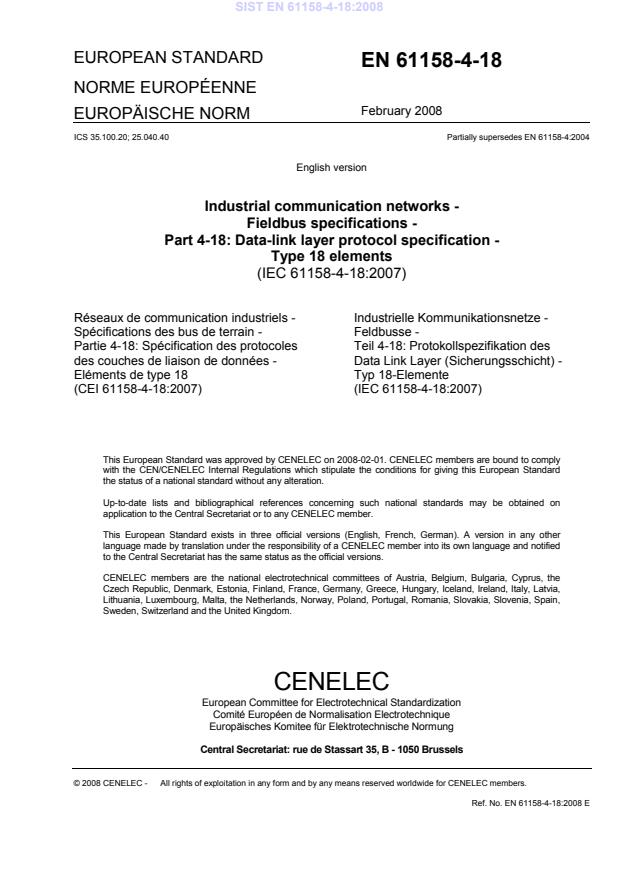
EUROPEAN STANDARD EN 61158-4-18 NORME EUROPÉENNE
EUROPÄISCHE NORM February 2008
CENELEC European Committee for Electrotechnical Standardization Comité Européen de Normalisation Electrotechnique Europäisches Komitee für Elektrotechnische Normung
Central Secretariat: rue de Stassart 35, B - 1050 Brussels
© 2008 CENELEC -
All rights of exploitation in any form and by any means reserved worldwide for CENELEC members.
Ref. No. EN 61158-4-18:2008 E
ICS 35.100.20; 25.040.40 Partially supersedes EN 61158-4:2004
English version
Industrial communication networks -
Fieldbus specifications -
Part 4-18: Data-link layer protocol specification -
Type 18 elements (IEC 61158-4-18:2007)
Réseaux de communication industriels -
Spécifications des bus de terrain -
Partie 4-18: Spécification des protocoles des couches de liaison de données -
Eléments de type 18 (CEI 61158-4-18:2007)
Industrielle Kommunikationsnetze -
Feldbusse -
Teil 4-18: Protokollspezifikation des
Data Link Layer (Sicherungsschicht) -
Typ 18-Elemente (IEC 61158-4-18:2007)
This European Standard was approved by CENELEC on 2008-02-01. CENELEC members are bound to comply with the CEN/CENELEC Internal Regulations which stipulate the conditions for giving this European Standard the status of a national standard without any alteration.
Up-to-date lists and bibliographical references concerning such national standards may be obtained on application to the Central Secretariat or to any CENELEC member.
This European Standard exists in three official versions (English, French, German). A version in any other language made by translation under the responsibility of a CENELEC member into its own language and notified to the Central Secretariat has the same status as the official versions.
CENELEC members are the national electrotechnical committees of Austria, Belgium, Bulgaria, Cyprus, the Czech Republic, Denmark, Estonia, Finland, France, Germany, Greece, Hungary, Iceland, Ireland, Italy, Latvia, Lithuania, Luxembourg, Malta, the Netherlands, Norway, Poland, Portugal, Romania, Slovakia, Slovenia, Spain, Sweden, Switzerland and the United Kingdom.
- 2 -
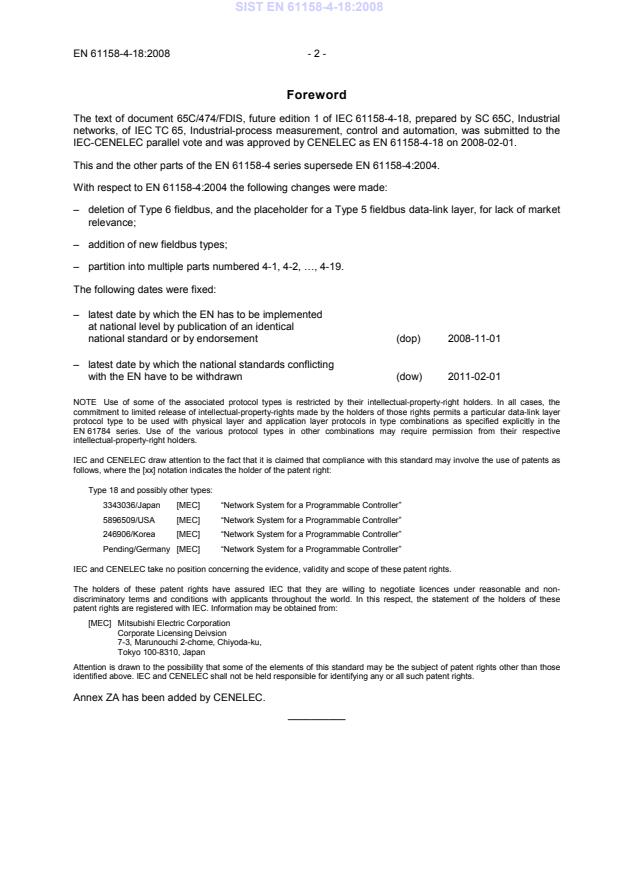
Foreword The text of document 65C/474/FDIS, future edition 1 of IEC 61158-4-18, prepared by SC 65C, Industrial networks, of IEC TC 65, Industrial-process measurement, control and automation, was submitted to the IEC-CENELEC parallel vote and was approved by CENELEC as EN 61158-4-18 on 2008-02-01. This and the other parts of the EN 61158-4 series supersede EN 61158-4:2004. With respect to EN 61158-4:2004 the following changes were made: – deletion of Type 6 fieldbus, and the placeholder for a Type 5 fieldbus data-link layer, for lack of market relevance;
– addition of new fieldbus types; – partition into multiple parts numbered 4-1, 4-2, …, 4-19. The following dates were fixed: – latest date by which the EN has to be implemented
at national level by publication of an identical
national standard or by endorsement
(dop)
2008-11-01 – latest date by which the national standards conflicting
with the EN have to be withdrawn
(dow)
2011-02-01 NOTE
Use of some of the associated protocol types is restricted by their intellectual-property-right holders. In all cases, the commitment to limited release of intellectual-property-rights made by the holders of those rights permits a particular data-link layer protocol type to be used with physical layer and application layer protocols in type combinations as specified explicitly in the EN 61784 series. Use of the various protocol types in other combinations may require permission from their respective intellectual-property-right holders. IEC and CENELEC draw attention to the fact that it is claimed that compliance with this standard may involve the use of patents as follows, where the [xx] notation indicates the holder of the patent right:
Type 18 and possibly other types:
3343036/Japan
[MEC]
“Network System for a Programmable Controller”
5896509/USA
[MEC]
“Network System for a Programmable Controller”
246906/Korea
[MEC]
“Network System for a Programmable Controller”
Pending/Germany
[MEC]
“Network System for a Programmable Controller” IEC and CENELEC take no position concerning the evidence, validity and scope of these patent rights. The holders of these patent rights have assured IEC that they are willing to negotiate licences under reasonable and non-discriminatory terms and conditions with applicants throughout the world. In this respect, the statement of the holders of these patent rights are registered with IEC. Information may be obtained from:
[MEC]
Mitsubishi Electric Corporation
Corporate Licensing Deivsion
7-3, Marunouchi 2-chome, Chiyoda-ku,
Tokyo 100-8310, Japan Attention is drawn to the possibility that some of the elements of this standard may be the subject of patent rights other than those identified above. IEC and CENELEC shall not be held responsible for identifying any or all such patent rights. Annex ZA has been added by CENELEC. __________ SIST EN 61158-4-18:2008
- 3 - EN 61158-4-18:2008 Endorsement notice The text of the International Standard IEC 61158-4-18:2007 was approved by CENELEC as a European Standard without any modification. In the official version, for Bibliography, the following notes have to be added for the standards indicated: IEC 61158-5-18 NOTE
Harmonized as EN 61158-5-18:2008 (not modified). IEC 61158-6-18 NOTE
Harmonized as EN 61158-6-18:2008 (not modified). IEC 61784-2 NOTE
Harmonized as EN 61784-2:2008 (not modified). __________ SIST EN 61158-4-18:2008
- 4 -
Annex ZA (normative)
Normative references to international publications with their corresponding European publications
The following referenced documents are indispensable for the application of this document. For dated references, only the edition cited applies. For undated references, the latest edition of the referenced document (including any amendments) applies.
NOTE
When an international publication has been modified by common modifications, indicated by (mod), the relevant EN/HD applies.
Publication Year Title EN/HD Year
IEC 61158-2 2007 Industrial communication networks -
Fieldbus specifications -
Part 2: Physical layer specification and service definition EN 61158-2 2008
IEC 61158-3-18 -1) Industrial communication networks -
Fieldbus specifications -
Part 3-18: Data-link layer service definition - Type 18 elements
EN 61158-3-18 20082)
ISO/IEC 7498-1 -1) Information technology - Open Systems Interconnection - Basic Reference Model:
The Basic Model EN ISO/IEC 7498-1 19952)
ISO/IEC 7498-3 -1) Information technology - Open Systems Interconnection - Basic Reference Model: Naming and addressing - -
ISO/IEC 13239 -1) Information technology - Telecommunications and information exchange between systems - High-level data link control (HDLC) procedures - -
1) Undated reference. 2) Valid edition at date of issue. SIST EN 61158-4-18:2008
IEC 61158-4-18Edition 1.0 2007-12INTERNATIONAL STANDARD
Industrial communication networks – Fieldbus specifications –
Part 4-18: Data-link layer protocol specification – Type 18 elements
INTERNATIONAL ELECTROTECHNICAL COMMISSION WICS 35.100.20; 25.040.40 PRICE CODEISBN 2-8318-9442-5SIST EN 61158-4-18:2008
– 2 – 61158-4-18 © IEC:2007(E)
CONTENTS FOREWORD.5 INTRODUCTION.7 1 Scope.8 1.1 General.8 1.2 Specifications.8 1.3 Procedures.8 1.4 Applicability.9 1.5 Conformance.9 2 Normative references.9 3 Terms, definitions, symbols, abbreviations and conventions.9 3.1 Reference model terms and definitions.9 3.2 Type 18: Symbols.10 3.3 Type 18: Additional conventions.11 4 DL-protocol overview.11 4.1 Introduction.11 4.2 Polled DLE classes.11 4.3 Packed DLE classes.11 5 DLPDU encoding and transmission.11 5.1 DL – PhL interface.11 5.2 DLPDU transmission encoding.12 6 DLPDU – basic structure.15 6.1 Overview.15 6.2 Address field.15 6.3 Status field.16 6.4 Data field.18 7 DLPDU – Detailed structure, segmenting and reassembly.20 8 Data transmission methods.24 8.1 Overview.24 8.2 Master-polled method.24 8.3 Level A slave-polled method.25 8.4 Level B slave-polled method.26 8.5 Level C slave-polled method.26 8.6 Master-packed method.27 8.7 Slave-packed method.28 9 DL-management – procedures.29 9.1 Overview.29 9.2 Establish master-polled DLE procedure.29 9.3 Establish slave-polled DLE procedure.30 9.4 Establish master-packed DLE procedure.32 9.5 Establish slave-packed DLE procedure.33 9.6 Release connection procedure.34 9.7 Suspend connection procedure.34 9.8 Resume connection procedure.34 9.9 Activate standby Master procedure.35 Bibliography.36
61158-4-18 © IEC:2007(E) – 3 – Figure 1 – HDLC flag.12
Table 1 – HDLC convention summary.13 Table 2 – HDLC exception summary.14 Table 3 – Master-polled DLE address octet 0.15 Table 4 – Slave-polled DLE address octet 0.15 Table 5 – Master-packed DLE address octet 0.16 Table 6 – Master-polled DLE status octet 0.16 Table 7 – Master-polled DLE status octet 1.17 Table 8 – Slave-polled DLE status octet 0.17 Table 9 – slave-polled DLE status octet 1.18 Table 10 – Slave-packed DLE status.18 Table 11 – DLPDU – Master-polled DLE acyclic data field.19 Table 12 – DLPDU – Slave-polled DLE acyclic data field.20 Table 13 – Example master-polled DLE RY contiguous data field.21 Table 14 – Example slave-polled DLE RX contiguous data field.21 Table 15 – Example master-polled DLE RWw contiguous data field.21 Table 16 – Example slave-polled DLE RWr contiguous data field.21 Table 17 – Bit-oriented segment header.22 Table 18 – Polled DLE acyclic segment number field.23 Table 19 – Slave-polled DLE acyclic data type and sequence field.23 Table 20 – DLPDU – Polled class poll with data.24 Table 21 – Slave-polled DLE response timeout.24 Table 22 – DLPDU – Poll.25 Table 23 – DLPDU – End of cycle.25 Table 24 – slave-polled DLE request timeout.25 Table 25 – DLPDU – Level A poll response.26 Table 26 – DLPDU – Level B poll response.26 Table 27 – DLPDU – Level C poll response.27 Table 28 – DLPDU – Packed class poll with data.27 Table 29 – Slave-packed DLE response timeout.27 Table 30 – Slave-packed DLE request timeout.28 Table 31 – DLPDU – Packed class poll response.28 Table 32 – Slave-packed DLE time constraints.29 Table 33 – DLPDU – Poll with test data.29 Table 34 – Slave-polled DLE response timeout.30 Table 35 – DLPDU – Poll test.30 Table 36 – Slave-polled DLE request timeout.30 Table 37 – DLPDU – Poll test response.31 Table 38 – Slave-polled DLE configuration parameter.31 Table 39 – DLPDU – Baud rate synchronization.32 Table 40 – DLPDU – Poll test.32 Table 41 – Slave-packed DLE response timeout.32 SIST EN 61158-4-18:2008
– 4 – 61158-4-18 © IEC:2007(E)
Table 42 – Slave-packed DLE number of occupied DLE station slots.33 Table 43 – Slave-packed DLE baud rate synchronization timeout.33 Table 44 – Slave-packed DLE Master timeout.34 Table 45 – DLPDU – Packed poll test response.34
61158-4-18 © IEC:2007(E) – 5 – INTERNATIONAL ELECTROTECHNICAL COMMISSION ____________ INDUSTRIAL COMMUNICATION NETWORKS – FIELDBUS SPECIFICATIONS –
Part 4-18: Data-link layer protocol specification – Type 18 elements
FOREWORD 1) The International Electrotechnical Commission (IEC) is a worldwide organization for standardization comprising all national electrotechnical committees (IEC National Committees). The object of IEC is to promote international co-operation on all questions concerning standardization in the electrical and electronic fields. To this end and in addition to other activities, IEC publishes International Standards, Technical Specifications, Technical Reports, Publicly Available Specifications (PAS) and Guides (hereafter referred to as “IEC Publication(s)”). Their preparation is entrusted to technical committees; any IEC National Committee interested in the subject dealt with may participate in this preparatory work. International, governmental and non-governmental organizations liaising with the IEC also participate in this preparation. IEC collaborates closely with the International Organization for Standardization (ISO) in accordance with conditions determined by agreement between the two organizations. 2) The formal decisions or agreements of IEC on technical matters express, as nearly as possible, an international consensus of opinion on the relevant subjects since each technical committee has representation from all interested IEC National Committees.
3) IEC Publications have the form of recommendations for international use and are accepted by IEC National Committees in that sense. While all reasonable efforts are made to ensure that the technical content of IEC Publications is accurate, IEC cannot be held responsible for the way in which they are used or for any misinterpretation by any end user. 4) In order to promote international uniformity, IEC National Committees undertake to apply IEC Publications transparently to the maximum extent possible in their national and regional publications. Any divergence between any IEC Publication and the corresponding national or regional publication shall be clearly indicated in the latter. 5) IEC provides no marking procedure to indicate its approval and cannot be rendered responsible for any equipment declared to be in conformity with an IEC Publication. 6) All users should ensure that they have the latest edition of this publication. 7) No liability shall attach to IEC or its directors, employees, servants or agents including individual experts and members of its technical committees and IEC National Committees for any personal injury, property damage or other damage of any nature whatsoever, whether direct or indirect, or for costs (including legal fees) and expenses arising out of the publication, use of, or reliance upon, this IEC Publication or any other IEC Publications.
8) Attention is drawn to the normative references cited in this publication. Use of the referenced publications is indispensable for the correct application of this publication. NOTE
Use of some of the associated protocol types is restricted by their intellectual-property-right holders. In all cases, the commitment to limited release of intellectual-property-rights made by the holders of those rights permits a particular data-link layer protocol type to be used with physical layer and application layer protocols in Type combinations as specified explicitly in the IEC 61784 series. Use of the various protocol types in other combinations may require permission from their respective intellectual-property-right holders. IEC draws attention to the fact that it is claimed that compliance with this standard may involve the use of patents as follows, where the [xx] notation indicates the holder of the patent right: Type 18 and possibly other Types: 3343036/Japan [MEC] “Network System for a Programmable Controller” 5896509/USA [MEC] “Network System for a Programmable Controller” 246906/Korea [MEC] “Network System for a Programmable Controller” Pending/Germany [MEC] “Network System for a Programmable Controller”
IEC takes no position concerning the evidence, validity and scope of these patent rights. The holders of these patent rights have assured IEC that they are willing to negotiate licences under reasonable and non-discriminatory terms and conditions with applicants throughout the world. In this respect, the statement of the holders of these patent rights are registered with IEC. Information may be obtained from: [MEC] Mitsubishi Electric Corporation Corporate Licensing Deivsion 7-3, Marunouchi 2-chome, Chiyoda-ku, Tokyo 100-8310, Japan SIST EN 61158-4-18:2008
– 6 – 61158-4-18 © IEC:2007(E)
Attention is drawn to the possibility that some of the elements of this standard may be the subject of patent rights other than those identified above. IEC shall not be held responsible for identifying any or all such patent rights. International Standard IEC 61158-4-18 has been prepared by subcommittee 65C: Industrial networks, of IEC technical committee 65: Industrial-process measurement, control and automation. This first edition and its companion parts of the IEC 61158-4 subseries cancel and replace IEC 61158-4:2003. This edition of this part constitutes a technical addition. This edition of IEC 61158-4 includes the following significant changes from the previous edition: a) deletion of the former Type 6 fieldbus, and the placeholder for a Type 5 fieldbus data link layer, for lack of market relevance; b) addition of new types of fieldbuses; c) division of this part into multiple parts numbered -4-1, -4-2, …, 4.19. The text of this standard is based on the following documents: FDIS Report on voting 65C/474/FDIS 65C/485/RVD
Full information on the voting for the approval of this standard can be found in the report on voting indicated in the above table. This publication has been drafted in accordance with ISO/IEC Directives, Part 2. The committee has decided that the contents of this publication will remain unchanged until the maintenance result date indicated on the IEC web site under http://webstore.iec.ch in the data related to the specific publication. At this date, the publication will be: • reconfirmed; • withdrawn; • replaced by a revised edition, or • amended. NOTE
The revision of this standard will be synchronized with the other parts of the IEC 61158 series. The list of all the parts of the IEC 61158 series, under the general title Industrial communication networks – Fieldbus specifications, can be found on the IEC web site. SIST EN 61158-4-18:2008
61158-4-18 © IEC:2007(E) – 7 – INTRODUCTION This part of IEC 61158 is one of a series produced to facilitate the interconnection of automation system components. It is related to other standards in the set as defined by the “three-layer” fieldbus reference model described in IEC 61158-1. The data-link protocol provides the data-link service by making use of the services available from the physical layer. The primary aim of this standard is to provide a set of rules for communication expressed in terms of the procedures to be carried out by peer data-link entities (DLEs) at the time of communication. These rules for communication are intended to provide a sound basis for development in order to serve a variety of purposes: a) as a guide for implementors and designers; b) for use in the testing and procurement of equipment; c) as part of an agreement for the admittance of systems into the open systems environment; d) as a refinement to the understanding of time-critical communications within OSI. This standard is concerned, in particular, with the communication and interworking of sensors, effectors and other automation devices. By using this standard together with other standards positioned within the OSI or fieldbus reference models, otherwise incompatible systems may work together in any combination. SIST EN 61158-4-18:2008
– 8 – 61158-4-18 © IEC:2007(E)
INDUSTRIAL COMMUNICATION NETWORKS – FIELDBUS SPECIFICATIONS –
Part 4-18: Data-link layer protocol specification – Type 18 elements
Scope 1.1 General The data-link layer provides basic time-critical messaging communications between devices in an automation environment. This protocol provides communication opportunities to all participating data-link entities a) in a synchronously-starting cyclic manner, according to a pre-established schedule, and b) in a cyclic or acyclic asynchronous manner, as requested each cycle by each of those data-link entities. Thus this protocol can be characterized as one which provides cyclic and acyclic access asynchronously but with a synchronous restart of each cycle. 1.2 Specifications This part of IEC 61158 specifies a) procedures for the timely transfer of data and control information from one data-link user entity to a peer user entity, and among the data-link entities forming the distributed data-link service provider; b) procedures for giving communications opportunities to all participating DL-entities, sequentially and in a cyclic manner for deterministic and synchronized transfer at cyclic intervals up to one millisecond; c) procedures for giving communication opportunities available for time-critical data transmission together with non-time-critical data transmission without prejudice to the time-critical data transmission; d) procedures for giving cyclic and acyclic communication opportunities for time-critical data transmission with prioritized access; e) procedures for giving communication opportunities based on standard ISO/ IEC 8802-3 medium access control, with provisions for nodes to be added or removed during normal operation;
f) the structure of the fieldbus DLPDUs used for the transfer of data and control information by the protocol of this standard, and their representation as physical interface data units. 1.3 Procedures The procedures are defined in terms of a) the interactions between peer DL-entities (DLEs) through the exchange of fieldbus DLPDUs; b) the interactions between a DL-service (DLS) provider and a DLS-user in the same system through the exchange of DLS primitives; c) the interactions between a DLS-provider and a Ph-service provider in the same system through the exchange of Ph-service primitives. SIST EN 61158-4-18:2008
61158-4-18 © IEC:2007(E) – 9 – 1.4 Applicability These procedures are applicable to instances of communication between systems which support time-critical communications services within the data-link layer of the OSI or fieldbus reference models, and which require the ability to interconnect in an open systems interconnection environment. Profiles provide a simple multi-attribute means of summarizing an implementation’s capabilities, and thus its applicability to various time-critical communications needs. 1.5 Conformance This part of IEC 61158 does not specify individual implementations or products, nor do they constrain the implementations of data-link entities within industrial automation systems. There is no conformance of equipment to this data-link layer service definition standard. Instead, conformance is achieved through implementation of the corresponding data-link protocol that fulfills the Type 18 data-link layer services defined in this standard. 2 Normative references The following referenced documents are indispensable for the application of this standard. For dated references, only the edition cited applies. For undated references, the latest edition of the referenced document (including any amendments) applies. IEC 61158-2 (Ed.4.0), Industrial communication networks – Fieldbus specifications – Part 2: Physical layer specification and service definition IEC 61158-3-18, Industrial communication networks – Fieldbus specifications – Part 3-18: Data-link layer service definition – Type 18 elements ISO/IEC 7498-1, Information technology – Open Systems Interconnection – Basic Reference Model – Basic Reference Model: The Basic Model ISO/IEC 7498-3, Information technology – Open Systems Interconnection – Basic Reference Model – Basic Reference Model: Naming and addressing ISO/IEC 13239, Information technology – Telecommunications and information exchange between systems – High-level data link control (HDLC) procedures 3 Terms, definitions, symbols, abbreviations and conventions For the purposes of this document, the following terms, definitions, symbols, abbreviations and conventions apply. 3.1 Reference model terms and definitions This standard is based in part on the concepts developed in ISO/IEC 7498-1 and ISO/IEC 7498-3, and makes use of the following additional terms: 3.1.1
DLE station identifier network address assigned to a DLE SIST EN 61158-4-18:2008
– 10 – 61158-4-18 © IEC:2007(E)
3.1.2
DLE station slot unit (granularity of one) of position dependent mapping (for cyclic data field) of which a DLE may occupy one or more, delineated by the range beginning at the DLE station identifier with a length equal to the configured number of occupied slots 3.1.3
Master DLE DLE that performs the functions of network master 3.1.4
Master-packed DLE master DLE that uses the packed response access protocol 3.1.5
Master-polled DLE master DLE that uses the polled response access protocol 3.1.6
Packed response transmission of data managed by the process of a master broadcasting a trigger message whereupon each slave waits a time period unique to its DLE station identifier then transmits its response resulting in a time-sliced packing of all slave responses triggered by a single master request 3.1.7
Polled response transmission of data managed by the process of a master individually interrogating each slave in a request/response paradigm 3.1.8
Slave DLE DLE that performs the functions of network slave 3.1.9
Slave-packed DLE slave DLE that uses the packed response access protocol 3.1.10
Slave-polled DLE slave DLE that uses the polled response access protocol 3.2 Type 18: Symbols Symbol Definition RX DLS-user visible register containing bit-oriented cyclic data of type input data that is transmitted from a slave DLE to a master DLE RY DLS-user visible register containing bit-oriented cyclic data of type output data that is transmitted from a master DLE to a slave DLE RWr DLS-user visible register containing word-oriented cyclic data of type input data that is transmitted from a slave DLE to a master DLE RWw DLS-user visible register containing word-oriented cyclic data of type input data that is transmitted from a master DLE to a slave DLE
61158-4-18 © IEC:2007(E) – 11 – 3.3 Type 18: Additional conventions 3.3.1 DLE support level There are three levels of data transmission support for a DLE. • Level A – supports only bit-oriented cyclic data transmission • Level B – includes level A as well as word-oriented cyclic data transmission • Level C – includes level B as well as acyclic data transmission 4 DL-protocol overview 4.1 Introduction There are four classes of Type 18 DLE:
a) Master-polled DLE b) Slave-polled DLE c) Master-packed DLE d) Slave-packed DLE. Only the master DLE classes are able to initiate traffic.
Slave DLEs only transmit in response to master DLE requests. 4.2 Polled DLE classes A slave-polled DLE transmits a response immediately upon receipt of an explicitly coded poll request addressed to the slave-polled DLE from a master-polled DLE.
The polled classes support both cyclic and acyclic data transport. 4.3 Packed DLE classes A slave-packed DLE transmits a response after a unique time has elapsed following a receipt of an explicitly coded poll request broadcast from a master-packed DLE.
This results in a time-sliced packing of all slave-packed DLE responses to a single master-packed DLE request.
The packed classes support cyclic data transport only. 5 DLPDU encoding and transmission 5.1 DL – PhL interface 5.1.1 Overview The polled DLE classes employ the Type 18 Ph-MDS standard type.
The packed DLE classes employ the Type 18 Ph-MDS high-density type. In order to effect transmission, reception and management via the PhE, the DLE assumes a requisite set of support services as described in the following subclauses. 5.1.2 Transmission A Type 18 DLE uses the following procedure to transmit data: 1) Segment DLPDUs into PhSDUs (single bits) using the HDLC protocol specified in 5.1 2) PH-DATA request (START-OF-ACTIVITY) 3) PH-DATA request (PhSDU) SIST EN 61158-4-18:2008
– 12 – 61158-4-18 © IEC:2007(E)
4) PH-DATA confirm (SUCCESS) 5) repeat steps (3) and (4) 6) PH-DATA request (END-OF-ACTIVITY). The DLE must sustain a rate of PhS requests that supports the configured baud rate as regulated by the PH-DATA success confirmation. 5.1.3 Reception A Type 18 DLE uses the following procedure to receive data: 1) Ph-Data indication (START-OF-ACTIVITY) 2) Ph-Data indication (PhSDU) 3) If not Ph-Data indication (END-OF-ACTIVITY), repeat step (2), otherwise proceed to step (4) 4) Reassemble PhSDUs (single bits) into a DLPDU using the HDLC protocol specified in 5.1. The DLE must sustain a rate of PhS indications that supports the configured baud rate. 5.1.4 Management A Type 18 DLE assumes that the PhE supports the following services: • PH-RESET • PH-SET-VALUE (baud-rate) 5.2 DLPDU transmission encoding 5.2.1 General The Type 18 DL implements a subset of the High-level Data Link Control (HDLC) protocol corresponding to ISO/IEC 13239:2002, named HDLC throughout the remainder of this clause, with some exceptions as noted. 5.2.2 Polled DLE 5.2.2.1 Preamble A preamble of three consecutive HDLC flags is transmitted as defined by ISO/IEC 13239:2002 and shown in Figure 1. 0 1 1 1 1 1 1 0 Figure 1 – HDLC flag 5.2.2.2 End of activity An end-of-frame (EOF) of three consecutive HDLC flags is transmitted as defined by ISO/IEC 13239:2002 and shown in Figure 1. 5.2.3 Packed DLE 5.2.3.1 Start of activity A preamble of one HDLC flag is transmitted as defined by ISO/IEC 13239:2002 and shown in Figure 1. SIST EN 61158-4-18:2008
61158-4-18 © IEC:2007(E) – 13 – 5.2.3.2 End of activity An end-of-frame (EOF) of one HDLC flag is transmitted as defined by ISO/IEC 13239:2002 and shown in Figure 1. 5.2.4 HDLC conventions 5.2.4.1 Data encoding Data is encoded using NRZI encoding as defined by ISO/IEC 9314-1. 5.2.4.2 Frame format The non-basic frame format is specified with a non-standard address field, as specified in 5.2.5.1, and a non-standard control field, as specified in 5.2.5.2. 5.2.4.3 Frame checking sequence field The 16-bit frame checking sequence (Cyclic Redundancy Check, CRC) option shall be implemented for all DLEs of the polled class.
The 8-bit frame checking sequence (CRC) option shall be implemented for all DLEs of the packed class. 5.2.4.4 Header check sequence field The header check sequence field shall not be implemented. 5.2.4.5 Operational mode The Normal Response Mode (NRM) shall be implemented. 5.2.4.6 Start/stop transmission – basic transparency The protocol for basic transparency shall not be implemented. 5.2.4.7 Summary The HDLC conventions implemented by the DL are summarized in Table 1. Table 1 – HDLC convention summary Component Implementation Data encoding NRZI Frame format non-basic frame Frame checking sequence field 16-bit / 8-bit Header check sequence field not implemented Operational mode normal response mode Start/stop transmission – basic transparency not implemented
5.2.5 HDLC exceptions 5.2.5.1 Address field The DLE implements a two-octet address field the encoding of which does not conform to HDLC.
A special subset of the response type messages are defined that exclude the address field entirely (field length = 0). SIST EN 61158-4-18:2008
– 14 – 61158-4-18 © IEC:2007(E)
5.2.5.2 Control field The DLE implements a two-octet control field the encoding of which does not conform to HDLC.
Throughout the remainder of this clause, the control field is named the status field. A special subset of the request type transmissions are defined that exclude the status field entirely.
Another special subset of the response type transmissions are defined with an abbreviated 4-bit status field. 5.2.5.3 Inter-frame time fill The polled DLE class implements an inter-frame time fill the encoding of which does not conform to HDLC.
The polled DLE class inter-frame time fill shall be accomplished by transmitting a continuous stream of alternating zeros and ones. 5.2.5.4 Summary The HDLC exceptions implemented by the DLE are summarized in Table 2. Table 2 – HDLC exception summary Component Implementation Address field conditional 16-bit field with non-standard encoding Control field conditional 16-bit/4-bit field with non-standard encoding Inter-frame time fill alternating zero-one data fill / one followed by all zeroes
5.2.6 Error handling The HDLC frame encoding and decoding for data transmission and reception may, as appropriate, send one or more Error indication to the DLS-user, as listed in the following list, and as explained by ISO/IEC 13239:2002. a) frame-error – any framing related error b) crc-error – a received transmission contained an invalid CRC value c) abort-error – an abort flag was received during transmission or reception d) buffer-overflow – a DLE implementation has exceeded its allocated memory for data reception e) invalid-address – an unexpected source address or destination address was received
61158-4-18 © IEC:2007(E) – 15 – 6 DLPDU – basic structure 6.1 Overview Described in this clause is the basic structure of the DLPDU.
In general, the Type 18 DLPDU includes an address field, a status field and a data field.
There are cases explained in the Type 18 DL-protocol where one or more of these fields are zero length.
The specific formats of the DLPDU are detailed in clause 7. 6.2 Address field 6.2.1 Master-polled DLE generated address field The address field contains two octets.
The first octet (octet 0) identifies the transmission type as specified in Table 3.
The second octet (octet 1) specifies the destination address (DLE station identifier). Table 3 – Master-polled DLE address octet 0 Value (hexadecimal) Transmission type FF Poll-with-data FE Poll FD Poll-with-test-data FC Poll-test FA End-of-cycle
6.2.2 Slave-polled DLE generated address field The address field contains two octets.
The first octet (octet 0) specifies the source address (DLE station identifier).
The second octet (octet 1) identifies the transmission type as specified in Table 4. Table 4 – Slave-polled DLE address octet 0 Value (hexadecimal) Transmission type FF Poll-with-data-response FE Poll-response FD Poll-with-test-data-response FC Poll-test-response
NOTE
The response transmission type is an echo of the requesting transmission type. 6.2.3 Master-packed DLE generated address field The address field contains two octets. The first octet (octet 0) identifies the transmission type as specified in Table 5.
The values to identify the transmission types are correlated to the configured bit width of the master-packed DLE as noted. The second octet (octet 1) specifies the highest DLE station identifier included in the list of slave-packed DLE.
For the purposes of the baud-rate-synchronization type and initial poll-with-test-data type transmissions, this value is set to 64. SIST EN 61158-4-18:2008
– 16 – 61158-4-18 © IEC:2007(E)
Table 5 – Master-packed DLE address octet 0 Value (hexadecimal)Corresponding bit width Transmission type DE all Baud rate synchronization 9E 4 AE 8 BE 16 Poll-with-test-data 9A 4 AA 8 BA 16 Connected slave-packed DLE list 5E 4 6E 8 7E 16 Poll-with-data
6.2.4 Slave-packed DLE generated address field The address field for the slave-packed DLE class is zero length. 6.3 Status field 6.3.1 Master-polled DLE generated status field The status field contains two octets.
These are specified in Table 6 and Table 7.
The specific values are updated from the most recent DLSDUs of corresponding DL-services. Table 6 – Master-polled DLE status octet 0 Bit Definition 0 DLS-user state (0 = Stop; 1 = Run) 1 DLS-user status (0 = Normal, 1 = Fault) 2 Cyclic refresh status (0 = Stop; 1 = Run) 3 Acyclic status (0 = Normal; 1 = Error) 4 Acyclic enabled (0 = Disabled; 1 = Enabled) 5 reserved 6 reserved 7 Master DLE type (0 = Active; 1 = Standby)
61158-4-18 © IEC:2007(E) – 17 – Table 7 – Master-polled DLE status octet 1 Bit Value Definition 0 0 1 32 2 64 3 96 4 128 5 160 6 192 7 224 8 256 3 – 0 9 – 15 reserved octets of bit oriented data in cyclic data field 0 0 1 64 2 128 3 192 4 256 5 320 6 384 7 448 8 512 7 – 4 9 – 15 reserved octets of word oriented data in cyclic data field
6.3.2 Slave-polled DLE generated status field The status field contains two octets.
These are specified in Table 8 and Table 9.
The specific values are updated from the most recent DLSDUs of corresponding DL-services. Table 8 – Slave-polled DLE status octet 0 Bit Definition 0 DSL-user fuse status (0 = Normal; 1 = Abnormal) 1 DLS-user status (0 = Normal, 1 = Fault) 2 Cyclic refresh status (0 = Complete; 1 = Not received) 3 Slave DLE parameter receive status (0 = Complete; 1 = Not received) 4 DLS-user switch status (0 = No change; 1 = Changed) 5 Cyclic transmission enabled (0 = Enabled; 1 = Disabled) 6 reserved 7 DLS-user watchdog timer status (0 = Normal; 1 = WDT error detected)
– 18 – 61158-4-18 © IEC:2007(E)
Table 9 – slave-polled DLE status octet 1 Bit Definition 0 Acyclic status (0 = Normal; 1 = Error) 1 Acyclic enabled (0 = Disabled; 1 = Enabled) 2 Acyclic type (0 = Master/Slave; 1 = Peer/Peer) 3 reserved 4 Transmission status (0 = Normal; 1 = Fault) 5 reserved (set to 1) 7 – 6 0 = 1x cyclic segmenting factor (or cyclic data segmenting
...