

prEN 2583
(Main)Aerospace series - Bolts, MJ threads, in heat resisting nickel base alloy NI-PH2601 (Inconel 718) - Classification: 1 275 MPa (at ambient temperature)/650 °C - Technical specification
- Abstract
This document specifies the characteristics, qualification and acceptance requirements for bolts with MJ threads in NI-PH2601.
Classification: 1 275 MPa /650 °C .
- Status
- Not Published
- Publication Date
- 12-Apr-2026
- Technical Committee
- ASD-STAN - Aerospace
- Drafting Committee
- ASD-STAN/D 3/S 2 - Fasteners
- Current Stage
- 4060 - Closure of enquiry - Enquiry
- Start Date
- 13-Feb-2025
- Completion Date
- 13-Feb-2025

prEN 2583 Aerospace Bolts Standard Overview
prEN 2583 is a crucial technical specification developed by CEN for aerospace bolts featuring MJ threads made from the heat-resistant nickel base alloy NI-PH2601, commonly known as Inconel 718. These bolts are specifically designed to perform reliably under demanding conditions, classified for a minimum tensile strength of 1,275 MPa at ambient temperature and capable of withstanding temperatures up to 650 °C. The standard defines detailed characteristics, qualification processes, and acceptance criteria to ensure quality and performance in aerospace applications.
Key Topics in prEN 2583
Material Specifications: Bolts are manufactured from NI-PH2601 alloy with strict chemical and mechanical property requirements to guarantee heat resistance and high strength, especially critical for aerospace components.
Thread and Bolt Design: The MJ thread type is specified along with detailed requirements on bolt dimensions, tolerances, and form, ensuring compatibility and consistent performance in aerospace assemblies.
Manufacturing Processes: The standard outlines conditions for forging (hot or cold) and mandates heat treatment in accordance with AMS2774 or equivalent processes to achieve required mechanical properties.
Quality Assurance and Testing:
- Qualification: A comprehensive qualification testing protocol is established including tensile strength, stress rupture, tension fatigue, and metallurgical examinations.
- Acceptance: Sampling plans based on statistical methods (ISO 2859-1) are used to verify batches via visual inspections, dimensional checks, and mechanical tests.
- Defect Classification: Specifies critical, major, and minor surface discontinuities relevant to bolt safety and function.
Mechanical Performance Criteria:
- Tensile strength tests at ambient and elevated temperatures.
- Stress rupture testing to ensure durability under continuous load at elevated temperature.
- Tension fatigue testing to simulate lifecycle stresses relevant to aerospace uses.
Surface and Coating Requirements: Surface roughness and coating specifications ensure corrosion resistance and durability. The document removes prior mandates for passivation treatment to reflect updated industry practices.
Identification and Packaging: Detailed instructions for product marking, labelling, and packaging to maintain traceability and prevent damage during transport and storage.
Applications
prEN 2583 applies to aerospace manufacturing environments where reliability under extreme temperature and mechanical stress is mandatory. Specific applications include:
- Aircraft Structural Fasteners: Critical joints in airframes subject to high mechanical loads and temperature fluctuations.
- Engine and Exhaust Systems: Fasteners in turbine engines and hot zones where materials like Inconel 718 maintain mechanical integrity.
- Spacecraft Components: Bolts resistant to thermal cycling and harsh environmental conditions encountered in space missions.
- High-performance Industrial Equipment: Specialized machinery operating under high temperature and stress where aerospace-grade fasteners are required.
Utilizing bolts that comply with prEN 2583 ensures enhanced safety, durability, and regulatory compliance within aerospace engineering projects.
Related Standards
prEN 2583 is part of a broader framework of aerospace fastener standards and references several important documents:
- EN 2583:2019 (superseded): Previous edition of the aerospace bolts standard.
- ISO 5855-2: Defines limit dimensions for MJ threads.
- AMS 2774: Heat treatment guidelines for nickel and cobalt alloys.
- ISO 2859-1: Sampling procedures associated with attribute inspection and acceptance quality limits (AQL).
- ISO 6892-1: Tensile testing methods at room temperature.
- NASM 1312-8 and 1312-11: Aeronautical fastener test methods for tensile strength and tension fatigue.
- ISO 3452-1: Penetrant testing for non-destructive defect detection.
- ASTM E112: Techniques to evaluate average grain size for metallurgical assessment.
Adhering to these interconnected standards facilitates comprehensive quality control and ensures full compliance with aerospace fastener requirements across international markets.
Keywords: Aerospace bolts, MJ threads, Inconel 718, NI-PH2601, heat-resistant alloy bolts, high tensile strength bolts, aerospace fasteners, prEN 2583, elevated temperature bolts, bolt qualification, aerospace quality standards.
Relations
- Effective Date
- 28-Jan-2026
- Effective Date
- 28-Jan-2026
- Effective Date
- 30-Oct-2024
Get Certified
Connect with accredited certification bodies for this standard

BUREAU VERITAS Certification Germany
Bureau Veritas certification in Germany.

Element Materials Technology
Materials testing and product certification.

AQMS Ltd.
AQMS provides ISO certification to SMEs across the UK.
Sponsored listings
Frequently Asked Questions
prEN 2583 is a draft published by the European Committee for Standardization (CEN). Its full title is "Aerospace series - Bolts, MJ threads, in heat resisting nickel base alloy NI-PH2601 (Inconel 718) - Classification: 1 275 MPa (at ambient temperature)/650 °C - Technical specification". This standard covers: This document specifies the characteristics, qualification and acceptance requirements for bolts with MJ threads in NI-PH2601. Classification: 1 275 MPa /650 °C .
This document specifies the characteristics, qualification and acceptance requirements for bolts with MJ threads in NI-PH2601. Classification: 1 275 MPa /650 °C .
prEN 2583 is classified under the following ICS (International Classification for Standards) categories: 49.030.20 - Bolts, screws, studs. The ICS classification helps identify the subject area and facilitates finding related standards.
prEN 2583 has the following relationships with other standards: It is inter standard links to EN ISO 4064-3:2025, EN ISO 4064-1:2025, EN 2583:2019. Understanding these relationships helps ensure you are using the most current and applicable version of the standard.
prEN 2583 is available in PDF format for immediate download after purchase. The document can be added to your cart and obtained through the secure checkout process. Digital delivery ensures instant access to the complete standard document.
Standards Content (Sample)
SLOVENSKI STANDARD
01-januar-2025
Aeronavtika - Sorniki, navoj MJ, iz toplotnoodporne zlitine na nikljevi osnovi NI-
PH2601 (Inconel 718) - Klasifikacija: 1 275 MPa (pri okoljski temperaturi)/650 °C -
Tehnična specifikacija
Aerospace series - Bolts, MJ threads, in heat resisting nickel base alloy NI-PH2601
(Inconel 718) - Classification: 1 275 MPa (at ambient temperature)/650 °C - Technical
specification
Luft- und Raumfahrt - Schrauben, MJ-Gewinde, aus hochwarmfester
Nickelbasislegierung NI-PH2601 (Inconel 718) - Klasse: 1 275 MPa (bei
Raumtemperatur)/650 °C - Technische Lieferbedingungen
Série aérospatiale - Vis à filetage MJ, en alliage résistant à chaud à base de nickel NI-
PH2601 (Inconel 718) - Classification: 1 275 MPa (à température ambiante)/650 °C -
Spécification technique
Ta slovenski standard je istoveten z: prEN 2583
ICS:
21.060.10 Sorniki, vijaki, stebelni vijaki Bolts, screws, studs
49.030.20 Sorniki, vijaki, stebelni vijaki Bolts, screws, studs
2003-01.Slovenski inštitut za standardizacijo. Razmnoževanje celote ali delov tega standarda ni dovoljeno.
DRAFT
EUROPEAN STANDARD
NORME EUROPÉENNE
EUROPÄISCHE NORM
November 2024
ICS 49.030.20 Will supersede EN 2583:2019
English Version
Aerospace series - Bolts, MJ threads, in heat resisting
nickel base alloy NI-PH2601 (Inconel 718) - Classification:
1 275 MPa (at ambient temperature)/650 °C - Technical
specification
Série aérospatiale - Vis à filetage MJ, en alliage résistant Luft- und Raumfahrt - Schrauben, MJ-Gewinde, aus
à chaud à base de nickel NI-PH2601 (Inconel 718) - hochwarmfester Nickelbasislegierung NI-PH2601
Classification: 1 275 MPa (à température (Inconel 718) - Klasse: 1 275 MPa (bei
ambiante)/650 °C - Spécification technique Raumtemperatur)/650 °C - Technische
Lieferbedingungen
This draft European Standard is submitted to CEN members for enquiry. It has been drawn up by the Technical Committee ASD-
STAN.
If this draft becomes a European Standard, CEN members are bound to comply with the CEN/CENELEC Internal Regulations
which stipulate the conditions for giving this European Standard the status of a national standard without any alteration.
This draft European Standard was established by CEN in three official versions (English, French, German). A version in any other
language made by translation under the responsibility of a CEN member into its own language and notified to the CEN-CENELEC
Management Centre has the same status as the official versions.
CEN members are the national standards bodies of Austria, Belgium, Bulgaria, Croatia, Cyprus, Czech Republic, Denmark, Estonia,
Finland, France, Germany, Greece, Hungary, Iceland, Ireland, Italy, Latvia, Lithuania, Luxembourg, Malta, Netherlands, Norway,
Poland, Portugal, Republic of North Macedonia, Romania, Serbia, Slovakia, Slovenia, Spain, Sweden, Switzerland, Türkiye and
United Kingdom.
Recipients of this draft are invited to submit, with their comments, notification of any relevant patent rights of which they are
aware and to provide supporting documentation.
Warning : This document is not a European Standard. It is distributed for review and comments. It is subject to change without
notice and shall not be referred to as a European Standard.
EUROPEAN COMMITTEE FOR STANDARDIZATION
COMITÉ EUROPÉEN DE NORMALISATION
EUROPÄISCHES KOMITEE FÜR NORMUNG
CEN-CENELEC Management Centre: Rue de la Science 23, B-1040 Brussels
© 2024 CEN All rights of exploitation in any form and by any means reserved Ref. No. prEN 2583:2024 E
worldwide for CEN national Members.
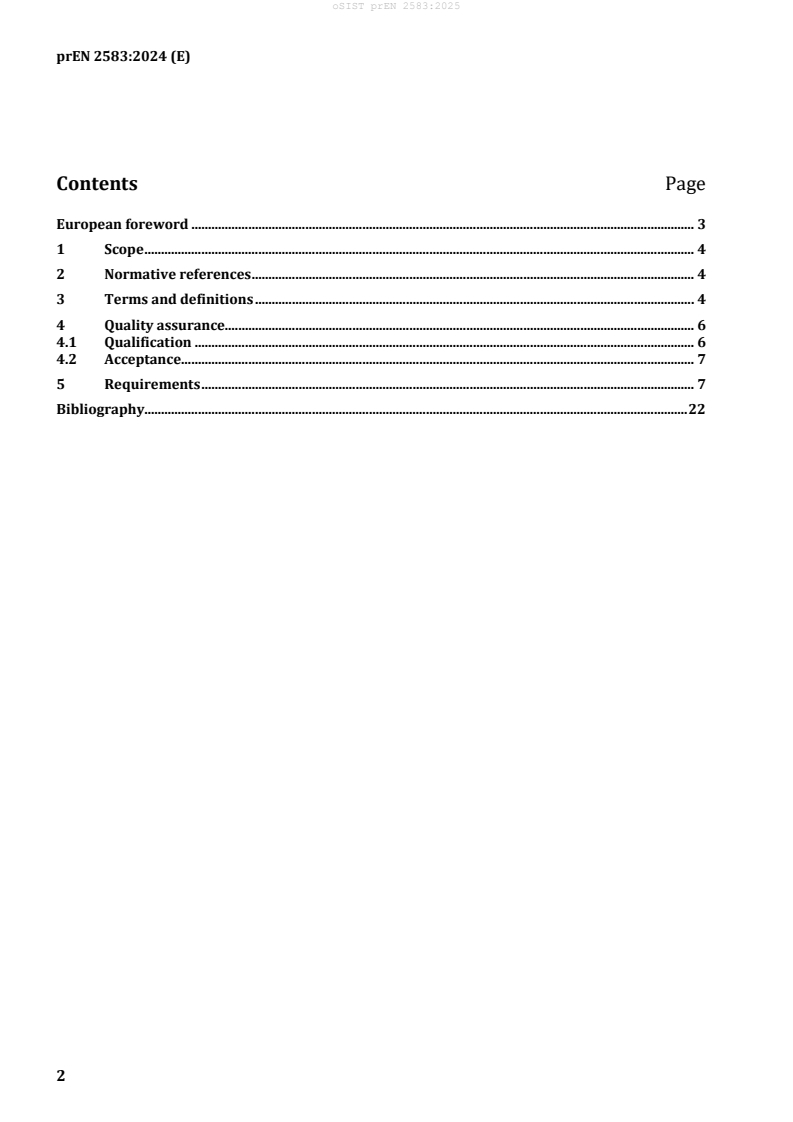
Contents Page
European foreword . 3
1 Scope . 4
2 Normative references . 4
3 Terms and definitions . 4
4 Quality assurance. 6
4.1 Qualification . 6
4.2 Acceptance . 7
5 Requirements . 7
Bibliography. 22
European foreword
This document (prEN 2583:2024) has been prepared by ASD-STAN.
This document will supersede EN 2583:2019.
This document includes the following significant technical changes with respect to EN 2583:2019:
— Clause 2, Normative references, has been updated;
— Subclause 4.1, Qualification, has been updated;
— Subclause 4.2.2, conditions, has been updated;
— Table 1, Technical requirements and test methods, has been updated;
— Table 4, Sampling plans for visual inspections and dimensional characteristics, has been deleted;
— Annex A, Passivation treatment for bolts, has been deleted.
1 Scope
This document specifies the characteristics, qualification and acceptance requirements for bolts with MJ
threads in NI-PH2601.
1 2
Classification: 1 275 MPa /650 °C .
2 Normative references
The following documents are referred to in the text in such a way that some or all of their content
constitutes requirements of this document. For dated references, only the edition cited applies. For
undated references, the latest edition of the referenced document (including any amendments) applies.
ISO 2859-1, Sampling procedures for inspection by attributes — Part 1: Sampling schemes indexed by
acceptance quality limit (AQL) for lot-by-lot inspection
ISO 3452-1, Non-destructive testing — Penetrant testing — Part 1: General principles
ISO 5855-2, Aerospace — MJ threads — Part 2: Limit dimensions for bolts and nuts
ISO 6892-1, Metallic materials — Tensile testing — Part 1: Method of test at room temperature
ISO 7961, Aerospace — Bolts — Test methods
ASTM E112, Standard Test Methods for Determining Average Grain Size
AMS2774, Heat Treatment Wrought Nickel Alloy and Cobalt Alloy Parts
NASM 1312-8, Aeronautical Fasteners Test Methods — Tensile Strength
3 Terms and definitions
For the purposes of this document, the following terms and definitions apply.
ISO and IEC maintain terminology databases for use in standardization at the following addresses:
— ISO Online browsing platform: available at https://www.iso.org/obp/
— IEC Electropedia: available at https://www.electropedia.org/
3.1
batch
quantity of finished bolts, of the same type and same diameter, produced from a material obtained from
the same melt, manufactured in the course of the same production cycle, following the same
manufacturing route and having undergone all the relevant heat treatments and surface treatments
Minimum tensile strength of the material at ambient temperature.
Maximum test temperature of the parts.
Published by American Society for Testing and Materials (ASTM International), available at:
https://www.astm.org.
Published by SAE International.
Published by
3.2
Surface discontinuities
3.2.1
crack
rupture in the material which may extend in any direction and which may be intercrystalline or
transcrystalline in character
3.2.2
seam
open surface defect
3.2.3
lap
surface defect caused by folding over metal fins or sharp corners and then compressing them into the
surface
3.2.4
inclusions
non-metallic particles originating from the material manufacturing process.
Note 1 to entry: These particles may be isolated or arranged in strings.
3.3
test temperature
ambient temperature, unless otherwise specified
3.4
simple random sampling
taking of n items from a population of N items in such a way that all possible combinations of n items have
the same probability of being chosen
[SOURCE: ISO 3534 (series)]
3.5
critical defect
defect that, according to judgement and experience, is likely to result in hazardous or unsafe conditions
for individuals using, maintaining, or depending upon the considered product, or that is likely to prevent
performance of the function of a major end item
[SOURCE: ISO 3534 (series)]
3.6
major defect
defect, other than critical, that is likely to result in a failure or to reduce materially the usability of the
considered product for its intended purpose
[SOURCE: ISO 3534 (series)]
3.7
minor defect
defect that is not likely to reduce materially the usability of the considered product for its intended
purpose, or that is a departure from established specification having little bearing on the effective use or
operation of this product
[SOURCE: ISO 3534 (series)]
3.8
sampling plan
plan according to which one or more samples are taken in order to obtain information and possibly to
reach a decision
[SOURCE: ISO 3534 (series)]
3.9
limiting quality
in a sampling plan, the quality level which corresponds to the specified 10 % probability of acceptance
3.10
acceptable quality level
AQL
quality level which in a sampling plan corresponds to a specified but relatively high probability of
acceptance.
Note 1 to entry: It is the maximum per cent defective (or the maximum number of defects per hundred units) that,
for purposes of sampling inspection, can be considered satisfactory as a process average.
[SOURCE: ISO 3534 (series), modified, - second sentence made into note to entry]
3.11
finished bolt
bolt ready for use, inclusive of any possible treatments and/or surface coatings, as specified in the
product standard or definition document
3.12
definition document
document specifying all the requirements for finished bolts
4 Quality assurance
4.1 Qualification
The qualification procedure for aerospace standard products (e.g. according to EN 9133 or an equivalent
aerospace accepted and established qualification procedure) shall be used and documented according to
the specified tests.
Qualification inspections and tests (requirements, methods, numbers of bolts) are specified in Table 1.
They shall be carried out on:
— each type and diameter of bolt;
— 25 bolts selected from a single batch by simple random sampling.
Table 2 indicates the allocation of bolt specimens for the inspections and tests.
4.2 Acceptance
4.2.1 Purpose
The purpose of acceptance inspections and tests is to check, as simply as possible, by a method
representative of actual use conditions, with the uncertainty inherent to statistical sampling, that the
bolts constituting the batch satisfy the requirements of this document.
4.2.2 Conditions
Acceptance inspections and tests (requirements, methods, numbers of bolts) are specified in Table 1.
They shall be carried out on each batch. Bolts from the batch to be tested shall be selected by simple
random sampling.
4.2.3 Responsibility
Acceptance inspections and tests shall be carried out by the manufacturer, or under their responsibility.
4.2.4 Inspection and test report
A test report showing actual numerical values shall be provided if specified in the purchase order.
5 Requirements
See Table 1.
Table 1 — Technical requirements and test methods
Inspection and test
a
Clause Characteristic Requirement Sample size
Q/A
method
5.1 Material In accordance with the product Chemical analysis or Q
standard or definition certificate of
A
document. compliance issued by
the manufacturer of
the semi-finished
product
5.2 Dimensions, In accordance with the product Standard gauging Q 25
tolerances and standard or definition
A Table 3
tolerances of document.
form and position
5.3 Manufacturing
5.3.1 Forging The head of the bolts shall be
The method of forging Q
formed by hot or cold forging. (hot or cold) shall be
If hot forged, the forging indicated
temperature shall not exceed
1 150 °C and they shall be air
cooled.
The equipment shall ensure a
uniform temperature
throughout the batch.
Inspection and test
a
Clause Characteristic Requirement Q/A Sample size
method
5.3.2 Heat treatment Heat treatment shall be Q
performed in accordance with
AMS2774. Alternative heat
treatment process parameters
may be established as long as
all mechanical properties are
achieved.
5.3.3 Head to shank After completion of solution, Dimensional check Q 25
fillet precipitation treatment and (see 5.2) and visual
A Table 3
machining, the underhead examination.
radius shall be cold rolled to
remove all visual signs of
machining and to create cold
working.
This may cause distortion
which shall not exceed the
values in Figure 2, unless
otherwise specified on the
product standard or definition
document.
For parts with compound radii
between head and shank
(e.g. T head bolts), cold work
only the radius hat blends with
the head, however it is
acceptable for cold work to
extend over the compound
radius.
The fillet shall not show seams
or inclusions (see Table 5).
5.3.4 Threads Shall be formed by a single Q
rolling process after full heat
treatment (see Figure 3).
5.3.5 Surface In accordance with the product Q 3
roughness standard or definition
A Table 3
document.
5.3.6 Surface coating In accordance with the product See applicable coating
standard or definition standard.
document.
5.4 Mechanical Mechanical tensile test EN ISO 6892-1 Q 5
properties
A Table 7,
column
...