

prEN 13383-2
(Main)Armourstone - Part 2: Complementary information and test methods
- Abstract
This document specifies sampling and test methods for natural, manufactured and recycled aggregates for use as armourstone. This document specifies the reference methods to be used for type testing and in case of dispute where an alternative method has been used. For other purposes, in particular factory production control, it allows for other methods to be used provided that an appropriate working relationship with the test method has been established. This document provides non-contradictory complementary information that can be of use when producing or purchasing armourstone produced according to harmonised standard prEN 13383-1:2021.
NOTE prEN 13383-1:2021 is also intended to be read in conjunction with the Construction Products Regulations.
- Status
- Not Published
- Publication Date
- 26-Jun-2023
- Technical Committee
- CEN/TC 154 - Aggregates
- Drafting Committee
- CEN/TC 154/WG 10 - Armourstone
- Current Stage
- 4098 - Decision to abandon - Enquiry
- Start Date
- 11-Jan-2023
- Completion Date
- 07-Oct-2026

Overview
The European Standard prEN 13383-2, titled "Armourstone - Part 2: Complementary information and test methods", is published by CEN (European Committee for Standardization) and details essential sampling and testing procedures for natural, manufactured, and recycled aggregates used as armourstone. This standard supports prEN 13383-1:2021 by providing comprehensive reference test methods for type testing and dispute resolution. It also facilitates the use of alternative testing methods for factory production control when a defined correlation with reference methods is established.
This standard is instrumental in ensuring the quality, reliability, and performance of armourstone-critical materials used in hydraulic engineering, coastal defense, and civil construction projects for erosion protection and structural stability.
Key Topics
- Scope and Application: Specifies methods for sampling and testing armourstone aggregates to verify compliance with prEN 13383-1:2021.
- Sampling Procedures: Detailed protocols for collecting representative samples, including sampling plans, apparatus, and sample handling, ensuring consistency and reliability.
- Test Methods: Reference methods include:
- Particle size distribution and mass distribution for coarse, light, and heavy gradings.
- Determination of armourstone shape to evaluate geometric suitability.
- Particle density and water absorption tests for assessing physical properties.
- Resistance testing including freezing/thawing cycles and salt crystallization to simulate environmental durability.
- Detection of potential issues such as "Sonnenbrand" and disintegration in steel slag aggregates.
- Complementary Information: Additional data on product characteristics such as classes, colour, impurities, and water-soluble constituents.
- Factory Production Control (FPC): Allows for alternative test methods under defined conditions when validated against reference methods.
- Documentation: Guidance on marking, labelling, packaging, and detailed test reporting formats.
Applications
- Hydraulic Engineering: Ensures armourstone used in revetments, breakwaters, and embankments meets rigorous durability and gradation standards to resist water erosion and mechanical stress.
- Coastal and Riverbank Protection: Provides reliable test methods to confirm performance of natural or recycled stone aggregates crucial for long-term stability.
- Construction Materials Quality Control: Supports manufacturers and purchasers in verifying aggregate quality for large-scale water infrastructure projects.
- Environmental Durability Assessment: Freezing/thawing and salt crystallization tests help predict stone longevity in harsh climates, protecting investments.
- Production and Dispute Resolution: Reference methods serve as authoritative procedures for quality certification and resolving contractual disagreements regarding armourstone quality.
Related Standards
- prEN 13383-1:2021 – Harmonized product standard detailing technical requirements for armourstone used in hydraulic constructions and civil engineering.
- Construction Products Regulation (CPR) – Relevant regulatory framework integrating prEN 13383 series for market compliance across the European Union.
- Other national and international standards governing mineral aggregates for construction, ensuring cross-sector alignment and quality assurance.
By adhering to prEN 13383-2, stakeholders including engineers, manufacturers, testing laboratories, and contractors can apply consistent, scientifically validated procedures for assessing armourstone quality. This standard plays a pivotal role in maintaining the safety, durability, and environmental suitability of stone aggregates used in critical infrastructure and water management projects across Europe and beyond.
Relations
- Effective Date
- 28-Jan-2026
- Effective Date
- 28-Jan-2026
- Effective Date
- 28-Jan-2026
- Effective Date
- 28-Jan-2026
- Effective Date
- 19-Jan-2023
Get Certified
Connect with accredited certification bodies for this standard

DIBt (Deutsches Institut für Bautechnik)
German Institute for Building Technology.
DIN CERTCO
DIN Group product certification.

Aboma Certification B.V.
Specialized in construction, metal, and transport sectors.
Sponsored listings
Frequently Asked Questions
prEN 13383-2 is a draft published by the European Committee for Standardization (CEN). Its full title is "Armourstone - Part 2: Complementary information and test methods". This standard covers: This document specifies sampling and test methods for natural, manufactured and recycled aggregates for use as armourstone. This document specifies the reference methods to be used for type testing and in case of dispute where an alternative method has been used. For other purposes, in particular factory production control, it allows for other methods to be used provided that an appropriate working relationship with the test method has been established. This document provides non-contradictory complementary information that can be of use when producing or purchasing armourstone produced according to harmonised standard prEN 13383-1:2021. NOTE prEN 13383-1:2021 is also intended to be read in conjunction with the Construction Products Regulations.
This document specifies sampling and test methods for natural, manufactured and recycled aggregates for use as armourstone. This document specifies the reference methods to be used for type testing and in case of dispute where an alternative method has been used. For other purposes, in particular factory production control, it allows for other methods to be used provided that an appropriate working relationship with the test method has been established. This document provides non-contradictory complementary information that can be of use when producing or purchasing armourstone produced according to harmonised standard prEN 13383-1:2021. NOTE prEN 13383-1:2021 is also intended to be read in conjunction with the Construction Products Regulations.
prEN 13383-2 is classified under the following ICS (International Classification for Standards) categories: 91.100.15 - Mineral materials and products. The ICS classification helps identify the subject area and facilitates finding related standards.
prEN 13383-2 has the following relationships with other standards: It is inter standard links to EN ISO 5832-2:2025, EN 14870-1:2023, EN 14870-4:2023, EN ISO 5832-3:2021, EN 13383-2:2019. Understanding these relationships helps ensure you are using the most current and applicable version of the standard.
prEN 13383-2 is available in PDF format for immediate download after purchase. The document can be added to your cart and obtained through the secure checkout process. Digital delivery ensures instant access to the complete standard document.
Standards Content (Sample)
SLOVENSKI STANDARD
01-september-2021
Kamen za obloge pri vodnih zgradbah in drugih gradbenih delih - 2. del: Dopolnilni
podatki in preskusne metode
Armourstone - Part 2: Complementary information and test methods
Wasserbausteine - Teil 2: Ergänzende Informationen und Prüfverfahren
Enrochements - Partie 2 : Informations complémentaires et méthodes d’essai
Ta slovenski standard je istoveten z: prEN 13383-2
ICS:
91.100.15 Mineralni materiali in izdelki Mineral materials and
products
2003-01.Slovenski inštitut za standardizacijo. Razmnoževanje celote ali delov tega standarda ni dovoljeno.
DRAFT
EUROPEAN STANDARD
NORME EUROPÉENNE
EUROPÄISCHE NORM
June 2021
ICS 91.100.15 Will supersede EN 13383-2:2019
English Version
Armourstone - Part 2: Complementary information and
test methods
Enrochements - Partie 2 : Informations Wasserbausteine - Teil 2: Ergänzende Informationen
complémentaires et méthodes d'essai und Prüfverfahren
This draft European Standard is submitted to CEN members for enquiry. It has been drawn up by the Technical Committee
CEN/TC 154.
If this draft becomes a European Standard, CEN members are bound to comply with the CEN/CENELEC Internal Regulations
which stipulate the conditions for giving this European Standard the status of a national standard without any alteration.
This draft European Standard was established by CEN in three official versions (English, French, German). A version in any other
language made by translation under the responsibility of a CEN member into its own language and notified to the CEN-CENELEC
Management Centre has the same status as the official versions.
CEN members are the national standards bodies of Austria, Belgium, Bulgaria, Croatia, Cyprus, Czech Republic, Denmark, Estonia,
Finland, France, Germany, Greece, Hungary, Iceland, Ireland, Italy, Latvia, Lithuania, Luxembourg, Malta, Netherlands, Norway,
Poland, Portugal, Republic of North Macedonia, Romania, Serbia, Slovakia, Slovenia, Spain, Sweden, Switzerland, Turkey and
United Kingdom.
Recipients of this draft are invited to submit, with their comments, notification of any relevant patent rights of which they are
aware and to provide supporting documentation.
Warning : This document is not a European Standard. It is distributed for review and comments. It is subject to change without
notice and shall not be referred to as a European Standard.
EUROPEAN COMMITTEE FOR STANDARDIZATION
COMITÉ EUROPÉEN DE NORMALISATION
EUROPÄISCHES KOMITEE FÜR NORMUNG
CEN-CENELEC Management Centre: Rue de la Science 23, B-1040 Brussels
© 2021 CEN All rights of exploitation in any form and by any means reserved Ref. No. prEN 13383-2:2021 E
worldwide for CEN national Members.
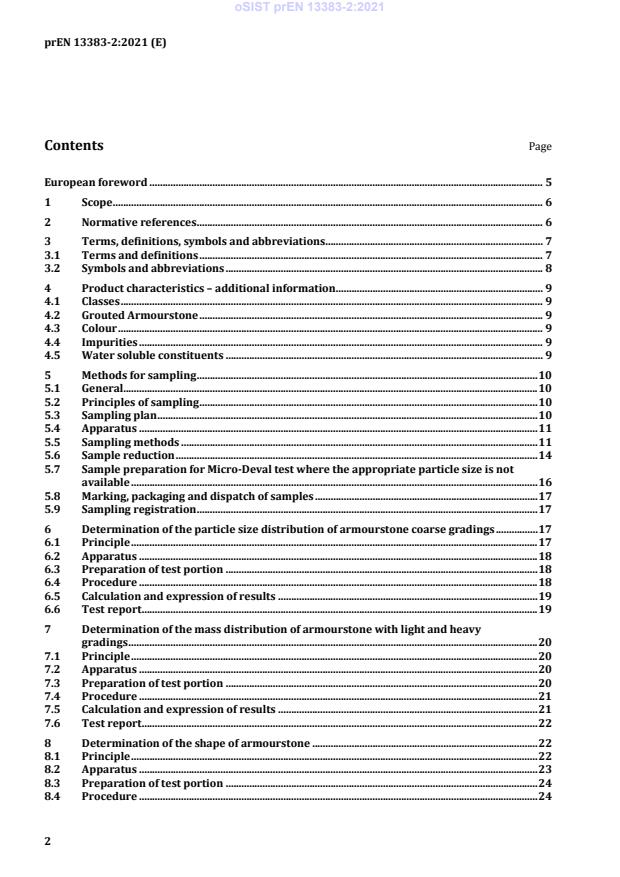
Contents Page
European foreword . 5
1 Scope . 6
2 Normative references . 6
3 Terms, definitions, symbols and abbreviations. 7
3.1 Terms and definitions . 7
3.2 Symbols and abbreviations . 8
4 Product characteristics – additional information . 9
4.1 Classes . 9
4.2 Grouted Armourstone . 9
4.3 Colour . 9
4.4 Impurities . 9
4.5 Water soluble constituents . 9
5 Methods for sampling . 10
5.1 General . 10
5.2 Principles of sampling . 10
5.3 Sampling plan . 10
5.4 Apparatus . 11
5.5 Sampling methods . 11
5.6 Sample reduction . 14
5.7 Sample preparation for Micro-Deval test where the appropriate particle size is not
available . 16
5.8 Marking, packaging and dispatch of samples . 17
5.9 Sampling registration . 17
6 Determination of the particle size distribution of armourstone coarse gradings . 17
6.1 Principle . 17
6.2 Apparatus . 18
6.3 Preparation of test portion . 18
6.4 Procedure . 18
6.5 Calculation and expression of results . 19
6.6 Test report . 19
7 Determination of the mass distribution of armourstone with light and heavy
gradings . 20
7.1 Principle . 20
7.2 Apparatus . 20
7.3 Preparation of test portion . 20
7.4 Procedure . 21
7.5 Calculation and expression of results . 21
7.6 Test report . 22
8 Determination of the shape of armourstone . 22
8.1 Principle . 22
8.2 Apparatus . 23
8.3 Preparation of test portion . 24
8.4 Procedure . 24
8.5 Calculation and expression of results . 25
8.6 Test report . 26
9 Determination of particle density and water absorption . 27
9.1 Principle . 27
9.2 Apparatus . 27
9.3 Materials . 27
9.4 Preparation of test portion . 27
9.5 Test procedure . 28
9.6 Calculation and expression of results . 28
9.7 Test report . 29
10 Determination of resistance to freezing and thawing . 30
10.1 Principle . 30
10.2 Apparatus . 30
10.3 Materials . 32
10.4 Test portions . 32
10.5 Procedure . 33
10.6 Calculation and expression of results . 34
10.7 Test report . 34
11 Determination of resistance to salt crystallization . 35
12 Determination of signs of “Sonnenbrand” and disintegration of steel slags . 35
12.1 Principle . 35
12.2 Apparatus . 35
12.3 Materials . 36
12.4 Preparation of test portions . 36
12.5 Procedure . 36
12.6 Calculation and expression of results . 37
12.7 Test report . 37
13 AVCP . 38
14 Marking and labelling and packaging . 38
Annex A (informative) Example of a sampling registration . 40
Annex B (informative) Example of a particle size distribution of armourstone with coarse
grading . 42
Annex C (informative) Example of a mass distribution: reference method . 43
Annex D (informative) Example method for determination of mass distribution (employing
bulk weighing) . 45
D.1 Principle . 45
D.2 Apparatus . 45
D.3 Preparation of test portion . 45
D.4 Procedure . 45
D.5 Calculation and expression of results . 45
D.6 Test report . 46
Annex E (informative) Density of water . 49
Annex F (informative) Precision for determination of particle density and water absorption
(see Clause 8) . 50
Annex G (informative) Guidance on sampling from floating plant . 51
G.1 General . 51
G.2 Sampling scheme 1 . 51
G.3 Sampling scheme 2 . 53
Annex H (informative) Guidance on gradings . 56
H.1 Limits of coarse, light and heavy gradings . 56
H.2 Declaration of non-standard light and heavy gradings . 57
H.2.1 General . 57
H.2.2 Class B light and heavy gradings . 59
H.2.3 Class A light and heavy gradings . 59
H.3 Declaration of non-standard coarse gradings . 60
H.3.1 General . 60
H.3.2 Coarse gradings . 61
Annex I (informative) Guidance on block integrity . 62
Annex J (informative) Guidance on the resistance of armourstone to freezing and thawing
and to salt crystallization . 63
J.1 General . 63
J.2 Climate . 63
J.3 Petrographic type . 64
J.4 Testing and selection of specification requirements . 64
J.4.1 Service record . 64
J.4.2 Petrographic examination . 64
J.4.3 Water absorption, freeze–thaw and magnesium sulfate tests . 64
Annex K (informative) Additional explanatory information . 66
K.1 Grading 90/180 . 66
K.2 Crushed and broken surfaces . 66
K.3 Resistance to attrition . 66
K.4 Particle density . 66
K.5 Shape . 67
Annex L (informative) Guidance on sampling for testing. 68
Bibliography . 73
European foreword
This document (prEN 13383-2:2021) has been prepared by Technical Committee CEN/TC 154
“Aggregates”, the secretariat of which is held by BSI.
This document is currently submitted to CEN Enquiry.
This document will supersede EN 13383-2:2019.
In comparison with the previous edition, the following changes have been made:
— a new Clause Symbols and abbreviations has been added;
— a new clause for product characteristics – additional information has been added, including
subclauses for classes, grouted armourstone, colour, impurities and water soluble constituents;
— the clause for determination of the percentage of pieces of armourstone with a length-to-thickness
ratio greater than 3 has been renamed to clause for determination of the shape of armourstone and
supplements for determination of crushed or broken surfaces have been added;
— the minimum required number of pieces of armourstone for determination of density was added;
— the procedure for determining resistance to freezing and thawing has been supplemented;
— a new clause for determining the resistance to salt crystallization has been added;
— the preparation of test portions for visual examination for signs of “Sonnenbrand” and for
determination of loss of mass of a piece of steel slag after boiling has been supplemented;
— a new clause for marking,labelling and packaging has been added,
— new informative annexes for Guidance on gradings, Guidance on block integrity, Guidance on the
resistance of armourstone to freezing and thawing and to salt crystallization and additional
explanatory information.
The prEN 13383 Armourstone series consists of the following parts:
— Part 1: Characteristics;
— Part 2: Complementary information and test methods.
1 Scope
This document specifies sampling and test methods for natural, manufactured and recycled aggregates
for use as armourstone. This document specifies the reference methods to be used for type testing and
in case of dispute where an alternative method has been used. For other purposes, in particular factory
production control, it allows for other methods to be used provided that an appropriate working
relationship with the test method has been established. This document provides non-contradictory
complementary information that can be of use when producing or purchasing armourstone produced
according to harmonised standard prEN 13383-1:2021.
NOTE prEN 13383-1:2021 is also intended to be read in conjunction with the Construction Products
Regulations.
2 Normative references
The following documents are referred to in the text in such a way that some or all of their content
constitutes requirements of this document. For dated references, only the edition cited applies. For
undated references, the latest edition of the referenced document (including any amendments) applies.
EN 932-1:1996, Tests for general properties of aggregates — Part 1: Methods for sampling
prEN 932-3:2020, Tests for general properties of aggregates — Part 3: Procedure and terminology for
simplified petrographic description
EN 932-5:2012, Tests for general properties of aggregates — Part 5: Common equipment and calibration
EN 933-1:2012, Tests for geometrical properties of aggregates — Part 1: Determination of particle size
distribution — Sieving method
EN 933-2:2020, Tests for geometrical properties of aggregates — Part 2: Determination of particle size
distribution — Test sieves, nominal size of apertures
EN 933-3:2012, Tests for geometrical properties of aggregates — Part 3: Determination of particle shape
— Flakiness index
EN 1097-1:2011, Tests for mechanical and physical properties of aggregates — Part 1: Determination of
the resistance to wear (micro-Deval)
EN 1097-5:2008, Tests for mechanical and physical properties of aggregates — Part 5: Determination of
the water content by drying in a ventilated oven
EN 1367-2:2009, Tests for thermal and weathering properties of aggregates — Part 2: Magnesium sulfate
test
EN 1744-3:2002, Tests for chemical properties of aggregates — Part 3: Preparation of eluates by leaching
of aggregates
ISO 3310-2:2013, Test sieves — Technical requirements and testing — Part 2: Test sieves of perforated
metal plate
3 Terms, definitions, symbols and abbreviations
For the purposes of this document, the following terms and definitions apply.
3.1 Terms and definitions
3.1.1
armourstone grading
armourstone designation with a nominal lower and upper limit
Note 1 to entry: This designation accepts the presence of undersize and oversize pieces of armourstone.
3.1.2
nominal lower limit
mass or sieve size in a grading below which the armourstone pieces are considered to be undersized
3.1.3
nominal upper limit
mass or sieve size in a grading above which the armourstone pieces are considered to be oversized
3.1.4
coarse grading
designation of grading with a nominal upper limit defined by a sieve size ≥ 90 mm and ≤ 250 mm
3.1.5
light grading
designation of grading with a nominal upper limit defined by a mass ≥ 40 and ≤ 300 kg
3.1.6
heavy grading
designation of grading with a nominal upper limit defined by a mass > 300 kg
3.1.7
fragment
aggregate pieces in the finest fraction of coarse gradings or the lightest fraction of light and heavy
gradings for which the particle size distribution or mass distribution requirements apply
Note 1 to entry: For further information on grading, see pr EN 13383-1:2021, 4.1.1.
3.1.8
batch
production quantity, delivery quantity, partial delivery quantity (railway wagon-load, lorry-load, ship's
cargo) or a stockpile produced at one time under conditions that are presumed uniform
3.1.9
sampling plan
procedure of allocation, withdrawal and preparation of a sample or samples from a material to yield the
required information
3.1.10
sampling increment
quantity of material taken from a batch by one operation of the sampling apparatus
3.1.11
bulk sample
aggregation of the sampling increments
3.1.12
representative sample
sample created by taking sampling increments according to sampling plan, which makes it likely that
the quality of this sample corresponds to that of the batch
3.1.13
subsample
sample obtained from sampling increments or a bulk sample by means of a sample reduction procedure
3.1.14
sampler
individual or a number of individuals working as a team, or an organisation, taking samples on a routine
basis
3.1.15
length
L
maximum dimension of a piece of armourstone as defined by the greatest distance apart of two parallel
planes tangential to the stone’s surface
3.1.16
thickness
T
minimum dimension of a piece of armourstone as defined by the least distance apart of two parallel
planes tangential to the stone’s surface
3.1.17
constant mass
successive weighings after drying at least 24 h apart not differing by more than 0,1 %
Note 1 to entry: In many cases, constant mass can be achieved after a test portion has been dried for a pre-
determined period in a specified oven at (110 ± 5) °C. Test laboratories can determine the time required to
achieve constant mass for specific types and sizes of sample dependent upon the drying capacity of the oven used.
3.2 Symbols and abbreviations
For the purposes of this document, the following symbols and abbreviations apply:
Symbol/Acronym Meaning:
AVCP Assessment for Verification of Constancy of Performance
FPC Factory Production Control
ELL Extreme Lower Limit
EUL Extreme Upper Limit
NLL Nominal Lower Limit
NUL Nominal Upper Limit
FT The percentage loss in mass of the test portion after freeze–thaw
cycling
L Maximum length
T Minimum thickness
Symbol/Acronym Meaning:
L/T Length to thickness ratio
W
Average water absorption
as
ρ Average particle density
ρ Minimum particle density
min
4 Product characteristics – additional information
4.1 Classes
Where compliance with a class is based on a value of a characteristic being less than or equal to a given
value, compliance with a more severe class (lower value) automatically confers compliance with all less
severe classes (higher values). Similarly for classes based on the value of a characteristic being greater
than or equal to a given value, compliance with a more severe (higher value) automatically confers
compliance with all less severe classes (lower values).
When the performance of a characteristic XX does not comply with even the least severe class in the
class table included in prEN 13383-1:2021, the manufacturer can declare an appropriate limiting value
in the XX class.
Stated
The particle size distribution of coarse gradings shall be determined in accordance with Clause 6 or as
declared by the manufacturer for class CP .
Stated
The mass distribution of light gradings shall be determined in accordance with Clause 7 or as
determined in accordance with Annex H (informative) and declared by the manufacturer for class
LMA or LMB
Stated Stated
The mass distribution of heavy gradings shall be determined in accordance with Clause 7 or as
determined in accordance with Annex H (informative) and declared by the manufacturer for class
HMA or HMB .
Stated Stated
4.2 Grouted Armourstone
Armourstone intended for use in a layer to be grouted with bituminous or cement mortar shall not be
coated with observable clayey or other adhesive soil.
4.3 Colour
Natural variation in colour supplied from a quarry (or distinct part of a quarry) with an established
pattern of supply shall not be grounds for rejection of any material. Any preference for a particular
general colour for the armourstone might be advised.
4.4 Impurities
Armourstone shall not contain any foreign matter such as scrap metal, wood and plastic in a quantity
that will cause damage to the structure or the environment in which it is used.
4.5 Water soluble constituents
For the determination of water soluble constituents, an eluate shall be prepared from a representative
sample of armourstone as specified in EN 1744-3:2002. Where suitable aggregate representative of the
armourstone is not available, the test portion shall be obtained by crushing, using a laboratory jaw
crusher, at least six separate pieces of armourstone for which the masses do not differ by more than
25 %.
5 Methods for sampling
5.1 General
This clause describes methods for obtaining samples of armourstone from preparation and processing
plants including stocks and from silos, stockpiles and deliveries.
NOTE 1 It is preferable for armourstone to be sampled at the quarry or during the loading for transport (or
unloading).
NOTE 2 Guidance on sampling for testing is given in Annex L.
The aim of sampling is to obtain samples that are representative of the average properties of the batch.
The methods described are also suitable for obtaining sampling increments, which are to be tested
separately.
Methods to be used for sample reduction are also given.
5.2 Principles of sampling
Proper and careful sampling and sample transport is a prerequisite for an analysis that will give reliable
results. The correct use of the specified apparatus and methods helps to avoid biased sampling inclusive
the possibility of human bias introduced by visual selection. Sampling variation caused by the
heterogeneity of the batch shall be reduced to an acceptable level by taking an adequate number of
sampling increments.
NOTE For guidance on numbers and sizes of samples and test portions for testing armourstone as specified in
this document, see Annex G.
Sampling increments are selected at random from all parts of the batch that the samples are to
represent. Armourstone from which no sampling increment can be taken (because it is not accessible,
or for some other practical reason) shall not be considered to be part of the batch that is represented by
the samples. For example, if sampling increments are taken from armourstone discharged from a silo,
the samples represent the armourstone that has been discharged, not the armourstone remaining in the
silo.
The sampler shall be informed of the aim of the sampling.
5.3 Sampling plan
A sampling plan shall be prepared, prior to sampling, taking into account the grading type, the nature
and size of the batch, the local circumstances and the purposes of sampling. It shall include:
a) the type of the armourstone;
b) the aim of the sampling including a list of the properties to be tested;
c) the identification of the sampling points;
d) the mass or number of stones of sampling increments;
e) the number of sampling increments;
f) the sampling apparatus to be used;
g) the methods of sampling and sample reduction with reference to the clauses of this document;
h) the relevant marking, packaging and dispatch of the samples.
5.4 Apparatus
5.4.1 Apparatus for sampling
5.4.1.1 Grab, fitted to either a crane or a hydraulic machine.
5.4.1.2 Bucket or fork, fitted to a wheeled loader or a hydraulic machine.
5.4.1.3 Truck, for receiving and/or transport of samples.
5.4.1.4 Lifting equipment and lifting aids, for stones that cannot be moved manually.
5.4.2 Apparatus for sample reduction and transport
5.4.2.1 A floor area, upon which samples can be deposited and tested. The floor shall be
sufficiently clean and close-textured to be able to distinguish and recover the material of the sample
from the floor material.
5.4.2.2 Shovels.
5.4.2.3 Rectangular sampling buckets, of sufficient size and of width not less than three times the
nominal upper grading limit.
5.4.2.4 Suitable plates and wires, for sample reduction.
5.4.2.5 Containers for transport, such as bags, buckets or other suitable containers.
5.5 Sampling methods
5.5.1 General
Regulations for safety and ergonomics are expected to be followed.
WARNING Some sampling methods will inevitably involve the samplers working close to processing
plant and moving vehicles. Those involved in the planning and execution of sampling should work
closely with the operational management to ensure safe working practices.
Mechanically selected gradings should preferably be sampled from a stationary conveyor belt or from
the stream of material. Sampling increments should be taken at regular intervals throughout the period
the batch is in motion. Gradings of which the pieces of armourstone are individually handled may be
sampled at the most convenient location.
Sampling from static batches should be avoided wherever possible since it is difficult to satisfy the
principle of taking sampling increments at random from all parts of the batch, and hence segregation is
likely to cause the sampling to produce biased results.
During sampling, grabs or other extraction equipment shall be filled to a minimum such that the degree
of filling does not adversely affect the representative nature of the sample or sampling increment.
5.5.2 Sampling, for the determination of particle size distribution, mass distribution and shape
characteristics
5.5.2.1 Sampling of material in bucket conveyors, bucket loaders, or grabs
Each sampling increment shall consist of the entire contents of a grab or bucket.
When this gives too large a sampling increment, it should be reduced by one of the methods described
in 5.6.
5.5.2.2 Sampling at belt and chute discharge points
The period during which the sampling is to be done shall be divided into a number of equal intervals,
and a sampling increment shall be taken in the middle of each interval.
A sample increment shall be taken by catching the discharge stream in a loader bucket, making sure
that the complete cross-section of the stream of material is intercepted. At the beginning and the ending
of the sampling, the edge of the bucket shall pass the cross-section of the stream as fast as possible.
Where appropriate, sampling should only be started after a preliminary run to ensure that possible
irregularities in the pass do not lead to unrepresentative samples.
Samples may also be taken at the discharge from a screen by the same method.
5.5.2.3 Sampling from stationary conveyor belts
Sampling should only be started after a preliminary run to ensure that possible irregularities in the pass
do not lead to unrepresentative samples.
All sampling increments shall be taken at the same sampling point. In every sampling increment, all
material between two cross-sections shall be taken. The distance between the cross-sections shall be
determined by the required quantity of the sampling increment.
5.5.2.4 Sampling from a silo
Sampling at a silo outlet shall be carried out in accordance with 5.5.2.2.
During filling of a silo the material segregates and as a result the finer material tends to be found in the
centre of the silo with the coarser material along the wall sides. Alternating loading and discharging of a
silo leads to a complex segregation pattern in the silo and this segregation causes variations in the
particle size distribution of the discharged material. The number of sampling increments should be
related to this variation.
5.5.2.5 Sampling from stockpiles
When sampling from a segregated stockpile, from which material is being collected for transporting, a
sampling increment shall be taken from the material which is being taken from the stockpile. For this
purpose, the contents of one or more loader buckets, grabs, lorries or any other means of handling or
transport shall be taken. The period during which the sampling is done shall be divided into a number
of equal intervals and a sampling increment shall be taken in the middle of each interval.
If at the time of sampling no material of a segregated stockpile is undergoing routine removal, the
removal of material shall be simulated so as not to distort the representativity of the sampling
increment with the segregation effects associated with the initiation of stockpile extraction. The
sampling increments shall be taken at random or at equal distances around the stockpile or part thereof
to be sampled.
When sampling from a non-segregated stockpile, a sampling increment shall be taken as indicated for a
segregated stockpile or by taking a quantity of material from a random location which is easily reached
with the equipment available.
5.5.2.6 Sampling from floating equipment
When sampling cannot be performed during loading or unloading, sampling from floating equipment
should be performed with reference to Scheme 1 or Scheme 2 of Annex G.
5.5.2.7 Sampling from wheeled transport
Discharge the contents of the vehicle partially or completely in a manner, which produces an evenly
distributed longitudinal pile of material. Sampling increments shall be taken from across the pile by
removing, at random or at equally distributed locations, adequate quantities of material whilst avoiding
the possibly segregated material at the start and finish of the pile (see Figure 1). Take the material in
strips over the full width of the pile or in equal numbers of half strips from the left and right hand side
of the centre line of the pile.
Dimensions are approximate
Key
1 potential segregation area
Figure 1 — Sampling locations in a spread-discharged load
When a batch to be sampled consists of more than one load, the sampling increments shall be taken
from randomly selected loads using the method described above or taking each selected load as a whole
as an increment.
When one load contains insufficient material for one sample to be tested, several loads shall be taken.
5.5.3 Sampling for the determination of physical, chemical, durability and other properties
For the determination of physical, chemical, durability and other properties individual pieces of
armourstone excluding fragments shall be taken randomly as sampling increments, forming together a
bulk sample. For properties for which testing of aggregate is permitted, sampling shall be carried out in
accordance with EN 932-1:1996.
Sampling increments consisting of individual pieces of armourstone shall be taken from the batch to be
tested and may be taken from the samples which have been taken for the determination of the particle
size or mass distribution.
Sampling increments shall be selected by one of the following methods:
a) using random numbers (see EN 932-1:1996, Annex D);
b) taking pieces of armourstone in a sequence of predetermined positions relative to a randomly
chosen starting point in a static batch;
c) taking pieces of armourstone from random sieve fractions or parts thereof during or after the
determination of the particle size distribution using two samplers, one being a blindfolded selector
and the other performing the actions;
d) taking pieces of armourstone at a time or number interval when the material to be sampled is
passing in a random sequence of the stones, for instance during the determination of the mass
distribution.
If individual pieces of armourstone are significantly larger than the minimum size or mass required for
the test(s) to be executed, a portion of appropriate size or mass may be obtained by breaking a
representative piece. (The objective is to obtain laboratory samples representative of the batch to be
tested but to have carried sample reduction at source so as to minimize transport costs and reduce
unnecessary sample reduction at the testing laboratory.)
5.6 Sample reduction
5.6.1 General
Wherever possible, samples shall be reduced to produce samples for testing of appropriate size at the
sampling location.
If a sampling increment of a coarse grading is too large as test portion, one of the procedures as
described in 5.6.2, 5.6.3 or 5.6.4 shall be used for the reduction of the sampling increment.
If a sampling increment of a light grading is too large for the preparation of the bulk sample, the
procedure as specified in 5.6.3 or 5.6.4 shall be used for the reduction of the sampling increment.
If a sampling increment of a heavy grading is too large for the preparation of the bulk sample, the
procedure as specified in 5.6.4 shall be used for the reduction of the sampling increment.
5.6.2 Reduction using buckets
Discharge the sample over one or more sample bucke
...