

EN 15503:2009+A1:2013/FprA2:2015
(Amendment)Garden equipment - Garden blowers, vacuums and blower/vacuums - Safety
- Abstract
Requirements for preventing accessibility to the inlet and discharge opening of garden blowers, vacuums and blowers/vacuums - Amendment on accessibility
- Status
- Not Published
- Technical Committee
- CEN/TC 144 - Tractors and machinery for agriculture and forestry
- Drafting Committee
- CEN/TC 144/WG 7 - Garden equipment
- Current Stage
- 5060 - Closure of Vote - Formal Approval
- Start Date
- 06-Oct-2015
- Due Date
- 25-Nov-2015
- Completion Date
- 06-Oct-2015


Overview
The EN 15503:2009+A1:2013/FprA2:2015 standard is a critical update focusing on the safety of garden equipment, specifically garden blowers, vacuums, and blower/vacuums. Published by CEN (European Committee for Standardization), this standard amendment addresses enhanced safety requirements for preventing accidental access to hazardous moving parts through the inlet and discharge openings of such equipment.
This amendment introduces the concept of the tortuous path-a design principle aimed at preventing finger access to dangerous components by requiring unnatural joint articulations, significantly improving user protection during operation.
Key Topics
- Scope of Safety Requirements: Targets garden blowers, vacuums, and combined blower/vacuums, ensuring that users cannot reach hazardous moving elements through openings.
- Tortuous Path Principle (Term 3.18): Defines a safety approach where the design of inlet and discharge openings restricts finger access by forcing joint movements beyond natural ranges, preventing contact with moving parts.
- Guarding of Openings (Clause 5.2):
- Openings must be protected against access via straight line guards complying with EN ISO 13857:2008.
- Alternatively, the use of tortuous path guards prevents hazardous contact when tested with arm probes simulating human reach.
- Guard Types and Fixings:
- Guards can be fixed (tool-detachable), interlocking (tool-free detachable), or automatically closing but tool-releasable.
- Guards removable during routine user maintenance must remain securely attached to prevent loss.
- Safety-Related Control Systems: Interlocking guards must use well-tried control principles and reliable components, ensuring consistent safety performance.
- Annex D (Normative) – Tortuous Path Test:
- Specifies test procedures using articulated arm probes representing young adult and adult limbs to check if design effectively blocks access.
- Testing involves applying force up to 20 N and performing complex probe articulations to simulate human attempts to reach hazardous parts.
- Tests are conducted with and without debris collectors, with additional safety interlocks required if removal stops power to moving parts.
Applications
- Garden Equipment Manufacturers: Designing and certifying garden blowers, vacuums, and combined blower/vacuums to comply with European safety regulations.
- Safety Compliance Testing: Applying the tortuous path test described in Annex D to verify guarding effectiveness and ensure protection against user injury.
- Product Development: Integrating fixed, interlocking, or automatic guards that meet updated accessibility requirements, while allowing for necessary maintenance procedures.
- Regulatory Bodies and Market Surveillance: Ensuring garden equipment on the European market satisfies the safety mandates outlined in this amendment tied to EU Machinery Directive 2006/42/EC.
Related Standards
- EN ISO 13857:2008 – Safety distances to prevent access to hazardous parts by upper and lower limbs.
- EU Directive 2006/42/EC – Machinery directive outlining essential health and safety requirements for the design and construction of machinery, supported by EN 15503 amendments.
- CEN/TC 144 Technical Committee – Responsible for standards on agricultural and forestry machinery, including garden equipment.
Keywords
Garden equipment safety, garden blowers standards, garden vacuum safety, tortuous path design, EN 15503 update, garden blower guarding, hazardous moving parts prevention, European safety standard garden tools, CEN garden equipment norms, accessible guard requirements, EU Machinery Directive compliance.
Relations
- Merged Into
EN 15503:2009+A2:2015 - Garden equipment - Garden blowers, vacuums and blower/vacuums - Safety - Effective Date
- 21-Oct-2015
- Amends
EN 15503:2009+A1:2013 - Garden equipment - Garden blowers, vacuums and blower/vacuums - Safety - Effective Date
- 21-Aug-2013
- Effective Date
- 07-Dec-2011
Get Certified
Connect with accredited certification bodies for this standard

Control Union Certifications
Global certification for agriculture and sustainability.

ECOCERT
Organic and sustainability certification.

FSC International
Forest Stewardship Council certification.
Sponsored listings
Frequently Asked Questions
EN 15503:2009+A1:2013/FprA2:2015 is a draft published by the European Committee for Standardization (CEN). Its full title is "Garden equipment - Garden blowers, vacuums and blower/vacuums - Safety". This standard covers: Requirements for preventing accessibility to the inlet and discharge opening of garden blowers, vacuums and blowers/vacuums - Amendment on accessibility
Requirements for preventing accessibility to the inlet and discharge opening of garden blowers, vacuums and blowers/vacuums - Amendment on accessibility
EN 15503:2009+A1:2013/FprA2:2015 is classified under the following ICS (International Classification for Standards) categories: 65.060.70 - Horticultural equipment. The ICS classification helps identify the subject area and facilitates finding related standards.
EN 15503:2009+A1:2013/FprA2:2015 has the following relationships with other standards: It is inter standard links to EN 15503:2009+A2:2015, EN 15503:2009+A1:2013, EN 15503:2009. Understanding these relationships helps ensure you are using the most current and applicable version of the standard.
EN 15503:2009+A1:2013/FprA2:2015 is associated with the following European legislation: EU Directives/Regulations: 2006/42/EC; Standardization Mandates: M/396. When a standard is cited in the Official Journal of the European Union, products manufactured in conformity with it benefit from a presumption of conformity with the essential requirements of the corresponding EU directive or regulation.
EN 15503:2009+A1:2013/FprA2:2015 is available in PDF format for immediate download after purchase. The document can be added to your cart and obtained through the secure checkout process. Digital delivery ensures instant access to the complete standard document.
Standards Content (Sample)
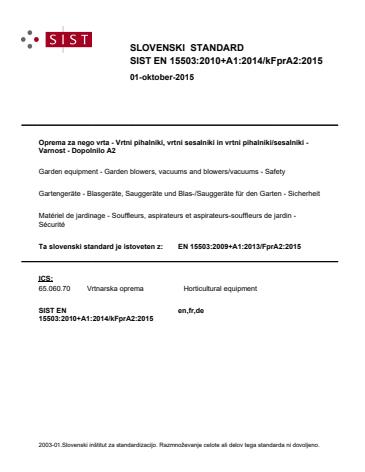
SLOVENSKI STANDARD
01-oktober-2015
Oprema za nego vrta - Vrtni pihalniki, vrtni sesalniki in vrtni pihalniki/sesalniki -
Varnost - Dopolnilo A2
Garden equipment - Garden blowers, vacuums and blowers/vacuums - Safety
Gartengeräte - Blasgeräte, Sauggeräte und Blas-/Sauggeräte für den Garten - Sicherheit
Matériel de jardinage - Souffleurs, aspirateurs et aspirateurs-souffleurs de jardin -
Sécurité
Ta slovenski standard je istoveten z: EN 15503:2009+A1:2013/FprA2:2015
ICS:
65.060.70 Vrtnarska oprema Horticultural equipment
SIST EN en,fr,de
15503:2010+A1:2014/kFprA2:2015
2003-01.Slovenski inštitut za standardizacijo. Razmnoževanje celote ali delov tega standarda ni dovoljeno.
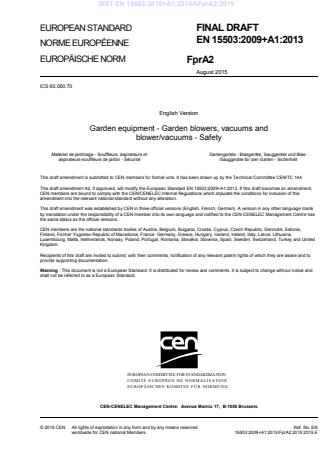
EUROPEAN STANDARD
FINAL DRAFT
EN 15503:2009+A1:2013
NORME EUROPÉENNE
EUROPÄISCHE NORM
FprA2
August 2015
ICS 65.060.70
English Version
Garden equipment - Garden blowers, vacuums and
blower/vacuums - Safety
Matériel de jardinage - Souffleurs, aspirateurs et Gartengeräte - Blasgeräte, Sauggeräte und Blas-
aspirateurs-souffleurs de jardin - Sécurité /Sauggeräte für den Garten - Sicherheit
This draft amendment is submitted to CEN members for formal vote. It has been drawn up by the Technical Committee CEN/TC 144.
This draft amendment A2, if approved, will modify the European Standard EN 15503:2009+A1:2013. If this draft becomes an amendment,
CEN members are bound to comply with the CEN/CENELEC Internal Regulations which stipulate the conditions for inclusion of this
amendment into the relevant national standard without any alteration.
This draft amendment was established by CEN in three official versions (English, French, German). A version in any other language made
by translation under the responsibility of a CEN member into its own language and notified to the CEN-CENELEC Management Centre has
the same status as the official versions.
CEN members are the national standards bodies of Austria, Belgium, Bulgaria, Croatia, Cyprus, Czech Republic, Denmark, Estonia,
Finland, Former Yugoslav Republic of Macedonia, France, Germany, Greece, Hungary, Iceland, Ireland, Italy, Latvia, Lithuania,
Luxembourg, Malta, Netherlands, Norway, Poland, Portugal, Romania, Slovakia, Slovenia, Spain, Sweden, Switzerland, Turkey and United
Kingdom.
Recipients of this draft are invited to submit, with their comments, notification of any relevant patent rights of which they are aware and to
provide supporting documentation.
Warning : This document is not a European Standard. It is distributed for review and comments. It is subject to change without notice and
shall not be referred to as a European Standard.
EUROPEAN COMMITTEE FOR STANDARDIZATION
COMITÉ EUROPÉEN DE NORMALISATION
EUROPÄISCHES KOMITEE FÜR NORMUNG
CEN-CENELEC Management Centre: Avenue Marnix 17, B-1000 Brussels
© 2015 CEN All rights of exploitation in any form and by any means reserved Ref. No. EN
worldwide for CEN national Members. 15503:2009+A1:2013/FprA2:2015:2015 E
Contents
Page
Foreword . 3
1 Modification to Clause 3 . 4
2 Modifications to 5.2 . 4
3 Addition of a new Annex D . 4
Annex D (normative) Tortuous path test . 5
D.1 Requirements . 5
D.2 Test procedure . 5
D.3 Test acceptance . 7
Foreword
This document (EN 15503:2009+A1:2013/FprA2:2015) has been prepared by Technical Committee
CEN/TC 144 “Tractors and machinery for agriculture and forestry”, the secretariat of which is held by
AFNOR.
This document is currently submitted to the Formal Vote.
This document has been prep
...