

FprEN 18253
(Main)Soil improvers and growing media - Determination of total organic carbon (TOC) by dry combustion
- Abstract
This document specifies a method for the determination of total organic carbon (TOC) in soil improvers and growing media containing more than 1 g carbon per kg of dry matter (0,1 %).
NOTE 1 Samples with a low dry matter content can have an influence on the achievable limit of quantification as defined in the scope (i.e. 1 g carbon per kg of dry matter).
NOTE 2 This method has been validated in an interlaboratory study with specific products that were present on the market during the study (as included in Annex b, being composted bark (20 mm to 40 mm), biowaste compost (Rottegrad 3), green compost (Rottegrad 5,0 mm to 15 mm), solid digestate, liquid digestate, soil improver (pellets, sieved 4 mm) and growing media blend 1 (white peat, green compost, wood fibre, lime, inorganic fertilizer (NPK + micro elements))).
- Status
- Not Published
- Publication Date
- 13-Jan-2027
- Technical Committee
- CEN/TC 223 - Soil improvers and growing media
- Drafting Committee
- CEN/TC 223/WG 4 - Analytical methods
- Current Stage
- 5020 - Submission to Vote - Formal Approval
- Start Date
- 24-Sep-2026
- Due Date
- 21-Dec-2024
- Completion Date
- 24-Sep-2026
- Mandate
- M/XXX - M/XXX

FprEN 18253 is a CEN draft European Standard for measuring total organic carbon (TOC) in soil improvers and growing media by dry combustion. It specifies a laboratory method for samples above 1 g carbon per kg dry matter, and it is written for laboratories and users who need comparable TOC results for these products.
What does FprEN 18253 specify?
FprEN 18253 specifies a method for determining TOC in soil improvers and growing media within its stated carbon range. It also shows how the sample is prepared, how the measurement is carried out, how results are calculated on a dry-matter basis, and what has to be reported.
The document is organized into:
- Clause 1, scope
- Clause 2, normative references
- Clause 3, terms and definitions
- Clause 4, principle
- Clauses 5 to 6, reagents and apparatus
- Clauses 7 to 10, sampling, procedure, calculation, and test report
- Clause 11, validation of the method
- Annexes A and B, informative material
| Annex | What it covers |
|---|---|
| Annex A | Example operational information from different laboratories |
| Annex B | Performance characteristics of the method from the interlaboratory study |
What are the key requirements of FprEN 18253?
FprEN 18253 sets out a complete analytical workflow: take a representative sample, prepare it correctly, choose a direct or indirect route, calibrate the instrument if needed, verify performance with control material, and report the result on a dry-matter basis.
Scope, sample type, and interferences
- Clause 1 limits the method to soil improvers and growing media with more than 1 g carbon per kg dry matter. In practice, this means very low-carbon products sit outside the intended working range.
- Clause 4.3 warns that high carbonate content can interfere with reliable TOC results if carbonates are not fully removed. This matters for carbonate-rich materials because incomplete removal can bias the result.
- Clause 4.3 also notes that carbon from urea and urea-condensates is treated as organic carbon in this method. If that matters for interpretation, it has to be checked separately and recorded.
Sampling and sample preparation
- Clause 7 sends sampling to EN 12579. The laboratory needs a representative sample that has not been altered during transport or storage.
- Clause 8.1 requires dried and ground solid samples and homogenized liquid samples. For moist or paste-like materials, aluminium oxide may be used to make a granular material, and the dilution factor must then be included in the calculation.
- Clause 8.2.3 gives two ways to handle liquid samples: use inert absorbent material such as Chromosorb® or dry the sample and follow the sample-preparation route in prEN 13040-1. This lets the lab choose the approach that fits its equipment and sample type.
Measurement routes
- Clause 4 describes Method A, the direct method, and Method B, the indirect method.
- Method A measures carbon dioxide released by combustion after carbonate removal with acid, or by combustion at 600°C so that only organically bound carbon is released. In practice, this is the direct route when the lab wants TOC from one combustion step.
- Method B calculates TOC as total carbon minus total inorganic carbon. Clause 8.2.5 links TIC determination to EN ISO 10693:2014 or CEN/TS 17776:2022, so the inorganic fraction is measured separately before subtraction.
Calibration and control
- Clause 8.3 requires calibration when a relative detector is used, for example infrared detection. The calibration has to be linear, and the working range has to stay within the linear range of the instrument.
- Clause 8.4 requires control measurements using the control mixture. This is the lab's routine check that the system is recovering carbon correctly and staying in control.
- Clause 8.4 also gives a recovery target and repeatability check for the control mixture. In practice, this tells the operator whether the combustion, detection and calibration chain is behaving properly before routine reporting.
Calculation and reporting
- Clause 9 requires TOC to be expressed on a dry-matter basis using separately determined water content, and any dilution caused by aluminium oxide has to be included. This is what makes results comparable between wet and dry products.
- Clause 10 requires the report to identify the sample, name the method, state any pre-treatment, give the TOC result in g/kg, and record sampling and analysis dates plus any unusual operating details. That documentation is what makes the result traceable.
What terms does FprEN 18253 define?
- total carbon (TC) - the carbon present in a sample as organic, inorganic and elemental carbon.
- total organic carbon (TOC) - the organic carbon measured by this method, either directly from combustion or by difference from TC and TIC.
- total inorganic carbon (TIC) - the inorganic carbon measured separately when Method B is used.
- control mixture - a prepared blend used to check recovery and routine instrument performance.
- relative detection method - a detection approach that needs calibration against standards, such as infrared detection.
- absolute detection method - a detection approach that uses specific constants rather than a calibration function.
- Method A - the direct TOC route based on combustion and measurement of released carbon dioxide.
- Method B - the indirect TOC route based on separate TC and TIC measurements.
Who uses FprEN 18253?
FprEN 18253 is used by laboratories that test soil improvers and growing media for TOC content. It is also relevant to manufacturers, quality managers, and product specifiers who need batch-to-batch comparability or laboratory data for product release.
The method is useful for work on composts, digestates, pellets, peat-based blends, and other mixed growing media. Buyers, auditors, and certification bodies may also use the reported results when they need a documented analytical basis for product evaluation.
Which standards are used with FprEN 18253?
- CEN/TS 17732:2022 - provides the terminology used in the document.
- EN 12579:2024 - covers sampling of soil improvers and growing media.
- prEN 13040-1:2025 - covers sample preparation and the dry-matter and moisture data used in result conversion.
- CEN/TS 17776:2022 - gives a related dry-combustion TOC method for organic and organo-mineral fertilizers.
- EN ISO 10693:2014 - provides a method for determining carbonate content, used for TIC determination in Method B.
- ISO 8466-1 - supports the linear calibration check used for relative detection methods.
- ISO 5725-2 - is used for validation and precision assessment of the method.
What does the FprEN 18253 document contain?
FprEN 18253 contains the analytical principle, reagent list, apparatus list, sampling and sample-preparation steps, two measurement routes, calibration rules, control checks, calculation formulas, and the required test-report items. It also includes validation guidance and interlaboratory performance data.
Annex A gives example operating conditions from different laboratories, such as preparation approach, vessel type, combustion setup, carrier gas and detector choice. Annex B gives the performance characteristics from the interlaboratory study and identifies the seven tested matrices used for validation.
Get Certified
Connect with accredited certification bodies for this standard

Control Union Certifications
Global certification for agriculture and sustainability.

ECOCERT
Organic and sustainability certification.

FSC International
Forest Stewardship Council certification.
Sponsored listings
Frequently Asked Questions
FprEN 18253 is a draft published by the European Committee for Standardization (CEN). Its full title is "Soil improvers and growing media - Determination of total organic carbon (TOC) by dry combustion". This standard covers: This document specifies a method for the determination of total organic carbon (TOC) in soil improvers and growing media containing more than 1 g carbon per kg of dry matter (0,1 %). NOTE 1 Samples with a low dry matter content can have an influence on the achievable limit of quantification as defined in the scope (i.e. 1 g carbon per kg of dry matter). NOTE 2 This method has been validated in an interlaboratory study with specific products that were present on the market during the study (as included in Annex b, being composted bark (20 mm to 40 mm), biowaste compost (Rottegrad 3), green compost (Rottegrad 5,0 mm to 15 mm), solid digestate, liquid digestate, soil improver (pellets, sieved 4 mm) and growing media blend 1 (white peat, green compost, wood fibre, lime, inorganic fertilizer (NPK + micro elements))).
This document specifies a method for the determination of total organic carbon (TOC) in soil improvers and growing media containing more than 1 g carbon per kg of dry matter (0,1 %). NOTE 1 Samples with a low dry matter content can have an influence on the achievable limit of quantification as defined in the scope (i.e. 1 g carbon per kg of dry matter). NOTE 2 This method has been validated in an interlaboratory study with specific products that were present on the market during the study (as included in Annex b, being composted bark (20 mm to 40 mm), biowaste compost (Rottegrad 3), green compost (Rottegrad 5,0 mm to 15 mm), solid digestate, liquid digestate, soil improver (pellets, sieved 4 mm) and growing media blend 1 (white peat, green compost, wood fibre, lime, inorganic fertilizer (NPK + micro elements))).
FprEN 18253 is classified under the following ICS (International Classification for Standards) categories: 65.080 - Fertilizers. The ICS classification helps identify the subject area and facilitates finding related standards.
FprEN 18253 is associated with the following European legislation: EU Directives/Regulations: 2003/2003, 2019/1009; Standardization Mandates: M/564, M/564 AMD 1, M/564 AMD 2, M/588, M/XXX. When a standard is cited in the Official Journal of the European Union, products manufactured in conformity with it benefit from a presumption of conformity with the essential requirements of the corresponding EU directive or regulation.
FprEN 18253 is available in PDF format for immediate download after purchase. The document can be added to your cart and obtained through the secure checkout process. Digital delivery ensures instant access to the complete standard document.
Standards Content (Sample)
SLOVENSKI STANDARD
oSIST prEN 18253:2025
01-december-2025
Izboljševalci tal in rastni substrati - Določanje celotnega organskega ogljika (TOC)
s suhim sežigom
Soil improvers and growing media - Determination of total organic carbon by dry
combustion
Bodenverbesserungsmittel und Kultursubstrate - Bestimmung von organischem
Gesamtkohlenstoff durch trockene Verbrennung
Amendements du sol et supports de culture - Détermination du carbone organique total
par combustion sèche
Ta slovenski standard je istoveten z: prEN 18253
ICS:
65.080 Gnojila Fertilizers
oSIST prEN 18253:2025 en,fr,de
2003-01.Slovenski inštitut za standardizacijo. Razmnoževanje celote ali delov tega standarda ni dovoljeno.
oSIST prEN 18253:2025
oSIST prEN 18253:2025
DRAFT
EUROPEAN STANDARD
prEN 18253
NORME EUROPÉENNE
EUROPÄISCHE NORM
October 2025
ICS 65.080
English Version
Soil improvers and growing media - Determination of total
organic carbon by dry combustion
Amendements du sol et supports de culture - Bodenverbesserungsmittel und Kultursubstrate -
Détermination du carbone organique total par Bestimmung von organischem Gesamtkohlenstoff
combustion sèche durch trockene Verbrennung
This draft European Standard is submitted to CEN members for enquiry. It has been drawn up by the Technical Committee
CEN/TC 223.
If this draft becomes a European Standard, CEN members are bound to comply with the CEN/CENELEC Internal Regulations
which stipulate the conditions for giving this European Standard the status of a national standard without any alteration.
This draft European Standard was established by CEN in three official versions (English, French, German). A version in any other
language made by translation under the responsibility of a CEN member into its own language and notified to the CEN-CENELEC
Management Centre has the same status as the official versions.
CEN members are the national standards bodies of Austria, Belgium, Bulgaria, Croatia, Cyprus, Czech Republic, Denmark, Estonia,
Finland, France, Germany, Greece, Hungary, Iceland, Ireland, Italy, Latvia, Lithuania, Luxembourg, Malta, Netherlands, Norway,
Poland, Portugal, Republic of North Macedonia, Romania, Serbia, Slovakia, Slovenia, Spain, Sweden, Switzerland, Türkiye and
United Kingdom.
Recipients of this draft are invited to submit, with their comments, notification of any relevant patent rights of which they are
aware and to provide supporting documentation.
Warning : This document is not a European Standard. It is distributed for review and comments. It is subject to change without
notice and shall not be referred to as a European Standard.
EUROPEAN COMMITTEE FOR STANDARDIZATION
COMITÉ EUROPÉEN DE NORMALISATION
EUROPÄISCHES KOMITEE FÜR NORMUNG
CEN-CENELEC Management Centre: Rue de la Science 23, B-1040 Brussels
© 2025 CEN All rights of exploitation in any form and by any means reserved Ref. No. prEN 18253:2025 E
worldwide for CEN national Members.
oSIST prEN 18253:2025
prEN 18253:2025 (E)
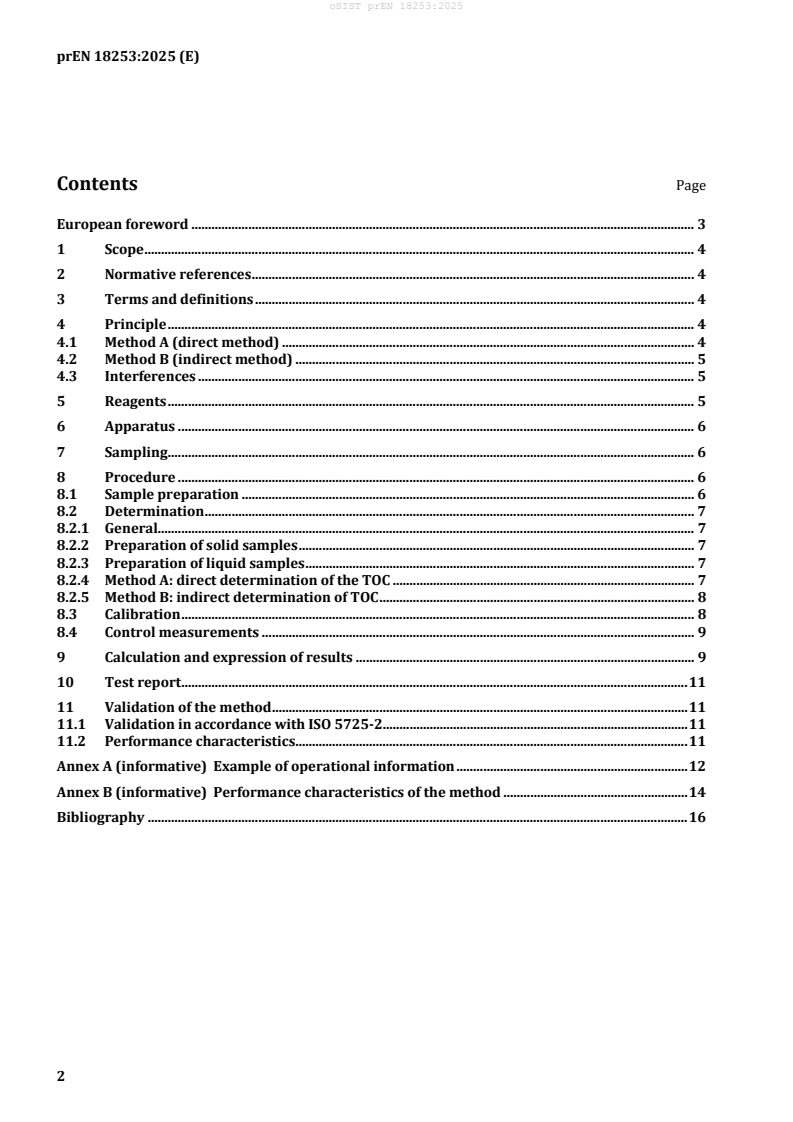
Contents Page
European foreword . 3
1 Scope . 4
2 Normative references . 4
3 Terms and definitions . 4
4 Principle . 4
4.1 Method A (direct method) . 4
4.2 Method B (indirect method) . 5
4.3 Interferences . 5
5 Reagents . 5
6 Apparatus . 6
7 Sampling . 6
8 Procedure . 6
8.1 Sample preparation . 6
8.2 Determination . 7
8.2.1 General. 7
8.2.2 Preparation of solid samples . 7
8.2.3 Preparation of liquid samples . 7
8.2.4 Method A: direct determination of the TOC . 7
8.2.5 Method B: indirect determination of TOC . 8
8.3 Calibration . 8
8.4 Control measurements . 9
9 Calculation and expression of results . 9
10 Test report . 11
11 Validation of the method . 11
11.1 Validation in accordance with ISO 5725-2. 11
11.2 Performance characteristics. 11
Annex A (informative) Example of operational information . 12
Annex B (informative) Performance characteristics of the method . 14
Bibliography . 16
oSIST prEN 18253:2025
prEN 18253:2025 (E)
European foreword
This document (prEN 18253:2025) has been prepared by Technical Committee CEN/TC 223 “Soil
improvers and growing media”, the secretariat of which is held by NEN.
This document is currently submitted to CEN Enquiry.
This document has been prepared under a standardization request addressed to CEN by the European
Commission. The Standing Committee of the EFTA States subsequently approves these requests for its
Member States.
oSIST prEN 18253:2025
prEN 18253:2025 (E)
1 Scope
This document specifies a method for the determination of total organic carbon (TOC) in soil improvers
and growing media containing more than 1 g carbon per kg of dry matter (0,1 %).
NOTE Samples with a low dry matter content can have an influence on the achievable limit of quantification as
defined in the scope (i.e. 1 g carbon per kg of dry matter).
2 Normative references
The following documents are referred to in the text in such a way that some or all of their content
constitutes requirements of this document. For dated references, only the edition cited applies. For
undated references, the latest edition of the referenced document (including any amendments) applies.
CEN/TS 17732:2022, Soil improvers and growing media - Terminology
EN 12579:2024, Soil improvers and growing media - Sampling
prEN 13040-1:2025, Soil improvers and growing media — Sample preparation — Part 1: Sample
preparation for chemical and physical tests, determination of dry matter content, moisture content and
laboratory bulk density
CEN/TS 17776:2022, Organic and organo-mineral fertilizers - Determination of the total organic carbon
(TOC) content by dry combustion
EN ISO 10693:2014, Soil quality - Determination of carbonate content - Volumetric method (ISO
10693:1995)
3 Terms and definitions
For the purposes of this document the terms and definitions given in CEN/TS 17732:2022 and the
following apply.
3.1
total carbon (TC)
quantity of carbon present in the sample in the form of organic, inorganic and elemental carbon
Note 1 to entry: In agreement with Regulation (EU) 2019/1009 [7], carbon derived from urea and polymers
containing urea are not considered as organic in this document.
[SOURCE: CEN/TS 17732:2022, 3.7.21 modified (note 1 to entry added)]
4 Principle
4.1 Method A (direct method)
The carbon dioxide released by the following combustion in an oxygen containing gas flow free of carbon
dioxide, is measured by infrared spectrometry, thermal conductivity detection, or by the detector
provided by the equipment used. To ensure complete combustion, catalysts and/or modifiers may be
used. The released amount of carbon dioxide indicates the TOC.
The carbonates present in the sample shall be previously removed by treating the sample with acid. The
carbon dioxide released by the following combustion step indicates the TOC directly.
Alternatively, the combustion temperature may be set at 600°C, thus only releasing organically bound
carbon.
oSIST prEN 18253:2025
prEN 18253:2025 (E)
4.2 Method B (indirect method)
TOC is obtained by the difference between the results of the measurements of total carbon and total
inorganic carbon (TIC). The total carbon (TC) present in the sample is converted into carbon dioxide by
combustion in an oxygen containing gas flow free of carbon dioxide. To ensure complete combustion,
catalysts and/or modifiers may be used. The released amount of carbon dioxide is measured e.g. by
infrared spectrometry, thermal conductivity detection, or other suitable techniques.
The TIC is determined separately from another sub-sample by means of acidification and purging of the
released carbon dioxide. The carbon dioxide shall be measured by one of the techniques mentioned
above.
4.3 Interferences
In the case of experience with samples containing high amounts of carbonates (e.g. carbonates to TOC
ratio higher than 10) the operator shall take care to correctly eliminate all the carbonates to make sure
to produce reliable TOC results.
When present, carbon from urea and urea-condensates carbides is determined as organic carbon using
the method described in this document. An interpretation of the measured value may therefore be
problematic in cases where the sample contains relevant levels of the above-mentioned components. If
needed, these components shall be determined separately by means of a suitable validated method and
be recorded in the test report.
5 Reagents
All reagents shall be of recognized analytical grade.
5.1 Potassium hydrogen phthalate, C8H5O4K.
H NO.
5.2 Acetanilide, C8 9
5.3 Atropine, C H NO .
17 23 3
5.4 Sodium salicylate, C H O Na.
7 5 3
5.5 Tetrasodium ethylenediamine tetraacetate-tetra-hydrate, Na
EDTA · 4H O (C H N O Na · 4H O), heated at 80 °C for 2 h.
2 10 12 2 8 4 2
Other forms of Na -EDTA hydrates may be used if the water content is exactly known. In these cases, the
composition of the control mixtures shall be recalculated accordingly (see also 5.8).
NOTE Other certified substances can be used as reference materials as well.
5.6 Aluminium oxide, Al O , neutral, granular size < 200 µm, annealed at 600 °C.
2 3
5.7 Calcium carbonate, CaCO .
5.8 Control mixture.
Control mixture prepared from sodium salicylate (5.4), calcium carbonate (5.7), Na -EDTA · 4H O (5.5)
4 2
and aluminium oxide (5.6) in a mass ratio of 1,00 : 4,36 : 1,97 : 8,40.
The mixture shall be homogenized thoroughly (e.g. fine grinding). It should contain 33,3 g/kg total
inorganic carbon and 66,6 g/kg TOC (e.g. 6,36 g of sodium salicylate, 27,73 g of calcium carbonate, 12,53 g
of Na -EDTA · 4H O, 53,42 g of aluminium oxide).
4 2
oSIST prEN 18253:2025
prEN 18253:2025 (E)
NOTE Other control mixtures can be used provided their suitability is checked.
®1
5.9 Inert absorbent material for determination on fluid samples, e.g. Chromosorb .
5.10 Non-oxidizing mineral acid used for carbon dioxide expulsion, e.g. phosphoric acid H PO
3 4
(w = 85 %).
NOTE Due to possible corrosion by hydrochloric acid, phosphoric acid is preferred.
5.11 Carrier gas, e.g. helium, oxygen or argon, free of carbon dioxide and organic impurities in
accordance with the manufacturer's instructions.
6 Apparatus
6.1. Precision balance, capable of weighing to the nearest 0,5 % of test portion mass.
6.2 Equipment for determination of carbon in solids, with accessories.
6.3 Crucibles, capsules or boats, made of e.g. silver, tin, ceramics or platinum.
Tin and nickel crucibles are not acid-resistant. In case of the necessity to remove inorganic carbon (8.2.4),
silver or ceramics vessels shall be used.
6.4 Pasteur pipettes.
6.5 Drying system, thermostatically controlled and capable of maintaining temperature of
105 °C ± 2 °C.
6.6 Desiccator, with an active drying agent such as silica gel.
6.7 Evaporating dish or crucible, temperature tolerant laboratory vessel with a temperature
resistance of at least 110 °C. Suitable materials are metallic, ceramic, borosilicate glass or quartz,
porcelain, etc.
7 Sampling
Sampling is not part of the method specified in this document. EN 12579:2024 shall be followed dealing
with soil improvers and growing media. It is important that the laboratory receives a sample that is
representative of the product under consideration. The sample should not have been damaged or
changed during transport or storage.
8 Procedure
8.1 Sample preparation
Solid samples are dried and ground < 0,5 mm according to prEN 13040-1:2025. Liquid samples are
homogenized by thorough mixing before weighing the test portion.
Chromosorb® is an example of a suitable product available commercially. This information is given for the
convenience of users of this document and does not constitute an endorsement by CEN of this product.
oSIST prEN 18253:2025
prEN 18253:2025 (E)
8.2 Determination
8.2.1 General
The mass of the test portion should be as large as possible and shall be chosen so that the liberated
quantity of carbon dioxide lies within the working range of the equipment and calibration. See example
in Table A.1.
8.2.2 Preparation of solid samples
For solid materials dried samples shall be used.
The operator shall weigh an aliquot of sample prepared according to 8.1 into a suitable vessel (6.3) using
the precision balance (6.1).
Moist or paste-like samples may be mixed with aluminium oxide (5.6) until granular material is obtained
and then be milled and homogenized. In th
...