


prEN 17770
(Main)Organic and organo-mineral fertilizers - Determination of the total content of specific elements by ICP-AES after digestion by aqua regia
Organic and organo-mineral fertilizers - Determination of the total content of specific elements by ICP-AES after digestion by aqua regia
This document specifies a method for the determination of arsenic (As), cadmium (Cd), copper (Cu), chromium (Cr), lead (Pb), nickel (Ni)), boron (B), cobalt (Co), iron (Fe), manganese (Mn), molybdenum (Mo), zinc (Zn), phosphorus (P), potassium (K), magnesium (Mg), calcium (Ca), sulfur (S) and sodium (Na) in aqua regia digests of organic, organo-mineral fertilizers, and their fertilizing product blends using inductively coupled plasma-atomic emission spectrometry (ICP-AES).
It is applicable and validated for several types of matrices as indicated in Annex A.
This document is applicable to the component materials “by-products”, when used as components of fertilizing products, as well as the fertilizing products blends where a blend is a mix of at least two of the following components: fertilizers, liming materials, soil improvers, growing media, inhibitors, plant biostimulants, and where the following category: organic fertilizers, organo-mineral fertilizers is the highest % in the blend by mass or volume, or in the case of liquid form by dry mass. If the organic fertilizer or the organo-mineral fertilizer is not the highest % in the blend, the European Standard for the highest % of the blend applies. In case a fertilizing product blend is composed of components in equal quantity, the user decides which standard to apply. Variations in analytical methods for fertilizing product blends can lead to differing results as some components or matrix interactions can affect the outcome. Validation procedures have shown that developed standard methods are robust and reliable across diverse product compositions, but possible interferences and unexpected results when analysing fertilizing product blends are possible.
This method is applicable to aqua regia digests prepared according to prEN 17768.
NOTE Alternatively, inductively coupled plasma mass spectrometry (ICP-MS) can be used for the determination of the elements in the aqua regia digests if the user proves that the method gives the same results.
Organische und organisch-mineralische Düngemittel - Bestimmung des Gesamtgehaltes spezifischer Elemente durch ICP-AES nach Aufschluss durch Königswasser
Dieses Dokument legt ein Verfahren zur Bestimmung von Arsen (As), Cadmium (Cd), Kupfer (Cu), Chrom (Cr), Blei (Pb), Nickel (Ni), Bor (B), Cobalt (Co), Eisen (Fe), Mangan (Mn), Molybdän (Mo), Zink (Zn), Phosphor (P), Kalium (K), Magnesium (Mg), Calcium (Ca), Schwefel (S) und Natrium (Na) in Königswasseraufschlüssen organischer und organisch-mineralischer Düngemittel sowie Düngeproduktmischungen daraus mittels Atomemissionsspektrometrie mit induktiv gekoppeltem Plasma (ICP-AES) fest.
Es ist anwendbar auf und validiert für mehrere Arten von Matrices, wie in Anhang A angegeben.
Dieses Dokument ist anwendbar auf die Komponentenmaterialien „Nebenprodukte“, wenn diese als Komponenten von Düngeprodukten verwendet werden, sowie auf Düngeproduktmischungen, bei denen eine Mischung aus mindestens zwei der folgenden Komponenten besteht: Düngemittel, Kalkdünger, Bodenverbesserungsmittel, Kultursubstrate, Hemmstoffe und Pflanzen-Biostimulanzien, und wenn die Kategorie „organische Düngemittel und organisch-mineralische Düngemittel“ den höchsten Prozentsatz in der Mischung bezüglich Masse oder Volumen, oder im Falle von flüssigen Formen bezüglich Trockenmasse ausmacht. Wenn das organische Düngemittel oder das organisch-mineralische Düngemittel nicht den höchsten Prozentsatz in der Mischung ausmacht, gilt die Europäische Norm für den höchsten Prozentsatz der Mischung. Im Falle, dass die Düngeproduktmischung aus Komponenten gleicher Menge besteht, entscheidet der Anwender, welche Norm angewendet wird. Variationen in analytischen Verfahren für Düngeproduktmischungen können zu unterschiedlichen Ergebnissen führen, da einige Komponenten oder Matrixwechselwirkungen das Ergebnis beeinflussen können. Validierungen haben gezeigt, dass die entwickelten Standardverfahren robust und zuverlässig über unterschiedliche Produktzusammensetzungen hinweg sind. Jedoch sind mögliche Interferenzen und unerwartete Ergebnisse bei der Analyse von Düngeproduktmischungen möglich.
Dieses Verfahren ist auf Königswasseraufschlüsse anwendbar, die nach prEN 17768 gewonnen wurden.
ANMERKUNG Alternativ kann die Massenspektrometrie mit induktiv gekoppeltem Plasma (ICP-MS) für die Bestimmung der Elemente in Königswasseraufschlüssen angewendet werden, sofern der Anwender nachweist, dass das Verfahren zu den gleichen Ergebnissen führt.
Engrais organiques et organo-minéraux - Détermination de la teneur totale en éléments spécifiques par ICP-AES après digestion à l’eau régale
Le présent document spécifie une méthode pour le dosage de l’arsenic (As), du cadmium (Cd), du cuivre (Cu), du chrome (Cr), du plomb (Pb), du nickel (Ni), du bore (B), du cobalt (Co), du fer (Fe), du manganèse (Mn), du molybdène (Mo), du zinc (Zn), du phosphore (P), du potassium (K), du magnésium (Mg), du calcium (Ca), du soufre (S) et du sodium (Na) dans les digestats à l’eau régale d’engrais organiques, organo-minéraux et leurs mélanges avec des fertilisants, par spectrométrie d’émission atomique par plasma à couplage inductif (ICP-AES).
Il est applicable et validé pour plusieurs types de matrices comme indiqué dans l’Annexe A.
Le présent document est applicable aux matières constitutives « sous-produits », lorsqu’elles sont utilisées comme composants de fertilisants, ainsi qu’aux mélanges de fertilisants constitués d’au moins deux des composants suivants : engrais, amendements minéraux basiques, amendements du sol, supports de culture, inhibiteurs, biostimulants des végétaux et dans lesquels la catégorie « engrais organiques et organo-minéraux » représente le pourcentage le plus élevé du mélange en masse ou en volume, ou dans le cas d’un liquide, en masse sèche. Si les engrais organiques ou les engrais organo-minéraux ne représentent pas le pourcentage le plus élevé du mélange, la Norme européenne relative au composant représentant le pourcentage le plus élevé du mélange s’applique. Dans le cas où le mélange de fertilisants est constitué de composants en quantités égales, l’utilisateur décide quelle norme appliquer. Les variations dans les méthodes d’analyse des mélanges de fertilisants peuvent conduire à des résultats différents, car certaines interactions de composants ou de la matrice peuvent affecter le résultat. Les procédures de validation ont montré que les méthodes normalisées développées sont robustes et fiables pour diverses compositions de produits, mais que des interférences éventuelles et des résultats inattendus lors de l’analyse des mélanges de fertilisants sont possibles.
Cette méthode est applicable aux digestats à l’eau régale préparés conformément au prEN 17768.
NOTE Il est également possible d’utiliser la spectrométrie de masse avec plasma à couplage inductif (ICP-MS) pour le dosage des éléments dans les digestats à l’eau régale, si l’utilisateur prouve que la méthode conduit aux mêmes résultats.
Organska in organsko-mineralna gnojila - Določanje celotne vsebnosti specifičnih elementov z atomsko emisijsko spektrometrijo z induktivno sklopljeno plazmo (ICP-AES) po razklopu z zlatotopko
General Information
- Status
- Not Published
- Publication Date
- 12-Sep-2027
- Technical Committee
- CEN/TC 260 - Fertilizers and liming materials
- Drafting Committee
- CEN/TC 260/WG 8 - Organic and organo-mineral fertilizers
- Current Stage
- 4060 - Closure of enquiry - Enquiry
- Start Date
- 16-Apr-2026
- Due Date
- 19-Jul-2026
- Completion Date
- 16-Apr-2026
Relations
- Effective Date
- 11-Jun-2025
Overview
prEN 17770 is a European standard developed by CEN relating to the analysis of organic and organo-mineral fertilizers. It establishes a robust, validated method for determining the total content of specific elements using inductively coupled plasma atomic emission spectrometry (ICP-AES), following sample digestion by aqua regia. The targeted elements include both nutrients and potentially hazardous substances: arsenic (As), cadmium (Cd), copper (Cu), chromium (Cr), lead (Pb), nickel (Ni), boron (B), cobalt (Co), iron (Fe), manganese (Mn), molybdenum (Mo), zinc (Zn), phosphorus (P), potassium (K), magnesium (Mg), calcium (Ca), sulfur (S), and sodium (Na). The method applies to organic fertilizers, organo-mineral fertilizers, their blends, and component materials such as by-products, in accordance with EU fertilizer regulations.
Key Topics
- ICP-AES Analysis: Use of inductively coupled plasma atomic emission spectrometry to identify and quantify trace and major elements in complex fertilizer matrices following aqua regia digestion.
- Scope of Application: Relevant to a wide range of organic and organo-mineral fertilizer products, including blends composed of fertilizers, liming materials, soil improvers, growing media, inhibitors, and plant biostimulants.
- Interference Management: Detailed procedures to recognize and minimize spectral, transport, excitation, chemical, and memory interferences during analysis.
- Validation and Precision: The method is validated for various fertilizer matrices and incorporates precision data from inter-laboratory studies to ensure repeatability and reproducibility.
- Alternative Techniques: The standard allows for the alternative use of inductively coupled plasma mass spectrometry (ICP-MS) provided equivalence can be demonstrated.
- Reporting Requirements: Guidelines for comprehensive test report documentation, facilitating regulatory compliance and traceability.
Applications
The standardized method outlined in prEN 17770 is widely applicable across the fertilizer supply chain and related industries, supporting:
- Quality Control: Essential for fertilizer manufacturers and laboratories to ensure products meet regulatory limits for nutrients and contaminants.
- Regulatory Compliance: Enables compliance with EU Regulation (EU) 2019/1009 and other relevant directives concerning fertilizer safety, environmental protection, and quality assurance.
- Trade and Certification: Supports certification, product labeling, and cross-border trade by providing a harmonized method for determining elemental content.
- Research and Development: Facilitates studies into fertilizer composition and efficiency, enabling development of improved or specialized products.
- Environmental Monitoring: Provides tools to assess the environmental impact of fertilizer use, monitor soil contamination, and ensure sustainable agricultural practices.
Related Standards
For best practice and comprehensive analysis, prEN 17770 should be used alongside the following European standards:
- prEN 17768: Details the procedure for sample digestion by aqua regia, a prerequisite for analysis using the prEN 17770 method.
- prEN 17773: Describes the determination of dry matter content in organic and organo-mineral fertilizers, needed for accurate result calculations.
- EN 12944-1 & EN 12944-2: Provide relevant vocabulary and terminology for fertilizers and liming materials, ensuring clarity and consistency in documentation.
- Other related CEN or ISO standards: On fertilizer sampling, liming materials, or analytical methods may complement the use of prEN 17770.
Practical Value
Implementing prEN 17770 ensures reliable, accurate assessment of essential and potentially toxic elements in organic and organo-mineral fertilizers. By leveraging the precision of ICP-AES after aqua regia digestion, laboratories and producers can enhance product quality, meet legal requirements, and demonstrate responsible environmental stewardship-critical for safe and effective fertilizer use throughout the European market.

Get Certified
Connect with accredited certification bodies for this standard

Control Union Certifications
Global certification for agriculture and sustainability.

ECOCERT
Organic and sustainability certification.

FSC International
Forest Stewardship Council certification.
Sponsored listings
Frequently Asked Questions
prEN 17770 is a draft published by the European Committee for Standardization (CEN). Its full title is "Organic and organo-mineral fertilizers - Determination of the total content of specific elements by ICP-AES after digestion by aqua regia". This standard covers: This document specifies a method for the determination of arsenic (As), cadmium (Cd), copper (Cu), chromium (Cr), lead (Pb), nickel (Ni)), boron (B), cobalt (Co), iron (Fe), manganese (Mn), molybdenum (Mo), zinc (Zn), phosphorus (P), potassium (K), magnesium (Mg), calcium (Ca), sulfur (S) and sodium (Na) in aqua regia digests of organic, organo-mineral fertilizers, and their fertilizing product blends using inductively coupled plasma-atomic emission spectrometry (ICP-AES). It is applicable and validated for several types of matrices as indicated in Annex A. This document is applicable to the component materials “by-products”, when used as components of fertilizing products, as well as the fertilizing products blends where a blend is a mix of at least two of the following components: fertilizers, liming materials, soil improvers, growing media, inhibitors, plant biostimulants, and where the following category: organic fertilizers, organo-mineral fertilizers is the highest % in the blend by mass or volume, or in the case of liquid form by dry mass. If the organic fertilizer or the organo-mineral fertilizer is not the highest % in the blend, the European Standard for the highest % of the blend applies. In case a fertilizing product blend is composed of components in equal quantity, the user decides which standard to apply. Variations in analytical methods for fertilizing product blends can lead to differing results as some components or matrix interactions can affect the outcome. Validation procedures have shown that developed standard methods are robust and reliable across diverse product compositions, but possible interferences and unexpected results when analysing fertilizing product blends are possible. This method is applicable to aqua regia digests prepared according to prEN 17768. NOTE Alternatively, inductively coupled plasma mass spectrometry (ICP-MS) can be used for the determination of the elements in the aqua regia digests if the user proves that the method gives the same results.
This document specifies a method for the determination of arsenic (As), cadmium (Cd), copper (Cu), chromium (Cr), lead (Pb), nickel (Ni)), boron (B), cobalt (Co), iron (Fe), manganese (Mn), molybdenum (Mo), zinc (Zn), phosphorus (P), potassium (K), magnesium (Mg), calcium (Ca), sulfur (S) and sodium (Na) in aqua regia digests of organic, organo-mineral fertilizers, and their fertilizing product blends using inductively coupled plasma-atomic emission spectrometry (ICP-AES). It is applicable and validated for several types of matrices as indicated in Annex A. This document is applicable to the component materials “by-products”, when used as components of fertilizing products, as well as the fertilizing products blends where a blend is a mix of at least two of the following components: fertilizers, liming materials, soil improvers, growing media, inhibitors, plant biostimulants, and where the following category: organic fertilizers, organo-mineral fertilizers is the highest % in the blend by mass or volume, or in the case of liquid form by dry mass. If the organic fertilizer or the organo-mineral fertilizer is not the highest % in the blend, the European Standard for the highest % of the blend applies. In case a fertilizing product blend is composed of components in equal quantity, the user decides which standard to apply. Variations in analytical methods for fertilizing product blends can lead to differing results as some components or matrix interactions can affect the outcome. Validation procedures have shown that developed standard methods are robust and reliable across diverse product compositions, but possible interferences and unexpected results when analysing fertilizing product blends are possible. This method is applicable to aqua regia digests prepared according to prEN 17768. NOTE Alternatively, inductively coupled plasma mass spectrometry (ICP-MS) can be used for the determination of the elements in the aqua regia digests if the user proves that the method gives the same results.
prEN 17770 is classified under the following ICS (International Classification for Standards) categories: 65.080 - Fertilizers. The ICS classification helps identify the subject area and facilitates finding related standards.
prEN 17770 has the following relationships with other standards: It is inter standard links to CEN/TS 17770:2022. Understanding these relationships helps ensure you are using the most current and applicable version of the standard.
prEN 17770 is associated with the following European legislation: EU Directives/Regulations: 2019/1009; Standardization Mandates: M/564, M/564 AMD 1, M/564 AMD 2. When a standard is cited in the Official Journal of the European Union, products manufactured in conformity with it benefit from a presumption of conformity with the essential requirements of the corresponding EU directive or regulation.
prEN 17770 is available in PDF format for immediate download after purchase. The document can be added to your cart and obtained through the secure checkout process. Digital delivery ensures instant access to the complete standard document.
Standards Content (Sample)
SLOVENSKI STANDARD
01-marec-2026
Organska in organsko-mineralna gnojila - Določanje celotne vsebnosti specifičnih
elementov z atomsko emisijsko spektrometrijo z induktivno sklopljeno plazmo
(ICP-AES) po razklopu z zlatotopko
Organic and organo-mineral fertilizers - Determination of the total content of specific
elements by ICP-AES after digestion by aqua regia
Organische und organisch-mineralische Düngemittel - Bestimmung des Gesamtgehaltes
spezifischer Elemente durch ICP-AES nach Aufschluss durch Königswasser
Engrais organiques et organo-minéraux - Détermination de la teneur totale en éléments
spécifiques par ICP-AES après digestion à l’eau régale
Ta slovenski standard je istoveten z: prEN 17770
ICS:
65.080 Gnojila Fertilizers
2003-01.Slovenski inštitut za standardizacijo. Razmnoževanje celote ali delov tega standarda ni dovoljeno.
DRAFT
EUROPEAN STANDARD
NORME EUROPÉENNE
EUROPÄISCHE NORM
January 2026
ICS 65.080 Will supersede CEN/TS 17770:2022
English Version
Organic and organo-mineral fertilizers - Determination of
the total content of specific elements by ICP-AES after
digestion by aqua regia
Engrais organiques et organo-minéraux - Organische und organisch-mineralische Düngemittel -
Détermination de la teneur totale en éléments Bestimmung des Gesamtgehaltes spezifischer
spécifiques par ICP-AES après digestion à l'eau régale Elemente durch ICP-AES nach Aufschluss durch
Königswasser
This draft European Standard is submitted to CEN members for enquiry. It has been drawn up by the Technical Committee
CEN/TC 260.
If this draft becomes a European Standard, CEN members are bound to comply with the CEN/CENELEC Internal Regulations
which stipulate the conditions for giving this European Standard the status of a national standard without any alteration.
This draft European Standard was established by CEN in three official versions (English, French, German). A version in any other
language made by translation under the responsibility of a CEN member into its own language and notified to the CEN-CENELEC
Management Centre has the same status as the official versions.
CEN members are the national standards bodies of Austria, Belgium, Bulgaria, Croatia, Cyprus, Czech Republic, Denmark, Estonia,
Finland, France, Germany, Greece, Hungary, Iceland, Ireland, Italy, Latvia, Lithuania, Luxembourg, Malta, Netherlands, Norway,
Poland, Portugal, Republic of North Macedonia, Romania, Serbia, Slovakia, Slovenia, Spain, Sweden, Switzerland, Türkiye and
United Kingdom.
Recipients of this draft are invited to submit, with their comments, notification of any relevant patent rights of which they are
aware and to provide supporting documentation.
Warning : This document is not a European Standard. It is distributed for review and comments. It is subject to change without
notice and shall not be referred to as a European Standard.
EUROPEAN COMMITTEE FOR STANDARDIZATION
COMITÉ EUROPÉEN DE NORMALISATION
EUROPÄISCHES KOMITEE FÜR NORMUNG
CEN-CENELEC Management Centre: Rue de la Science 23, B-1040 Brussels
© 2026 CEN All rights of exploitation in any form and by any means reserved Ref. No. prEN 17770:2026 E
worldwide for CEN national Members.
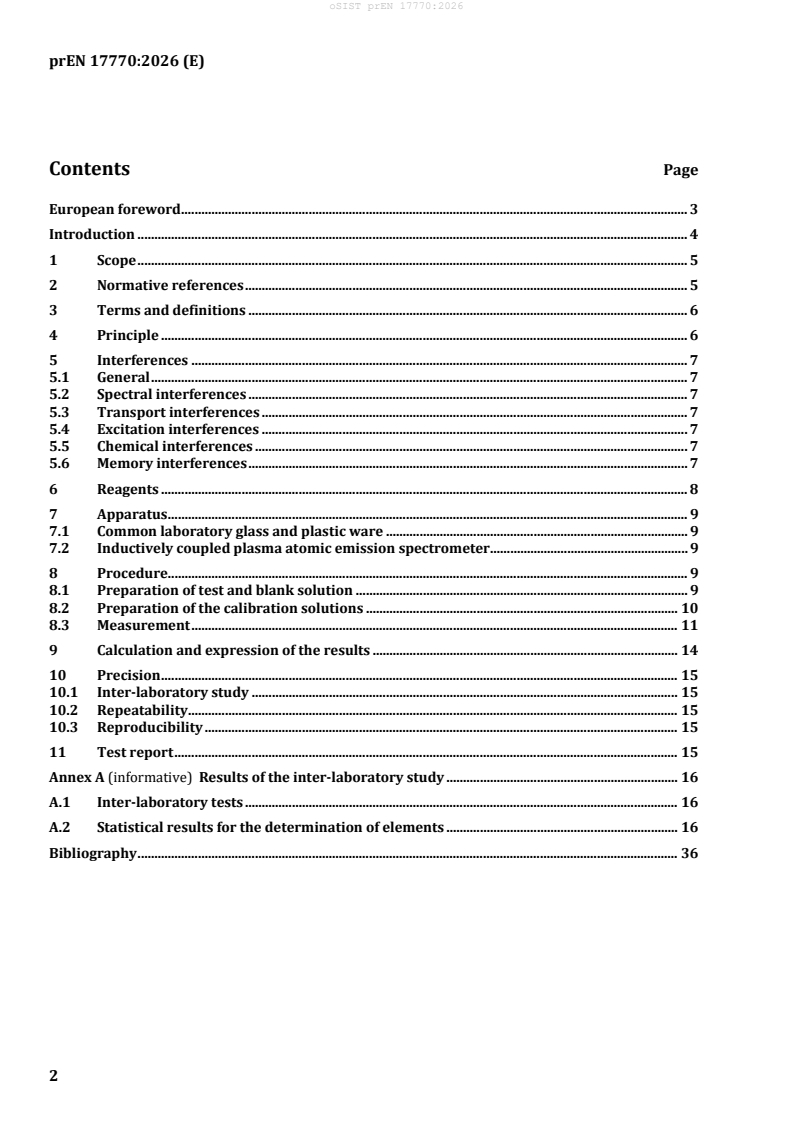
Contents Page
European foreword . 3
Introduction . 4
1 Scope . 5
2 Normative references . 5
3 Terms and definitions . 6
4 Principle . 6
5 Interferences . 7
5.1 General . 7
5.2 Spectral interferences . 7
5.3 Transport interferences . 7
5.4 Excitation interferences . 7
5.5 Chemical interferences . 7
5.6 Memory interferences . 7
6 Reagents . 8
7 Apparatus . 9
7.1 Common laboratory glass and plastic ware . 9
7.2 Inductively coupled plasma atomic emission spectrometer . 9
8 Procedure. 9
8.1 Preparation of test and blank solution . 9
8.2 Preparation of the calibration solutions . 10
8.3 Measurement . 11
9 Calculation and expression of the results . 14
10 Precision . 15
10.1 Inter-laboratory study . 15
10.2 Repeatability . 15
10.3 Reproducibility . 15
11 Test report . 15
Annex A (informative) Results of the inter-laboratory study . 16
A.1 Inter-laboratory tests . 16
A.2 Statistical results for the determination of elements . 16
Bibliography . 36
European foreword
This document (prEN 17770:2026) has been prepared by Technical Committee CEN/TC 260 “Fertilizers
and liming materials”, the secretariat of which is held by DIN.
This document is currently submitted to the CEN Enquiry.
This document will supersede CEN/TS 17770:2022.
Compared to the previous edition, prEN 17770:2026 includes the following significant technical changes:
— the CEN Technical Specification has been adopted as a European Standard;
Scope (Clause 1) updated including clarification on fertilizing product blends;
normative references to the digestion and reference to dry matter content determination added;
terms and definitions revised;
Clause 6 (Reagents) widened to include information about measures avoiding contamination by
boron;
Clause 9 (Calculation and expression of the results) modified with the change of the Formula;
test report revised;
Clause 10 (Precision) added;
Annex A (Results of the inter-laboratory study) added;
Bibliography revised.
This document has been prepared under a Standardization Request addressed to CEN by the European
Commission. The Standing Committee of the EFTA States subsequently approves these requests for its
Member States.
Introduction
An EU fertilizing product consists solely of component materials complying with the requirements for
one or more of the component material categories (CMCs), as specified in the Regulation (EU) 2019/1009
[1]. This regulation lays down the rules on the making available on the market of EU fertilizing products
and the specific safety and quality requirements for the CMCs.
By-products within the meaning of Directive 2008/98/EC have been classified as CMC 11 in Regulation
(EU) 2019/1009 [1].
This document concerns the analytical measurement step. Aqua regia digestion followed by inductively
coupled plasma atomic emission spectrometry (ICP-AES) is widely used for determination of many
elements. For example, a multi-matrix standard for aqua regia extraction of environmental solid matrices
including soils, sludges, biowaste [2] and water [3]. A similar procedure was applied for determination
of aqua regia extractable contents of arsenic, mercury, cadmium, chromium, nickel and lead in fertilizers
and liming materials [4] and for determination of micronutrients in mineral fertilizers [5]. Inductively
coupled plasma atomic emission spectrometry (ICP-AES) is nowadays widely used and a well-established
method in many laboratories. A standard for a similar procedure for plant biostimulants is available [6].
Inductively coupled plasma atomic emission spectrometry (ICP-AES) is often called also inductively
coupled plasma optical emission spectrometry (ICP-OES). Both these terms are synonyms for the same
analytical technique.
The inter-laboratory study reflects the final statistical characteristics of the method for the determination
of the specific elements in aqua regia digests including both, the digestion and the measurement steps.
WARNING — Persons using this document should be familiar with usual laboratory practice. This
document does not purport to address all of the safety issues, if any, associated with its use. It is the
responsibility of the user to establish appropriate health and safety practices and to ensure compliance
with any national regulatory conditions.
IMPORTANT — It is absolutely essential that tests conducted according to this document are carried out
by suitably trained staff.
1 Scope
This document specifies a method for the determination of arsenic (As), cadmium (Cd), copper (Cu),
chromium (Cr), lead (Pb), nickel (Ni)), boron (B), cobalt (Co), iron (Fe), manganese (Mn), molybdenum
(Mo), zinc (Zn), phosphorus (P), potassium (K), magnesium (Mg), calcium (Ca), sulfur (S) and sodium
(Na) in aqua regia digests of organic, organo-mineral fertilizers, and their fertilizing product blends using
inductively coupled plasma-atomic emission spectrometry (ICP-AES).
It is applicable and validated for several types of matrices as indicated in Annex A.
This document is applicable to the component materials “by-products”, when used as components of
fertilizing products, as well as the fertilizing products blends where a blend is a mix of at least two of the
following components: fertilizers, liming materials, soil improvers, growing media, inhibitors, plant
biostimulants, and where the following category: organic fertilizers, organo-mineral fertilizers is the
highest % in the blend by mass or volume, or in the case of liquid form by dry mass. If the organic fertilizer
or the organo-mineral fertilizer is not the highest % in the blend, the European Standard for the highest
% of the blend applies. In case a fertilizing product blend is composed of components in equal quantity,
the user decides which standard to apply. Variations in analytical methods for fertilizing product blends
can lead to differing results as some components or matrix interactions can affect the outcome. Validation
procedures have shown that developed standard methods are robust and reliable across diverse product
compositions, but possible interferences and unexpected results when analysing fertilizing product
blends are possible.
This method is applicable to aqua regia digests prepared according to prEN 17768.
NOTE Alternatively, inductively coupled plasma mass spectrometry (ICP-MS) can be used for the
determination of the elements in the aqua regia digests if the user proves that the method gives the same results.
2 Normative references
The following documents are referred to in the text in such a way that some or all of their content
constitutes requirements of this document. For dated references, only the edition cited applies. For
undated references, the latest edition of the referenced document (including any amendments) applies.
prEN 17768, Organic and organo-mineral fertilizers — Digestion by aqua regia for subsequent
determination of elements
prEN 17773, Organic and organo-mineral fertilizers — Determination of the dry matter content
EN 12944-1, Fertilizers and liming materials — Vocabulary — Part 1: General terms
EN 12944-2, Fertilizers and liming materials — Vocabulary — Part 2: Terms relating to fertilizers
Under preparation.
Under preparation.
3 Terms and definitions
For the purposes of this document, the terms and definitions given in EN 12944-1 and EN 12944-2 and
the following apply.
ISO and IEC maintain terminology databases for use in standardization at the following addresses:
— ISO Online browsing platform: available at https://www.iso.org/obp/
— IEC Electropedia: available at https://www.electropedia.org/
3.1
analyte
parameter to be determined
3.2
blank calibration solution
solution prepared in the same way as the calibration solution but leaving out the analytes
3.3
blank test solution
solution prepared in the same way as the test sample solution but omitting the test portion
3.4
calibration solution
solution used to calibrate the instrument, prepared from stock solutions by adding acids, buffer, reference
element and salts as needed
3.5
digest
solution received after mineralization of the organic matter of a sample and dissolution of its mineral
part, more or less completely, when reacting with a reagent mixture
3.6
stock solution
solution with accurately known analyte concentration(s), prepared from pure chemicals
3.7
test sample solution
solution prepared after extraction or digestion of the test sample according to appropriate specifications
3.8
calibration check solution
one of the calibration solutions used to check the stability of the calibration during measurement
4 Principle
The method is based on the inductively coupled plasma atomic emission spectrometry (ICP-AES)
measurement of the concentration of elements in the digests of organic fertilizers and organo-mineral
fertilizers and their fertilizing product blends that shall be prepared according to prEN 17768. The
elements are determined after an appropriate dilution of the digest, if necessary. The solution is
dispersed by a suitable nebulizer of the ICP-AES instrument and the resulting aerosol is transported into
the plasma torch. Element specific emission spectra are produced by a radiofrequency inductively
coupled argon plasma where atoms or ions are excited at high temperature. The emission spectra are
dispersed by a spectrometer, and the intensities of the emission lines are monitored by photosensitive
devices. Multi-element determinations using sequential or simultaneous optical systems and axial, radial
or dual viewing of the plasma may be used.
5 Interferences
5.1 General
Interferences and matrix effects shall be recognized and appropriate measures to minimize them shall be
made. There are several types of interferences, see 5.2 to 5.6.
5.2 Spectral interferences
Spectral interferences are due to incomplete isolation of the radiation emitted by the analyte from other
detected radiation sources. Spectral interferences are caused by the background emission from
continuous or recombination phenomena, by stray light which causes background increase or overlap of
a spectral line from another element, or by the unresolved overlap of molecular band spectra. Background
emission and stray light can usually be compensated for by subtracting the background emission
measured adjacent to the analyte wavelength peak. To correct a sloping background, shift background
correction points on each side of the peak are used. The increase of background is more intensive with
axial-view instruments. Background correction is not required in cases of line broadening where a
background correction measurement would actually degrade the analytical result. A spectral line overlap
usually leads to the choice of an alternative line. If this is not possible, mathematical correction
procedures (e.g. inter-element correction technique or multi-component spectral fitting) can be used to
compensate for the interference. These correction procedures are usually a part of the instrument
software.
5.3 Transport interferences
Transport interferences are caused by differences in the properties between the sample solutions and
the calibration solutions (viscosity, surface tension, density, dissolved solid content, type and
concentration of acids). As a consequence, the supply of solution to the nebuliser, the efficiency of
nebulisation and the droplet size distribution of the aerosol is altered, resulting in a change of sensitivity.
Errors due to these interferences can be overcome by dilution of the solutions, by matrix matching, by
standard addition or by internal standard.
5.4 Excitation interferences
Excitation interferences are attributed to a change in the excitation conditions in the plasma, especially
by the presence of easily ionisable elements. The interference depends on the operating conditions of the
plasma (e.g. power, sample introduction, gas flowrate or observation height) and differ from element to
element. Improvement of the plasma conditions can therefore reduce excitation interferences. Other
possibilities are dilution of the solutions, matrix matching or the standard addition technique.
5.5 Chemical interferences
Chemical interferences are not significant with the ICP-AES technique, but if observed, they can be
minimized by a careful selection of operating conditions (e.g. radio frequency power, observation
position, gas flow rate and so forth).
5.6 Memory interferences
Memory interferences result when analytes in a previous sample contribute to the signals measured in a
new sample. This type of interference can be caused by sample deposits or the accumulation in pump
tubing, nebulizer, spray chamber or plasma torch. The possibility of memory interferences should be
recognized within an analytical run and suitable rinse steps and rinse times should be used.
6 Reagents
6.1 General
The concentration of the analyte or interfering substances in the reagents and the water should be
negligible compared to the lowest concentration to be determined. All solutions should be stored in clean
boron-free vessels to avoid contamination during storage.
6.2 Water, with a specific conductivity not higher than 0,2 mS/m at 25 °C, free from the elements to be
determined.
6.3 Nitric acid, substance concentration, c(HNO ) ≈ 14,3 mol/l, mass concentration, ρ ≈ 1,4 g/ml.
6.3.1 Diluted nitric acid solution, c(HNO ) = 5 mol/l.
Add 350 ml of nitric acid (6.3) to 600 ml of water (6.2) and fill up to 1 000 ml with water (6.2).
6.4 Hydrochloric acid, c(HCl) ≈ 12 mol/l, ρ ≈ 1,18 g/ml.
6.5 Mixed acid solution, 0,8 mol/l nitric acid and 1,8 mol/l hydrochloric acid.
Add 150 ml of hydrochloric acid (6.4) and 56 ml nitric acid (6.3) consecutively to 600 ml of water (6.2)
and fill up to 1 000 ml with water (6.2).
6.6 Single-element standard stock solutions, mass concentration, ρ = 10 000 mg/l of Ca, K, P and S.
Single-element stock solutions with adequate specification, stating the acid used and the preparation
technique, are commercially available. These solutions are considered to be stable for more than one
year, but in reference to guaranteed stability, the recommendations of the manufacturer should be
considered. Alternatively, the stock solutions may be prepared by the dissolution of high purity elements
or their suitable compounds.
6.7 Single element standard stock solutions mass concentration, ρ = 1 000 mg/l.
6.7.1 General
For Ca, K, and P pipette 10 ml each of the single element stock solution (6.6) into a 100 ml volumetric
flask, add 10 ml of diluted nitric acid (6.3.1), fill to the mark with water and mix well.
For the other elements, single-element stock solutions and multi-element stock solutions with adequate
specification, stating the acid used and the preparation technique, are commercially available. These
solutions are considered to be stable for more than one year, but in reference to guaranteed stability, the
recommendations of the manufacturer should be considered. Alternatively, the stock solutions may be
prepared by the dissolution of high purity elements or their suitable compounds.
6.7.2 Multielement standard stock solution A, mass concentration, ρ = 100 mg/l of As, Co, Mo and
Ni.
Use commercially available solution of this concentration for each element or pipette 10 ml of the
appropriate element stock solution (6.7) into a 100 ml volumetric flask. Add 10 ml of diluted nitric acid
(6.3.1), fill to the mark with water and mix well. This solution is used to prepare spiked test solutions and
calibration solutions.
6.7.3 Multielement standard stock solution B, mass concentration, ρ = 100 mg/l of B, Cr, Cu, Fe, Mn,
Pb and Zn.
Use commercially available solution of this concentration for each element or pipette 10 ml of the
appropriate element stock solution (6.7) into a 100 ml volumetric flask. Add 10 ml of diluted nitric acid
(6.3.1), fill to the mark with water and mix well. This solution is used to prepare spiked test solutions and
calibration solutions.
6.7.4 Standard solution for Cd, mass concentration, ρ = 10 mg/l.
Pipette 1 ml of standard solution (6.7) into a 100 ml volumetric flask. Add 10 ml of diluted nitric acid
(6.3.1), fill to the mark with water and mix well. This solution is used to prepare calibration solutions.
6.8 Argon, purity 99,995 % or better.
7 Apparatus
7.1 Common laboratory glass and plastic ware
If boron content is to be determined, it is necessary to minimize the contact of all solutions with
borosilicate glassware. Suitable plastic or silica ware shall be used. Glass volumetric flasks may be used
for making up to volume but not for storage of digests, reagents, and solutions.
7.2 Inductively coupled plasma atomic emission spectrometer
WARNING – It is essential that the manufacturer’s safety instructions are strictly observed when using
this apparatus.
The inductively coupled plasma atomic-emission spectrometer consists of a sample introduction system,
the plasma as an excitation source, an optical system, a detector and a computer with suitable software.
The sample is transported by the introduction system (rotation tube pump, nebuliser and a spray
chamber) to the plasma torch. Around the torch a water-cooled RF coil is placed. A frequency of 27 MHz
to 56 MHz with a power of 600 W to 2 000 W is usually used. The emission from the plasma can be
observed either from the side (radial) or from the torch central symmetrical axis (axial). Axial viewing
gives more signal intensity due to the increased observation path length of the normal analytical zone of
the plasma, but an increase of interference is also commonly observed. Spectral lines are measured and
registered either in a sequential or a simultaneous manner.
8 Procedure
8.1 Preparation of test and blank solution
Aqua regia digests, that shall be prepared according to prEN 17768, are usually measured using ICP-AES
directly with calibration solutions of the same final concentration of aqua regia. The aqua regia extracts
may also be used for the determination of other elements.
A blank test solution is prepared for the measurement following the same procedure as for test sample
solutions.
If dilution is necessary, dilute an aliquot portion of the aqua regia digest in one or more steps so that the
final concentration of the element to be determined is approximately in the middle of the given
calibration range (8.2). In the final diluting step fill to the mark with the mixed acid solution (6.5) and mix
well. Prepare a diluted blank test solution by pipetting a blank test solution and dilute in the same way
as the test sample solution.
8.2 Preparation of the calibration solutions
For aqua regia digests three sets of calibration solutions are recommended. The first containing arsenic,
cadmium, copper, chromium, lead, nickel, zinc, boron, cobalt, iron, manganese and molybdenum. The
second containing phosphorus, potassium, magnesium, calcium and sodium, and the third only for
sulphur. The concentrations of the suggested calibration solutions are given in Table 1.
Set 1: Pipette volumes of 0 ml, 0,5 ml, 1 ml, 2 ml, and 5 ml of the multielement standard stock solution A
(6.7.2) into the five 100 ml volumetric flasks. Add 0 ml, 1 ml, 2 ml, 5 ml, and 10 ml of the multielement
standard stock solution B (6.7.3) into the same five 100 ml volumetric flasks. Finally, add to the same
volumetric flasks 0 ml, 0,5 ml, 1 ml, 2 ml, and 5 ml of the standard solution for cadmium (6.7.4). Fill the
volumetric flasks to the mark with the mixed acid solution (6.5) and mix well.
Set 2: Prepare five 100 ml volumetric flasks for this calibration set. Pipette 0 ml, 2 ml, 5 ml of the single
element stock solutions (6.6) for calcium, potassium, and phosphorus into the three volumetric flasks.
Pipette 1 ml, and 2,5 ml of the single element stock solutions (6.6) for calcium, potassium, and
phosphorus into the remaining two100 ml volumetric flasks. Pipette into the five volumetric flasks 0 ml,
1 ml, 2 ml, 5 ml, and 10 ml of the single element stock solution (6.6) of magnesium and finally add to the
same volumetric flasks 0 ml, 0,5 ml, 1 ml, 2 ml, and 5 ml single element stock solution (6.6) of sodium. Fill
the volumetric flasks to the mark with the mixed acid solution (6.5) and mix well.
Set 3: Pipette 0 ml, 2 ml, 5 ml, 10 ml, and 25 ml single element stock solution (6.6) of sulphur into the five
100 ml volumetric flasks. Fill the volumetric flasks to the mark with the mixed acid solution (6.5) and mix
well.
Different mixed calibration solutions or individual sets of calibration solutions for each element may be
used. If necessary, calibration solutions of higher or lower concentrations than given in Table 1 may be
prepared.
NOTE 1 Small differences in acid concentration between sample digests and calibration solutions do not affect
the measurement.
NOTE 2 It is possible to calibrate the instrument for higher concentrations of the elements than given in Table 1
if the calibration curve is linear.
Many samples can have relatively high concentration of iron. In this case calibration solutions for iron
may be added to the calibration set 2 in the same concentrations as calcium, potassium and phosphorus.
Table 1— Suggested calibration standards
Calibration SET 1 SET 2 SET 3
solution
Cd Ni, As, Co, B, Pb, Cr, Ca, K, P Mg Na S
No
Mo Cu, Zn,
Mn, Fe
mg/l
1 0 0 0 0 0 0 0
2 0,05 0,5 1,0 20 10 5 20
3 0,1 1,0 2,0 50 20 10 50
4 0,2 2,0 5,0 100 50 20 100
5 0,5 5,0 10,0 250 100 50 250
8.3 Measurement
8.3.1 Instrument conditions
Due to differences between various kinds of instruments, no detailed instructions can be given to operate
the specific instrument. The instruction provided by the manufacturer for waiting time, instrument
stability, gas flows, plasma conditions, nebuliser conditions, sample uptake rate, etc. should be followed.
Higher RF power (>1 300 W) is preferable because it can very effectively remove some interferences.
The software of the instrument is used to calculate concentrations of the elements in the individual test
solutions. All test sample solutions, blank test solutions and calibration solutions are measured under the
same optimized conditions using background correction and other suitable steps to eliminate or
minimize interferences.
8.3.2 Optimization of the instrument conditions
The aim is to find the best sensitivity and precision and to minimize interferences for the set of lines to
be used. Emission efficiency is related, amongst other parameters, to the plasma robustness, which is a
function of RF power, argon gas flows and observation height (for radially viewed plasmas). Also, the type
of nebuliser and sample uptake rate will have an impact on the signal and the background.
8.3.3 Interferences
Background shall be measured adjacent to analyte lines on sample during analysis. The position selected
for the background intensity measurement, on one or both sides of the analytical line, will be determined
by the complexity of the spectrum adjacent to the analytical line. When working with an unknown matrix
it is necessary to check the signal of every element to be measured for possible interferences by studying
the region of the line. If spectral interferences (partial line overlap, line coincidence) occur, the
measurement shall be carried out at another wavelength. If this is not possible, correction of the
interference by mathematical correction procedures shall be carried out. Higher plasma power can
minimize the matrix influence.
Spectral lines which are free of interference by other elements shall be selected. Recommended
wavelengths are given in Table 2. As the spectral interferences depend on the instrument resolution, they
shall be identified for each type of instrument in practical trials using mixtures of standard solutions
containing the elements typically contained in organic fertilizers, organo-mineral fertilizers, and their
fertilizing product blends of varying concentrations.
8.3.4 Measurement
The calibration blank and calibration solutions, calibration check solution, blank test solution, test sample
solutions are measured after stabilization of the instrument and verification of the stable conditions. The
instrument is calibrated using all three sets of the calibration solutions (8.2). All elements are determined
first in the undiluted sample digests followed by the determination of the elements in the diluted sample
digests. The dilution should ensure that the concentrations of the elements exceeding the calibration
range in the undiluted digests will be in the calibration range after dilution. Read the emission intensity
of the solution at least twice and average the values. Run a calibration blank and a calibration check
solution every 20 samples or less and at the end of the measurement.
NOTE For most samples 10 times dilution is sufficient. No 3 calibration solution (see Table 1) from all three
sets of calibration solutions is suitable as check calibration solution.
8.3.5 Matrix effects
Whenever an unknown matrix is encountered, check the following:
— matrix effects by running the spiked test sample solution;
— matrix effects by running a fivefold diluted test sample solution;
— matrix effects by analysing at a different wavelength.
Spike recovery shall be between 90 % and 110 %. The difference between the results for the original test
sample solution and the fivefold-diluted test sample solution shall be less than 10 %. If the spike recovery
or difference for the diluted test sample solution exceeds the given limit, the standard addition method
shall be used.
8.3.6 Spiking
Add a known amount of a standard solution of the analyte and an equal amount of a blank test solution
to two separate but equal portions of the test sample solution (or its dilution). The spike shall be between
0,4 and 2 times the expected sample mass concentration. Measure both solutions as test sample solutions.
Determine the ‘measured spike concentration' as the difference in mass concentration between the two
spiked test sample portions.
The standard addition method, spike recovery and dilution are recommended to check the efficiency of
interference reduction especially in complicated matrices and for unknown samples.
EXAMPLE Spiking procedure: pipette 10 ml of a test sample solution or diluted digest into two test tubes, add
0,1 ml of multielement standard stock solutions A (6.7.2) or B (6.7.3) or from the standard solution (6.7.4) into the
first test tube and 0,1 ml of blank test solution into the second test tube. Mix well and measure. To achieve a higher
concentration of an element by spiking, stock solutions of higher concentration may be used.
If the analytical results according to the standard addition method and the standard calibration method
are equal, the calibration curve method may be applied.
The standard addition method, spike recovery and dilution are recommended to check the efficiency of
interference reduction especially in complicated matrices and for unknown samples.
Table 2 — Recommended wavelengths
Element Wavelength [nm] Interfering elements
As 193,696 Fe, Al, Mo
189,042 Al, La
B 249,773 Fe
208,959 Al, Mo
249,678 -
Ca 422,673 -
183,801 -
Cd 214,438 Fe
228,802 As, Fe, Co, Cs
Co 228,616 Ti
Element Wavelength [nm] Interfering elements
Cu 324,754 Ti, Fe
327,396 Co
Cr 267,716 Mn, V
205,552 Fe, Mo
357,869 V, As
Fe 259,941 Co
238,204 -
K 766,491 -
Mg 285,213 -
279,553 -
Mo 202,030 Al, Fe
202,095 -
Mn 259,373 Fe
257,610 Fe, Mo, Cr
293,306 Al, Fe
Na 589,592 -
Ni 221,648 Fe, Co, Si
231,604 Co, Fe
216,560 Fe, Mn
P 177,495 Cu
178,287 -
214,914 -
Pb 168,215 C
220,353 Al, Co, Ti
283,306 Fe
S 182,034 -
180,731 Ca
Zn 213,856 Cu, Ni, Fe
206,191 Cr
Alternative wavelengths may be used.
9 Calculation and expression of the results
Calculate the content of an element in the sample, w , mass fraction in mg/kg or %, according to
X
Formula (1). The results can be expressed in the sample as received or recalculated on a dry matter
content basis.
V ×−XX
( )
dig S b
w ××D T (1)
X
m× F
where
w is a mass fraction of the individual element, in mg/kg or %; expressed on a dry matter
X
content basis or in sample as received;
V is the final volume after digestion, in ml;
dig
X is the mass concentration of the test sample solution, in mg/l;
S
is the mass concentration of the blank test solution, in mg/l;
Xb
m is the mass of the test sample, in g;
D is the dilution factor calculated according to Formula (2), if no dilution is applied, D = 1;
T is the factor for recalculation on a dry matter content basis calculated according to
Formula (3), if the results are expressed in sample as received, T = 1;
F is the factor for recalculation of the results. F = 1, the results are expressed in mg/kg,
F = 10 000, the results are expressed in %.
VV V
12 n
D= ××. (2)
VV V
pp1 2 pn
where
V are the volumes of the volumetric flasks, in ml;
1,2…n
V are the volumes of the pipetted solutions used for an individual diluting step, in
p1,2…n
ml.
T= (3)
w
where
w is the dry matter content of the test sample expressed as a mass fraction in percent
determined according to EN 17773.
=
10 Precision
10.1 Inter-laboratory study
Details of inter-laboratory studies on the precision of the method are summarized in Annex A.
Repeatability and reproducibility were calculated according to ISO 5725-2.
It is possible that the values derived from this study are not applicable to concentration ranges and
matrices other than those given.
10.2 Repeatability
The absolute difference between two independent single test results, obtained using the same method on
identical test material in the same laboratory by the same operator using the same equipment within a
short interval of time, will in no more than 5 % of the cases be greater than the repeatability limit r given
in Annex A, Tables A.2 to A.19.
10.3 Reproducibility
The absolute difference between two independent single test results, obtained using the same method on
identical test material in different laboratories with different operators using different equipment, will in
no more than 5 % of the cases be greater than the reproducibility limit R given in Annex A, Tables A.2 to
A.19.
11 Test report
The test report shall contain at least the following information:
a) all information necessary for the complete identification of the sample;
b) the method used for preparation of the digest;
c) the standard used (including its year of publication);
d) the test method used with reference to this document (including its year of publication);
e) the test results obtained;
f) date of sampling and sampling procedure (if known);
g) date when the analysis was finished;
h) all operating details not specified in this document, or regarded as optional, together with details of
any incidents occurred when performing the method, which might have influenced the test result(s).
Annex A
(informative)
Results of the inter-laboratory study
A.1 Inter-laboratory tests
The precision of the method has been determined in an inter-laboratory study (ILS) with 11 participating
laboratories from 8 EU countries (Belgium, Spain, Italy, Germany, Czechia, Austria, France and Greece)
using nine different samples. The ILS was organized by Central Institute for Supervising and Testing in
Agriculture, Department of Interlaboratory Trials, Brno, Czechia.
The samples were chosen to represent all typical organic and organo-mineral fertilizers and fertilizing
product blends containing them available on the market. The concentrations of some elements in the
samples were very low. Therefore, spiking was necessary to achieve measurable concentrations of the
elements.
Nine different sample materials (7 solid and 2 liquid, 2 of them fertilizing product blends) were included
in the ILS. A detailed description of the materials is given in Table A.1.
A.2 Statistical results for the determination of elements
Statistical evaluation was carried out by QuoData (QuoData GmbH, Dresden, Germany). The statistical
evaluation was based on the mathematical algorithms prescribed by ISO 5725-2 [7]. The ILS reflects the
final statistical characteristics of the method for the determination of the specific elements in aqua regia
digests including both, the digestion and the measurement steps. The results are summarized in Table A.2
to Table A.19.
Based on the statistical evaluation of the results from the collaborative trial, it is concluded that the
proposed method is suitable for the determination of arsenic (As), cadmium (Cd), copper (Cu), chromium
(Cr), lead (Pb), nickel (Ni)), boron (B), cobalt (Co), iron (Fe), manganese (Mn), molybdenum (Mo), zinc
(Zn), phosphorus (P), potassium (K), magnesium (Mg), calcium (Ca), sulphur (S) and sodium (Na) by ICP-
AES after digestion of the samples by hot aqua regia. The method was tested for solid and liquid organic
and organo-mineral fertilizers and their blends and is also applicable to the determination of cobalt (Co),
copper (Cu), iron (Fe), manganese (Mn) and zinc (Zn) in samples which belongs to CMC 11.
Table A.1 — Samples selected for the interlaboratory study
Sample ID Sample type
Chicken manure, solid organic fertilizer
S1
Hydrocompost, solid organic fertilizer
S2
Fertilizer for conifers and ornamental trees, solid organo-mineral fertilizer
S3
Vermicompost, solid organic fertilizer
S4
Fertilizer for strawberries and small fruits, solid organo-mineral fertilizer
S5
Fertilizer with guano and seaweed, solid fertilizing product blend
S6
Fertilizer for the whole garden, NPK 6,4–1,7–9, liquid organo-mineral
S7
fertilizer
South Bohemian Fertilizer 5 in 1, liquid fertilizing product blend
S8
CMC 11, solid
S9
Table A.2 — Determination of arsenic
Sample
AR-S-1 AR-S-2 AR-S-3 AR-S-4 AR-S-5 AR-S-6 AR-S-7 AR-S-8 AR-S-9
L 10 10 10 10 10 10 10 10 –-
L 10 10 10 9 10 9 10 10 –-
A
N 30 30 30 30 30 30 30 30 –-
N 30 30 30 27 30 27 30 30 –-
A
O 0,00 0,00 0,00 10,00 0,00 10,00 0,00 0,00 –-
x̿ 12,42 4,81 15,93 2,62 6,19 33,16 5,01 10,77 –-
s 0,79 0,63 1,04 0,44 0,52 1,92 0,42 0,58 –-
R
s 0,28 0,19 0,49 0,11 0,21 0,52 0,21 0,23 –-
r
RSD 6,30 13,20 6,50 16,80 8,40 5,80 8,40 5,40 –-
R
RSDr 2,30 4,00 3,10 4,20 3,50 1,60 4,20 2,10 –-
R 2,2 1,77 2,9 1,23 1,46 5,37 1,17 1,63 –-
r 0,78 0,54 1,36 0,31 0,6 1,47 0,58 0,64 –-
HorRat 0,6 1 0,6 1,2 0,7 0,6 0,7 0,5 –-
L Number of participating laboratories;
L Number of laboratories after elimination of outliers;
A
N Number of all analytical values;
N Number of analytical values after rejection of outliers;
A
O Percentage of outliers, in %;
x̿ Total mean of results (without outliers), in mg/kg;
s Reproducibility standard deviation, in mg/kg;
R
s Repeatability standard deviation, in mg/kg;
r
RSD Relative reproducibility standard deviation, in %;
R
RSD Relative repeatability standard deviation, in %;
r
R Reproducibility limit (2,77 s ), in mg/kg;
R
r Repeatability limit (2,77 s ), in mg/kg;
r
HorRat HorRat index.
Table A.3 — Determination of boron
Sample
AR-S-1 AR-S-2 AR-S-3 AR-S-4 AR-S-5 AR-S-6 AR-S-7 AR-S-8 AR-S-9
L 9 9 9 9 9 9 9 9 –-
L 9 9 8 9 8 8 8 8 –-
A
N 27 27 27 27 27 27 27 2
...
Questions, Comments and Discussion
Ask us and Technical Secretary will try to provide an answer. You can facilitate discussion about the standard in here.
Loading comments...