

EN 17609:2022
(Main)Building automation and control systems - Control applications
General Information
- Abstract
This document specifies control applications and function blocks focusing on but not limited to lighting, solar protection and HVAC applications.
It describes how energy performance, comfort, and operational requirements of buildings are translated into functional specifications for integrated plant and room control.
- Status
- Withdrawn
- Publication Date
- 26-Jul-2022
- Withdrawal Date
- 29-Sep-2026
- Technical Committee
- CEN/TC 247 - Controls for mechanical building services
- Drafting Committee
- CEN/TC 247/WG 4 - Open System Data Transmission
- Current Stage
- 9960 - Withdrawal effective - Withdrawal
- Start Date
- 03-Sep-2025
- Completion Date
- 30-Sep-2026

Relations
- Effective Date
- 19-Apr-2023
- Effective Date
- 28-Jan-2026
Get Certified
Connect with accredited certification bodies for this standard

BSI Group
BSI (British Standards Institution) is the business standards company that helps organizations make excellence a habit.

DIBt (Deutsches Institut für Bautechnik)
German Institute for Building Technology.
DIN CERTCO
DIN Group product certification.
Sponsored listings
Frequently Asked Questions
EN 17609:2022 is a standard published by the European Committee for Standardization (CEN). Its full title is "Building automation and control systems - Control applications". This standard covers: This document specifies control applications and function blocks focusing on but not limited to lighting, solar protection and HVAC applications. It describes how energy performance, comfort, and operational requirements of buildings are translated into functional specifications for integrated plant and room control.
This document specifies control applications and function blocks focusing on but not limited to lighting, solar protection and HVAC applications. It describes how energy performance, comfort, and operational requirements of buildings are translated into functional specifications for integrated plant and room control.
EN 17609:2022 is classified under the following ICS (International Classification for Standards) categories: 35.240.67 - IT applications in building and construction industry; 91.140.01 - Installations in buildings in general. The ICS classification helps identify the subject area and facilitates finding related standards.
EN 17609:2022 has the following relationships with other standards: It is inter standard links to EN ISO 16484-4:2025, EN ISO 52120-1:2022. Understanding these relationships helps ensure you are using the most current and applicable version of the standard.
EN 17609:2022 is available in PDF format for immediate download after purchase. The document can be added to your cart and obtained through the secure checkout process. Digital delivery ensures instant access to the complete standard document.
Standards Content (Sample)
SLOVENSKI STANDARD
01-oktober-2022
Sistemi za avtomatizacijo in regulacijo stavb - Izvedba regulacije
Building automation and control systems - Control applications
Systeme der Gebäudeautomation - Steuerungsanwendung
Systèmes d'automatisation et de régulation des bâtiments - Applications de régulation
Ta slovenski standard je istoveten z: EN 17609:2022
ICS:
35.240.67 Uporabniške rešitve IT v IT applications in building
gradbeništvu and construction industry
91.140.01 Napeljave v stavbah na Installations in buildings in
splošno general
2003-01.Slovenski inštitut za standardizacijo. Razmnoževanje celote ali delov tega standarda ni dovoljeno.
EN 17609
EUROPEAN STANDARD
NORME EUROPÉENNE
July 2022
EUROPÄISCHE NORM
ICS 35.240.67; 91.140.01
English Version
Building automation and control systems - Control
applications
Systèmes d'automatisation et de régulation des Systeme der Gebäudeautomation -
bâtiments - Applications de régulation Steuerungsanwendung
This European Standard was approved by CEN on 13 June 2022.
CEN members are bound to comply with the CEN/CENELEC Internal Regulations which stipulate the conditions for giving this
European Standard the status of a national standard without any alteration. Up-to-date lists and bibliographical references
concerning such national standards may be obtained on application to the CEN-CENELEC Management Centre or to any CEN
member.
This European Standard exists in three official versions (English, French, German). A version in any other language made by
translation under the responsibility of a CEN member into its own language and notified to the CEN-CENELEC Management
Centre has the same status as the official versions.
CEN members are the national standards bodies of Austria, Belgium, Bulgaria, Croatia, Cyprus, Czech Republic, Denmark, Estonia,
Finland, France, Germany, Greece, Hungary, Iceland, Ireland, Italy, Latvia, Lithuania, Luxembourg, Malta, Netherlands, Norway,
Poland, Portugal, Republic of North Macedonia, Romania, Serbia, Slovakia, Slovenia, Spain, Sweden, Switzerland, Türkiye and
United Kingdom.
EUROPEAN COMMITTEE FOR STANDARDIZATION
COMITÉ EUROPÉEN DE NORMALISATION
EUROPÄISCHES KOMITEE FÜR NORMUNG
CEN-CENELEC Management Centre: Rue de la Science 23, B-1040 Brussels
© 2022 CEN All rights of exploitation in any form and by any means reserved Ref. No. EN 17609:2022 E
worldwide for CEN national Members.
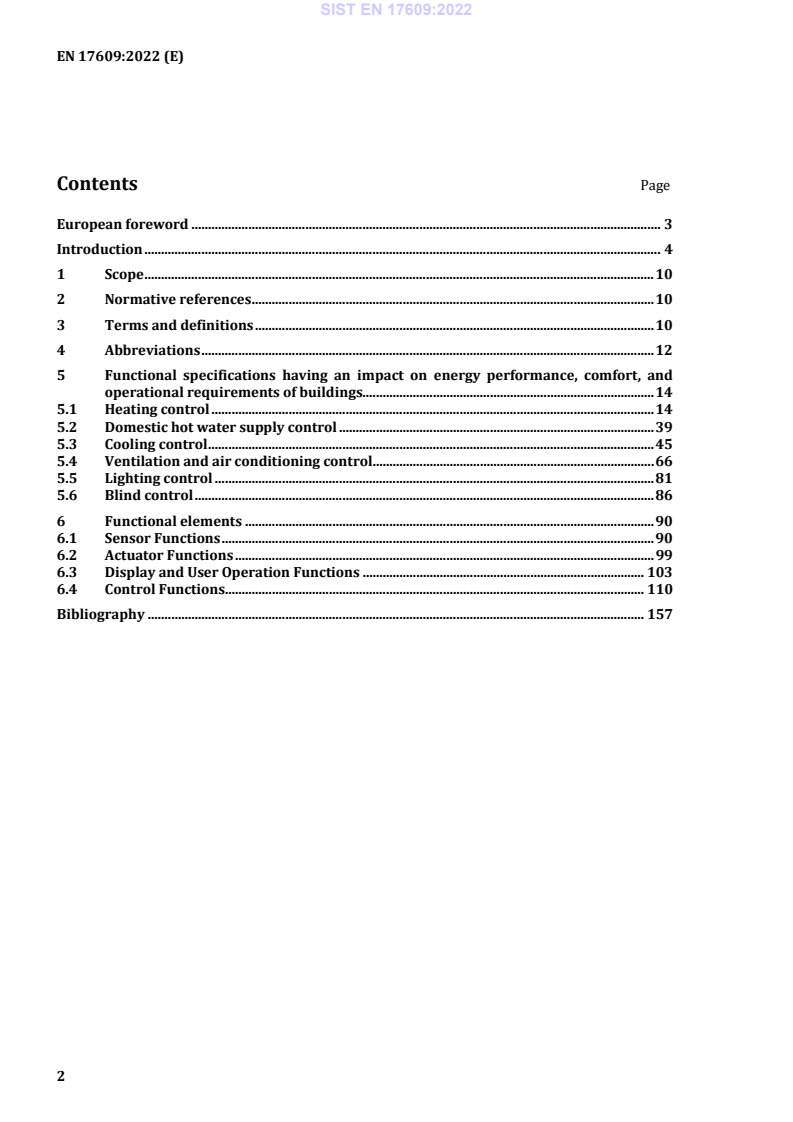
Contents Page
European foreword . 3
Introduction . 4
1 Scope . 10
2 Normative references . 10
3 Terms and definitions . 10
4 Abbreviations . 12
5 Functional specifications having an impact on energy performance, comfort, and
operational requirements of buildings. 14
5.1 Heating control . 14
5.2 Domestic hot water supply control . 39
5.3 Cooling control . 45
5.4 Ventilation and air conditioning control . 66
5.5 Lighting control . 81
5.6 Blind control . 86
6 Functional elements . 90
6.1 Sensor Functions . 90
6.2 Actuator Functions . 99
6.3 Display and User Operation Functions . 103
6.4 Control Functions. 110
Bibliography . 157
European foreword
This document (EN 17609:2022) has been prepared by Technical Committee CEN/TC 247 “Building
Automation, Controls and Building Management” the secretariat of which is held by SNV.
This European Standard shall be given the status of a national standard, either by publication of an
identical text or by endorsement, at the latest by January 2023, and conflicting national standards shall
be withdrawn at the latest by January 2023.
Attention is drawn to the possibility that some of the elements of this document may be the subject of
patent rights. CEN shall not be held responsible for identifying any or all such patent rights.
Any feedback and questions on this document should be directed to the users’ national standards body.
A complete listing of these bodies can be found on the CEN website.
According to the CEN-CENELEC Internal Regulations, the national standards organisations of the
following countries are bound to implement this European Standard: Austria, Belgium, Bulgaria, Croatia,
Cyprus, Czech Republic, Denmark, Estonia, Finland, France, Germany, Greece, Hungary, Iceland, Ireland,
Italy, Latvia, Lithuania, Luxembourg, Malta, Netherlands, Norway, Poland, Portugal, Republic of North
Macedonia, Romania, Serbia, Slovakia, Slovenia, Spain, Sweden, Switzerland, Türkiye and the United
Kingdom.
Introduction
Buildings are built and operated serving a specific purpose, e.g. as an office workspace, a manufacturing
floor, or a data centre. In each case, the usage of the space requires specific environmental conditions, e.g.
temperature, light level or air quality, which is provided.
Increasing the efficient usage of energy to provide these environmental conditions is a key aspect of
building design addressed in EN ISO 52120-1, Energy Performance of Buildings — Energy performance of
buildings — Part 1: Impact of Building Automation, Controls and Building Management.
Energy efficiency requirements cannot be fulfilled by optimizing the primary systems of a building alone.
A holistic view on the building and especially on the room control systems for lighting, solar protection
and HVAC is the basis for optimizing the energy efficiency of buildings. This requires integration of the
room and building controls and management systems from the design phase through installation and
commissioning to the building operation.
The planning process for the technical infrastructure of a building and its spaces includes several steps
starting with a rough set of requirements. With each step in the planning process the design becomes
more detailed. First basic design choices or decisions allow for a budget estimate. These first design
choices may be documented as depicted in Figure 1.
Figure 1 — Example for documentation of design choices for technical infrastructure of a
building (Source: SN 502411:2016 / SIA 411:2016)
Figure 1 shows the equipment required for the different technical building disciplines (heating, cooling,
ventilation, lighting, solar protection) in the space including energy related interconnections between the
equipment of the respective disciplines. The schema depicts source/sink, conversion, storage,
distribution, and emission elements and their interconnections in a simple manner. This is a high-level
view on the mechanical and electrical equipment. It does not yet include the automation requirements
associated with the equipment.
In a further planning step, the control functions (BAC functions) associated with the technical
infrastructure equipment of a building are added as depicted in Figure 2.
Figure 2 — Example for documentation of design choices for technical infrastructure and
associated control functions of a building (Source: SN 502411:2016 / SIA 411:2016)
The column “usage/operation” contains control functions required for user interaction with the technical
building infrastructure in the space and/or for super-ordinated (e.g. building-wide) functions and
requirements.
Whereas the control functions are determined by the technical building equipment and the user
operation interface in general, the sophistication of these control functions is determined by the desired
level of energy efficiency of a building or comfort and operational requirements. Hence, both views, the
desired level of energy efficiency of a building and the comfort and operational requirements, are
considered and documented such that this documentation serves as a requirement specification for
building control applications (heating, cooling, ventilation, lighting, solar protection) in a space.
In Figure 2, BAC functions have been added to the equipment. The labels refer to BAC functions listed in
EN ISO 52120-1:2022, Table 5. These BAC functions are not specified in detail in EN ISO 52120-1.
Clause 5 of this document provides a method to transfer energy performance, comfort, and operational
requirements as defined in EN ISO 52120-1:2022 into a more detailed specification of building
automation functions.
Refer to EN ISO 52120-1:2022, Table 5, for a list of functions contributing to achieve the desired level of
energy performance. Whereas EN ISO 52120-1:2022 only provides a very brief description of the
functionality, Clause 5 contains a more detailed description.
NOTE Application of automated control improves the energy performance of buildings. Clause 5 of this
document covers automated control applications only. Any manual or non-automated control listed in EN
ISO 52120-1:2022, Table 5, is not covered in this document.
For the purpose of clarity, each subclause in Clause 5 contains a reference in square brackets to the
corresponding entry in Table 5 of EN ISO 52120-1:2022 directly after the sub-clause heading.
The more detailed description includes information about mandatory and optional inputs as well as
mandatory and optional outputs for the control function. The control function is not described in detail
but rather is a “black box” as the actual implementation may be project or manufacturer specific.
Figure 3 provides an informative schematic view with the function (box), mandatory (blue) and optional
(grey) inputs and mandatory (blue) and optional (grey) outputs. The informative schematic drawing also
shows if inputs may be controlled, e.g. by manual operation or by a schedule and if output values are
associated e.g. with an alarm or a trend.
Figure 3 — Informative depiction of control application scheme for Heating control – Emission
control – Type 1: Central automatic control
Clause 5 contains in each sub-clause a brief description of the control function itself, the target of the
function, different operating modes, where applicable, and a description of the inputs and outputs of the
function. Optionally, parameters and implementation equipment may be described.
For some of these functions more than one version is described, covering different technological
implementations.
Building control functions may be associated with a specific zone, a room, a building segment, or the
whole building.
The result of applying Clause 5 is a collection of building automation control function blocks. This does
not yet depict how these blocks work in detail or how they are linked to each other. A more detailed
control scheme description can be provided using the function blocks described in Clause 6.
Clause 6 of this document provides function blocks, which can be used to describe building control
functions in more detail independent of a specific building control system or vendor.
Applications can be described by a combination of sensor input, actuator output, user interaction, and
control and monitoring functions. Certain functions in a room (e.g. presence detection) may be shared by
two or more applications. A common set of function blocks covering sensor input, actuator output, user
interaction, and control functions for the different applications in a room serves as the basis for
describing room automation, controls and management systems.
Using a typical example, Figure 4 shows the relationship between sensor, display/operation, control and
actuator functions. Information exchanged between functions is provided from outputs to inputs.
Physical inputs and outputs associated with Sensor and Actuator functions are not depicted in the figure.
As some functions may require parameters these are also depicted in each function block.
Figure 4 — Relationship between Automation functions (typical example)
A sensor function typically includes a physical input (e.g. a temperature sensor, not depicted in Figure 4)
and provides a logical output (OUTPUT of the Sensor function block in Figure 4) for use by other
functions.
A display and operation function includes physical inputs or outputs depending on its functionality and
provides logical inputs for display purposes and logical outputs for use by other functions (Display and
Operation function block in Figure 4).
Control functionality as depicted in Figure 4 is assigned to specific control functions with one or more
logical inputs (INPUT 1 and INPUT 2 of the Control function block in Figure 4) and at least one logical
output (OUTPUT of the Control function block in Figure 4). Control functions are not directly associated
with physical inputs or outputs.
Actuator functionality is assigned to specific actuator functions. An actuator function typically includes a
physical output (controlling e.g. a valve) and provides a logical input (INPUT of the Actuator function in
Figure 4) and logical output. This logical output could be used as a feedback status information.
The generalized description format used in Clause 6 for functions includes a brief description of the
function, of the physical input(s), of the logical input(s) expected from other functions, of the logical
output(s) provided to other functions, and of the physical output(s). In addition, parameters are listed
that are required to more precisely define the function for a specific project.
The description of the functions blocks follows this uniform scheme:
— Short description of the function;
— Physical Input(s);
— Logical Input(s);
— Logical Output(s);
— Physical Output(s);
— Parameters (optional).
The list of functions may be extended where necessary.
1 Scope
This document specifies control applications and function blocks focusing on but not limited to lighting,
solar protection and HVAC applications.
It describes how energy performance, comfort, and operational requirements of buildings are translated
into functional specifications for integrated plant and room control.
2 Normative references
The following documents are referred to in the text in such a way that some or all of their content
constitutes requirements of this document. For dated references, only the edition cited applies. For
undated references, the latest edition of the referenced document (including any amendments) applies.
EN ISO 52120-1:2022, Energy performance of buildings — Contribution of building automation, controls
and building management — Part 1: General framework and procedures (ISO 52120-1:2021)
3 Terms and definitions
For the purposes of this document, the terms and definitions given in EN ISO 52120-1 and the following
apply.
ISO and IEC maintain terminological databases for use in standardization at the following addresses:
— IEC Electropedia: available at https://www.electropedia.org/
— ISO Online browsing platform: available at https://www.iso.org/obp
3.1
building part
one or more rooms horizontally and/or vertically positioned with a joint perimeter typically determined
by walls or floors
Note 1 to entry: A horizontal building part may be a floor. A vertical building part may be a building wing or side,
e.g. North side or West wing. A building part may be a part of another building part (e.g. West wing – floor 2) and
contains at least one room.
3.2
display function
presentation of information coming from an actuator, control, monitoring or sensor function in a visible
format understandable by a human user
Note 1 to entry: Information may be displayed in text form (e.g. 18 °C, 100 %) or in a graphical form (e.g. light
blue for cool, bar graph).
3.3
energy efficiency
ratio or other quantitative relationship between an output of performance, service, goods or energy, and
an input of energy
EXAMPLE Efficiency conversion energy; energy required/energy used; output/input; theoretical energy used
to operate/energy used to operate.
Note 1 to entry: Both input and output need to be clearly specified in quantity and quality. Additionally, they need
to be measurable.
[SOURCE: EN ISO 52120-1:2022]
3.4
building automation
coordinated control of lighting, solar protection, heating/ventilation/air conditioning devices and
systems in a building providing the desired comfort level with maximum energy efficiency
Note 1 to entry: Coordinated control may also encompass access control via information links from those devices
and systems to other building control devices and systems.
3.5
room automation
coordinated control of lighting, solar protection, heating/ventilation/air conditioning devices and
systems in a room providing the desired comfort level with maximum energy efficiency
Note 1 to entry: Coordinated control may also encompass access control via information links from those devices
and systems to other room control devices and systems.
3.6
logical input
interface of a function receiving data from an output of another function
3.7
logical output
interface of a function sending data to an input of another function
3.8
operation function
means for input of information by a human user intended for use by an actuator, control, monitoring or
display function
Note 1 to entry: Operation of e.g. a wall switch, touch panel area may be used as input.
3.9
plant
equipment for generation of hot or cold water and/or conditioned air
3.10
room
one or more zones with a joint perimeter typically determined by walls or other types of partitions
Note 1 to entry: Typically, a room is a part of a building segment.
3.11
room automation
control of one or more lighting, solar protection, and/or heating/ventilation/air conditioning in a room
providing the desired comfort levels of these separate applications
3.12
smart control
coordination between all control disciplines providing optimal balance of energy-efficiency, comfort, low
life-cycle cost, ease of operation, engineering, and maintenance
Note 1 to entry: The implementation of the coordination may be achieved via logical information exchange
and/or simply via physics. In the latter case coordination is relying on the synchronization of different disciplines
during the design phase.
3.13
solar protection
means for reducing heat losses at night and for controlling the impact of solar radiation on the
temperature in a space and/or on the visual comfort of an occupant of a space
Note 1 to entry: The impact of solar radiation on the temperature can lead to an undesired (in summer) or a
desired (in winter) temperature rise.
3.14
space
complete building, building part, room, or zone
3.15
superordinate control
building control functions situated on a supervisory system overseeing automation functions and
aggregating information spanning across a building, a campus, or several locations
3.16
zone
smallest space determined by the minimum technical infrastructure required to operate that space
Note 1 to entry: The minimum technical infrastructure may be a heating radiator, ventilation outlet, or other
mechanical or electrical equipment element.
3.17
technical building management
TBM
process(es) and services related to operation and management of buildings and technical building system
through the interrelationships between the different disciplines and trades
Note 1 to entry: The disciplines and trades comprise all technical building services for the purpose of optimized
maintenance and energy consumption.
EXAMPLE Optimization of buildings through interrelationships ranging from heating, ventilation and air
conditioning (HVAC) to lighting and day lighting to life safety and security to electric power systems and energy
monitoring and metering; to its services, including communications and maintenance and to its management.
[SOURCE: EN ISO 52120-1:2022]
4 Abbreviations
Abbreviation Description
BAC Building Automation and Control
BACS Building Automation and Control System
COP Coefficient of Performance
DHW Domestic Hot Water
TBM Technical Building Management
TABS Thermally Activated Building Structure
For the purposes of Clause 6, the following abbreviations and acronyms apply:
Abbreviation Description
PAR Parameter
T Temperature
For the purposes of Clause 6, for the data types of input and output information shown in the informative
examples, the following abbreviations apply:
Abbreviation Description
Presence Presence of persons, comprising the states
— present and
— absent
Binary Two-valued state whose meaning depends on the function, e.g.
— window open
— window closed
Function Enumeration type for controller function (see also 6.4.21)
Solar Data structure providing information on position (in percent) and slat tilt
(in degrees, optionally for blinds) of the solar protection
Light Control value or current value of the lighting system (in percent)
Lux Illuminance (in lux)
Mode Enumeration type for the energy mode, comprising the states
— comfort
— pre-comfort
— economy
— protection
Usage Enumeration type for various room utilisation types
Pos Control value or current value of drives, e.g. valves, ventilation dampers or
windows (in percent)
Qual Air quality (e.g. CO content, in ppm)
Temp Temperature (in degrees Celsius)
Wind Wind velocity (in metres per second)
Angle Angle, e.g. of solar position (in degrees)
Time Current time and date
NOTE Although the identifiers of the input/output information in the informative function blocks merely serve
for unambiguous allocation to the text, the naming follows a systematic pattern, consisting of two codes which allow
stating the data type and the use:
st nd
1 code Data type 2 code Meaning
A_ Angle ACT Current
B_ Binary AUTO Automatic
F_ Function BMS Centralised specification from
building management system
H_ Humidity DEW Dewpoint
I_ Lux MAN Manual
L_ Light MAINT Maintenance
M_ Mode ON On/off
P_ Presence OUT Outdoor
Q_ Qual PROT Protection
R_ Precipitation ROOM Room…
S_ Solar SET Control value
T_ Temp SETPT Setpoint
U_ Usage SETPTS Setpoint group
V_ Pos STA Current (state) value
W_ Wind SUN Sun
X_ Diverse SUPPLY Supply air
SYNC Synchronization
WINDOW Window
XXX Diverse
5 Functional specifications having an impact on energy performance, comfort,
and operational requirements of buildings
5.1 Heating control
5.1.1 Emission control
5.1.1.1 Type 1 – Central automatic control
[EN ISO 52120-1:2022, Table 5: 1.1, HEATING CONTROL, Emission control, Type 1]
NOTE This Type 1 is no longer considered to be energy efficiency class C but defined as energy efficiency
class D.
Description: Central automatic control of temperature in rooms by means of heating, is acting either on
the distribution or on the generation. Heating control is performed without consideration of local demand
of different rooms, possibly by using one room as reference. This can be achieved for example by an
outside air temperature controller conforming to EN 12098-1 or EN 12098-3.
Target: To improve Energy Performance by minimizing emitted heat by emitters (e.g. radiators) or by
air in the building using central control of temperature and/or flow. This control may be based on outside
air temperature and/or a reference sensor inside the building and assumes similar demands in different
parts/rooms of the building.
Different operating modes: comfort, economy (pre-comfort), night, building protection.
Inputs (mandatory):
— Outside Air Temperature (varies inside space temperature setpoint; in summer: increases cooling
setpoint, in winter: reduces heating setpoint),
— Room Temperature Setpoint,
— Operating mode,
— Room Temperature (reference room)
Inputs (optional):
— Supply water (flow) temperature,
— Return water temperature
Outputs (mandatory):
— Supply water (valve position),
— Boiler/Pumps On/Off
Outputs (optional):
---
5.1.1.2 Type 2 – Individual room control
[EN ISO 52120-1:2022, Table 5: 1.1, HEATING CONTROL, Emission control, Type 2]
Description: Individual room control by thermostatic valves or electronic controllers.
The individual room control of heating temperature in rooms is performed either by thermostatic valves
or local (non-communicating) electronic control units. The individual control should/may be combined
with scheduler programs providing different operating modes.
Target: To improve Energy Performance by minimizing emitted heat by emitters (e.g. radiators) or by
air in the building using local control of temperature and/or flow in the rooms, thereby adapting to local
demand, i.e. different loads in different rooms.
Different operating modes: comfort, pre-comfort (economy), night, building protection.
Inputs: indoor temperature as reference.
Inputs (mandatory):
— Room Temperature,
— Room Temperature Setpoint,
— Operating mode
Inputs (optional):
— Presence detection,
— Optimized start/stop control (adaptive),
— Window contact
Outputs (mandatory):
— Supply water (valve position)
Outputs (optional):
---
5.1.1.3 Type 3 – Individual modulating room control with communication
[EN ISO 52120-1:2022, Table 5: 1.1, HEATING CONTROL, Emission control, Type 3]
Description: Individual modulating room control with communication between controllers and to BACS.
Individual modulating control of temperature in rooms by means of heating, with communication
between controllers and to BACS, allows exchange of setpoints, demand and other status information.
Target: To improve Energy Performance by minimizing emitted heat by emitters (e.g. radiators) or by
air in the building using local control of temperature and/or flow in the rooms, thereby adapting to local
demand, i.e. different loads in different rooms. Furthermore, to obtain energy demand for further use to
control distribution and generators, keeping run time at minimum and setpoints optimal.
Different operating modes: comfort, pre-comfort (economy), night, building protection.
Inputs (mandatory):
— Room Temperature,
— Room Temperature Setpoint,
— Operation mode (Operation request on demand – local push button control overriding automatic
sequence),
— Window contact (override automatic control if a window is opened)
Inputs (optional):
— Presence detection (to change operating mode),
— Outside Air Temperature (varies inside space temperate setpoint; in summer increases cooling
setpoint, in winter reduces heating setpoint),
st
— Frost protection (based on central plant and outside air temperature 1 (pump circulation) and 2nd
stage (Pumps plus heating demand) strategy),
— Optimized start/stop control (adaptive; provides a pre occupancy comfort mode and optimised
start/stop based around a time/calendar schedule and internal building fabric protection)
Outputs (mandatory):
— Heating demand;
— Supply water (valve position).
Outputs (optional):
— Manual override – local manual control overriding automatic sequence
5.1.1.4 Type 4 – Individual modulating room control with communication and occupancy
detection
[EN ISO 52120-1:2022, Table 5: 1.1, HEATING CONTROL, Emission control, Type 4]
Description: Individual modulating room control with communication between controllers and to BACS.
Demand/presence control performed by occupancy.
Individual modulating control of temperature in rooms by means of heating, with communication
between controllers and to BACS, allows exchange of setpoints, demand and other status information.
Presence detection shall be installed to reach the highest level of energy performance.
Outside air temperature – varies inside space temperate setpoint; in summer increases cooling setpoint,
in winter reduces heating setpoint.
Optimum start stop provides a pre occupancy comfort mode and optimised start/stop based around a
time/calendar schedule and internal building fabric protection.
Target: To improve Energy Performance by minimizing emitted heat by emitters (e.g. radiators) or by
air in the building using local control of temperature and/or flow in the rooms, thereby adapting to local
demand, i.e. different loads in different rooms. Furthermore, to obtain energy demand for further use to
control distribution and generators, keeping run time at minimum and setpoints optimal.
Different operating modes: comfort, pre-comfort (economy), night, building protection.
Inputs (mandatory):
— Room Temperature,
— Room Temperature Setpoint,
— Operation mode (Operation request on demand – local push button control overriding automatic
sequence),
— Presence detection,
— Window contact (override automatic control if a window is opened).
Inputs (optional):
— Optimized start/stop control (adaptive).
Outputs (mandatory):
— Heating demand
Outputs (optional):
---
5.1.2 Emission control for TABS (heating mode)
5.1.2.1 Type 1 – Central automatic control
[EN ISO 52120-1:2022, Table 5: 1.2, HEATING CONTROL, Emission control for TABS (heating mode),
Type 1]
Description: The central automatic control for a TABS zone (which comprises all rooms which get the
same supply water temperature) typically is a supply water temperature control loop whose setpoint is
dependent on the median outside air temperature, e.g. the average of the previous 24 h.
Target: The supply water temperature shall be set according to the median outside air temperature
(median-weather compensated supply water temperature).
Inputs (mandatory):
— Outside Air Temperature
— Supply or return water (flow) temp.
Inputs (optional):
— Room temperature
— Room Temperature (reference room)
— Room temperature setpoint
— Presence detection
Outputs (mandatory):
— Supply water temp. (valve position)
— Heating demand
Outputs (optional):
---
Parameters: Ramp to determine setpoint.
Additional equipment: None.
Possible variants: The controls might cover both heating and cooling.
5.1.2.2 Type 2 – Advanced central automatic control
[EN ISO 52120-1:2022, Table 5: 1.2, HEATING CONTROL, Emission control for TABS (heating mode),
Type 2]
Description: This is an automatic control of the TABS zone that fulfils the following conditions
— If the TABS is used only for heating: The central automatic control is designed and tuned to achieve
an optimal self-regulating of the room temperature within the required comfort range (specified by
the room temperature heating setpoint). “Optimal” means that the room temperatures of all rooms
of the TABS zone remain during operation periods in the comfort range, to meet comfort
requirements, but also is as low as possible to reduce the energy demand for heating.
— If the TABS is used for heating and cooling: The central automatic control is designed and tuned to
achieve an optimal self-regulating of the room temperature within the required comfort range
(specified by room temperature heating and cooling setpoints). “Optimal” means that the room
temperatures of all rooms of the TABS zone remain during operation periods in the comfort range,
to meet comfort requirements, but also uses as far as possible the full range to reduce the energy
demand for heating and cooling.
— If the TABS is used for heating and cooling: the automatic switching between heating and cooling is
not done only dependent on the outside air temperature, but also taking at least indirectly the heat
gains (internal and solar) into account.
Target: Achieve temperatures within the desired bandwidth for all rooms in the heating/cooling group.
Inputs (mandatory):
— Outside Air Temperature
— Supply or return water (flow) temp
— Room temperature
— Room temperature setpoint
Inputs (optional):
— Room Temperature (reference room)
— Presence detection
Outputs (mandatory):
— Supply water temp. (valve position)
— Heating demand
Outputs (optional):
---
Parameters: Room heating setpoint, comfort range.
Additional equipment: Room setpoint device.
Possible variants: Heating/cooling changeover, room cooling setpoint.
5.1.2.3 Type 3 – Advanced central automatic control with intermittent operation and/or room
temperature feedback control
[EN ISO 52120-1:2022, Table 5: 1.2, HEATING CONTROL, Emission control for TABS (heating mode),
Type 3]
Description: Advanced central automatic control with room temperature feedback control:
— Advanced central automatic control with intermittent operation. This is an advanced central
automatic control according to 2) with the following supplement: The pump is switched off regularly
to save electrical energy, either with a fast frequency – typically 6 hours on/off cycle time – or with a
slow frequency, corresponding to 24 hours on/off cycle time. If the TABS is used for cooling,
intermittent operation with 24 hours on/off cycle time can also be used to reject the heat to the
outside air if the outside air is cold.
— Advanced central automatic control with room temperature feedback control. This is an advanced
central automatic control according to 2) with the following supplement: The supply water
temperature setpoint is corrected by the output of a room temperature feedback controller, to adapt
the setpoint to non-predictable day-to-day variation of the heat gain. Since TABS react slowly, only
day-to-day room temperature correction is applied, an instant correction cannot be achieved with
TABS. The room temperature that is fed back is the temperature of a reference room or another
temperature representative for the zone.
— Advanced central automatic control with intermittent operation and room temperature feedback
control.
Target: The goal is to compensate room/zone behaviour into the supply water temperature control in
order to optimize emissions considering heat gain and radiation.
Inputs (mandatory):
— Outside Air Temperature
— Supply and return water (flow) temp.
— Room temperature
— Room Temperature setpoint
Inputs (optional):
— Room temperature
— Room Temperature (reference room)
— Return water temperature
— Presence detection
Outputs (mandatory):
— Supply water temp. (valve position)
— Pumps On/Off
— Heating demand
Outputs (optional):
— Heating / cooling status
NOTE Locking of heating and cooling operation is described in chapter 5.3.6.1.
Parameters: Setpoint heating, setpoint cooling (if)
Additional equipment: None.
Possible variants: Mean zone temperature instead of reference temperature.
5.1.3 Control of distribution network hot water temperature (supply or return)
5.1.3.1 Type 1 – Outside air temperature compensated control
[EN ISO 52120-1:2022, Table 5: 1.3, HEATING CONTROL, Control of distribution network hot water
temperature (supply or return), Type 1]
Description: Control of the temperature of the hot water distribution based on outside air temperature
compensation.
Target: To achieve Energy Performance by lowering the mean temperature of the flow,
thereby minimizing heat losses.
Inputs (mandatory):
— Outside Air Temperature
— Supply water Temperature
Inputs (optional):
— Room Temperature (reference room)
— Room Temperature setpoint (ref. room)
— Supply water (flow) temperature
— Return water temperature
Outputs (mandatory):
— Supply water temp. (valve position)
— Heating demand (to the boiler)
Outputs (optional):
— Boiler/Pumps On/Off
Additional equipment: Outside air temperature sensor.
Possible variants: None.
5.1.3.2 Type 2 – Demand based control
[EN ISO 52120-1:2022, Table 5: 1.3, HEATING CONTROL, Control of distribution network hot water
temperature (supply or return), Type 2]
Description: Control of the temperature of the hot water distribution is based on indoor temperature
measurements.
Prerequisite: Communicating system to room control units.
Target: To achieve Energy Performance by lowering the mean temperature of the flow as well as
decreasing the flow rate, thereby minimizing heat losses. In addition, use energy demand information to
keep run time at minimum and setpoints optimal.
Heating demand from space (emissions) Utilisation of loop parameters or valve positions to affect a
reduction in flow rate or temperature set-points based on overall distribution demand
st
Frost protection based on central plant and outside air temperature 1 (pump circulation) and 2nd stage
(Pumps plus heating demand) strategy
Outside air temperature – varies inside space temperate setpoint; in summer increases cooling setpoint,
in winter reduces heating setpoint
Time/Calendar Schedule – utilised to switch between different operating modes
Optimum start stop in addition to the time/Calendar schedule provides a pre occupancy comfort mode
and optimised start/stop based around a time/calendar schedule and internal building fabric protection.
Manual override – local manual control overriding automatic sequence
Operational request on demand – local push button or setpoint override
Energy usage metering – provide information on energy used in local area to enable analysis and
benchmarking
Boiler on/off – switch generator demand
Pumps on/off – switch distributor demand
Inputs (mandatory):
— Supply water temperature
— Room temperature (reference room)
— Room Temperature setpoint (ref. room)
Inputs (optional):
— Outside Air Temperature
— Heating demand from space (emission)
Outputs (mandatory):
— Supply water temp. (valve position)
— Heating demand
Outputs (optional):
— Boiler/Pumps On/Off
Parameters: Time programs for different operating modes.
Possible variants: Outdoor temperature measurement included.
5.1.4 Control of distribution pumps in networks
5.1.4.1 Type 1 – On/Off control
[EN ISO 52120-1:2022, Table 5: 1.4, HEATING CONTROL, Control of distribution pumps in networks,
Type 1]
Description: Automatic control is realised to reach intermittent operation of the emission and/or
distribution components.
Target: To get Energy Performance by lowering the temperature setpoints during certain conditions (e.g.
night). This leads to Energy Performance due to shortened operation time of the generation/distribution,
lower losses of the room(s) due to lower temperature differences to the outside.
Inputs (mandatory):
— Supply water temperature
— Return water temperature
Inputs (optional):
— Operating mode
— Time schedule
— Outside air temperature
— Differential pressure
Outputs (mandatory):
— Pump On/Off
Outputs (optional):
---
Parameters: Setpoints for “economy”, “pre-comfort”, “comfort”.
Possible variants: One-time program for a “group” of rooms (zone); one-time program for a whole
building.
5.1.4.2 Type 2 – Multi stage control
[EN ISO 52120-1:2022, Table 5: 1.4, HEATING CONTROL, Control of distribution pumps in networks,
Type 2]
Description: Automatic control is realised to reach optimized Start/Stop of intermittent operation of the
emission and/or distribution components.
Target: To achieve Energy Performance through optimized start/stop to maximize time for economy
mode by considering energy capacity of the building in control.
Inputs (mandatory):
— Supply (flow) water temperature
— Return water temperature
Inputs (optional):
— Heating demand (valve position)
— Time schedule
— Differential pressure
— Outside air temperature
Outputs (mandatory):
— Pump on/off – Stage 1
— Pump on/off – Stage 2
Outputs (optional):
— Pump on/off – variable speed drive
Parameters: Setpoints for “economy”, “pre-comfort”, “comfort”.
Possible variants: One-time program for a “group” of rooms (zone); one-time program for a whole
building.
5.1.4.3 Type 3 – Variable speed pump control (pump unit (internal) estimations)
[EN ISO 52120-1:2022, Table 5: 1.4, HEATING CONTROL, Control of distribution pumps in networks,
Type 3]
Description: Automatic control is realised to reach intermittent operation of emission and/or
distribution based on demand (occupancy).
Target: To achieve Energy Performance through maximizing “pre-comfort” and/or “economy” time
periods by detecting or using information about real demand (e.g. occupancy).
Optional
— Pump status contact – for flow proving
— Differential pressure sensor – monitoring system pressure and evaluating demand
— Time/Calendar Schedule – utilised to switch between different operating modes
st
— Frost protection based on central plant and outside air temperature 1 (pump circulation) and 2nd
stage (Pumps plus heating demand) strategy
— Outside air temper
...