

EN 13925-1:2003
(Main)Non-destructive testing - X-ray diffraction from polycrystalline and amorphous material - Part 1: General principles
- Abstract
This European Standard defines the general principles of X-ray diffraction from polycrystalline and amorphous materials. This materials testing method has traditionally been referred to as "X-ray Powder Diffraction (XRPD)", and is now applied to powders, bulk materials, thin film, and others. As the method can be used for various types of materials and to obtain a large variety of information, this standard reviews a large number of types of analysis but remains non-exhaustive.
- Status
- Published
- Publication Date
- 11-Mar-2003
- Technical Committee
- CEN/TC 138 - Non-destructive testing
- Drafting Committee
- CEN/TC 138 - Non-destructive testing
- Current Stage
- 9060 - Closure of 2 Year Review Enquiry - Review Enquiry
- Start Date
- 02-Dec-2024
- Completion Date
- 02-Dec-2024

Overview
EN 13925-1:2003 (CEN) - Non-destructive testing - X-ray diffraction from polycrystalline and amorphous material - Part 1: General principles - defines the general principles of X‑ray powder diffraction (XRPD) as applied to powders, bulk materials, thin films and other specimen forms. The standard provides unified concepts, terminology and practical guidance for XRPD in the context of non‑destructive testing (NDT). It is introductory and non‑exhaustive, intended to support laboratories from routine testing through research and to form a basis for quality assurance and further procedural standards.
Key topics and technical requirements
- Scope and terminology: clear definitions for terms such as powder, specimen, phase and diffraction line specific to XRPD.
- Fundamental principles: description of diffraction physics (Bragg’s law), distinction between angular‑dispersive (monochromatic, scanning angle) and energy‑dispersive (polychromatic, fixed angle) techniques.
- Specimen considerations: meaning of “powder” in diffraction (randomly oriented crystallites), specimen volume, absorption, geometry effects and implications for reproducible intensity measurements.
- Line profile characteristics: position, intensity, integrated area, shape, FWHM and integral breadth; convolution of instrument and specimen contributions to peak broadening.
- Types of analysis (overview of common XRPD analyses):
- Phase identification (qualitative phase analysis)
- Quantitative phase analysis
- Estimation of crystalline vs amorphous fractions
- Lattice parameter determination
- Crystal structure determination and refinement
- Texture (preferred orientation) characterization
- Macrostress determination
- Crystallite size and microstrain analysis
- Electron radial distribution function (RDF)
- Instrument focus: Bragg–Brentano diffractometers are considered in most detail to make the standard broadly applicable.
- Radiation protection: emphasizes adherence to national X‑ray safety legislation or ICRP recommendations where national rules are absent.
- Quality assurance: guidance to support performance testing, instrument monitoring and comparability of results across instruments and labs.
Applications and users
EN 13925-1:2003 is relevant to:
- NDT laboratories performing XRPD for materials inspection
- Materials scientists and crystallographers characterizing polycrystalline and amorphous phases
- Industrial quality assurance teams (metals, ceramics, polymers, thin films)
- Instrument manufacturers and service providers developing XRPD systems or test protocols
- Regulatory bodies and testing agencies seeking harmonized terminology and principles
Practical value includes standardizing methodology, improving reproducibility of phase identification and quantification, and establishing the conceptual basis for subsequent parts (procedures, instruments, reference materials).
Related standards
- EN 13925-2:2003 - Part 2: Procedures (normative reference)
- EN 13925 series (Parts 3 and 4 under development): Instruments and Reference Materials
Keywords: EN 13925-1:2003, XRPD, X‑ray powder diffraction, non‑destructive testing, polycrystalline, amorphous, Bragg–Brentano, phase identification, quantitative phase analysis.
Relations
- Effective Date
- 28-Jan-2026
- Effective Date
- 28-Jan-2026
Get Certified
Connect with accredited certification bodies for this standard

IMP NDT d.o.o.
Non-destructive testing services. Radiography, ultrasonic, magnetic particle, penetrant, visual inspection.
Inštitut za kovinske materiale in tehnologije
Institute of Metals and Technology. Materials testing, metallurgical analysis, NDT.
Q Techna d.o.o.
NDT and quality assurance specialist. 30+ years experience. NDT personnel certification per ISO 9712, nuclear and thermal power plant inspections, QA/
Sponsored listings
Frequently Asked Questions
EN 13925-1:2003 is a standard published by the European Committee for Standardization (CEN). Its full title is "Non-destructive testing - X-ray diffraction from polycrystalline and amorphous material - Part 1: General principles". This standard covers: This European Standard defines the general principles of X-ray diffraction from polycrystalline and amorphous materials. This materials testing method has traditionally been referred to as "X-ray Powder Diffraction (XRPD)", and is now applied to powders, bulk materials, thin film, and others. As the method can be used for various types of materials and to obtain a large variety of information, this standard reviews a large number of types of analysis but remains non-exhaustive.
This European Standard defines the general principles of X-ray diffraction from polycrystalline and amorphous materials. This materials testing method has traditionally been referred to as "X-ray Powder Diffraction (XRPD)", and is now applied to powders, bulk materials, thin film, and others. As the method can be used for various types of materials and to obtain a large variety of information, this standard reviews a large number of types of analysis but remains non-exhaustive.
EN 13925-1:2003 is classified under the following ICS (International Classification for Standards) categories: 19.100 - Non-destructive testing. The ICS classification helps identify the subject area and facilitates finding related standards.
EN 13925-1:2003 has the following relationships with other standards: It is inter standard links to EN 13925-2:2003, EN 15305:2008. Understanding these relationships helps ensure you are using the most current and applicable version of the standard.
EN 13925-1:2003 is available in PDF format for immediate download after purchase. The document can be added to your cart and obtained through the secure checkout process. Digital delivery ensures instant access to the complete standard document.
Standards Content (Sample)
2003-01.Slovenski inštitut za standardizacijo. Razmnoževanje celote ali delov tega standarda ni dovoljeno.Zerstörungsfreie Prüfung - Röntgendiffraktometrie von polykristallinen und amorphen Materialien - Teil 1: Allgemeine GrundlagenEssais non destructifs - Diffraction des rayons X appliquée aux matériaux polycristallins et amorphes - Partie 1: Principes générauxNon-destructive testing - X-ray diffraction from polycrystalline and amorphous material - Part 1: General principles19.100Neporušitveno preskušanjeNon-destructive testingICS:Ta slovenski standard je istoveten z:EN 13925-1:2003SIST EN 13925-1:2004en01-marec-2004SIST EN 13925-1:2004SLOVENSKI
STANDARD
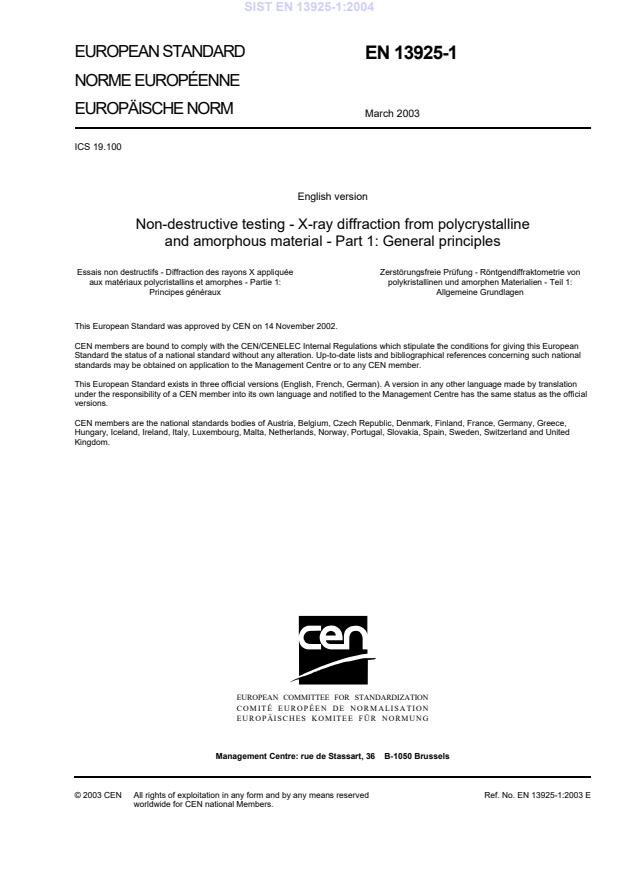
EUROPEAN STANDARDNORME EUROPÉENNEEUROPÄISCHE NORMEN 13925-1March 2003ICS 19.100English versionNon-destructive testing - X-ray diffraction from polycrystallineand amorphous material - Part 1: General principlesEssais non destructifs - Diffraction des rayons X appliquéeaux matériaux polycristallins et amorphes - Partie 1:Principes générauxZerstörungsfreie Prüfung - Röntgendiffraktometrie vonpolykristallinen und amorphen Materialien - Teil 1:Allgemeine GrundlagenThis European Standard was approved by CEN on 14 November 2002.CEN members are bound to comply with the CEN/CENELEC Internal Regulations which stipulate the conditions for giving this EuropeanStandard the status of a national standard without any alteration. Up-to-date lists and bibliographical references concerning such nationalstandards may be obtained on application to the Management Centre or to any CEN member.This European Standard exists in three official versions (English, French, German). A version in any other language made by translationunder the responsibility of a CEN member into its own language and notified to the Management Centre has the same status as the officialversions.CEN members are the national standards bodies of Austria, Belgium, Czech Republic, Denmark, Finland, France, Germany, Greece,Hungary, Iceland, Ireland, Italy, Luxembourg, Malta, Netherlands, Norway, Portugal, Slovakia, Spain, Sweden, Switzerland and UnitedKingdom.EUROPEAN COMMITTEE FOR STANDARDIZATIONCOMITÉ EUROPÉEN DE NORMALISATIONEUROPÄISCHES KOMITEE FÜR NORMUNGManagement Centre: rue de Stassart, 36
B-1050 Brussels© 2003 CENAll rights of exploitation in any form and by any means reservedworldwide for CEN national Members.Ref. No. EN 13925-1:2003 ESIST EN 13925-1:2004
(informative)
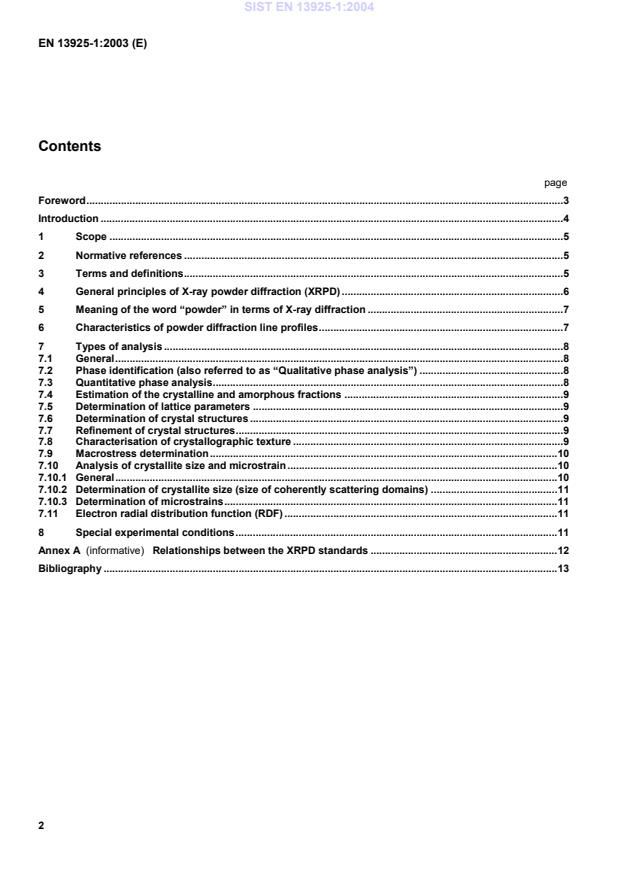
Relationships between the XRPD standards.12Bibliography.13SIST EN 13925-1:2004
1)a draft of European Standard (WI 00138078 "Non-destructive testing - Terminology - X-ray powder diffraction") is inpreparation.SIST EN 13925-1:2004
the hkl lattice planes and half of the so called "diffraction angle", i.e. the anglebetween the directions of the incident beam and the diffracted beam (see Figure 1).n is the diffraction order (see hereafter):1) the equation (1) (Bragg equation), is satisfied if the path difference (AB+BC) between the rays scatteredfrom successive lattice planes of the same set is an exact multiple of l (see Figure 1).Keyd Separation between two successive lattice planes.q Angle between the incident beam and the lattice planes separated by a distance of d.A and C
Points on the incident beam (So) and the diffracted beam (S).B and D represent two of the point scatterers, one in each lattice plane.Figure 1 — Diffraction of X-rays from two successive lattice planes2) the diffraction of nth order from lattice plane hkl is equivalent to a diffraction of first order from the set oflattice planes nh, nk, nl. For most purposes in XRPD, n is taken as unity and equation (1) is more commonlyused in the form:2dhkl×sinqhkl = l(2)where the symbols are as in equation (1).SIST EN 13925-1:2004
...