

EN 455-3:2015
(Main)Medical gloves for single use - Part 3: Requirements and testing for biological evaluation
- Abstract
This part of EN 455 specifies requirements for the evaluation of biological safety for medical gloves for single use. It gives requirements for labelling and the disclosure of information relevant to the test methods used.
- Status
- Withdrawn
- Publication Date
- 31-Mar-2015
- Withdrawal Date
- 06-Oct-2026
- Technical Committee
- CEN/TC 205 - Non-active medical devices
- Drafting Committee
- CEN/TC 205/WG 3 - Medical gloves
- Current Stage
- 9960 - Withdrawal effective - Withdrawal
- Start Date
- 29-Nov-2023
- Completion Date
- 07-Oct-2026
- Directive
- 93/42/EEC - Medical devices

Relations
- Effective Date
- 08-Apr-2015
- Effective Date
- 18-Dec-2019
- Effective Date
- 25-Aug-2026
- Effective Date
- 28-Jan-2026
- Effective Date
- 28-Jan-2026
- Effective Date
- 28-Jan-2026
- Effective Date
- 28-Jan-2026
- Effective Date
- 28-Jan-2026
- Effective Date
- 28-Jan-2026
- Refers
EN ISO 21171:2006 - Medical gloves - Determination of removable surface powder (ISO 21171:2006) - Effective Date
- 28-Jan-2026
- Effective Date
- 28-Jan-2026
- Effective Date
- 18-May-2016
Get Certified
Connect with accredited certification bodies for this standard

BSI Group
BSI (British Standards Institution) is the business standards company that helps organizations make excellence a habit.

TÜV Rheinland
TÜV Rheinland is a leading international provider of technical services.

TÜV SÜD
TÜV SÜD is a trusted partner of choice for safety, security and sustainability solutions.
Sponsored listings
Frequently Asked Questions
EN 455-3:2015 is a standard published by the European Committee for Standardization (CEN). Its full title is "Medical gloves for single use - Part 3: Requirements and testing for biological evaluation". This standard covers: This part of EN 455 specifies requirements for the evaluation of biological safety for medical gloves for single use. It gives requirements for labelling and the disclosure of information relevant to the test methods used.
This part of EN 455 specifies requirements for the evaluation of biological safety for medical gloves for single use. It gives requirements for labelling and the disclosure of information relevant to the test methods used.
EN 455-3:2015 is classified under the following ICS (International Classification for Standards) categories: 11.140 - Hospital equipment. The ICS classification helps identify the subject area and facilitates finding related standards.
EN 455-3:2015 has the following relationships with other standards: It is inter standard links to EN 455-3:2006, EN 455-3:2023, ISO 14971:2007, EN 12201-3:2011/FprA1, EN 1041:2008+A1:2013, EN ISO 14971:2012, EN ISO 10993-5:2009, EN ISO 15223-1:2012, EN ISO 10993-10:2013, EN ISO 21171:2006, EN 13718-2:2015+A1:2020, EN 455-3:2015/prA1. Understanding these relationships helps ensure you are using the most current and applicable version of the standard.
EN 455-3:2015 is associated with the following European legislation: EU Directives/Regulations: 93/42/EEC; Standardization Mandates: M/023. When a standard is cited in the Official Journal of the European Union, products manufactured in conformity with it benefit from a presumption of conformity with the essential requirements of the corresponding EU directive or regulation.
EN 455-3:2015 is available in PDF format for immediate download after purchase. The document can be added to your cart and obtained through the secure checkout process. Digital delivery ensures instant access to the complete standard document.
Standards Content (Sample)
2003-01.Slovenski inštitut za standardizacijo. Razmnoževanje celote ali delov tega standarda ni dovoljeno.Medicinske rokavice za enkratno uporabo - 3. del: Zahteve in preskušanje za biološko ovrednotenjeMedizinische Handschuhe zum einmaligen Gebrauch - Teil 3: Anforderungen und Prüfung für die biologische BewertungGants médicaux non réutilisables - Partie 3 : Exigences et essais pour évaluation biologiqueMedical gloves for single use - Part 3: Requirements and testing for biological evaluation11.140Oprema bolnišnicHospital equipmentICS:Ta slovenski standard je istoveten z:EN 455-3:2015SIST EN 455-3:2015en,fr,de01-junij-2015SIST EN 455-3:2015SLOVENSKI
STANDARDSIST EN 455-3:20071DGRPHãþD
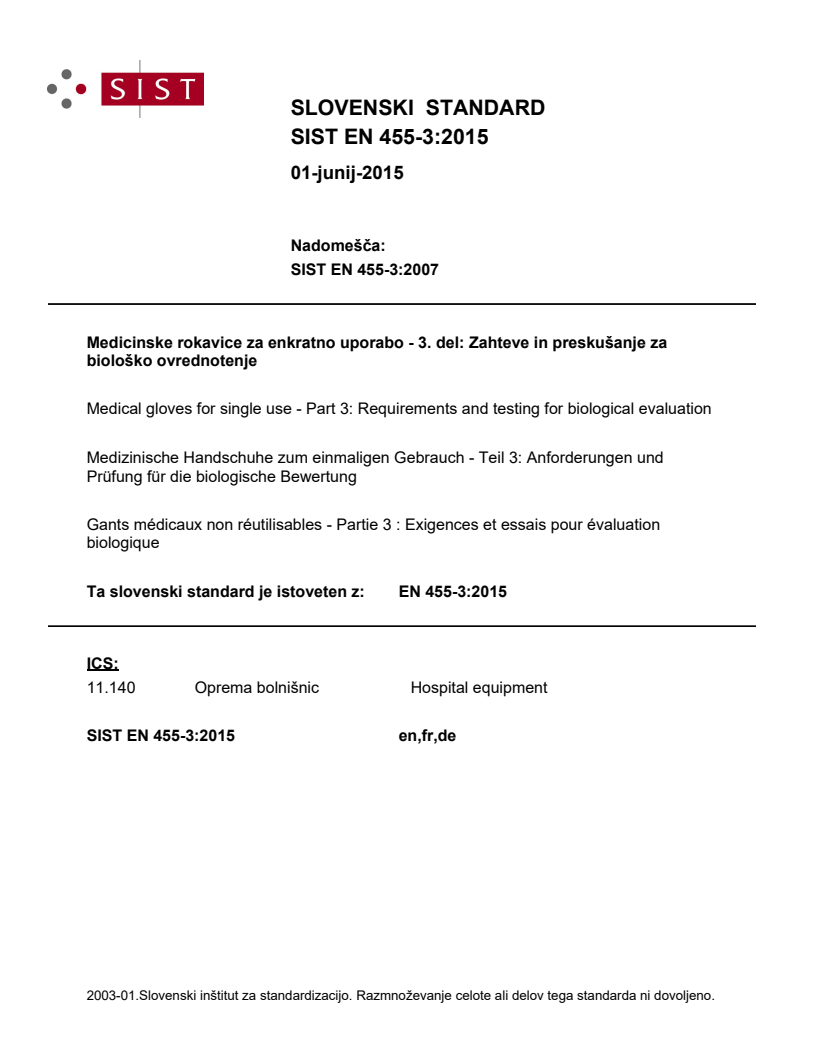
EUROPEAN STANDARD NORME EUROPÉENNE EUROPÄISCHE NORM
EN 455-3
April 2015 ICS 11.140 Supersedes EN 455-3:2006English Version
Medical gloves for single use - Part 3: Requirements and testing for biological evaluation
Gants médicaux non réutilisables - Partie 3 : Exigences et essais pour évaluation biologique
Medizinische Handschuhe zum einmaligen Gebrauch - Teil 3: Anforderungen und Prüfung für die biologische Bewertung This European Standard was approved by CEN on 24 January 2015.
CEN members are bound to comply with the CEN/CENELEC Internal Regulations which stipulate the conditions for giving this European Standard the status of a national standard without any alteration. Up-to-date lists and bibliographical references concerning such national standards may be obtained on application to the CEN-CENELEC Management Centre or to any CEN member.
This European Standard exists in three official versions (English, French, German). A version in any other language made by translation under the responsibility of a CEN member into its own language and notified to the CEN-CENELEC Management Centre has the same status as the official versions.
CEN members are the national standards bodies of Austria, Belgium, Bulgaria, Croatia, Cyprus, Czech Republic, Denmark, Estonia, Finland, Former Yugoslav Republic of Macedonia, France, Germany, Greece, Hungary, Iceland, Ireland, Italy, Latvia, Lithuania, Luxembourg, Malta, Netherlands, Norway, Poland, Portugal, Romania, Slovakia, Slovenia, Spain, Sweden, Switzerland, Turkey and United Kingdom.
EUROPEAN COMMITTEE FOR STANDARDIZATION
COMITÉ EUROPÉEN DE NORMALISATION EUROPÄISCHES KOMITEE FÜR NORMUNG
CEN-CENELEC Management Centre:
Avenue Marnix 17,
B-1000 Brussels © 2015 CEN All rights of exploitation in any form and by any means reserved worldwide for CEN national Members. Ref. No. EN 455-3:2015 ESIST EN 455-3:2015
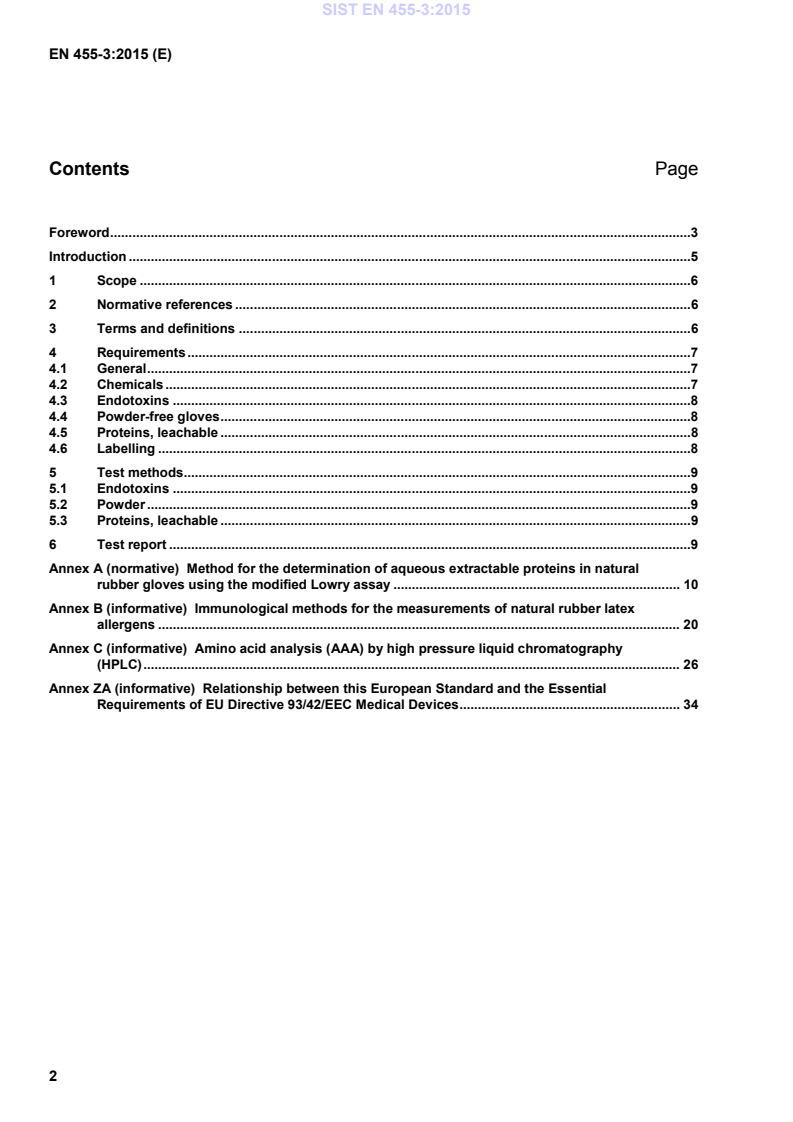
Foreword .3 Introduction .5 1 Scope .6 2 Normative references .6 3 Terms and definitions .6 4 Requirements .7 4.1 General .7 4.2 Chemicals .7 4.3 Endotoxins .8 4.4 Powder-free gloves .8 4.5 Proteins, leachable .8 4.6 Labelling .8 5 Test methods .9 5.1 Endotoxins .9 5.2 Powder .9 5.3 Proteins, leachable .9 6 Test report .9 Annex A (normative)
Method for the determination of aqueous extractable proteins in natural rubber gloves using the modified Lowry assay . 10 Annex B (informative)
Immunological methods for the measurements of natural rubber latex allergens . 20 Annex C (informative)
Amino acid analysis (AAA) by high pressure liquid chromatography (HPLC) . 26 Annex ZA (informative)
Relationship between this European Standard and the Essential Requirements of EU Directive 93/42/EEC Medical Devices . 34
(Product) contains natural rubber latex which may cause allergic reactions, including anaphylactic responses; b) the labelling shall include a prominent indication of whether the glove is powdered or powder-free; c) sterile powdered gloves shall be labelled with the following or equivalent: 'CAUTION: Surface powder shall be removed aseptically prior to undertaking operative procedures in order to minimize the risk of adverse tissue reactions; NOTE 1 This caution statement can be given on the inner wrapping. d) for any medical glove containing natural rubber latex the product labelling shall not include: — any term suggesting relative safety, such as low allergenicity, hypoallergenicity or low protein; — any unjustified indication of the presence of allergens; e) if the manufacturer labels the gloves with the protein content, the process limit, measured as specified in 5.3 shall be given. NOTE 2 This does not allow a protein labelling claim below 50 µg/g. Lower claims are not considered to be reliable given the expected process variation in manufacture and inter-laboratory testing. SIST EN 455-3:2015
Method for the determination of aqueous extractable proteins in natural rubber gloves using the modified Lowry assay A.1 Scope This method is for the determination of the amount of aqueous extractable proteins in gloves for medical use made from natural rubber (NR). It has been validated during inter-laboratory tests. The lower quantification limit is approximately 10
weight. Chemicals such as surfactants, accelerators and antioxidants added to the NR latex during the manufacture of the gloves can interfere with the colour development during the determination, some materials may reduce colour development while others can increase it. If the test method yields results that appear erroneous due to interferants, then any validated amino acid analysis method can be used (as an example see the method given in Annex C). Persons using this method should be familiar with normal laboratory practice.
NOTE This method does not purport to address all of the safety problems, if any, associated with its use. It is the responsibility of the user to establish appropriate safety and health practices and to ensure compliance with any national regulatory conditions. A.2 Principle Water soluble proteins are extracted into a buffer solution and then precipitated with acids in the presence of sodium deoxycholate to concentrate them and to separate them from water soluble substances which may interfere with the determination. The precipitated proteins are redissolved in alkali and quantified colorimetrically by a modified Lowry method. The assay is based on the reaction of proteins with copper and Folin reagent in an alkaline medium to give a characteristic blue colour. Spectrophotometric measurements are performed at a fixed wavelength in the range 600 nm to 750 nm. A.3 Reagents A.3.1 General Wherever water is called for, double distilled water or water of equivalent quality should be used. All other reagents should be of analytical quality. A.3.2 Extractant A.3.2.1 N-tris-[Hydroxymethyl]-methyl-2-aminoethanesulfonic acid (TES), hemisodium salt. A.3.2.2 Extraction buffer, 0,1 M, prepared by dissolving 24 g TES (A.3.2.1) in 1 l water. Any equivalent buffering system can be used provided the solution has sufficient buffering capacity to hold a pH of 7,4 ± 0,2 in the glove extracts. Prepare a sufficient quantity for the glove extraction (A.6.2), the preparation of the protein standard solutions (A.6.3.2) and the blank. SIST EN 455-3:2015
1) Lowry Micro DC Protein Assay Kit (catalogue number 500-0116), available from BioRad Laboratories, 2000 Alfred Nobel Drive, Hercules, CA 9456547, USA. This information is given for the convenience of users of this European Standard and does not constitute an endorsement by CEN of the product named. 2) This ovalbumin is prepared from fresh chicken egg whites by ammonium sulfate fractionation and repeated crystallisation at pH 4,5; for example Sigma A 5503, chicken egg albumin, Grade V, available from Sigma Chemical Co. P.0. Box 14506, St Louis, MO 63178, USA is suitable. This information is given for the convenience of users of this European Standard and does not constitute an endorsement by CEN of the product named. SIST EN 455-3:2015
R
T is the mean ovalbumin content of the test solution after passage through the tubes (i.e. the mean of six va The value for the absorbed albumin (Ofor the determination. SIST EN 455-3:2015
R
T is the mean ovalbumin content of the test solution after passage through the filter units (i.e. the mean
The value for the absorbed albumin (Ofor the determination. A.6 Procedure A.6.1 General The procedure involves the extraction of the gloves followed by purification and concentration of the extract by a factor of five. The determination on the extract is performed by reference to a calibration curve prepared using standard protein solutions which have been concentrated in the same manner. The extraction procedure employed is one in which the inside of one glove and the outside of a second glove are extracted simultaneously. It allows the extraction volume to be minimized at 25 ml and avoids any loss of proteins to container surfaces because the extraction buffer is only exposed to the gloves. NOTE Alternative extraction procedures may be used if they are validated against this method. A round robin test by selected laboratories in Europe and in the USA revealed equivalent results with the ASTM Standard D5712:1995 [2] when extracting cut pieces of gloves for 2 h at 25 °C in TES buffer pH 7,4. A.6.2 Extraction procedure A.6.2.1 Use synthetic gloves (A.4.1) to handle the glove samples used for the extraction. Take eight glove specimens of the same size and the same lot and separate them into four pairs. In the case of hand-specific gloves, choose four right-handed and four left-handed samples and separate them into two right-handed and two left-handed pairs. SIST EN 455-3:2015
Use extraction buffer as a blank. The solutions are stable for 2 days refrigerated or for 2 months frozen at -18 °C. Thawing requires heating to 45 °C for 15 min. A.6.4 Precipitation and concentration of protein A.6.4.1 Carry out the procedure in duplicate at (25 ± 5) °C.
3) Assuming a molecular weight of 43000 D and a molar extinction of 30745 at 280 nm and pH 7,4, the extinction of 1 mg/ml ovalbumin in 0,1 M TES buffer pH 7,4 is 0,715 using a light path of 1 cm [3]. SIST EN 455-3:2015
NOTE Some protein is lost during the concentration process. It is assumed that the same percentage of protein is lost from the standards as from the test samples during the concentration process. A.7.1.2 Concentration of extract For each of the four extracts, calculate the average absorbance of the duplicate determinations (see A.6.4.1). If the individual values differ by more than 20 % repeat the determination. Determine the concentrations of the extracted samples (C NOTE In the event that the calibration curve is non-linear, the value can be calculated by quadratic regression. It is suggested that commercial computer software for curve fitting and calculation of unknown concentrations is more practical. A.7.2 Results The protein content of each sample is given by: mFCVP)(⋅⋅= where P
V is the volume of extraction medium used in ml; C
F is the dilution factor; NOTE F is the real volume of NaOH solution in ml used to re-dissolve the protein divided by 0,2. m is the mass of glove extracted in g (A.6.2.6). Report the mean protein content of the four determinations of glove extracts. SIST EN 455-3:2015
Key 1 outer glove (glove 1) 2 inner glove (glove 2) 3 extraction buffer 4 dye solution 5 glove clamp Figure A.1 — Extraction of gloves (cross section) SIST EN 455-3:2015
Key Y absorbance at 750 nm X ovalbumin concentration (µg/ml) 1 absorbance 2 computer generated polynoma of best fitting 0247,0013,05,042++−−=xxEY Concentration [µg/ml] Absorbance 2,1 5,2 10,4 20,8 52,0 104,0 0,036 0,099 0,159 0,291 0,583 0,945 Figure A.2 — typical standard curve measured in a spectrophotometer at 750 nm with 1 cm path length A.7.3 Statistical information Nine laboratories participated in an inter-laboratory exercise as part of a scientific study supported by the EU in 1996 to 1998 and published in the final report MAT 1 – CT 940060 European Commission Directorate General XII. In this experiment both were tested the precision of the Lowry method and the precision of the whole procedure including the extraction. The whole method includes additionally the variation of the protein content from glove to glove, which is in some cases much higher than the variation of the method. The results are summarized in Table A.1. SIST EN 455-3:2015
Number of measurements Number of extracts Number of days Mean in µg/ml
Repeatability coeffiecient of variation in % (within laboratories) Reproducibility coefficient of variation in % (between laboratories) Glove extract 8 triplicates 1 used by all participants 1 63,9 4,9 9,6 Glove extract 15 triplicates 5 61,7 6,8 6,3 Glove A 5 triplicates 5 1 88,8 7,9 22,5 Glove A 5 triplicates 5 5 84,5 6,1 20,3 Glove B 3 triplicates 3 1 109 20,2 23,3 Glove C 3 triplicates 3 1 727 8,3 23,0 Glove D 3 triplicates 3 1 46,5 10,1 31,8 Mean extract without extraction procedure 5,0 8,0 Mean whole procedure (glove A to D) 10,5 24,2 The limit of quantification was set to 10 µg/g because it is dependent on the thickness (weight) of the gloves. It was found to be between 1 µg/g and 5 µg/g. A.8 References [1] Lowry OH, Rosebrough, NJ, Farr AL, Randall RJ, Protein measurement with Folin Phenol reagent. J Biol Chem 1951 : 193 : 265-275 [2] ASTM D 5712:1995, Standard test method for analysis of protein in natural rubber and its products [3] Kidwai SA, Ansari AA, Salahuddin, Effect of succinylation (3-carboxypropionylation) on the conformation and immunological activity of ovalbumin. Biochem J 1976 : 155 : 171-180 SIST EN 455-3:2015
Immunological methods for the measurements of natural rubber latex allergens B.1 Introduction Immediate allergic reactions to natural rubber latex (NRL) proteins are recognized as an important medical and occupational health problem. A major source of sensitisation has been considered to be proteins or peptides eluting from protective NRL gloves [1]. Although the amount of extractable total protein usually correlates reasonably well with the allergen content of NRL gloves measured by skin prick test (SPT) or human IgE-based assays [2], [3], [4], [5], the total protein methods also measure non-allergenic proteins that are unikely to be relevant in NLR allergy. Therefore, there has been an increasing need for methods capable of specifically and accurately measuring allergens in NRL goods. It is agreed that allergen-specific assays would provide much more accurate and reliable information both for regulatory purposes and for monitoring manufacturing processes. The availability of specific assays has, however, been scanty. Moreover, the still incomplete knowledge on the overall significance of the wide spectrum of NRL allergens has made it difficult to decide which of the numerous allergens present in the NRL source material should be measured. Semiquantitative methods, such as RAST-inhibition and IgE ELISA inhibition, based on the use of human IgE antibodies, have been available for several years in research laboratories. Drawbacks of these methods are that they are difficult to standardise and they suffer from limited availability of human sera containing clinically relevant latex-specific IgE antibodies. In addition, it should be noted that the standards used do not equate to glove proteins. The principle that an ideal test for assessing allergenic potential of NRL products should be based on specific allergen quantification has recently been adopted and endorsed in the ongoing standardisation work both in Europe [6], [7] and the US [8], [31]. Substantial progress has recently been made in the development of specific and quantitative assays for individual NRL allergen quantification [9], [10], [30]. These new assays, based on the capture-enzyme immunoassay (EIA)-principle and on the use of monoclonal antibodies and purified or recombinant allergens, are specific; they can be properly standardized and are of sufficient sensitivity and reproducibility. In this informative annex current methods for NRL allergen measurement are reviewed. B.2 Natural rubber latex allergens in manufactured rubber products Of the some 250 different proteins or polypeptides demonstrated in the NRL source material, the liquid latex of the rubber tree, Hevea brasiliensis, about one fourth to one fifth have been shown to bind with IgE and represent allergens [11], [12]. The mixture of plant proteins in source material reflects the stress response of the rubber tree to wounding (the tapping procedure). Several of these proteins are defense proteins that have been well preserved in plants during evolution. The structural homologies shared with these proteins provide the molecular basis for the common cross-reactions of latex-allergic patients’ IgE towards various plant proteins. It is likely that all of the significant allergens probably are present in the liquid NRL but, as referred to above, the majority of proteins and polypeptides present in the NRL source material are likely to be irrelevant in the assessment of allergenic properties of manufactured NRL products. The WHO/IUIS Allergen Nomenclature Committee lists (February 2013) 14 NRL allergens characterized t the molecular level (www.allergen.org.), most of which have been cloned and produced by recombinant DNA techniques. An optimal test should be designed to accurately measure all allergens that can be present in manufactured rubber products. This could include epitopes present on the natural proteins, as well as new epitopes on the break down products resulting from the harsh rubber manufacturing processes. So far a limited number of SIST EN 455-3:2015
...