

EN 13795-2:2025
(Main)Surgical clothing and drapes - Requirements and test methods - Part 2: Clean air suits
- Abstract
This document specifies information to be supplied to users and third-party verifiers in addition to the usual labelling of medical devices (see EN ISO 20417 and EN ISO 15223-1), concerning manufacturing and processing requirements.
This document gives information on the characteristics of single-use and reusable clean air suits used as medical devices for clinical staff, intended to prevent the transmission of infective agents between clinical staff and patients during surgical and other invasive procedures.
This document specifies test methods for evaluating the identified characteristics of clean air suits and sets performance requirements for these products.
- Status
- Published
- Publication Date
- 28-Jan-2025
- Technical Committee
- CEN/TC 205 - Non-active medical devices
- Current Stage
- 6060 - Definitive text made available (DAV) - Publishing
- Start Date
- 29-Jan-2025
- Due Date
- 03-May-2024
- Completion Date
- 29-Jan-2025
- Directive
- 2017/745 - Regulation (EU) 2017/745 of the European Parliament and of the Council of 5 April 2017 on medical devices, amending Directive 2001/83/EC, Regulation (EC) No 178/2002 and Regulation (EC) No 1223/2009 and repealing Council Directives 90/385/EEC and 93/42/EECOJ Ref: OJ, OJ L 2025/2078 OJ Date: 20-Oct-2025

Overview
EN 13795-2:2025, published by the European Committee for Standardization (CEN), specifies requirements and test methods for clean air suits used in surgical and other invasive medical procedures. This European standard is key for both manufacturers and healthcare providers, as it ensures that clean air suits offer effective protection against the transfer of infective agents between clinical staff and patients. Covering both single-use and reusable surgical clothing, EN 13795-2:2025 defines stringent performance requirements to help reduce the risk of surgical site infections and uphold patient safety during medical interventions.
This standard supersedes EN 13795-2:2019 and aligns closely with the General Safety and Performance Requirements (GSPR) mandated by Regulation (EU) 2017/745 for medical devices.
Key Topics
- Scope: EN 13795-2:2025 covers the essential characteristics, manufacturing, and processing requirements for clean air suits, along with information that must be supplied to end users and third-party verifiers.
- Performance Requirements: It identifies core attributes such as microbial cleanliness (bioburden), resistance to dry microbial penetration, particle release, tensile strength, and bursting strength. These requirements are outlined for both standard and high performance classifications.
- Testing Methods: The standard specifies detailed test methods for evaluating key performance characteristics. Methods comply with referenced standards such as EN ISO 11737-1 for bioburden, EN ISO 9073-10 for particle release, and EN ISO 22612 for microbial penetration.
- Documentation and Labelling: EN 13795-2:2025 establishes comprehensive documentation protocols, including information to support compliance, labelling aligned with EN ISO 20417 and EN ISO 15223-1, and clear communication of product performance to users.
- Quality Management: The standard requires manufacturers and processors to implement and maintain an effective quality management system throughout the product life cycle, including development, manufacturing, and (where applicable) reprocessing of reusable clean air suits.
Applications
- Clinical Use: Clean air suits compliant with EN 13795-2:2025 are essential in operating theatres and medical settings where the risk of infection must be minimized. By maintaining barrier performance, these suits help prevent the transmission of potentially harmful microorganisms during surgery.
- Manufacturers: Producers of both single-use and reusable clean air suits rely on this standard to design, test, document, and label their products for conformity and safety. This is crucial for regulatory approval and market acceptance in the European Union and beyond.
- Healthcare Institutions: Hospitals and surgical centers use EN 13795-2:2025 as a benchmark when selecting clean air suits and related products, ensuring that their procurement practices support infection prevention and meet applicable legal and regulatory requirements.
- Third-Party Verifiers: Testing laboratories and certification bodies reference EN 13795-2:2025 when validating product performance, supporting compliance with EU medical device regulations.
Related Standards
- EN 13795-1: Surgical drapes and gowns - Part 1 of the series, detailing requirements for surgical drapes and gowns.
- EN ISO 20417: Medical devices - Information to be supplied by the manufacturer.
- EN ISO 15223-1: Medical devices - Symbols to be used with medical device labels, labelling, and information to be supplied.
- EN ISO 10993-1: Biological evaluation of medical devices - Risk management and biocompatibility assessment.
- EN ISO 13485: Medical devices - Quality management systems.
- EN ISO 22612: Clothing for protection against infectious agents - Resistance test for dry microbial penetration.
- EN ISO 9073-10: Nonwovens - Test methods for lint and particle release.
- Regulation (EU) 2017/745: Medical Device Regulation (MDR) - Establishes safety and performance requirements for all medical devices marketed in the EU.
By following EN 13795-2:2025, healthcare professionals and manufacturers can ensure higher safety and compliance standards in the use and production of surgical clean air suits, supporting efforts to reduce infection rates and contribute to better outcomes in clinical environments.
Relations
- Effective Date
- 18-Jan-2023
- Effective Date
- 28-Jan-2026
- Effective Date
- 28-Jan-2026
- Effective Date
- 28-Jan-2026
- Effective Date
- 28-Jan-2026
- Effective Date
- 28-Jan-2026
- Effective Date
- 28-Jan-2026
- Effective Date
- 28-Jan-2026
- Effective Date
- 28-Jan-2026
- Effective Date
- 28-Jan-2026
- Effective Date
- 28-Jan-2026
Get Certified
Connect with accredited certification bodies for this standard

BSI Group
BSI (British Standards Institution) is the business standards company that helps organizations make excellence a habit.

TÜV Rheinland
TÜV Rheinland is a leading international provider of technical services.

TÜV SÜD
TÜV SÜD is a trusted partner of choice for safety, security and sustainability solutions.
Sponsored listings
Frequently Asked Questions
EN 13795-2:2025 is a standard published by the European Committee for Standardization (CEN). Its full title is "Surgical clothing and drapes - Requirements and test methods - Part 2: Clean air suits". This standard covers: This document specifies information to be supplied to users and third-party verifiers in addition to the usual labelling of medical devices (see EN ISO 20417 and EN ISO 15223-1), concerning manufacturing and processing requirements. This document gives information on the characteristics of single-use and reusable clean air suits used as medical devices for clinical staff, intended to prevent the transmission of infective agents between clinical staff and patients during surgical and other invasive procedures. This document specifies test methods for evaluating the identified characteristics of clean air suits and sets performance requirements for these products.
This document specifies information to be supplied to users and third-party verifiers in addition to the usual labelling of medical devices (see EN ISO 20417 and EN ISO 15223-1), concerning manufacturing and processing requirements. This document gives information on the characteristics of single-use and reusable clean air suits used as medical devices for clinical staff, intended to prevent the transmission of infective agents between clinical staff and patients during surgical and other invasive procedures. This document specifies test methods for evaluating the identified characteristics of clean air suits and sets performance requirements for these products.
EN 13795-2:2025 is classified under the following ICS (International Classification for Standards) categories: 11.140 - Hospital equipment. The ICS classification helps identify the subject area and facilitates finding related standards.
EN 13795-2:2025 has the following relationships with other standards: It is inter standard links to EN 13795-2:2019, EN ISO 139:2005/A1:2011, EN ISO 13938-1:2019, EN ISO 139:2005, EN ISO 10993-1:2020, EN ISO 9073-10:2004, EN ISO 11737-1:2018, EN ISO 22612:2005, EN ISO 11737-1:2018/A1:2021, EN ISO 9073-3:2023, EN 14126:2003. Understanding these relationships helps ensure you are using the most current and applicable version of the standard.
EN 13795-2:2025 is associated with the following European legislation: EU Directives/Regulations: 2017/745; Standardization Mandates: M/575, M/575 AMD 2. When a standard is cited in the Official Journal of the European Union, products manufactured in conformity with it benefit from a presumption of conformity with the essential requirements of the corresponding EU directive or regulation.
EN 13795-2:2025 is available in PDF format for immediate download after purchase. The document can be added to your cart and obtained through the secure checkout process. Digital delivery ensures instant access to the complete standard document.
Standards Content (Sample)
SLOVENSKI STANDARD
01-marec-2025
Nadomešča:
SIST EN 13795-2:2019
Operacijska oblačila in pokrivala - Zahteve in preskusne metode - 2. del: Čista
oblačila
Surgical clothing and drapes - Requirements and test methods - Part 2: Clean air suits
Operationskleidung und -abdecktücher - Anforderungen und Prüfverfahren - Teil 2: Rein-
Luft-Kleidung
Vêtements et champs chirurgicaux - Exigences et méthodes d'essai - Partie 2 : Tenues
de bloc
Ta slovenski standard je istoveten z: EN 13795-2:2025
ICS:
11.140 Oprema bolnišnic Hospital equipment
2003-01.Slovenski inštitut za standardizacijo. Razmnoževanje celote ali delov tega standarda ni dovoljeno.
EN 13795-2
EUROPEAN STANDARD
NORME EUROPÉENNE
January 2025
EUROPÄISCHE NORM
ICS 11.140 Supersedes EN 13795-2:2019
English Version
Surgical clothing and drapes - Requirements and test
methods - Part 2: Clean air suits
Vêtements et champs chirurgicaux - Exigences et Operationskleidung und -abdecktücher -
méthodes d'essai - Partie 2 : Tenues de bloc Anforderungen und Prüfverfahren - Teil 2: Rein-Luft-
Kleidung
This European Standard was approved by CEN on 29 December 2024.
CEN members are bound to comply with the CEN/CENELEC Internal Regulations which stipulate the conditions for giving this
European Standard the status of a national standard without any alteration. Up-to-date lists and bibliographical references
concerning such national standards may be obtained on application to the CEN-CENELEC Management Centre or to any CEN
member.
This European Standard exists in three official versions (English, French, German). A version in any other language made by
translation under the responsibility of a CEN member into its own language and notified to the CEN-CENELEC Management
Centre has the same status as the official versions.
CEN members are the national standards bodies of Austria, Belgium, Bulgaria, Croatia, Cyprus, Czech Republic, Denmark, Estonia,
Finland, France, Germany, Greece, Hungary, Iceland, Ireland, Italy, Latvia, Lithuania, Luxembourg, Malta, Netherlands, Norway,
Poland, Portugal, Republic of North Macedonia, Romania, Serbia, Slovakia, Slovenia, Spain, Sweden, Switzerland, Türkiye and
United Kingdom.
EUROPEAN COMMITTEE FOR STANDARDIZATION
COMITÉ EUROPÉEN DE NORMALISATION
EUROPÄISCHES KOMITEE FÜR NORMUNG
CEN-CENELEC Management Centre: Rue de la Science 23, B-1040 Brussels
© 2025 CEN All rights of exploitation in any form and by any means reserved Ref. No. EN 13795-2:2025 E
worldwide for CEN national Members.
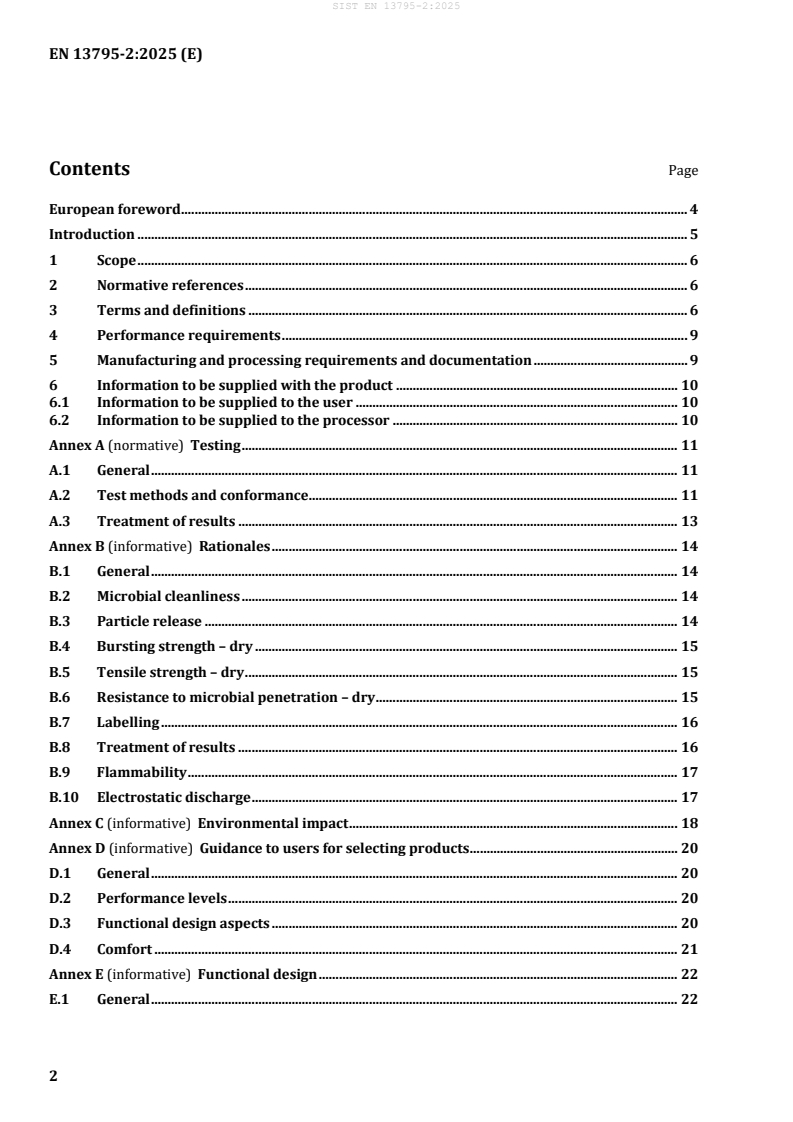
Contents Page
European foreword . 4
Introduction . 5
1 Scope . 6
2 Normative references . 6
3 Terms and definitions . 6
4 Performance requirements . 9
5 Manufacturing and processing requirements and documentation . 9
6 Information to be supplied with the product . 10
6.1 Information to be supplied to the user . 10
6.2 Information to be supplied to the processor . 10
Annex A (normative) Testing . 11
A.1 General . 11
A.2 Test methods and conformance . 11
A.3 Treatment of results . 13
Annex B (informative) Rationales . 14
B.1 General . 14
B.2 Microbial cleanliness . 14
B.3 Particle release . 14
B.4 Bursting strength – dry . 15
B.5 Tensile strength – dry . 15
B.6 Resistance to microbial penetration – dry . 15
B.7 Labelling . 16
B.8 Treatment of results . 16
B.9 Flammability . 17
B.10 Electrostatic discharge . 17
Annex C (informative) Environmental impact . 18
Annex D (informative) Guidance to users for selecting products . 20
D.1 General . 20
D.2 Performance levels . 20
D.3 Functional design aspects . 20
D.4 Comfort . 21
Annex E (informative) Functional design . 22
E.1 General . 22
E.2 Test method for measuring source strength . 22
E.3 Use of source strength measurements . 24
Annex ZA (informative) Relationship between this European standard and General Safety
and Performance Requirements of Regulation (EU) 2017/745 aimed to be covered . 26
Bibliography . 28
European foreword
This document (EN 13795-2:2025) has been prepared by Technical Committee CEN/TC 205 “Non-active
medical devices”, the secretariat of which is held by DIN.
This European Standard shall be given the status of a national standard, either by publication of an
identical text or by endorsement, at the latest by July 2025, and conflicting national standards shall be
withdrawn at the latest by July 2025.
Attention is drawn to the possibility that some of the elements of this document may be the subject of
patent rights. CEN shall not be held responsible for identifying any or all such patent rights.
This document supersedes EN 13795-2:2019.
a) clarification of testing specifications and reporting of results;
b) expansion of Annex C (formerly read “Environmental aspects”) to include considerations regarding
environmental impact and circular economy (now Annex C “Environmental impact”);
c) alignment with Regulation (EU) 2017/745 (including updated Annex ZA);
d) update of normative references and bibliography.
This document has been prepared under a standardization request addressed to CEN by the European
Commission. The Standing Committee of the EFTA States subsequently approves these requests for its
Member States.
For the relationship with EU Legislation, see informative Annex ZA, which is an integral part of this
document.
EN 13795 consists of the following parts, under the general title Surgical clothing and drapes —
Requirements and test methods:
— Part 1: Surgical drapes and gowns;
— Part 2: Clean air suits.
Any feedback and questions on this document should be directed to the users’ national standards body.
A complete listing of these bodies can be found on the CEN website.
According to the CEN-CENELEC Internal Regulations, the national standards organisations of the
following countries are bound to implement this European Standard: Austria, Belgium, Bulgaria, Croatia,
Cyprus, Czech Republic, Denmark, Estonia, Finland, France, Germany, Greece, Hungary, Iceland, Ireland,
Italy, Latvia, Lithuania, Luxembourg, Malta, Netherlands, Norway, Poland, Portugal, Republic of North
Macedonia, Romania, Serbia, Slovakia, Slovenia, Spain, Sweden, Switzerland, Türkiye and the United
Kingdom.
Introduction
Clean air suits are used to minimize the spread of infective agents to patients, surgical sites and
equipment, through prevention of dispersal of bacteria-carrying skin scales from the operating room
staff, thereby helping to prevent post-operative surgical site infections.
The performance required of working clothes for clinical staff varies with, for example, the type and
duration of the procedure, and the susceptibility of the patient to infection. In infection-prone invasive
operations, a clean air suit can contribute to reduction of infection risks, in conjunction with ventilation
and correct working methods.
This document is intended to assist the communication between manufacturers and third parties with
regard to material or product characteristics and performance requirements.
Therefore, Annex B provides comprehensive information on characteristics, measurement of
performance and performance requirements. Annex C includes considerations regarding environmental
impact and circular economy. Annex D explains the concept of performance levels and provides guidance
to users for selecting products. Annex E gives information on the impact of the design of clean air suits
and the source strength concept as an evaluation means for the impact of the entire clothing (including
clean air suits) on particle release.
This document focuses on General Safety and Performance Requirements (GSPR) arising from the
Medical Device Regulation (EU) 2017/745, which are applicable to clean air suits. The requirements and
guidance in this document are expected to be of help to manufacturers and users when designing,
processing, assessing and selecting products. It is the intention of this document to ensure the same level
of safety from single-use and reusable clean air suits throughout their useful life.
1 Scope
This document specifies information to be supplied to users and third-party verifiers in addition to the
usual labelling of medical devices (see EN ISO 20417 and EN ISO 15223-1), concerning manufacturing
and processing requirements.
This document gives information on the characteristics of single-use and reusable clean air suits used as
medical devices for clinical staff, intended to prevent the transmission of infective agents between clinical
staff and patients during surgical and other invasive procedures.
This document specifies test methods for evaluating the identified characteristics of clean air suits and
sets performance requirements for these products.
2 Normative references
The following documents are referred to in the text in such a way that some or all of their content
constitutes requirements of this document. For dated references, only the edition cited applies. For
undated references, the latest edition of the referenced document (including any amendments) applies.
EN ISO 139:2005, Textiles — Standard atmospheres for conditioning and testing (ISO 139:2005)
EN ISO 9073-3:2023, Nonwovens — Test methods — Part 3: Determination of tensile strength and
elongation at break using the strip method (ISO 9073-3:2023)
EN ISO 9073-10:2004, Textiles — Test methods for nonwovens — Part 10: Lint and other particles
generation in the dry state (ISO 9073-10:2003)
EN ISO 10993-1:2020, Biological evaluation of medical devices — Part 1: Evaluation and testing within a
risk management process (ISO 10993-1:2018, including corrected version 2018-10)
EN ISO 11737-1:2018, Sterilization of medical devices — Microbiological methods — Part 1:
Determination of a population of microorganisms on products (ISO 11737-1:2018)
EN ISO 13938-1:2019, Textiles — Bursting properties of fabrics — Part 1: Hydraulic method for
determination of bursting strength and bursting distension (ISO 13938-1:2019)
EN ISO 22612:2005, Clothing for protection against infectious agents — Test method for resistance to dry
microbial penetration (ISO 22612:2005)
3 Terms and definitions
For the purposes of this document, the following terms and definitions apply.
ISO and IEC maintain terminology databases for use in standardization at the following addresses:
— ISO Online browsing platform: available at https://www.iso.org/obp/
— IEC Electropedia: available at https://www.electropedia.org/
As impacted by EN ISO 139:2005/A1:2011.
As impacted by EN ISO 11737-1:2018/A1:2021.
3.1
colony forming unit
CFU
unit by which the culturable number of microorganisms is expressed
Note 1 to entry: The culturable number is the number of microorganisms, single cells or aggregates, able to form
colonies on a solid nutrient medium.
3.2
clean air suit
suit, used as working garment, intended and shown to minimize contamination of the operating room air
from skin scales originating on the skin of persons wearing it
Note 1 to entry: A scrub suit is a working garment for operating room staff that does not need to meet the
requirements for a clean air suit. The scrub suit is not primarily intended to prevent airborne dispersal from staff
and can be designed and processed as the manufacturer thinks fit.
Note 2 to entry: A clean air suit consists of a coverall, or a blouse and a pair of trousers and can also include a
barrier hood.
3.3
infective agent
microorganism that has been shown to cause wound infections or that might cause infection in a member
of the surgical team or the patient
3.4
manufacturer
natural or legal person who manufactures or fully refurbishes a device or has a device designed,
manufactured or fully refurbished, and markets that device under its name or trademark
Note 1 to entry: For more details, refer to the Medical Device Regulation (EU) 2017/745.
3.5
microbial cleanliness
freedom from population of viable micro-organisms on a product and/or a package
Note 1 to entry: In practical use, microbial cleanliness is often referred to as ‘bioburden’.
3.6
particle release
release of fibre fragments and other particles during mechanical stress simulating handling and use
3.7
performance level
discrete standard defined to classify products according to the performance requirements of this
document
Note 1 to entry: With the introduction of two performance levels, this document acknowledges the fact that
products are challenged to differing extents during surgical procedures, dependent upon the microbial cleanliness
of the operating room required for the procedure.
3.7.1
standard performance
classification addressing minimum performance requirements for various characteristics of products
used as medical devices in invasive surgical procedures
3.7.2
high performance
classification addressing elevated performance requirements for various characteristics of products used
as medical devices in invasive surgical procedures
Note 1 to entry: Examples of surgical procedures where high performance level might be considered are infection
prone clean surgical procedures where air counts in the operating room of ≤ 10 CFU/m are required.
3.8
processor
natural or legal person who processes products so that their performance complies with the
requirements of this document
Note 1 to entry: A processor who places a product on the market is a manufacturer in the sense of this document.
Note 2 to entry: A processor of reusable products is often referred to as a ‘reprocessor’ and processing reusable
products is often referred to as ‘reprocessing’ (as e.g. in Medical Device Regulation (EU) 2017/745). References in
EN 13795-1 and this document to ‘processors’ include ‘reprocessors’ and to ‘processing’ include ‘reprocessing’.
3.9
product
clean air suit
3.10
resistance to microbial penetration
ability of material(s) to withstand penetration of micro-organisms from one side of the material through
to the other
3.10.1
dry penetration
effect of a combination of air movement and mechanical action by vibration on microbial penetration in
dry condition
3.11
reusable product
product intended by the manufacturer to be reprocessed and reused
3.12
single-use product
device that is intended to be used on one individual during a single procedure
3.13
source strength
average number of bacteria-carrying particles (CFU) emitted per second from a person wearing a
specified garment during a certain activity in a specified environment
4 Performance requirements
To comply with this document, products shall meet all the requirements specified in this document
including Table 1, when tested according to Annex A of this document throughout their useful life.
The biocompatibility of the product shall be evaluated and approved for acceptable risk in accordance
with EN ISO 10993-1:2020.
For general information on testing and details on the test methods given in this clause including Table 1
and their application for the purpose of this document, see Annex A.
NOTE 1 In order to reflect the broad variety of technologies currently used to manufacture and (if applicable)
process surgical textiles and not to hinder technical development and innovation, the requirements set by this
document are expressed in terms of quantifiable performance rather than specific technical design or descriptive
characteristics.
NOTE 2 Information on characteristics, which cannot be properly evaluated or which are not regarded
normative (as e.g. ‘comfort’) is given in Annexes B, D and E.
Table 1 — Characteristics to be evaluated and performance requirements for clean air suits
Testing Requirement
as specified in Unit
Characteristic
Standard High
according to this document
performance Performance
in clause
a a
Microbial penetration — A.2.5 CFU ≤ 100 ≤ 50
EN ISO 22612:2005
Dry
A.2.1 CFU/ ≤ 100 ≤ 100
Microbial cleanliness/
EN ISO 11737-1:2018
Bioburden
100 cm
A.2.2 log ≤ 4,0 ≤ 4,0
Particle release EN ISO 9073-10:2004
(lint count)
Bursting strength — Dry EN ISO 13938-1:2019 A.2.3 kPa ≥ 40 ≥ 40
Tensile strength — Dry EN ISO 9073-3:2023 A.2.4 N ≥ 20 ≥ 20
a 8
Test conditions: challenge concentration 10 CFU/g talcum and 30 min vibration time.
The test methods given in Table 1 are materials tests. In order to manufacture a functioning clean air suit,
design shall also be considered. When the material of the clean air suit is tight, bacteria are dispersed
through the openings for head, arms and feet. Arm and feet openings shall therefore be closed. A barrier
hood should be worn, tucked into the gap at the neckline (see Annex E, E.1). If the clean air suit consists
of a blouse and trousers, the blouse should be tucked into the trousers or designed with a tightly fitting
waist.
5 Manufacturing and processing requirements and documentation
5.1 The manufacturer and processor shall document that the requirements of this document are met
and that the fitness for the intended purpose has been established for each use, both for single-use and
reusable medical devices. For reusable products the effects of clinical use (in addition to the effects of
processing) shall be considered.
5.2 The manufacturer/processor shall establish, document, implement and maintain a formal quality
management system, which includes risk management, and maintain its effectiveness. This quality
management system shall include requirements throughout product realization, including development,
design, manufacture, testing, packaging, labelling, distribution and, for reusable products, processing and
life-cycle control.
Inputs for product realization shall include the outputs from risk management.
A quality system such as EN ISO 13485 is recommended, in case of processing of reusable products
applied in accordance with EN 14065.
For testing processes, quantitative physical, chemical and/or biological tests are preferred.
5.3 A clinical evaluation for clean air suits shall be carried out and shall consider the performance of
the clothing system to establish fitness for purpose. The evaluation shall include the critical review of the
applicable clinical literature and the results of post market surveillance and vigilance.
6 Information to be supplied with the product
6.1 Information to be supplied to the user
6.1.1 The following information shall be supplied on request:
a) the identity or information on the test methods used;
b) the results of testing and test conditions for the characteristics given in Clause 4.
6.1.2 The user shall be informed of residual risks due to any shortcomings of the protection measures
adopted.
6.1.3 The user shall be provided with sufficient information about intended use of the product or
product system when conducting a surgical procedure. This shall include information on the performance
level of the product.
6.2 Information to be supplied to the processor
For reusable products, the processor shall be provided with information on the number of reuses based
on standardized processes, together with information on measures for maintaining the technical and
functional safety of the medical device and packaging.
NOTE EN ISO 15797, though dealing with workwear and personal protective equipment (PPE), can be useful
in developing standardized methods for reusable surgical textiles since it contains information on the principles
and equipment for simulated industrial laundering.
Annex A
(normative)
Testing
A.1 General
A.1.1 Testing for evaluation of the performance of products shall be done according to the test methods
specified in A.2. All test results and test conditions including details of weak spots covered by the tests
shall be recorded and retained.
A.1.2 Testing shall be performed on the finished product. Testing shall include potential weak spots.
NOTE 1 Performance requirements can vary in relation to the risk of transfer of infective agents to or from the
wound and the sterile field, and in relation to the ventilation flow of the room.
NOTE 2 To ensure product performance, combinations of materials or products in systems can be used.
A.1.3 During manufacture and processing, testing shall be conducted according to the requirements of
the manufacturer's and processor's quality system.
A.1.4 Alternative test methods for monitoring may be used provided that they are validated and
address the same characteristic and that the results have been shown to correlate with the test methods
given in this document.
A.1.5 Where the test methods of this document do not specify the atmosphere for pre-conditioning,
conditioning and testing, the specifications of EN ISO 139:2005 shall be applied, except for the microbial
cleanliness (EN ISO 11737-1:2018), particle release (EN ISO 9073-10:2004) and the microbial barrier
test (EN ISO 22612:2005) where external contaminations shall be avoided.
A.2 Test methods and conformance
A.2.1 Test method for evaluation of microbial cleanliness/bioburden
For evaluation of microbial cleanliness, the product shall be tested according to EN ISO 11737-1:2018.
NOTE EN ISO 11737-1:2018 does not provide a fixed test method but specifies requirements for test methods
and test mechanisms. The requirements of EN ISO 11737-1:2018 are such that different test methods developed in
accordance with it provide comparable results.
Five specimens shall be tested. The results shall be expressed as CFU/100 cm . Report the individual
results and determine M and U (see A.3). U shall be equal to or less than the performance requirements
d q q
in Table 1.
A.2.2 Test method for evaluation of particle release
For evaluation of particle release, the product shall be tested according to EN ISO 9073-10:2004 and
calculations undertaken as below.
As specified in EN ISO 9073-10:2004, ten specimens, five for each side of the material, shall be tested. The
result of the test, i.e. the coefficient of linting, shall be calculated for particles in the size range 3 µm to
25 µm and reported as log of the count value. Pool the 5 results from each side together and calculate
the U value for each side. Report the individual results and determine M and U (see A.3). U for each
q d q q
side shall be equal to or less than the performance requirements in Table 1.
NOTE Particles of this size range are considered to be capable of carrying microorganisms.
A.2.3 Test method for evaluation of bursting strength in dry state
For evaluation of bursting strength, the product shall be tested according to EN ISO 13938-1:2019. The
size of the test area shall be 10 cm (35,7 mm diameter).
The test conditions should be specified in the test report.
If there are differences in the test results of both sides of material, both sides should be tested, and the
results should be recorded.
Five specimens shall be tested. The pressure needed to break or compromise the barrier of the sample
shall be reported. Report the individual results and determine M and L (see A.3). L shall be equal to or
d q q
greater than the performance requirements in Table 1.
A.2.4 Test method for evaluation of tensile strength in dry state
For evaluation of tensile strength, the product shall be tested according to EN ISO 9073-3:2023.
The dimension of the specimens shall be in accordance with EN ISO 9073-3:2023, 9.2.2 (width of 50 mm).
Five specimens shall be tested for each direction. The pressure needed to break or compromise the
barrier of the sample shall be reported. Report the individual results and determine M and L (see A.3)
d q
separately for each direction. Lq for each direction shall be equal to or greater than the performance
requirements in Table 1.
As some materials might not fully fracture during this test (for example laminated products incorporating
a plastic film), the tensile testing apparatus might reach its limit of elongation before the sample fractures.
In these circumstances, the test limit for tensile strength shall be reported as the peak value recorded
during the test.
NOTE This is in line with the principles of EN ISO 9073-3:2023 when several peaks occur for breaking strength.
A.2.5 Test method for evaluation of dry microbial penetration
For evaluation of dry microbial penetration, the product shall be tested according to EN ISO 22612:2005.
If both sides of the material to be tested are different, the side intended to cover the contamination source
during medical use shall be exposed to the contaminated talc in the test.
NOTE The side intended to cover the contamination source during medical use is, e.g. the inner side of a clean
air suit.
If the product has an antimicrobial treatment, it shall be mentioned in the test report since it can influence
the results.
Ten specimens shall be tested. Report the individual results and determine M and U (see A.3). U shall
d q q
be equal to or less than the performance requirement in Table 1.
A.2.6 Test method for evaluation of biocompatibility
The clean air suit shall be evaluated according to EN ISO 10993-1:2020. The results of the evaluation shall
be reported.
A.3 Treatment of results
In order to determine whether a sample conforms to the performance requirements of this document, it
is necessary to convert the replicate results from a test into an acceptance value (or test statistic). The
median (M ) was the chosen value (see Annex B), together with one of two test statistics a) the lower
d
quartile value (L )for minimum performance (PR ) and b) the upper quartile (U ) for maximum
q min q
performance (PR ).
max
The conformance of the product shall be determined using the following calculated values:
— L ≥ PR (see Table 1);
q min
— U ≤ PR (see Table 1); and
q max
— M , L and U (or any percentile value).
d q q
It is recognized that most laboratories will wish to use software to calculate the test statistics. Therefore,
to calculate the kth percentile (where k is 25 for identifying the lower quartile number and 75 for
identifying the upper quartile value), use software which uses the Hyndman and Fan Method 7 [40]. The
standard Excel functions QUARTILE.EXC and QUARTILE.INC calculate the quartiles based on Method 7.
Other software packages may use this method by default or offer it as an option.
Annex B
(informative)
Rationales
B.1 General
This annex provides a concise rationale for the important requirements of this document and is intended
for use by those who are familiar with the subject of this document but who have not participated in its
development. An understanding of the reasons for the main requirements is considered essential for its
proper application. Furthermore, as clinical practices and technologies change, it is believed that
rationales for the present requirements will facilitate any revisions of this document necessitated by
those developments.
The first task undertaken by CEN/TC 205/WG 14 in its early days was deciding on the key product
characteristics which needed to be assessed. After much consideration four categories emerged, namely
barrier properties, strength properties relevant to maintaining barrier properties, particle release and
bioburden level. Most of the performance limits in this document are based on expert consensus.
In the operating room, several measures are taken to prevent deep post-operative wound infection. In
clean operations, the skins of the patient or of other persons present in the operating room are the main
sources of infection. Antimicrobial prophylaxis is often administered to kill or inhibit bacteria from
infecting the wound, but with increasing risks of antimicrobial resistance can fail. Airborne
contamination of the sterile field shall therefore be reduced to a minimum [14].
A level of ≤ 10 CFU/m is generally accepted as a definition for ultra-clean air in operating rooms intended
for infection-prone clean surgery [15]. This can be achieved through a combination of ventilations,
clothing and restriction of movement in the operating room (see also Figure E.2).
B.2 Microbial cleanliness
The test for microbial cleanliness is intended to estimate the numbers of viable organisms on the
products. This is frequently referred to as the 'bioburden', which manufacturers routinely measure.
In a bioburden (cleanliness) test, the presence of microorganisms is expected, and the test is designed to
quantify the amount of microorganisms present (for example, through rinsing, filtering and counting).
The cleanliness limit of 100 CFU (Table 1) is based on what is routinely achievable at present, both for
single-use and reusable clean air suits as finished products. For re-usable clean air suits, it requires a
controlled laundry process. A controlled handling procedure is mandatory (e.g. one-product packaging)
to reduce contamination during transport and storage.
B.3 Particle release
This method is designed to measure the release of particles from the device.
Particle release is a concern during surgery as foreign body contamination can cause an increased
frequency of postoperative complications such as keloids, wound dehiscence, incisional hernias, chronic
abscesses, intestinal obstruction and, in some circumstances, even death [16], [17]. Fibres from gowns
and drapes which have been deposited in wounds have been shown to cause post-operative granulomas
[18], [19]. Blood clots around fibres can cause emboli, obstructing vital blood vessels [20]. Fibres can also
reduce the ability of tissue to resist infection, due to impaired function of the blood and tissue
macrophage systems [21], [22].
As well as having a direct effect clinically, an indirect effect is observed, whereby fibres and particles
released from operating room materials can deposit on surfaces in the operating room, providing a
potential vector for microorganisms to be transported into wounds and cavities [23]. See section on
“Resistance to microbial penetration” for a discussion on contamination versus infection.
The particulate size range of 3 µm to 25 µm has been chosen based on the opinion that particles smaller
than 3 µm are too small to carry microorganisms, and particles larger than 25 µm are too large to remain
airborne because of gravity. This is supported in work published by Noble in 1963 who found that
“Organisms associated with human disease or carriage were usually found on particles in the range 4 µm to
20 µm equivalent diameter” [24].
B.4 Bursting strength – dry
This test is designed to assess the device’s ability to withstand pressure over, for example, a clinician’s
elbow or hip and to ensure its barrier properties are not prejudiced by mechanical failure.
Materials with more than one layer can show several break points when tested for bursting strength, e.g.
one corresponding to each layer. In order to address the scope of the requirement it was agreed to
evaluate the performance of the material based on the pressure needed to break or compromise the
barrier of the sample.
The limit (see Table 1) is based on manufacturer’s experience of products deemed to be clinically suitable
in the market place.
B.5 Tensile strength – dry
The 'tensile strength' of a material is the maximum stress, generated by pulling or stretching the material
that a material can withstand before failing.
The test is designed to assess whether the basic strength of the device material is sufficient to ensure its
barrier properties are not prejudiced. It is a standard textile material test.
Materials with more than one layer can show several break points when tested for tensile strength, e.g.
one corresponding to each layer. In order to address the scope of the requirement it was agreed to
evaluate the performance of the material based on the force needed to break or compromise the barrier
of the sample.
The limit (see Table 1) is based on manufacturer’s experience of products deemed to be clinically suitable
in the market place.
Table 1 has limits for the material only in the dry state, as the clean air suit is expected to be protected by
a gown or apron if exposed to wet conditions during use.
B.6 Resistance to microbial penetration – dry
Dry bacterial penetration EN ISO 22612:2005 is a test method that was designed to simulate the
penetration of bacteria-carrying skin scales through fabrics.
This test provides a means for assessing the resistance to penetration through barrier materials of
bacteria-carrying particles.
Whilst the relationship between contamination and infection is complex - contamination of the surgical
field does not necessarily lead to infection - it is generally agreed that healthcare facilities should consider
methods to reduce levels of airborne particles carrying bacteria in operating rooms [25].
The skin is the most important source of airborne contamination in the operating room. A person releases
approximately 10 skin particles per minute when walking and approximately 10 % of these carry
bacteria. Activity and friction against the skin, e.g. from clothing, increase the dispersal. Bacteria-carrying
skin scales are dispersed from the human body surface mainly from the lower part of the torso.
Normal shedding of human skin cells (keratinocytes) produces individual cells which are approximately
25 µm to 30 µm in diameter (when hydrated) [26]. Whyte and Bailey [27] noted that bacterial-carrying
skin scales are on average about 20 µm in size, whilst Mackintosh and colleagues [28] showed that
dispersed skin fragments had a wide size range extending below 5 µm for the minimum projected
diameter (MPD), with a median MPD about 20 µm, and with 7 % to 10 % less than 10 µm. When skin
scales pass through relatively impermeable clothing, they can also become fragmented, with the result
that more than 50 % of the bacteria-carrying particles can be less than 5 µm.
The skin scales behave aerodynamically as particles of unit density and size approximately 10 µm. These
particles are distributed in the operating room with air currents and settle on exposed surfaces, thereby
contaminating the sterile field and causing infection of the surgical site.
For microorganisms to penetrate the material in the dry state, they need to be carried on a physical
particle, for example, skin scales. In this test, the physical particles are composed of talc, where 95 % of
the particles shall be ≤ 15 µm. The referenced talc (Finntalc M15) has a median particle size of 4,5 µm, a
maximum size of approximately 17 µm, and approximately 18 % of the particles are ≤ 2 µm.
During the dry penetration test, the talcum particles are sifted through the material to be tested, and
spore-forming bacteria are used as marker organisms. The test is intended to measure penetration of
dust, e.g. skin scales through clothes, and has been shown to correlate well to airborne dispersal of
bacteria.
The size range in the test talc covers the range of skin fragments found in practice down to particle sizes
smaller than we would expect from skin fragmentation.
Penetration in this test method is influenced by the physical properties of the materials, e.g. pore size and
tortuosity factor.
The limit of ≤ 100 CFU (Table 1) is based on results of materials used for the manufacturing of clean air
suits in clinical use today, both reusable and single-use.
Dry penetration is intended to examine the ability of a material to prevent airborne transmission. The
test is particularly relevant for the clean air suit, which is intended to prevent airborne transmission
when made from a tight material and adequately designed.
B.7 Labelling
Labelling requirements are adequately covered in Section 23.2 of Annex I (General Safety and
Performance Requirements) of the Medical Device Regulation (EU) 2017/745.
B.8 Treatment of results
The median, M , was chosen as the preferred statistic to the mean because of the small sample size and
d
its greater robustness to the influence of outliers. Consequently, 25th and 75th percentiles (L and U
q q
respectively) were chosen as the test statistics for assessing compliance against the performance
requirements in Table 1. More simply, for PR , for five replicates the highest four shall pass and for ten
min
replicates the highest eight shall pass. The method for determining Lq and Uq in A.3 gives the statistical
justification for this.
It was recognized that manufacturers and processors may wish to use means and standard deviations for
quality assurance purposes, especially where more data would be generated leading to better estimates
of population statistics and the more reliable setting of processing conditions.
B.9 Flammability
Though clean air suits do not provide ignition sources or oxidizer they might serve as fuel, when a fire
breaks out. This document does not specify further General Safety and Performance Requirements
(GSPR) of Regulation (EU) 2017/745 on Medical Devices or Essential Health and Safety Requirements
(EHSR) of Regulation (EU) 2016/425 on Personal Protective Equipment regarding flammability of clean
air suits.
B.10 Electrostatic discharge
CEN/TC 205/WG 14 discussed whether specific tests for Electrostatic Discharge (ESD) were necessary
in this document.
After taking advice from clinicians, hospital engineers, experts in electromedical equipment and
electrostatic engineers, WG 14 note the following:
a) There are three potential risks from ESD:
1) ESD damage to equipment;
2) ESD ignition of flammable anaesthetic agents;
3) ESD ignition of flammable vapours (specifically alcohols).
b) The electrostatic immunity requirement according to IEC 60601-1-2:2014 is 15 kV.
EN 61000-4-2:2009 has a useful graph in informative Annex A showing that synthetic fabrics can
generate a maximum electrostatic voltage of 13 kV in rooms without humidity control (down to
15 %RH). Therefore, medical electrical equipment that complies with the latest version of
EN 60601-1-2 should be adequately protected from ESD.
c) Traditional risks associated with flammable anaesthetic agents no longer exist in hospitals as these
agents have all been replaced with safer alternatives.
d) Use of flammable liquids in theatres is controlled, as diathermy would not be viable if there were a
risk from sparks. Diathermy is a much greater risk than ESD.
Nowadays, the theoretical risks
...