

EN 12098-1:2013
(Main)Controls for heating systems - Part 1: Control equipment for hot water heating systems
- Abstract
This European Standard applies to electronic control equipment for heating systems with water as the heating medium and a flow water temperature up to 120 °C.
This control equipment controls and regulates the distribution and/or the generation of heat in relation to the outside temperature and time and other reference variables.
This standard covers also controllers which contain an integrated optimum start or an optimum start-stop control function.
Safety requirements on heating systems remain unaffected by this standard. The dynamic behaviour of the valves and actuators are not covered in this standard.
A multi-distribution and/or multi-generation system needs a coordinated solution to prevent undesired interaction and is not part of this standard.
- Status
- Withdrawn
- Publication Date
- 13-Aug-2013
- Withdrawal Date
- 06-Oct-2026
- Technical Committee
- CEN/TC 247 - Controls for mechanical building services
- Current Stage
- 9960 - Withdrawal effective - Withdrawal
- Start Date
- 03-May-2017
- Completion Date
- 07-Oct-2026

Relations
- Effective Date
- 21-Aug-2013
- Effective Date
- 14-Nov-2009
- Effective Date
- 08-Jun-2022
- Effective Date
- 09-Feb-2026
- Effective Date
- 09-Feb-2026
- Effective Date
- 28-Jan-2026
Get Certified
Connect with accredited certification bodies for this standard

DIBt (Deutsches Institut für Bautechnik)
German Institute for Building Technology.
DIN CERTCO
DIN Group product certification.

Aboma Certification B.V.
Specialized in construction, metal, and transport sectors.
Sponsored listings
Frequently Asked Questions
EN 12098-1:2013 is a standard published by the European Committee for Standardization (CEN). Its full title is "Controls for heating systems - Part 1: Control equipment for hot water heating systems". This standard covers: This European Standard applies to electronic control equipment for heating systems with water as the heating medium and a flow water temperature up to 120 °C. This control equipment controls and regulates the distribution and/or the generation of heat in relation to the outside temperature and time and other reference variables. This standard covers also controllers which contain an integrated optimum start or an optimum start-stop control function. Safety requirements on heating systems remain unaffected by this standard. The dynamic behaviour of the valves and actuators are not covered in this standard. A multi-distribution and/or multi-generation system needs a coordinated solution to prevent undesired interaction and is not part of this standard.
This European Standard applies to electronic control equipment for heating systems with water as the heating medium and a flow water temperature up to 120 °C. This control equipment controls and regulates the distribution and/or the generation of heat in relation to the outside temperature and time and other reference variables. This standard covers also controllers which contain an integrated optimum start or an optimum start-stop control function. Safety requirements on heating systems remain unaffected by this standard. The dynamic behaviour of the valves and actuators are not covered in this standard. A multi-distribution and/or multi-generation system needs a coordinated solution to prevent undesired interaction and is not part of this standard.
EN 12098-1:2013 is classified under the following ICS (International Classification for Standards) categories: 91.140.10 - Central heating systems; 97.120 - Automatic controls for household use. The ICS classification helps identify the subject area and facilitates finding related standards.
EN 12098-1:2013 has the following relationships with other standards: It is inter standard links to EN 12098-1:1996, EN 12098-2:2001, EN 12098-1:2017, EN 60529:1991, EN IEC 60730-1:2024, CEN/TS 15810:2008. Understanding these relationships helps ensure you are using the most current and applicable version of the standard.
EN 12098-1:2013 is available in PDF format for immediate download after purchase. The document can be added to your cart and obtained through the secure checkout process. Digital delivery ensures instant access to the complete standard document.
Standards Content (Sample)
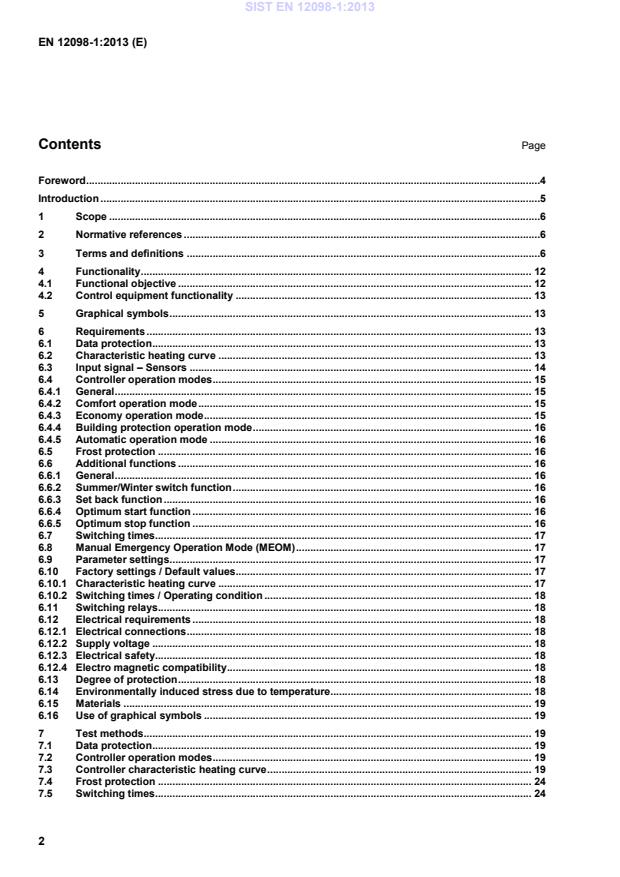
2003-01.Slovenski inštitut za standardizacijo. Razmnoževanje celote ali delov tega standarda ni dovoljeno.Regulacijske naprave za sisteme ogrevanja - 1. del: Naprave za regulacijo delovanja toplovodnih ogrevalnih sistemovMeß-, Steuer- und Regeleinrichtungen für Raumheizungen - Teil 1: Regelung für WarmwasserheizungenRégulation pour les systèmes de chauffage - Partie 1: Equipement de régulation pour les systèmes de chauffage à eau chaudeControls for heating systems - Part 1: Control equipment for hot water heating systems97.120Avtomatske krmilne naprave za domAutomatic controls for household use91.140.10Sistemi centralnega ogrevanjaCentral heating systemsICS:Ta slovenski standard je istoveten z:EN 12098-1:2013SIST EN 12098-1:2013en,fr,de01-november-2013SIST EN 12098-1:2013SLOVENSKI
STANDARDSIST EN 12098-2:2002SIST EN 12098-1:20021DGRPHãþD
EUROPEAN STANDARD NORME EUROPÉENNE EUROPÄISCHE NORM
EN 12098-1
August 2013 ICS 91.140.10; 97.120 Supersedes EN 12098-1:1996, EN 12098-2:2001English Version
Controls for heating systems - Part 1: Control equipment for hot water heating systems
Régulation pour les systèmes de chauffage - Partie 1: Equipement de régulation pour les systèmes de chauffage à eau chaude
Mess-, Steuer- und Regeleinrichtungen für Heizungen - Teil 1: Regeleinrichtungen für Warmwasserheizungen This European Standard was approved by CEN on 8 June 2013.
CEN members are bound to comply with the CEN/CENELEC Internal Regulations which stipulate the conditions for giving this European Standard the status of a national standard without any alteration. Up-to-date lists and bibliographical references concerning such national standards may be obtained on application to the CEN-CENELEC Management Centre or to any CEN member.
This European Standard exists in three official versions (English, French, German). A version in any other language made by translation under the responsibility of a CEN member into its own language and notified to the CEN-CENELEC Management Centre has the same status as the official versions.
CEN members are the national standards bodies of Austria, Belgium, Bulgaria, Croatia, Cyprus, Czech Republic, Denmark, Estonia, Finland, Former Yugoslav Republic of Macedonia, France, Germany, Greece, Hungary, Iceland, Ireland, Italy, Latvia, Lithuania, Luxembourg, Malta, Netherlands, Norway, Poland, Portugal, Romania, Slovakia, Slovenia, Spain, Sweden, Switzerland, Turkey and United Kingdom.
EUROPEAN COMMITTEE FOR STANDARDIZATION
COMITÉ EUROPÉEN DE NORMALISATION EUROPÄISCHES KOMITEE FÜR NORMUNG
CEN-CENELEC Management Centre:
Avenue Marnix 17,
B-1000 Brussels © 2013 CEN All rights of exploitation in any form and by any means reserved worldwide for CEN national Members. Ref. No. EN 12098-1:2013: ESIST EN 12098-1:2013
1) EN 12098-4:2005 is bound to be superseded in the future by an upcoming new edition of EN 12098-3. SIST EN 12098-1:2013
This European Standard applies to electronic control equipment for heating systems with water as the heating medium and a flow water temperature up to 120 °C. This control equipment controls and regulates the distribution and/or the generation of heat in relation to the outside temperature and time and other reference variables. This standard covers also controllers which contain an integrated optimum start or an optimum start-stop control function. Safety requirements on heating systems remain unaffected by this standard. The dynamic behaviour of the valves and actuators are not covered in this standard. A multi-distribution and/or multi-generation system needs a coordinated solution to prevent undesired interaction and is not part of this standard. 2 Normative references The following documents, in whole or in part, are normatively referenced in this document and are indispensable for the application of this document. For dated references, only the edition cited applies. For undated references, the latest edition of the referenced document (including any amendments) applies. CEN/TS 15810, Graphical symbols for use on integrated building automation equipment EN 60038, CENELEC standard voltages (IEC 60038) EN 60529, Degrees of protection provided by enclosures (IP Code) (IEC 60529) EN 60730-1, Automatic electrical controls for household and similar use — Part 1: General requirements (IEC 60730-1) 3 Terms and definitions For the purposes of this document, the following terms and definitions apply. 3.1 Outside Temperature Compensated Controller
OTC instrument that controls and regulates the distribution and/or the generation of heat in relation to the outside temperature and time and other reference variables Note 1 to entry: The Outside Temperature Compensated function calculates the flow (supply) temperature in relation to the outside temperature, based on the heating curve. 3.2 control equipment equipment which consists of the OTC, sensor input signals and output signals, but does not include the sensors and actuating equipment Note 1 to entry: See Figure 1. SIST EN 12098-1:2013
Key 1 OTC 2 output signals 3 input signals: reference variables 4 input signal: controlled variable 5 actuating equipment 6 heat generation & distribution Figure 1 — Control equipment for heating systems 3.3 actuating equipment equipment by which the controller affects the controlled variable 3.4 controlled variable (input signal) supply water temperature and/or boiler water temperature as a result of the heating curve in accordance to the reference variables 3.5 output signals signals generated by the OTC controller for operating the actuating equipment 3.6 reference variables (input signal) outside temperature with or without other influences or variables (e.g. room temperature) used to determine the setpoint of the controlled variable 3.7 outside temperature reference variable that is measured with a sensor fitted outside the building, mainly intended to measure the ambient air temperature 3.8 room temperature resulting room temperature in the building that arises in comfort, economy or building protection operation mode of the OTC controller and that can be different for individual rooms SIST EN 12098-1:2013
Key 1 comfort room temperature 2 reduced room temperature A(0)
beginning of comfort occupation period A(x)
switch-on time with start optimisation (variable start) A(y)
switch-on time without start optimisation (fixed start) B(0)
end of comfort occupation period without stop optimisation (fixed stop) B(x)
switch-off time with stop optimisation (variable stop) C = A(0) - B(0)
comfort occupation period A(x) - A(0)
optimum start period B(x) - B(0)
optimum stop period W time period of wasted heat (energy saving potential with start optimisation) Figure 2 — Temperature time curve with optimiser function The optimum start and the optimum stop functions are illustrated by Figure 3. Heating periods are different from scheduled occupation periods. These differences, due to thermal inertia, depend mainly on heating loads (or temperatures differences). A start and/or stop optimiser controls these switching points, using outside and/or room temperatures or their differences in relation to setpoints. SIST EN 12098-1:2013
Key S schedule occupation period O heating operation status R room temperature profile 1 comfort room temperature 2 reduced room temperature 3 comfort occupation period 4 optimum start period 5 main controller function 6 optimum stop period 7 set back period Figure 3 — Example Optimum start and stop function 3.17 adaptive optimum start function added function to optimum start function, which recalculates the parameters used to determine the switch-on time, based on measured room temperature 3.18 optimum stop function switches off or reduces the heat generation at the earliest possible point in time so that the room temperature will drop max. 0,5 K below the comfort setpoint when the operation mode changes from comfort mode to economy or building protection mode Note 1 to entry: See Figure 2. 3.19 adaptive optimum stop function added function to optimum stop function, which recalculates the parameters used to determine the switch-off time, based on measured room temperature 3.20 scheduler function which switches heating modes affecting the heating control system (see Figure 3) according to a program which includes memorised switch times, reproducing periods or periodic cycles, daily, weekly or yearly, and may also include periods of derogation 3.21 switch points and time periods
− Lower Diagram: “derogation manual start” changes the mode until the next programmed switch time. SIST EN 12098-1:2013
Key 1 comfort room temperature A and B
programmed switch times 2 reduced room temperature C derogation manual start D programmable duration Figure 4 — Examples of derogation 3.22 valve protection function (valve exercise function) anti-jamming function for valves in which the valves should be moved periodically during longer off periods 3.23 pump protection function (pump exercise function) anti-jamming function for pump in which the pumps should be switched on during longer off periods
3.24 frost protection function function in all operation modes (except manual emergency operation) to prevent the heating system from freezing by providing specific output signals 3.25 Manual Emergency Operation Mode
MEOM mode in which the controller is inactive and the actuating equipment is manipulated manually 4 Functionality 4.1 Functional objective The objective of outside temperature compensated control equipment is to save energy by reducing waste potential and supply losses performing these main functions: SIST EN 12098-1:2013
Figure 5 — Block-scheme of control equipment
5 Graphical symbols Graphical symbols are described in CEN/TS 15810. Plain language can be used instead of, or in conjunction with, graphical s
...