


EN ISO/IEC 15408-3:2020
(Main)Information technology - Security techniques - Evaluation criteria for IT security - Part 3: Security assurance components (ISO/IEC 15408-3:2008, Corrected version 2011-05)
General Information
- Abstract
ISO/IEC 15408-3:2008 defines the assurance requirements of the evaluation criteria. It includes the evaluation assurance levels that define a scale for measuring assurance for component targets of evaluation (TOEs), the composed assurance packages that define a scale for measuring assurance for composed TOEs, the individual assurance components from which the assurance levels and packages are composed, and the criteria for evaluation of protection profiles and security targets.
ISO/IEC 15408-3:2008 defines the content and presentation of the assurance requirements in the form of assurance classes, families and components and provides guidance on the organization of new assurance requirements. The assurance components within the assurance families are presented in a hierarchical order.
- Status
- Withdrawn
- Publication Date
- 17-Mar-2020
- Withdrawal Date
- 22-Sep-2026
- Technical Committee
- CEN/CLC/TC 13 - Cybersecurity and Data Protection
- Drafting Committee
- CEN/CLC/TC 13 - Cybersecurity and Data Protection
- Current Stage
- 9960 - Withdrawal effective - Withdrawal
- Start Date
- 06-Dec-2023
- Completion Date
- 23-Sep-2026

Relations
- Effective Date
- 18-Jan-2023
- Effective Date
- 09-Feb-2026
- Effective Date
- 09-Feb-2026
Get Certified
Connect with accredited certification bodies for this standard

BSI Group
BSI (British Standards Institution) is the business standards company that helps organizations make excellence a habit.

Bureau Veritas
Bureau Veritas is a world leader in laboratory testing, inspection and certification services.

DNV
DNV is an independent assurance and risk management provider.
Sponsored listings
Frequently Asked Questions
EN ISO/IEC 15408-3:2020 is a standard published by the European Committee for Standardization (CEN). Its full title is "Information technology - Security techniques - Evaluation criteria for IT security - Part 3: Security assurance components (ISO/IEC 15408-3:2008, Corrected version 2011-05)". This standard covers: ISO/IEC 15408-3:2008 defines the assurance requirements of the evaluation criteria. It includes the evaluation assurance levels that define a scale for measuring assurance for component targets of evaluation (TOEs), the composed assurance packages that define a scale for measuring assurance for composed TOEs, the individual assurance components from which the assurance levels and packages are composed, and the criteria for evaluation of protection profiles and security targets. ISO/IEC 15408-3:2008 defines the content and presentation of the assurance requirements in the form of assurance classes, families and components and provides guidance on the organization of new assurance requirements. The assurance components within the assurance families are presented in a hierarchical order.
ISO/IEC 15408-3:2008 defines the assurance requirements of the evaluation criteria. It includes the evaluation assurance levels that define a scale for measuring assurance for component targets of evaluation (TOEs), the composed assurance packages that define a scale for measuring assurance for composed TOEs, the individual assurance components from which the assurance levels and packages are composed, and the criteria for evaluation of protection profiles and security targets. ISO/IEC 15408-3:2008 defines the content and presentation of the assurance requirements in the form of assurance classes, families and components and provides guidance on the organization of new assurance requirements. The assurance components within the assurance families are presented in a hierarchical order.
EN ISO/IEC 15408-3:2020 is classified under the following ICS (International Classification for Standards) categories: 35.030 - IT Security. The ICS classification helps identify the subject area and facilitates finding related standards.
EN ISO/IEC 15408-3:2020 has the following relationships with other standards: It is inter standard links to EN ISO/IEC 15408-3:2023, ISO/IEC 15408-1:2009, ISO/IEC 15408-2:2008. Understanding these relationships helps ensure you are using the most current and applicable version of the standard.
EN ISO/IEC 15408-3:2020 is available in PDF format for immediate download after purchase. The document can be added to your cart and obtained through the secure checkout process. Digital delivery ensures instant access to the complete standard document.
Standards Content (Sample)
SLOVENSKI STANDARD
01-maj-2020
Informacijska tehnologija - Varnostne tehnike - Merila za vrednotenje varnosti IT -
3. del: Komponente za zagotavljanje varnosti (ISO/IEC 15408-3:2008. popravljena
različica 2011-05)
Information technology - Security techniques - Evaluation criteria for IT security - Part 3:
Security assurance components (ISO/IEC 15408-3:2008, Corrected version 2011-05)
Informationstechnik - IT-Sicherheitsverfahren - Evaluationskriterien für IT-Sicherheit - Teil
3: Komponenten zur Sicherheitskontrolle (ISO/IEC 15408-3:2008, korrigierte Fassung
2011-05)
Technologies de l'information - Techniques de sécurité - Critères d'évaluation pour la
sécurité TI - Partie 3: Composants d'assurance de sécurité (ISO/IEC 15408-3:2008,
Version corrigée 2011-05)
Ta slovenski standard je istoveten z: EN ISO/IEC 15408-3:2020
ICS:
35.030 Informacijska varnost IT Security
2003-01.Slovenski inštitut za standardizacijo. Razmnoževanje celote ali delov tega standarda ni dovoljeno.
EUROPEAN STANDARD EN ISO/IEC 15408-3
NORME EUROPÉENNE
EUROPÄISCHE NORM
March 2020
ICS 35.030
English version
Information technology - Security techniques - Evaluation
criteria for IT security - Part 3: Security assurance
components (ISO/IEC 15408-3:2008, Corrected version
2011-05)
Technologies de l'information - Techniques de sécurité Informationstechnik - IT-Sicherheitsverfahren -
- Critères d'évaluation pour la sécurité TI - Partie 3: Evaluationskriterien für IT-Sicherheit - Teil 3:
Composants d'assurance de sécurité (ISO/IEC 15408- Komponenten zur Sicherheitskontrolle (ISO/IEC
3:2008, Version corrigée 2011-05) 15408-3:2008, korrigierte Fassung 2011-05)
This European Standard was approved by CEN on 2 March 2020.
This European Standard was corrected and reissued by the CEN-CENELEC Management Centre on 28 April 2021.
CEN and CENELEC members are bound to comply with the CEN/CENELEC Internal Regulations which stipulate the conditions for
giving this European Standard the status of a national standard without any alteration. Up-to-date lists and bibliographical
references concerning such national standards may be obtained on application to the CEN-CENELEC Management Centre or to
any CEN and CENELEC member.
This European Standard exists in three official versions (English, French, German). A version in any other language made by
translation under the responsibility of a CEN and CENELEC member into its own language and notified to the CEN-CENELEC
Management Centre has the same status as the official versions.
CEN and CENELEC members are the national standards bodies and national electrotechnical committees of Austria, Belgium,
Bulgaria, Croatia, Cyprus, Czech Republic, Denmark, Estonia, Finland, France, Germany, Greece, Hungary, Iceland, Ireland, Italy,
Latvia, Lithuania, Luxembourg, Malta, Netherlands, Norway, Poland, Portugal, Republic of North Macedonia, Romania, Serbia,
Slovakia, Slovenia, Spain, Sweden, Switzerland, Turkey and United Kingdom.
CEN-CENELEC Management Centre:
Rue de la Science 23, B-1040 Brussels
© 2020 CEN/CENELEC All rights of exploitation in any form and by any means Ref. No. EN ISO/IEC 15408-3:2020 E
reserved worldwide for CEN national Members and for
CENELEC Members.
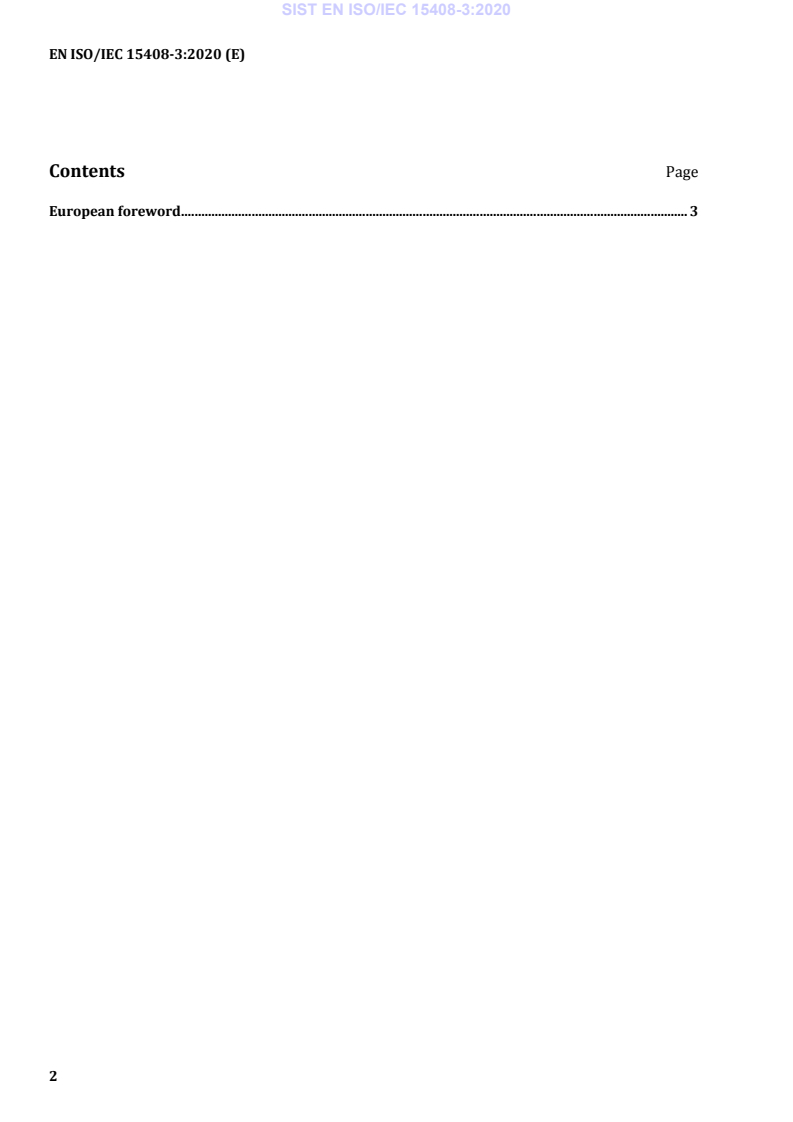
Contents Page
European foreword . 3
European foreword
The text of ISO/IEC 15408-3:2008, Corrected version 2011-05 has been prepared by Technical
Committee ISO/IEC JTC 1 "Information technology” of the International Organization for
Standardization (ISO) and has been taken over as EN ISO/IEC 15408-3:2020 by Technical Committee
CEN/CLC/JTC 13 “Cybersecurity and Data Protection” the secretariat of which is held by DIN.
This European Standard shall be given the status of a national standard, either by publication of an
identical text or by endorsement, at the latest by September 2020, and conflicting national standards
shall be withdrawn at the latest by September 2020.
Attention is drawn to the possibility that some of the elements of this document may be the subject of
patent rights. CEN shall not be held responsible for identifying any or all such patent rights.
According to the CEN-CENELEC Internal Regulations, the national standards organizations of the
following countries are bound to implement this European Standard: Austria, Belgium, Bulgaria,
Croatia, Cyprus, Czech Republic, Denmark, Estonia, Finland, France, Germany, Greece, Hungary, Iceland,
Ireland, Italy, Latvia, Lithuania, Luxembourg, Malta, Netherlands, Norway, Poland, Portugal, Republic of
North Macedonia, Romania, Serbia, Slovakia, Slovenia, Spain, Sweden, Switzerland, Turkey and the
United Kingdom.
Endorsement notice
The text of ISO/IEC 15408-3:2008, Corrected version 2011-05 has been approved by CEN as
INTERNATIONAL ISO/IEC
STANDARD 15408-3
Third edition
2008-08-15
Corrected version
2011-06-01
Information technology Security
techniques — Evaluation criteria for IT
security —
Part 3:
Security assurance components
Technologies de l'information — Techniques de sécurité — Critères
d'évaluation pour la sécurité TI —
Partie 3: Composants d'assurance de sécurité
Reference number
ISO/IEC 15408-3:2008(E)
©
ISO/IEC 2008
ISO/IEC 15408-3:2008(E)
© ISO/IEC 2008
All rights reserved. Unless otherwise specified, no part of this publication may be reproduced or utilized in any form or by any means,
electronic or mechanical, including photocopying and microfilm, without permission in writing from either ISO at the address below or
ISO's member body in the country of the requester.
ISO copyright office
Case postale 56 • CH-1211 Geneva 20
Tel. + 41 22 749 01 11
Fax + 41 22 749 09 47
E-mail copyright@iso.org
Web www.iso.org
Published in Switzerland
ii © ISO/IEC 2008 – All rights reserved
ISO/IEC 15408-3:2008(E)
Contents Page
Foreword .ix
Introduction.xi
1 Scope.1
2 Normative references.1
3 Terms and definitions, symbols and abbreviated terms.1
4 Overview.1
4.1 Organisation of this part of ISO/IEC 15408.1
5 Assurance paradigm.2
5.1 ISO/IEC 15408 philosophy .2
5.2 Assurance approach.2
5.2.1 Significance of vulnerabilities.2
5.2.2 Cause of vulnerabilities .3
5.2.3 ISO/IEC 15408 assurance.3
5.2.4 Assurance through evaluation.3
5.3 ISO/IEC 15408 evaluation assurance scale.3
6 Security assurance components .4
6.1 Security assurance classes, families and components structure .4
6.1.1 Assurance class structure.4
6.1.2 Assurance family structure .5
6.1.3 Assurance component structure .6
6.1.4 Assurance elements.8
6.1.5 Component taxonomy.8
6.2 EAL structure.9
6.2.1 EAL name.9
6.2.2 Objectives.9
6.2.3 Application notes .9
6.2.4 Assurance components.10
6.2.5 Relationship between assurances and assurance levels .10
6.3 CAP structure.11
6.3.1 CAP name.11
6.3.2 Objectives.11
6.3.3 Application notes .11
6.3.4 Assurance components.12
6.3.5 Relationship between assurances and assurance levels .13
7 Evaluation assurance levels .13
7.1 Evaluation assurance level (EAL) overview .14
7.2 Evaluation assurance level details .15
7.3 Evaluation assurance level 1 (EAL1) - functionally tested.15
7.3.1 Objectives.15
7.3.2 Assurance components.16
7.4 Evaluation assurance level 2 (EAL2) - structurally tested .16
7.4.1 Objectives.16
7.4.2 Assurance components.16
7.5 Evaluation assurance level 3 (EAL3) - methodically tested and checked.17
7.5.1 Objectives.17
7.5.2 Assurance components.17
7.6 Evaluation assurance level 4 (EAL4) - methodically designed, tested, and reviewed.18
7.6.1 Objectives.18
7.6.2 Assurance components.18
© ISO/IEC 2008 – All rights reserved iii
ISO/IEC 15408-3:2008(E)
7.7 Evaluation assurance level 5 (EAL5) - semiformally designed and tested .19
7.7.1 Objectives.19
7.7.2 Assurance components .19
7.8 Evaluation assurance level 6 (EAL6) - semiformally verified design and tested.20
7.8.1 Objectives.20
7.8.2 Assurance components .20
7.9 Evaluation assurance level 7 (EAL7) - formally verified design and tested .21
7.9.1 Objectives.21
7.9.2 Assurance components .22
8 Composed assurance packages.23
8.1 Composed assurance package (CAP) overview .23
8.2 Composed assurance package details .24
8.3 Composition assurance level A (CAP-A) - Structurally composed .24
8.3.1 Objectives.24
8.3.2 Assurance components .24
8.4 Composition assurance level B (CAP-B) - Methodically composed .25
8.4.1 Objectives.25
8.4.2 Assurance components .25
8.5 Composition assurance level C (CAP-C) - Methodically composed, tested and reviewed .26
8.5.1 Objectives.26
8.5.2 Assurance components .26
9 Class APE: Protection Profile evaluation.27
9.1 PP introduction (APE_INT) .28
9.1.1 Objectives.28
9.1.2 APE_INT.1 PP introduction.28
9.2 Conformance claims (APE_CCL).29
9.2.1 Objectives.29
9.2.2 APE_CCL.1 Conformance claims.29
9.3 Security problem definition (APE_SPD).31
9.3.1 Objectives.31
9.3.2 APE_SPD.1 Security problem definition .31
9.4 Security objectives (APE_OBJ).31
9.4.1 Objectives.31
9.4.2 Component levelling .32
9.4.3 APE_OBJ.1 Security objectives for the operational environment.32
9.4.4 APE_OBJ.2 Security objectives .32
9.5 Extended components definition (APE_ECD) .33
9.5.1 Objectives.33
9.5.2 APE_ECD.1 Extended components definition.33
9.6 Security requirements (APE_REQ) .34
9.6.1 Objectives.34
9.6.2 Component levelling .34
9.6.3 APE_REQ.1 Stated security requirements.34
9.6.4 APE_REQ.2 Derived security requirements.35
10 Class ASE: Security Target evaluation.36
10.1 ST introduction (ASE_INT).37
10.1.1 Objectives.37
10.1.2 ASE_INT.1 ST introduction .37
10.2 Conformance claims (ASE_CCL).38
10.2.1 Objectives.38
10.2.2 ASE_CCL.1 Conformance claims.38
10.3 Security problem definition (ASE_SPD).40
10.3.1 Objectives.40
10.3.2 ASE_SPD.1 Security problem definition .40
10.4 Security objectives (ASE_OBJ).41
10.4.1 Objectives.41
10.4.2 Component levelling .41
10.4.3 ASE_OBJ.1 Security objectives for the operational environment.41
iv © ISO/IEC 2008 – All rights reserved
ISO/IEC 15408-3:2008(E)
10.4.4 ASE_OBJ.2 Security objectives.41
10.5 Extended components definition (ASE_ECD) .42
10.5.1 Objectives.42
10.5.2 ASE_ECD.1 Extended components definition.42
10.6 Security requirements (ASE_REQ).43
10.6.1 Objectives.43
10.6.2 Component levelling .43
10.6.3 ASE_REQ.1 Stated security requirements.44
10.6.4 ASE_REQ.2 Derived security requirements .44
10.7 TOE summary specification (ASE_TSS) .46
10.7.1 Objectives.46
10.7.2 Component levelling .46
10.7.3 ASE_TSS.1 TOE summary specification.46
10.7.4 ASE_TSS.2 TOE summary specification with architectural design summary.47
11 Class ADV: Development.48
11.1 Security Architecture (ADV_ARC).52
11.1.1 Objectives.52
11.1.2 Component levelling .52
11.1.3 Application notes .52
11.1.4 ADV_ARC.1 Security architecture description.53
11.2 Functional specification (ADV_FSP) .54
11.2.1 Objectives.54
11.2.2 Component levelling .54
11.2.3 Application notes .54
11.2.4 ADV_FSP.1 Basic functional specification.56
11.2.5 ADV_FSP.2 Security-enforcing functional specification.57
11.2.6 ADV_FSP.3 Functional specification with complete summary .58
11.2.7 ADV_FSP.4 Complete functional specification .59
11.2.8 ADV_FSP.5 Complete semi-formal functional specification with additional error
information.60
11.2.9 ADV_FSP.6 Complete semi-formal functional specification with additional formal
specification.61
11.3 Implementation representation (ADV_IMP) .63
11.3.1 Objectives.63
11.3.2 Component levelling .63
11.3.3 Application notes .63
11.3.4 ADV_IMP.1 Implementation representation of the TSF.64
11.3.5 ADV_IMP.2 Complete mapping of the implementation representation of the TSF.64
11.4 TSF internals (ADV_INT).65
11.4.1 Objectives.65
11.4.2 Component levelling .65
11.4.3 Application notes .65
11.4.4 ADV_INT.1 Well-structured subset of TSF internals.66
11.4.5 ADV_INT.2 Well-structured internals.67
11.4.6 ADV_INT.3 Minimally complex internals .68
11.5 Security policy modelling (ADV_SPM).69
11.5.1 Objectives.69
11.5.2 Component levelling .69
11.5.3 Application notes .69
11.5.4 ADV_SPM.1 Formal TOE security policy model.70
11.6 TOE design (ADV_TDS) .71
11.6.1 Objectives.71
11.6.2 Component levelling .71
11.6.3 Application notes .71
11.6.4 ADV_TDS.1 Basic design.72
11.6.5 ADV_TDS.2 Architectural design.73
11.6.6 ADV_TDS.3 Basic modular design .74
11.6.7 ADV_TDS.4 Semiformal modular design .76
11.6.8 ADV_TDS.5 Complete semiformal modular design .77
© ISO/IEC 2008 – All rights reserved v
ISO/IEC 15408-3:2008(E)
11.6.9 ADV_TDS.6 Complete semiformal modular design with formal high-level design
presentation .78
12 Class AGD: Guidance documents .80
12.1 Operational user guidance (AGD_OPE) .80
12.1.1 Objectives.80
12.1.2 Component levelling .81
12.1.3 Application notes.81
12.1.4 AGD_OPE.1 Operational user guidance.81
12.2 Preparative procedures (AGD_PRE).82
12.2.1 Objectives.82
12.2.2 Component levelling .82
12.2.3 Application notes.82
12.2.4 AGD_PRE.1 Preparative procedures.83
13 Class ALC: Life-cycle support.83
13.1 CM capabilities (ALC_CMC).84
13.1.1 Objectives.84
13.1.2 Component levelling .85
13.1.3 Application notes.85
13.1.4 ALC_CMC.1 Labelling of the TOE .85
13.1.5 ALC_CMC.2 Use of a CM system .86
13.1.6 ALC_CMC.3 Authorisation controls.87
13.1.7 ALC_CMC.4 Production support, acceptance procedures and automation .88
13.1.8 ALC_CMC.5 Advanced support.90
13.2 CM scope (ALC_CMS) .92
13.2.1 Objectives.92
13.2.2 Component levelling .93
13.2.3 Application notes.93
13.2.4 ALC_CMS.1 TOE CM coverage.93
13.2.5 ALC_CMS.2 Parts of the TOE CM coverage.93
13.2.6 ALC_CMS.3 Implementation representation CM coverage .94
13.2.7 ALC_CMS.4 Problem tracking CM coverage .95
13.2.8 ALC_CMS.5 Development tools CM coverage.96
13.3 Delivery (ALC_DEL).97
13.3.1 Objectives.97
13.3.2 Component levelling .97
13.3.3 Application notes.97
13.3.4 ALC_DEL.1 Delivery procedures.98
13.4 Development security (ALC_DVS) .98
13.4.1 Objectives.98
13.4.2 Component levelling .98
13.4.3 Application notes.98
13.4.4 ALC_DVS.1 Identification of security measures .99
13.4.5 ALC_DVS.2 Sufficiency of security measures.99
13.5 Flaw remediation (ALC_FLR).100
13.5.1 Objectives.100
13.5.2 Component levelling .100
13.5.3 Application notes.100
13.5.4 ALC_FLR.1 Basic flaw remediation .100
13.5.5 ALC_FLR.2 Flaw reporting procedures.101
13.5.6 ALC_FLR.3 Systematic flaw remediation.102
13.6 Life-cycle definition (ALC_LCD).104
13.6.1 Objectives.104
13.6.2 Component levelling .104
13.6.3 Application notes.104
13.6.4 ALC_LCD.1 Developer defined life-cycle model.105
13.6.5 ALC_LCD.2 Measurable life-cycle model .106
13.7 Tools and techniques (ALC_TAT).106
13.7.1 Objectives.106
13.7.2 Component levelling .107
vi © ISO/IEC 2008 – All rights reserved
ISO/IEC 15408-3:2008(E)
13.7.3 Application notes .107
13.7.4 ALC_TAT.1 Well-defined development tools.107
13.7.5 ALC_TAT.2 Compliance with implementation standards .108
13.7.6 ALC_TAT.3 Compliance with implementation standards - all parts .108
14 Class ATE: Tests.109
14.1 Coverage (ATE_COV).110
14.1.1 Objectives.110
14.1.2 Component levelling .110
14.1.3 Application notes .110
14.1.4 ATE_COV.1 Evidence of coverage .110
14.1.5 ATE_COV.2 Analysis of coverage .111
14.1.6 ATE_COV.3 Rigorous analysis of coverage .112
14.2 Depth (ATE_DPT).112
14.2.1 Objectives.112
14.2.2 Component levelling .113
14.2.3 Application notes .113
14.2.4 ATE_DPT.1 Testing: basic design .113
14.2.5 ATE_DPT.2 Testing: security enforcing modules.114
14.2.6 ATE_DPT.3 Testing: modular design .114
14.2.7 ATE_DPT.4 Testing: implementation representation .115
14.3 Functional tests (ATE_FUN).116
14.3.1 Objectives.116
14.3.2 Component levelling .116
14.3.3 Application notes .116
14.3.4 ATE_FUN.1 Functional testing.117
14.3.5 ATE_FUN.2 Ordered functional testing.117
14.4 Independent testing (ATE_IND) .118
14.4.1 Objectives.118
14.4.2 Component levelling .118
14.4.3 Application notes .119
14.4.4 ATE_IND.1 Independent testing - conformance.119
14.4.5 ATE_IND.2 Independent testing - sample .120
14.4.6 ATE_IND.3 Independent testing - complete.121
15 Clas
...