

CEN/CLC ISO/IEC/TS 23532-1:2024
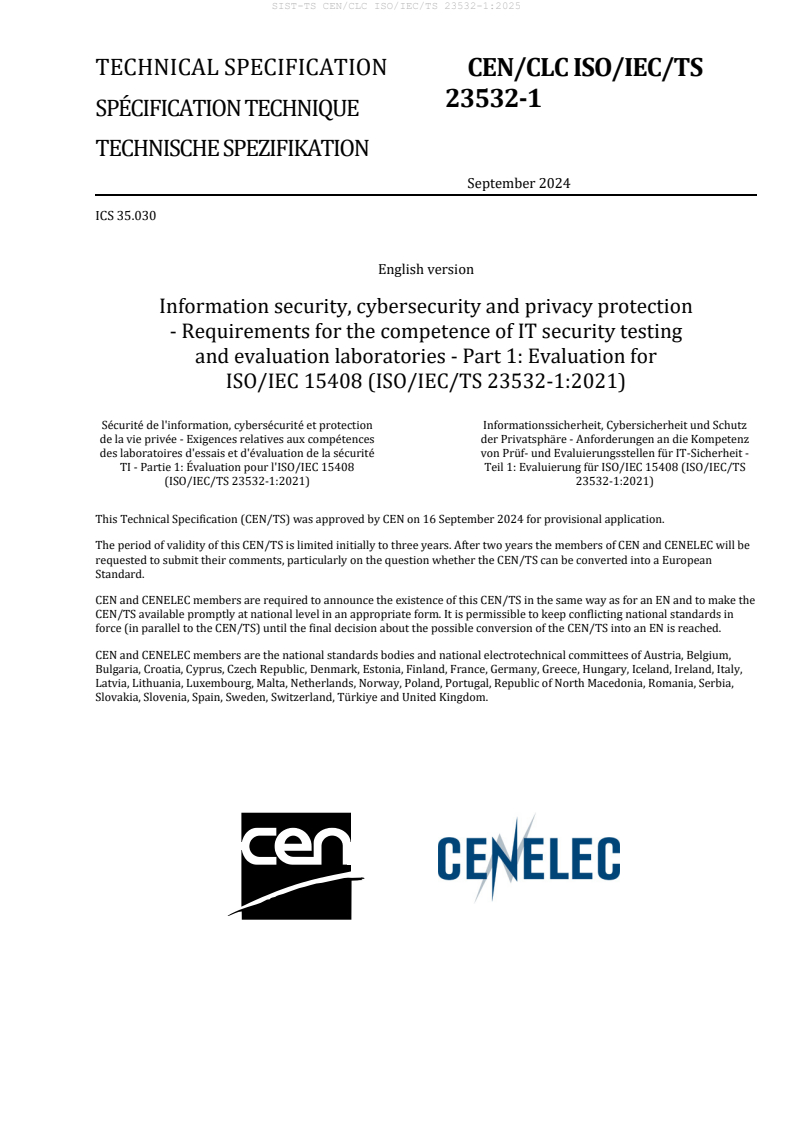
(Main)Information security, cybersecurity and privacy protection - Requirements for the competence of IT security testing and evaluation laboratories - Part 1: Evaluation for ISO/IEC 15408 (ISO/IEC/TS 23532-1:2021)
- Abstract
This document complements and supplements the procedures and general requirements found in ISO/IEC 17025:2017 for laboratories performing evaluations based on the ISO/IEC 15408 series and ISO/IEC 18045.
- Status
- Published
- Publication Date
- 24-Sep-2024
- Technical Committee
- CEN/CLC/TC 13 - Cybersecurity and Data Protection
- Current Stage
- 6060 - Definitive text made available (DAV) - Publishing
- Start Date
- 25-Sep-2024
- Due Date
- 19-Nov-2025
- Completion Date
- 25-Sep-2024


Overview
CEN/CLC ISO/IEC/TS 23532-1:2024 defines specialized requirements for the competence of IT security testing and evaluation laboratories engaged in assessments based on the ISO/IEC 15408 series (Common Criteria) and ISO/IEC 18045. This technical specification complements the broad requirements of ISO/IEC 17025:2017 by providing additional guidance specific to laboratories that assess IT security for information systems, supporting improved harmonization and reliability across the sector.
The standard aims to ensure that evaluation labs demonstrate impartiality, confidentiality, technical proficiency, and the integrity necessary to conduct credible information security and cybersecurity evaluations. By detailing expectations for management systems, personnel competence, resource management, and process controls, it facilitates national and international cooperation among labs and accreditation bodies, ultimately contributing to more robust cybersecurity and privacy protection.
Key Topics
Impartiality and Confidentiality: Laboratories must establish procedures and policies to prevent conflicts of interest and safeguard sensitive data. Individuals involved in developing an IT product or its security profile cannot also test or evaluate the same product, and confidentiality controls must be robust and regularly reviewed.
Personnel Competence and Records: The standard emphasizes rigorous processes for defining, monitoring, and documenting personnel qualifications and ongoing training, referencing ISO/IEC 19896-3 for evaluator competence.
Facilities and Environmental Controls: Laboratories need secure, isolated, and well-controlled environments for testing, with protective measures against both physical and electronic threats to ensure data integrity through the entire evaluation process.
Equipment and Metrological Traceability: Equipment used in testing must be properly maintained, calibrated, and traceable to ensure reliable results. Documentation of equipment configuration and suitability is required.
Process Control: Comprehensive requirements are specified for reviewing evaluation requests, selecting and validating test methods, managing test records, reporting results, and handling nonconformities and complaints.
Management System Requirements: Integrated management practices in accordance with ISO/IEC 17025:2017 must be adapted with additional documentation and evaluation security manuals specific to IT security evaluations.
Applications
CEN/CLC ISO/IEC/TS 23532-1:2024 has practical value across several critical domains:
Accreditation of IT Security Laboratories: Used by accreditation and certification bodies to assess whether a lab is qualified to perform evaluations under ISO/IEC 15408/Common Criteria.
Vendor and Supplier Assessments: Organizations seeking to validate the trustworthiness of products and suppliers can reference labs accredited under this specification for reliable product security evaluation.
Regulatory and Procurement Compliance: Supports government, defense, and highly regulated industries requiring demonstrable, internationally recognized IT security evaluations for products and systems.
Cross-Border Recognition: Facilitates mutual recognition of laboratory competence among countries, supporting cross-jurisdictional acceptance of IT security evaluation results and certificates.
Development and Maintenance of Secure Products: Product developers benefit from understanding evaluation requirements early in the design process, streamlining product certification.
Related Standards
- ISO/IEC 15408 Series: Security evaluation criteria for IT security, commonly known as the Common Criteria.
- ISO/IEC 18045: Guidance for the evaluation methodology used in conjunction with ISO/IEC 15408.
- ISO/IEC 17025:2017: General requirements for competence of testing and calibration laboratories.
- ISO/IEC 19896-1 and 19896-3: Competence requirements for information security testers and evaluators.
- ISO/IEC 17000: Conformity assessment vocabulary and general principles.
These related standards jointly form the framework for information security laboratory competence, assurance certification, and global trust in cybersecurity product evaluation.
Keywords: IT security evaluation, laboratory competence, ISO/IEC 15408, Common Criteria, cybersecurity assessment, privacy protection, laboratory accreditation, ISO/IEC 17025, CEN, management system, test laboratory, evaluator qualifications, information security testing.
Relations
- Refers
ISO/IEC 17025:2017 - General requirements for the competence of testing and calibration laboratories - Effective Date
- 25-Aug-2026
- Effective Date
- 25-Aug-2026
- Effective Date
- 25-Aug-2026
- Effective Date
- 25-Aug-2026
- Effective Date
- 25-Aug-2026
- Effective Date
- 28-Jan-2026
- Effective Date
- 28-Jan-2026
- Effective Date
- 28-Jan-2026
- Effective Date
- 28-Jan-2026
- Effective Date
- 28-Jan-2026
Get Certified
Connect with accredited certification bodies for this standard

BSI Group
BSI (British Standards Institution) is the business standards company that helps organizations make excellence a habit.

Bureau Veritas
Bureau Veritas is a world leader in laboratory testing, inspection and certification services.

DNV
DNV is an independent assurance and risk management provider.
Sponsored listings
Frequently Asked Questions
CEN/CLC ISO/IEC/TS 23532-1:2024 is a technical specification published by the European Committee for Standardization (CEN). Its full title is "Information security, cybersecurity and privacy protection - Requirements for the competence of IT security testing and evaluation laboratories - Part 1: Evaluation for ISO/IEC 15408 (ISO/IEC/TS 23532-1:2021)". This standard covers: This document complements and supplements the procedures and general requirements found in ISO/IEC 17025:2017 for laboratories performing evaluations based on the ISO/IEC 15408 series and ISO/IEC 18045.
This document complements and supplements the procedures and general requirements found in ISO/IEC 17025:2017 for laboratories performing evaluations based on the ISO/IEC 15408 series and ISO/IEC 18045.
CEN/CLC ISO/IEC/TS 23532-1:2024 is classified under the following ICS (International Classification for Standards) categories: 35.030 - IT Security. The ICS classification helps identify the subject area and facilitates finding related standards.
CEN/CLC ISO/IEC/TS 23532-1:2024 has the following relationships with other standards: It is inter standard links to ISO/IEC 17025:2017, ISO/IEC 17000:2020, ISO/IEC 19896-3:2018, ISO/IEC 15408-1:2022, ISO/IEC 19896-1:2018, EN ISO 17468:2023, EN 13523-25:2022, EN 12255-4:2023, EN 18064-3:2025, EN 15457:2022. Understanding these relationships helps ensure you are using the most current and applicable version of the standard.
CEN/CLC ISO/IEC/TS 23532-1:2024 is available in PDF format for immediate download after purchase. The document can be added to your cart and obtained through the secure checkout process. Digital delivery ensures instant access to the complete standard document.
Standards Content (Sample)
SLOVENSKI STANDARD
01-februar-2025
Informacijska varnost, kibernetska varnost in varstvo zasebnosti - Zahteve za
usposobljenost laboratorijev za testiranje in ocenjevanje varnosti IT - 1. del:
Vrednotenje za ISO/IEC 15408 (ISO/IEC/TS 23532-1:2021)
Information security, cybersecurity and privacy protection - Requirements for the
competence of IT security testing and evaluation laboratories - Part 1: Evaluation for
ISO/IEC 15408 (ISO/IEC/TS 23532-1:2021)
Informationssicherheit, Cybersicherheit und Schutz der Privatsphäre - Anforderungen an
die Kompetenz von Prüf- und Evaluierungsstellen für IT-Sicherheit - Teil 1: Evaluierung
für ISO/IEC 15408 (ISO/IEC/TS 23532-1:2021)
Sécurité de l'information, cybersécurité et protection de la vie privée - Exigences
relatives aux compétences des laboratoires d'essais et d'évaluation de la sécurité TI -
Partie 1: Évaluation pour l'ISO/IEC 15408 (ISO/IEC/TS 23532-1:2021)
Ta slovenski standard je istoveten z: CEN/CLC ISO/IEC/TS 23532-1:2024
ICS:
35.030 Informacijska varnost IT Security
SIST-TS CEN/CLC ISO/IEC/TS 23532- en,fr,de
1:2025
2003-01.Slovenski inštitut za standardizacijo. Razmnoževanje celote ali delov tega standarda ni dovoljeno.
TECHNICAL SPECIFICATION CEN/CLC ISO/IEC/TS
23532-1
SPÉCIFICATION TECHNIQUE
TECHNISCHE SPEZIFIKATION
September 2024
ICS 35.030
English version
Information security, cybersecurity and privacy protection
- Requirements for the competence of IT security testing
and evaluation laboratories - Part 1: Evaluation for
ISO/IEC 15408 (ISO/IEC/TS 23532-1:2021)
Sécurité de l'information, cybersécurité et protection Informationssicherheit, Cybersicherheit und Schutz
de la vie privée - Exigences relatives aux compétences der Privatsphäre - Anforderungen an die Kompetenz
des laboratoires d'essais et d'évaluation de la sécurité von Prüf- und Evaluierungsstellen für IT-Sicherheit -
TI - Partie 1: Évaluation pour l'ISO/IEC 15408 Teil 1: Evaluierung für ISO/IEC 15408 (ISO/IEC/TS
(ISO/IEC/TS 23532-1:2021) 23532-1:2021)
This Technical Specification (CEN/TS) was approved by CEN on 16 September 2024 for provisional application.
The period of validity of this CEN/TS is limited initially to three years. After two years the members of CEN and CENELEC will be
requested to submit their comments, particularly on the question whether the CEN/TS can be converted into a European
Standard.
CEN and CENELEC members are required to announce the existence of this CEN/TS in the same way as for an EN and to make the
CEN/TS available promptly at national level in an appropriate form. It is permissible to keep conflicting national standards in
force (in parallel to the CEN/TS) until the final decision about the possible conversion of the CEN/TS into an EN is reached.
CEN and CENELEC members are the national standards bodies and national electrotechnical committees of Austria, Belgium,
Bulgaria, Croatia, Cyprus, Czech Republic, Denmark, Estonia, Finland, France, Germany, Greece, Hungary, Iceland, Ireland, Italy,
Latvia, Lithuania, Luxembourg, Malta, Netherlands, Norway, Poland, Portugal, Republic of North Macedonia, Romania, Serbia,
Slovakia, Slovenia, Spain, Sweden, Switzerland, Türkiye and United Kingdom.
Contents Page
European foreword . 3
European foreword
The text of ISO/IEC TS 23532-1:2021 has been prepared by Technical Committee ISO/IEC JTC 1
"Information technology” of the International Organization for Standardization (ISO) and has been
taken over as CEN/CLC ISO/IEC/TS 23532-1:2024 by Technical Committee CEN-CENELEC/ JTC 13
“Cybersecurity and Data Protection” the secretariat of which is held by DIN.
Attention is drawn to the possibility that some of the elements of this document may be the subject of
patent rights. CEN-CENELEC shall not be held responsible for identifying any or all such patent rights.
Any feedback and questions on this document should be directed to the users’ national standards body.
A complete listing of these bodies can be found on the CEN and CENELEC websites.
According to the CEN-CENELEC Internal Regulations, the national standards organizations of the
following countries are bound to announce this Technical Specification: Austria, Belgium, Bulgaria,
Croatia, Cyprus, Czech Republic, Denmark, Estonia, Finland, France, Germany, Greece, Hungary, Iceland,
Ireland, Italy, Latvia, Lithuania, Luxembourg, Malta, Netherlands, Norway, Poland, Portugal, Republic of
North Macedonia, Romania, Serbia, Slovakia, Slovenia, Spain, Sweden, Switzerland, Türkiye and the
United Kingdom.
Endorsement notice
The text of ISO/IEC TS 23532-1:2021 has been approved by CEN-CENELEC as
TECHNICAL ISO/IEC TS
SPECIFICATION 23532-1
First edition
2021-11
Information security, cybersecurity
and privacy protection —
Requirements for the competence
of IT security testing and evaluation
laboratories —
Part 1:
Evaluation for ISO/IEC 15408
Sécurité de l'information, cybersécurité et protection de la vie
privée — Exigences relatives aux compétences des laboratoires
d'essais et d'évaluation de la sécurité TI —
Partie 1: Évaluation pour l'ISO/IEC 15408
Reference number
ISO/IEC TS 23532-1:2021(E)
© ISO/IEC 2021
ISO/IEC TS 23532-1:2021(E)
© ISO/IEC 2021
All rights reserved. Unless otherwise specified, or required in the context of its implementation, no part of this publication may
be reproduced or utilized otherwise in any form or by any means, electronic or mechanical, including photocopying, or posting on
the internet or an intranet, without prior written permission. Permission can be requested from either ISO at the address below
or ISO’s member body in the country of the requester.
ISO copyright office
CP 401 • Ch. de Blandonnet 8
CH-1214 Vernier, Geneva
Phone: +41 22 749 01 11
Email: copyright@iso.org
Website: www.iso.org
Published in Switzerland
ii
© ISO/IEC 2021 – All rights reserved
ISO/IEC TS 23532-1:2021(E)
Contents Page
Foreword .v
Introduction . vi
1 Scope . 1
2 Normative references . 1
3 Terms and definitions . 1
4 General requirements . 2
4.1 Impartiality . 2
4.2 Confidentiality . 2
5 Structural requirements .3
6 Resource requirements .4
6.1 General . 4
6.2 Personnel . 4
6.3 Facilities and environmental conditions . 5
6.4 Equipment . 6
6.5 Metrological traceability . 7
6.6 Externally provided products and services . 7
7 Process requirements . 8
7.1 Review of requests, tenders and contracts . 8
7.2 Selection, verification and validation of methods . 8
7.2.1 Selection and verification of methods . 8
7.2.2 Validation of methods . 9
7.3 Sampling . 9
7.4 Handling of test or calibration items . 9
7.5 Technical records . 10
7.6 Evaluation of measurement uncertainty . 10
7.7 Ensuring the validity of results . 11
7.8 Reporting of results . 11
7.8.1 General . 11
7.8.2 Common requirements for reports (test, calibration or sampling) . 11
7.8.3 Specific requirements for test reports . 11
7.8.4 Specific requirements for calibration certificates .12
7.8.5 Reporting sampling – specific requirements .12
7.8.6 Reporting statements of conformity .12
7.8.7 Reporting opinions and interpretations .12
7.8.8 Amendments to reports .12
7.9 Complaints.13
7.10 Nonconforming work . 13
7.11 Control of data and information management . 13
8 Management system requirements .14
8.1 Options. 14
8.1.1 General . 14
8.1.2 Option A . 14
8.1.3 Option B . 14
8.2 Management system documentation (Option A). 14
8.3 Control of management system documents (Option A) . 15
8.4 Records (Option A) .15
8.5 Actions to address risks and opportunities (Option A) . 16
8.6 Improvement (Option A) . 16
8.7 Corrective actions (Option A) . . 16
8.8 Internal audits (Option A) . . 16
8.9 Management reviews (Option A) . 16
iii
© ISO/IEC 2021 – All rights reserved
ISO/IEC TS 23532-1:2021(E)
Annex A (informative) Metrological traceability .17
Annex B (informative) Management system options .18
Annex C (informative) Standards relation in IT security evaluation .19
Bibliography .20
iv
© ISO/IEC 2021 – All rights reserved
ISO/IEC TS 23532-1:2021(E)
Foreword
ISO (the International Organization for Standardization) and IEC (the International Electrotechnical
Commission) form the specialized system for worldwide standardization. National bodies that are
members of ISO or IEC participate in the development of International Standards through technical
committees established by the respective organization to deal with particular fields of technical
activity. ISO and IEC technical committees collaborate in fields of mutual interest. Other international
organizations, governmental and non-governmental, in liaison with ISO and IEC, also take part in the
work.
The procedures used to develop this document and those intended for its further maintenance
are described in the ISO/IEC Directives, Part 1. In particular, the different approval criteria
needed for the different types of document should be noted. This document was drafted in
accordance with the editorial rules of the ISO/IEC Directives, Part 2 (see www.iso.org/directives or
www.iec.ch/members_experts/refdocs).
Attention is drawn to the possibility that some of the elements of this document may be the subject
of patent rights. ISO and IEC shall not be held responsible for identifying any or all such patent
rights. Details of any patent rights identified during the development of the document will be in the
Introduction and/or on the ISO list of patent declarations received (see www.iso.org/patents) or the IEC
list of patent declarations received (see https://patents.iec.ch).
Any trade name used in this document is information given for the convenience of users and does not
constitute an endorsement.
For an explanation of the voluntary nature of standards, the meaning of ISO specific terms and
expressions related to conformity assessment, as well as information about ISO's adherence to
the World Trade Organization (WTO) principles in the Technical Barriers to Trade (TBT) see
www.iso.org/iso/foreword.html. In the IEC, see www.iec.ch/understanding-standards.
This document was prepared by Joint Technical Committee ISO/IEC JTC 1, Information technology,
Subcommittee SC 27, Information security, cybersecurity and privacy protection.
A list of all parts in the ISO/IEC 23532 series can be found on the ISO and IEC websites.
Any feedback or questions on this document should be directed to the user’s national standards
body. A complete listing of these bodies can be found at www.iso.org/members.html and
www.iec.ch/national-committees.
v
© ISO/IEC 2021 – All rights reserved
ISO/IEC TS 23532-1:2021(E)
Introduction
Laboratories performing evaluations for conformance to information security standards including the
ISO/IEC 15408 series may utilize and require conformance to ISO/IEC 17025:2017. ISO/IEC 17025:2017
gives generalized requirements for a broad range of testing and calibration laboratories to enable them
to demonstrate that they operate competently and are able to generate valid results.
Laboratories that perform such evaluations have specific requirements for competence to the
ISO/IEC 15408 series that will enable them to generate valid results.
By providing additional details and supplementary requirements to ISO/IEC 17025:2017 that are
specific to information security evaluation laboratories, this document will facilitate cooperation and
better conformity and harmonization between laboratories and other bodies. This document may be
used by countries and accreditation bodies as a set of requirements for laboratory assessments and
accreditations.
To help implementers, this document is numbered identically to ISO/IEC 17025:2017. Supplementary
requirements are presented as subclauses additional to ISO/IEC 17025:2017.
vi
© ISO/IEC 2021 – All rights reserved
TECHNICAL SPECIFICATION ISO/IEC TS 23532-1:2021(E)
Information security, cybersecurity and privacy
protection — Requirements for the competence of IT
security testing and evaluation laboratories —
Part 1:
Evaluation for ISO/IEC 15408
1 Scope
This document complements and supplements the procedures and general requirements found in
ISO/IEC 17025:2017 for laboratories performing evaluations based on the ISO/IEC 15408 series and
ISO/IEC 18045.
2 Normative references
The following documents are referred to in the text in such a way that some or all of their content
constitutes requirements of this document. For dated references, only the edition cited applies. For
undated references, the latest edition of the referenced document (including any amendments) applies.
ISO/IEC 15408-1, Information technology — Security techniques — Evaluation criteria for IT security —
Part 1: Introduction and general model
ISO/IEC 17000, Conformity assessment — Vocabulary and general principles
ISO/IEC 17025:2017, General requirements for the competence of testing and calibration laboratories
ISO/IEC 19896-1, IT security techniques — Competence requirements for information security testers and
evaluators — Part 1: Introduction, concepts and general requirements
ISO/IEC 19896-3, IT security techniques — Competence requirements for information security testers and
evaluators — Part 3: Knowledge, skills and effectiveness requirements for ISO/IEC 15408 evaluators
3 Terms and definitions
For the purposes of this document, the terms and definitions given in ISO/IEC 17000, ISO/IEC 17025:2017,
ISO/IEC 15408-1, ISO/IEC 19896-1, ISO/IEC 19896-3 and the following apply.
ISO and IEC maintain terminology databases for use in standardization at the following addresses:
— ISO Online browsing platform: available at https:// www .iso .org/ obp
— IEC Electropedia: available at https:// www .electropedia .org/
3.1
evaluation laboratory
organization with a management system providing evaluation in accordance with a defined set of
policies and procedures and utilizing a defined methodology for evaluating the security functionality of
IT products
Note 1 to entry: These organizations are often given alternative names by various evaluation authorities. For
example, IT Security Evaluation Facility (ITSEF), Commercial Evaluation Facility (CLEF).
Note 2 to entry: The defined methodology is given ISO/IEC 18045.
© ISO/IEC 2021 – All rights reserved
ISO/IEC TS 23532-1:2021(E)
4 General requirements
4.1 Impartiality
4.1.1 ISO/IEC 17025:2017, 4.1.1 applies.
4.1.1.1 ISO/IEC 17025:2017, 4.1.1 applies with the following additions.
The evaluation laboratory shall establish and maintain policies and procedures for maintaining
laboratory impartiality and integrity in the conduct of information technology security evaluations.
When conducting evaluations, the laboratory policies and procedures shall ensure that:
a) evaluators cannot both develop and evaluate the same protection profile, security target, or IT
product, and
b) evaluators cannot both provide consulting services for and participate in the evaluation or testing
of the same protection profile, security target, or IT product.
4.1.2 ISO/IEC 17025:2017, 4.1.2 applies.
4.1.2.1 ISO/IEC 17025:2017, 4.1.2 applies with the following additions.
The organization to which the evaluator belongs shall not be the same as the organization to which the
department that develops the target of evaluation (TOE) belongs.
4.1.3 ISO/IEC 17025:2017, 4.1.3 applies.
4.1.4 ISO/IEC 17025:2017, 4.1.4 applies.
4.1.5 ISO/IEC 17025:2017, 4.1.5 applies.
4.1.6 ISO/IEC 17025:2017, 4.1 applies with the following additions.
To maintain impartiality, the laboratory shall maintain proper separation between evaluators and
other personnel inside the laboratory or outside the laboratory, but inside the parent organization.
4.2 Confidentiality
4.2.1 ISO/IEC 17025:2017, 4.2.1 applies.
4.2.2 ISO/IEC 17025:2017, 4.2.2 applies.
4.2.3 ISO/IEC 17025:2017, 4.2.3 applies.
4.2.4 ISO/IEC 17025:2017, 4.2.4 applies.
4.2.5 ISO/IEC 17025:2017, 4.2 applies with the following additions.
Confidentiality mechanisms shall be employed to ensure that the evaluation report cannot be disclosed
to anyone other than the intended recipient(s).
© ISO/IEC 2021 – All rights reserved
ISO/IEC TS 23532-1:2021(E)
4.2.6 ISO/IEC 17025:2017, 4.2 applies with the following additions.
Because of confidentiality requirements of the evaluation laboratory and client, some evaluation output
may need to exclude:
a) proprietary information (e.g. source code);
b) TOE-specific sampling and test information;
c) effort estimates;
d) commercially sensitive information.
4.2.7 ISO/IEC 17025:2017, 4.2 applies with the following additions.
The evaluation laboratory shall have physical and electronic controls augmented with an explicit
policy and a set of procedures for maintaining separation, both physical and electronic, between the
laboratory, evaluators and laboratory consultants, product developers, system integrators, and others
who may have an interest in and/or may unduly influence the evaluation outcome.
4.2.8 ISO/IEC 17025:2017, 4.2 applies with the following additions.
The management system shall include policies and procedures to ensure the protection of proprietary
information. This protection shall specify how proprietary information will be protected from persons
outside the laboratory, from visitors to the laboratory, from laboratory personnel without a need to
know, and from other unauthorized persons. The evaluation laboratory shall possess its own security
manual that sets out the procedures and responsibilities to be undertaken by all the evaluators of the
evaluation laboratory, to maintain the security required to protect commercially sensitive information.
5 Structural requirements
5.1 ISO/IEC 17025:2017, 5.1 applies.
5.2 ISO/IEC 17025:2017, 5.2 applies.
5.3 ISO/IEC 17025:2017, 5.3 applies.
5.3.1 ISO/IEC 17025:2017, 5.3 applies with the following additions.
The evaluation laboratory shall create and maintain a cross-referenced document mapping Clauses 4 to
8 to the laboratory’s management system documentation.
5.4 ISO/IEC 17025:2017, 5.4 applies.
5.5 ISO/IEC 17025:2017, 5.5 applies.
5.6 ISO/IEC 17025:2017, 5.6 applies.
5.7 ISO/IEC 17025:2017, 5.7 applies.
5.8 ISO/IEC 17025:2017, Clause 5 applies with the following additions.
There shall be a nominated person within the evaluation laboratory with overall responsibility for the
security of the evaluation laboratory and the production of the evaluation laboratory security manual.
© ISO/IEC 2021 – All rights reserved
ISO/IEC TS 23532-1:2021(E)
6 Resource requirements
6.1 General
ISO/IEC 17025:2017, 6.1 applies.
6.2 Personnel
6.2.1 ISO/IEC 17025:2017, 6.2.1 applies.
6.2.2 ISO/IEC 17025:2017, 6.2.2 applies.
NOTE Laboratories document the required qualifications for each staff position. The staff information can
be kept in the official personnel folders.
6.2.2.1 ISO/IEC 17025:2017, 6.2.2 applies with the following additions.
The evaluation laboratory shall maintain a list of personnel designated to fulfil laboratory requirements
including:
a) laboratory director,
b) approved report signatories,
c) evaluation team leaders, and
d) evaluators.
An individual may be assigned or appointed to serve in more than one position; however, to the extent
possible, the laboratory director position should be independently staffed.
NOTE Significant change in a laboratory’s key technical personnel or facilities can result in a laboratory no
longer being deemed proficient by relevant scheme owner(s).
6.2.3 ISO/IEC 17025:2017, 6.2.3 applies.
6.2.4 ISO/IEC 17025:2017, 6.2.4 applies.
6.2.5 ISO/IEC 17025:2017, 6.2.5 applies.
6.2.5.1 ISO/IEC 17025:2017, 6.2.5 applies with the following additions.
The evaluation laboratory shall have procedure(s) and retain records for determining the competence
requirements for personnel in ISO/IEC 19896-3.
6.2.5.2 ISO/IEC 17025:
...