

prEN 144-4
(Main)Respiratory protective devices - Gas cylinder valves - Part 4: Excess flow devices
- Abstract
This document specifies the technical requirements and the necessary tests of Excess Flow Device (EFD) for use with respiratory protective devices (RPD), up to 300 bar operating pressure.
Devices that only close the flow in the event of a valve break-off do not fall within the scope of this document.
NOTE Throughout the breathing apparatus market exists a variety of cylinder valves that can have different ways of connecting to an EFD. The interchangeability of the EFD is only possible in the case of verified combinations of cylinder valve and EFD. The use of unverified combinations is not considered safe.
- Status
- Not Published
- Publication Date
- 24-Sep-2026
- Technical Committee
- CEN/TC 79 - Respiratory protective devices
- Drafting Committee
- CEN/TC 79/WG 6 - Self-contained breathing apparatus
- Current Stage
- 4060 - Closure of enquiry - Enquiry
- Start Date
- 14-May-2026
- Due Date
- 23-Oct-2025
- Completion Date
- 14-May-2026

Overview
prEN 144-4: Respiratory protective devices - Gas cylinder valves - Part 4: Excess flow devices is a European draft standard developed by CEN/TC 79. It specifies the technical requirements and testing methods for Excess Flow Devices (EFD) used with respiratory protective devices (RPDs) operating up to 300 bar. EFDs are key safety components designed to limit gas flow from compressed air cylinders if a valve is accidentally opened or sheared off, helping to reduce the risk of uncontrolled cylinder movement.
This standard does not cover devices that only close the flow in the event of a complete valve break-off. The document outlines criteria to ensure the suitability, durability, and safety performance of EFDs in high-pressure breathing apparatus systems.
Key Topics
- Technical Requirements: prEN 144-4 defines how an EFD must function both in normal and activated states to maintain system integrity and user safety.
- Compatibility & Interchangeability: Emphasizes that only verified combinations of cylinder valves and EFDs should be used, as unverified pairings may pose safety risks.
- Testing Procedures: The standard details a comprehensive test regimen, including:
- Maximum flow and activation pressure tests up to 300 bar
- Impact and drop tests to validate mechanical robustness
- Lifespan tests simulating 400 filling cycles and 200 activation cycles
- Visual inspections after each test to assure no damage or material cracking
- Marking Requirements: EFDs must be permanently marked with manufacturer identification, type number, date of manufacture, and the standard reference.
- Manufacturer Information: Accompanying documentation must specify compatible interfaces, suitable cylinder types, incident response procedures, expected service life, and compliance statements.
Applications
EFDs specified in prEN 144-4 are primarily used with compressed gas cylinders for respiratory protective devices such as those worn by firefighters, emergency responders, and in industrial safety contexts. Key applications include:
- Firefighting breathing apparatus: Enhances cylinder security, reducing hazards in case of impact or misuse.
- Industrial escape apparatus: Provides an added level of safety during high-risk evacuation scenarios.
- Rescue operations: Ensures reliable function of rescue team respiratory equipment under stressful conditions.
- SCBA (Self-Contained Breathing Apparatus): Applies to open-circuit compressed air systems used in hazardous environments.
The standard’s rigorous performance and compatibility requirements help prevent incidents where uncontrolled gas release could cause cylinders to move or become dangerous projectiles, significantly improving user safety.
Related Standards
prEN 144-4 references and aligns with several other important European and international standards in the field of respiratory protection and gas cylinder safety, including:
- prEN 137: Self-contained open-circuit compressed air breathing apparatus with full face mask - Requirements, testing, marking
- EN 1146: Self-contained open-circuit compressed air hoods for escape - Requirements, testing, marking
- EN 144-1: Gas cylinder valves - Part 1: Inlet connections
- EN 12021: Breathing gases for respiratory equipment
- EN ISO 10286: Gas cylinders - Vocabulary
- EN ISO 11114-1 / 11114-2: Compatibility of cylinder and valve materials with gas contents (metallic and non-metallic materials)
- EN ISO 11117: Valve protection caps and guards - Design, construction, and tests
- EN ISO 13341: Fitting of valves to gas cylinders
By adhering to prEN 144-4 and its related standards, manufacturers and users ensure greater reliability and interoperability of critical safety equipment across European and international markets.
Keywords: Excess Flow Device, EFD, respiratory protective devices, gas cylinder valves, breathing apparatus, compressed air cylinders, CEN, prEN 144-4, high-pressure safety, SCBA, industrial safety standards
Get Certified
Connect with accredited certification bodies for this standard

CIS Institut d.o.o.
Personal Protective Equipment (PPE) certification body. Notified Body NB-2890 for EU Regulation 2016/425 PPE.

Kiwa BDA Testing
Building and construction product certification.
Kmetijski inštitut Slovenije
Agricultural Institute of Slovenia. Soil testing, plant health, agricultural product analysis.
Sponsored listings
Frequently Asked Questions
prEN 144-4 is a draft published by the European Committee for Standardization (CEN). Its full title is "Respiratory protective devices - Gas cylinder valves - Part 4: Excess flow devices". This standard covers: This document specifies the technical requirements and the necessary tests of Excess Flow Device (EFD) for use with respiratory protective devices (RPD), up to 300 bar operating pressure. Devices that only close the flow in the event of a valve break-off do not fall within the scope of this document. NOTE Throughout the breathing apparatus market exists a variety of cylinder valves that can have different ways of connecting to an EFD. The interchangeability of the EFD is only possible in the case of verified combinations of cylinder valve and EFD. The use of unverified combinations is not considered safe.
This document specifies the technical requirements and the necessary tests of Excess Flow Device (EFD) for use with respiratory protective devices (RPD), up to 300 bar operating pressure. Devices that only close the flow in the event of a valve break-off do not fall within the scope of this document. NOTE Throughout the breathing apparatus market exists a variety of cylinder valves that can have different ways of connecting to an EFD. The interchangeability of the EFD is only possible in the case of verified combinations of cylinder valve and EFD. The use of unverified combinations is not considered safe.
prEN 144-4 is classified under the following ICS (International Classification for Standards) categories: 13.340.30 - Respiratory protective devices. The ICS classification helps identify the subject area and facilitates finding related standards.
prEN 144-4 is available in PDF format for immediate download after purchase. The document can be added to your cart and obtained through the secure checkout process. Digital delivery ensures instant access to the complete standard document.
Standards Content (Sample)
SLOVENSKI STANDARD
01-april-2026
Oprema za varovanje dihal - Ventili za plinske jeklenke - 4. del: Oprema za
omejevanje pretoka plina
Respiratory protective devices - Gas cylinder valves - Part 4: Excess flow devices
Atemschutzgeräte - Gasflaschenventile - Teil 4: Abströmsicherung
Appareils de protection respiratoire - Robinets de bouteilles à gaz - Partie 4 : Limiteurs
de débit
Ta slovenski standard je istoveten z: prEN 144-4
ICS:
13.340.30 Varovalne dihalne naprave Respiratory protective
devices
2003-01.Slovenski inštitut za standardizacijo. Razmnoževanje celote ali delov tega standarda ni dovoljeno.
DRAFT
EUROPEAN STANDARD
NORME EUROPÉENNE
EUROPÄISCHE NORM
February 2026
ICS 13.340.30
English Version
Respiratory protective devices - Gas cylinder valves - Part
4: Excess flow devices
Appareils de protection respiratoire - Robinets de Atemschutzgeräte - Gasflaschenventile - Teil 4:
bouteilles à gaz - Partie 4 : Limiteurs de débit Abströmsicherung
This draft European Standard is submitted to CEN members for enquiry. It has been drawn up by the Technical Committee
CEN/TC 79.
If this draft becomes a European Standard, CEN members are bound to comply with the CEN/CENELEC Internal Regulations
which stipulate the conditions for giving this European Standard the status of a national standard without any alteration.
This draft European Standard was established by CEN in three official versions (English, French, German). A version in any other
language made by translation under the responsibility of a CEN member into its own language and notified to the CEN-CENELEC
Management Centre has the same status as the official versions.
CEN members are the national standards bodies of Austria, Belgium, Bulgaria, Croatia, Cyprus, Czech Republic, Denmark, Estonia,
Finland, France, Germany, Greece, Hungary, Iceland, Ireland, Italy, Latvia, Lithuania, Luxembourg, Malta, Netherlands, Norway,
Poland, Portugal, Republic of North Macedonia, Romania, Serbia, Slovakia, Slovenia, Spain, Sweden, Switzerland, Türkiye and
United Kingdom.
Recipients of this draft are invited to submit, with their comments, notification of any relevant patent rights of which they are
aware and to provide supporting documentation.
Warning : This document is not a European Standard. It is distributed for review and comments. It is subject to change without
notice and shall not be referred to as a European Standard.
EUROPEAN COMMITTEE FOR STANDARDIZATION
COMITÉ EUROPÉEN DE NORMALISATION
EUROPÄISCHES KOMITEE FÜR NORMUNG
CEN-CENELEC Management Centre: Rue de la Science 23, B-1040 Brussels
© 2026 CEN All rights of exploitation in any form and by any means reserved Ref. No. prEN 144-4:2026 E
worldwide for CEN national Members.
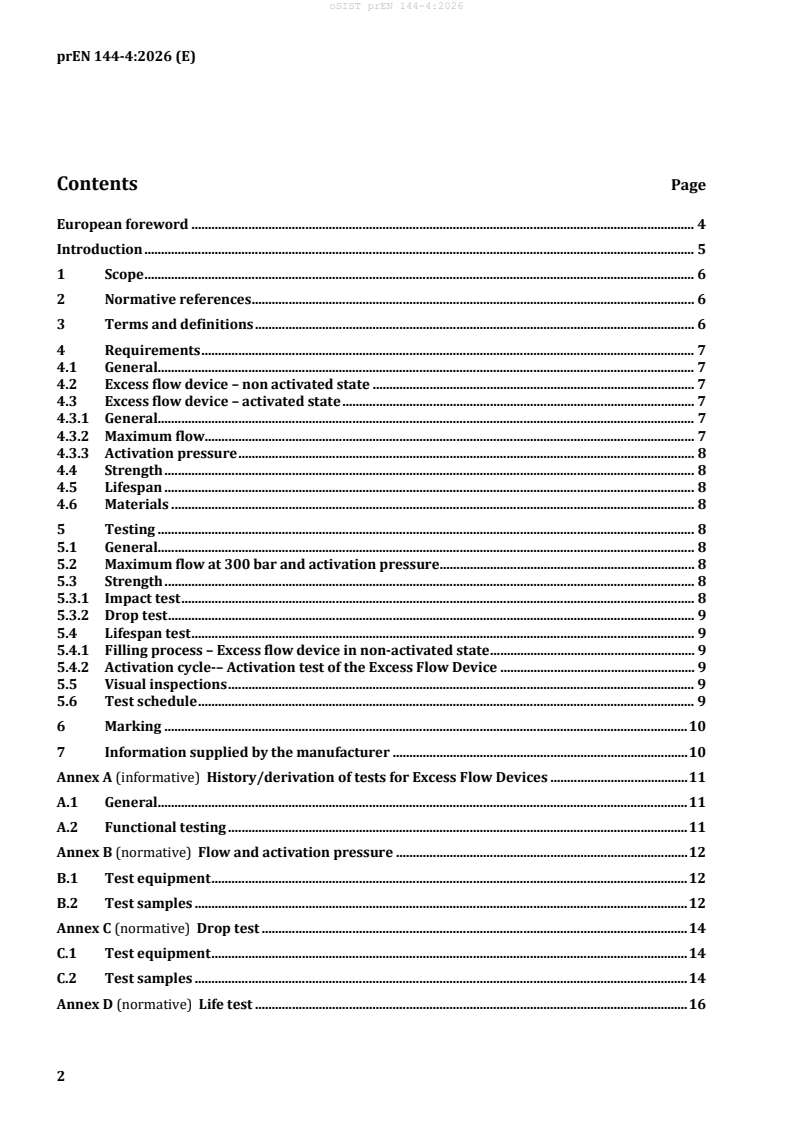
Contents Page
European foreword . 4
Introduction . 5
1 Scope . 6
2 Normative references . 6
3 Terms and definitions . 6
4 Requirements . 7
4.1 General. 7
4.2 Excess flow device – non activated state . 7
4.3 Excess flow device – activated state . 7
4.3.1 General. 7
4.3.2 Maximum flow . 7
4.3.3 Activation pressure . 8
4.4 Strength . 8
4.5 Lifespan . 8
4.6 Materials . 8
5 Testing . 8
5.1 General. 8
5.2 Maximum flow at 300 bar and activation pressure . 8
5.3 Strength . 8
5.3.1 Impact test . 8
5.3.2 Drop test . 9
5.4 Lifespan test . 9
5.4.1 Filling process – Excess flow device in non-activated state . 9
5.4.2 Activation cycle-– Activation test of the Excess Flow Device . 9
5.5 Visual inspections . 9
5.6 Test schedule . 9
6 Marking . 10
7 Information supplied by the manufacturer . 10
Annex A (informative) History/derivation of tests for Excess Flow Devices . 11
A.1 General. 11
A.2 Functional testing . 11
Annex B (normative) Flow and activation pressure . 12
B.1 Test equipment . 12
B.2 Test samples . 12
Annex C (normative) Drop test . 14
C.1 Test equipment . 14
C.2 Test samples . 14
Annex D (normative) Life test . 16
D.1 Test equipment. 16
D.2 Test samples . 16
D.3 Test procedure . 16
European foreword
This document (prEN 144-4:2026) has been prepared by Technical Committee CEN/TC 79 “Respiratory
protective devices”, the secretariat of which is held by DIN.
This document is currently submitted to the CEN Enquiry.
Introduction
Respiratory protective device, among other things, of compressed gas cylinder(s) equipped with a valve,
can be equipped with excess flow devices as an additional component to increase safety in the event of
demolition or unintentional opening (see Annex A).
1 Scope
This document specifies the technical requirements and the necessary tests of Excess Flow Device (EFD)
for use with respiratory protective devices (RPD), up to 300 bar operating pressure.
Devices that only close the flow in the event of a valve break-off do not fall within the scope of this
document.
NOTE Throughout the breathing apparatus market exists a variety of cylinder valves that can have
different ways of connecting to an EFD. The interchangeability of the EFD is only possible in the case of
verified combinations of cylinder valve and EFD. The use of unverified combinations is not considered
safe.
2 Normative references
The following documents are referred to in the text in such a way that some or all of their content
constitutes requirements of this document. For dated references, only the edition cited applies. For
undated references, the latest edition of the referenced document (including any amendments) applies.
prEN 137, Respiratory protective devices — Self-contained open-circuit compressed air breathing
apparatus with full face mask — Requirements, testing, marking
EN 1146, Respiratory protective devices — Self-contained open-circuit compressed air breathing apparatus
incorporating a hood for escape — Requirements, testing, marking
EN 144-1:2018, Respiratory protective devices — Gas cylinder valves — Part 1: Inlet connections
EN 12021, Respiratory equipment — Compressed gases for breathing apparatus
EN ISO 10286, Gas cylinders — Vocabulary (ISO 10286)
EN ISO 11114-1, Gas cylinders — Compatibility of cylinder and valve materials with gas contents — Part 1:
Metallic materials (ISO 11114-1)
EN ISO 11114-2, Gas cylinders — Compatibility of cylinder and valve materials with gas contents — Part 2:
Non-metallic materials (ISO 11114-2)
EN ISO 11117:2019, Gas cylinders — Valve protection caps and guards — Design, construction and tests
(ISO 11117:2019)
EN ISO 13341, Gas cylinders — Fitting of valves to gas cylinders (ISO 13341)
3 Terms and definitions
For the purposes of this document, the following terms given in EN ISO 10286 and the following apply.
ISO and IEC maintain terminology databases for use in standardization at the following addresses:
— ISO Online browsing platform: available at https://www.iso.org/obp/
— IEC Electropedia: available at https://www.electropedia.org/
3.1
operating pressure
pressure that occurs after a complete filling of a breathable air cylinder at a uniform reference
temperature of 15 °C in bar
Note 1 to entry: Referred to as “nominal filling pressure” in prEN 137:2025 or also referred to as “filling pressure”.
3.2
Excess Flow Device (EFD)
device that limits the flow escaping from a compressed air cylinder, not connected to an RPD, when the
valve is suddenly opened or sheared off by accident
Note 1 to entry: Its function is to reduce the risk of the cylinder flying around or spinning thus becoming a risk for
the persons and the environment.
4 Requirements
4.1 General
An EFD shall be connected to the inlet thread of the valve. Both when filling and when extracting
breathing air f
...