


prEN 14579
(Main)Natural stone test methods - Determination of sound speed propagation
General Information
- Abstract
This document specifies a method for the determination of the velocity of propagation of pulses of ultrasonic longitudinal waves in natural stone, both in laboratory and in situ.
- Status
- Not Published
- Publication Date
- 03-Nov-2026
- Technical Committee
- CEN/TC 246 - Natural stones
- Drafting Committee
- CEN/TC 246/WG 2 - Test methods
- Current Stage
- 4020 - Submission to enquiry - Enquiry
- Start Date
- 23-Jul-2026
- Due Date
- 18-Jun-2025
- Completion Date
- 23-Jul-2026

Overview
prEN 14579:2026 defines a standardized method for determining the velocity of ultrasonic longitudinal wave propagation in natural stone materials, both in laboratory and in situ (on-site) settings. Developed by the European Committee for Standardization (CEN), this draft European Standard supersedes EN 14579:2004 and forms part of a comprehensive series on natural stone test methods. By specifying clear procedures and performance requirements, prEN 14579:2026 aims to ensure reliable, consistent measurement of sound speed propagation, which is vital for assessing the quality and durability of natural stone.
Key Topics
- Ultrasonic Pulse Velocity Measurement: The standard details the use of electro-acoustic transducers and electronic timing equipment to measure pulse velocity in natural stones. It specifies direct, semi-direct, and indirect (surface) arrangements for transmitting and receiving ultrasonic pulses.
- Performance Requirements: The apparatus used for sound speed determination must achieve high accuracy, particularly with respect to measuring transit times and ensuring sharp pulse onsets. The document provides guidelines for the appropriate selection of transducers based on frequency and path length considerations.
- Specimen Preparation: Procedures for sampling, drying, and preparing test specimens are outlined to achieve consistent results, including the importance of surface finish and dimensions that minimize measurement variability.
- Factors Affecting Measurement: Annexes discuss the influence of water content, specimen shape and size, path length, and the presence of fissures or voids within the stone on the measured sound velocity.
- Reporting Requirements: Comprehensive requirements for test reports are provided to ensure traceability, including apparatus details, sample provenance, measurement arrangements, results, and deviations from standard procedures.
Applications
prEN 14579:2026 is integral for:
- Quality Assessment of Natural Stone: Determining the ultrasonic pulse velocity aids in evaluating the integrity, homogeneity, and physical properties (such as strength and porosity) of natural stone used in construction, masonry, and architectural applications.
- On-Site Diagnostics: Suitable for both laboratory and in situ measurements, facilitating the assessment of installed stone structures without destructive sampling.
- Correlation to Physical Properties: The measured velocity can be correlated to other properties, supporting structural health monitoring and material specification in building projects, mining operations, and restoration works.
- Detection of Flaws: Ultrasonic propagation methods help identify internal cracks, voids, and zones of weakness, essential for maintenance and safety evaluations.
Related Standards
prEN 14579:2026 is part of a comprehensive suite of natural stone test methods. Key related standards include:
- EN 12370: Resistance to salt crystallization
- EN 12372: Flexural strength under concentrated load
- EN 12407: Petrographic examination
- EN 13364: Breaking load at dowel hole
- EN 13755: Water absorption at atmospheric pressure
- EN 14066: Resistance to ageing by thermal shock
- EN 14231: Slip resistance by pendulum tester
- EN 14580: Static elastic modulus
- EN 12504-4: Determination of ultrasonic pulse velocity in concrete (useful for cross-reference)
- EN 12670: Natural stone terminology
Practical Value
For manufacturers, quarry operators, engineers, and testing laboratories, adherence to prEN 14579 ensures:
- Uniformity in Testing: Promotes comparability of results across Europe and internationally.
- Reliable Stone Selection: Facilitates informed decisions on material suitability for structural and decorative use.
- Support for Certification and Compliance: Meets regulatory and specification requirements for construction materials.
By implementing prEN 14579:2026, stakeholders gain a robust framework for the non-destructive evaluation of natural stone’s internal quality, supporting both new build and conservation projects and strengthening confidence in material performance over the structure’s lifecycle.
Relations
- Effective Date
- 31-Jul-2024
Get Certified
Connect with accredited certification bodies for this standard

DIBt (Deutsches Institut für Bautechnik)
German Institute for Building Technology.
DIN CERTCO
DIN Group product certification.

Aboma Certification B.V.
Specialized in construction, metal, and transport sectors.
Sponsored listings
Frequently Asked Questions
prEN 14579 is a draft published by the European Committee for Standardization (CEN). Its full title is "Natural stone test methods - Determination of sound speed propagation". This standard covers: This document specifies a method for the determination of the velocity of propagation of pulses of ultrasonic longitudinal waves in natural stone, both in laboratory and in situ.
This document specifies a method for the determination of the velocity of propagation of pulses of ultrasonic longitudinal waves in natural stone, both in laboratory and in situ.
prEN 14579 is classified under the following ICS (International Classification for Standards) categories: 73.020 - Mining and quarrying; 91.100.15 - Mineral materials and products. The ICS classification helps identify the subject area and facilitates finding related standards.
prEN 14579 has the following relationships with other standards: It is inter standard links to EN 14579:2004. Understanding these relationships helps ensure you are using the most current and applicable version of the standard.
prEN 14579 is available in PDF format for immediate download after purchase. The document can be added to your cart and obtained through the secure checkout process. Digital delivery ensures instant access to the complete standard document.
Standards Content (Sample)
SLOVENSKI STANDARD
01-oktober-2026
Preskušanje naravnega kamna - Ugotavljanje hitrosti širjenja zvoka
Natural stone test methods - Determination of sound speed propagation
Prüfverfahren für Naturstein - Bestimmung der Geschwindigkeit der Schallausbreitung
Méthodes d'essai pour pierres naturelles - Détermination de la vitesse et propagation du
son
Ta slovenski standard je istoveten z: prEN 14579
ICS:
73.020 Rudarstvo in kamnolomsko Mining and quarrying
izkopavanje
91.100.15 Mineralni materiali in izdelki Mineral materials and
products
2003-01.Slovenski inštitut za standardizacijo. Razmnoževanje celote ali delov tega standarda ni dovoljeno.
DRAFT
EUROPEAN STANDARD
NORME EUROPÉENNE
EUROPÄISCHE NORM
July 2026
ICS 73.020; 91.100.15 Will supersede EN 14579:2004
English Version
Natural stone test methods - Determination of sound
speed propagation
Méthodes d'essai pour pierres naturelles - Prüfverfahren für Naturstein - Bestimmung der
Détermination de la vitesse et propagation du son Geschwindigkeit der Schallausbreitung
This draft European Standard is submitted to CEN members for enquiry. It has been drawn up by the Technical Committee
CEN/TC 246.
If this draft becomes a European Standard, CEN members are bound to comply with the CEN/CENELEC Internal Regulations
which stipulate the conditions for giving this European Standard the status of a national standard without any alteration.
This draft European Standard was established by CEN in three official versions (English, French, German). A version in any other
language made by translation under the responsibility of a CEN member into its own language and notified to the CEN-CENELEC
Management Centre has the same status as the official versions.
CEN members are the national standards bodies of Austria, Belgium, Bulgaria, Croatia, Cyprus, Czech Republic, Denmark, Estonia,
Finland, France, Germany, Greece, Hungary, Iceland, Ireland, Italy, Latvia, Lithuania, Luxembourg, Malta, Netherlands, Norway,
Poland, Portugal, Republic of North Macedonia, Romania, Serbia, Slovakia, Slovenia, Spain, Sweden, Switzerland, Türkiye and
United Kingdom.
Recipients of this draft are invited to submit, with their comments, notification of any relevant patent rights of which they are
aware and to provide supporting documentation.
Warning : This document is not a European Standard. It is distributed for review and comments. It is subject to change without
notice and shall not be referred to as a European Standard.
EUROPEAN COMMITTEE FOR STANDARDIZATION
COMITÉ EUROPÉEN DE NORMALISATION
EUROPÄISCHES KOMITEE FÜR NORMUNG
CEN-CENELEC Management Centre: Rue de la Science 23, B-1040 Brussels
© 2026 CEN All rights of exploitation in any form and by any means reserved Ref. No. prEN 14579:2026 E
worldwide for CEN national Members.
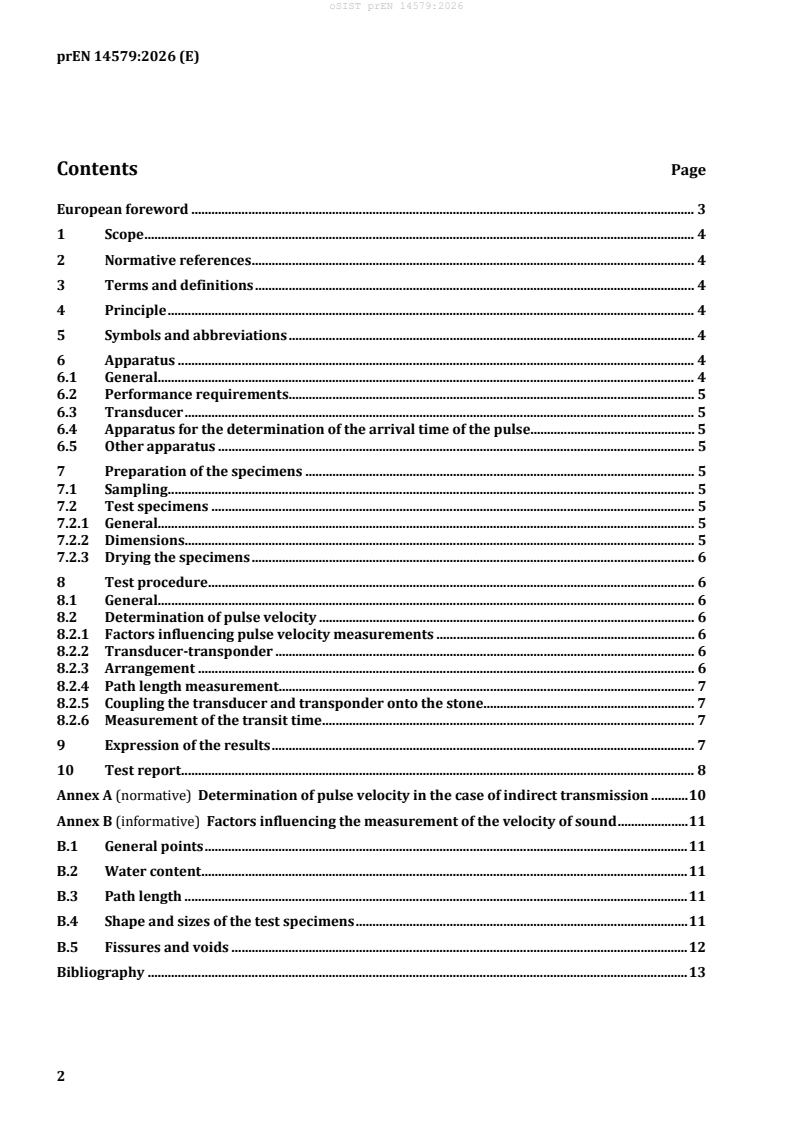
Contents Page
European foreword . 3
1 Scope . 4
2 Normative references . 4
3 Terms and definitions . 4
4 Principle . 4
5 Symbols and abbreviations . 4
6 Apparatus . 4
6.1 General. 4
6.2 Performance requirements . 5
6.3 Transducer . 5
6.4 Apparatus for the determination of the arrival time of the pulse. 5
6.5 Other apparatus . 5
7 Preparation of the specimens . 5
7.1 Sampling . 5
7.2 Test specimens . 5
7.2.1 General. 5
7.2.2 Dimensions. 5
7.2.3 Drying the specimens . 6
8 Test procedure . 6
8.1 General. 6
8.2 Determination of pulse velocity . 6
8.2.1 Factors influencing pulse velocity measurements . 6
8.2.2 Transducer-transponder . 6
8.2.3 Arrangement . 6
8.2.4 Path length measurement. 7
8.2.5 Coupling the transducer and transponder onto the stone. 7
8.2.6 Measurement of the transit time . 7
9 Expression of the results . 7
10 Test report . 8
Annex A (normative) Determination of pulse velocity in the case of indirect transmission . 10
Annex B (informative) Factors influencing the measurement of the velocity of sound . 11
B.1 General points . 11
B.2 Water content . 11
B.3 Path length . 11
B.4 Shape and sizes of the test specimens . 11
B.5 Fissures and voids . 12
Bibliography . 13
European foreword
This document (prEN 14579:2026) has been prepared by Technical Committee CEN/TC 246 “Natural
stones”, the secretariat of which is held by UNI.
This document is currently submitted to the CEN Enquiry.
This document will supersede EN 14579:2004.
EN 14579:2026 includes the following significant technical changes with respect to EN 14579:2004:
— inclusion of the possibility to measure the sound speed propagation with an apparatus using a fixed
distance between the transducer and transponder.
This standard is one of the series for tests on natural stone.
Test methods for natural stone consist of the following parts:
— EN 12370, Natural stone test methods — Determination of resistance to salt crystallization
— EN 12372, Natural stone test methods — Determination of flexural strength under concentrated load
— EN 12407, Natural stone test methods — Petrographic examination
— EN 13161, Natural stone test methods — Determination of flexural strength under constant moment
— EN 13364, Natural stone test methods — Determination of the breaking load at dowel hole
— EN 13373, Natural stone test methods — Determination of geometric characteristics on units
— EN 13755, Natural stone test methods — Determination of water absorption at atmospheric pressure
— EN 14066, Natural stone test methods — Determination of resistance to ageing by thermal shock
— EN 14231, Natural stone test methods — Determination of the slip resistance by means of the
pendulum tester
— EN 14157, Natural stone test methods — Determination of abrasion resistance
— EN 14158, Natural stone test methods — Determination of rupture energy
— EN 14580, Natural stone test methods — Determination of the static elastic modulus
— EN 14581, Natural stone test methods — Determination of linear thermal expansion coefficient
1 Scope
This document specifies a method for the determination of the velocity of propagation of pulses of
ultrasonic longitudinal waves in natural stone, both in laboratory and in situ.
2 Normative references
There are no normative references in this document.
3 Terms and definitions
No terms and definitions are listed in this document.
4 Principle
A pulse of longitudinal vibrations is produced by an electro-acoustical transducer held in contact with
one surface of the stone under test. After traversing a known path length in the stone, the pulse is received
converted into an electrical signal by a transponder and electronic timing circuits enable the transit time
of the pulse to be measured.
5 Symbols and abbreviations
V pulse velocity, in km/s
L path length, in mm
T time taken by the pulse to transverse the length, in µs
6 Apparatus
6.1 General
The apparatus consists essentially of an electrical pulse generator, a transducer (transmitting a pulse at
a defined frequency), a compatible transponder (receiving the pulse), an amplifier and an electronic
timing device for measuring the time interval elapsing between the onset of a pulse generated at the
transmitting transducer and the onset of its arrival at the receiving transponder.
Three forms of electronic timing apparatus are available:
a) an oscilloscope on which the first front of the pulse is displayed in relation to a suitable time scale;
b) an interval timer with a direct reading digital display;
c) an apparatus for indirect or surface transmission with a direct reading digital display, having fixed
distance between transmitting and transponder thus providing a reading computed from frequency,
time and path length.
NOTE 1 An oscilloscope provides the facility for examining the wave form, which can be advantageous in
complex situations.
NOTE 2 A graphic representation of the various forms of transducer-transponder arrangement is reported in
Figure 1.
6.2 Performance requirements
The apparatus shall comply with the following performance requirements:
— to measure transit times in the calibration bar to an accuracy of ±0,1 µs;
— to ensure a sharp pulse onset, that is the electronic excitation pulse applied to the transducer shall
have a rise time of not greater than one-quarter of its natural period;
— the pulse repetition frequency shall be low enough to ensure that the onset of the received signal is
free from interference by reverberations.
6.3 Transducer
The natural frequency of the transducer shall be within the range 20 kHz to 150 kHz.
NOTE Frequencies as low as 10 kHz and as high as 200 kHz is sometimes used. High frequency pulses have a
well-defined onset, but, as they pass through the natural stone, they become attenuated more rapidly than pulses
of lower frequency. It is therefore preferable to use high frequency transducers (82 kHz to 200 kHz) for short path
lengths (down to 50 mm) and low frequency transducers (10 kHz to 40 kHz) for long path lengths (up to a maximum
of 15 m). Transducers with a frequency of 40 kHz to 82 kHz are found to be useful for most applications.
6.4 Apparatus for the determination of the arrival time of the pulse
The apparatus receives the signal from the transponder and shall be capable of determining the time of
arrival of the first front of the pulse, even though this may be of small amplitude compared with that of
the first half wave of the pulse.
6.5 Other apparatus
A weighing instrument with an accuracy of 0,01 % of the mass to be weighed.
A ventilated oven capable of maintaining a temperature of (70 ± 5) °C.
7 Preparation of the specimens
7.1 Sampling
Sampling is not the responsibility of the test laboratory except where specially requested.
At least 6 specimens shall be selected from a homogeneous batch (see also 7.2.2).
7.2 Test specimens
7.2.1 General
As a standard reference the surface finish of the faces o
...