

EN 13796-1:2005
(Main)Safety requirements for cableway installations designed to carry persons - Carriers - Part 1: Grips, carrier trucks, on-board brakes, cabins, chairs, carriages, maintenance carriers, tow-hangers
- Abstract
This European Standard specifies the safety requirements applicable to carriers for cableway installations designed to carry persons. This standard is applicable to the various types of installations and takes into account their environment.
It includes requirements relating to the prevention of accidents and the protection of workers.
This standard does not apply to installations for the transportation of goods nor to inclined lifts.
- Status
- Withdrawn
- Publication Date
- 24-May-2005
- Withdrawal Date
- 06-Oct-2026
- Technical Committee
- CEN/TC 242 - Safety requirements for passenger transportation by rope
- Drafting Committee
- CEN/TC 242 - Safety requirements for passenger transportation by rope
- Current Stage
- 9960 - Withdrawal effective - Withdrawal
- Start Date
- 29-Mar-2017
- Completion Date
- 07-Oct-2026
- Directive
- 00/9/EC - Cableway installations designed to carry personsOJ Ref: C, C 230 OJ Date: 20-Sep-2005
2000/9/EC - Cableway installations designed to carry personsOJ Ref: C, C 230 OJ Date: 20-Sep-2005

Relations
- Effective Date
- 08-Jun-2022
- Effective Date
- 25-Mar-2026
- Effective Date
- 28-Jan-2026
- Effective Date
- 28-Jan-2026
- Effective Date
- 28-Jan-2026
- Effective Date
- 28-Jan-2026
- Effective Date
- 28-Jan-2026
- Effective Date
- 28-Jan-2026
- Refers
EN 12927:2019 - Safety requirements for cableway installations designed to carry persons - Ropes - Effective Date
- 28-Jan-2026
- Effective Date
- 28-Jan-2026
- Effective Date
- 28-Jan-2026
- Effective Date
- 28-Jan-2026
- Effective Date
- 28-Jan-2026
- Effective Date
- 28-Jan-2026
- Effective Date
- 28-Jan-2026
Get Certified
Connect with accredited certification bodies for this standard

IRIS Certification (UNIFE)
International Railway Industry Standard certification.

TÜV SÜD Rail GmbH
TÜV SÜD railway certification services.

Bureau Veritas Railway Certification
Railway and transportation certification.
Sponsored listings
Frequently Asked Questions
EN 13796-1:2005 is a standard published by the European Committee for Standardization (CEN). Its full title is "Safety requirements for cableway installations designed to carry persons - Carriers - Part 1: Grips, carrier trucks, on-board brakes, cabins, chairs, carriages, maintenance carriers, tow-hangers". This standard covers: This European Standard specifies the safety requirements applicable to carriers for cableway installations designed to carry persons. This standard is applicable to the various types of installations and takes into account their environment. It includes requirements relating to the prevention of accidents and the protection of workers. This standard does not apply to installations for the transportation of goods nor to inclined lifts.
This European Standard specifies the safety requirements applicable to carriers for cableway installations designed to carry persons. This standard is applicable to the various types of installations and takes into account their environment. It includes requirements relating to the prevention of accidents and the protection of workers. This standard does not apply to installations for the transportation of goods nor to inclined lifts.
EN 13796-1:2005 is classified under the following ICS (International Classification for Standards) categories: 45.100 - Cableway equipment. The ICS classification helps identify the subject area and facilitates finding related standards.
EN 13796-1:2005 has the following relationships with other standards: It is inter standard links to EN 13796-1:2017, EN 1993-1-11:2026, EN 1993-1-9:2025, EN ISO 9606-1:2017, EN 1993-1-11:2006, EN 13796-3:2017+A1:2022, EN 1999-1-3:2023, EN 12930:2015, EN 12927:2019, EN 10025-4:2019+A1:2022, EN 13243:2015, EN 1993-1-3:2024, EN 13223:2015+A1:2022, EN 1993-1-2:2024, EN 13107:2015. Understanding these relationships helps ensure you are using the most current and applicable version of the standard.
EN 13796-1:2005 is associated with the following European legislation: EU Directives/Regulations: 00/9/EC, 2000/9/EC; Standardization Mandates: M/300. When a standard is cited in the Official Journal of the European Union, products manufactured in conformity with it benefit from a presumption of conformity with the essential requirements of the corresponding EU directive or regulation.
EN 13796-1:2005 is available in PDF format for immediate download after purchase. The document can be added to your cart and obtained through the secure checkout process. Digital delivery ensures instant access to the complete standard document.
Standards Content (Sample)
2003-01.Slovenski inštitut za standardizacijo. Razmnoževanje celote ali delov tega standarda ni dovoljeno.Safety requirements for cableway installations designed to carry persons - Carriers - Part 1: Grips, carrier trucks, on-board brakes, cabins, chairs, carriages, maintenance carriers, tow-hangersPrescriptions de sécurité pour les installations a câbles transportant des personnes - Véhicules - Partie 1 : Attaches, chariots, freins embarqués, cabines, sieges, voitures, véhicules de maintenance, agresSicherheitsanforderungen für Seilbahnen für den Personenverkehr - Fahrzeuge - Teil 1: Befestigungen am Seil, Laufwerke, Fangbremsen, Kabinen, Sessel, Wagen, Instandhaltungsfahrzeuge, SchleppgehängeTa slovenski standard je istoveten z:EN 13796-1:2005SIST EN 13796-1:2005en45.100Cableway equipmentICS:SLOVENSKI
STANDARDSIST EN 13796-1:200501-november-2005
EUROPEAN STANDARDNORME EUROPÉENNEEUROPÄISCHE NORMEN 13796-1May 2005ICS 45.100English versionSafety requirements for cableway installations designed to carrypersons - Carriers - Part 1: Grips, carrier trucks, on-boardbrakes, cabins, chairs, carriages, maintenance carriers, tow-hangersPrescriptions de sécurité pour les installations à câblestransportant des personnes - Véhicules - Partie 1 :Attaches, chariots, freins embarqués, cabines, sièges,voitures, véhicules de maintenance, agrèsSicherheitsanforderungen für Seilbahnen undSchleppaufzüge des Personenverkehrs - Fahrzeuge - Teil1: Befestigungen am Seil, Laufwerke, Fangbremsen,Kabinen, Sessel, Wagen, Wartungsfahrzeuge,SchleppgehängeThis European Standard was approved by CEN on 17 April 2005.CEN members are bound to comply with the CEN/CENELEC Internal Regulations which stipulate the conditions for giving this EuropeanStandard the status of a national standard without any alteration. Up-to-date lists and bibliographical references concerning such nationalstandards may be obtained on application to the Central Secretariat or to any CEN member.This European Standard exists in three official versions (English, French, German). A version in any other language made by translationunder the responsibility of a CEN member into its own language and notified to the Central Secretariat has the same status as the officialversions.CEN members are the national standards bodies of Austria, Belgium, Cyprus, Czech Republic, Denmark, Estonia, Finland, France,Germany, Greece, Hungary, Iceland, Ireland, Italy, Latvia, Lithuania, Luxembourg, Malta, Netherlands, Norway, Poland, Portugal, Slovakia,Slovenia, Spain, Sweden, Switzerland and United Kingdom.EUROPEAN COMMITTEE FOR STANDARDIZATIONCOMITÉ EUROPÉEN DE NORMALISATIONEUROPÄISCHES KOMITEE FÜR NORMUNGManagement Centre: rue de Stassart, 36
B-1050 Brussels© 2005 CENAll rights of exploitation in any form and by any means reservedworldwide for CEN national Members.Ref. No. EN 13796-1:2005: E
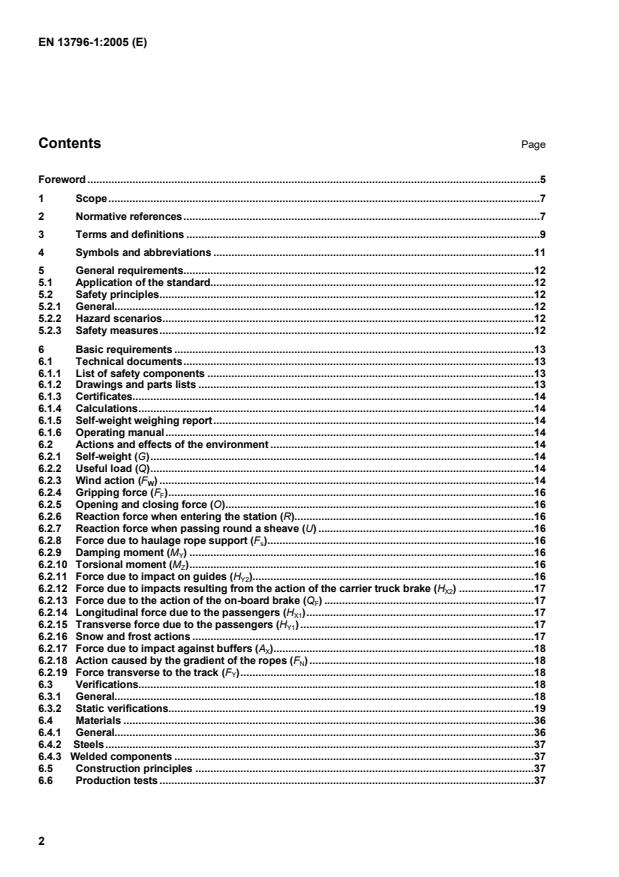
Static verifications.19 6.4 Materials.36 6.4.1 General.36 6.4.2
Steels.37 6.4.3
Welded components.37 6.5 Construction principles.37 6.6 Production tests.37
Socket end fixings.39 7.3.1 General.39 7.3.2 Conical bush for cast socket.39 7.4 Aerial ropeway grips (excluding chapeaux de gendarme).40 7.4.1 General.40 7.4.2 Fixed grips.43 7.4.3 Detachable grips.44 7.5 Chapeau de gendarme.45 7.5.1 General.45 7.5.2 Design requirements.45 7.5.3 Verifications.45 7.5.4 Coefficients of friction.46 7.6 Grips for towing ropes.46 7.6.1 General.46 7.6.2 Fixed grips.47 7.6.3 Detachable bush grips.48 8 Carrier truck for aerial ropeways.48 9 Chassis of funicular railways.49 10 On-board brake.49 10.1
Automatic application.49 10.2
Manual application.50 10.3
Verifications of the brake.50 11 Cabins, chairs and other carriers of aerial ropeways.51 11.1 General.51 11.1.1 Space envelopes.51 11.1.2 Carrier equipment.51 11.2 Cabins.51 11.2.1 General.51 11.2.2 Cabins for reversible aerial ropeways.55 11.2.3 Cabin doors.55 11.3 Rescue carriers.56 11.4 Chairs.56 11.4.1 General.56 11.4.2 Seats, backs and armrests.57 11.4.3 Safety bars and footrests.57 11.4.4 Hoods.57 12 Carriages for funicular railways.59 12.1 General.59 12.2 Carriage doors.61 12.2.1 General.61 12.2.2 Doors for carriages with attendant.62 12.2.3 Doors for carriages without attendant.62 13 Maintenance carriers.62 13.1 General.62 13.2 Space envelopes.63 13.3 Identification plate.63 13.4 Dimensioning of the carrier.63 14 Tow-hangers.63
Relationship between this
European
Standard and the Essential Requirements
of EU Directive 2000/9/EC relating to cableway installations designed to carry persons.66
1) Safety requirements for cableway installations designed to carry persons - Terminology 2) Safety requirements for cableway installations designed to carry persons - General requirements 3) Safety requirements for cableway installations designed to carry persons - Calculations 4) Safety requirements for cableway installations designed to carry persons - Ropes 5) Safety requirements for cableway installations designed to carry persons - Tensioning devices 6) Safety requirements for cableway installations designed to carry persons - Drive systems and other mechanical equipment 7) Safety requirements for cableway installations designed to carry persons - Carriers 8) Safety requirements for cableway installations designed to carry persons - Electrical equipment other than for drive systems 9) Safety requirements for cableway installations designed to carry persons - Civil engineering works 10) Safety requirements for cableway installations designed to carry persons – Pre-commissioning inspection, maintenance and operational inspection and checks 11) Safety requirements for cableway installations designed to carry persons – Recovery and evacuation
For dated references, only the edition cited applies.
For undated references, the latest edition of the referenced document (including any amendments) applies. EN 287-1, Approval testing of welders – Fusion welding – Part 1: Steels EN 287-2, Approval testing of welders – Fusion welding – Part 2: Aluminium and aluminium alloys EN 1709, Safety requirements for cableway installations designed to carry persons – Pre-commissioning inspection, maintenance and operational inspection and checks EN 1907:2005, Safety requirements for cableway installations designed to carry persons – Terminology EN 1908, Safety requirements for cableway installations designed to carry persons – Tensioning devices EN 1909, Safety requirements for cableway installations designed to carry persons – Recovery and evacuation ENV 1993-1, Eurocode 3: Design of steel structures ENV 1999-2, Eurocode 9: Design of aluminium structures – Part 2: Structures susceptible to fatigue EN 10025, Hot-rolled products of structural steels EN 10045-1, Metallic materials – Charpy impact test – Part 1: Test method EN 10083, Quenched and tempered steels EN 10113, Hot-rolled products in weldable fine grain structural steels EN 10204, Metallic products – Types of inspection documents EN 12397, Safety requirements for cableway installations designed to carry persons – Operation EN 12408, Safety requirements for cableway installations designed to carry persons – Quality assurance EN 12927-1, Safety requirements for cableway installations designed to carry persons – Ropes – Part 1: Selection criteria for ropes and their end fixings
EN 12927-2, Safety requirements for cableway installations designed to carry persons – Ropes – Part 2: Safety factors EN 12927-3, Safety requirements for cableway installations designed to carry persons – Ropes – Part 3: Long splicing of 6-strand hauling, carrying-hauling and towing ropes
transportation by rope - Ropes - Part
4: End fixing EN 12927-5, Safety requirements for cableway installations designed to carry persons – Ropes – Part 5: Storage, transportation, installation and tensioning EN 12927-6, Safety requirements for cableway installations designed to carry persons – Ropes – Part 6: Discard criteria EN 12927-7, Safety requirements for cableway installations designed to carry persons – Ropes – Part 7: Calculation, repair and maintenance EN 12927-8, Safety requirements for cableway installations designed to carry persons – Ropes – Part 8: Magnetic rope testing EN 12929-1, Safety requirements for cableway installations designed to carry persons – General provisions – Part 1: Requirements for all installations EN 12929-2, Safety requirements for cableway installations designed to carry persons – General provisions – Part 2: Additional requirements for reversible bicable aerial ropeways without carrier truck brakes EN 12930, Safety requirements for cableway installations designed to carry persons – Calculations EN 13107, Safety requirements for cableway installations designed to carry persons – Civil engineering works EN 13223, Safety requirements for cableway installations designed to carry persons – Drive systems and other mechanical equipment EN 13243, Safety requirements for cableway installations designed to carry persons – Electrical installations other than for drive systems EN 13796-2, Safety requirements for cableway installations designed to carry persons - Carriers – Part 2:
Slipping resistance tests for grips EN 13796-3, Safety requirements for cableway installations designed to carry persons - Carriers – Part 3: Fatigue testing EN ISO 898, Mechanical properties of fasteners made of carbon steel and alloy steel EN ISO 5817, Fusion-welded joints in steel,
nickel, titanium and their alloys (beam
welding excluded) - Quality levels for
imperfections (ISO 5817:2003)
.
3.2 slipping resistance force F characterizes the resistance to slipping provided by a grip.
A distinction is made between the following slipping resistance forces when they occur: Ftheo calculated slipping resistance force; Flab slipping resistance force determined experimentally in the laboratory on the rope; Feff
slipping resistance force measured on the rope on the installation
3.3 pull-off resistance force Faus characterizes the resistance provided by a fixed grip on the rope when a lifting force is exerted normal to the rope axis in a vertical plane (see Figure 1)
Figure 1 — Pull-off resistance force
3.4 gripping force exerted by the jaws Fkl scalar sum of all the normal forces between the surface of the gripping jaws and the surface of the rope.
(m2) Ax Force due to impact into buffer
(N) d Rope diameter (nominal)
(m) F Slipping resistance force
(N) Faus Pull-off resistance force
(N) Feff
Slipping resistance force measured on the rope on the installation
(N) Fkl
Gripping force imparted by the jaws
(N)
Flab
Slipping resistance force determined experimentally in the laboratory
(N) Ftheo Calculated slipping resistance force
(N) FF Force due to the springs of a fixed or detachable grip
(N) FN Action caused by
the gradient of the ropes
(N) FS Force due to the support of a haulage rope
(N) FT Gravitational driving force
(N) FW Wind action
(N)
FY Force transverse to the track
(N) G Self-weight of the carrier with all its accessories
(N) HX Force due to longitudinal impact
(N or N/m) HY Force due to transverse impact
(N or N/m) MY Damping moment
(N.m) MZ Torsional moment about the vertical axis
(N.m) N Number of cycles
(-) O
Force to open and close a detachable grip
(N) Q Useful load
(N) QF Force due to the action of the on-board brake
(N) R Reaction force on a carrier when entering the station
(N) S Force due to start-up
(N) U Reaction force when passing round a sheave
(N)
EN 13223, EN 13243, EN 13796-2, EN13796-3. 5.2 Safety principles 5.2.1 General The safety principles set out in EN 12929-1 apply. In addition, the following hazard scenarios and safety requirements relative to the scope of this European Standard shall be taken into account. 5.2.2 Hazard scenarios
The following events may lead to hazardous situations that may be avoided or limited by the safety requirements of this European Standard: a) overloading of the carrier; b) exceeding the limits of use permitted by the manufacturer; c) damage caused by ageing, corrosion, wear, fatigue or deformation; d) hooking up and impact (carrier with carrier, carrier with people, carriers with ropes, stations, line structures and external objects); e) derailment and deropement when carrier passes; f) derailment or instability of the carrier; g) failure of the haulage rope or carrying hauling rope where a grip is attached; h) failure of the attachment or detachment of a grip; i) inadequate resistance to slipping and pull-off of a rope grip; j) faulty door operation (unexpected opening, slamming shut); k) inadequate protection against passengers and any element
falling out of the carrier; l) inadequate positioning and difficult access for the maintenance and evacuation personnel; m) fire. 5.2.3 Safety measures The safety measures to be taken to eliminate the hazard scenarios listed in 5.2.2 are the following: a)
checking of the load or limiting the area available to each passenger and systematically
informing the passengers of the maximum authorized load;
b) establishment of an operating manual defining the limits of use;
e) design to allow unrestricted passage of the grips past the rope-catchers; f) requirements relating to the guiding and stability of the carriers; g) adequate design of the grip to limit the risks of fatigue failure of the haulage rope or carrying hauling rope; h) monitoring the attachment and detachment of the carriers, catching a carrier not properly attached to the rope,
i) monitoring during operation of the gripping force, or of a value representative of this force, of detachable grips j) design of fixed grips to facilitate their systematic displacement without upsetting the adjustment of the spring force; k) periodic checks during operation; l) limiting the effect of an impermissible reduction in the gripping force of the grip; m) monitoring the closing and locking of the doors prior to departure of the carrier; monitoring of the position and speed of the carriers prior to unlocking and opening of the doors, limiting the closing force of the doors, fitting the edges of the doors with soft material; n) use of an efficient safety bar on chairlifts, minimum height of backrests and sides, selection of non-slip materials; o)
use of handholds and anchorage points for PPE against falls from a height; p)
use of positions and access allowing personnel to carry out maintenance and evacuation operations; q) selection of suitable materials to limit the risks of fire. 6 Basic requirements 6.1 Technical documents The following technical documents shall be supplied: 6.1.1 List of safety components A list of all the safety components deemed necessary through a safety analysis shall be drawn up. 6.1.2 Drawings and parts lists 6.1.2.1 General arrangement drawings of the carriers with indications of the main dimensions. 6.1.2.2 Detail drawings with lists of parts and indications of the materials in accordance with 6.4 for: all the safety components
(1) and
of a wind pressure q = qref Ce (Ze) cd [kN/m2]
(2) In the absence of any verification, the wind pressure q shall be taken as 0,25 kN/m2 for wind actions during operation and 1,2 kN/m2 contrary to the requirements of EN 12930 for wind actions when not in operation. b) In the absence of any verification from wind tunnel tests or numerical simulations, the following coefficients shall be used: 1) For cabins: sharp edged cf = 1,6 with rounded edges
cf = 1,6 – 2 lr
Key r
is the radius of the edge [m] l
is the cabin length [m]
Figure 2 — Geometrical data of the cabins 2) For uncovered chairs where the passenger sits facing the direction of travel, where n is the number of
persons per chair, irrespective of the wind direction:
empty chair
cf Aref = 0,2
+ 0,1n [m2] occupied chair
cf Aref = 0,4 + 0,2 n [m2] For covered chairs, the force coefficients shall be determined with the hood open and closed under the effect of wind hitting the vehicle at angles of 0°, 45°, 90°, 135° and 180° to the direction of travel, both under operating conditions and when not in service.
MY = ± 100 N.m per person; b) without sway damper acting at the joint axis:
MY = ± 25 N.m per person. 6.2.10 Torsional moment (MZ) Moment around a vertical axis due to forces acting in the horizontal plane. For bicable aerial ropeways, the following values shall be used:
MZ = ± 50 N.m per person 6.2.11 Force due to impact on guides (HY2) Dynamic force due to the impact of a carrier of a reversible aerial ropeway on guides. An impact at the most unfavourable point for the cabin shall be considered, with a value: HY2 = 200 N per person.
The characteristic values shall be verified. 6.2.13 Force due to the action of the on-board brake (QF) Dynamic force caused on the carrier by the action of the on-board brake following a failure of the haulage rope. This force shall be determined by means of a recognized calculation method. 6.2.14 Longitudinal force due to the passengers (HX1) Dynamic force exerted in the direction of travel by the passengers on the outside and intermediate carrier walls, the doors, the seats or the rails. For carriers with a capacity of more than 40 persons, this force HX1 shall be determined on the basis of the useful load of the carrier or of the compartment taking into account the maximum deceleration due to the action of one or other of the brakes.
This value shall not be less than 5000 N/m For carriers with a lower capacity, this value may be reduced by the following formula: HX1 = 5000 – 100x(40-n) [N/m] (3) where n is the number of standing passengers transported in each compartment of the carrier. This force is applied 1,10 m above the floor in the absence of a rail.
If there is a rail, reference shall be made to 11.2.1.2 and 12.1.2. 6.2.15 Transverse force due to the passengers (HY1) Dynamic force exerted by the passengers on the carrier walls, doors, seats and rails transverse to the direction of travel. For carriers with a capacity of more than 40 persons, the value to be used shall be:
HY1 = 2500 N/m For carriers with a lower capacity, this value may be reduced using the following formula: HY1 = 2500 – 30x(40-n)
[N/m] (4) where n is the number of standing passengers transported in each compartment of the carrier. This force is applied 1,10 m above the floor in the absence of a rail.
If there is a rail, reference shall be made to 11.2.1.2 and 12.1.2. 6.2.16 Snow and frost actions Snow and frost actions shall be determined in accordance with EN 12930. a) snow and frost actions may produce the following effects on the carriers:
be given in the operating manual. 6.2.17 Force due to impact against buffers (AX)
The forces due to the impact of a carrier against the buffers in a station during normal operation shall comply with the specifications of EN 13223. 6.2.18 Action caused by the gradient of the ropes (FN) The effect of the gradient of the ropes on the grips during operation shall be taken into account. 6.2.19 Force transverse to the track (FY) The force transverse to the funicular railway track shall take account of the following influences: transverse acceleration; forces resulting from the rope guides; wind action. With regard to transverse acceleration during operation, particularly when entering and leaving the passing loop, and in curves, a minimum value of 0,10 g shall be taken into account.
Lower values may be allowed if they are verified by measurement or calculation. The values of the forces due to the rope guides (horizontal deviation of the rope due to the rollers at the points and at bends) shall be calculated on the basis of the most unfavourable factors determined geometrically. The dynamic changes in the rope tension during operation (starting, braking .) shall be considered according to the maximum allowable values. Wind actions shall be determined in accordance with 6.2.3. The force FY determined takes into account the swaying forces. 6.3 Verifications 6.3.1 General 6.3.1.1 Verifications by calculation shall be provided to meet the minimum requirements regarding: static safety; fatigue strength for components subject to fatigue; lateral deviation due to wind during operation. 6.3.1.2 Verification shall be carried out using recognized methods and taking into account the material and the surface, thickness and shape of the components. 6.3.1.3 For components that fail mainly because of stability problems (buckling, canting), the safety factors shall be verified by specific calculations.
Static verifications 6.3.2.1 General 6.3.2.1.1 As a general rule, static verifications shall be carried out with the equivalent VON MISES stresses relative to the elastic limit of the material Re or the plastic limit Rp0.2. For aluminium alloys, if the elastic limit is greater than 0,72 Rm, a reduced yield point of 0,72 Rm (Rm = tensile strength) shall be taken into account. 6.3.2.1.2 The stability verifications shall indicate at least the same safety factors as when verifying the static safety. 6.3.2.1.3 The following tables give combinations of actions corresponding to the most current load cases that shall be examined. The safety factors in them shall be met.
They may be reduced by 20 % with a minimum of 1 if the calculations are done by finite element surface or volume modelling. If other load cases are to be examined, as a general rule these safety factors are taken as being equal to: 3 in frequent cases; 2 for cases taking account of the wind; 1,6 in rare cases; 1,2 in exceptional cases. For all the load cases, the most favourable positions of the carrier (for example, maximum and minimum gradients of the track) shall be examined.
Detachable grips Load case 1 2 3 4 Reference subclause Self-weight G G G G 6.2.1 Useful load Q Q G ½ Q 6.2.2 Gripping force FF FF FF FF 6.2.4 Wind action FW
6.2.3 Action caused by the gradient of the ropes
FN
6.2.18 Damping moment MY MY
MY 6.2.9 Force caused by opening and closing of the grip
O
6.2.5
Reaction force when entering the station
R 6.2.6 Safety factor 3 3 3 1,6
6.3.2.2.2
Fixed grips Load case 1 2 4a 5 6 7 Reference subclause Self-weight G G G G G G 6.2.1 Useful load Q Q ½ Q
½ Q
Q 6.2.2 Gripping force
FF FF FF FF FF FF 6.2.4 Wind action FW
6.2.3 Action caused by the gradient of the ropes
FN
6.2.18 Damping moment MY MY MY
6.2.9 Reaction force when passing round a sheave
U U U 6.2.7 Reaction force when entering the station
R
6.2.6 Safety factor 2 3 1,6 3 1,6 1
...