

EN 13802:2013
(Main)Railway applications - Suspension components - Hydraulic dampers
General Information
- Abstract
This European Standard applies to hydraulic dampers and their end mountings used on rail vehicles. The dampers covered in this standard include:
- Dampers that control the dynamic behaviour of a vehicle:
- Suspensions dampers, (e.g. primary vertical dampers, secondary vertical dampers and secondary lateral dampers);
- Yaw dampers;
- Roll dampers;
- Inter-vehicles dampers.
- Dampers that control the dynamic behaviour of mechanical systems:
- Pantograph dampers;
- Motor dampers, etc.
All relevant terminology which is specific to the subject is defined in this European Standard.
- Status
- Published
- Publication Date
- 17-Dec-2013
- Technical Committee
- CEN/TC 256 - Railway applications
- Drafting Committee
- CEN/TC 256/SC 2/WG 14 - Steel springs
- Current Stage
- 9093 - Decision to confirm - Review Enquiry
- Start Date
- 03-Dec-2024
- Completion Date
- 30-Sep-2026



Overview
EN 13802:2013 - "Railway applications - Suspension components - Hydraulic dampers" (CEN) is the European standard that specifies requirements, test methods and specification procedures for hydraulic dampers and their end mountings used on rail vehicles. The standard covers dampers that control vehicle dynamics (primary/secondary suspension, yaw, roll, inter-vehicle) and dampers for mechanical systems (pantograph and motor dampers). All subject‑specific terminology, interfaces and lifecycle considerations are defined to ensure interoperability, safety and performance.
Key topics and technical requirements
- Scope and terminology: Definitions of damper types, orientation, axes and key symbols used throughout the standard.
- Method of specifying: Guidance for documenting operational environment, technical requirements and product data to unambiguously specify a damper.
- Operational environment: Service conditions, climatic exposure, special environmental conditions and vibrational exposure requirements.
- Physical characteristics: Strength, surface protection, fire resistance, noise, leakage, dimensions, stroke and mass requirements for dampers and end mountings.
- Functional requirements: Orientation, nominal and maximum forces/velocities, force–displacement and force–velocity characteristics, dynamic behaviour and priming.
- Test methods: Detailed test procedures for operational, physical and functional verifications including test temperatures, test machines and sample requirements.
- Production control and quality: Product verification, serial testing, conformity assessment, traceability and monitoring of production quality.
- Marking, packaging and maintainability: Requirements for permanent marking (including orientation-specific marking), packaging and maintenance considerations.
- Informative annexes: Specification templates, recommended damper dimensions, nominal velocities, characteristic examples, test velocity guidance and conformity procedures.
Applications
EN 13802:2013 is used to:
- Specify and procure hydraulic dampers for new rolling stock and retrofit programs.
- Design suspension systems (primary/secondary dampers, yaw/roll dampers) and mechanical subsystem dampers (pantograph, motor).
- Develop acceptance tests and type/serial testing programs to verify damper performance.
- Define interfaces and end‑mounting dimensions to ensure interchangeability across suppliers.
- Assess lifecycle and environmental performance (durability, leakage, noise and surface protection).
Who should use this standard
- Rolling stock manufacturers and design engineers
- Damper and suspension component suppliers/OEMs
- Railway system integrators and procurement teams
- Test laboratories and certification bodies
- Maintenance planners and fleet engineers
- Regulatory authorities overseeing vehicle acceptance
Related standards
EN 13913 (rubber suspension components), EN 14363 (running behaviour testing), EN ISO 2813 (gloss measurement) and EN ISO 9227 (salt spray corrosion testing) are cited normative references in EN 13802 and often used together for comprehensive component qualification.
Keywords: EN 13802:2013, hydraulic dampers, railway suspension, suspension components, damper testing, CEN standard, damper specification.
Relations
- Effective Date
- 05-Nov-2011
- Effective Date
- 28-Jan-2026
- Refers
EN ISO 9227:2022 - Corrosion tests in artificial atmospheres - Salt spray tests (ISO 9227:2022) - Effective Date
- 28-Jan-2026
- Effective Date
- 28-Jan-2026
- Effective Date
- 28-Jan-2026
- Effective Date
- 28-Jan-2026
Get Certified
Connect with accredited certification bodies for this standard

IRIS Certification (UNIFE)
International Railway Industry Standard certification.

TÜV SÜD Rail GmbH
TÜV SÜD railway certification services.

Bureau Veritas Railway Certification
Railway and transportation certification.
Sponsored listings
Frequently Asked Questions
EN 13802:2013 is a standard published by the European Committee for Standardization (CEN). Its full title is "Railway applications - Suspension components - Hydraulic dampers". This standard covers: This European Standard applies to hydraulic dampers and their end mountings used on rail vehicles. The dampers covered in this standard include: - Dampers that control the dynamic behaviour of a vehicle: - Suspensions dampers, (e.g. primary vertical dampers, secondary vertical dampers and secondary lateral dampers); - Yaw dampers; - Roll dampers; - Inter-vehicles dampers. - Dampers that control the dynamic behaviour of mechanical systems: - Pantograph dampers; - Motor dampers, etc. All relevant terminology which is specific to the subject is defined in this European Standard.
This European Standard applies to hydraulic dampers and their end mountings used on rail vehicles. The dampers covered in this standard include: - Dampers that control the dynamic behaviour of a vehicle: - Suspensions dampers, (e.g. primary vertical dampers, secondary vertical dampers and secondary lateral dampers); - Yaw dampers; - Roll dampers; - Inter-vehicles dampers. - Dampers that control the dynamic behaviour of mechanical systems: - Pantograph dampers; - Motor dampers, etc. All relevant terminology which is specific to the subject is defined in this European Standard.
EN 13802:2013 is classified under the following ICS (International Classification for Standards) categories: 45.040 - Materials and components for railway engineering. The ICS classification helps identify the subject area and facilitates finding related standards.
EN 13802:2013 has the following relationships with other standards: It is inter standard links to EN 13802:2004, EN 13913:2003, EN ISO 9227:2022, EN 14363:2016+A2:2022, EN ISO 2813:2014, EN 15827:2011. Understanding these relationships helps ensure you are using the most current and applicable version of the standard.
EN 13802:2013 is associated with the following European legislation: EU Directives/Regulations: 2008/57/EC; Standardization Mandates: M/334, M/483. When a standard is cited in the Official Journal of the European Union, products manufactured in conformity with it benefit from a presumption of conformity with the essential requirements of the corresponding EU directive or regulation.
EN 13802:2013 is available in PDF format for immediate download after purchase. The document can be added to your cart and obtained through the secure checkout process. Digital delivery ensures instant access to the complete standard document.
Standards Content (Sample)
2003-01.Slovenski inštitut za standardizacijo. Razmnoževanje celote ali delov tega standarda ni dovoljeno.Bahnanwendungen - Federungselemente - Hydraulische DämpferApplications ferroviaires - Eléments de suspension - AmortisseursRailway applications - Suspension components - Hydraulic dampers45.040Materiali in deli za železniško tehnikoMaterials and components for railway engineeringICS:Ta slovenski standard je istoveten z:EN 13802:2013SIST EN 13802:2014en,fr,de01-marec-2014SIST EN 13802:2014SLOVENSKI
STANDARDSIST EN 13802:20041DGRPHãþD
EUROPEAN STANDARD NORME EUROPÉENNE EUROPÄISCHE NORM
EN 13802
December 2013 ICS 45.040 Supersedes EN 13802:2004English Version
Railway applications - Suspension components - Hydraulic dampers
Applications ferroviaires - Eléments de suspension - Amortisseurs hydrauliques
Bahnanwendungen - Federungselemente - Hydraulische Dämpfer This European Standard was approved by CEN on 5 October 2013.
CEN members are bound to comply with the CEN/CENELEC Internal Regulations which stipulate the conditions for giving this European Standard the status of a national standard without any alteration. Up-to-date lists and bibliographical references concerning such national standards may be obtained on application to the CEN-CENELEC Management Centre or to any CEN member.
This European Standard exists in three official versions (English, French, German). A version in any other language made by translation under the responsibility of a CEN member into its own language and notified to the CEN-CENELEC Management Centre has the same status as the official versions.
CEN members are the national standards bodies of Austria, Belgium, Bulgaria, Croatia, Cyprus, Czech Republic, Denmark, Estonia, Finland, Former Yugoslav Republic of Macedonia, France, Germany, Greece, Hungary, Iceland, Ireland, Italy, Latvia, Lithuania, Luxembourg, Malta, Netherlands, Norway, Poland, Portugal, Romania, Slovakia, Slovenia, Spain, Sweden, Switzerland, Turkey and United Kingdom.
EUROPEAN COMMITTEE FOR STANDARDIZATION
COMITÉ EUROPÉEN DE NORMALISATION EUROPÄISCHES KOMITEE FÜR NORMUNG
CEN-CENELEC Management Centre:
Avenue Marnix 17,
B-1000 Brussels © 2013 CEN All rights of exploitation in any form and by any means reserved worldwide for CEN national Members. Ref. No. EN 13802:2013 ESIST EN 13802:2014
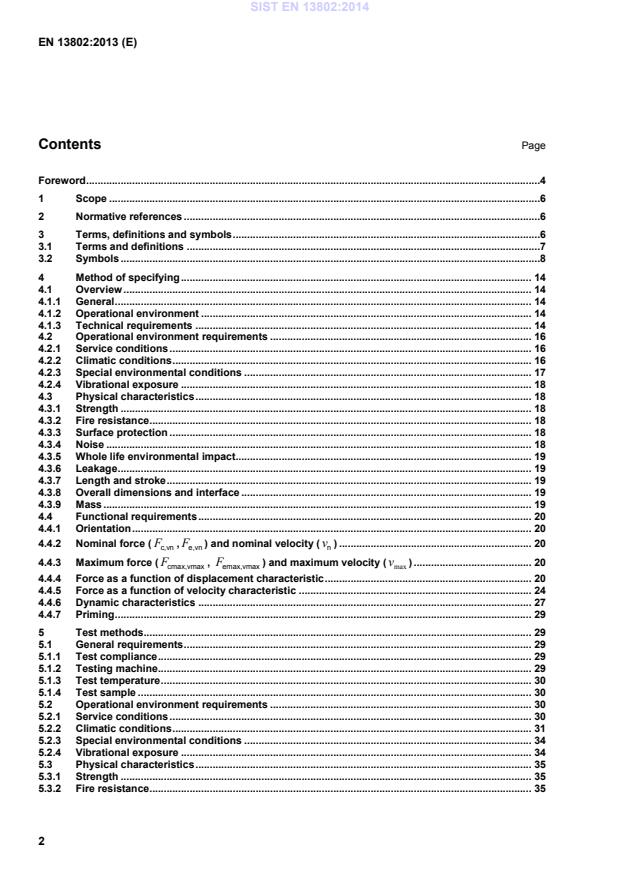
Damper specification . 42 Annex B (informative)
Damper dimensions . 46 B.1 Range of damper overall dimensions . 46 B.2 Calculating the damper length . 47 B.3 Preferred end mounting dimensions . 50 Annex C (informative)
Nominal velocities . 53 Annex D (informative)
Examples of force as a function of velocity characteristic . 54 Annex E (informative)
Checks and tests to be performed according to damper category . 56 Annex F (informative)
Dynamic test velocities . 57 Annex G (informative)
Conformity assessment procedures, samples, validity and monitoring . 58 G.1 Conformity assessment procedure of the product . 58 G.2 Validity of the product approval . 59 G.3 Control and monitoring of production quality . 59 G.4 Traceability . 59 Bibliography . 60
Clause 1 The complete hydraulic dampers, with their end mountings, are now considered in the scope. This new consideration has been taken into account in the whole standard.
Clause 2 The normative references have been updated.
4.2.1.2 A new item concerning the life cycle of the dampers has been added.
4.2.2.2 The value of minao,T to take by default has been decreased.
4.2.2.3 The value of minae,Tto take by default has been decreased.
4.2.4 and 5.2.4 The requirements concerning the behaviour against the vibrational exposures are now given as recommendations.
4.3.3 A criterion about of the surface protection has been defined.
4.3.4 A criterion about the noise generated by the damper has been defined.
4.3.9 The supply of the value of the mass is now required.
4.4.1 A criterion about the orientation of the damper has been defined.
4.4.6 and 5.4.6 The definition of the dynamic characteristics of the dampers has been revised.
6.3 Requirements about the serial tests have been added.
Clause 7 The position of the permanent marking of horizontally orientated dampers has been specified.
B.2 Methods of calculation of the damper length have been defined in this new sub-clause. SIST EN 13802:2014
B.3 Preferred interface dimensions of end mountings have been defined in this new sub-clause.
Annex F Dynamic test velocities have been defined in this new annex. NOTE The above list of changes includes the significant technical changes from EN 13802:2004 but is not an exhaustive list of all modifications from the previous version. According to the CEN-CENELEC Internal Regulations, the national standards organizations of the following countries are bound to implement this European Standard: Austria, Belgium, Bulgaria, Croatia, Cyprus, Czech Republic, Denmark, Estonia, Finland, Former Yugoslav Republic of Macedonia, France, Germany, Greece, Hungary, Iceland, Ireland, Italy, Latvia, Lithuania, Luxembourg, Malta, Netherlands, Norway, Poland, Portugal, Romania, Slovakia, Slovenia, Spain, Sweden, Switzerland, Turkey and the United Kingdom.
Note 1 to entry: The life time can consist of several service intervals. SIST EN 13802:2014
dc [N.s/m] Dynamic damping rate, this includes the effect of phase shift
cd [m] Compression margin, the part of damper compression travel never reached by the piston during operation in the given mechanical system NOTE 1 minmin,LLdu−=c Fnullc,d [m] Displacement corresponding to zero force value in compression (measured on the diagram force as a function of displacement and is negative by convention).
ed [m] Extension margin, the part of damper extension travel never reached by the piston during operation in the given mechanical system NOTE 2 max,maxueLLd−= Fnulle,d [m] Displacement corresponding to zero force value in extension (measured on the diagram force as a function of displacement and is positive by convention) nd [m] Nominal travel, the travel over which the damper meets the operational requirements established by the damper specification NOTE 3 The nominal travel is indicative of the operating travel of the damper in the given mechanical system. wd [m] Working stroke NOTE 4 min,max,uuwLLd−= SIST EN 13802:2014
F [N] Damper force, the axial force of the damper vnc,F [N] Nominal damper compression force (is negative by convention) NOTE 7 Force at nominal velocity. v0c,F [N] Damper compression force at maximum velocity of the test (measured at mid stroke on the diagram force as a function of displacement and is negative by convention) vmaxcmax,F [N] Maximum damper compression force measured on the diagram force as a function of displacement at the maximum damper velocity maxv (is negative by convention) cmax,v0F [N] Damper maximum compression force with sinusoidal displacement (measured on the diagram force as a function of displacement and is negative by convention) e,vnF [N] Nominal damper extension force (is positive by convention) NOTE 8 Force at nominal velocity. v0e,F [N] Damper extension force at maximum velocity of the test (measured at mid stroke on the diagram force as a function of displacement and is positive by convention) emax,vmaxF [N] Maximum damper extension force measured on the diagram force as a function of displacement at the maximum damper velocity maxv( is positive by convention) emax,v0F [N] Damper maximum extension force with sinusoidal displacement (measured on the diagram force as a function of displacement and is positive by convention). 0F [N] Damper force amplitude at sinusoidal motion resH [m] Height of the additional damper reservoir to damper centreline (see Figure 3) dk [N/m] Dynamic damper stiffness SIST EN 13802:2014
If not otherwise specified, the damper length is between the centres of the end mountings (see Figure 4). delL [m] Damper length at delivery NOTE 9 The length of the damper to permit mounting it on a vehicle at rest on straight, horizontal track (except for particular cases, for example pantograph dampers). iL [m] Length of the damper installed NOTE 10 Length when the damper is mounted on a vehicle at rest on straight, horizontal track. maxL [m] Damper length when the damper is fully extended minL [m] Damper length when the damper is fully compressed nL [m] Nominal damper length ()2minmaxLLL+=n maxu,L [m] Maximum utilization length of the damper NOTE 11 The maximum length of the damper during operation. minu,L [m] Minimum utilization length of the damper NOTE 12 The minimum length of the damper during operation. maxae,T [°C] Maximum ambient temperature (i.e. temperature of the air surrounding the damper) in extreme situations minae,T [°C] Minimum ambient temperature (i.e. temperature of the air surrounding the damper) in extreme situations maxao,T [°C] Maximum ambient temperature for normal vehicle operation minao,T [°C] Minimum ambient temperature for normal vehicle operation nT [°C] Nominal test temperature of the damper (see 4.2.2.1) maxs,T [°C] Maximum transportation or storage temperature to be experienced by the damper mins,T [°C] Minimum transportation or storage temperature to be experienced by the damper v [m/s] Damper velocity, piston velocity that is the relative axial velocity of the damper SIST EN 13802:2014
ω [rad/s] Angular velocity of excitation NOTE 16 00dv=ω SIST EN 13802:2014
Figure 1 — Spatial definition
Figure 2 — Diameter maxD of the damper space envelope SIST EN 13802:2014
Figure 3 — Cross sectional dimensions of damper (maxD,resD, resH)
Figure 4 — Definition of damper length L SIST EN 13802:2014
Service conditions 4.2.1 5.2.1
Service interval 4.2.1.1
Life cycle 4.2.1.2
Climatic conditions 4.2.2 5.2.2
Nominal test temperature 4.2.2.1
Operating temperature range 4.2.2.2 5.2.2.1
Temperature extremes 4.2.2.3 5.2.2.2
Storage temperatures 4.2.2.4 5.2.2.3
Specific climatic conditions 4.2.2.5 5.2.2.4
Special environmental conditions 4.2.3 5.2.3
Vibrational exposure 4.2.4 5.2.4 Physical characteristics 4.3 5.3
Strength a 4.3.1 5.3.1
Fire resistance 4.3.2 5.3.2
Surface protection a 4.3.3 5.3.3
Noise 4.3.4 5.3.4
Whole life environmental impact 4.3.5 5.3.5
Leakage 4.3.6 5.3.6
Length and stroke a 4.3.7 5.3.7
Overall dimensions and interface a 4.3.8 5.3.8
Mass 4.3.9 5.3.9 Functional requirements 4.4 5.4
Orientation a 4.4.1 5.4.1
Nominal force and nominal velocity a 4.4.2 5.4.2
Maximum force and maximum velocity a 4.4.3 5.4.3
Force as a function of displacement characteristic 4.4.4 5.4.4
Force as a function of velocity characteristic a 4.4.5 5.4.5
Acceptance a 4.4.5.2 5.4.5.2
Dynamic characteristics 4.4.6 5.4.6
Dynamic damping characteristics
5.4.6.3
Dynamic stiffness characteristics
5.4.6.4
Priming 4.4.7 5.4.7 a These items are mandatory.
0max>−=maxu,eLLd If necessary (especially for friction characteristic type dampers), the delivery length delLshall be defined. By default, mm 5idel−=LL. 4.3.8 Overall dimensions and interface The damper specification shall define the maximum overall dimensions required for the damper, determined from a defined volume-envelope. The overall dimensions shall be determined using simple volume elements (such as cylinders) in a set of reference co-ordinates linked to the damper when it is assumed fully compressed (minu,L) or fully extended (maxu,L). See Figure 2 and Figure 3. The overall dimensions of the damper shall remain within the specified volume envelope. It is recommended to use typical dimensions given in Annex B. 4.3.9 Mass The mass of the specified damper shall be given. A maximum mass limit may be specified in the damper specification. SIST EN 13802:2014
Key 1 displacement ()td [mm] 2 velocity ()tv [mm/s] 3 damper force ()tF [N] 4 displacement d [mm] or velocity v [mm/s] 5 damper force F [N] Figure 5 — Example of a diagram of travel, velocity and force
for a symmetrical linear characteristics damper
Key 1 damper force F [N] 2 displacement d [mm] Figure 6 — Example of force as a function of displacement diagram
for a symmetrical linear characteristics damper at 0v
Key 1 damper force F [N] 2 displacement d [mm] Figure 7 — Example of force as a function of displacement diagram
for a symmetrical friction characteristic type damper at 0v
The values of the forces e,v0F and c,v0F shall be taken at mid-travel on the diagram. In the case of a real diagram, maximum force values emax,v0F and cmax,v0F can differ significantly from the same forces evaluated at maximum velocity e,v0F and c,v0F (see Figure 6 and Figure 7). However, maximum forces values emax,vmaxF and cmax,vmaxF represent maximum forces applied by the damper, while forces evaluated at maximum velocity e,v0F and c,v0F shall be used as an index of the damping performance. The force as a function of displacement diagram shall be regular and shall not have any irregularity indicative of malfunctioning of the damper (for example vibrational phenomena, jumping, loss of force, sudden change in the shape of the diagram). SIST EN 13802:2014
Key 1 characteristic for extension and compression Figure 8 — Variation of force as a function of velocity for a symmetrical damper
Key 1 characteristic for extension (or compression) 2 characteristic for compression (or extension) Figure 9 — Variation of force as a function of velocity for an asymmetrical damper
...