


prEN 17775
(Main)Organic and organo-mineral fertilizers - Determination of the inorganic arsenic content
Organic and organo-mineral fertilizers - Determination of the inorganic arsenic content
This document specifies a method for extraction, separation, and determination of inorganic arsenic (iAs) in organic or organo-mineral fertilizers using anion-exchange high performance liquid chromatography (HPLC) or ion chromatography (IC) coupled to ICP-MS.
This document is applicable to fertilizing product blends where a blend is a mix of at least two of the following components: fertilizers, liming materials, soil improvers, growing media, inhibitors, plant biostimulants and where the following category organic fertilizer or organo-mineral fertiliser is the highest % in the blend by mass or volume, or in the case of liquid form by dry mass. If the organic fertilizer or the organo-mineral fertilizer is not the highest % in the blend, the European Standard for the highest % of the blend applies. In case a fertilizing product blend is composed of components in equal quantity, the user decides which standard to apply. Variations in analytical methods for fertilizing product blends can lead to differing results as some components or matrix interactions can affect the outcome. Validation procedures have shown that developed standard methods are robust and reliable across diverse product compositions, but possible interferences and unexpected results when analysing fertilizing product blends are possible.
Organische und organisch-mineralische Düngemittel - Bestimmung des Gehalts an anorganischem Arsen
Dieses Dokument legt ein Verfahren zur Extraktion, Trennung und Bestimmung von anorganischem Arsen (iAs) in organischen bzw. organisch-mineralischen Düngemitteln mit Anionenaustausch-Hochleistungs-Flüssigkeitschromatographie (HPLC) oder Ionenchromatographie (IC) gekoppelt mit ICP-MS fest.
Dieses Dokument ist anwendbar auf Düngeproduktmischungen, bei denen eine Mischung aus mindestens zwei der folgenden Komponenten besteht: Düngemittel, Kalkdünger, Bodenverbesserungsmittel, Kultursubstrate, Hemmstoffe und Pflanzen-Biostimulanzien, und wenn die Kategorie „organische Düngemittel und organisch-mineralische Düngemittel“ den höchsten Prozentsatz in der Mischung bezüglich Masse oder Volumen, oder im Falle von flüssigen Formen bezüglich Trockenmasse ausmacht. Wenn das organische Düngemittel oder das organisch-mineralische Düngemittel nicht den höchsten Prozentsatz in der Mischung ausmacht, gilt die Europäische Norm für den höchsten Prozentsatz der Mischung. Im Falle, dass die Düngeproduktmischung aus Komponenten gleicher Menge besteht, entscheidet der Anwender, welche Norm angewendet wird. Variationen in analytischen Verfahren für Düngeproduktmischungen können zu unterschiedlichen Ergebnissen führen, da einige Komponenten oder Matrixwechselwirkungen das Ergebnis beeinflussen können. Validierungen haben gezeigt, dass die entwickelten Standardverfahren robust und zuverlässig über unterschiedliche Produktzusammensetzungen hinweg sind. Jedoch sind mögliche Interferenzen und unerwartete Ergebnisse bei der Analyse von Düngeproduktmischungen möglich.
Engrais organiques et organo-minéraux - Détermination de la teneur en arsenic inorganique
Le présent document spécifie une méthode d’extraction, de séparation et de dosage de l’arsenic inorganique (iAs) dans les engrais organiques ou organo-minéraux par chromatographie en phase liquide haute performance (HPLC) avec échange d’anions ou par chromatographie ionique (IC) couplée à une ICP-MS.
Le présent document est applicable aux mélanges de fertilisants constitués d’au moins deux des composants suivants : engrais, amendements minéraux basiques, amendements du sol, supports de culture, inhibiteurs, biostimulants des végétaux et dans lesquels la catégorie « engrais organiques et organo-minéraux » représente le pourcentage le plus élevé du mélange en masse ou en volume, ou dans le cas d’un liquide, en masse sèche. Si les engrais organiques ou les engrais organo-minéraux ne représentent pas le pourcentage le plus élevé du mélange, la Norme européenne relative au composant représentant le pourcentage le plus élevé du mélange s’applique. Dans le cas où le mélange de fertilisants est constitué de composants en quantités égales, l’utilisateur décide quelle norme appliquer. Les variations dans les méthodes d’analyse des mélanges de fertilisants peuvent conduire à des résultats différents, car certaines interactions de composants ou de la matrice peuvent affecter le résultat. Les procédures de validation ont montré que les méthodes normalisées développées sont robustes et fiables pour diverses compositions de produits, mais que des interférences éventuelles et des résultats inattendus lors de l’analyse des mélanges de fertilisants sont possibles.
Organska in organsko-mineralna gnojila - Določanje anorganskega arzena
General Information
- Status
- Not Published
- Publication Date
- 12-Sep-2027
- Technical Committee
- CEN/TC 260 - Fertilizers and liming materials
- Drafting Committee
- CEN/TC 260/WG 8 - Organic and organo-mineral fertilizers
- Current Stage
- 4060 - Closure of enquiry - Enquiry
- Start Date
- 30-Apr-2026
- Due Date
- 19-Jul-2026
- Completion Date
- 30-Apr-2026
Relations
- Effective Date
- 11-Jun-2025
Overview
prEN 17775:2026 is a European draft standard developed by CEN that specifies a method for the extraction, separation, and determination of inorganic arsenic (iAs) in organic and organo-mineral fertilizers. The method utilizes anion-exchange high performance liquid chromatography (HPLC) or ion chromatography (IC), both coupled with inductively coupled plasma mass spectrometry (ICP-MS), to achieve accurate quantification. This standard is applicable to a wide range of fertilizing product blends, particularly those where organic or organo-mineral fertilizer forms the predominant component by mass or volume.
The aim of prEN 17775 is to promote reliable, robust, and reproducible testing of inorganic arsenic levels, ensuring safety and compliance with regulatory arsenic limits for fertilizers placed on the European market.
Key Topics
Scope of Application:
- Applies to organic and organo-mineral fertilizers, including blends with soil improvers, liming materials, growing media, inhibitors, and plant biostimulants when these fertilizer types are the most significant component.
- Defines rules for which standard applies based on blend composition.
Analytical Methodology:
- Focuses on mild acid oxidative extraction techniques to solubilize arsenic species.
- Arsenite (As(III)) is oxidized to arsenate (As(V)) for selective detection and quantification.
- Arsenic species are separated using HPLC or IC and detected using ICP-MS due to its high sensitivity and specificity for trace elements.
- External calibration with matrix-matched standards ensures accurate results.
Interferences and Matrix Effects:
- Highlights the need to assess and address possible interferences arising from complex fertilizer matrices or blend interactions.
- Provides procedures for method validation to ensure applicability across varied product types.
Quality Assurance:
- Emphasizes the importance of using high-purity reagents and proper laboratory practices.
- Recommends regular quality controls, including blank and spiked sample analyses.
Applications
The prEN 17775 standard serves several practical applications in the agriculture and fertilizer sectors:
Regulatory Compliance:
- Enables manufacturers and laboratories to demonstrate compliance with European regulations on maximum allowable inorganic arsenic levels in fertilizers.
- Supports transparency and trust in fertilizer safety among producers, regulators, and end-users.
Quality Control:
- Used by fertilizer manufacturers and third-party testing laboratories for batch testing and product certification.
- Assists in process optimization by identifying contamination sources during production.
Trade and Market Access:
- Harmonizes test methodology across Europe, facilitating cross-border trade and market acceptance of products.
- Reduces disputes arising from differences in arsenic determination methods between countries or organizations.
Environmental Monitoring:
- Contributes to the reduction of arsenic contamination in agricultural soils and food chains by promoting the use of fertilizers with controlled inorganic arsenic content.
Related Standards
Implementing prEN 17775 is best supported by reference to other essential standards in fertilizer analysis and safety:
prEN 17773:
Organic and organo-mineral fertilizers - Determination of the dry matter contentprEN 12944-1 & prEN 12944-2:
Fertilizers, liming materials and inhibitors - Vocabulary - General terms and terms relating to fertilizersEN 1482-2:
Fertilizers, liming materials and inhibitors - Sampling and sample preparation
Additionally:
- ISO 5725-2: Guidance on precision (repeatability and reproducibility) for analytical methods.
- prEN 17768, prEN 17770: Standards related to aqua regia extraction and total arsenic determination.
By referencing prEN 17775 and its related standards, laboratories and manufacturers ensure best practices in inorganic arsenic testing in fertilizers, fostering product safety, regulatory compliance, and environmental protection.

Get Certified
Connect with accredited certification bodies for this standard

Control Union Certifications
Global certification for agriculture and sustainability.

ECOCERT
Organic and sustainability certification.

FSC International
Forest Stewardship Council certification.
Sponsored listings
Frequently Asked Questions
prEN 17775 is a draft published by the European Committee for Standardization (CEN). Its full title is "Organic and organo-mineral fertilizers - Determination of the inorganic arsenic content". This standard covers: This document specifies a method for extraction, separation, and determination of inorganic arsenic (iAs) in organic or organo-mineral fertilizers using anion-exchange high performance liquid chromatography (HPLC) or ion chromatography (IC) coupled to ICP-MS. This document is applicable to fertilizing product blends where a blend is a mix of at least two of the following components: fertilizers, liming materials, soil improvers, growing media, inhibitors, plant biostimulants and where the following category organic fertilizer or organo-mineral fertiliser is the highest % in the blend by mass or volume, or in the case of liquid form by dry mass. If the organic fertilizer or the organo-mineral fertilizer is not the highest % in the blend, the European Standard for the highest % of the blend applies. In case a fertilizing product blend is composed of components in equal quantity, the user decides which standard to apply. Variations in analytical methods for fertilizing product blends can lead to differing results as some components or matrix interactions can affect the outcome. Validation procedures have shown that developed standard methods are robust and reliable across diverse product compositions, but possible interferences and unexpected results when analysing fertilizing product blends are possible.
This document specifies a method for extraction, separation, and determination of inorganic arsenic (iAs) in organic or organo-mineral fertilizers using anion-exchange high performance liquid chromatography (HPLC) or ion chromatography (IC) coupled to ICP-MS. This document is applicable to fertilizing product blends where a blend is a mix of at least two of the following components: fertilizers, liming materials, soil improvers, growing media, inhibitors, plant biostimulants and where the following category organic fertilizer or organo-mineral fertiliser is the highest % in the blend by mass or volume, or in the case of liquid form by dry mass. If the organic fertilizer or the organo-mineral fertilizer is not the highest % in the blend, the European Standard for the highest % of the blend applies. In case a fertilizing product blend is composed of components in equal quantity, the user decides which standard to apply. Variations in analytical methods for fertilizing product blends can lead to differing results as some components or matrix interactions can affect the outcome. Validation procedures have shown that developed standard methods are robust and reliable across diverse product compositions, but possible interferences and unexpected results when analysing fertilizing product blends are possible.
prEN 17775 is classified under the following ICS (International Classification for Standards) categories: 65.080 - Fertilizers. The ICS classification helps identify the subject area and facilitates finding related standards.
prEN 17775 has the following relationships with other standards: It is inter standard links to CEN/TS 17775:2022. Understanding these relationships helps ensure you are using the most current and applicable version of the standard.
prEN 17775 is associated with the following European legislation: EU Directives/Regulations: 2019/1009; Standardization Mandates: M/564, M/564 AMD 1, M/564 AMD 2. When a standard is cited in the Official Journal of the European Union, products manufactured in conformity with it benefit from a presumption of conformity with the essential requirements of the corresponding EU directive or regulation.
prEN 17775 is available in PDF format for immediate download after purchase. The document can be added to your cart and obtained through the secure checkout process. Digital delivery ensures instant access to the complete standard document.
Standards Content (Sample)
SLOVENSKI STANDARD
01-marec-2026
Organska in organsko-mineralna gnojila - Določanje anorganskega arzena
Organic and organo-mineral fertilizers - Determination of the inorganic arsenic content
Organische und organisch-mineralische Düngemittel - Bestimmung des Gehalts an
anorganischem Arsen
Engrais organiques et organo-minéraux - Détermination de la teneur en arsenic
inorganique
Ta slovenski standard je istoveten z: prEN 17775
ICS:
65.080 Gnojila Fertilizers
2003-01.Slovenski inštitut za standardizacijo. Razmnoževanje celote ali delov tega standarda ni dovoljeno.
DRAFT
EUROPEAN STANDARD
NORME EUROPÉENNE
EUROPÄISCHE NORM
February 2026
ICS 65.080 Will supersede CEN/TS 17775:2022
English Version
Organic and organo-mineral fertilizers - Determination of
the inorganic arsenic content
Engrais organiques et organo-minéraux - Organische und organisch-mineralische Düngemittel -
Détermination de la teneur en arsenic inorganique Bestimmung des Gehalts an anorganischem Arsen
This draft European Standard is submitted to CEN members for enquiry. It has been drawn up by the Technical Committee
CEN/TC 260.
If this draft becomes a European Standard, CEN members are bound to comply with the CEN/CENELEC Internal Regulations
which stipulate the conditions for giving this European Standard the status of a national standard without any alteration.
This draft European Standard was established by CEN in three official versions (English, French, German). A version in any other
language made by translation under the responsibility of a CEN member into its own language and notified to the CEN-CENELEC
Management Centre has the same status as the official versions.
CEN members are the national standards bodies of Austria, Belgium, Bulgaria, Croatia, Cyprus, Czech Republic, Denmark, Estonia,
Finland, France, Germany, Greece, Hungary, Iceland, Ireland, Italy, Latvia, Lithuania, Luxembourg, Malta, Netherlands, Norway,
Poland, Portugal, Republic of North Macedonia, Romania, Serbia, Slovakia, Slovenia, Spain, Sweden, Switzerland, Türkiye and
United Kingdom.
Recipients of this draft are invited to submit, with their comments, notification of any relevant patent rights of which they are
aware and to provide supporting documentation.
Warning : This document is not a European Standard. It is distributed for review and comments. It is subject to change without
notice and shall not be referred to as a European Standard.
EUROPEAN COMMITTEE FOR STANDARDIZATION
COMITÉ EUROPÉEN DE NORMALISATION
EUROPÄISCHES KOMITEE FÜR NORMUNG
CEN-CENELEC Management Centre: Rue de la Science 23, B-1040 Brussels
© 2026 CEN All rights of exploitation in any form and by any means reserved Ref. No. prEN 17775:2026 E
worldwide for CEN national Members.
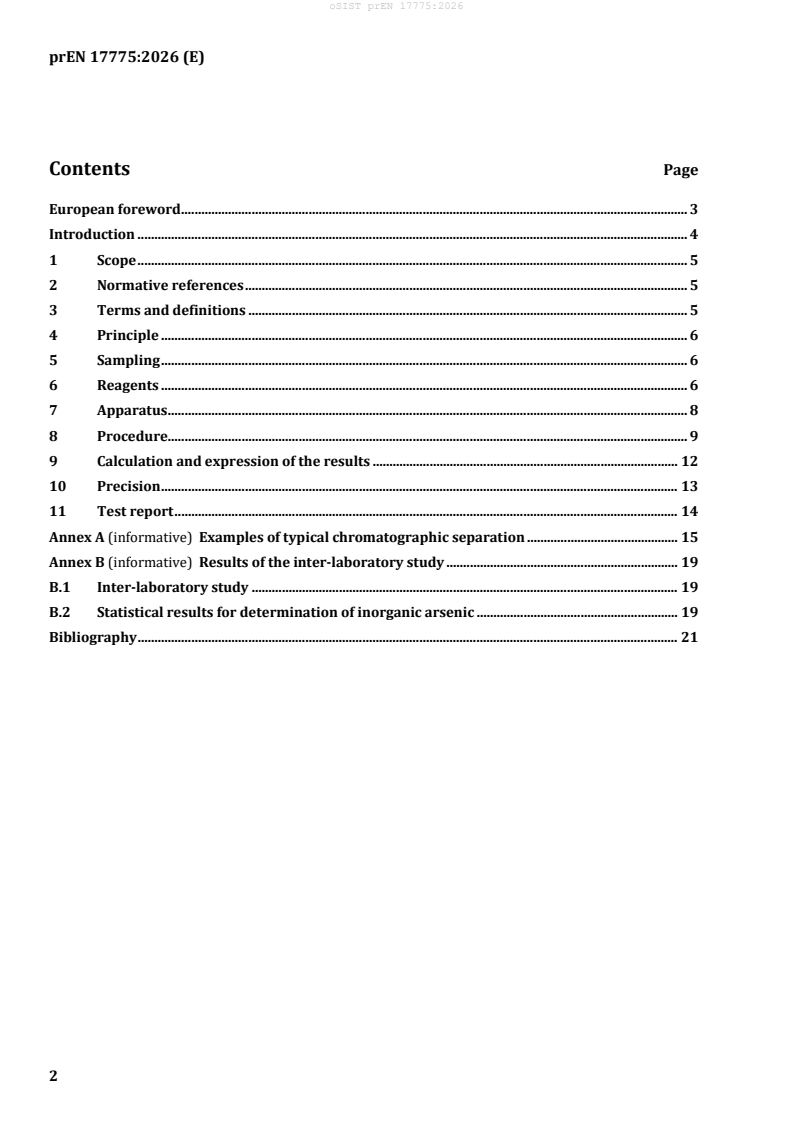
Contents Page
European foreword . 3
Introduction . 4
1 Scope . 5
2 Normative references . 5
3 Terms and definitions . 5
4 Principle . 6
5 Sampling . 6
6 Reagents . 6
7 Apparatus . 8
8 Procedure. 9
9 Calculation and expression of the results . 12
10 Precision . 13
11 Test report . 14
Annex A (informative) Examples of typical chromatographic separation . 15
Annex B (informative) Results of the inter-laboratory study . 19
B.1 Inter-laboratory study . 19
B.2 Statistical results for determination of inorganic arsenic . 19
Bibliography . 21
European foreword
This document (prEN 17775:2026) has been prepared by Technical Committee CEN/TC 260 “Fertilizers
and liming materials”, the secretariat of which is held by DIN.
This document is currently submitted to the CEN Enquiry.
This document will supersede CEN/TS 17775:2022.
Compared to the previous edition, prEN 17775:2026 includes the following significant technical changes:
— the CEN Technical Specification has been adopted as a European Standard;
— Scope (Clause 1) updated including a clarification on fertilizing product blends;
— Normative references to dry matter content determination added;
— Normative references to sampling added;
— Terms and definitions revised;
— Test report revised;
— Bibliography revised;
— Annex A (Examples of typical chromatographic separation) revised;
— Annex B (Results of the inter-laboratory study) added.
This document has been prepared under a Standardization Request addressed to CEN by the European
Commission. The Standing Committee of the EFTA States subsequently approves these requests for its
Member States.
Introduction
The method is based on a mild acid oxidative extraction of the arsenic species followed by liquid
chromatography (high performance liquid chromatography [HPLC] or ion chromatography [IC]) coupled
to the element-specific detector ICP-MS (inductively coupled plasma mass spectrometer) for the
determination of the mass fraction of inorganic arsenic (iAs).
Other standards developed for determination of inorganic arsenic content in plant biostimulants, animal
feeding stuffs and foodstuffs were studied and considered as a basis of the described method [2], [3], [4],
[5], [6].
The inter-laboratory study reflects the final statistical characteristics of the method for the determination
of inorganic arsenic content in organic and organo-mineral fertilizers. The results are given in Annex B
(informative).
To prove the compliance with existing limit values for inorganic arsenic in organic and organo-mineral
fertilizers, there is the possibility to choose between:
Using a test method determining the total arsenic content, as long as the result of the test shows a
content below the limit value for inorganic arsenic. In such a case, it can be safely assumed that the
organic fertilizer or the organo-mineral fertilizer complies with the limit value for inorganic arsenic.
Using a test method which determines only inorganic arsenic content.
A preliminary determination of the total arsenic in aqua regia extracts by ICP-AES (inductively coupled
plasma atomic emission spectrometry) according to prEN 17768 [8] and prEN 17770 [9] can reduce the
number of the samples where the determination of iAs is necessary because if the content of aqua regia
(total) extractable arsenic is lower than the legislative limit for iAs then the determination of iAs is not
necessary. In case total As is measured and is presented above or equal the legislative limit for iAs, the
content of inorganic As should be determined according to this document.
WARNING — Persons using this document should be familiar with usual laboratory practice. This
document does not purport to address all of the safety issues, if any, associated with its use. It is the
responsibility of the user to establish appropriate health and safety practices and to ensure compliance
with any national regulatory conditions.
IMPORTANT — It is absolutely essential that tests conducted according to this document are carried out
by suitably trained staff.
1 Scope
This document specifies a method for extraction, separation, and determination of inorganic arsenic (iAs)
in organic or organo-mineral fertilizers using anion-exchange high performance liquid chromatography
(HPLC) or ion chromatography (IC) coupled to ICP-MS.
This document is applicable to fertilizing product blends where a blend is a mix of at least two of the
following components: fertilizers, liming materials, soil improvers, growing media, inhibitors, plant
biostimulants and where the following category organic fertilizer or organo-mineral fertiliser is the
highest % in the blend by mass or volume, or in the case of liquid form by dry mass. If the organic fertilizer
or the organo-mineral fertilizer is not the highest % in the blend, the European Standard for the highest
% of the blend applies. In case a fertilizing product blend is composed of components in equal quantity,
the user decides which standard to apply. Variations in analytical methods for fertilizing product blends
can lead to differing results as some components or matrix interactions can affect the outcome. Validation
procedures have shown that developed standard methods are robust and reliable across diverse product
compositions, but possible interferences and unexpected results when analysing fertilizing product
blends are possible.
2 Normative references
The following documents are referred to in the text in such a way that some or all of their content
constitutes requirements of this document. For dated references, only the edition cited applies. For
undated references, the latest edition of the referenced document (including any amendments) applies.
prEN 17773, Organic and organo-mineral fertilizers — Determination of the dry matter content
prEN 12944-1, Fertilizers, liming materials and inhibitors — Vocabulary — Part 1: General terms
prEN 12944-2, Fertilizers, liming materials and inhibitors — Vocabulary — Part 2: Terms relating to
fertilizers
EN 1482-2, Fertilizers, liming materials and inhibitors — Sampling and sample preparation — Part 2:
General sample preparation provisions
3 Terms and definitions
For the purposes of this document, the terms and definitions given in prEN 12944-1 and prEN 12944-2
and the following apply.
ISO and IEC maintain terminology databases for use in standardization at the following addresses:
— ISO Online browsing platform: available at https://www.iso.org/obp/
— IEC Electropedia: available at https://www.electropedia.org/
3.1
analyte
parameter to be determined
3.2
blank calibration solution
solution prepared in the same way as the calibration solution but leaving out the analytes
3.3
blank test solution
solution prepared in the same way as the test sample solution but omitting the test portion
3.4
calibration solution
solution used to calibrate the instrument, prepared from stock solutions by adding acids, buffer, reference
element and salts as needed
3.5
stock solution
solution with accurately known analyte concentration(s), prepared from pure chemicals
3.6
test sample solution
solution prepared after extraction or digestion of the test sample according to appropriate specifications
4 Principle
This document specifies a method for the determination of inorganic arsenic in organic or organo-
mineral fertilizers. Inorganic arsenic consists of arsenite As(III) and arsenate As(V). A representative test
portion of the sample is treated with a diluted nitric acid and hydrogen peroxide solution in a heated
water bath. By this means the sample is solubilised, arsenic species are extracted into solution and As(III)
is oxidized to As(V). The inorganic arsenic is selectively separated from other arsenic compounds using
anion exchange HPLC (high performance liquid chromatography) coupled online to the element-specific
detector ICP-MS (inductively coupled plasma mass spectrometer) for the determination of the mass
fraction of the inorganic arsenic. External calibration with solvent matrix-matched standards is used for
the quantification of the amount of the inorganic arsenic. Alternatively, IC (ion chromatography) coupled
to ICP-MS can be used.
5 Sampling
Sampling is not part of the method specified in this document. Recommended sampling methods are
given in EN 1482-1 [11] and in EN 1482-3 [12].
It is important that the laboratory receives a sample that is representative of both the product under
consideration and the given analysis. The sample should not have been damaged or changed during
transport or storage.
Sample preparation shall be carried out in accordance with EN 1482-2.
6 Reagents
6.1 General
When using a method of high sensitivity like ICP-MS, the control of the blank levels of water, acid and
other reagents is very important. The reagents shall be of adequate purity and of recognized analytical
grade. The concentration of arsenic species in the reagents and water used shall be negligible and low
enough not to affect the results of the determination. Generally, ultra-pure water and nitric acid of
minimum p.a. quality is recommended.
6.2 Water, with an electrical conductivity not higher than 0,1 mS/m at 25 °C.
6.3 Nitric acid (HNO ), concentrated, ≥ 65 % (mass fraction), mass concentration of approximately ρ
(HNO ) 1,4 g/ml.
Use only nitric acid available with high purity (minimum p.a. quality) in order to avoid potential
contamination.
6.4 Hydrogen peroxide, H O not less than 30 % (mass fraction).
2 2
High purity is essential to avoid potential contamination. Commercially available hydrogen peroxide for
analysis should be tested for contamination of arsenic prior to use. It is necessary to prevent peroxide
degradation and ensure the stability of the solution, this is in the discretion of the analyst to use only H O
2 2
of adequate quality.
6.5 Extraction solution, 0,1 mol/l HNO in 3 % (volume fraction) H O .
3 2 2
Add 6,5 ml of HNO (6.3) and thereafter 100 ml of hydrogen peroxide (6.4) into 800 ml water (6.2) in
a 1 000 ml volumetric flask. Fill the flask to the mark with water (6.2). This solution is prepared on the
day of use.
It is recommended that the total volume needed for the analysis is estimated and only this amount is
produced in the day of use.
6.6 Ammonium carbonate, (NH ) CO , mass fraction w ≥ 99,999 %, for preparation of the mobile
4 2 3
phase solution.
6.7 Aqueous ammonia, (NH (aq)), mass fraction w ≥ 25 %, for adjustment of pH in the mobile phase.
6.8 Methanol, (CH OH), HPLC grade, for preparation of the mobile phase solution.
6.9 Mobile phase, e.g. 50 mmol/l ammonium carbonate in 3 % (volume fraction) methanol at pH 10,3.
Dissolve 4,80 g of ammonium carbonate (6.6) in approximately 800 ml water (6.2). Adjust the pH to 10,3
with aqueous ammonia (6.7) and add 30 ml of methanol (6.8) and then fill up to 1 000 ml with water
(6.2). Prior to use filter the mobile phase solution through a 0,45 μm filter using a filtering device (7.4).
The optimal concentration of ammonium carbonate in the mobile phase depends on the analytical column
used (e.g. brand, particle size and dimensions) and should be verified in advance. The appropriate
concentration of ammonium carbonate (usually between 10 mmol/l to 50 mmol/l) is highly dependent
on the column used and is up to the discretion of the analyst. It should fulfil the criteria for sufficient
resolution of the arsenate peak.
Methanol is added to the mobile phase in order to enhance the signal intensity for arsenic. The
concentration of methanol to achieve the highest signal to noise ratio depends on the instrument used
and should be identified by the analyst.
NOTE 1 Different mobile phase can be also used according to the instructions of the manufacturer of the column
but it is necessary to verify the optimal separation conditions.
NOTE 2 For example, Agilent column G3154–65001 with a guard column G3154–65002 and a mobile phase
recommended for this column, as a mixture of potassium dihydrogen phosphate (KH2PO4) 2 mmol/l,
ethylenediaminetetraacetic acid disodium salt dihydrate (EDTA disodium salt) 0,2 mmol/l, pH 6,0 adjusted with
sodium hydroxide (NaOH) 1 mol/l, were successfully used for the analysis.
6.10 Arsenic (V) standard stock solution, with an arsenic (V) mass concentration of 1 000 mg/l.
The use of commercial standards of arsenic As(V), with a mass concentration of 1 000 mg/l is
recommended.
1 ®
Agilent is a registered trademark of Agilent Technologies Inc. This information is given for the convenience of
users of this document and does not constitute an endorsement by CEN of the product named.
6.11 Arsenic (V) standard solution I, with an arsenic (V) mass concentration of 10 mg/l in 2 %
(volume fraction) HNO3.
Pipette 1 ml of arsenic standard stock solution (6.10) into a 100 ml volumetric flask. Add 2 ml of nitric
acid (6.3), fill to the mark with water (6.2) and mix well. This solution is stable in a refrigerator at least
one week.
6.12 Arsenic (V) standard solution II, with an arsenic (V) mass concentration of 1 mg/l.
Pipette 10 ml of arsenic standard solution I (6.11) into a 100 ml volumetric flask, fill to the mark with
water (6.2) and mix well. This solution should be prepared on the same day of use.
6.13 Solution for checking chromatographic separation, containing organic arsenic compounds (e.g.
10 μg/l) monomethylarsenous acid (MMA), dimethylarsinic acid (DMA) and arsenobetaine (AB), as well
as arsenate (e.g. 10 μg/l), arsenite (e.g. 10 μg/l) and chloride (e.g. 100 mg/l).
This solution is recommended to demonstrate satisfactory resolution of individual arsenic species,
possible interferents and to find out how the chromatographic conditions should be optimized (e.g. by
changing the mobile phase concentration or the mobile phase flow rate).
The solution shall be prepared in water (6.2), not in the extraction solution, to check the retention time
of the individual arsenic species, their visual presentation in the chromatogram and how the peaks are
separated.
7 Apparatus
7.1 Common laboratory glass and plastic ware.
Plastic volumetric flasks are recommended for the preparation of the mobile phase and calibration
solutions. All glassware and plastic ware shall be adequately cleaned and stored to avoid any
contamination.
7.2 Laboratory grinder, capable of grinding to a particle size less than 0,5 mm.
7.3 Analytical balance, capable of weighing to the nearest of 1 mg or better.
7.4 Filtering device, for filtration of mobile phase with a filter, pore size 0,45 μm.
7.5 Heated (shaking) water bath, capable of maintaining 90 °C.
Some fine materials can form a thin layer on the surface of the extraction solution and the contact of the
sample with the extraction solution can be less intensive. Therefore, the shaking water bath is
recommended to ensure the efficient extraction of the sample.
The manual shaking of the solutions in a specific time intervals (e.g. every 10 min) is also possible.
7.6 Extraction plastic tubes with screwing caps, resistance to temperature of 90 °C, of nominal
capacity 25 ml to 50 ml.
To maintain the extraction ratio (sample portion/extraction solution) use the test tubes volume
accordingly. Before use, check the cleanliness of tubes and caps.
-1
7.7 Centrifuge, for minimum 4 000 min (approx. 2 000 g).
7.8 Single
...