

EN 1983:2006
(Main)Industrial valves - Steel ball valves
- Abstract
This European Standard specifies requirements for industrial steel ball valves having flanged, threaded, socket welding or butt welding ends.
The DN range is:
¾ DN 4 ; DN 6 ; DN 8 ; DN 10 ; DN 15 ; DN 20 ; DN 25 ; DN 32 ; DN 40 ; DN 50 ; DN 65 ; DN 80 ; DN 100 ; DN 125 ; DN 150 ; DN 200 ; DN 250 ; DN 300 ; DN 350 ; DN 400 ; DN 450 ; DN 500 ; DN 550 ; DN 600 ; DN 650 ; DN 700 ; DN 750 ; DN 800 ; DN 850 ; DN 900.
The PN and Class ranges are:
¾ PN 6 ; PN 10 ; PN 16 ; PN 25 ; PN 40 ; PN 63 ; PN 100 ;
¾ Class 150 ; Class 300 ; Class 600 ; Class 900 ; Class 1 500 ; Class 2 500 ; Class 4 500.
This European Standard applies to steel ball valves mainly used for industrial and general purpose applications. However, they can be used for other applications provided the requirements of the relevant performance standard are met.
- Status
- Withdrawn
- Publication Date
- 02-May-2006
- Withdrawal Date
- 27-Aug-2013
- Technical Committee
- CEN/TC 69 - Industrial valves
- Drafting Committee
- CEN/TC 69/WG 5 - Plug and ball valves
- Current Stage
- 9960 - Withdrawal effective - Withdrawal
- Start Date
- 28-Aug-2013
- Completion Date
- 28-Aug-2013
- Directive
- 97/23/EC - Pressure equipmentOJ Ref: C, C 118 OJ Date: 15-Apr-2011

Relations
- Effective Date
- 04-Sep-2013
- Effective Date
- 25-Aug-2026
- Effective Date
- 22-Apr-2026
- Effective Date
- 04-Mar-2026
- Effective Date
- 28-Jan-2026
- Effective Date
- 28-Jan-2026
- Effective Date
- 28-Jan-2026
- Refers
prEN 15116 - Ventilation in buildings - Chilled beams - Testing and rating of active chilled beams - Effective Date
- 28-Jan-2026
- Effective Date
- 28-Jan-2026
- Effective Date
- 28-Jan-2026
- Effective Date
- 28-Jan-2026
- Effective Date
- 28-Jan-2026
- Effective Date
- 28-Jan-2026
- Effective Date
- 28-Jan-2026
- Effective Date
- 28-Jan-2026
Get Certified
Connect with accredited certification bodies for this standard

Institut za varilstvo d.o.o. (Welding Institute)
Slovenia's leading welding institute since 1952. ISO 3834, EN 1090, pressure equipment certification, NDT personnel, welder qualification. Only IIW Au
Sponsored listings
Frequently Asked Questions
EN 1983:2006 is a standard published by the European Committee for Standardization (CEN). Its full title is "Industrial valves - Steel ball valves". This standard covers: This European Standard specifies requirements for industrial steel ball valves having flanged, threaded, socket welding or butt welding ends. The DN range is: ¾ DN 4 ; DN 6 ; DN 8 ; DN 10 ; DN 15 ; DN 20 ; DN 25 ; DN 32 ; DN 40 ; DN 50 ; DN 65 ; DN 80 ; DN 100 ; DN 125 ; DN 150 ; DN 200 ; DN 250 ; DN 300 ; DN 350 ; DN 400 ; DN 450 ; DN 500 ; DN 550 ; DN 600 ; DN 650 ; DN 700 ; DN 750 ; DN 800 ; DN 850 ; DN 900. The PN and Class ranges are: ¾ PN 6 ; PN 10 ; PN 16 ; PN 25 ; PN 40 ; PN 63 ; PN 100 ; ¾ Class 150 ; Class 300 ; Class 600 ; Class 900 ; Class 1 500 ; Class 2 500 ; Class 4 500. This European Standard applies to steel ball valves mainly used for industrial and general purpose applications. However, they can be used for other applications provided the requirements of the relevant performance standard are met.
This European Standard specifies requirements for industrial steel ball valves having flanged, threaded, socket welding or butt welding ends. The DN range is: ¾ DN 4 ; DN 6 ; DN 8 ; DN 10 ; DN 15 ; DN 20 ; DN 25 ; DN 32 ; DN 40 ; DN 50 ; DN 65 ; DN 80 ; DN 100 ; DN 125 ; DN 150 ; DN 200 ; DN 250 ; DN 300 ; DN 350 ; DN 400 ; DN 450 ; DN 500 ; DN 550 ; DN 600 ; DN 650 ; DN 700 ; DN 750 ; DN 800 ; DN 850 ; DN 900. The PN and Class ranges are: ¾ PN 6 ; PN 10 ; PN 16 ; PN 25 ; PN 40 ; PN 63 ; PN 100 ; ¾ Class 150 ; Class 300 ; Class 600 ; Class 900 ; Class 1 500 ; Class 2 500 ; Class 4 500. This European Standard applies to steel ball valves mainly used for industrial and general purpose applications. However, they can be used for other applications provided the requirements of the relevant performance standard are met.
EN 1983:2006 is classified under the following ICS (International Classification for Standards) categories: 23.060.20 - Ball and plug valves. The ICS classification helps identify the subject area and facilitates finding related standards.
EN 1983:2006 has the following relationships with other standards: It is inter standard links to EN 1983:2013, ISO 7-1:1994, EN 12570:2000, EN ISO 5211:2026, EN 1515-1:1999, EN 1503-1:2000, EN 12516-2:2004, prEN 15116, EN 12266-1:2012, EN 12266-2:2012, EN ISO 5211:2023, EN 1515-2:2001, EN 12627:2017, EN ISO 10497:2004, EN 19:2002. Understanding these relationships helps ensure you are using the most current and applicable version of the standard.
EN 1983:2006 is associated with the following European legislation: EU Directives/Regulations: 97/23/EC; Standardization Mandates: M/071. When a standard is cited in the Official Journal of the European Union, products manufactured in conformity with it benefit from a presumption of conformity with the essential requirements of the corresponding EU directive or regulation.
EN 1983:2006 is available in PDF format for immediate download after purchase. The document can be added to your cart and obtained through the secure checkout process. Digital delivery ensures instant access to the complete standard document.
Standards Content (Sample)
2003-01.Slovenski inštitut za standardizacijo. Razmnoževanje celote ali delov tega standarda ni dovoljeno.Industrial valves - Steel ball valvesIndustrijski ventili – Jekleni krogelni ventiliRobinetterie industrielle - Robinets a tournant sphérique en acierIndustriearmaturen - Kugelhähne aus StahlTa slovenski standard je istoveten z:EN 1983:2006SIST EN 1983:2006en23.060.20Zapirni ventili (kroglasti in pipe)Ball and plug valvesICS:SLOVENSKI
STANDARDSIST EN 1983:200601-oktober-2006
EUROPEAN STANDARDNORME EUROPÉENNEEUROPÄISCHE NORMEN 1983May 2006ICS 23.060.20 English VersionIndustrial valves - Steel ball valvesRobinetterie industrielle - Robinets à tournant sphérique enacierIndustriearmaturen - Kugelhähne aus StahlThis European Standard was approved by CEN on 23 March 2006.CEN members are bound to comply with the CEN/CENELEC Internal Regulations which stipulate the conditions for giving this EuropeanStandard the status of a national standard without any alteration. Up-to-date lists and bibliographical references concerning such nationalstandards may be obtained on application to the Central Secretariat or to any CEN member.This European Standard exists in three official versions (English, French, German). A version in any other language made by translationunder the responsibility of a CEN member into its own language and notified to the Central Secretariat has the same status as the officialversions.CEN members are the national standards bodies of Austria, Belgium, Cyprus, Czech Republic, Denmark, Estonia, Finland, France,Germany, Greece, Hungary, Iceland, Ireland, Italy, Latvia, Lithuania, Luxembourg, Malta, Netherlands, Norway, Poland, Portugal, Romania,Slovakia, Slovenia, Spain, Sweden, Switzerland and United Kingdom.EUROPEAN COMMITTEE FOR STANDARDIZATIONCOMITÉ EUROPÉEN DE NORMALISATIONEUROPÄISCHES KOMITEE FÜR NORMUNGManagement Centre: rue de Stassart, 36
B-1050 Brussels© 2006 CENAll rights of exploitation in any form and by any means reservedworldwide for CEN national Members.Ref. No. EN 1983:2006: E
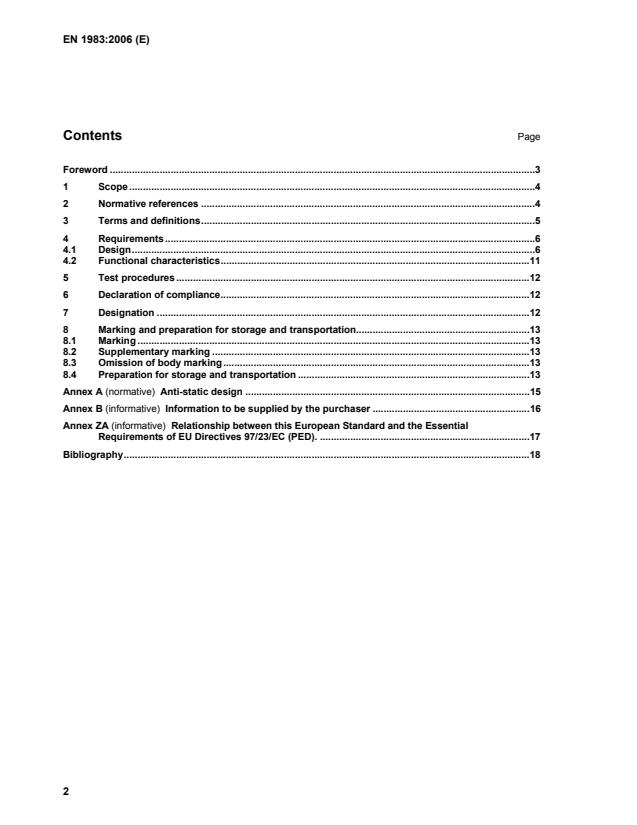
Anti-static design.15 Annex B (informative)
Information to be supplied by the purchaser.16 Annex ZA (informative)
Relationship between this European Standard and the Essential Requirements of EU Directives 97/23/EC (PED).17 Bibliography.18
1) Under preparation.
EN 736-2:1997 and EN 736-3:1999 and the following apply. 3.1 Effective diameter manufactured minimum diameter through the flow passage of the valve in the fully open position
Figure 1a — Full bore pattern Figure 1b — Reduced bore pattern Figure 1 — Valve patterns 4.1.1.2 Size and pressure designation The range of nominal sizes and pressure designations covered by each type of body end connection shall be as specified in Tables 1 to 3. Table 1 — Ball valves with flanged and butt welding ends Size PN Class DN 8 to DN 900 PN 10 to PN 100Class 150 Class 300 Class 600 DN 8 to DN 600 - Class 900 DN 8 to DN 400 - Class 1 500 DN 8 to DN 50
Class 2 500 NOTE Sizes DN 8, DN 550, DN 650, DN 750 and DN 850 are not applicable to flanged valves.
Table 2 — Ball valves with socket weld ends Size PN Class DN 8 to DN 100 PN 10 - DN 8 to DN 50 PN 16 to PN 100 -
Typical ball valve construction variants are illustrated in Figure 2.
Figure 2a — Type of ball
Figure 2b — Type of body Key 1 Seat support 2 Trunnion support 3 Sealed 4 One piece body - Axial entry (insert) 5 Top entry 6 Split body in two pieces 7 Split body in three pieces NOTE The end connections are only examples. Figure 2 — Typical ball valve construction 4.1.1.3 Body Valves shall be designed in accordance with EN 12516-1, EN 12516-2 or EN 12516-3. 4.1.1.4 Ball The ball port shall be circular with minimum effective diameters as specified in Table 4. Where a specific ball construction is required, this shall be specified by the purchaser (see Figure 3 for examples).
...