

EN 15714-4:2025
(Main)Industrial valves - Actuators - Part 4: Hydraulic part-turn actuators for industrial valves - Basic requirements
- Abstract
This document specifies basic requirements for hydraulic part-turn valve actuators, both double acting and single acting, used for on-off and modulating control duties.
It includes guidelines, recommendations and methods for enclosure and corrosion protection, control and testing.
It does not apply to hydraulic actuators which are integral parts of control valves and to hydraulic actuators designed for permanent immersion in fresh or sea water as well as electro-hydraulic actuators.
Other requirements, or conditions of use, different from those indicated in this document can vary upon request.
- Status
- Published
- Publication Date
- 13-May-2025
- Technical Committee
- CEN/TC 69 - Industrial valves
- Drafting Committee
- CEN/TC 69/WG 1 - Basic standards
- Current Stage
- 6060 - Definitive text made available (DAV) - Publishing
- Start Date
- 14-May-2025
- Due Date
- 03-Nov-2025
- Completion Date
- 14-May-2025

Overview
EN 15714-4:2025 - published by CEN in May 2025 - defines the basic requirements for hydraulic part-turn actuators for industrial valves. It covers both double acting (DA) and single acting (SA) hydraulic part‑turn actuators used for on‑off and modulating control duties, and provides guidance on enclosure and corrosion protection, control interfaces and testing. The standard supersedes the previous edition and updates endurance values and testing/marking structure.
This standard does not apply to:
- hydraulic actuators that are integral parts of control valves,
- actuators designed for permanent immersion in fresh or sea water,
- electro‑hydraulic actuators.
Key topics and technical requirements
EN 15714-4:2025 addresses practical design, selection and verification elements for hydraulic part‑turn actuators:
- Classification and designation
- Duty types: on‑off and modulating
- Action: double acting (DA) and single acting (SA)
- Motive energy and hydraulics
- Operating medium, quality and pressure parameters (MAP, design, working, structural test, minimum moving pressure)
- Performance data
- Minimum moving pressure, operating time, displacement volume
- Basic design requirements
- Safety requirements and actuator attachment (ISO 5211 compatibility)
- Angular stroke and endurance (updated ranges)
- Leakage limits and structural safety factors
- Environmental and protection
- Ambient temperature ranges, enclosure protection (IP ratings per EN 60529), corrosion protection methods
- Pressure connections and pilot valve mounting
- Requirements for remote and direct‑mounted pilot valves and single‑acting actuator connections
- Control, indication and optional equipment
- Position indication, manual operation options, mechanical end‑stop adjustment, ancillaries
- Testing and conformity
- Type tests, endurance tests, control of production, marking and documentation requirements
- Selection guidance
- Annexes provide actuator type test procedures and actuator selection guidelines for practical application
Applications and users
EN 15714-4:2025 is intended for:
- Valve manufacturers and actuator designers specifying hydraulic part‑turn actuators (rack‑and‑pinion, scotch‑yoke, etc.)
- Plant engineers and procurement teams selecting actuators for ball, plug and other part‑turn industrial valves
- EPC contractors, integrators and maintenance teams responsible for actuator installation, testing and documentation
- Test houses and certification bodies performing type tests and conformity assessment
Typical use cases include on‑off isolation and modulating control in oil & gas, petrochemical, water treatment, power generation and industrial process systems where hydraulic actuation is required.
Related standards
- EN ISO 5211 - Part‑turn actuator attachments
- EN 12570 - Sizing the operating element
- EN 15714-1 - Terminology and definitions for actuators
- EN 60529 - Degrees of protection (IP Code)
- ISO 4401 / ISO 4406 - Hydraulic valve mounting and fluid contamination coding
Keywords: EN 15714-4:2025, hydraulic part-turn actuators, industrial valves, double acting, single acting, on-off control, modulating control, corrosion protection, IP rating, actuator testing.
Relations
- Effective Date
- 26-Jul-2023
- Effective Date
- 25-Aug-2026
- Refers
ISO 4401:2005 - Hydraulic fluid power — Four-port directional control valves — Mounting surfaces - Effective Date
- 25-Aug-2026
- Effective Date
- 22-Apr-2026
- Effective Date
- 04-Mar-2026
- Effective Date
- 09-Feb-2026
- Effective Date
- 28-Jan-2026
- Effective Date
- 28-Jan-2026
- Effective Date
- 28-Jan-2026
- Effective Date
- 28-Jan-2026
Get Certified
Connect with accredited certification bodies for this standard

Institut za varilstvo d.o.o. (Welding Institute)
Slovenia's leading welding institute since 1952. ISO 3834, EN 1090, pressure equipment certification, NDT personnel, welder qualification. Only IIW Au
Sponsored listings
Frequently Asked Questions
EN 15714-4:2025 is a standard published by the European Committee for Standardization (CEN). Its full title is "Industrial valves - Actuators - Part 4: Hydraulic part-turn actuators for industrial valves - Basic requirements". This standard covers: This document specifies basic requirements for hydraulic part-turn valve actuators, both double acting and single acting, used for on-off and modulating control duties. It includes guidelines, recommendations and methods for enclosure and corrosion protection, control and testing. It does not apply to hydraulic actuators which are integral parts of control valves and to hydraulic actuators designed for permanent immersion in fresh or sea water as well as electro-hydraulic actuators. Other requirements, or conditions of use, different from those indicated in this document can vary upon request.
This document specifies basic requirements for hydraulic part-turn valve actuators, both double acting and single acting, used for on-off and modulating control duties. It includes guidelines, recommendations and methods for enclosure and corrosion protection, control and testing. It does not apply to hydraulic actuators which are integral parts of control valves and to hydraulic actuators designed for permanent immersion in fresh or sea water as well as electro-hydraulic actuators. Other requirements, or conditions of use, different from those indicated in this document can vary upon request.
EN 15714-4:2025 is classified under the following ICS (International Classification for Standards) categories: 23.060.20 - Ball and plug valves. The ICS classification helps identify the subject area and facilitates finding related standards.
EN 15714-4:2025 has the following relationships with other standards: It is inter standard links to EN 15714-4:2009, ISO 4406:2021, ISO 4401:2005, EN 12570:2000, EN ISO 5211:2026, EN 60529:1991, EN 15714-1:2009, EN 3155-015:2026, EN ISO 5211:2023, EN 659:2003+A1:2008/AC:2009. Understanding these relationships helps ensure you are using the most current and applicable version of the standard.
EN 15714-4:2025 is available in PDF format for immediate download after purchase. The document can be added to your cart and obtained through the secure checkout process. Digital delivery ensures instant access to the complete standard document.
Standards Content (Sample)
SLOVENSKI STANDARD
01-junij-2025
Nadomešča:
SIST EN 15714-4:2011
Industrijski ventili - Pogoni - 4. del: Hidravlični pogoni z delnim zasukom za
industrijske ventile - Osnovne zahteve
Industrial valves - Actuators - Part 4: Hydraulic part-turn actuators for industrial valves -
Basic requirements
Industriearmaturen - Antriebe - Teil 4: Hydraulische Schwenkantriebe für
Industriearmaturen - Grundanforderungen
Robinetterie industrielle - Actionneurs - Partie 4: Actionneurs hydrauliques à fraction de
tour pour robinetterie industrielle - Prescriptions de base
Ta slovenski standard je istoveten z: EN 15714-4:2025
ICS:
23.060.20 Zapirni ventili (kroglasti in Ball and plug valves
pipe)
2003-01.Slovenski inštitut za standardizacijo. Razmnoževanje celote ali delov tega standarda ni dovoljeno.
EN 15714-4
EUROPEAN STANDARD
NORME EUROPÉENNE
May 2025
EUROPÄISCHE NORM
ICS 23.060.20 Supersedes EN 15714-4:2009
English Version
Industrial valves - Actuators - Part 4: Hydraulic part-turn
actuators for industrial valves - Basic requirements
Robinetterie industrielle - Actionneurs - Partie 4 : Industriearmaturen - Antriebe - Teil 4: Hydraulische
Actionneurs hydrauliques à fraction de tour pour Schwenkantriebe für Industriearmaturen -
robinetterie industrielle - Prescriptions de base Grundanforderungen
This European Standard was approved by CEN on 7 April 2025.
CEN members are bound to comply with the CEN/CENELEC Internal Regulations which stipulate the conditions for giving this
European Standard the status of a national standard without any alteration. Up-to-date lists and bibliographical references
concerning such national standards may be obtained on application to the CEN-CENELEC Management Centre or to any CEN
member.
This European Standard exists in three official versions (English, French, German). A version in any other language made by
translation under the responsibility of a CEN member into its own language and notified to the CEN-CENELEC Management
Centre has the same status as the official versions.
CEN members are the national standards bodies of Austria, Belgium, Bulgaria, Croatia, Cyprus, Czech Republic, Denmark, Estonia,
Finland, France, Germany, Greece, Hungary, Iceland, Ireland, Italy, Latvia, Lithuania, Luxembourg, Malta, Netherlands, Norway,
Poland, Portugal, Republic of North Macedonia, Romania, Serbia, Slovakia, Slovenia, Spain, Sweden, Switzerland, Türkiye and
United Kingdom.
EUROPEAN COMMITTEE FOR STANDARDIZATION
COMITÉ EUROPÉEN DE NORMALISATION
EUROPÄISCHES KOMITEE FÜR NORMUNG
CEN-CENELEC Management Centre: Rue de la Science 23, B-1040 Brussels
© 2025 CEN All rights of exploitation in any form and by any means reserved Ref. No. EN 15714-4:2025 E
worldwide for CEN national Members.
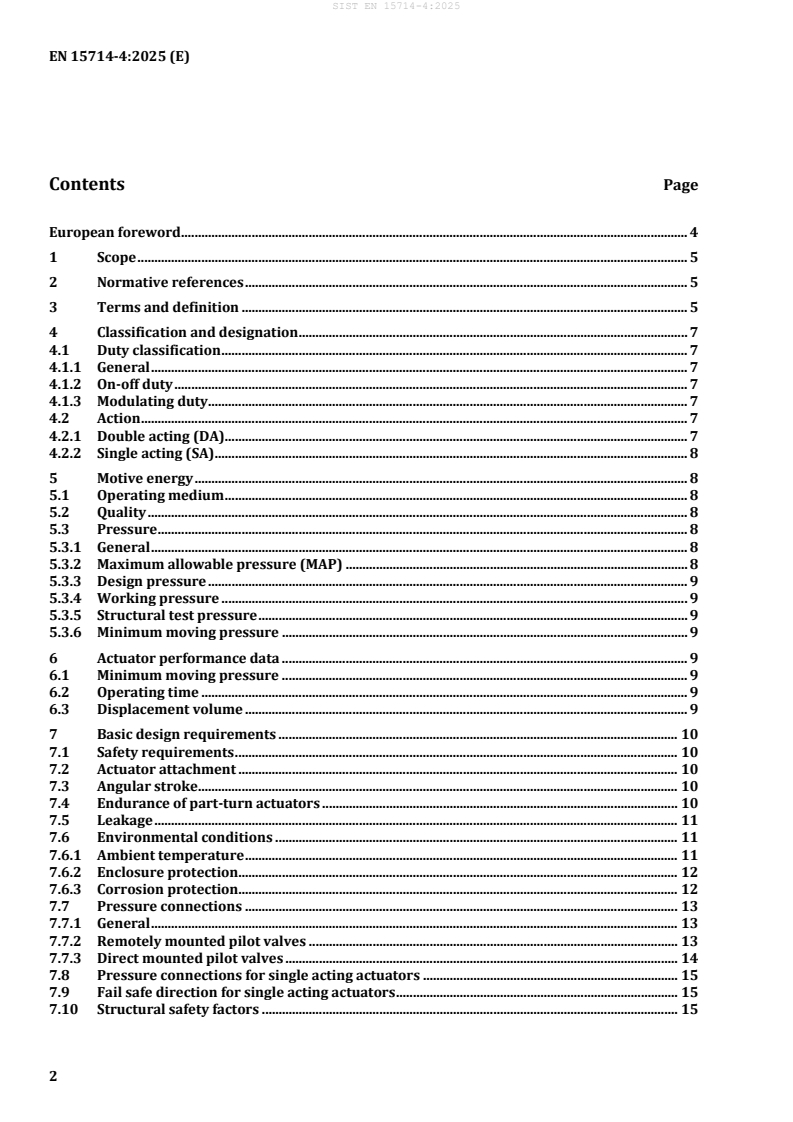
Contents Page
European foreword . 4
1 Scope . 5
2 Normative references . 5
3 Terms and definition . 5
4 Classification and designation . 7
4.1 Duty classification . 7
4.1.1 General . 7
4.1.2 On-off duty . 7
4.1.3 Modulating duty . 7
4.2 Action . 7
4.2.1 Double acting (DA) . 7
4.2.2 Single acting (SA) . 8
5 Motive energy . 8
5.1 Operating medium . 8
5.2 Quality . 8
5.3 Pressure . 8
5.3.1 General . 8
5.3.2 Maximum allowable pressure (MAP) . 8
5.3.3 Design pressure . 9
5.3.4 Working pressure . 9
5.3.5 Structural test pressure . 9
5.3.6 Minimum moving pressure . 9
6 Actuator performance data . 9
6.1 Minimum moving pressure . 9
6.2 Operating time . 9
6.3 Displacement volume . 9
7 Basic design requirements . 10
7.1 Safety requirements . 10
7.2 Actuator attachment . 10
7.3 Angular stroke . 10
7.4 Endurance of part-turn actuators . 10
7.5 Leakage . 11
7.6 Environmental conditions . 11
7.6.1 Ambient temperature . 11
7.6.2 Enclosure protection. 12
7.6.3 Corrosion protection. 12
7.7 Pressure connections . 13
7.7.1 General . 13
7.7.2 Remotely mounted pilot valves . 13
7.7.3 Direct mounted pilot valves . 14
7.8 Pressure connections for single acting actuators . 15
7.9 Fail safe direction for single acting actuators . 15
7.10 Structural safety factors . 15
7.11 Position indication . 16
8 Optional equipment . 16
8.1 Ancillaries. 16
8.2 Manual operation . 19
8.3 Mechanical end stop adjustment . 19
9 Conformity assessment . 19
9.1 General . 19
9.2 Type tests . 19
9.3 Control of production process . 20
10 Marking . 21
10.1 Mandatory marking . 21
10.2 Optional marking . 21
11 Documentation . 22
12 Part-turn actuator selection guidelines . 22
Annex A (normative) Actuator type test procedure . 23
A.1 General . 23
A.2 Test equipment . 23
A.3 Test conditions . 23
A.4 Test procedure . 23
A.4.1 Initial tests . 23
A.4.2 Endurance test . 24
A.4.3 Final tests . 24
A.5 Acceptance criteria . 24
Annex B (informative) Actuator selection guidelines . 25
B.1 General . 25
B.2 Selection parameters . 25
B.2.1 General . 25
B.2.2 Valve questions. 25
B.2.3 Actuator questions . 25
B.2.4 Ancillary questions . 26
B.2.5 Environmental conditions . 26
B.3 Actuator selection . 26
B.3.1 General . 26
B.3.2 Torque characteristics for rack and pinion actuators . 27
B.3.3 Torque characteristics for scotch yoke actuators (e.g. symmetric system) . 28
Bibliography . 30
European foreword
This document (EN 15714-4:2025) has been prepared by Technical Committee CEN/TC 69 “Industrial
valves”, the secretariat of which is held by AFNOR.
This European Standard shall be given the status of a national standard, either by publication of an
identical text or by endorsement, at the latest by November 2025, and conflicting national standards
shall be withdrawn at the latest by November 2025.
Attention is drawn to the possibility that some of the elements of this document may be the subject of
patent rights. CEN shall not be held responsible for identifying any or all such patent rights.
This document supersedes EN 15714-4:2009.
The main changes compared to EN 15714-4:2009 are:
— new endurance values with wider range were introduced;
— the structure was renewed according to the latest edition of other EN 15714 parts;
— minor changes on marking and testing were made.
Any feedback and questions on this document should be directed to the users’ national standards body.
A complete listing of these bodies can be found on the CEN website.
According to the CEN-CENELEC Internal Regulations, the national standards organisations of the
following countries are bound to implement this European Standard: Austria, Belgium, Bulgaria,
Croatia, Cyprus, Czech Republic, Denmark, Estonia, Finland, France, Germany, Greece, Hungary, Iceland,
Ireland, Italy, Latvia, Lithuania, Luxembourg, Malta, Netherlands, Norway, Poland, Portugal, Republic of
North Macedonia, Romania, Serbia, Slovakia, Slovenia, Spain, Sweden, Switzerland, Türkiye and the
United Kingdom.
1 Scope
This document specifies basic requirements for hydraulic part-turn valve actuators, both double acting
and single acting, used for on-off and modulating control duties.
It includes guidelines, recommendations and methods for enclosure and corrosion protection, control
and testing.
It does not apply to hydraulic actuators which are integral parts of control valves and to hydraulic
actuators designed for permanent immersion in fresh or sea water as well as electro-hydraulic
actuators.
Other requirements, or conditions of use, different from those indicated in this document can vary upon
request.
2 Normative references
The following documents are referred to in the text in such a way that some or all of their content
constitutes requirements of this document. For dated references, only the edition cited applies. For
undated references, the latest edition of the referenced document (including any amendments) applies.
EN ISO 5211, Industrial valves — Part-turn actuator attachments (ISO 5211)
EN 12570, Industrial valves — Method for sizing the operating element
EN 15714-1, Industrial valves — Actuators — Part 1: Terminology and definitions
EN 60529, Degrees of protection provided by enclosures (IP Code) (IEC 60529)
ISO 4401, Hydraulic fluid power — Four-port directional control valves — Mounting surfaces
ISO 4406, Hydraulic fluid power — Fluids — Method for coding the level of contamination by solid
particles
3 Terms and definition
For the purposes of this document, the terms and definitions given in EN 15714-1 and the following
apply.
ISO and IEC maintain terminology databases for use in standardization at the following addresses:
— ISO Online browsing platform: available at https://www.iso.org/obp
— IEC Electropedia: available at https://www.electropedia.org/
3.1
part-turn actuator
actuator which transmits torque to the valve for less than one revolution and which does not have the
capability of withstanding axial thrust
Note 1 to entry: Part-turn actuators are classified by action and duty.
3.2
stroke
single and complete movement from one end of travel to the other
3.3
end stop
mechanical part designed to stop the actuator drive train at an end position
Note 1 to entry: End stop can be fixed or adjustable.
3.4
torque
3.4.1
output torque
minimum guaranteed output torque capability of the actuator, in both directions, at specified supply
pressures conditions as provided by the manufacturer/supplier
Note 1 to entry: Where the output torque varies with the stroke, in a linear or nonlinear relationship with
pressure, tabulated data and/or torque versus stroke diagram shall be provided at significant pressure values for
each direction of movement.
3.4.2
rated torque
characterizing figure, indicated by the actuator manufacturer/supplier, used to specify the maximum
actuator operating torque
Note 1 to entry: The rated torque corresponds to the maximum torque value developed by the actuator when
powered with maximum allowable pressure.
Note 2 to entry: The rated torque for the single acting version is the guaranteed output torque of the actuator
with maximum allowable pressure at the beginning of the stroke in the direction to compress the spring.
3.4.3
start torque
actuator output torque at the beginning of the stroke in the direction of movement
3.4.4
maximum operating torque
MOT
for double acting version, output torque of the actuator when the pressure of the power supply
corresponds to the maximum allowable pressure; for single acting version, maximum output torque
among the torque at the beginning of the stroke when the pressure of the power supply corresponds to
the maximum allowable pressure and the torque generated by the spring at the end of specified
compression stroke
3.4.5
fluid starting torque
OST
output torque, at specified pressure value, at the beginning of the stroke in opposition to the spring
3.4.6
fluid ending torque
OET
output torque, at specified pressure value, at the end of the stroke when spring is at its maximum
compression
3.4.7
fluid running torque
ORT
output torque value between OST and OET at specified pressure value
3.4.8
spring ending torque
SET
output torque generated by the spring at the end of its stroke with no fluid in the cylinder
3.4.9
spring starting torque
SST
output torque generated by the spring at its maximum compression with no fluid in the cylinder
3.4.10
spring running torque
SRT
output torque value between SST and SET
4 Classification and designation
4.1 Duty classification
4.1.1 General
According to their intended function, two versions of hydraulic part-turn valve actuators are specified
by this document: on-off duty and modulating duty.
4.1.2 On-off duty
The actuator is required to drive the valve through its entire travel from the fully open position to the
fully closed position or vice-versa.
4.1.3 Modulating duty
The actuator shall continuously drive the valve to any position between fully open and fully closed or
vice.
4.2 Action
4.2.1 Double acting (DA)
This is an actuator which requires the supply of motive energy to operate in both travel directions.
4.2.2 Single acting (SA)
This is an actuator which requires external power to operate the valve in one direction only, the return
stroke being powered by an alternative form of stored energy (fail-safe actuators).
For the purpose of this document, the stored energy shall be supplied by a mechanical spring.
5 Motive energy
5.1 Operating medium
The operating medium shall be hydraulic fluid.
The fluid used shall be selected to be compatible with the maximal allowable pressure, with internal
actuator components and shall have lubricant properties.
The flashpoint shall be of not less than 93 °C for pressures below or equal to 10 bar and 157 °C for
pressures above 10 bar. The chemical and physical properties of the hydraulic fluid shall be suitable for
use with the materials used in the design of the actuator and its accessories. The hydraulic fluid shall be
suitable for operation of the hydraulic system through the entire temperature range to which it may be
subjected in service.
5.2 Quality
The operating medium shall have a contamination level specified to ISO 4406 class 18/16/13 as a
maximum.
When necessary, the actuator shall be properly flushed to guarantee an internal cleanliness consistent
with the above specified contamination level.
5.3 Pressure
5.3.1 General
As a general information, for each actuator model, the pressure limits, including at least the maximum
allowable pressure and working pressure range shall be indicated for a specific application. Other
pressure values shall be available on demand.
5.3.2 Maximum allowable pressure (MAP)
This is the pressure not to be exceeded for the supply to the hydraulic actuator. Recommended values
for maximum allowable pressure are in Table 1.
Table 1 — Pressure level
MPa bar psi
PN 50 5,5 55 800
PN 100 10,3 103 1 500
PN 200 20,7 207 3 000
PN 350 34,5 345 5 000
5.3.3 Design pressure
The design pressure shall be at least 1,1 times the maximum allowable pressure.
5.3.4 Working pressure
The working pressure is the pressure applied to the actuator to guarantee the performances on a
specific application.
5.3.5 Structural test pressure
For structural test under pressure, consider a minimum value 1,5 times the design pressure for a
minimum holding period 5 min after pressure stabilization.
Structural test under pressure is carried out to validate the capability of the pressure retaining parts of
the actuator to withstand the pressure without permanent deformations.
5.3.6 Minimum moving pressure
The minimum moving pressure required, at ambient temperature, to complete the specified stroke
without external load, starting from not pressurized conditions, shall be made available upon request.
6 Actuator performance data
6.1 Minimum moving pressure
For double acting actuators, the minimum moving pressure, at no load condition and ambient
temperature, shall be made available upon request.
For single acting actuators, the minimum starting and release pressure in contrast to the spring at the
beginning and ending of the nominal stroke, at no load condition and ambient temperature, shall be
made available upon request.
6.2 Operating time
The minimum operating time in both directions, without external load, at working pressure and
without any significant external restriction on supply nor exhaust flow rates shall be stated.
6.3 Displacement volume
The internal actuator displaced volumes for each direction shall be stated, including the dead volumes,
for the maximum stroke without any external limitation.
Displacement volume should be expressed in litres.
7 Basic design requirements
7.1 Safety requirements
Actuators shall be designed to take into account the technical principles and specifications for safety.
The design of spring return actuators shall permit their safe assembly/disassembly, when complying
with the instructions manual.
Provisions shall be taken to avoid that the pressure within the spring enclosure exceeds 0,05 MPa
(0,50 bar) during the actuator operation if the spring is not located in a pressurized enclosure.
7.2 Actuator attachment
Attachment for part-turn actuators shall be as per EN ISO 5211.
7.3 Angular stroke
Standard angular stroke for part-turn actuators shall be 90°.
For part-turn actuators, without adjustable end-stops, the standard tolerance on 90° angular stroke
shall be 2° for each end of stroke (-2° to 0° and 90° to 92°).
For part-turn actuators, with adjustable end-stop in one or both directions, the adjustment range
referred to 90° angular stroke shall be stated, but at least not less than ±3° for each end where
adjustable stroke is provided.
Tolerances on adjustment for any other angular strokes, within the limit of one revolution are allowed.
7.4 Endurance of part-turn actuators
The actuator shall be designed to guarantee a minimum endurance, without maintenance, in accordance
with values given in Table 2. Minimum endurance shall be demonstrated by a suitable test.
For double acting actuators the endurance test shall be performed at a load, along the complete stroke,
of at least 60 % of the minimum run torque developed with the maximum allowable pressure as
specified in 5.3.2.
For single acting actuators the endurance test shall be performed at a load, along the complete stroke, of
at least 60 % of the minimum value between the minimum fluid run torque at maximum allowable
pressure as specified in 5.3.2 and the minimum spring run torque.
Number of cycles and stroking time for the endurance test shall be selected from Table 2 considering
the range of rated torque (3.4.2) where the actuator under test falls.
Test endurance shall be performed in accordance with the procedure detailed in Annex A.
Table 2 — Endurance test parameters
a b Maximum stroking time for
Rated torque Minimum number of cycles
testing, based on 0° to 90°
s
Nm
≤ 125 100 000 3
> 125 to ≤ 1 000 50 000 5
> 1 000 to ≤ 2 000 20 000 8
> 2 000 to ≤ 8 000 10 000 12
> 8 000 to ≤ 16 000 5 000 15
> 16 000 to ≤ 32 000 2 500 20
> 32 000 to ≤ 63 000 1 600 30
> 63 000 to ≤ 125 000 1 600 45
> 125 000 to ≤ 250 000 1 000
...