

EN 13451-1:2011
(Main)Swimming pool equipment - Part 1: General safety requirements and test methods
General Information
- Abstract
This European Standard specifies general safety requirements and test methods for equipment used in classified swimming pools as specified in EN 15288-1 and EN 15288-2.
Where specific standards exist, this general standard should not be used alone.
Special care is required in applying this general standard alone to equipment for which no product specific standard has yet been published.
- Status
- Withdrawn
- Publication Date
- 06-Sep-2011
- Withdrawal Date
- 11-Oct-2016
- Technical Committee
- CEN/TC 136 - Sports, playground and other recreational equipment
- Drafting Committee
- CEN/TC 136/WG 8 - Swimming pool equipment
- Current Stage
- 9960 - Withdrawal effective - Withdrawal
- Start Date
- 12-Oct-2016
- Completion Date
- 12-Oct-2016

Relations
- Replaces
EN 13451-1:2001 - Swimming pool equipment - Part 1: General safety requirements and test methods - Effective Date
- 10-Sep-2011
- Effective Date
- 19-Jan-2023
- Effective Date
- 25-Mar-2026
- Effective Date
- 28-Jan-2026
- Effective Date
- 28-Jan-2026
- Effective Date
- 28-Jan-2026
- Refers
EN 1991-1-4:2005 - Eurocode 1: Actions on structures - Part 1-4: General actions - Wind actions - Effective Date
- 28-Jan-2026
- Effective Date
- 28-Jan-2026
- Effective Date
- 28-Jan-2026
- Refers
EN 15288-1:2018+A1:2024 - Swimming pools for public use - Part 1: Safety requirements for design - Effective Date
- 28-Jan-2026
- Effective Date
- 28-Jan-2026
- Effective Date
- 28-Jan-2026
- Effective Date
- 28-Jan-2026
- Effective Date
- 28-Jan-2026
- Effective Date
- 28-Jan-2026
Frequently Asked Questions
EN 13451-1:2011 is a standard published by the European Committee for Standardization (CEN). Its full title is "Swimming pool equipment - Part 1: General safety requirements and test methods". This standard covers: This European Standard specifies general safety requirements and test methods for equipment used in classified swimming pools as specified in EN 15288-1 and EN 15288-2. Where specific standards exist, this general standard should not be used alone. Special care is required in applying this general standard alone to equipment for which no product specific standard has yet been published.
This European Standard specifies general safety requirements and test methods for equipment used in classified swimming pools as specified in EN 15288-1 and EN 15288-2. Where specific standards exist, this general standard should not be used alone. Special care is required in applying this general standard alone to equipment for which no product specific standard has yet been published.
EN 13451-1:2011 is classified under the following ICS (International Classification for Standards) categories: 97.220.10 - Sports facilities. The ICS classification helps identify the subject area and facilitates finding related standards.
EN 13451-1:2011 has the following relationships with other standards: It is inter standard links to EN 13451-1:2001, EN 13451-1:2011+A1:2016, EN 1991-1-4:2026, EN 12503-1:2013, EN 12503-5:2001, EN 10088-1:2023, EN 1991-1-4:2005, EN 10088-2:2024, EN 1991-1-3:2025, EN 15288-1:2018+A1:2024, EN 12503-6:2001, EN ISO 12100:2010, EN 13451-2:2015, EN 13451-3:2011+A1:2013, EN 13451-4:2014. Understanding these relationships helps ensure you are using the most current and applicable version of the standard.
EN 13451-1:2011 is available in PDF format for immediate download after purchase. The document can be added to your cart and obtained through the secure checkout process. Digital delivery ensures instant access to the complete standard document.
Standards Content (Sample)
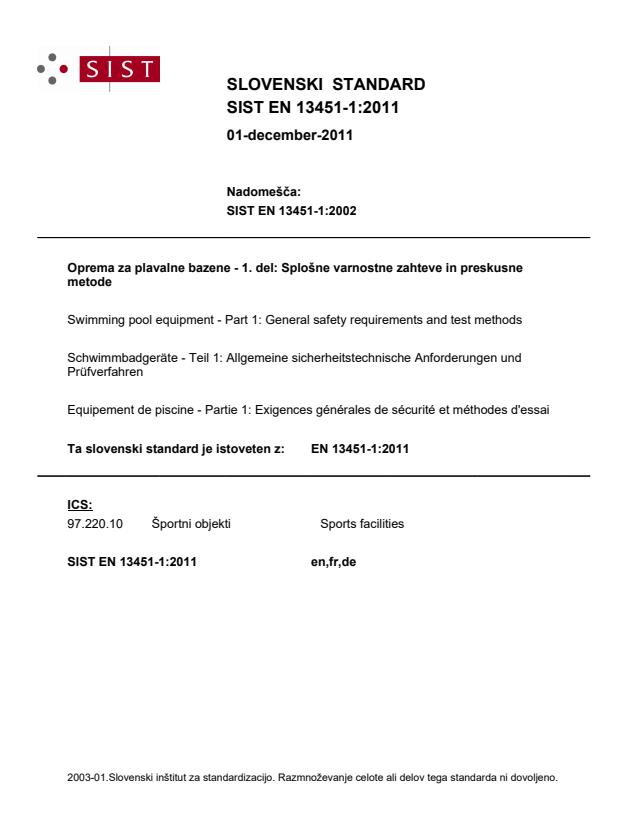
2003-01.Slovenski inštitut za standardizacijo. Razmnoževanje celote ali delov tega standarda ni dovoljeno.Oprema za plavalne bazene - 1. del: Splošne varnostne zahteve in preskusne metodeSchwimmbadgeräte - Teil 1: Allgemeine sicherheitstechnische Anforderungen und PrüfverfahrenEquipement de piscine - Partie 1: Exigences générales de sécurité et méthodes d'essaiSwimming pool equipment - Part 1: General safety requirements and test methods97.220.10Športni objektiSports facilitiesICS:Ta slovenski standard je istoveten z:EN 13451-1:2011SIST EN 13451-1:2011en,fr,de01-december-2011SIST EN 13451-1:2011SLOVENSKI
STANDARDSIST EN 13451-1:20021DGRPHãþD
EUROPEAN STANDARD NORME EUROPÉENNE EUROPÄISCHE NORM
EN 13451-1
September 2011 ICS 97.220.10 Supersedes EN 13451-1:2001English Version
Swimming pool equipment -Part 1: General safety requirements and test methods
Equipement de piscine - Partie 1: Exigences générales de sécurité et méthodes d'essai
Schwimmbadgeräte - Teil 1: Allgemeine sicherheitstechnische Anforderungen und Prüfverfahren This European Standard was approved by CEN on 29 July 2011.
CEN members are bound to comply with the CEN/CENELEC Internal Regulations which stipulate the conditions for giving this European Standard the status of a national standard without any alteration. Up-to-date lists and bibliographical references concerning such national standards may be obtained on application to the CEN-CENELEC Management Centre or to any CEN member.
This European Standard exists in three official versions (English, French, German). A version in any other language made by translation under the responsibility of a CEN member into its own language and notified to the CEN-CENELEC Management Centre has the same status as the official versions.
CEN members are the national standards bodies of Austria, Belgium, Bulgaria, Croatia, Cyprus, Czech Republic, Denmark, Estonia, Finland, France, Germany, Greece, Hungary, Iceland, Ireland, Italy, Latvia, Lithuania, Luxembourg, Malta, Netherlands, Norway, Poland, Portugal, Romania, Slovakia, Slovenia, Spain, Sweden, Switzerland and United Kingdom.
EUROPEAN COMMITTEE FOR STANDARDIZATION
COMITÉ EUROPÉEN DE NORMALISATION EUROPÄISCHES KOMITEE FÜR NORMUNG
Management Centre:
Avenue Marnix 17,
B-1000 Brussels © 2011 CEN All rights of exploitation in any form and by any means reserved worldwide for CEN national Members. Ref. No. EN 13451-1:2011: ESIST EN 13451-1:2011
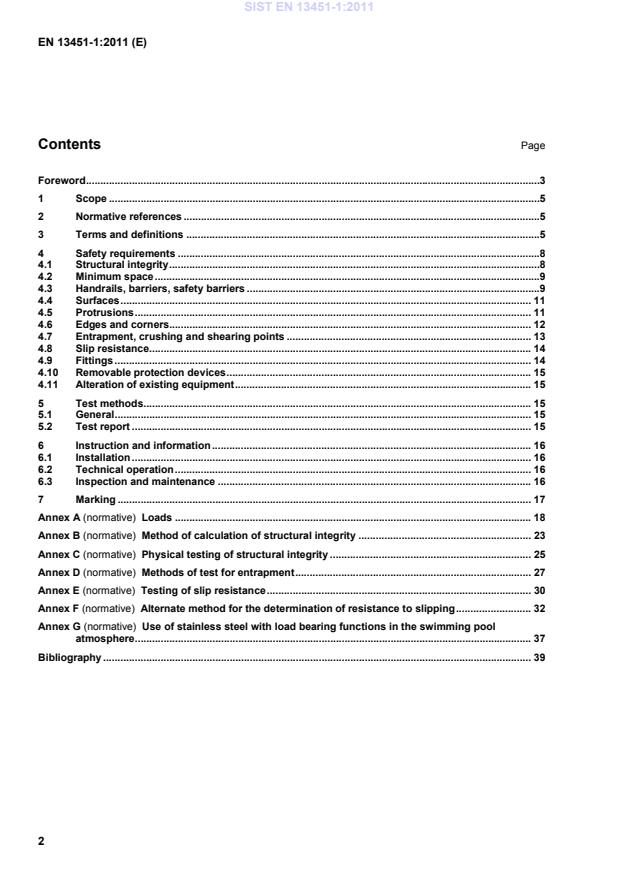
Loads . 18Annex B (normative)
Method of calculation of structural integrity . 23Annex C (normative)
Physical testing of structural integrity . 25Annex D (normative)
Methods of test for entrapment . 27Annex E (normative)
Testing of slip resistance . 30Annex F (normative)
Alternate method for the determination of resistance to slipping . 32Annex G (normative)
Use of stainless steel with load bearing functions in the swimming pool atmosphere . 37Bibliography . 39 SIST EN 13451-1:2011
Part 11: Additional specific safety requirements and test methods for moveable pool floors and moveable bulkheads
This standard may also be applicable to other equipment not specified, provided the safety requirements are fulfilled. There can be additional requirements for purposes such as competition swimming and advice should be sought from the governing body of the sport in question. In relation to EN 13451-1:2001 the following main amendments have been made: a) scope modified in accordance with EN 15288-1 and EN 15288-2; b) definition pool/swimming pool deleted; c) requirements for materials (see 4.1.2) added; d) requirements for barriers (see 4.3) added; SIST EN 13451-1:2011
test report (see 5.2) modified; h) values of total vertical user load (see Table A.1) modified; i) only two test probes for the test methods of head and neck entrapment (see Annex D); j) normative Annex F "Alternate method for the determination of resistance to slipping" added; k) normative Annex G "Use of stainless steel with load bearing functions in the swimming pool atmosphere" added. According to the CEN/CENELEC Internal Regulations, the national standards organizations of the following countries are bound to implement this European Standard: Austria, Belgium, Bulgaria, Croatia, Cyprus, Czech Republic, Denmark, Estonia, Finland, France, Germany, Greece, Hungary, Iceland, Ireland, Italy, Latvia, Lithuania, Luxembourg, Malta, Netherlands, Norway, Poland, Portugal, Romania, Slovakia, Slovenia, Spain, Sweden, Switzerland and the United Kingdom. SIST EN 13451-1:2011
Figure 1 — Grip [EN 1176-1:2008, 3.15] 3.5 grasp holding of the hand around part of the circumference of a support NOTE See Figure 2. SIST EN 13451-1:2011
Figure 2 — Grasp [EN 1176-1:2008, 3.16] 3.6 finger hold holding which is found with hand, at least with the finger head by hooking in 3.7 entrapment hazard presented by the situation in which a body, or part of a body, the hair or clothing can become trapped NOTE Entrapment hazard can arise from situations where the body, its parts, etc. get trapped, but also from situations where the body of the user has no complete freedom to emerge from the water, e.g. when swimming underneath a stepladder. 3.8 edge line being formed by two surfaces of something solid which meet one another 3.9 corner point being formed by two or more edges which meet one another 3.10 minimum space smallest space required for the safe installation and use of the equipment 3.11 minimum zone for use minimum space required for anyone who may come into contact with equipment 3.12 protrusion object, or a portion of an object, that stands or protrudes in/into the minimum zone for use 3.13 handrail rail intended to assist the user to balance [EN 1176-1:2008, 3.21] 3.14 barrier means of segregation to prevent movement or access SIST EN 13451-1:2011
4.1.1 General Structural integrity, including stability, of the equipment shall be assessed by one of the following: a) calculation, carried out in accordance with Annex A and Annex B; b) physical testing, in accordance with Annex C; or c) a combination of a) and b). When calculations are carried out in accordance with Annex B, no limit states shall be exceeded at combinations of loads as given in B.2. When tested in accordance with Annex C, the equipment shall not show any cracks or damage. Deformation shall remain within the elastic field. In some cases, these specific calculations or tests are not appropriate but the structural integrity shall be at least equivalent. Each structure shall resist both the permanent and variable loads acting on equipment and parts of equipment as described in Annex C. No allowance for accidental loads, i.e. loads produced by fire, collision by vehicles or earthquake has to be made for swimming pool equipment. The loads associated with fatigue are much smaller than the loads in combination with the appropriate load factors when calculated according to B.2. Therefore, swimming pool equipment need not be verified for fatigue. Structural parts shall resist the worst case loading condition. If a piece of equipment is made by components, it has to be constructed in such a way that every component is secured in its working position. 4.1.2 Materials 4.1.2.1 General Any material may be used provided it is fit for purpose, also considering the particular characteristics of the swimming pool environment (e.g. oxidizing atmosphere, humidity, ageing). SIST EN 13451-1:2011
4.3.2 Barriers The design of the barriers shall not encourage the users to stand or sit on them and shall prevent climbing. Barriers may be in form of gratings, full faced panels or walls. NOTE The design should consider the visual needs connected with the use of the facility. 4.3.3 Safety barriers Safety barriers shall be used to prevent users from falling from heights > 600 mm, except in situations where a risk assessment shows that a safety barrier is not necessary.
Gaps shall have a width ≤ 110 mm and where two or more safety barriers are used in combination (e.g. ladder, stair and platform) the safety barrier shall be designed to give continuous protection. Safety barriers shall have a height ≥ 1 000 mm, measured from the highest point on which a person can stand within 1 000 mm from the barriers themselves, see Figure 3. SIST EN 13451-1:2011
Key 1 highest standing point 2 platform 3 safety barrier within 1 000 mm from a higher standpoint 4 safety barrier outside 1 000 mm from a higher standpoint 3, 4 are different possibilities for placing barriers X height of highest point on which a person can stand Figure 3 — Height of the safety barriers 4.3.4 Grip The cross section of any component designed to be gripped shall have in any direction, when measured across its centre, a dimension not less than 16 mm and not more than 50 mm. 4.3.5 Grasp The thickness of any component designed to be grasped shall have a width not exceeding 60 mm. 4.3.6 Finger hold The minimum space for clutching shall be at least 15 mm high and at least 20 mm wide. For an example, see Figure 4. SIST EN 13451-1:2011
Dimensions in millimetres
Figure 4 — Finger hold 4.4 Surfaces 4.4.1 Surface finishing The surface finishing in the minimum zone for use shall not present any risk of injury. Special attention shall be paid to: the finishing of welds; the risk of splintering. 4.4.2 Surface materials The materials in contact with the water shall have no detrimental effect on its quality and shall be fit for purpose. 4.5 Protrusions NOTE Protrusions are a hazard of impact or entrapment especially where water movement can cause involuntary movement of users. Protrusions with a height h ≤ 3 mm, not shielded by adjacent areas as shown in Figure 5 a), shall be rounded with a radius R > h/2 or chamfered in accordance with Figure 5 b). Protrusions with a height h > 3 mm to ≤ 15 mm, not shielded by adjacent areas, as shown in Figure 5 a), shall be rounded with a radius R ≥ 3 mm. See Figure 5 c). Protrusions with a height h > 15 mm, not shielded by adjacent areas or additional measures (e.g. handles for counter-flow plants), for the first 15 mm of projection shall be radiused as stated in the previous paragraph, and for the remaining projection shall have an inclination of < 45°, tangentially connected. See Figure 5 d). SIST EN 13451-1:2011
a) Example of a countersunk part shielded by adjacent areas
b) Example of a protrusion height ≤ 3 mm
c) Example of a protrusion height >>>> 3 mm ≤ 15 mm d) Example of a protrusion height >>>> 15 mm Key 1 free space, see entrapment requirements B max. width of the protrusion for height > 15 mm L min. width of the flat top part of the protrusion H height of a protrusion between > 15 mm and < 75 mm h height of a protrusion between > 3 mm and ≤ 15 mm R radius Figure 5 — Safety requirements for protrusions 4.6 Edges and corners Edges and corners within the minimum zone shall be radiused depending on the result of design risk assessment. NOTE A minimum radius of 3 mm proved to be suitable in all conditions. SIST EN 13451-1:2011
Surfaces of the equipment, where the user can stand or walk on with bare feet and which may be tested in accordance with Annex E, shall comply with Table 1. Table 1 — Minimum angles to be obtained for specific surfaces
Surfaces of equipment Rating group — installed in horizontal pool areas from 800 mm to 1 350 mm water depth 12° — installed in horizontal pool areas from 0 mm to 800 mm water depth — installed in up to 8° inclined pool areas from 0 mm to 1 350 mm water depth — installed in pool surrounding areas occasionally wetted 18° — installed in more than 8° inclined pool areas from 0 mm to 1 350 mm water depth — steps, starting platforms, treads of ladders and stepladders 24°
Surfaces of the equipment where the user can stand or walk with bare feet, which may not be tested in accordance with Annex E, shall be tested complying with Annex F. 4.9 Fittings Fittings, either fixed or removable, shall be: a) considered as integral part of the equipment; b) subjected to the same safety requirements; c) tested with the equipment in its working position. Fittings for removable equipment/items not in use (e.g. for starting blocks) shall be protected by suitable tamper proof devices when the equipment/item is removed. Where new equipment utilises existing installed fittings the contractor (supplier/manufacturer/installer of the new equipment) shall assess their suitability.
report; c) a reference to this European Standard; d) name and address of client; e) description and identification of the test item; f) date of receipt of test item, if applicable, and date(s) of performance of test; g) identification of the test specification or description of the method or procedure; h) description of sampling procedure, where relevant; i) any deviations, additions or exclusions from the test specification, and any other information relevant to a specific test; j) measurements, examinations and derived results, supported by tables, graphs, sketches and photographs as appropriate, and any failures identified; k) a statement on measurement uncertainty (where relevant); l) a signature and title or an equivalent marking of person(s) accepting technical responsibility for the test report and date of issue. SIST EN 13451-1:2011
...