

EN 14255-3:2008
(Main)Measurement and assessment of personal exposures to incoherent optical radiation - Part 3: UV-Radiation emitted by the sun
- Abstract
This European Standard specifies procedures for the measurement or estimation and the assessment of personal exposures to ultraviolet radiation emitted by the sun.
NOTE 1 According to CIE 17.4 UV-radiation is defined as an electromagnetic radiation with wavelength between 100 nm and 400 nm. Due to atmospheric absorption only solar UV-radiation in the spectral region between 280 nm and 400 nm reaches the earth's surface in significant amounts.
This European Standard applies to solar UV-exposures when staying outdoors.
This European Standard is applicable to workers and to the general population.
This European Standard does not apply to UV-exposures caused by artificial sources, e.g. UV-lamps, welding arcs.
NOTE 2 Part 1 of this European Standard deals with UV-exposures caused by artificial sources.
NOTE 3 For radiation emissions of products other standards apply, such as CIE S 009 for lamps and lamp systems, EN 60335-2-27 [6] for sunbeds, EN 60335-2-59 [7] for insect killers and EN 12198 [8] for radiation emissions of machinery.
This European Standard does not apply to radiation exposures which concern the retina of the eyes.
NOTE 4 Ultraviolet and visible radiation exposures of the eyes may result in photochemical damage to the retina (this is often called the blue light hazard). The associated action spectrum contains mainly visible radiation and only a very small contribution in the ultraviolet region. The determination and assessment of radiation which may result in a blue light hazard may be done in accordance with part 2 of EN 14255 [20].
- Status
- Published
- Publication Date
- 18-Mar-2008
- Technical Committee
- CEN/TC 169 - Lighting applications
- Drafting Committee
- CEN/TC 169/WG 8 - Photobiology
- Current Stage
- 9060 - Closure of 2 Year Review Enquiry - Review Enquiry
- Start Date
- 04-Jun-2026
- Completion Date
- 04-Jun-2026

Overview - EN 14255-3:2008 (CEN)
EN 14255-3:2008 is the CEN European Standard that specifies procedures for the measurement, estimation and assessment of personal exposures to ultraviolet (UV) radiation emitted by the sun. It applies to solar UV exposure for people staying outdoors, including both workers and the general population, and covers solar UV in the spectral region that reaches the Earth’s surface (approximately 280–400 nm, per CIE 17.4). The standard excludes UV from artificial sources (see EN 14255‑1 for artificial UV) and does not address retinal (blue‑light) hazards covered in EN 14255‑2.
Key topics and technical requirements
- Risk-assessment methods using the solar UV‑Index (IUV) to determine erythemally effective irradiance and to plan protective measures.
- Skin exposure factor: procedures to estimate local and individual exposure by accounting for clothing, behavior, albedo and cloud cover.
- Radiative transfer models: use of computational models to calculate seasonal, geographic and time‑of‑day UV exposures for planning and travel.
- Direct measurements:
- Measurement of erythemal effective radiant exposure (Her) - methods and instruments referenced in informative Annex D.
- Measurement/assessment of non‑melanoma skin cancer radiant exposure (Hnmsc).
- Personal dosimetry options consistent with EN 14255‑1 for incoherent optical radiation.
- Assessment and decision flow: guidance on interpreting measurement/estimation results, determining when protective measures are necessary, and noting advantages/limitations of each method.
- Annexes: practical tools such as skin type ↔ minimal erythema dose relations and examples of protective measures.
Practical applications and users
Who uses EN 14255‑3:
- Occupational health & safety professionals managing outdoor worker exposures (construction, agriculture, services).
- Public health agencies and meteorological services issuing UV‑Index warnings and public advice.
- Environmental scientists and exposure assessors modelling population UV exposure across regions and seasons.
- Policy makers and risk assessors developing guidance on sun protection and workplace controls.
Practical uses:
- Estimating personal UV doses for risk communication and training.
- Selecting monitoring strategies (regional UV‑Index vs. personal dosimetry).
- Designing and validating sun‑safety measures (schedules, clothing, shade, sunscreen).
Related standards
- EN 14255‑1 (artificial UV personal exposures)
- EN 14255‑2 (visible/IR and blue‑light assessment)
- EN 14255‑4 (terminology and quantities)
- CIE S 009, EN 60335‑2‑27 (sunbeds), EN 60335‑2‑59 (insect killers), EN 12198 (machinery emissions) - for product emissions and specific device testing.
Keywords: EN 14255-3:2008, solar UV, UV‑Index, erythemal exposure, personal UV dosimetry, measurement and assessment, CEN, outdoor worker protection.
Relations
- Effective Date
- 28-Jan-2026
- Effective Date
- 28-Jan-2026
Get Certified
Connect with accredited certification bodies for this standard

BSMI (Bureau of Standards, Metrology and Inspection)
Taiwan's standards and inspection authority.
Sponsored listings
Frequently Asked Questions
EN 14255-3:2008 is a standard published by the European Committee for Standardization (CEN). Its full title is "Measurement and assessment of personal exposures to incoherent optical radiation - Part 3: UV-Radiation emitted by the sun". This standard covers: This European Standard specifies procedures for the measurement or estimation and the assessment of personal exposures to ultraviolet radiation emitted by the sun. NOTE 1 According to CIE 17.4 UV-radiation is defined as an electromagnetic radiation with wavelength between 100 nm and 400 nm. Due to atmospheric absorption only solar UV-radiation in the spectral region between 280 nm and 400 nm reaches the earth's surface in significant amounts. This European Standard applies to solar UV-exposures when staying outdoors. This European Standard is applicable to workers and to the general population. This European Standard does not apply to UV-exposures caused by artificial sources, e.g. UV-lamps, welding arcs. NOTE 2 Part 1 of this European Standard deals with UV-exposures caused by artificial sources. NOTE 3 For radiation emissions of products other standards apply, such as CIE S 009 for lamps and lamp systems, EN 60335-2-27 [6] for sunbeds, EN 60335-2-59 [7] for insect killers and EN 12198 [8] for radiation emissions of machinery. This European Standard does not apply to radiation exposures which concern the retina of the eyes. NOTE 4 Ultraviolet and visible radiation exposures of the eyes may result in photochemical damage to the retina (this is often called the blue light hazard). The associated action spectrum contains mainly visible radiation and only a very small contribution in the ultraviolet region. The determination and assessment of radiation which may result in a blue light hazard may be done in accordance with part 2 of EN 14255 [20].
This European Standard specifies procedures for the measurement or estimation and the assessment of personal exposures to ultraviolet radiation emitted by the sun. NOTE 1 According to CIE 17.4 UV-radiation is defined as an electromagnetic radiation with wavelength between 100 nm and 400 nm. Due to atmospheric absorption only solar UV-radiation in the spectral region between 280 nm and 400 nm reaches the earth's surface in significant amounts. This European Standard applies to solar UV-exposures when staying outdoors. This European Standard is applicable to workers and to the general population. This European Standard does not apply to UV-exposures caused by artificial sources, e.g. UV-lamps, welding arcs. NOTE 2 Part 1 of this European Standard deals with UV-exposures caused by artificial sources. NOTE 3 For radiation emissions of products other standards apply, such as CIE S 009 for lamps and lamp systems, EN 60335-2-27 [6] for sunbeds, EN 60335-2-59 [7] for insect killers and EN 12198 [8] for radiation emissions of machinery. This European Standard does not apply to radiation exposures which concern the retina of the eyes. NOTE 4 Ultraviolet and visible radiation exposures of the eyes may result in photochemical damage to the retina (this is often called the blue light hazard). The associated action spectrum contains mainly visible radiation and only a very small contribution in the ultraviolet region. The determination and assessment of radiation which may result in a blue light hazard may be done in accordance with part 2 of EN 14255 [20].
EN 14255-3:2008 is classified under the following ICS (International Classification for Standards) categories: 17.240 - Radiation measurements. The ICS classification helps identify the subject area and facilitates finding related standards.
EN 14255-3:2008 has the following relationships with other standards: It is inter standard links to EN 14255-1:2005, EN 14255-4:2006. Understanding these relationships helps ensure you are using the most current and applicable version of the standard.
EN 14255-3:2008 is available in PDF format for immediate download after purchase. The document can be added to your cart and obtained through the secure checkout process. Digital delivery ensures instant access to the complete standard document.
Standards Content (Sample)
2003-01.Slovenski inštitut za standardizacijo. Razmnoževanje celote ali delov tega standarda ni dovoljeno.Measurement and assessment of personal exposures to incoherent optical radiation - Part 3: UV-Radiation emitted by the sunMesure et évaluation des expositions individuelles au rayonnement optique incohérent - Parie 3: Rayonnement ultraviolet émis par le soleilMessung und Beurteilung von personenbezogenen Expositionen gegenüber inkohärenter optischer Strahlung - Teil 3: Von der Sonne emittierte UV-Strahlung17.240Merjenje sevanjaRadiation measurements17.180.20Barve in merjenje svetlobeColours and measurement of lightICS:SIST EN 14255-3:2008en,fr,deTa slovenski standard je istoveten z:EN 14255-3:200801-junij-2008SIST EN 14255-3:2008SLOVENSKI
STANDARD
EUROPEAN STANDARDNORME EUROPÉENNEEUROPÄISCHE NORMEN 14255-3March 2008ICS 17.240 English VersionMeasurement and assessment of personal exposures toincoherent optical radiation - Part 3: UV-Radiation emitted by thesunMesurage et évaluation des expositions individuelles aurayonnement optique incohérent - Partie 3: Rayonnementultraviolet émis par le soleilMessung und Beurteilung von personenbezogenenExpositionen gegenüber inkohärenter optischer Strahlung -Teil 3: Von der Sonne emittierte UV-StrahlungThis European Standard was approved by CEN on 16 February 2008.CEN members are bound to comply with the CEN/CENELEC Internal Regulations which stipulate the conditions for giving this EuropeanStandard the status of a national standard without any alteration. Up-to-date lists and bibliographical references concerning such nationalstandards may be obtained on application to the CEN Management Centre or to any CEN member.This European Standard exists in three official versions (English, French, German). A version in any other language made by translationunder the responsibility of a CEN member into its own language and notified to the CEN Management Centre has the same status as theofficial versions.CEN members are the national standards bodies of Austria, Belgium, Bulgaria, Cyprus, Czech Republic, Denmark, Estonia, Finland,France, Germany, Greece, Hungary, Iceland, Ireland, Italy, Latvia, Lithuania, Luxembourg, Malta, Netherlands, Norway, Poland, Portugal,Romania, Slovakia, Slovenia, Spain, Sweden, Switzerland and United Kingdom.EUROPEAN COMMITTEE FOR STANDARDIZATIONCOMITÉ EUROPÉEN DE NORMALISATIONEUROPÄISCHES KOMITEE FÜR NORMUNGManagement Centre: rue de Stassart, 36
B-1050 Brussels© 2008 CENAll rights of exploitation in any form and by any means reservedworldwide for CEN national Members.Ref. No. EN 14255-3:2008: E
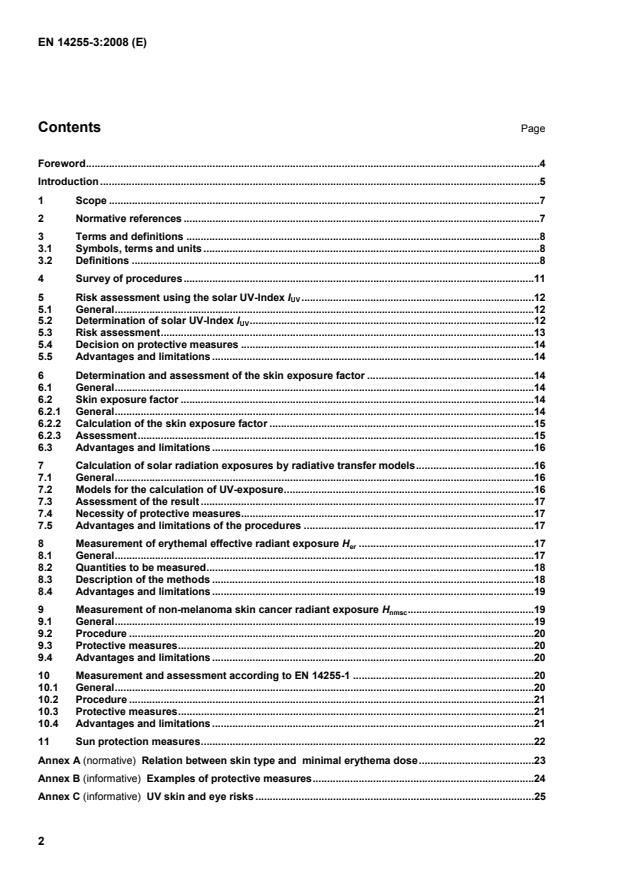
Relation between skin type and
minimal erythema dose.23 Annex B (informative)
Examples of protective measures.24 Annex C (informative)
UV skin and eye risks.25
Methods for the measurement of solar erythemal effective radiant exposure Her.26 D.1 General.26 D.2 Methods A to F for the measurement of the erythemal effective radiant exposure Her.26 D.2.1 General.26 D.2.2 Method A.27 D.2.3 Method B.27 D.2.4 Method C.28 D.2.5 Method D.28 D.2.6 Method E.29 D.2.7 Method F.29 Bibliography.31
“Light and lighting”, the secretariat of which is held by DIN. This European Standard shall be given the status of a national standard, either by publication of an identical text or by endorsement, at the latest by September 2008, and conflicting national standards shall be withdrawn at the latest by September 2008. Attention is drawn to the possibility that some of the elements of this document may be the subject of patent rights. CEN [and/or CENELEC] shall not be held responsible for identifying any or all such patent rights. EN 14255 Measurement and assessment of personal exposures to incoherent optical radiation is published in four parts: Part 1: Ultraviolet radiation emitted by artificial sources in the workplace Part 2: Visible and infrared radiation emitted by artificial sources in the workplace
Part 3 (this part): UV-Radiation emitted by the sun Part 4: Terminology and quantities used in UV-, visible and IR-exposure measurements According to the CEN/CENELEC Internal Regulations, the national standards organizations of the following countries are bound to implement this European Standard: Austria, Belgium, Bulgaria, Cyprus, Czech Republic, Denmark, Estonia, Finland, France, Germany, Greece, Hungary, Iceland, Ireland, Italy, Latvia, Lithuania, Luxembourg, Malta, Netherlands, Norway, Poland, Portugal, Romania, Slovakia, Slovenia, Spain, Sweden, Switzerland and the United Kingdom.
Introduction People may be exposed to ultraviolet (UV) radiation emitted by artificial or natural sources. The most important natural source for UV-radiation exposure is the sun. Depending on global factors such as geographical position, season, time of day, altitude, cloudiness and individual factors such as clothing, the time spent outdoors may result in a significant UV-exposure to the sun. Exposure to ultraviolet radiation from the sun is of considerable health concern. UV-exposure can produce both beneficial and harmful health effects. Vitamin D production is recognized as a beneficial effect. Acute harmful effects on the eyes and the skin can be induced by short term UV-irradiation of high intensity. Typical injuries are photoconjunctivitis and photokeratitis of the eye and UV-erythema of the skin. Minor doses of UV-radiation may induce or aggravate some diseases such as porphyria or lupus erythematosis or may trigger phototoxic and photoallergic reactions. The visible and the infrared part of the radiation spectrum of the sun may also cause short term injuries, when overexposure occurs, such as thermal damage to the skin as well as thermal and photochemical injuries of the retina of the eyes. However, visible and infrared radiation exposures are not dealt with in this standard.
Additionally, long term UV-irradiation may result in damage to the eyes and skin, such as cataracts, skin aging and skin cancer. There is also increasing evidence that UV-exposure suppresses the immune system, which could lead to a reduction in the efficacy of immunization programmes and increase the spread of infectious diseases. Between two and three million non-melanoma skin cancers are diagnosed worldwide each year which are rarely fatal and can be surgically removed; approximately 132,000 melanoma skin cancers occur globally each year. Melanoma is responsible for approximately 80 % of an estimated 66,000 deaths annually due to skin cancer [1]. Worldwide some 12 to 15 million people become blind from cataracts annually, of which up to 20% may be caused or aggravated by sun exposure, according to estimates by the World Health Organization (WHO). These numbers will increase as the stratospheric ozone layer is depleted over the next decades, unless people become aware of the hazards of UV-radiation exposure, especially from the sun [2]. In order to avoid short term injuries and reduce additional risks from long term UV-exposures international recommendations advise restriction of solar UV-exposures [3]. To achieve this, it is necessary to determine the level of solar UV-exposure and assess its gravity. Such determination can be achieved either by measurements or by estimations.
This European Standard supports the application of recommendations of international or European organisations (e. g. WHO, ICNIRP1) , EUROSKIN) for protection against harmful solar UV-exposure.
This standard specifies procedures for the measurement or estimation and the assessment of solar UV-exposures. For radiation protection purposes it is not always necessary to determine exactly the personal solar UV-exposure. Often a more general determination of the solar UV-exposure level is sufficient. The UV-Index is one of the means for that. The UV-Index can describe the current measured, the expected daily maximum, or the expected daily trend of the erythemally effective irradiance. It is based on regional measurements or calculations of the global solar radiation. It is published by various organisations and in weather forecasts. It can be used to forecast the expected solar UV-exposure and to plan protective measures, if necessary. So it is a means to determine an approximate personal solar UV-exposure. As the UV-Index is usually determined for a larger regional area the local solar UV-exposure may deviate due to different cloud cover and other reasons. So the local and individual UV-exposure assessment has to be adjusted accordingly.
1) ICNIRP International Commission on Non-Ionizing Radiation
For the planning of solar UV-radiation protection purposes when travelling, a calculation of the global solar radiation exposure depending on season, time of day, geographical position, etc. may be helpful. There are software programs which allow such calculations. In some cases it is necessary to determine the personal solar UV-exposure more exactly. This can be done by measurements of the erythemal and/or the non-melanoma skin cancer radiant exposure. These exposure data can be used to determine individual risks.
Personal solar UV-exposures can in some cases also be determined by UV-exposure measurements
according to EN 14255-1. The results can be compared to recommended or required limit values in order to assess the gravity of the exposure.
When the solar UV-exposure exceeds a certain level it may be necessary to apply protective measures in order to avoid injuries of the skin and the eyes. This standard does not specify sun protection measures but gives corresponding reference sources.
1 Scope This European Standard specifies procedures for the measurement or estimation and the assessment of personal exposures to ultraviolet radiation emitted by the sun. NOTE 1 According to CIE 17.4 UV-radiation is defined as an electromagnetic radiation with wavelength between 100 nm and 400 nm. Due to atmospheric absorption only solar UV-radiation in the spectral region between 280 nm and 400 nm reaches the earth's surface in significant amounts. This European Standard applies to solar UV-exposures when staying outdoors. This European Standard is applicable to workers and to the general population. This European Standard does not apply to UV-exposures caused by artificial sources, e.g. UV-lamps, welding arcs. NOTE 2 Part 1 of this European Standard deals with UV-exposures caused by artificial sources. NOTE 3 For radiation emissions of products other standards apply, such as CIE S 009 for lamps and lamp systems, EN 60335-2-27 [6] for sunbeds, EN 60335-2-59 [7] for insect killers and EN 12198 [8] for radiation emissions of machinery. This European Standard does not apply to radiation exposures which concern the retina of the eyes. NOTE 4 Ultraviolet and visible radiation exposures of the eyes may result in photochemical damage to the retina (this is often called the blue light hazard). The associated action spectrum contains mainly visible radiation and only a very small contribution in the ultraviolet region. The determination and assessment of radiation which may result in a blue light hazard may be done in accordance with part 2 of EN 14255 [20].
2 Normative references The following referenced documents are indispensable for the application of this document. For dated references, only the edition cited applies. For undated references, the latest edition of the referenced document (including any amendments) applies. EN 14255-1:2005, Measurement and assessment of personal exposures to incoherent optical radiation — Part 1: Ultraviolet radiation emitted by artificial sources in the workplace EN 14255-4:2006, Measurement and assessment of personal exposures to incoherent optical radiation — Part 4: Terminology and quantities used in UV-, visible and IR-exposure measurements CIE S 013, International standard global solar UV-Index CIE 17.4, International lighting vocabulary; Chapter 845: lighting CIE S 019, Photocarcinogenesis Action Spectrum (Non-Melanoma Skin Cancers) ISO/CIE 17166, Erythema reference action spectrum and standard erythema dose
H radiant exposure J/m² CIE 17.4 ref 845-01-42 Hλ(λ) spectral radiant exposure J/(m²⋅nm) EN 14255-4
Es ultraviolet hazard irradiance W/m² EN 14255-4 Hs ultraviolet hazard radiant exposure J/m² EN 14255-4 s(λ) ultraviolet hazard weighting function — EN 14255-4 IUV solar UV-Index — CIE S 013 fSE skin exposure factor — 3.2.2 ser(λ) erythemal weighting function — ISO/CIE 17166 Eer erythemal effective irradiance W/m² ISO/CIE 17166 Her erythemal effective radiant exposure J/m² ISO/CIE 17166 SED standard erythema dose — 3.2.6 MED minimal erythema dose J/m² or SED 3.2.7 snmsc(λ) non-melanoma skin cancer weighting function — CIE S 019 Enmsc non-melanoma skin cancer irradiance W/m² EN 14255-4 Hnmsc non-melanoma skin cancer radiant exposure J/m² EN 14255-4
3.2 Definitions 3.2.1 solar UV-Index IUV quantity which expresses the erythemal potential of the terrestrial solar UV-radiation, incident on a horizontal plane, given by
is the solar spectral irradiance
ser()
is the erythemal weighting function as specified by ISO/CIE 17166 ker
is a constant equal to 40 m2/W. NOTE 1 The UV-Index is quoted to the nearest whole integer value. The irradiance measurement is carried out on an unobstructed horizontal plane e.g. on top of a building. NOTE 2 This is a simplified definition. More information about the international standard global UV-Index can be found in CIE S 013 which is based on the recommendations of WHO/WMO/UNEP/ICNIRP [3]. NOTE 3 The solar UV-Index was developed as a simple scale for the public domain and for public information about the risk of erythema and related hazards from solar exposures. It is used e.g. in weather forecasts. 3.2.2 Skin exposure factor
fSE quantity that estimates the severity of solar UV skin exposure accounting for environmental and individual variables, given by fSE = f1 ⋅ f2 ⋅ f3 ⋅ f4 ⋅ f5 ⋅ f6
(see [4], [5]) (2) where f1
is the factor depending on geographical latitude and season; f2
is the factor depending on cloud cover; f3
is the factor depending on duration of exposure; f4
is the factor depending on ground reflectance; f5
is the factor depending on clothing; f6
is the factor depending on shade. 3.2.3
erythemal effective radiant exposure
Her
radiant exposure spectrally weighted with the erythemal weighting function ser(λ), given by: dtdsEHertnmnmerλλλ∆λ)()(exp400250⋅=∫∫ (3) or: ()∫=expderertttEH∆
(4) where
is the spectral irradiance;
Eer
is the erythemal effective irradiance; ser() is the erythemal weighting function; ∆texp
is the exposure duration. NOTE
The erythemal effective radiant exposure is defined, from 250 nm to 400 nm, in ISO/CIE 17166 3.2.4 erythemal weighting function
ser(λλλλ)
spectral weighting function reflecting the erythemal effect of ultraviolet radiation on the skin. NOTE 1 The definition is derived from ISO/CIE 17166. CIE uses a slightly different name: “erythema action spectrum”. Values for this function are specified in ISO/CIE 17166 within a wavelength range from 250 nm to 400 nm.
3.2.5 standard erythema dose SED standardised measure of the erythemal effective radiant exposure Her NOTE 1 1 SED is equivalent to an erythemal effective radiant exposure of 100 J/m². SED is used as a unit in order to express the minimal erythema dose of an individual person, e. g.: 1 MED = 2,5 SED. NOTE 2 The definition of the standard erythema dose is derived from ISO/CIE 17166. 3.2.6 minimal erythema dose
MED measure of the erythemal effective radiant exposure that produces a just noticeable erythema on the skin of an individual person NOTE The MED is a subjective measure based on the reddening of the skin; it depends on many variables, e. g. individual sensitivity to UVR, radiometric characteristics of the source, skin pigmentation, anatomic site, elapsed time between irradiation and observing the reddening (typical value: 24 h), etc. (taken from ISO/CIE 17166). It should be reserved solely for observational studies in humans and animals. The MED is either expressed in J/m² or in SED. 3.2.7
non-melanoma skin cancer weighting function
snmsc(λλλλ)
spectral weighting function reflecting the spectral dependency of the risk of causation of non-melanoma skin cancer by UV-exposure. NOTE Values for this function are specified in CIE S 019 within a wavelength range from 250 nm to 400 nm.
3.2.8
non-melanoma skin cancer irradiance
Enmsc irradiance spectrally weighted with the non-melanoma skin cancer weighting function snmsc(), given by: λλλλd)()(ünmsc400250nmscsEnmnm⋅=∫ (5) where
Eλ(λ)
is the spectral irradiance;
is the non-melanoma skin cancer weighting function. 3.2.9 Non-melanoma skin cancer radiant exposure
Hnmsc radiant exposure spectrally weighted with the non-melanoma skin cancer weighting function snmsc(λ), given by either :
λλλλd)()(nmsc400250nmscsHHnmnm⋅=∫ (6) or: ()∫∆=expdnmscnmsctttEH (7) where Hλ(λ)
is the spectral radiant exposure;
snmsc(λ)
is the non-melanoma skin cancer weighting function; Enmsc
is the non-melanoma skin cancer irradiance. 3.2.10
erythemal effective irradiance
Eer irradiance spectrally weighted with the erythemal weighting function ser(λ), given by: λλλλdsEEernmnmer)()(400250⋅=∫ (8) where
E() is the spectral irradiance;
ser() is the erythemal weighting function.
NOTE
The erythemal effective irradiance is defined, from 250 nm to 400 nm, in ISO/CIE 17166.
4 Survey of procedures There are several procedures which can be applied in order to determine and assess personal UV-radiation exposures caused by the sun:
Risk assessment using the solar UV-Index (see Clause 5) Determination of the skin exposure factor (see Clause 6) Calculation of solar radiation exposures depending on geographical parameters (see Clause 7) Measurement of the erythemal effective exposure Her (see Clause 8) Measurement of the non-melanoma skin cancer radiant exposure Hnmsc (see Clause 9)
Which of the procedures is to be applied in a given situation depends on the context of the solar UV-exposure and should be judged and decided in each specific case. Some of the procedures are quite simple and can be applied by everybody. Other procedures are more refined and accurate but require specialist skills. The advantages and limitations of the procedures are given with their descriptions. This guidance may help to select an appropriate procedure in a specific case. NOTE 2 There may also be other suitable procedures for the measurement and assessment of UV-exposures of the sun, which are not covered by this standard. NOTE 3 UV-radiation exposure measurements are often costly and time consuming. This is true especially for solar UV-exposures since the solar spectrum changes during the day and with the seasons. So it may be reasonable to avoid measurements if possible and select a procedure without measurement instead. 5 Risk assessment using the solar UV-Index IUV 5.1 General
Increasing public concern over UV-radiation reaching the earth has brought about the need to communicate daily information to the public in a credible and understandable manner. A unified scale for communicating UV dose rate to the public has been introduced by the World Health Organization (WHO), the World Meteorological Organization (WMO), the United Nations Environment Programme (UNEP) and the International Non-Ionizing Radiation Protection Commission (ICNIRP) (see CIE S 013). In the absence of specific information relating to a particular outdoor location, a risk assessment may be made using the solar UV-Index. The solar UV-Index (IUV) is an approximation of the level of erythemally effective ultraviolet radiation which is measured or forecast under the existing or expected weather conditions. Actual values and forecasts are provided by COST [9], weather forecasting services and national radiation protection bodies. 5.2 Determination of solar UV-Index IUV For the determination of IUV the following procedures are commonly used: Earth based continuous measurement of erythemal effective irradiance; Calculation of the IUV on earth surface level, taking into account the thickness of the ozone layer, the cloud absorption, albedo, air pollution, etc.;
Prediction (normally done for one or two days) based upon current measurements, historical information on UV-exposure data and meteorological data [10]. The values of IUV quoted by meteorological organisations are based on the average erythemal effective irradiance during 30 min periods. For forecasts it is most common that the highest IUV expected during a day is presented to the public alongside other weather forecast information. In some cases, the quoted IUV may represent the maximum attainable value if the sky is expected to be cloud free, and in other cases
NOTE 2 It should be taken into account that the solar UV-Index is determined for a horizontal plane. A personal UV-exposure on the skin or the eyes may deviate from that because parts of the skin or the eyes may be directed towards or away from the sun. 5.3 Risk assessment The values of the solar UV-Index range from zero up to 11 in Europe. The higher the index value, the greater the potential for damage to skin and eyes and the less time it takes for harm to occur. WHO recommends a system for the assessment of the risks and personal protection required as listed in Table 2. Table 2 – Solar UV-Index assessment system (adapted from WHO [3]) Solar Exposure Category IUV range Colour Code for Communication
Recommended Protection1)
Low 0 to 2 Green None Moderate 3 to 5 Yellow High 6 to 7 Orange Seek shade during midday hours!
Slip on a shirt, slop on sunscreen2) and slap on a hat Very high 8 to 10 Red Extreme 11+ Purple Avoid being outside during midday hours! Make sure you seek shade! Shirt, sunscreen2) and hat are a must! 1) In addition to the personal skin protection required, protection of the eyes should also be taken into account. 2) Sun protection factor (SPF) of sunscreens should be appropriate to the solar exposure category. NOTE 1 The solar UV-Index has been developed to assess the erythemal risk to the skin. However, in practice it is often also used to estimate other solar UV associated risks like skin cancer, hazards to the eyes, immunosuppression, etc. NOTE 2 The IUV can also be used to assess the risk of solar UV-exposure for different skin sensitivities and for the eyes (see Table C.1).
5.5 Advantages and limitations
Data for the solar UV-Index are readily available e.g. via internet, tv, radio, newspapers and mobile phones. The solar UV-Index is internationally standardised. It is determined by experts and has high accuracy at the locations for which it is determined. There is a severe limitation to the use of predicted solar UV-Index values as a means of risk assessment. This is that the prediction, based on a forecast of the weather, may be wrong. If the weather is better than was forecast, the solar UV-Index will be higher than forecast. This will be a particular problem if the weather forecast covers a large geographic region.
Unless a range of solar UV-Indexes is forecast, the single figure represents the estimated maximum for the day. On clear days, the solar UV-Index will rise to its maximum value at local solar noon, and then fall again. On such clear days, the solar UV-Index is predictable for different times of the day, and depends only on solar elevation. Note that local solar noon is often not at 12:00 o'clock, but earlier or later.
On cloudy days the maximum solar UV-Index may occur at local solar noon, or it may occur when cloud cover lifts. The behaviour of solar UV-Index on days like this is not predictable. As the solar UV-index is usually determined for a larger regional area, the local solar UV-exposure may deviate due to different cloud cover and other reasons (altitude, albedo, landscape factors). So the local and individual UV-exposure assessment has to be adjusted accordingly. The solar UV-Index depends on global factors such as geographical position, season, time of day, altitude and cloud cover. It does not directly relate to individual solar UV-exposures, because it does not take into account individual factors such as posture, clothing and time spent outdoors. Due to geometric factors specific sites on the body may receive higher or lower irradiances than indicated by the solar UV-Index, which is defined on a horizontal plane. 6 Determination and assessment of the skin exposure factor 6.1 General For sun exposures an alternative concept for the hazard evaluation and risk assessment for outdoor workers has been developed [4, 5]. It is based on a set of factors that quantitatively influence the magnitude of skin and eyes exposure in the outdoor environment. The procedure may be applied to a particular location and to given weather conditions. It takes into regard personal sun protection. So a personal exposure can be estimated. It can be carried out by everybody. No specific equipment or special knowledge is necessary.
The method was originally designed for outdoor workers but can also be applied for the public. NOTE In this standard the skin exposure factor has been taken from [5].
The ocular exposure factor published in [5] has not been adopted in this European Standard at present due to concerns that its application may not adequately protect the lens from UV-A exposure.
6.2 Skin exposure factor 6.2.1 General The skin exposure factor fSE is defined in 3.2.2.
Table 3 — Hazard assessment factors for skin exposure (adapted from [4]) Symbol Designation Conditions Value> 50° N or S 4 30° - 50° N or S 7 Spring / Summer < 30° N or S 9 > 50° N or S 0,3 30° - 50° N or S 1,5 f1 Geographical latitude and season factor Autumn / Winter < 30° N or S 5 clear sky 1 partial cloud sometimes covering sun 0,7 f2 Cloud cover factor overcast sky 0,2 All day 1 An hour or two around midday 0,5 f3 Duration of exposure factor Early morning or late afternoon 0,2 Fresh snow 1,8 Dry sand, sea surf, concrete 1,2 f4 Ground reflectance factor All other surfaces, including open water 1 Unprotected trunk, shoulders & legs 1 Protected trunk but exposed arms & legs 0,5 f5 Clothing factor Fully clothed with only hands & face exposed 0,02 No shade e.g. open fields, tundra, beach, ocean 1 Partial shade e.g. low density housing, scattered trees0,3 f6 Shade factor Good shade e.g. high density housing, forest, canopy 0,02
6.2.3 Assessment
Depending on the skin exposure factor fSE reference [4] gives guidance which minimal skin protection is recommended (see Table 4).
Detailed information about the skin protection can be found in [2, 3, 12]. 6.3 Advantages and limitations
The determination and assessment of the skin exposure factor is a simple means to carry out a rough risk assessment for solar UV-exposures. As it includes information on the individual sun protection a personal UV-exposure can be determined. The individual factors f1 to f6 are rough estimations and therefore the resulting skin exposure factor has limited precision. However, the procedure provides a quick and convenient method for hazard assessment and for determining the minimal required protection. As the solar UV-exposure is estimated and not measured the procedure has a lower accuracy than the measurement methods described in Clauses 8, 9 and 10.
7 Calculation of solar radiation exposures by radiative transfer models 7.1 General Exposures to UV-radiation emitted by the sun can be calculated by UV forecasting models. Radiative transfer models are used to calculate quantities such as spectral irradiance Eλ(λ), irradiance E(λ1 to λ2) in a defined wavelength band, erythemal effective irradiance Eer, ultraviolet hazard irradiance Es, solar UV-index IUV, etc. on the earth’s surface and/or at an altitude above the ground level. Typical input parameters are geographical coordinates such as latitude and longitude, day and time or alternatively the solar zenith angle. Some models also use predicted values of the relevant atmospheric parameters, like ozone, aerosols, etc. 7.2 Models for the calculation of UV-exposure The available radiative transfer models can be divided into three types: Empirical models: Models to compute UV-irradiances based on fits of several years of UV observations. The input variables are usually solar elevation and ozone thickness (Dobson unit). Time duration for the calculation of the result is in the order of milliseconds. Fast spectral models: This group covers a wide range of different spectral models. The input variables are ozone thickness, solar elevation and sometimes aerosol concentration. The calculation time is in the order of 0,1 to 10 s. Multiple scattering spectral models: In these models the atmosphere is characterized in as much detail as possible (by profiles of temperature, humidity, ozone, sulphur dioxide, aerosols, scattering and absorbing properties of atmospheric constituents, albedo, etc.). The calculation time duration is in the order of 10 to 100 seconds. A description of several available models is given in [14].
7.3 Assessment of the result
The results of the calculations can be assessed in the same way as the results of the procedures described in Clauses 5, 8 and 10: If a value for the solar UV-Index IUV has been calculated the assessment shall be carried out according to 5.3.
If the erythemal effective radiant exposure Her has been calculated it shall be assessed by using Table A.1. If the erythemal effective radiant exposure Her determined exceeds the minimal erythema dose (MED) specified in Table A.1 for the skin type under consideration, erythema may occur when previously unexposed skin is exposed to the sun.
If the erythemal effective irradiance Eer has been determined it can be assessed by using Table 2 after calculating the corresponding UV-Index IUV (see 3.2.1). Eer can also be used to calculate the erythemal effective radiant exposure Her and carry out an assessment by using Table A.1. In the latter case Her shall be calculated from Eer and the exposure duration ∆texp by using equation (4). Variations of Eer during the day shall be taken into account. If the erythemal effective radiant exposure Her determined exceeds the minimal erythema dose (MED) specified in Table A.1 for the skin type under consideration, erythema may occur when previously unexposed skin is exposed to the sun. If the result of the model calculation is the ultraviolet hazard irradiance Es the assessment shall be carried out following 10.2. When carrying out exposure assessments care should be taken on the specifications of the result’s quantities. So e.g. the UV-index IUV is determined by measurements according to 5.2 on a horizontal plane. When it is calculated using a radiative transfer model the reference plane may be different, e.g. perpendicular to the line in which the sun is to be seen. So the result may differ from that obtained by measurements. This difference should be taken into account. 7.4 Necessity of
...