

EN 15101-1:2013
(Main)Thermal insulation products for buildings - In-situ formed loose fill cellulose (LFCI) products - Part 1: Specification for the products before installation
- Abstract
This European Standard specifies requirements for loose-fill cellulose insulation (LFCI) products for the thermal and/or sound insulation of buildings when installed into walls, floors, galleries, roofs and ceilings.
This European Standard is a specification for the loose-fill cellulose insulation (LFCI) products before installation.
This European Standard describes the product characteristics and includes procedures for testing, marking and labelling and the rules for evaluation of conformity.
Products covered by this European Standard may also be used in prefabricated thermal insulation systems and composite panels; the structural performance of systems incorporating these products is not covered.
Products with a declared thermal conductivity at 10 °C greater than 0,060 W/(m K) or a declared thermal resistance lower than 0,25 m2 K/W are not covered by this European Standard.
This European Standard does not specify the required level of all properties to be achieved by a product to demonstrate fitness for purpose in a particular application. The required levels are to be found in local regulations or non-conflicting standards.
This European Standard does not cover factory made cellulose products placed on the market as bats, mats or boards intended to be used for the insulation of buildings or loose-fill cellulose products for the insulation of building equipment and industrial installations.
- Status
- Withdrawn
- Publication Date
- 24-Sep-2013
- Withdrawal Date
- 06-Oct-2026
- Technical Committee
- CEN/TC 88 - Thermal insulating materials and products
- Drafting Committee
- CEN/TC 88/WG 15 - In situ formed insulation products
- Current Stage
- 9960 - Withdrawal effective - Withdrawal
- Start Date
- 24-Apr-2019
- Completion Date
- 07-Oct-2026

Relations
- Effective Date
- 18-Jan-2023
- Effective Date
- 25-Aug-2026
- Effective Date
- 05-Aug-2026
- Effective Date
- 22-Jul-2026
- Effective Date
- 17-Jun-2026
- Effective Date
- 04-Feb-2026
- Effective Date
- 28-Jan-2026
- Effective Date
- 28-Jan-2026
- Effective Date
- 28-Jan-2026
- Effective Date
- 28-Jan-2026
- Effective Date
- 28-Jan-2026
- Effective Date
- 28-Jan-2026
- Effective Date
- 28-Jan-2026
- Refers
EN ISO 354:2003 - Acoustics - Measurement of sound absorption in a reverberation room (ISO 354:2003) - Effective Date
- 28-Jan-2026
- Effective Date
- 28-Jan-2026
Get Certified
Connect with accredited certification bodies for this standard

DIBt (Deutsches Institut für Bautechnik)
German Institute for Building Technology.
DIN CERTCO
DIN Group product certification.

Aboma Certification B.V.
Specialized in construction, metal, and transport sectors.
Sponsored listings
Frequently Asked Questions
EN 15101-1:2013 is a standard published by the European Committee for Standardization (CEN). Its full title is "Thermal insulation products for buildings - In-situ formed loose fill cellulose (LFCI) products - Part 1: Specification for the products before installation". This standard covers: This European Standard specifies requirements for loose-fill cellulose insulation (LFCI) products for the thermal and/or sound insulation of buildings when installed into walls, floors, galleries, roofs and ceilings. This European Standard is a specification for the loose-fill cellulose insulation (LFCI) products before installation. This European Standard describes the product characteristics and includes procedures for testing, marking and labelling and the rules for evaluation of conformity. Products covered by this European Standard may also be used in prefabricated thermal insulation systems and composite panels; the structural performance of systems incorporating these products is not covered. Products with a declared thermal conductivity at 10 °C greater than 0,060 W/(m K) or a declared thermal resistance lower than 0,25 m2 K/W are not covered by this European Standard. This European Standard does not specify the required level of all properties to be achieved by a product to demonstrate fitness for purpose in a particular application. The required levels are to be found in local regulations or non-conflicting standards. This European Standard does not cover factory made cellulose products placed on the market as bats, mats or boards intended to be used for the insulation of buildings or loose-fill cellulose products for the insulation of building equipment and industrial installations.
This European Standard specifies requirements for loose-fill cellulose insulation (LFCI) products for the thermal and/or sound insulation of buildings when installed into walls, floors, galleries, roofs and ceilings. This European Standard is a specification for the loose-fill cellulose insulation (LFCI) products before installation. This European Standard describes the product characteristics and includes procedures for testing, marking and labelling and the rules for evaluation of conformity. Products covered by this European Standard may also be used in prefabricated thermal insulation systems and composite panels; the structural performance of systems incorporating these products is not covered. Products with a declared thermal conductivity at 10 °C greater than 0,060 W/(m K) or a declared thermal resistance lower than 0,25 m2 K/W are not covered by this European Standard. This European Standard does not specify the required level of all properties to be achieved by a product to demonstrate fitness for purpose in a particular application. The required levels are to be found in local regulations or non-conflicting standards. This European Standard does not cover factory made cellulose products placed on the market as bats, mats or boards intended to be used for the insulation of buildings or loose-fill cellulose products for the insulation of building equipment and industrial installations.
EN 15101-1:2013 is classified under the following ICS (International Classification for Standards) categories: 91.100.60 - Thermal and sound insulating materials. The ICS classification helps identify the subject area and facilitates finding related standards.
EN 15101-1:2013 has the following relationships with other standards: It is inter standard links to EN 15101-1:2013+A1:2019, ISO 12491:1997, EN 13238:2026, EN 312:2010, EN ISO 9053-1:2026, EN ISO 11925-2:2026, EN 520:2004+A1:2009, EN 508-1:2021, EN ISO 11654:1997, EN 13172:2012, EN 13501-1:2018, EN ISO 29767:2019, EN ISO 10456:2007, EN ISO 354:2003, EN 12667:2001. Understanding these relationships helps ensure you are using the most current and applicable version of the standard.
EN 15101-1:2013 is associated with the following European legislation: EU Directives/Regulations: 305/2011, 89/106/EEC; Standardization Mandates: M/103. When a standard is cited in the Official Journal of the European Union, products manufactured in conformity with it benefit from a presumption of conformity with the essential requirements of the corresponding EU directive or regulation.
EN 15101-1:2013 is available in PDF format for immediate download after purchase. The document can be added to your cart and obtained through the secure checkout process. Digital delivery ensures instant access to the complete standard document.
Standards Content (Sample)
2003-01.Slovenski inštitut za standardizacijo. Razmnoževanje celote ali delov tega standarda ni dovoljeno.Toplotnoizolacijski proizvodi za stavbe - Razsuti celulozni proizvodi (LFCI) za oblikovanje na mestu vgradnje - 1. del: Specifikacija za proizvode pred vgradnjoWärmedämmstoffe für Gebäude - An der Verwendungsstelle hergestellter Wärmedammstoff aus Zellulosefüllstoff (LFCI) - Teil 1: Spezifikation für die Produkte vor dem EinbauProduits isolants thermiques destinés aux applications du bâtiment - Isolation thermique formée en place à base de cellulose (LFCI) - Partie 1 : Spécification des produits en vrac avant la mise en oeuvreThermal insulation products for buildings - In-situ formed loose fill cellulose (LFCI) products - Part 1: Specification for the products before installation91.100.60Thermal and sound insulating materialsICS:Ta slovenski standard je istoveten z:EN 15101-1:2013SIST EN 15101-1:2013en,fr,de01-november-2013SIST EN 15101-1:2013SLOVENSKI
STANDARD
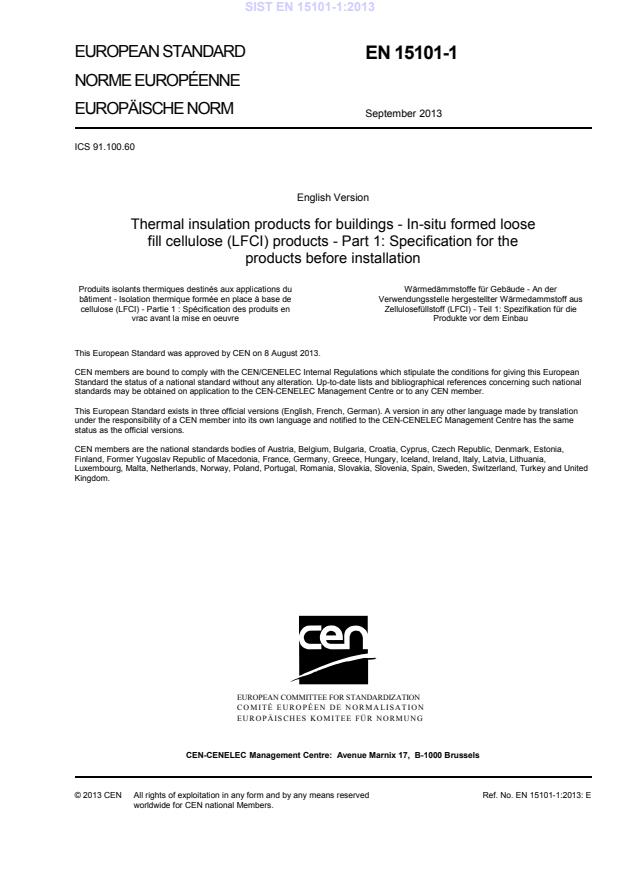
EUROPEAN STANDARD NORME EUROPÉENNE EUROPÄISCHE NORM
EN 15101-1
September 2013 ICS 91.100.60 English Version
Thermal insulation products for buildings - In-situ formed loose fill cellulose (LFCI) products - Part 1: Specification for the products before installation
Produits isolants thermiques destinés aux applications du bâtiment - Isolation thermique formée en place à base de cellulose (LFCI) - Partie 1 : Spécification des produits en vrac avant la mise en oeuvre
Wärmedämmstoffe für Gebäude - An der Verwendungsstelle hergestellter Wärmedammstoff aus Zellulosefüllstoff (LFCI) - Teil 1: Spezifikation für die Produkte vor dem Einbau This European Standard was approved by CEN on 8 August 2013.
CEN members are bound to comply with the CEN/CENELEC Internal Regulations which stipulate the conditions for giving this European Standard the status of a national standard without any alteration. Up-to-date lists and bibliographical references concerning such national standards may be obtained on application to the CEN-CENELEC Management Centre or to any CEN member.
This European Standard exists in three official versions (English, French, German). A version in any other language made by translation under the responsibility of a CEN member into its own language and notified to the CEN-CENELEC Management Centre has the same status as the official versions.
CEN members are the national standards bodies of Austria, Belgium, Bulgaria, Croatia, Cyprus, Czech Republic, Denmark, Estonia, Finland, Former Yugoslav Republic of Macedonia, France, Germany, Greece, Hungary, Iceland, Ireland, Italy, Latvia, Lithuania, Luxembourg, Malta, Netherlands, Norway, Poland, Portugal, Romania, Slovakia, Slovenia, Spain, Sweden, Switzerland, Turkey and United Kingdom.
EUROPEAN COMMITTEE FOR STANDARDIZATION
COMITÉ EUROPÉEN DE NORMALISATION EUROPÄISCHES KOMITEE FÜR NORMUNG
CEN-CENELEC Management Centre:
Avenue Marnix 17,
B-1000 Brussels © 2013 CEN All rights of exploitation in any form and by any means reserved worldwide for CEN national Members. Ref. No. EN 15101-1:2013: ESIST EN 15101-1:2013
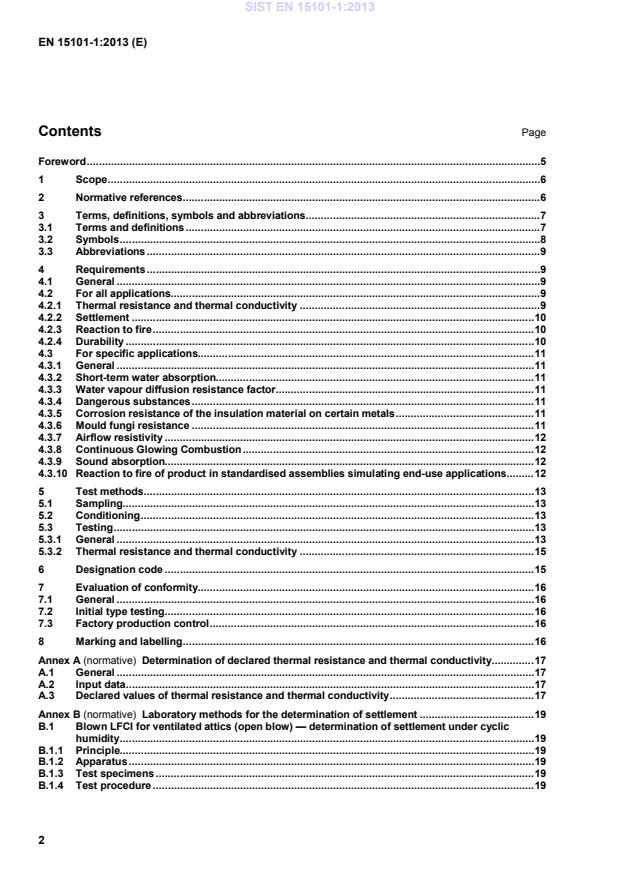
Determination of declared thermal resistance and thermal conductivity . 17 A.1 General . 17 A.2 Input data . 17 A.3 Declared values of thermal resistance and thermal conductivity . 17 Annex B (normative)
Laboratory methods for the determination of settlement . 19 B.1 Blown LFCI for ventilated attics (open blow) — determination of settlement under cyclic humidity . 19 B.1.1 Principle. 19 B.1.2 Apparatus . 19 B.1.3 Test specimens . 19 B.1.4 Test procedure . 19 SIST EN 15101-1:2013
Testing for reaction to fire of products . 30 C.1 Scope . 30 C.1.1 General . 30 C.1.2 Product and installation parameters . 30 C.1.3 Ignitability (EN ISO 11925-2) . 31 C.1.4 Single Burning Item [SBI] (EN 13823) for loose-fill cellulose insulation products . 32 Annex D (normative)
Specimen preparation method for the water absorption test . 36 D.1 Principle . 36 D.2 Conditioning . 36 D.3 Procedure . 36 Annex E (normative)
Method of test for corrosion resistance . 37 E.1 Principle . 37 E.2 Conditioning . 37 E.3 Reagents and materials . 37 E.4 Apparatus . 37 E.5 Procedure . 38 E.6 Classification of the results . 38 E.7 Report . 38 Annex F (normative)
Method for determining mould fungi resistance . 39 F.1 Scope . 39 F.2 Significance and use . 39 F.3 Apparatus . 39 F.4 Reagents and materials . 39 F.4.1 Water . 39 F.4.2 Inoculum . 40 F.5 Specimens . 40 F.5.1 Viability control specimens . 40 F.5.2 Comparative material . 40 F.5.3 Test specimens . 40 F.6 Procedure . 40 F.6.1 Spore suspension . 40 F.6.2 Inoculation of test specimens, comparative material and control specimens . 41 F.6.3 Incubation . 41 F.7 Test analysis . 41 F.7.1 General . 41 F.7.2 Validation . 42 F.7.3 Classification . 42 F.8 Report . 42 F.9 Precision and bias . 42 SIST EN 15101-1:2013
Specimen preparation method for the airflow resistance test . 43 G.1 Principle. 43 G.2 Procedure . 43 Annex H (normative)
Specimen preparation method for thermal resistance and thermal conductivity test . 44 H.1 Principle. 44 H.2 Procedure . 44 H.2.1 Horizontal applications, loft and floors . 44 H.2.2 Cavity insulation, frame constructions and cavity walls . 45 Annex I (normative)
Factory production control . 47 Annex J (normative)
Testing for reaction to fire of products in standardised assemblies simulating end-use application(s) . 50 J.1 Scope . 50 J.2 Product and installation parameters . 50 J.3 Mounting and fixing . 51 J.3.1 Ignitability (EN ISO 11925-2) . 51 J.3.2 Single Burning Item [SBI] (EN 13823) . 51 J.4 Field of application . 54 Annex K (normative)
An example of a performance chart . 56 Annex ZA (informative)
Clause of this European Standard addressing the provisions of the EU Construction Products Directive . 57 ZA.1 Scope and relevant characteristics . 57 ZA.2 Procedure for attestation of conformity of in situ formed loose-fill cellulose . 59 ZA.2.1 System(s) of attestation of conformity . 59 ZA.2.2 EC Certificate and Declaration of conformity . 61 ZA.3 CE marking and labelling . 62 Bibliography. 64
This European Standard is one of a series for mineral wool, expanded clay, expanded perlite, exfoliated vermiculite, polyurethane/polyisocyanurate, cellulose, bound expanded polystyrene and expanded polystyrene in-situ formed insulation products used in buildings, but this standard may be used in other areas where appropriate. The reduction in energy used and emissions produced during the installed life of insulation products exceeds by far the energy used and emissions made during the production and disposal processes. According to the CEN-CENELEC Internal Regulations, the national standards organisations of the following countries are bound to implement this European Standard: Austria, Belgium, Bulgaria, Croatia, Cyprus, Czech Republic, Denmark, Estonia, Finland, Former Yugoslav Republic of Macedonia, France, Germany, Greece, Hungary, Iceland, Ireland, Italy, Latvia, Lithuania, Luxembourg, Malta, Netherlands, Norway, Poland, Portugal, Romania, Slovakia, Slovenia, Spain, Sweden, Switzerland, Turkey and the United Kingdom. SIST EN 15101-1:2013
3.1 Terms and definitions
For the purposes of this document, the following terms and definitions apply. 3.1.1 open blow applications all applications except cavity applications 3.1.2 declared insulation thickness: “open blow” applications installed insulation thickness minus the thickness loss according to the settlement class of the product 3.1.3 declared insulation thickness: cavity applications identical with the thickness of the cavity 3.1.4 floor horizontal division between two storeys, over a crawl space or a floor directly on the ground 3.1.5 frame construction walls with wood or metal studs, sloping roof with insulation between and above rafters, as well as stud girders and internal and external insulation on solid masonry construction 3.1.6 settlement decrease of installed insulation thickness in lofts or height in cavities and frame constructions either under vibration, humidity, cyclic conditions and time, expressed as a percentage of the initial installed insulation thickness (after compaction if required) 3.1.7 coverage mass of insulation per unit area 3.1.8 performance chart table giving thickness and coverage requirements for different values of declared thermal resistance SIST EN 15101-1:2013
αw weighted sound absorption coefficient
Ra is the level of airflow resistivity kPa s/m2 S0 is the height before the settlement tests mm sD is the mean declared settlement value mm Si is the mean value of measured insulation height for settlement process number i mm sλ is the estimate of the standard deviation of the thermal conductivity W/(m × K) λ90/90 is the 90 % fractile with a confidence level of 90 % for the thermal conductivity W/(m × K) λD is the declared thermal conductivity W/(m × K) λi is one test result of thermal conductivity W/(m × K) λmean is the mean thermal conductivity W/(m × K) µ is the water vapour diffusion resistance factor
N is the number of test results
ρ is the bulk density before settlement test kg/m3 AF is the symbol for the level of airflow resistivity
BA is the symbol for the declared class for resistance to biological agents
CR is the symbol for the declared class for corrosion
SH is the declared class of settlement for horizontal applications loft and floors
SC is the declared class of settlement for cavity insulation, frame constructions and cavity walls
WS is the symbol of the declared level for short-term water absorption
NOTE There are additional symbols in Annex B which are not listed here. SIST EN 15101-1:2013
4.1 General Product properties shall be tested in accordance with Clause 5. To conform to this standard, products shall meet the requirements of 4.2 and 4.3 as appropriate. This European Standard gives an example of a manufacturer’s performance chart (declared thermal resistance related to the declared density range) which can be adapted for any application, see Annex K. NOTE Different applications can require different classes for settlement. One test result of a product property is the average of the measured values on the number of test specimens given in Table 6. 4.2 For all applications
4.2.1 Thermal resistance and thermal conductivity Thermal resistance and thermal conductivity shall be based upon measurements carried out in accordance with EN 12667 and/or EN 12939 for thick products and 5.3.2. The thermal values shall be determined in accordance with Annex A, 5.1 and 5.3.2 and declared by the manufacturer, according to the following: the reference mean temperature shall be 10 °C; the values shall be measured in dry conditions but the values declared shall be given for the product when conditioned at 23 °C and a relative humidity of 50 % (see 5.2); the thermal resistance, RD, shall always be declared. The thermal conductivity, D, shall be declared where possible; the thermal resistance, RD, and the thermal conductivity, D, shall be given as limit values representing at least 90 % of the production determined with a confidence level of 90 %; the measured values shall be expressed to three significant figures; the declared thermal resistance, RD, shall be calculated from the declared thermal insulation thickness and the corresponding D, taking into account the declared settlement sD (see NOTE below);
the value of thermal conductivity D shall be rounded upwards to the nearest 0,001 W/(m × K) and declared in levels with steps of 0,001 W/(m × K); the thermal conductivity value shall be declared; the value of thermal resistance, RD, shall be rounded downwards to the nearest 0,05 m2 K/W and declared in levels with steps of 0,05 m2 K/W; since LFCI can be installed at a variety of thickness (e.g. in a void or cavity) a table giving declared R-values at different thickness shall be used for marking and labelling. NOTE
The thermal resistance for loose-fill cellulose insulation is declared by the manufacturer in accordance with the declared density range using thermal conductivity measurements taken at densities across the declared density range and the worst result used as the declared value (see Annex K).
4.2.2.1 General Settlement shall be determined by testing by the appropriate method given in Annex B.
4.2.2.2 Horizontal applications, loft and floors Settlement shall be classified and declared in accordance with Table 1. The classification shall be based on measurements made in accordance with the laboratory method B.1 given in Annex B (temperature and humidity cycle). Table 1 — Classes for settlement for horizontal applications, lofts and floors Class Requirement
SH 0 No measureable settlement (≤ 1 %) SH 5 ≤ 5 % SH 10 ≤ 10 % SH 15 ≤ 15 % SH 20 ≤ 20 % SH 25 ≤ 25 % SH 30 > 25 % 4.2.2.3
Cavity insulation, frame constructions and cavity walls Settlement shall be classified and declared in accordance with Table 2. The classification shall be based on the long-term settlement experience after installation or measurements made in accordance with the laboratory Method B.2 given in Annex B. Table 2 — Class for settlement for cavity insulation, frame constructions and cavity walls Class
Requirement
SC O No measureable settlement (≤ 1 %) 4.2.3 Reaction to fire Reaction to fire classification of the product, as placed on the market, shall be determined in accordance with EN 13501-1 and the basic mounting and fixing rules given in Annex C. 4.2.4 Durability 4.2.4.1 General The appropriate durability characteristics have been considered and are covered in 4.2.4.2 to 4.2.4.3. 4.2.4.2 Durability of reaction to fire against ageing/degradation The long-term fire resistance of LFCI does not change with time. 4.2.4.3 Durability of thermal resistance against ageing/degradation All durability aspects of thermal conductivity are detailed in Annex A. In particular, settlement and change in thickness over time for open blow applications needs to be considered. SIST EN 15101-1:2013
4.3.2 Short-term water absorption Short-term water absorption, Wp, shall be determined in accordance with EN 1609, Method A with specimen preparation in accordance with Annex D. Test results shall be classified according to Table 3. Table 3 — Classes of short-term water absorption Class
Requirements
WS1 ≤ 1,0 kg/m2 WS 2 ≤ 2,0 kg/m2 4.3.3 Water vapour diffusion resistance factor Loose-fill Cellulose products have a structure that is highly permeable to water vapour. The water vapour resistance factor, , may be assumed to be 1 if no measurements are available. If measurements are undertaken, the product shall be tested in accordance with EN 12086, climatic condition A. Alternatively, values cited in EN ISO 10456 may be used. 4.3.4 Dangerous substances National regulations on dangerous substances may require verification and declaration on release, and sometimes content, when construction products covered by this standard are placed on those markets. In the absence of European harmonised test methods, verification and declaration on release/content should be done taking into account national provisions in the place of use. NOTE An informative database covering European and national provisions on dangerous substances is available at the Construction web site on EUROPA accessed through: http://ec.europa.eu/enterprise/construction/cpd-ds/ 4.3.5 Corrosion resistance of the insulation material on certain metals Corrosion resistance shall be classified and declared in accordance with Table 4 after testing in accordance with Annex E. Table 4 — Classes of corrosion resistance Class
Requirements
CR Test passed 4.3.6 Mould fungi resistance Resistance to mould fungi shall be classified and declared in accordance with Table 5 after testing in accordance with the procedure given in Annex F. SIST EN 15101-1:2013
Class BA
Intensity of growth in relation to comparative material
0 no mould visible on specimen surface, examined with reflected-light microscope at 50× magnification 1 mould growth not or hardly visible to the naked eye, but clearly visible at 50× magnification 2 mould clearly visible to the naked eye – considerably weaker than on the comparison material 3 mould clearly visible to the naked eye – equal or more intensive than on the comparison material 4.3.7 Airflow resistivity The airflow resistivity, ra, shall be determined in accordance with EN 29053, Method A using specimens prepared in accordance with Annex G. The value of the airflow resistivity shall be declared in levels with steps of 1 kPa s/m2. No test result shall be lower than the declared value. NOTE Airflow resistivity can be used when estimating the risk for reduced thermal resistance caused by convection or when evaluating the sound insulation capability. 4.3.8 Continuous Glowing Combustion Where subject to regulations, the manufacturer shall declare the glowing combustion of the product. In the absence of an existing test method, the compliance with the requirement shall be made on basis of the existing method used in the place of use of the product. NOTE A European test method is under development and the standard will be amended when this is available. 4.3.9 Sound absorption The sound absorption coefficient shall be determined in accordance with EN ISO 354 but always without a plenum. The sound absorption characteristics shall be calculated in accordance with EN ISO 11654 using the values for the practical sound absorption coefficient, αp, at the frequencies: 125 Hz, 250 Hz, 500 Hz, 1 000 Hz, 2 000 Hz and 4 000 Hz and the single number value for αw (weighted sound absorption coefficient). αp and αw shall be rounded to the nearest 0,05 (αp > 1 shall be expressed as αp=1) and declared in levels with steps of 0,05. No test result (αp and αw) shall be lower than the declared level. 4.3.10 Reaction to fire of product in standardised assemblies simulating end-use applications Reaction to fire classification of products in standardized assemblies simulating end-use applications shall be determined in accordance with EN 13501-1 with the basic mounting and fixing rules given in Annex J. This classification offers the opportunity to give a complementary and optional declaration on reaction to fire for standard test configurations of assemblies which include the insulation product. Detailed information about the test conditions and the field of application of the classification as stated in the reaction to fire classification report shall be given in the manufacturer's literature. SIST EN 15101-1:2013
EN 12667 or EN 12939 See EN 12667 or EN 12939
1 Measuring area: In order to maintain uniform material of the samples the measuring area should be sufficiently large. 4.2.2 Settlement
4.2.2.2 a) Lofts and floors B.1 600 mm x 600 mm x 300 mm
4.2.2.3 b) Frame constructions and cavity walls B.2 2300 mm x 600 mm x 240 mm minimum and 2300 mm x 600 mm x 100 mm minimum 1
4.2.3 Reaction to fire See EN 13501-1 and Annex C
4.3.2 Short-term water absorption EN 1609, Method A 200 mm x 200 mm x 150 mm or diameter 200 mm x 150mm
4.3.3 Water vapour diffusion resistance factor EN 12086 See 6.1 of EN 12086:2013 5
4.3.4 Release of dangerous substances - -
a 4.3.5 Corrosion resistance Annex E 20 g test specimens 4
4.3.6 Mould fungi resistance Annex F Petri Dish 90 mm 4
4.3.7 Airflow resistivity EN 29053, Method A See EN 29053 Thickness 100 mm 9
4.3.8 Continuous glowing combustion
– – – a 4.3.9 Sound absorption
EN ISO 354:2003, A.1 Minimum 10m2 1
4.3.10 Reaction to fire of products in standardized assemblies simulating end-use applications
Annex
J - 1 - a
Test not yet available.
Thermal resistance and thermal conductivity shall be determined in accordance with EN 12667 or EN 12939 for thick products and under the following conditions: at mean temperature of (10 ± 0,3) °C; after conditioning according to step 1 of 5.2 (i.e. under dry conditions); using the test specimens prepared by the procedure given in Annex H. Thermal resistance and thermal conductivity may also be measured at mean temperatures other than 10 °C, providing that the accuracy of the relationship between temperature and thermal properties is well doc
...