

EN ISO 10993-11:2018
(Main)Biological evaluation of medical devices - Part 11: Tests for systemic toxicity (ISO 10993-11:2017)
- Abstract
ISO 10993-11:2017 specifies requirements and gives guidance on procedures to be followed in the evaluation of the potential for medical device materials to cause adverse systemic reactions.
- Status
- Published
- Publication Date
- 29-May-2018
- Withdrawal Date
- 29-Nov-2018
- Technical Committee
- CEN/TC 206 - Biocompatibility of medical and dental materials and devices
- Current Stage
- 6060 - Definitive text made available (DAV) - Publishing
- Start Date
- 30-May-2018
- Completion Date
- 30-May-2018
90/385/EEC - Active implantable medical devicesOJ Ref: L, L 90 OJ Date: 25-Mar-2020
93/42/EEC - Medical devicesOJ Ref: LI 90, LI 90/1 OJ Date: 25-Mar-2020

Overview
EN ISO 10993-11:2018 (ISO 10993-11:2017) - "Biological evaluation of medical devices - Part 11: Tests for systemic toxicity" - specifies requirements and provides guidance on procedures to evaluate the potential of medical device materials to cause adverse systemic reactions. Endorsed as a European standard (EN ISO 10993-11:2018), it supports conformity assessment for EU medical device directives and is part of the ISO 10993 biocompatibility series.
Key topics and technical requirements
- Scope: Focuses on systemic toxicity assessment of device materials and extracts rather than mechanical or functional performance of devices.
- Guidance on test selection and study design: Helps determine when systemic toxicity testing is needed and how to plan appropriate biological studies based on exposure, duration and clinical use.
- Integration with risk management: Aligned with ISO 10993-1 and referencing risk-management expectations (e.g., ISO 14971) to ensure testing is proportionate to identified risks.
- Combined studies: Describes when systemic toxicity studies can be combined with local effect evaluations (for example, in conjunction with ISO 10993-6) and when implantation studies may satisfy systemic requirements.
- Regulatory relevance: Includes informative annexes (ZA/ZB) mapping the standard to EU Directives (93/42/EEC and 90/385/EEC), supporting presumption of conformity when normative clauses are followed.
Note: This summary highlights the standard’s intent and relationships; consult the full text for detailed procedural requirements and test-method specifics.
Practical applications - who uses this standard
- Medical device manufacturers preparing biocompatibility evidence for new or modified devices.
- Regulatory affairs professionals compiling technical files and demonstrating conformity with EU directives.
- Biocompatibility scientists and toxicologists designing systemic toxicity studies and interpreting results.
- Contract testing laboratories executing extract testing and in vivo/in vitro studies as specified.
- Notified bodies and auditors assessing compliance during conformity assessment and certification reviews.
Why it matters (value)
- Ensures a consistent, risk-based approach to identify systemic hazards from device materials.
- Helps manufacturers generate defensible data for safety dossiers and regulatory submissions.
- Facilitates harmonized assessment across jurisdictions through alignment with the ISO 10993 series and EN adoption.
Related standards
- ISO 10993-1 - Biological evaluation framework and general principles (normative reference).
- ISO 10993-6 - Tests for local effects after implantation (relevant for combined studies).
- EN ISO 14971 / ISO 14971 - Medical device risk management (referenced for risk-reduction expectations).
- Other parts of the ISO 10993 series covering specific endpoints (irritation, sensitization, genotoxicity, etc.).
Keywords: ISO 10993-11, EN ISO 10993-11:2018, systemic toxicity, medical device biocompatibility, toxicity testing, biological evaluation, risk management.
Relations
- Effective Date
- 06-Jun-2018
- Refers
ISO 10993-2:2006 - Biological evaluation of medical devices — Part 2: Animal welfare requirements - Effective Date
- 25-Aug-2026
- Effective Date
- 09-Feb-2026
- Effective Date
- 28-Jan-2026
- Effective Date
- 09-Feb-2026
- Effective Date
- 28-Jan-2026
- Effective Date
- 28-Jan-2026
- Effective Date
- 28-Jan-2026
- Referred By
EN 12022:1999 - Blood gas exchangers - Effective Date
- 28-Jan-2026
- Consolidated By
ISO 10993-11:2017 - Biological evaluation of medical devices — Part 11: Tests for systemic toxicity - Effective Date
- 12-Feb-2026
- Effective Date
- 26-Apr-2023
Related Packages

Get Certified
Connect with accredited certification bodies for this standard

BSI Group
BSI (British Standards Institution) is the business standards company that helps organizations make excellence a habit.

TÜV Rheinland
TÜV Rheinland is a leading international provider of technical services.

TÜV SÜD
TÜV SÜD is a trusted partner of choice for safety, security and sustainability solutions.
Sponsored listings
Frequently Asked Questions
EN ISO 10993-11:2018 is a standard published by the European Committee for Standardization (CEN). Its full title is "Biological evaluation of medical devices - Part 11: Tests for systemic toxicity (ISO 10993-11:2017)". This standard covers: ISO 10993-11:2017 specifies requirements and gives guidance on procedures to be followed in the evaluation of the potential for medical device materials to cause adverse systemic reactions.
ISO 10993-11:2017 specifies requirements and gives guidance on procedures to be followed in the evaluation of the potential for medical device materials to cause adverse systemic reactions.
EN ISO 10993-11:2018 is classified under the following ICS (International Classification for Standards) categories: 11.100.20 - Biological evaluation of medical devices. The ICS classification helps identify the subject area and facilitates finding related standards.
EN ISO 10993-11:2018 has the following relationships with other standards: It is inter standard links to EN ISO 10993-11:2009, ISO 10993-2:2006, ISO 10993-1:2009, EN ISO 10961:2012, EN 60601-1:2006/A2:2021, EN ISO 12836:2015, CEN/TS 15277:2006, EN 455-3:2006, EN 12022:1999, ISO 10993-11:2017, prEN ISO 10993-11. Understanding these relationships helps ensure you are using the most current and applicable version of the standard.
EN ISO 10993-11:2018 is associated with the following European legislation: EU Directives/Regulations: 2007/47/EC, 90/385/EEC, 93/42/EEC; Standardization Mandates: M/295. When a standard is cited in the Official Journal of the European Union, products manufactured in conformity with it benefit from a presumption of conformity with the essential requirements of the corresponding EU directive or regulation.
EN ISO 10993-11:2018 is available in PDF format for immediate download after purchase. The document can be added to your cart and obtained through the secure checkout process. Digital delivery ensures instant access to the complete standard document.
Standards Content (Sample)
SLOVENSKI STANDARD
01-september-2018
Nadomešča:
SIST EN ISO 10993-11:2009
Biološko ovrednotenje medicinskih pripomočkov - 11. del: Preskusi sistemske
toksičnosti (ISO 10993-11:2017)
Biological evaluation of medical devices - Part 11: Tests for systemic toxicity (ISO 10993-
11:2017)
Biologische Beurteilung von Medizinprodukten - Teil 11: Prüfungen auf systemische
Toxizität (ISO 10993-11:2017)
Évaluation biologique des dispositifs médicaux - Partie 11: Essais de toxicité systémique
(ISO 10993-11:2017)
Ta slovenski standard je istoveten z: EN ISO 10993-11:2018
ICS:
11.100.20 Biološko ovrednotenje Biological evaluation of
medicinskih pripomočkov medical devices
2003-01.Slovenski inštitut za standardizacijo. Razmnoževanje celote ali delov tega standarda ni dovoljeno.
EN ISO 10993-11
EUROPEAN STANDARD
NORME EUROPÉENNE
May 2018
EUROPÄISCHE NORM
ICS 11.100.20 Supersedes EN ISO 10993-11:2009
English Version
Biological evaluation of medical devices - Part 11: Tests for
systemic toxicity (ISO 10993-11:2017)
Évaluation biologique des dispositifs médicaux - Partie Biologische Beurteilung von Medizinprodukten - Teil
11: Essais de toxicité systémique (ISO 10993-11:2017) 11: Prüfungen auf systemische Toxizität (ISO 10993-
11:2017)
This European Standard was approved by CEN on 31 July 2017.
CEN members are bound to comply with the CEN/CENELEC Internal Regulations which stipulate the conditions for giving this
European Standard the status of a national standard without any alteration. Up-to-date lists and bibliographical references
concerning such national standards may be obtained on application to the CEN-CENELEC Management Centre or to any CEN
member.
This European Standard exists in three official versions (English, French, German). A version in any other language made by
translation under the responsibility of a CEN member into its own language and notified to the CEN-CENELEC Management
Centre has the same status as the official versions.
CEN members are the national standards bodies of Austria, Belgium, Bulgaria, Croatia, Cyprus, Czech Republic, Denmark, Estonia,
Finland, Former Yugoslav Republic of Macedonia, France, Germany, Greece, Hungary, Iceland, Ireland, Italy, Latvia, Lithuania,
Luxembourg, Malta, Netherlands, Norway, Poland, Portugal, Romania, Serbia, Slovakia, Slovenia, Spain, Sweden, Switzerland,
Turkey and United Kingdom.
EUROPEAN COMMITTEE FOR STANDARDIZATION
COMITÉ EUROPÉEN DE NORMALISATION
EUROPÄISCHES KOMITEE FÜR NORMUNG
CEN-CENELEC Management Centre: Rue de la Science 23, B-1040 Brussels
© 2018 CEN All rights of exploitation in any form and by any means reserved Ref. No. EN ISO 10993-11:2018 E
worldwide for CEN national Members.
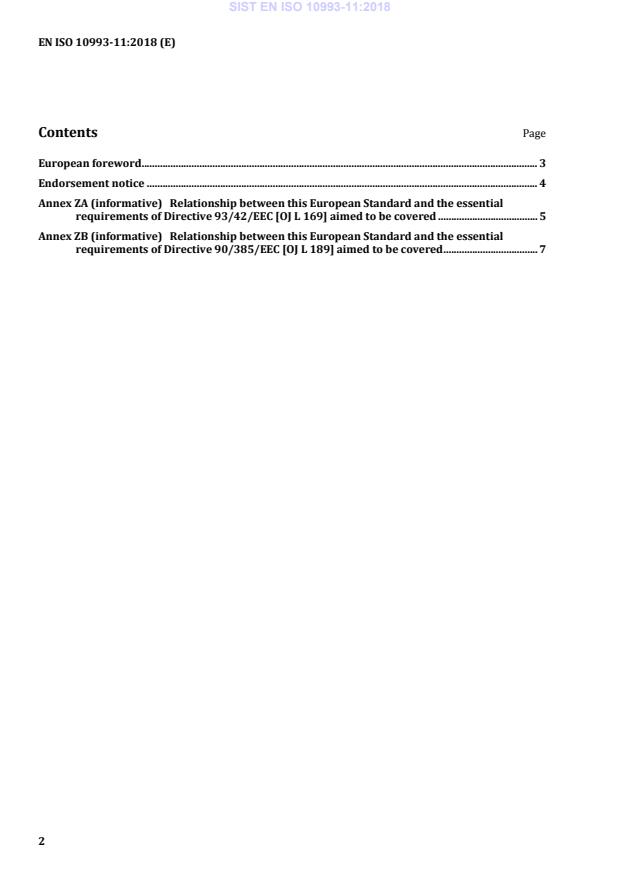
Contents Page
European foreword . 3
Endorsement notice . 4
Annex ZA (informative) Relationship between this European Standard and the essential
requirements of Directive 93/42/EEC [OJ L 169] aimed to be covered . 5
Annex ZB (informative) Relationship between this European Standard and the essential
requirements of Directive 90/385/EEC [OJ L 189] aimed to be covered . 7
European foreword
This document (EN ISO 10993-11:2018) has been prepared by Technical Committee ISO/TC 194 "
Biological and clinical evaluation of medical devices " in collaboration with Technical Committee
CEN/TC 206 “Biological and clinical evaluation of medical devices” the secretariat of which is held by
DIN.
This European Standard shall be given the status of a national standard, either by publication of an
identical text or by endorsement, at the latest by November 2018, and conflicting national standards
shall be withdrawn at the latest by November 2018.
Attention is drawn to the possibility that some of the elements of this document may be the subject of
patent rights. CEN shall not be held responsible for identifying any or all such patent rights.
This document supersedes EN ISO 10993-11:2009.
This document has been prepared under a mandate given to CEN by the European Commission and the
European Free Trade Association, and supports essential requirements of EU Directive(s).
For relationship with EU Directive(s), see informative Annex ZA and ZB, which is an integral part of this
document.
The following referenced documents are indispensable for the application of this document. For
undated references, the latest edition of the referenced document (including any amendments) applies.
For dated references, only the edition cited applies. However, for any use of this standard ‘within the
meaning of Annex ZA’, the user should always check that any referenced document has not been
superseded and that its relevant contents can still be considered the generally acknowledged state-of-
art.
When an IEC or ISO standard is referred to in the ISO standard text, this shall be understood as a
normative reference to the corresponding EN standard, if available, and otherwise to the dated version
of the ISO or IEC standard, as listed below.
NOTE 1 The way in which these referenced documents are cited in normative requirements determines the
extent (in whole or in part) to which they apply.
Table 1 — Correlations between undated normative references and dated EN and ISO standards
Normative references Equivalent dated standard
as listed in Clause 2 of
EN ISO or IEC
the ISO standard
ISO 10993-1 EN ISO 10993-1:2009 ISO 10993-1:2009
ISO 10993-2 EN ISO 10993-2:2006 ISO 10993-2:2006
NOTE 2 This part of EN ISO 10993 refers to ISO 10993-1 which itself refers to ISO 14971. In Europe, it should
be assumed that the reference to ISO 14971 is to EN ISO 14971:2012.
According to the CEN-CENELEC Internal Regulations, the national standards organizations of the
following countries are bound to implement this European Standard: Austria, Belgium, Bulgaria,
Croatia, Cyprus, Czech Republic, Denmark, Estonia, Finland, Former Yugoslav Republic of Macedonia,
France, Germany, Greece, Hungary, Iceland, Ireland, Italy, Latvia, Lithuania, Luxembourg, Malta,
Netherlands, Norway, Poland, Portugal, Romania, Slovakia, Slovenia, Spain, Sweden, Switzerland,
Turkey and the United Kingdom.
Endorsement notice
The text of ISO 10993-11:2017 has been approved by CEN as EN ISO 10993-11:2018 without any
modification.
Annex ZA
(informative)
Relationship between this European Standard and the essential
requirements of Directive 93/42/EEC [OJ L 169] aimed to be covered
This European Standard has been prepared under a Commission’s joint standardization request
M/BC/CEN/89/9 concerning harmonized standards relating to horizontal aspects in the field of medical
devices to provide one voluntary means of conforming to essential requirements of Council Directive
93/42/EEC of 14 June 1993 concerning medical devices [OJ L 169].
Once this standard is cited in the Official Journal of the European Union under that Directive,
compliance with the normative clauses of this standard given in Table ZA.1 confers, within the limits of
the scope of this standard, a presumption of conformity with the corresponding essential requirements
of that Directive and associated EFTA regulations.
NOTE 1 Where a reference from a clause of this standard to the risk management process is made, the risk
management process needs to be in compliance with Directive 93/42/EEC as amended by 2007/47/EC. This
means that risks have to be reduced ‘as far as possible’, ‘to a minimum’, ‘to the lowest possible level’, ‘minimized’
or ‘removed’, according to the wording of the corresponding essential requirement.
NOTE 2 The manufacturer’s policy for determining acceptable risk must be in compliance with Essential
Requirements 1, 2, 5, 6, 7, 8, 9, 11 and 12 of the Directive.
NOTE 3 This Annex ZA is based on normative references according to the table of references in the European
foreword, replacing the references in the core text.
NOTE 4 When an Essential Requirement does not appear in Table ZA.1, it means that it is not addressed by this
European Standard.
Table ZA.1 — Correspondence between this European Standard and Annex I of Directive
93/42/EEC [OJ L 169]
Essential Requirements of Clause(s)/sub-clause(s) of Remarks/Notes
Directive 93/42/EEC this EN
ER 7.1 is only partly covered by ISO
10993-11, since the standard does not
provide requirements on design and
manufacture. However, this part of ISO
10993 specifies test methods for the
assessment of systemic toxicity of
materials intended for use in medical
devices. Therefore, this standard
provides a means to evaluate systemic
7.1 (First and second indent) 4, 5 and 6
toxicity risks associated with the
materials which are used.
These tests are not intended to evaluate
or determine the performance of the test
sample in terms of mechanical or
functional loading.
Systemic toxicity studies conducted by
Essential Requirements of Clause(s)/sub-clause(s) of Remarks/Notes
Directive 93/42/EEC this EN
implantation may satisfy the
requirements of this part of ISO 10993.
When conducting combined studies for
evaluating local effects and systemic
effects, the requirements of this part of
ISO 10993 and ISO 10993-6 shall be
fulfilled.
For ER 7.1 (first and second indent),
flammability is not covered
ER 7.2 is not covered by ISO 10993-11,
since the standard does not provide
requirements on design, manufacture
and packaging and does not oblige to
minimize risk. However, this part of ISO
10993 specifies test methods for the
assessment of systemic effects arising
7.2 4, 5 and 6
from the exposure of users or patients to
contaminants or residues present in
medical devices. This assessment can be
a preliminary step for risk minimization.
However it does not address risks to
persons involved in the transport or
storage of medical devices.
ER 7.5 is not covered by ISO 10993-11,
since the standard does not provide
requirements on design and manufacture
and does not oblige to minimize risk.
However, this part of ISO 10993 specifies
7.5, first paragraph, first sentence
4, 5 and 6
test methods for the assessment of
only
systemic effects arising from exposure to
substances released by or leaching from
medical devices. This evaluation can be a
preliminary step for risk minimization.
Other forms of toxicity are not dealt with
in this standard.
General Note: Presumption of conformity depends on also complying with all relevant
clauses/subclauses of ISO 10993-1.
WARNING 1 — Presumption of conformity stays valid only as long as a reference to this European
Standard is maintained in the list published in the Official Journal of the European Union. Users of this
standard should consult frequently the latest list published in the Official Journal of the European
Union.
WARNING 2 — Other Union legislation may be applicable to the products falling within the scope of
this standard.
Annex ZB
(informative)
Relationship between this European Standard and the essential
requirements of Directive 90/385/EEC [OJ L 189] aimed to be covered
This European Standard has been prepared under a Commission’s joint standardization request
M/BC/CEN/89/9 concerning harmonized standards relating to horizontal aspects in the field of medical
devices to provide one voluntary means of conforming to essential requirements of Council Directive
90/385/EEC of 20 June 1990 on the approximation of the laws of the Member States relating to active
implantable medical devices [OJ L 189].
Once this standard is cited in the Official Journal of the European Union under that Directive,
compliance with the normative clauses of this standard given in Table ZB.1 confers, within the limits of
the scope of this standard, a presumption of conformity with the corresponding essential requirements
of that Directive and associated EFTA regulations.
NOTE 1 Where a reference from a clause of this standard to the risk management process is made, the risk
management process needs to be in compliance with Directive 90/385/EEC as amended by 2007/47/EC. This
means that risks have to be reduced ‘as far as possible’, ‘to a minimum’, ‘to the lowest possible level’, ‘minimized’
or ‘removed’, according to the wording of the corresponding essential requirement.
NOTE 2 The manufacturer’s policy for determining acceptable risk must be in compliance with Essential
Requirements 1, 4, 5, 8, 9 and 10 of the Directive.
NOTE 3 This Annex ZB is based on normative references according to the table of references in the European
foreword, replacing the references in the core text.
NOTE 4 When an Essential Requirement does not appear in Table ZB.1, it means that it is not addressed by this
European Standard.
Table ZB.1 — Correspondence between this European Standard and Annex I of Directive
90/385/EEC [OJ L 189]
Essential Requirements of Clause(s)/sub-clause(s) Remarks/Notes
Directive 90/385/EEC of this EN
ER 9 is only partly covered by ISO
10993-11, since the standard does
not provide requirements on
design and manufacture. However,
this part of ISO 10993 specifies test
methods for the assessment of
systemic toxicity of materials
9 (only first and second
intended for use in medical
4, 5 and 6
indent)
devices. Therefore, this standard
provides a means to evaluate
systemic toxicity risks associated
with the materials which are used.
These tests are not intended to
evaluate or determine the
Essential Requirements of Clause(s)/sub-clause(s) Remarks/Notes
Directive 90/385/EEC of this EN
performance of the test sample in
terms of mechanical or functional
loading.
Systemic toxicity studies
conducted by implantation may
satisfy the requirements of this
part of ISO 10993. When
conducting combined studies for
evaluating local effects and
systemic effects, the requirements
of this part of ISO 10993 and
ISO 10993-6 shall be fulfilled.
Other forms of toxicity are not
covered.
General Note: Presumption of conformity depends on also complying with all relevant
clauses/subclauses of ISO 10993-1.
WARNING 1 — Presumption of conformity stays valid only as long as a reference to this European
Standard is maintained in the list published in the Official Journal of the European Union. Users of this
standard should consult frequently the latest list published in the Official Journal of the European
Union.
WARNING 2 — Other Union legislation may be applicable to the products falling within the scope of
this standard.
INTERNATIONAL ISO
STANDARD 10993-11
Third edition
2017-09
Biological evaluation of medical
devices —
Part 11:
Tests for systemic toxicity
Évaluation biologique des dispositifs médicaux —
Partie 11: Essais de toxicité systémique
Reference number
ISO 10993-11:2017(E)
©
ISO 2017
ISO 10993-11:2017(E)
© ISO 2017, Published in Switzerland
All rights reserved. Unless otherwise specified, no part of this publication may be reproduced or utilized otherwise in any form
or by any means, electronic or mechanical, including photocopying, or posting on the internet or an intranet, without prior
written permission. Permission can be requested from either ISO at the address below or ISO’s member body in the country of
the requester.
ISO copyright office
Ch. de Blandonnet 8 • CP 401
CH-1214 Vernier, Geneva, Switzerland
Tel. +41 22 749 01 11
Fax +41 22 749 09 47
copyright@iso.org
www.iso.org
ii © ISO 2017 – All rights reserved
ISO 10993-11:2017(E)
Contents Page
Foreword .v
Introduction .vi
1 Scope . 1
2 Normative references . 1
3 Terms and definitions . 1
4 General considerations . 3
4.1 General . 3
4.2 Selection of animal species . 3
4.3 Animal status . 3
4.4 Animal care and husbandry . 3
4.5 Size and number of groups . 4
4.5.1 Size of groups . 4
4.5.2 Number of groups . 4
4.5.3 Treatment controls . 4
4.6 Route of exposure . 5
4.7 Sample preparation . 5
4.8 Dosing . 5
4.8.1 Test sample administration . 5
4.8.2 Dosage volumes . 5
4.8.3 Dosage frequency . 6
4.9 Body weight and food/water consumption . 6
4.10 Clinical observations . 6
4.11 Clinical pathology . 6
4.12 Anatomic pathology . 7
4.13 Study designs . 7
4.14 Quality of investigation . 7
5 Acute systemic toxicity . 7
5.1 General . 7
5.2 Study design . 8
5.2.1 Preparations . 8
5.2.2 Experimental animals. 8
5.2.3 Test conditions. 8
5.2.4 Body weights . 9
5.2.5 Clinical observations . 9
5.2.6 Pathology . 9
5.3 Evaluation criteria .10
5.3.1 General.10
5.3.2 Evaluation of results .10
5.4 Final report .10
6 Repeated exposure systemic toxicity (subacute, subchronic and chronic
systemic toxicity) .12
6.1 General .12
6.2 Study design .12
6.2.1 Preparations .12
6.2.2 Experimental animals.12
6.2.3 Test conditions.13
6.2.4 Body weights .13
6.2.5 Clinical observations .13
6.2.6 Pathology .13
6.3 Evaluation criteria .14
6.3.1 General.14
6.3.2 Evaluation of results .14
ISO 10993-11:2017(E)
6.4 Final report .15
Annex A (informative) Routes of administration .16
Annex B (informative) Dosage volumes .18
Annex C (informative) Common clinical signs and observations .19
Annex D (informative) Suggested haematology, clinical chemistry and urinalysis measurements 20
Annex E (informative) Suggested organ list for histopathological evaluation .22
Annex F (informative) Organ list for limited histopathology for medical devices subjected
to systemic toxicity testing .24
Annex G (informative) Information on material-mediated pyrogens .25
Annex H (informative) Subchronic rat — Dual routes of parenteral administration .26
Bibliography .28
iv © ISO 2017 – All rights reserved
ISO 10993-11:2017(E)
Foreword
ISO (the International Organization for Standardization) is a worldwide federation of national standards
bodies (ISO member bodies). The work of preparing International Standards is normally carried out
through ISO technical committees. Each member body interested in a subject for which a technical
committee has been established has the right to be represented on that committee. International
organizations, governmental and non-governmental, in liaison with ISO, also take part in the work.
ISO collaborates closely with the International Electrotechnical Commission (IEC) on all matters of
electrotechnical standardization.
The procedures used to develop this document and those intended for its further maintenance are
described in the ISO/IEC Directives, Part 1. In particular the different approval criteria needed for the
different types of ISO documents should be noted. This document was drafted in accordance with the
editorial rules of the ISO/IEC Directives, Part 2 (see www.iso.org/directives).
Attention is drawn to the possibility that some of the elements of this document may be the subject of
patent rights. ISO shall not be held responsible for identifying any or all such patent rights. Details of
any patent rights identified during the development of the document will be in the Introduction and/or
on the ISO list of patent declarations received (see www.iso.org/patents).
Any trade name used in this document is information given for the convenience of users and does not
constitute an endorsement.
For an explanation on the voluntary nature of standards, the meaning of ISO specific terms and
expressions related to conformity assessment, as well as information about ISO's adherence to the
World Trade Organization (WTO) principles in the Technical Barriers to Trade (TBT) see the following
URL: www.iso.org/iso/foreword.html.
This document was prepared by Technical Committee ISO/TC 194 Biological and clinical evaluation of
medical devices.
This third edition cancels and replaces the second edition (ISO 10993-11:2006), which has been
technically revised with the following changes:
a) reduction in group size for chronic toxicity testing in Table 1;
b) a new Annex F was added;
c) the original Annex F was moved to Annex G;
d) a new Annex H was added;
e) the Bibliography was updated.
A list of all parts in the ISO 10993 series can be found on the ISO website.
ISO 10993-11:2017(E)
Introduction
Systemic toxicity is a potential adverse effect of the use of medical devices. Generalized effects, as well
as organ and organ system effects can result from absorption, distribution and metabolism of leachates
from the device or its materials to parts of the body with which they are not in direct contact. This
document addresses the evaluation of generalized systemic toxicity, not specific target organ or organ
system toxicity, even though these effects may result from the systemic absorption and distribution of
toxicants.
Because of the broad range of medical devices, and their materials and intended uses, this document
is not overly prescriptive. While it addresses specific methodological aspects to be considered in the
design of systemic toxicity tests, proper study design has to be uniquely tailored to the nature of the
device’s materials and its intended clinical application.
Other elements of this document are prescriptive in nature, including those aspects that address
compliance with good laboratory practices and elements for inclusion in reporting.
While some systemic toxicity tests (e.g. long term implantation or dermal toxicity studies) can be
designed to study systemic effects as well as local, carcinogenic or reproductive effects, this document
focuses only on those aspects of such studies, which are intended to address systemic effects. Studies
which are intended to address other toxicological end points are addressed in ISO 10993-3, ISO 10993-6,
ISO 10993-10 and ISO/TS 10993-20.
Prior to conducting a systemic toxicity study, all reasonably available data and scientifically sound
methods in the planning and refinement of the systemic toxicity study design should be reviewed.
This includes the suitability of use of input data such as existing toxicological data, data from chemical
characterization studies and/or other biological tests (including in vitro tests and less invasive in vivo
tests) for the refinement of study design, dose selection, and/or selection of pathological end points to
cover in the evaluation of a study. For the repeated exposure systemic toxicity study in particular, the
use of scientifically sound study design, the use of pilot studies and statistical study design and the
use of unbiased, quantitative end points/methods in the pathological (including histopathological) and
clinical chemistry methods are important so as to obtain data which have sufficient scientific validity.
Finally, toxicology is an imperfect science. The outcome of any single test should not be the sole basis
for making a determination of whether a device is safe for its intended use.
vi © ISO 2017 – All rights reserved
INTERNATIONAL STANDARD ISO 10993-11:2017(E)
Biological evaluation of medical devices —
Part 11:
Tests for systemic toxicity
1 Scope
This document specifies requirements and gives guidance on procedures to be followed in the
evaluation of the potential for medical device materials to cause adverse systemic reactions.
2 Normative references
The following documents are referred to in the text in such a way that some or all of their content
constitutes requirements of this document. For dated references, only the edition cited applies. For
undated references, the latest edition of the referenced document (including any amendments) applies.
ISO 10993-1, Biological evaluation of medical devices — Part 1: Evaluation and testing within a risk
management process
ISO 10993-2, Biological evaluation of medical devices — Part 2: Animal welfare requirements
3 Terms and definitions
For the purposes of this document, the terms and definitions given in ISO 10993-1 and the following apply.
ISO and IEC maintain terminological databases for use in standardization at the following addresses:
— IEC Electropedia: available at http://www.electropedia.org/
— ISO Online browsing platform: available at http://www.iso.org/obp
3.1
dose
dosage
amount of test sample administered (e.g. mass, volume) expressed per unit of body weight or surface area
3.2
dose-effect
relationship between the dosage and the magnitude of a defined biological effect either in an individual
or in a population sample
3.3
dose-response
relationship of dosage to the spectrum of effects related to the exposure
Note 1 to entry: There are two types of dose-response relationships. The first type is the response of an
individual to a range of doses. The second type is the distribution of responses of a population of individuals to
a range of doses.
ISO 10993-11:2017(E)
3.4
leachable substance
chemical removed from a device or material by the action of water or other liquids related to the use of
the device
Note 1 to entry: Examples of leachable substances are additives, sterilant residues, process residues, degradation
products, solvents, plasticizers, lubricants, catalysts, stabilizers, anti-oxidants, colouring agents, fillers and
monomers.
3.5
limit test
use of a single group treated at a suitable dosage of test sample in order to delineate the presence or
absence of a toxic hazard
3.6
systemic toxicity
toxicity that is not limited to adverse effects at the site of contact between the body and the device
Note 1 to entry: Systemic toxicity requires absorption and distribution of a toxicant from its entry point to a
distant site at which deleterious effects are produced.
3.7
acute systemic toxicity
adverse effects occurring at any time within 72 h after single, multiple or continuous exposures of a
test sample for 24 h
3.8
subacute systemic toxicity
adverse effects occurring after multiple or continuous exposure between 24 h and 28 d
Note 1 to entry: Since this term is semantically incorrect, the adverse effects occurring within the specified time
period may also be described as a short-term repeated exposure systemic toxicity study. The selection of time
intervals between 14 d and 28 d is consistent with most international regulatory guidelines and considered
a reasonable approach. Subacute intravenous studies are generally defined as treatment durations of >24 h
but <14 d.
3.9
subchronic systemic toxicity
adverse effects occurring after the repeated or continuous administration of a test sample for a part of
the lifespan
Note 1 to entry: Subchronic toxicity studies are usually 90 d in rodents but not exceeding 10 % of the lifespan
of other species. Subchronic intravenous studies are generally defined as treatment durations of 14 d to 28 d for
rodents and non-rodents, respectively.
3.10
chronic systemic toxicity
adverse effects occurring after the repeated or continuous administration of a test sample for a major
part of the life span
Note 1 to entry: Chronic toxicity studies usually have a duration of 6 months to 12 months.
3.11
test sample
material, device, device portion, component, extract or portion thereof that is subjected to biological or
chemical testing or evaluation
2 © ISO 2017 – All rights reserved
ISO 10993-11:2017(E)
4 General considerations
4.1 General
Before a decision to perform a systemic toxicity test is made, ISO 10993-1 shall be taken into account.
The decision to perform a test shall be justified on the basis of an assessment of the risk of systemic
toxicity. Selection of the appropriate test(s) for a device shall be in accordance with ISO 10993-1, giving
due consideration to mode and duration of contact.
Testing shall be performed on the final product and/or representative component samples of the final
product and/or materials. Test samples shall reflect the conditions under which the device is normally
manufactured and processed. If deviations are necessary, they shall be recorded in the test report,
together with their justification. For hazard identification purposes, it may be necessary to exaggerate
exposure to the test samples.
Physical and chemical properties of the test sample including, for example, pH, stability, viscosity,
osmolality, buffering capacity, solubility and sterility, are some factors to consider when designing
the study.
When animal tests are considered, all reasonably and practically available replacement, reduction and
refinement alternatives should be identified and implemented to satisfy the provisions of ISO 10993-2.
For in vivo acute toxicity testing, in vitro cytotoxicity data are useful in estimating starting doses.
4.2 Selection of animal species
There is no absolute criterion for selecting a particular animal species for systemic toxicity testing of
medical devices. However, the species used shall be scientifically justified and in line with the provisions
of ISO 10993-2. For acute oral, intravenous, dermal and inhalation studies of medical devices the
rodent (mouse or rat) is preferred with the option of the rabbit (lagomorph) in the case of dermal and
implantation studies. Other non-rodent species may also need to be considered for testing, recognizing
that a number of factors might dictate the number or choice of species for study.
It is preferred that a single animal species and strain are used when a series of systemic toxicity studies
of different durations are performed, e.g. acute, subacute, subchronic and/or chronic systemic toxicity.
This controls the variability between species and strains and facilitates an evaluation related solely
to study duration. Should multiple species or strains be used, justification for their selection shall be
documented.
4.3 Animal status
Generally, healthy purpose-bred young adult animals of known origin and with defined microbiological
health status should be used. At the commencement of the study, the weight variation of animals used
within a sex should not exceed ±20 % of the mean weight. When females are used, they should be
nulliparous and non-pregnant. Animal selection shall be justified.
4.4 Animal care and husbandry
Care and handling of animals shall conform to accepted animal husbandry guidelines. Animals shall
be acclimatized to the laboratory conditions prior to treatment and the period of time documented.
Control of environmental conditions and proper animal care techniques are necessary for meaningful
results. Dietary constituents and bedding materials that are known to produce or influence toxicity
should be properly characterized and their potential to influence test results taken into account.
ISO 10993-11:2017(E)
4.5 Size and number of groups
4.5.1 Size of groups
The precision of the systemic toxicity test is dependent to a large extent on the number of animals
used per dose level. The degree of precision needed and, in turn, the number of animals per dose group
needed depends on the purpose of the study.
Group sizes should logically increase with the duration of treatment, such that at the end of the study
enough animals in every group are available for thorough biological evaluation. However, the minimum
number of animals should be used consistent with obtaining meaningful results (see ISO 10993-2).
Recommended minimum group sizes, all routes considered, are given in Table 1.
Table 1 — Recommended minimum group sizes
Study type Rodent Non-rodent
a
Acute 5 3
a a
Subacute 10 (5 per sex) 6 (3 per sex)
a a
Subchronic 20 (10 per sex) 8 (4 per sex)
b, c c
Chronic 30 (15 per sex)
a
Testing in a single sex is acceptable. When a device is
intended for use in only one sex, testing should be done in
that sex.
b
The recommendation for rodents refers to one dose-level
group testing. Where additional exaggerated dose groups are
included the recommended group size may be reduced to 10
per sex.
c
Expert statistical consultation for chronic study non-
rodent group size is recommended. The number of animals
tested should be based on the minimum required to provide
meaningful data. Enough animals shall remain at the
termination of the study to ensure proper statistical evaluation
of the results.
4.5.2 Number of groups
One dose group treated at a suitable dosage of test sample in a single species could delineate the
presence or absence of a toxic hazard (i.e. limit test). However, other multi-dose or dose response
studies require multiple groups to delineate the toxic response.
The number of treatment groups may be increased when attempting to characterize a dose response
using exaggerated doses. The following examples for exaggerating the dose should be considered:
— multiples of the clinical surface area of exposure;
— multiples of the duration of exposure;
— multiples of the extractable fraction or the individual chemicals;
— multiple administrations within a 24-h period.
Other methods to exaggerate the dose may be acceptable. The method used shal
...