


FprEN 13378
(Main)Pasta processing plant - Pasta presses - Safety and hygiene requirements
Pasta processing plant - Pasta presses - Safety and hygiene requirements
This document applies to pasta presses (see Clause 3), used for continuous pasta production, hereinafter called presses.
These machines are usually used in a production line, but can also operate independently.
When the machines are part of a line, this standard does not cover the other constituent units of the line and their interfaces.
This document specifies the safety requirements for the design, manufacture and information for use for presses and deals with all significant hazards, hazardous situations and events when they are used as intended and under conditions of misuse which are reasonably foreseeable by the manufacturer (see Clause 4).
It deals with the hazards during the following phases of the machines' lifetime: transport, assembly and installation, commissioning, setting and adjusting, operation, cleaning, fault finding, maintenance, decommissioning, dismantling, disabling and scrapping.
The measures for risk reduction are given in Clause 5.
This document does not apply to:
- machines for household use;
- machines fed under manual control and working in cycles (batch machines);
- cutting units (see EN 13379).
The significant hazards covered by this document are listed in Clause 4.
This document is not applicable to machines in its scope which are manufactured before the date of its publication as EN.
Maschinen zur Teigwarenherstellung - Pressen zur Teigwarenherstellung - Sicherheits- und Hygieneanforderungen
Diese Europäische Norm gilt für Pressen zur Teigwarenherstellung (siehe Abschnitt 3), die für den Einsatz für die kontinuierliche Teigwarenherstellung gebaut sind.
Diese Europäische Norm spezifiziert die Sicherheitsanforderungen in Bezug auf die Konstruktion, die Herstellung und Informationen für den Einsatz für kontinuierlichen Pressen für die Teigwarenherstellung fest und behandelt alle schwerwiegenden Gefährdungen, gefährdende Situationen und Ereignisse, bei denen die Maschinen, die unter den Anwendungsbereich dieses Standards fallen, wie vorgesehen, bestimmungsgemäß verwendet werden sowie unter Bedingungen der vom Hersteller vorhersehbaren missbräuchlichen Verwendung, siehe Abschnitt 4.
Sie behandelt Gefährdungen während der folgenden Phasen der Lebenszeit der Maschine: Transport, Montage und Einrichtung, Inbetriebnahme, Einstellung und Justierung, Betrieb, Reinigung, Fehlersuche, Instandhaltung, Außerbetriebnahme, Demontage, Abschaltung und Verschrottung.
Die Maßnahmen für die Risikominderung sind in Abschnitt 5 aufgeführt.
Diese Europäische Norm gilt nicht für:
- Haushaltsmaschinen;
- Batchmaschinen,
- Schneideeinheit.
Die signifikanten Gefährdungen, die durch diese Norm abgedeckt sind, werden im Abschnitt 4 dieser Norm aufgelistet.
Die Gefährdungen sowie die Maßnahmen für deren Reduzierung sind in dieser Europäischen Norm beschrieben.
Zusatzgeräte, die nicht Bestandteil der kontinuierlichen Presse für die Teigwarenherstellung sind (z. B. Trichter, Förderband etc.), werden von dieser Europäischen Norm nicht abgedeckt.
Diese Europäische Norm gilt nicht für Maschinen, die in den Anwendungsbereich dieser Norm fallen, aber vor ihrem EN-Veröffentlichungsdatum hergestellt wurden.
Machines pour pâtes alimentaires - Presses pour pâtes alimentaires - Prescriptions relatives à la sécurité et à l'hygiène
La présente Norme européenne s'applique aux presses pour pâtes alimentaires (voir Article 3) utilisées pour la production de pâtes en continu.
La présente Norme européenne spécifie les prescriptions de sécurité relatives à la conception, la fabrication et aux informations pour l'utilisation des presses pour pâtes alimentaires à fonctionnement continu, et traite de tous les phénomènes dangereux, situations et événements dangereux significatifs relatifs aux machines entrant dans le domaine d'application de la présente norme lorsqu'elles sont utilisées normalement et dans les conditions de mauvais usage raisonnablement prévisible par le fabricant (voir Article 4).
Elle traite des phénomènes dangereux survenant dans les phases suivantes de la durée de vie de la machine : transport, assemblage et installation, mise en service, paramétrage et réglage, fonctionnement, nettoyage, recherche de défauts, maintenance, mise hors service, démontage et mise au rebut.
Les mesures de réduction du risque sont données à l'Article 5.
La présente Norme européenne ne s'applique pas :
- aux machines à usage domestique,
- aux machines semi-automatiques, également appelées machines en discontinu,
- aux unités de coupe.
Les phénomènes dangereux significatifs couverts par la présente norme sont énumérés à l'Article 4.
Ces phénomènes dangereux, ainsi que les mesures à prendre pour les limiter sont décrits dans la présente Norme européenne.
Les équipements auxiliaires qui ne font pas partie intégrante de la presse pour pâtes alimentaires à fonctionnement continu (par exemple les trémies, les convoyeurs, etc.) ne sont pas couverts par la présente Norme européenne.
La présente Norme européenne ne s’applique pas aux machines entrant dans son domaine d’application qui ont été fabriquées avant la date de sa publication en tant qu’EN.
Stroji za izdelavo testenin - Iztiskovalniki testenin - Varnostne in higienske zahteve
General Information
- Status
- Not Published
- Publication Date
- 07-Oct-2018
- Withdrawal Date
- 07-Apr-2019
- Technical Committee
- CEN/TC 153 - Food processing machinery - Safety and hygiene specifications
- Drafting Committee
- CEN/TC 153/WG 7 - Pasta processing plant
- Current Stage
- 5098 - Decision to abandon - Formal Approval
- Start Date
- 22-Sep-2021
- Completion Date
- 11-Feb-2026
Relations
- Revises
EN 13378:2001+A1:2013 - Pasta processing plants - Pasta presses - Safety and hygiene requirements - Effective Date
- 18-Jan-2023
Overview
FprEN 13378 is a European standard developed by the CEN Technical Committee CEN/TC 153, focusing on pasta processing plants specifically pasta presses used for continuous pasta production. This standard establishes safety and hygiene requirements for the design, manufacture, and operational use of continuous pasta presses. It covers all significant hazards that could arise during the machine's lifecycle including transport, installation, commissioning, operation, cleaning, maintenance, and decommissioning.
The standard excludes household pasta machines, batch-operated presses, cutting units, and non-integral ancillary equipment such as hoppers or conveyors. It aims to ensure risk reduction against mechanical, electrical, thermal, noise, and hygiene-related hazards likely during intended use or reasonable misuse.
Key Topics
Scope of Application
Applies exclusively to continuous pasta presses, not to batch machines or cutting units. Covers hazards throughout all phases from transport to scrapping.Hazard Identification and Risk Reduction
Addresses significant hazards including:- Mechanical hazards: moving and movable parts, ejection of components or fluids, unexpected start-ups
- Electrical hazards: protection against shocks, electromagnetic phenomena, cable safety
- Thermal hazards and noise reduction
- Slip, trip, and fall risks
- Hygiene and ergonomic considerations ensuring cleanability and operator safety
Safety Requirements
Implements design features and protective measures to mitigate risks, such as safeguarding moving parts, ensuring electrical safety, controlling exposure to heat and noise, and incorporating ergonomic and hygienic principles suitable for food production environments.Verification and Information for Use
Specifies procedures for verifying compliance with safety requirements and mandates clear technical information, marking, warning signs, and use instructions.Cleanability and Hygiene Design
Provides detailed principles for materials, surface treatments, internal connections, ventilation, and control panels to assure ease of cleaning and sanitation, essential for food safety and compliance.
Applications
FprEN 13378 is essential for manufacturers, designers, safety engineers, and operators involved with industrial pasta presses in food processing plants. It ensures machinery meets legal and quality standards for:
- Continuous pasta production lines
- Minimizing workplace accidents and food contamination
- Compliance with the EU Machinery Directive 2006/42/EC and related food safety regulations
- Enhancing operational efficiency through ergonomic and hygienic machine design
This standard is especially relevant for large-scale pasta manufacturing facilities aiming to enhance safety, hygiene, and regulatory compliance in their equipment.
Related Standards
- EN 13379 – Pertains to cutting units for pasta processing, complementing the pasta press safety requirements.
- EN ISO 12100 – General principles for risk assessment and risk reduction for machinery, establishing foundational safety concepts.
- EU Directive 2006/42/EC – Machinery directive under which this standard supports essential health and safety requirements.
- Other CEN standards governing food machinery hygiene and electrical safety may also apply in tandem.
By implementing FprEN 13378, pasta processing plants can secure safe, hygienic, and efficient operation of continuous pasta presses, facilitating compliance with European regulations and promoting workplace safety. The standard’s detailed requirements on hazard control, machine design, and information provision serve as critical guidance to machinery manufacturers and users in the food industry.

Get Certified
Connect with accredited certification bodies for this standard

BSI Group
BSI (British Standards Institution) is the business standards company that helps organizations make excellence a habit.

Bureau Veritas
Bureau Veritas is a world leader in laboratory testing, inspection and certification services.

DNV
DNV is an independent assurance and risk management provider.
Sponsored listings
Frequently Asked Questions
FprEN 13378 is a draft published by the European Committee for Standardization (CEN). Its full title is "Pasta processing plant - Pasta presses - Safety and hygiene requirements". This standard covers: This document applies to pasta presses (see Clause 3), used for continuous pasta production, hereinafter called presses. These machines are usually used in a production line, but can also operate independently. When the machines are part of a line, this standard does not cover the other constituent units of the line and their interfaces. This document specifies the safety requirements for the design, manufacture and information for use for presses and deals with all significant hazards, hazardous situations and events when they are used as intended and under conditions of misuse which are reasonably foreseeable by the manufacturer (see Clause 4). It deals with the hazards during the following phases of the machines' lifetime: transport, assembly and installation, commissioning, setting and adjusting, operation, cleaning, fault finding, maintenance, decommissioning, dismantling, disabling and scrapping. The measures for risk reduction are given in Clause 5. This document does not apply to: - machines for household use; - machines fed under manual control and working in cycles (batch machines); - cutting units (see EN 13379). The significant hazards covered by this document are listed in Clause 4. This document is not applicable to machines in its scope which are manufactured before the date of its publication as EN.
This document applies to pasta presses (see Clause 3), used for continuous pasta production, hereinafter called presses. These machines are usually used in a production line, but can also operate independently. When the machines are part of a line, this standard does not cover the other constituent units of the line and their interfaces. This document specifies the safety requirements for the design, manufacture and information for use for presses and deals with all significant hazards, hazardous situations and events when they are used as intended and under conditions of misuse which are reasonably foreseeable by the manufacturer (see Clause 4). It deals with the hazards during the following phases of the machines' lifetime: transport, assembly and installation, commissioning, setting and adjusting, operation, cleaning, fault finding, maintenance, decommissioning, dismantling, disabling and scrapping. The measures for risk reduction are given in Clause 5. This document does not apply to: - machines for household use; - machines fed under manual control and working in cycles (batch machines); - cutting units (see EN 13379). The significant hazards covered by this document are listed in Clause 4. This document is not applicable to machines in its scope which are manufactured before the date of its publication as EN.
FprEN 13378 is classified under the following ICS (International Classification for Standards) categories: 67.260 - Plants and equipment for the food industry. The ICS classification helps identify the subject area and facilitates finding related standards.
FprEN 13378 has the following relationships with other standards: It is inter standard links to EN 13378:2001+A1:2013. Understanding these relationships helps ensure you are using the most current and applicable version of the standard.
FprEN 13378 is associated with the following European legislation: EU Directives/Regulations: 2006/42/EC; Standardization Mandates: M/396. When a standard is cited in the Official Journal of the European Union, products manufactured in conformity with it benefit from a presumption of conformity with the essential requirements of the corresponding EU directive or regulation.
FprEN 13378 is available in PDF format for immediate download after purchase. The document can be added to your cart and obtained through the secure checkout process. Digital delivery ensures instant access to the complete standard document.
Standards Content (Sample)
SLOVENSKI STANDARD
oSIST prEN 13378:2016
01-junij-2016
Stroji za izdelavo testenin - Iztiskovalniki testenin - Varnostne in higienske zahteve
Pasta processing plant - Pasta presses - Safety and hygiene requirements
Maschinen zur Teigwarenherstellung - Pressen zur Teigwarenherstellung - Sicherheits-
und Hygieneanforderungen
Ta slovenski standard je istoveten z: prEN 13378
ICS:
67.260 Tovarne in oprema za Plants and equipment for the
živilsko industrijo food industry
oSIST prEN 13378:2016 en,fr,de
2003-01.Slovenski inštitut za standardizacijo. Razmnoževanje celote ali delov tega standarda ni dovoljeno.
oSIST prEN 13378:2016
oSIST prEN 13378:2016
DRAFT
EUROPEAN STANDARD
prEN 13378
NORME EUROPÉENNE
EUROPÄISCHE NORM
April 2016
ICS 67.260 Will supersede EN 13378:2001+A1:2013
English Version
Pasta processing plant - Pasta presses - Safety and hygiene
requirements
Machines pour pâtes alimentaires - Presses pour pâtes Maschinen zur Teigwarenherstellung - Pressen zur
alimentaires - Prescriptions relatives à la sécurité et à Teigwarenherstellung - Sicherheits- und
l'hygiène Hygieneanforderungen
This draft European Standard is submitted to CEN members for enquiry. It has been drawn up by the Technical Committee
CEN/TC 153.
If this draft becomes a European Standard, CEN members are bound to comply with the CEN/CENELEC Internal Regulations
which stipulate the conditions for giving this European Standard the status of a national standard without any alteration.
This draft European Standard was established by CEN in three official versions (English, French, German). A version in any other
language made by translation under the responsibility of a CEN member into its own language and notified to the CEN-CENELEC
Management Centre has the same status as the official versions.
CEN members are the national standards bodies of Austria, Belgium, Bulgaria, Croatia, Cyprus, Czech Republic, Denmark, Estonia,
Finland, Former Yugoslav Republic of Macedonia, France, Germany, Greece, Hungary, Iceland, Ireland, Italy, Latvia, Lithuania,
Luxembourg, Malta, Netherlands, Norway, Poland, Portugal, Romania, Slovakia, Slovenia, Spain, Sweden, Switzerland, Turkey and
United Kingdom.
Recipients of this draft are invited to submit, with their comments, notification of any relevant patent rights of which they are
aware and to provide supporting documentation.
Warning : This document is not a European Standard. It is distributed for review and comments. It is subject to change without
notice and shall not be referred to as a European Standard.
EUROPEAN COMMITTEE FOR STANDARDIZATION
COMITÉ EUROPÉEN DE NORMALISATION
EUROPÄISCHES KOMITEE FÜR NORMUNG
CEN-CENELEC Management Centre: Avenue Marnix 17, B-1000 Brussels
© 2016 CEN All rights of exploitation in any form and by any means reserved Ref. No. prEN 13378:2016 E
worldwide for CEN national Members.
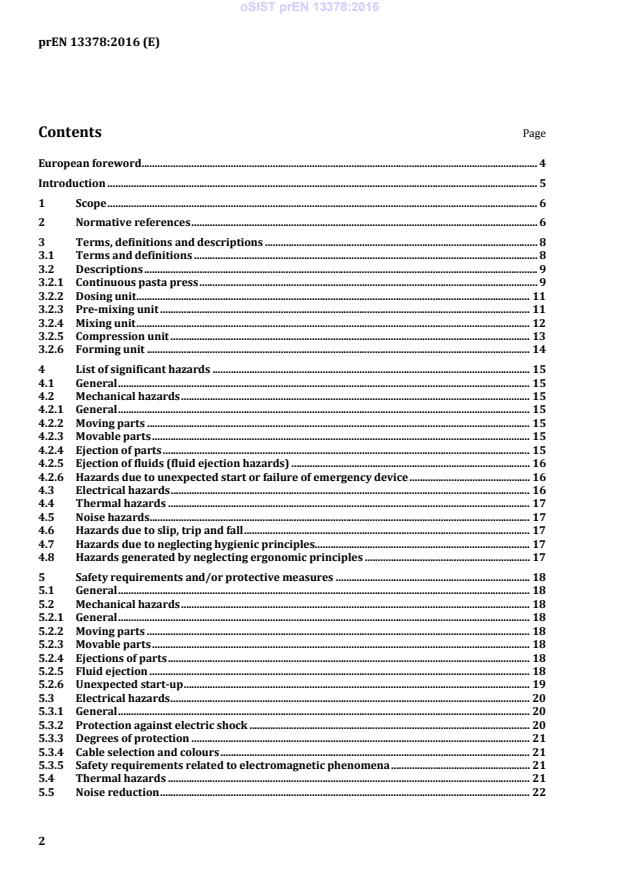
oSIST prEN 13378:2016
prEN 13378:2016 (E)
Contents Page
European foreword . 4
Introduction . 5
1 Scope . 6
2 Normative references . 6
3 Terms, definitions and descriptions . 8
3.1 Terms and definitions . 8
3.2 Descriptions . 9
3.2.1 Continuous pasta press . 9
3.2.2 Dosing unit . 11
3.2.3 Pre-mixing unit . 11
3.2.4 Mixing unit . 12
3.2.5 Compression unit . 13
3.2.6 Forming unit . 14
4 List of significant hazards . 15
4.1 General . 15
4.2 Mechanical hazards . 15
4.2.1 General . 15
4.2.2 Moving parts . 15
4.2.3 Movable parts . 15
4.2.4 Ejection of parts . 15
4.2.5 Ejection of fluids (fluid ejection hazards) . 16
4.2.6 Hazards due to unexpected start or failure of emergency device . 16
4.3 Electrical hazards . 16
4.4 Thermal hazards . 17
4.5 Noise hazards. 17
4.6 Hazards due to slip, trip and fall . 17
4.7 Hazards due to neglecting hygienic principles . 17
4.8 Hazards generated by neglecting ergonomic principles . 17
5 Safety requirements and/or protective measures . 18
5.1 General . 18
5.2 Mechanical hazards . 18
5.2.1 General . 18
5.2.2 Moving parts . 18
5.2.3 Movable parts . 18
5.2.4 Ejections of parts . 18
5.2.5 Fluid ejection . 18
5.2.6 Unexpected start-up . 19
5.3 Electrical hazards . 20
5.3.1 General . 20
5.3.2 Protection against electric shock . 20
5.3.3 Degrees of protection . 21
5.3.4 Cable selection and colours . 21
5.3.5 Safety requirements related to electromagnetic phenomena . 21
5.4 Thermal hazards . 21
5.5 Noise reduction . 22
oSIST prEN 13378:2016
prEN 13378:2016 (E)
5.6 Protective measures against slip, trip and fall . 22
5.7 Protective measures against hazards due to neglecting hygienic principles . 22
5.7.1 General . 22
5.7.2 Food area . 22
5.7.3 Splash area . 22
5.7.4 Non-food area . 22
5.8 Ergonomic design principles . 22
6 Verification of the safety requirements and/or measures . 22
7 Information for use . 23
7.1 Technical information . 23
7.2 Indicators. 24
7.2.1 General . 24
7.2.2 Warning signs for residual hazards . 24
7.3 Marking . 24
Annex A (normative) Principles of design to ensure the cleanability of the machinery . 26
A.1 Terms and definitions . 26
A.2 Materials of construction . 26
A.2.1 Type of materials . 26
A.2.2 Surface conditions . 26
A.3 Design . 27
A.3.1 Connections of internal surfaces . 27
A.3.2 Surface assemblies and overlaps . 29
A.3.3 Fasteners. 32
A.3.4 Machines on the floor . 33
A.3.5 Ventilation openings . 34
A.3.6 Hinges . 35
A.3.7 Control panel . 35
Annex B (normative) Noise test code – Grade 2 or 3 . 36
B.1 Terms and definitions . 36
B.2 Installation and mounting conditions . 36
B.3 Operating conditions . 36
B.4 Measurements . 36
B.5 Emission sound pressure level determination . 36
B.6 Sound power level determination . 37
B.7 Measurement uncertainties . 37
B.8 Information to be recorded . 38
B.9 Information to be reported . 38
B.10 Declaration and verification of noise emission value . 38
Annex ZA (informative) Relationship between this European Standard and the essential
requirements of Directive 2006/42/EC aimed to be covered . 39
Bibliography . 40
oSIST prEN 13378:2016
prEN 13378:2016 (E)
European foreword
This document (prEN 13378:2016) has been prepared by Technical Committee CEN/TC 153
“Machinery intended for use with foodstuffs and feed”, the secretariat of which is held by DIN.
This document is currently submitted to the CEN Enquiry.
This document will supersede EN 13378:2001+A1:2013.
This document has been prepared under a mandate given to CEN by the European Commission and the
European Free Trade Association, and supports essential requirements of EU Directive 2006/42/EC.
For relationship with EU Directive 2006/42/EC, see informative Annex ZA, which is an integral part of
this document.
oSIST prEN 13378:2016
prEN 13378:2016 (E)
Introduction
This European Standard is a type-C-standard as stated in EN ISO 12100.
The machinery concerned and the extent to which hazards, hazardous situations and hazardous events
are covered are indicated in the scope of this document.
When provisions of this type-C-standard are different from those which are stated in type-A- or -B-
standards, the provisions of this type-C-standard take precedence over the provisions of the other
standards, for machines that have been designed and built according to the provisions of this type-C-
standard.
Complementary to the hygiene requirements common to all food processing machines, specific
requirements for cleanability and sanitation of the machines in the scope are formulated.
oSIST prEN 13378:2016
prEN 13378:2016 (E)
1 Scope
This European Standard applies to pasta presses (see Clause 3) used for continuous pasta production.
This European Standard specifies the safety requirements for the design, manufacture and information
for use for continuous pasta presses and deals with all significant hazards, hazardous situations, and
events when the machines falling within the scope of this standard are used as intended and under
conditions of misuse which are reasonably foreseeable by the manufacturer (see Clause 4).
It deals with the hazards during the following phases of the machines' lifetime: transport, assembly and
installation, commissioning, setting and adjusting, operation, cleaning, fault finding, maintenance,
decommissioning, dismantling, disabling and scrapping.
The measures for risk reduction are given in Clause 5.
This European Standard does not apply to:
— household machines,
— batch machines,
— cutting unit.
The significant hazards covered by this standard are listed in Clause 4.
These hazards, as well as the measures for their reduction, are described in the present European
Standard.
Ancillary equipment which is not an integral part of the continuous pasta press (e.g. hoppers,
conveyors, etc.) is not covered by this European Standard.
This European Standard is not applicable to machines in its scope which are manufactured before the
date of its publication as EN.
2 Normative references
The following documents, in whole or in part, are normatively referenced in this document and are
indispensable for its application. For dated references, only the edition cited applies. For undated
references, the latest edition of the referenced document (including any amendments) applies.
EN 614-1, Safety of machinery — Ergonomic design principles — Part 1: Terminology and general
principles
EN 953:1997+A1:2009, Safety of machinery — Guards — General requirements for the design and
construction of fixed and movable guards
EN 1005-2:2003+A1:2008, Safety of machinery — Human physical performance — Part 2: Manual
handling of machinery and component parts of machinery
EN 1037:1995+A1:2008, Safety of machinery — Prevention of unexpected start-up
EN 1672-2:2005+A1:2009, Food processing machinery — Basic concepts — Part 2: Hygiene requirements
EN 60204-1:2006, Safety of machinery — Electrical equipment of machines — Part 1: General
requirements (IEC 60204-1:2005)
oSIST prEN 13378:2016
prEN 13378:2016 (E)
1)
EN 60529:1991 , Degrees of protection provided by enclosures (IP code) (IEC 60529:1989)
EN 60947-5-5, Low-voltage switchgear and controlgear — Part 5-5: Control circuit devices and switching
elements — Electrical emergency stop device with mechanical latching function (IEC 60947-5-5)
EN 61310-1, Safety of machinery - Indication, marking and actuation — Part 1: Requirements for visual,
acoustic and tactile signals (IEC 61310 1)
EN ISO 3744, Acoustics — Determination of sound power levels and sound energy levels of noise sources
using sound pressure — Engineering methods for an essentially free field over a reflecting plane
(ISO 3744)
EN ISO 3746, Acoustics — Determination of sound power levels and sound energy levels of noise sources
using sound pressure — Survey method using an enveloping measurement surface over a reflecting plane
(ISO 3746)
EN ISO 3747, Acoustics — Determination of sound power levels and sound energy levels of noise sources
using sound pressure — Engineering/survey methods for use in situ in a reverberant environment
(ISO 3747)
EN ISO 4413:2010, Hydraulic fluid power — General rules and safety requirements for systems and their
components (ISO 4413:2010)
EN ISO 4414:2010, Pneumatic fluid power — General rules and safety requirements for systems and their
components (ISO 4414:2010)
EN ISO 4871, Acoustics — Declaration and verification of noise emission values of machinery and
equipment (ISO 4871)
EN ISO 7731, Ergonomics — Danger signals for public and work areas — Auditory danger signals
(ISO 7731)
EN ISO 9614-1, Acoustics — Determination of sound power levels of noise sources using sound intensity —
Part 1: Measurement at discrete points (ISO 9614-1)
EN ISO 9614-2, Acoustics — Determination of sound power levels of noise sources using sound intensity —
Part 2: Measurement by scanning (ISO 9614-2)
EN ISO 11201, Acoustics — Noise emitted by machinery and equipment — Determination of emission
sound pressure levels at a work station and at other specified positions in an essentially free field over a
reflecting plane with negligible environmental corrections (ISO 11201)
EN ISO 11202, Acoustics — Noise emitted by machinery and equipment — Determination of emission
sound pressure levels at a work station and at other specified positions applying approximate
environmental corrections (ISO 11202)
EN ISO 11204, Acoustics — Noise emitted by machinery and equipment — Determination of emission
sound pressure levels at a work station and at other specified positions applying accurate environmental
corrections (ISO 11204)
1) EN 60529:1991 is currently impacted by the amendments EN 60529:1991/A1:2000 and
EN 60529:1991/A2:2013.
oSIST prEN 13378:2016
prEN 13378:2016 (E)
EN ISO 11688-1, Acoustics — Recommended practice for the design of low-noise machinery and
equipment — Part 1: Planning (ISO/TR 11688-1)
EN ISO 12100:2010, Safety of machinery — General principles for design —- Risk assessment and risk
reduction (ISO 12100:2010)
EN ISO 13732-1, Ergonomics of the thermal environment — Methods for the assessment of human
responses to contact with surfaces — Part 1: Hot surfaces (ISO 13732-1)
EN ISO 13849-1, Safety of machinery — Safety-related parts of control systems — Part 1: General
principles for design (ISO 13849-1)
EN ISO 13850, Safety of machinery — Emergency stop function — Principles for design (ISO 13850)
EN ISO 13857, Safety of machinery — Safety distances to prevent hazard zones being reached by upper
and lower limbs (ISO 13857)
EN ISO 14119:2013, Safety of machinery — Interlocking devices associated with guards — Principles for
design and selection (ISO 14119:2013)
EN ISO 14122 (all parts), Safety of machinery — Permanent means of access to machinery — Part 1:
Choice of fixed means of access between two levels (ISO 14122, all parts)
ISO 468, Surface roughness — Parameters, their values and general rules for specifying requirements
ISO 3864-1, Graphical symbols — Safety colours and safety signs — Part 1: Design principles for safety
signs and safety markings
ISO 3864-2, Graphical symbols — Safety colours and safety signs — Part 2: Design principles for product
safety labels
ISO 3864-3, Graphical symbols — Safety colours and safety signs — Part 3: Design principles for graphical
symbols for use in safety signs
3 Terms, definitions and descriptions
For the purposes of this document, the terms and definitions given in EN ISO 12100:2010 and the
following apply.
3.1 Terms and definitions
3.1.1
movable parts
features that need to be exchanged and therefore handled due to cleaning, maintenance or product
change
Note 1 to entry: Features are, for example, shafts, screws, dies, pre-dies, covers, etc.
3.1.2
continuous pasta press
machine with non-stop product cycle where the raw materials are fed automatically into the machine
and the end product is extruded without interruptions
oSIST prEN 13378:2016
prEN 13378:2016 (E)
3.1.3
dosing unit
assembly where solid and liquid ingredients are measured and transferred into the mixing unit
3.1.4
mixing unit
assembly where ingredients are mixed until becoming a homogeneous dough which is transferred into
the compression unit
3.1.5
compression unit
assembly where the dough is pressed to become pasta to be transferred to the forming units
3.1.6
forming unit
assembly where pasta is pushed through to be shaped
3.1.7
pre-mixing unit
unit that carries out the initial mixing stage of milled products and liquid ingredients, i.e. water and
eggs, by rotation of a mixing tool
3.2 Descriptions
3.2.1 Continuous pasta press
The pasta press (see Figure 1) begins with the dosing unit and ends with the die.
The principal components are:
— dosing unit;
— pre-mixing unit (optional);
— mixing unit;
— compression unit;
— forming unit.
oSIST prEN 13378:2016
prEN 13378:2016 (E)
Key
1 dosing units
2 mixing units
3 compression units
4 forming units
Figure 1 — Continuous pasta press
oSIST prEN 13378:2016
prEN 13378:2016 (E)
3.2.2 Dosing unit
Dosing units are composed principally of solid ingredients dosers (for example for flour, semolina
and/or other milled ingredients) and of liquid dosers (e.g. for water, eggs, additives).
Solid ingredients dosers can be volumetric or gravimetric.
The principal components for solid ingredients dosing units (see Figure 2) are for example feeding
devices, devices to keep the flow continuous and dosing tools.
Key
1 hopper
2 shaker
3 screw
Figure 2 — Example of volumetric dosing unit
The principal components for liquid dosing units are for example valves, pumps and flow meters.
3.2.3 Pre-mixing unit
The principal components are (see Figure 3):
— case with connection pieces for inlet of solid and liquid ingredients and pre-mix outlet;
— mixing tool (e.g. single or double shaft with blades).
oSIST prEN 13378:2016
prEN 13378:2016 (E)
Key
1 shaft with blades
2 milled products entry
3 liquid entry
4 product exit (to mixing unit)
Figure 3 — Pre-mixing unit
3.2.4 Mixing unit
Mixing is usually performed in a mixing tank either by a single or double shaft with kneading blades
(see Figure 4).
The principal components are:
— tank with tank lid (one or more);
— single or double shaft with kneading blades.
a) single shaft b) double shaft
Key
1 bowl lid
2 shaft with blades
3 dough exit gate
Figure 4 — Mixing unit
oSIST prEN 13378:2016
prEN 13378:2016 (E)
Alternatively, it is possible to realize mixing through a pre-mixer and a dough stabilization
(see Figure 5).
In systems with vertical dough flow the dough is filled overhead in a dough box and the required
residence time is achieved by the velocity of the rotary discharge valve.
In systems with horizontal dough flow, the dough is filled in a dough box at the inlet side. The needed
residence time is achieved by the velocity of the horizontal conveyor belt that transports the dough to
the discharge.
a) Device for dough stabilization vertical b) Device for dough stabilization by belt
Key
1 dough
2 dough box
3 rotary discharge valve/discharge
4 conveyor belt
Figure 5 — Device for dough stabilization
3.2.5 Compression unit
The principal components are (see Figures 6a) and 6b)):
— cylinder with compression screw (one or more);
— screw extraction devices (optional).
oSIST prEN 13378:2016
prEN 13378:2016 (E)
a) Compression unit and forming unit
b) Compression unit and forming unit
Key
1 dough exit gate
2 feeding unit
3 compression screw
4 die
5 head
Figure 6 — Examples of compression and forming unit
3.2.6 Forming unit
The principal components are (see Figures 1, 6a) and 6b)):
— head containing a die (one or more);
— pressure relieve valve(s);
— die extraction devices (optional).
oSIST prEN 13378:2016
prEN 13378:2016 (E)
4 List of significant hazards
4.1 General
This clause covers all hazards, as far as they are considered in this European Standard, and identified by
risk assessment significant for this type of machinery and requiring an action to eliminate or reduce the
risk.
4.2 Mechanical hazards
4.2.1 General
The significant mechanical hazards are:
— crushing hazard;
— cutting or severing hazard;
— drawing-in and trapping;
— entanglement hazard;
— shearing hazard;
— fluid ejection hazard;
— injection hazard (fluid ejection);
— impact hazard;
— slipping, tripping and falling hazard.
Figure 7 illustrates the different danger zones associated with mechanical hazards for each component.
4.2.2 Moving parts
Moving parts for driving systems such as belts, chains, gears, shafts, etc. may cause hazards such as
shearing, crushing, and entanglement of fingers, hands and arms.
See Zone 1, Figure 7.
Moving parts for feeding and mixing systems such as paddles of the mixing and pre-mixing units,
rotating chambers, compression and feeding screws which may cause hazards such as entanglement,
shearing, cutting or severing of fingers, hands, arms or the whole body.
See Zone 2, Figure 7.
4.2.3 Movable parts
Movable parts which need to be handled due to cleaning, maintenance or changing production, e.g.
shafts, screws, dies, pre-dies, lids. These parts may cause hazards such as crushing and cutting of parts
of the body.
See Zone 3, Figure 7.
4.2.4 Ejection of parts
Parts of the compression and forming units which may be ejected due to overpressure in these units,
e.g. bolts, nuts and screws. This may cause impact hazards to the body.
oSIST prEN 13378:2016
prEN 13378:2016 (E)
See Zone 4, Figure 7.
Key
1 Zone 1
2 Zone 2
3 Zone 3
4 Zone 4
Figure 7 — Pasta press – Danger zones
4.2.5 Ejection of fluids (fluid ejection hazards)
Leakage of pressurized pipes – including the heat exchangers – or leakage of hydraulic drives may cause
the hazard of fluid release, e.g. water, steam, hydraulic oil (hydraulic drives) and compressed air, which
may cause a burn hazard or impact hazard when whipped from flexible pipes or receiving a hit of the
fluid.
Pressure drop in hydraulic and pneumatic drives caused by leakage may result in dangerous
unexpected movements, e.g. when a movable part of the machine is held in the upper position by
pressure.
Fluid release may cause a slipping hazard.
4.2.6 Hazards due to unexpected start or failure of emergency device
Unexpected start-up may cause unexpected contact with dangerous moving parts that may result in all
significant hazards listed in 4.2.1.
4.3 Electrical hazards
Electrical equipment on the machine can generate a potential electric shock hazard from direct or
indirect contact with live components. This hazard occurs in control panels, junction boxes, motor
connectors, electrical resistances and in the electrical components.
oSIST prEN 13378:2016
prEN 13378:2016 (E)
An external disturbance such as electromagnetic interference can lead to malfunction or loss of function
of electrical equipment.
If liquids, e.g. fluids used for pasta processing or cleaning agents as water, come into contact with the
electrical conductors there is a risk of electric shock.
4.4 Thermal hazards
Risks of burns exist by touching pipes when machines operate with hot fluids for dough or for
barrel/head conditioning. Electrical motors and gearboxes can reach dangerous temperatures on their
external surface. The burning hazard will usually continue to exist for a period of time after power has
been disconnected.
4.5 Noise hazards
Noise generated by presses can lead to:
— permanent loss of hearing,
— ringing in the ears,
— fatigue, stress,
— interference with speech communication, acoustic signals.
4.6 Hazards due to slip, trip and fall
Walkways, stairs and gangways may cause hazards such as slip, trip and fall.
Slip accidents can occur if liquids or solids from the machine, e.g. lubricants or the product, spill onto
traffic routes, work stations or means of access around the machine.
Trip accidents may occur if parts of the machine protrude beyond the machine frame at low level or if
cables and pipes associated with the machine are incorrectly installed.
Falls can occur if people working on the platform have to access parts in high location compared to the
platform level.
4.7 Hazards due to neglecting hygienic principles
Neglecting hygienic principles may create a hazard to human health and unacceptable modifications to
foodstuff (i.e. contamination by microbial growth or foreign materials and pests).
4.8 Hazards generated by neglecting ergonomic principles
During operation, production changing, cleaning and maintenance, there is a hazard to safety and health
resulting from awkward body postures or the use of excessive effort.
A hazard of injury to the body can occur during handling materials for:
— loading ingredients;
— exchanging machine parts during maintenance or during production changes.
oSIST prEN 13378:2016
prEN 13378:2016 (E)
5 Safety requirements and/or protective measures
5.1 General
Machinery shall comply with the safety requirements and/or protective measures of this clause. In
addition, the machine shall be designed according to the principles of EN ISO 12100:2010 for relevant
but not significant hazards, which are not dealt with by this document.
5.2 Mechanical hazards
5.2.1 General
For mechanical hazards machinery shall comply with the safety requirements and/or protective
measures of 5.2. In addition, the machine shall be designed according to the principles of
EN ISO 12100:2010 for relevant but not significant hazards, which are not dealt with by this document.
5.2.2 Moving parts
Moving parts for drive systems as described in 4.2.2 shall be safeguarded in accordance with
EN 953:1997+A1:2009, 3.2.
The safety distances of EN ISO 13857 shall apply.
Access to moving parts for feeding and mixing systems with frequent access, e.g. paddles of mixing units
shall be prevented by movable guard. The movable guard shall be provided with interlocking devices in
accordance with EN ISO 14119:2013, 3.2. When movable parts are still moving and accessible a guard
locking shall be provided, see EN ISO 14119:2013, 3.5.
Moving parts which are inside the machine structure/frame and shall not be reached through openings
(see EN ISO 13857) shall be protected with fixed guards.
5.2.3 Movable parts
Provisions shall be made for easy and safe handling. The weight shall be defined in accordance with
EN 1005-2:2003+A1:2008, 4.3.3.
The lid, when in opening position, shall have a device to keep it in a stable position.
The insertion and extraction of dies and screws that are heavier than 25 kg need to be assisted with a
dedicated device as a hoist.
5.2.4 Ejections of parts
Ejection of parts of the machine shall be prevented by an overpressure safety device or through the use
of mechanical devices (e.g. a fixed guard containing the ejected bolts).
Overpressure events shall be detected to stop the extrusion.
5.2.5 Fluid ejection
Water, superheated water, steam and diathermic oil piping systems together with their intercepting
and controlling devices shall be designed for a pressure 1,5 times of the maximum working pressure.
Hydraulic and pneumatic systems shall be designed and manufactured according to EN ISO 4413 and
EN ISO 4414.
Where pressure drop in hydraulic and pneumatic drives caused by leakage of the pipes or malfunction
of the compressor may result in dangerous unexpected movements, e.g. creeping of a bowl lid of the
mixing unit or sliding back of the compression screw, when extracted the cylinders (hydraulic or
pneumatic) shall be fitted with check valves directly at the cylinders.
oSIST prEN 13378:2016
prEN 13378:2016 (E)
The arrangements of quick connect couplings or other junctions for hydraulic piping shall be such, that
the pollution of the food area of the machinery is not likely.
Quick-connection couplings for frequent use shall be arranged outside the traffic route for the operators
to prevent the traffic route getting slippery. Where this is not possible provisions shall be taken, e.g. a
sufficiently dimensioned grid.
5.2.6 Unexpected start-up
5.2.6.1 General
To avoid hazards due to unexpected start-up, the continuous pasta press shall be provided with devices
intended for isolation and energy dissipation especially with a view to major maintenance, work on
power circuits and handling mobile parts (see EN 1037:1995+A1:2008, Clause 4). For electrical
equipment see EN 60204-1:2006, Clause 9. For hydraulic equipment, see EN ISO 4413:2010, 5.4.7. For
pneumatic equipment, see EN ISO 4414:2010, 5.4.6.
If the use of isolation and energy dissipation is not appropriate (e.g. handling of mobile parts during
product change) the manufacturer shall provide, according to the risk assessment, other measures to
prevent unexpected start-up.
5.2.6.2 Supply disconnecting device
Each machine shall be equipped with power supply disconnecting devices for all energy supplies
according to EN 1037:1995+A1:2008, 5.1, capable of being locked or otherwise secured in the OFF-
position. Location and mounting of the device shall be in accordance with EN 60204-1:2006, 10.1.2.
In addition, for hydraulic and pneumatic equipment a device for stored energy dissipation or restraint
shall be incorporated into the machine where stored energy can give rise to a hazard due to unexpected
start-up. For hydraulic equipment, see EN ISO 4413:2010, 5.4.7.2.1. For pneumatic equipment,
see EN ISO 4414:2010, 5.4.6.1. In particular, for electric power disconnecting devices shall be according
to EN 60204-1:2006, 5.3.2, types a, b or c.
5.2.6.3 Emergency stop device
Each machine shall be equipped with emergency stop devices positioned on the control panels and at
the interface with other machines when the interface can create dangerous situations (e.g. spreader).
The emergency stop function shall be a stop of category 0 or 1 according to EN 60204-1:2006, 9.2.2, and
comply with EN 60204-1:2006, 9.2.5.4.1 and 9.2.5.4.2. The emergency stop shall also comply with
EN ISO 13850. Electrical switchgear and control gear shall comply with EN 60947-5-5.
5.2.6.4 Normal stop
For pasta equipment the normal stop shall follow a procedure to stop each machine according to the
technological process inside (the procedure follows the product passage through the equipment). The
aim is to stop each machine when it is empty. If the machine is equipped with a normal stop device,
every machine shall be equipped with devices for normal stop that shall be of category 0 or 1, as
defined in EN 60204-1:2006, 9.2.5.3. The stop control of the machinery shall have priority over the start
controls. Once the machinery or its hazardous functions have stopped, the energy supply to the
actuators concerned shall be cut off.
For pasta equipment under PLC control, category 0 or 1 are not required, but the normal stop condition
shall be monitored and maintained.
5.2.6.5 Safety-related parts of control system
The safety-related parts of the control system shall present at least a performance level “c” as defined in
accordance with EN ISO 13849-1.
oSIST prEN 13378:2016
prEN 13378:2016 (E)
For interlocking movable guards, the safety-related parts of the control system shall present at least a
performance level “d” as defined in accordance with EN ISO 13849-1.
5.2.6.6 Automatic start warning
Where any form of automatic starting is provided, machines shall be equipped with a start-up warning
device, complying with EN ISO 7731, to alert people to leave the danger zone.
5.2.6.7 Interlocking system of guards
Interlocking system of guards shall:
— comply with EN ISO 14119, considering environment conditions inside the machine (i.e.
temperature, moisture) and cleaning procedures;
— comply with hygiene requirements of EN 1672-2:2005+A1:2009 and Annex A of this standard;
— be resistant to or protected from the action of cleaning and disinfection agents, oil and liquids;
— the arrangement and fastening of position switches and actuators shall be such that the possibility
that they come loose or change their intended position relative to the actuation system during the
intended lifetime is minimized. Therefore position switches and actuators shall be located and, if
necessary, protected so that damage from foreseeable external causes is avoided. Position switches
and actuators shall not be used as a mechanical stop, unless this is the intended use of the position
switch as declared by the manufacturer.
5.2.6.8 Controls for maintenance operations
The design objective for all machines shall be that adjustments, maintenance, repair, cleaning and
servicing can be carried out while the machine is isolated from all power sources or from outside the
hazard zones as indicated in the information for use by the manufacturer.
If this objective cannot be achieved for technical reasons, a special operation mode which permits
potentially hazardous operations with open guards under reduced risk conditions shall be provided as
given by the manufacturer, i.e. the machine shall be designed to allow the introduction of an enabling
device, which permits the operator to override the control panel (see EN ISO 12100:2010, 6.2.11.9
and 6.2.11.10), and to operate a specific moving part from a safe position, e.g. a portable control device
that plugs into a local control position. The local control shall be equipped with a hold-to-run control
allowing low speed or limited movements. The local control shall also be provided with an emergency
stop device.
5.3 Electrical hazards
5.3.1 General
Unless stated otherwise, all electrical equipment associated with the machine shall comply with the
requirements of EN 60204-1:2006 as indicated in this clause.
5.3.2 Protection against electric shock
5.3.2.1 Direct contact
Live parts shall be located inside enclosures that provide protection against direct contact of at least
IP2X as defined in EN 60529:1991. The opening of enclosure shall only be possible
...
Questions, Comments and Discussion
Ask us and Technical Secretary will try to provide an answer. You can facilitate discussion about the standard in here.
Loading comments...