

CEN/TR 17741:2021
(Main)Guidance for understanding and utilize EN/ISO 29481-1 Building information models - Information delivery manual - Part 1: Methodology and format
- Abstract
This document provides guidance on how to develop an information delivery manual (IDM) in compliance with EN ISO 29481-1 hereafter referred to as the “IDM standard”. This document explains the core components and development process of the IDM methodology in non-technical terms. This document aims to help users and software vendors understand and utilize the IDM standard in defining information requirements and deliverables.
The technical implementation of IDM in a data model, model view definition (MVD), is excluded from this document’s scope. IDM standard introduces the MVD concept but does not specify it in detail.
This document also utilizes some transaction framework concepts introduced in EN ISO 29481-2. The technical XML- and XSD-schema definitions supporting the software solutions are excluded from this document.
- Status
- Published
- Publication Date
- 21-Dec-2021
- Technical Committee
- CEN/TC 442 - Building Information Modelling (BIM)
- Drafting Committee
- CEN/TC 442/WG 3 - Information Delivery Specification
- Current Stage
- 6060 - Definitive text made available (DAV) - Publishing
- Start Date
- 22-Dec-2021
- Due Date
- 01-Jan-2021
- Completion Date
- 22-Dec-2021

Overview
CEN/TR 17741:2021 - "Guidance for understanding and utilize EN/ISO 29481-1" explains how to develop an Information Delivery Manual (IDM) in compliance with EN ISO 29481-1. Written for non‑technical readers, this CEN Technical Report clarifies IDM core components, structure and the IDM development process to help clients, project teams and software vendors define and verify information requirements and deliverables in a BIM-enabled environment.
Key topics and requirements
- IDM purpose and structure: Clear explanation of what an IDM is and how it captures user requirements and the overall information delivery process.
- Process definitions and maps: Guidance on creating process representations including process maps, interaction maps and transaction maps to describe how information flows between actors.
- Exchange requirements: How to specify the information to be exchanged, distinguishing between geometrical information and alphanumerical information.
- Use cases and method: Steps for defining use cases and selecting an appropriate IDM development approach (including reverse engineering, information constraint customization and process discovery).
- IDM vs MVD: Explains the concept of a Model View Definition (MVD) and its role as a technical implementation of IDM in a data model, but explicitly excludes detailed MVD, XML or XSD schema definitions from its scope.
- Transaction framework concepts: Uses selected concepts from EN ISO 29481-2 to describe coordination acts and interaction patterns between actors.
- Non-technical orientation: Focuses on readable, actionable guidance rather than low-level schema or software specifications.
Practical applications
- Define clear, repeatable information delivery specifications for BIM projects.
- Translate client and regulatory information needs into verifiable exchange requirements.
- Support procurement and project documentation (EIR, OIR, AIR, PIR) by providing structured IDMs.
- Help software vendors and BIM coordinators understand IDM intent when developing tools-even though MVD and XML/XSD technical implementations are out of scope.
- Apply beyond model-based exchanges to regulatory submissions, national information standards and other data‑centric workflows.
Who should use this standard
- Clients, owners and asset managers
- Architects, engineers and contractors
- Surveyors, authorities and facility managers
- BIM managers, coordinators and software vendors seeking to align tools with IDM methodology
Related standards
- EN ISO 29481-1: IDM methodology and format (primary reference)
- EN ISO 29481-2: Interaction framework (concepts used)
- EN ISO 19650 series: Information management and verification of deliverables
CEN/TR 17741:2021 is a practical, SEO‑friendly reference for professionals who need to specify, implement or verify information delivery in BIM-enabled construction and asset management.
Relations
- Effective Date
- 28-Jan-2026
- Effective Date
- 28-Jan-2026
Get Certified
Connect with accredited certification bodies for this standard

BSI Group
BSI (British Standards Institution) is the business standards company that helps organizations make excellence a habit.

DIBt (Deutsches Institut für Bautechnik)
German Institute for Building Technology.
DIN CERTCO
DIN Group product certification.
Sponsored listings
Frequently Asked Questions
CEN/TR 17741:2021 is a technical report published by the European Committee for Standardization (CEN). Its full title is "Guidance for understanding and utilize EN/ISO 29481-1 Building information models - Information delivery manual - Part 1: Methodology and format". This standard covers: This document provides guidance on how to develop an information delivery manual (IDM) in compliance with EN ISO 29481-1 hereafter referred to as the “IDM standard”. This document explains the core components and development process of the IDM methodology in non-technical terms. This document aims to help users and software vendors understand and utilize the IDM standard in defining information requirements and deliverables. The technical implementation of IDM in a data model, model view definition (MVD), is excluded from this document’s scope. IDM standard introduces the MVD concept but does not specify it in detail. This document also utilizes some transaction framework concepts introduced in EN ISO 29481-2. The technical XML- and XSD-schema definitions supporting the software solutions are excluded from this document.
This document provides guidance on how to develop an information delivery manual (IDM) in compliance with EN ISO 29481-1 hereafter referred to as the “IDM standard”. This document explains the core components and development process of the IDM methodology in non-technical terms. This document aims to help users and software vendors understand and utilize the IDM standard in defining information requirements and deliverables. The technical implementation of IDM in a data model, model view definition (MVD), is excluded from this document’s scope. IDM standard introduces the MVD concept but does not specify it in detail. This document also utilizes some transaction framework concepts introduced in EN ISO 29481-2. The technical XML- and XSD-schema definitions supporting the software solutions are excluded from this document.
CEN/TR 17741:2021 is classified under the following ICS (International Classification for Standards) categories: 35.240.67 - IT applications in building and construction industry; 91.010.01 - Construction industry in general. The ICS classification helps identify the subject area and facilitates finding related standards.
CEN/TR 17741:2021 has the following relationships with other standards: It is inter standard links to EN ISO 29481-2:2025, EN ISO 29481-1:2025. Understanding these relationships helps ensure you are using the most current and applicable version of the standard.
CEN/TR 17741:2021 is available in PDF format for immediate download after purchase. The document can be added to your cart and obtained through the secure checkout process. Digital delivery ensures instant access to the complete standard document.
Standards Content (Sample)
SLOVENSKI STANDARD
01-marec-2022
Navodila za razumevanje in uporabo EN/ISO 29481-1 Informacijski modeli stavb -
Priročnik z informacijami - 1. del: Metodologija in oblika
Guidance for understanding and utilize EN/ISO 29481-1 Building information models -
Information delivery manual - Part 1: Methodology and format
Anleitung zum Verständnis und zur Umsetzung der EN/ISO 29481-1
Bauwerksinformationsmodelle - Handbuch der Informationslieferungen - Teil 1: Methodik
und Format
Guide pour comprendre et utiliser EN/ISO 29481-1 Modèles des informations de la
construction - Protocole d`échange dìnformation - Partie 1: Méthodologie et format
Ta slovenski standard je istoveten z: CEN/TR 17741:2021
ICS:
35.240.67 Uporabniške rešitve IT v IT applications in building
gradbeništvu and construction industry
91.010.01 Gradbeništvo na splošno Construction industry in
general
2003-01.Slovenski inštitut za standardizacijo. Razmnoževanje celote ali delov tega standarda ni dovoljeno.
CEN/TR 17741
TECHNICAL REPORT
RAPPORT TECHNIQUE
December 2021
TECHNISCHER BERICHT
ICS 91.010.01; 35.240.67
English Version
Guidance for understanding and utilize EN/ISO 29481-1
Building information models - Information delivery
manual - Part 1: Methodology and format
Document d'orientation pour comprendre et utiliser Anleitung zum Verständnis und zur Umsetzung der
l'EN/ISO 29481-1 Modèles des informations de la EN/ISO 29481-1 Bauwerksinformationsmodelle -
construction - Protocole d'échange d'informations - Handbuch der Informationslieferungen - Teil 1:
Méthodologie et format Methodik und Format
This Technical Report was approved by CEN on 5 December 2021. It has been drawn up by the Technical Committee CEN/TC
442.
CEN members are the national standards bodies of Austria, Belgium, Bulgaria, Croatia, Cyprus, Czech Republic, Denmark, Estonia,
Finland, France, Germany, Greece, Hungary, Iceland, Ireland, Italy, Latvia, Lithuania, Luxembourg, Malta, Netherlands, Norway,
Poland, Portugal, Republic of North Macedonia, Romania, Serbia, Slovakia, Slovenia, Spain, Sweden, Switzerland, Turkey and
United Kingdom.
EUROPEAN COMMITTEE FOR STANDARDIZATION
COMITÉ EUROPÉEN DE NORMALISATION
EUROPÄISCHES KOMITEE FÜR NORMUNG
CEN-CENELEC Management Centre: Rue de la Science 23, B-1040 Brussels
© 2021 CEN All rights of exploitation in any form and by any means reserved Ref. No. CEN/TR 17741:2021 E
worldwide for CEN national Members.
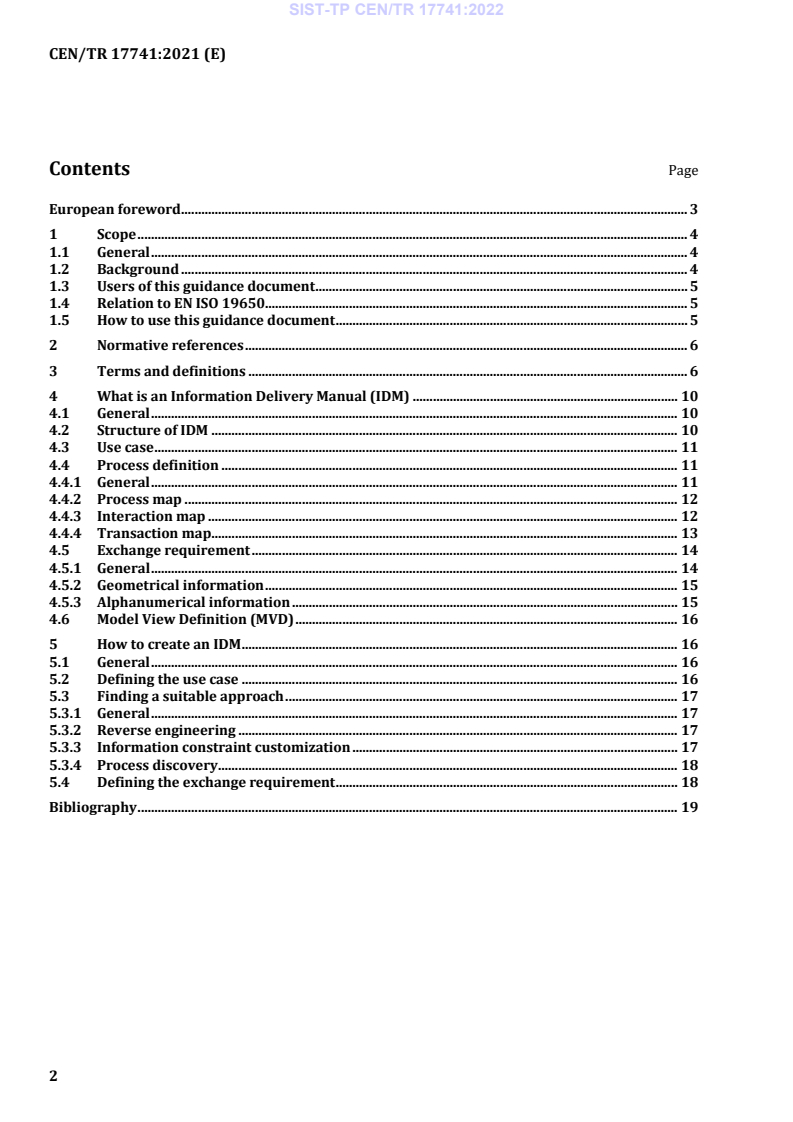
Contents Page
European foreword . 3
1 Scope . 4
1.1 General . 4
1.2 Background . 4
1.3 Users of this guidance document . 5
1.4 Relation to EN ISO 19650. 5
1.5 How to use this guidance document . 5
2 Normative references . 6
3 Terms and definitions . 6
4 What is an Information Delivery Manual (IDM) . 10
4.1 General . 10
4.2 Structure of IDM . 10
4.3 Use case . 11
4.4 Process definition . 11
4.4.1 General . 11
4.4.2 Process map . 12
4.4.3 Interaction map . 12
4.4.4 Transaction map . 13
4.5 Exchange requirement . 14
4.5.1 General . 14
4.5.2 Geometrical information . 15
4.5.3 Alphanumerical information . 15
4.6 Model View Definition (MVD) . 16
5 How to create an IDM . 16
5.1 General . 16
5.2 Defining the use case . 16
5.3 Finding a suitable approach . 17
5.3.1 General . 17
5.3.2 Reverse engineering . 17
5.3.3 Information constraint customization . 17
5.3.4 Process discovery . 18
5.4 Defining the exchange requirement . 18
Bibliography . 19
European foreword
This document (CEN/TR 17741:2021) has been prepared by Technical Committee CEN/TC 442 “Building
Information Modeling”, the secretariat of which is held by SN.
Attention is drawn to the possibility that some of the elements of this document may be the subject of
patent rights. CEN shall not be held responsible for identifying any or all such patent rights.
Any feedback and questions on this document should be directed to the users’ national standards body.
A complete listing of these bodies can be found on the CEN website.
1 Scope
1.1 General
This document provides guidance on how to develop an information delivery manual (IDM) in
compliance with EN ISO 29481-1 hereafter referred to as the “IDM standard”. This document explains the
core components and development process of the IDM methodology in non-technical terms. This
document aims to help users and software vendors understand and utilize the IDM standard in defining
information requirements and deliverables.
The technical implementation of IDM in a data model, model view definition (MVD), is excluded from
this document’s scope. IDM standard introduces the MVD concept but does not specify it in detail.
This document also utilizes some transaction framework concepts introduced in EN ISO 29481-2. The
technical XML- and XSD-schema definitions supporting the software solutions are excluded from this
document.
1.2 Background
This document primary reference is the IDM standard part 1 (EN ISO 29481-1:2017) (hereafter referred
to as IDM standard). This document helps in understanding and using the IDM standard to describe
information delivery. This document also uses some concepts described in part 2 of the IDM standard
series (EN ISO 29481-2:2016). Considerable efforts have been made to align this document with the
terminology and concepts introduced in EN ISO 19650-1 and EN ISO 19650-2.
Information delivery manual specification (hereafter referred to as the IDM specification) provides help
in getting the full benefit from building information modelling (BIM). When the required information is
available using BIM to support a construction process or use case, and the quality of information is
satisfactory, the process itself is much improved. The IDM standard provides a method to create the
specification.
A complete IDM specification should support two perspectives: user requirements and technical
solutions. User requirements describe the needed information delivery and the overall process in which
information exchange occurs. The technical solution defines an exchange requirement model using a
harmonized data schema.
EN ISO 29481-1 provides a methodology and a harmonized format to specify information requirements.
It offers a framework and method to determine the needed information delivery with process maps and
exchange requirements.
EN ISO 29481-2 specifies an interaction framework and format to describe “coordination acts” between
actors or parties within an appointment. It facilitates interoperability between software applications
used in the construction process to promote digital collaboration between actors in the building
construction process. Also, it provides a basis for accurate, reliable, repeatable, and high-quality
information exchange.
An MVD defines a data model or a subset of an existing data model that is necessary to support one or many specific data
exchange requirements. MVDs are used in software development and should have a machine-readable representation. An MVD
that is dedicated to a single IDM can be used to filter information in software tools to a specific exchange requirement. [SOURCE:
EN ISO 29481-1:2017, 5.6.4].
1.3 Users of this guidance document
This document is intended for clients, architects, engineers, contractors, surveyors, authorities, and other
parties who need to specify or implement information delivery. Originally, the IDM standard was focused
on defining model-based deliverables, but the possible application of the standard is much broader. It can
be used to specify any requirement for information delivery.
Although software developers and technology adapters are not the primary audiences of this document,
it may help them better understand existing IDMs and develop their own IDMs.
1.4 Relation to EN ISO 19650
The IDM standard is a process-oriented methodology used to describe the information exchange
requirements for a particular purpose which may complement the information-management approach
outlined in the EN ISO 19650 series. Simultaneously, the IDM standard pre-dates EN ISO 19650 and has
a broader scope of application beyond model-based information exchanges.
Figure 1 — IDM specifications can support the definition of the information requirements and to
verify the information deliverables
The scope of EN ISO 19650-1 stipulates that information deliverables “should be described clearly within
the OIR, PIR, AIR or EIR”. Figure 1 depicts how IDMs can support the definition of information
deliverables for these requirements. The figure also shows how the IDM standard can be applied to use
cases outside of the EN ISO 19650 series scope. These use cases may include information requirements
for regulatory processes or other common demands such as national information standards. In addition,
Figure 1 presents how the IDM that is used to specify the exchange requirement can be used to verify the
information delivery.
1.5 How to use this guidance document
This document is split into two sections:
— The first section explains the IDM components and can be used to get a better understanding of the
IDM structure.
— The second section gives and overview of the IDM methodology and steps through how to create an
IDM.
In both sections the IDM standard can be used in parallel to this document.
Several similar terms are used in this document, the following list helps clarify these terms:
— IDM standard: this is the EN ISO 29481-1 standard itself (as indicated in 1.2 above);
— IDM specification: this is information delivery manual specification (as indicated in 1.2 above); and
— IDM method: This is the general method of developing an IDM.
As noted above, this document has references to part 2 of the IDM standard series (EN ISO 29481-2). To
avoid confusion, in these cases the standard code is mentioned in its full length i.e. EN ISO 29481-2.
2 Normative references
The following documents are referred to in the text in such a way that some or all of their content
constitutes requirements of this document. For dated references, only the edition cited applies. For
undated references, the latest edition of the referenced document (including any amendments) applies.
EN ISO 29481-1, Building information models — Information delivery manual — Part 1: Methodology and
format (ISO 29481-1)
EN ISO 29481-2, Building information models — Information delivery manual — Part 2: Interaction
framework (ISO 29481)
3 Terms and definitions
For the purposes of this document, the terms and definitions given in EN ISO 29481-1 and
EN ISO 29481-2 and the following apply.
ISO and IEC maintain terminological databases for use in standardization at the following addresses:
— IEC Electropedia: available at https://www.electropedia.org/
— ISO Online browsing platform: available at https://www.iso.org/obp
3.1
activities
tasks that are needed to complete deliverables
[SOURCE: EN 15221-5:2011, 3.1]
3.2
actor
person, organization or organizational unit involved in a construction process
Note 1 to entry: Organizational units include, but are not limited to, departments, teams.
Note 2 to entry: In the context of this document, construction processes take place during the delivery phase and
the operational phase.
[SOURCE: EN ISO 29481-1:2017, 3.1, as modified by EN ISO 19650-1:2018, 3.2.1: The words “such as a
department, team, etc.” have been removed; Note 1 and 2 to entry have been added.]
3.3
appointment
agreed instruction for the provision of information concerning works, goods or services
Note 1 to entry: This term is used whether or not there is a formal appointment between the parties.
[SOURCE: EN ISO 19650-1:2018, 3.2.2]
3.4
asset
item, thing or entity that has potential or actual value to an organization
[SOURCE: ISO 55000:2014, 3.2.1, as modified by EN ISO 19650-1:2017, 3.2.8: Note 1, 2 and 3 to entry
have been removed.]
3.5
business process
partially ordered set of enterprise activities that can be executed to achieve some desired end-result in
pursuit of a given objective of an organization
[SOURCE: ISO/IEC/IEEE 24765:2017, 3.445]
3.6
BIM execution plan
plan that specifies in detail how the information management aspects of the appointment will be carried
out by the delivery team
Note 1 to entry: The pre-appointment BIM execution plan focuses on the delivery team’s proposed approach to
information management, and their capability and capacity to manage information.
[SOURCE: EN ISO 19650-2:2018, 3.1.3.1]
3.7
end user
person receiving facility services
Note 1 to entry: A visitor could also be an end user.
[SOURCE: EN 15221-5:2011, 3.4]
3.8
exchange information requirements
EIR
information requirements in relation to an appointment
[SOURCE: EN ISO 19650-1:2018, 3.3.6]
3.9
Industry Foundation Classes
IFC
conceptual data schema and exchange file format for building information modelling (BIM) data
Note 1 to entry: See EN ISO 16739-1:2020.
3.10
information
interpretable representation of data in a formalized manner suitable for communication, interpretation
or processing
Note 1 to entry: Information can be processed by human or automatic means.
[SOURCE: EN ISO 19650-1:2018, 3.3.1]
3.11
information requirement
IR
specification for what, when, how and for whom information is to be produced
[SOURCE: EN ISO 19650-1:2018, 3.3.2]
3.12
level of information need
framework which defines the extent and granularity of information
[SOURCE: EN ISO 19650-1:2018, 3.3.16]
3.13
process
set of interrelated or interacting activities that use inputs to deliver an intended result
Note 1 to entry: Whether the “intended result” of a process is called output, product or service depends on the
context of the reference.
Note 2 to entry: Inputs to a process are generally the outputs of other processes and outputs of a process are
generally the inputs to other processes.
Note 3 to entry: Two or more interrelated and interacting processes in series can also be referred to as a process.
Note 4 to entry: Processes in an organization are generally planned and carried out under controlled conditions
to add value.
Note 5 to entry: A process where the conformity of the resulting output cannot be readily or economically
validated is frequently referred to as a “special process”.
Note 6 to entry: This constitutes one of the common terms and core definitions for ISO management system
standards given in Annex SL of the Consolidated ISO Supplement to the ISO/IEC Directives, Part 1. The original
definition has been modified to prevent circularity between process and output and Notes 1 to 5 to entry have been
added.
[SOURCE: EN ISO 9000:2015, 3.4.1]
3.14
business process model and notation
BPMN
graphical representation for specifying dynamic business processes in a business process model
[SOURCE: ISO/IEC 19510:2013]
3.15
project information requirements
PIR
information requirements in relation to the delivery of an asset
[SOURCE: EN ISO 19650-1:2018, 3.3.5]
3.16
purpose
context and conditions of data/record use at a specific point in time, and within a specific setting
[SOURCE: ISO/TS 21089:2018, 3.117.1]
3.17
organization information requirements
OIR
information requirements in relation to organizational objectives
[SOURCE: ISO 19650-1:2018, 3.3.3]
3.18
requirement
need or expectation that is stated, generally implied or obligatory
Note 1 to entry: “Generally implied” means that it is custom or common practice for the organization and
interested parties that the need or expectation under consideration is implied.
Note 2 to entry: A specified requirement is one that is stated, for example in documented information.
[SOURCE: ISO/IEC 27000:2018, 3.56]
3.19
reverse engineering
design process that consists in analysing the shape, dimensions and function of a finished part or
prototype and using this information to produce a similar product
[SOURCE: ISO/TS 14253-4:2010, 3.1]
3.20
specification
document stating requirements
EXAMPLE Quality manual, quality plan, technical drawing, procedure document, work instruction.
Note 1 to entry: A specification can be related to activities (e.g. procedure document, process specification and
test specification), or products (e.g. product specification, performance specification and drawing).
Note 2 to entry: It can be that, by stating requirements, a specification additionally is stating results achieved by
design and development and thus in some cases can be used as a record.
[SOURCE: EN ISO 9000:2015, 3.8.7]
3.21
use case
textual and graphical depiction of the actors and operations that address information
exchange in the context of a set of specific tasks for a workflow performed by different systems or devices
[SOURCE: ISO/TR 28380-1:2014, 2.13]
3.22
use case
typical application stated at a high level for the purposes of extracting
technical considerations or comparing usages across fields
[SOURCE: ISO/IEC TR 20547-2:2018, 3.2.1]
4 What is an information delivery manual (IDM)
4.1 General
The term IDM is used both for the standardized method that describes information requirements for a
specific purpose, and the actual specification that is the outcome of
...