

EN 17446:2021+A1:2024
(Main + Amendment)Fire extinguishing systems in commercial kitchens - System design, documentation, and test requirements
- Abstract
This document establishes the minimum requirements applicable to the design, installation, functioning, test and maintenance of fixed automatic fire extinguishing systems for kitchen protection that covers the cooking appliances, the hood, the plenum and the air extract ducts. This document also provides requirements for the construction and components performance as applicable to specific types, designs, sizes and arrangements of pre-engineered kitchen fire-extinguishing systems.
This document does not cover household kitchens or industrial food production equipment.
The detailed test procedures for the plenum and air extract ducts are contained in CEN/TS 17749.
Closed plenum type ventilated ceilings designed similar to standard hoods are included in this document. Open plenum type ventilated ceilings are excluded and require an engineered solution for the plenum protection. Protection for appliances below open or closed plenum ventilated ceilings are included.
- Status
- Published
- Publication Date
- 29-Oct-2024
- Technical Committee
- CEN/TC 191 - Fixed firefighting systems
- Drafting Committee
- CEN/TC 191/WG 6 - Gas extinguishing Systems and components
- Current Stage
- 6060 - Definitive text made available (DAV) - Publishing
- Start Date
- 30-Oct-2024
- Completion Date
- 30-Oct-2024

Overview - EN 17446:2021+A1:2024 (CEN)
EN 17446:2021+A1:2024 is a European standard published by CEN that defines minimum requirements for the design, installation, operation, testing and maintenance of fixed automatic fire extinguishing systems in commercial kitchens. The standard covers protection of cooking appliances, the hood, the plenum and the air extract ducts and applies to pre‑engineered kitchen fire‑extinguishing systems. It supersedes EN 17446:2021 and includes Amendment 1 (approved September 2024). Household kitchens and industrial food‑production equipment are excluded.
Key topics and technical requirements
- Scope and exclusions: Applies to commercial kitchens (restaurants, hotels, hospitals) and includes closed plenum ventilated ceilings; open plenums require engineered solutions. Detailed plenum/duct test procedures are in CEN/TS 17749.
- System design principles: Systems must be designed per the manufacturer’s system manual and provide hazard‑focused protection rather than mandating a single system type.
- Mandatory system elements:
- Extinguishing agent storage and actuation mechanism (mechanical/electrical)
- Discharge nozzles and piping
- Detection and automatic/manual actuation
- Fuel/power shut‑down functions
- Component control: Only components used in the system’s type‑testing and listed in the system manual may be used - no substitutions.
- Performance and environment: Equipment should be suitable for an ambient temperature range (specified in the standard as typically +5 °C to +60 °C) and operate reliably under fire conditions; secondary power supplies are recommended where primary power is essential.
- Testing and verification: The standard defines test methods covering extinguishing tests for appliances, splash tests, hood and duct entrance tests, plenum tests and agent distribution tests, plus requirements for test reports.
- Commissioning, maintenance and documentation: Requires system commissioning, periodic maintenance, full system manual and a full review when kitchen equipment is changed.
- Safety: Addresses hazards to personnel, safety in occupied zones and electrostatic discharge considerations.
Applications - who uses this standard
- Fire protection engineers and system designers specifying kitchen suppression systems
- Manufacturers of pre‑engineered kitchen extinguishing systems and components
- Installation contractors and commissioning agents
- Testing laboratories performing appliance, hood, plenum and duct tests
- Facilities managers, building owners, and compliance officers in commercial hospitality, healthcare and institutional kitchens
- Regulatory bodies and inspectors assessing conformity with CEN standards
Related standards
- CEN/TS 17749 - detailed test procedures for plenums and air extract ducts
- EN 3-7, EN 3-8 - portable fire extinguisher requirements (referenced)
- EN 1860-2 - barbecue fuel/appliance testing (referenced)
Using EN 17446:2021+A1:2024 ensures consistent, hazard‑based protection of commercial cooking risks and supports safe, test‑verified kitchen fire suppression system design, installation and maintenance.
Relations
- Effective Date
- 11-Sep-2024
- Effective Date
- 11-Sep-2024
- Effective Date
- 28-Jan-2026
- Effective Date
- 28-Jan-2026
- Effective Date
- 28-Jan-2026
- Effective Date
- 08-Jul-2026
Get Certified
Connect with accredited certification bodies for this standard

CIS Institut d.o.o.
Personal Protective Equipment (PPE) certification body. Notified Body NB-2890 for EU Regulation 2016/425 PPE.

Kiwa BDA Testing
Building and construction product certification.
Kmetijski inštitut Slovenije
Agricultural Institute of Slovenia. Soil testing, plant health, agricultural product analysis.
Sponsored listings
Frequently Asked Questions
EN 17446:2021+A1:2024 is a standard published by the European Committee for Standardization (CEN). Its full title is "Fire extinguishing systems in commercial kitchens - System design, documentation, and test requirements". This standard covers: This document establishes the minimum requirements applicable to the design, installation, functioning, test and maintenance of fixed automatic fire extinguishing systems for kitchen protection that covers the cooking appliances, the hood, the plenum and the air extract ducts. This document also provides requirements for the construction and components performance as applicable to specific types, designs, sizes and arrangements of pre-engineered kitchen fire-extinguishing systems. This document does not cover household kitchens or industrial food production equipment. The detailed test procedures for the plenum and air extract ducts are contained in CEN/TS 17749. Closed plenum type ventilated ceilings designed similar to standard hoods are included in this document. Open plenum type ventilated ceilings are excluded and require an engineered solution for the plenum protection. Protection for appliances below open or closed plenum ventilated ceilings are included.
This document establishes the minimum requirements applicable to the design, installation, functioning, test and maintenance of fixed automatic fire extinguishing systems for kitchen protection that covers the cooking appliances, the hood, the plenum and the air extract ducts. This document also provides requirements for the construction and components performance as applicable to specific types, designs, sizes and arrangements of pre-engineered kitchen fire-extinguishing systems. This document does not cover household kitchens or industrial food production equipment. The detailed test procedures for the plenum and air extract ducts are contained in CEN/TS 17749. Closed plenum type ventilated ceilings designed similar to standard hoods are included in this document. Open plenum type ventilated ceilings are excluded and require an engineered solution for the plenum protection. Protection for appliances below open or closed plenum ventilated ceilings are included.
EN 17446:2021+A1:2024 is classified under the following ICS (International Classification for Standards) categories: 13.220.20 - Fire protection. The ICS classification helps identify the subject area and facilitates finding related standards.
EN 17446:2021+A1:2024 has the following relationships with other standards: It is inter standard links to EN 17446:2021, EN 17446:2021/FprA1, EN 1860-2:2023, EN 3-8:2021, EN 3-7:2004+A1:2007, EN 16282-7:2026. Understanding these relationships helps ensure you are using the most current and applicable version of the standard.
EN 17446:2021+A1:2024 is available in PDF format for immediate download after purchase. The document can be added to your cart and obtained through the secure checkout process. Digital delivery ensures instant access to the complete standard document.
Standards Content (Sample)
SLOVENSKI STANDARD
01-december-2024
Nadomešča:
SIST EN 17446:2021
Gasilni sistemi v profesionalnih kuhinjah - Načrtovanje sistema, dokumentacija in
preskusne zahteve (vključno z dopolnilom A1)
Fire extinguishing systems in commercial kitchens - System design, documentation, and
test requirements
Brandbekämpfungsanlagen in Großküchen - Planung, Dokumentation und
Prüfanforderungen
Systèmes d'extinction d'incendie dans les cuisines professionnelles - Conception du
système, documentation et exigences d'essai
Ta slovenski standard je istoveten z: EN 17446:2021+A1:2024
ICS:
13.220.20 Požarna zaščita Fire protection
97.040.99 Druga kuhinjska oprema Other kitchen equipment
2003-01.Slovenski inštitut za standardizacijo. Razmnoževanje celote ali delov tega standarda ni dovoljeno.
EN 17446:2021+A1
EUROPEAN STANDARD
NORME EUROPÉENNE
October 2024
EUROPÄISCHE NORM
ICS 13.220.20 Supersedes EN 17446:2021
English Version
Fire extinguishing systems in commercial kitchens -
System design, documentation, and test requirements
Systèmes d'extinction d'incendie dans les cuisines Brandbekämpfungsanlagen in Großküchen - Planung,
professionnelles - Conception du système, Dokumentation und Prüfanforderungen
documentation et exigences d'essai
This European Standard was approved by CEN on 4 July 2021 and includes Amendment 1 approved by CEN on 30 September
2024.
CEN members are bound to comply with the CEN/CENELEC Internal Regulations which stipulate the conditions for giving this
European Standard the status of a national standard without any alteration. Up-to-date lists and bibliographical references
concerning such national standards may be obtained on application to the CEN-CENELEC Management Centre or to any CEN
member.
This European Standard exists in three official versions (English, French, German). A version in any other language made by
translation under the responsibility of a CEN member into its own language and notified to the CEN-CENELEC Management
Centre has the same status as the official versions.
CEN members are the national standards bodies of Austria, Belgium, Bulgaria, Croatia, Cyprus, Czech Republic, Denmark, Estonia,
Finland, France, Germany, Greece, Hungary, Iceland, Ireland, Italy, Latvia, Lithuania, Luxembourg, Malta, Netherlands, Norway,
Poland, Portugal, Republic of North Macedonia, Romania, Serbia, Slovakia, Slovenia, Spain, Sweden, Switzerland, Türkiye and
United Kingdom.
EUROPEAN COMMITTEE FOR STANDARDIZATION
COMITÉ EUROPÉEN DE NORMALISATION
EUROPÄISCHES KOMITEE FÜR NORMUNG
CEN-CENELEC Management Centre: Rue de la Science 23, B-1040 Brussels
© 2024 CEN All rights of exploitation in any form and by any means reserved Ref. No. EN 17446:2021+A1:2024 E
worldwide for CEN national Members.
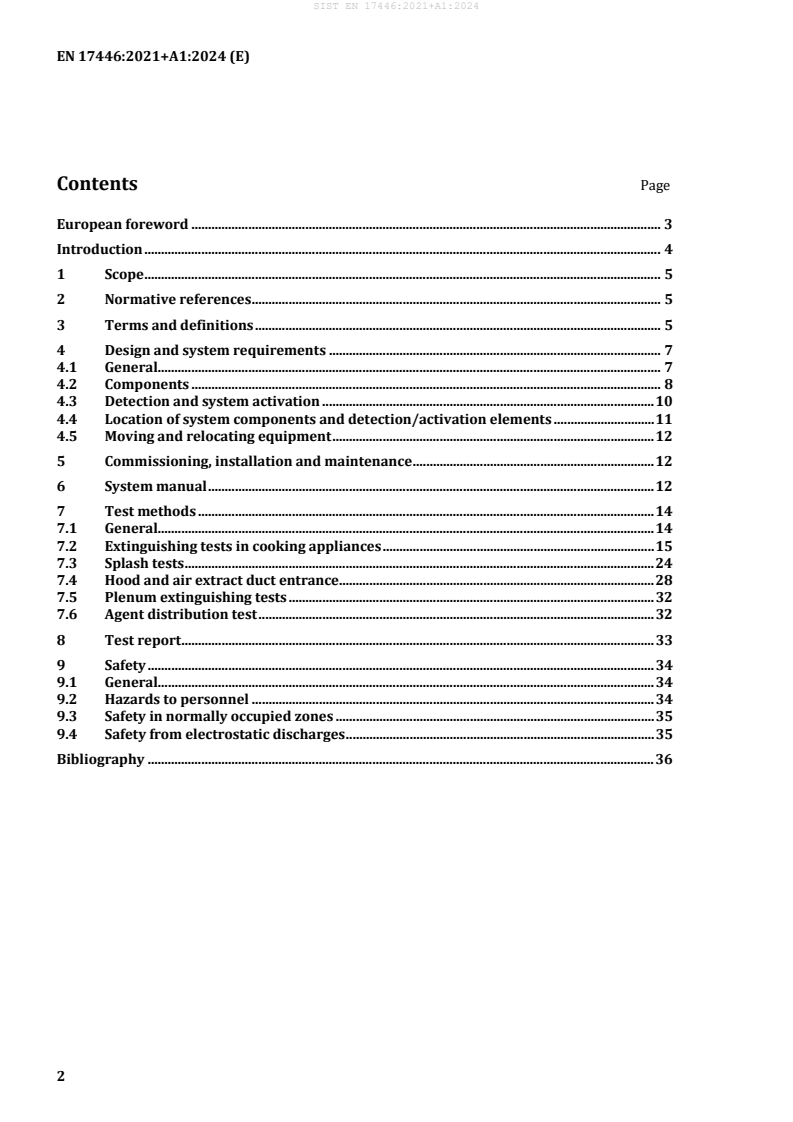
Contents Page
European foreword . 3
Introduction . 4
1 Scope . 5
2 Normative references . 5
3 Terms and definitions . 5
4 Design and system requirements . 7
4.1 General. 7
4.2 Components . 8
4.3 Detection and system activation . 10
4.4 Location of system components and detection/activation elements . 11
4.5 Moving and relocating equipment . 12
5 Commissioning, installation and maintenance . 12
6 System manual . 12
7 Test methods . 14
7.1 General. 14
7.2 Extinguishing tests in cooking appliances . 15
7.3 Splash tests . 24
7.4 Hood and air extract duct entrance . 28
7.5 Plenum extinguishing tests . 32
7.6 Agent distribution test . 32
8 Test report . 33
9 Safety . 34
9.1 General. 34
9.2 Hazards to personnel . 34
9.3 Safety in normally occupied zones . 35
9.4 Safety from electrostatic discharges . 35
Bibliography . 36
European foreword
This document (EN 17446:2021+A1:2024) has been prepared by Technical Committee CEN/TC 191
“Fixed firefighting systems”, the secretariat of which is held by BSI.
This European Standard shall be given the status of a national standard, either by publication of an
identical text or by endorsement, at the latest by April 2025, and conflicting national standards shall be
withdrawn at the latest by April 2025.
Attention is drawn to the possibility that some of the elements of this document may be the subject of
patent rights. CEN shall not be held responsible for identifying any or all such patent rights.
!This document supersedes EN 17446:2021".
This document includes Amendment 1 approved by CEN on 30 September 2024.
The start and finish of text introduced or altered by amendment is indicated in the text by tags !".
Any feedback and questions on this document should be directed to the users’ national standards body.
A complete listing of these bodies can be found on the CEN website.
According to the CEN-CENELEC Internal Regulations, the national standards organisations of the
following countries are bound to implement this European Standard: Austria, Belgium, Bulgaria, Croatia,
Cyprus, Czech Republic, Denmark, Estonia, Finland, France, Germany, Greece, Hungary, Iceland, Ireland,
Italy, Latvia, Lithuania, Luxembourg, Malta, Netherlands, Norway, Poland, Portugal, Republic of North
Macedonia, Romania, Serbia, Slovakia, Slovenia, Spain, Sweden, Switzerland, Türkiye and the United
Kingdom.
Introduction
This document has been developed with the purpose of establishing a common base for fire protection
of commercial kitchens (for example, the ones used in restaurants, hotels and hospitals), attending to the
appliances usually found in them and independently from the typology of the fire extinguishing system
used. This approach focused in hazard protection rather than in the definition of the system, allows
achieving a same fire hazard protection level independently from the type of system used.
This document does not consider the requirements for the components that constitute the different types
of fire extinguishing systems to which it applies. This circumstance does not reduce the importance to
the need that components are designed to ensure functionality and reliability of the system, both for those
having existing standards and for those that at this moment do not count with them.
Summarizing, this document offers a full set of requirements to carry out the design, installation and
maintenance of fire protection systems for kitchens, together with test protocols applicable to any
system, which shall be completed when required, with specific requirements in relationship with the
components constituting a system for each typology.
It is important to understand that the protection of the cooking areas only without including the hood,
plenum or the air extract ducts may become incomplete because of the possibility of fire causing the
ignition of the grease present in them, and to which an extinguishing agent discharge not including these
points, will not be capable to extinguish it. The existence of fire in the air extract ducts can cause its
propagation to other parts of the building.
1 Scope
This document establishes the minimum requirements applicable to the design, installation, functioning,
test and maintenance of fixed automatic fire extinguishing systems for kitchen protection that covers the
cooking appliances, the hood, the plenum and the air extract ducts. This document also provides
requirements for the construction and components performance as applicable to specific types, designs,
sizes and arrangements of pre-engineered kitchen fire-extinguishing systems.
This document does not cover household kitchens or industrial food production equipment.
The detailed test procedures for the plenum and air extract ducts are contained in CEN/TS 17749.
Closed plenum type ventilated ceilings designed similar to standard hoods are included in this document.
Open plenum type ventilated ceilings are excluded and require an engineered solution for the plenum
protection. Protection for appliances below open or closed plenum ventilated ceilings are included.
2 Normative references
The following documents are referred to in the text in such a way that some or all of their content
constitutes requirements of this document. For dated references, only the edition cited applies. For
undated references, the latest edition of the referenced document (including any amendments) applies.
EN 3-7:2004+A1:2007, Portable fire extinguishers — Part 7: Characteristics, performance requirements
and test methods
EN 3-8, Portable fire extinguishers — Part 8: Requirements for the construction, pressure resistance and
mechanical tests for extinguishers with a maximum allowable pressure equal to or lower than 30 bar, which
comply with the requirements of EN 3-7
EN 1860-2, Appliances, solid fuels and firelighters for barbecuing — Part 2: Barbecue charcoal and
barbecue charcoal briquettes — Requirements and test methods
3 Terms and definitions
For the purposes of this document, the following terms and definitions apply.
ISO and IEC maintain terminology databases for use in standardization at the following addresses:
— IEC Electropedia: available at https://www.electropedia.org/
— ISO Online browsing platform: available at https://www.iso.org/obp
3.1
extinguishing agent
substance whose action causes the extinguishment of a fire
3.2
cooking appliance
cooking device that has, or is capable of having, a surface of liquid grease or one in which cooking with
grease is involved
EXAMPLE Deep fat fryer, griddle, range, chain-broiler, electric char-broiler, charcoal broiler, mesquite broiler,
gas radiant char broiler, wok, tilt skillet/braising pan and similar appliances.
Note 1 to entry: The protected area is limited to the cooking area of the appliance only.
3.3
hood
device part of an exhaust system that directs and captures grease and oil vapours and also the combustion
gases from a cooking appliance
3.4
deep fat fryer
cooking appliance where the food is fried submerged in a fixed vat filled with oil exposed to an intense
radiant or convective heat source
3.4.1
multiple vat fryer
fryer that incorporates vats that are mechanically joined together, where each vat incorporates a
separately controlled heating source
3.4.2
split-vat deep fat fryer
fryer that incorporates a divided partition which splits the fryer in sections, where each split-vat fryer
incorporates a separately controlled heating source
Note 1 to entry: It may have one or several vats arranged adjoining each other.
3.5
expellant gas
means used to discharge the extinguishing agent from its container
3.6
grease
melted animal fat, vegetable shortening, or other type of oily substance used in, or as a result from, the
preparation of foods
3.7
range top
cooking appliance where the food is cooked and is directly exposed to a heat source
3.8
system manual
manufacturer’s documentation where the design, installation, functioning and maintenance of the system
are defined
3.9
griddle
cooking appliance where the food is not directly exposed to the fire but on a flat surface intensely heated
by radiation or convection
3.10
broiler
cooking appliance where the food is on a grill, directly exposed to an intense heat source by radiation,
and perhaps by convection, where neither the food nor the radiation source have to be necessarily in the
horizontal position
3.11
plenum
hood space behind the filters
3.12
tested hazard
kitchen appliance, hood or plenum where the fire is generated, and the air extract duct during the tests
described in this document and that will determine the scope of the obtained results
3.13
tilt skillet
cooking appliance consisting in a large dimension vessel exposed to an intense heat source, which can
move from one side to the other tilting on an axis, where the food is cooked, boiled, sautéed or fried
3.14
extinguishing system
components fitted to each other forming a fixed system that discharges an extinguishing agent for the
purpose of extinguishing fires in kitchens
3.15
discharge time
time during which the discharge of the extinguishing agent occurs without interruptions in it, without
including the residual expellant gas discharge, if applicable
3.16
wok
bottom domed round frying pan
3.17
protected kitchen area
surface enclosing all the cooking appliances located under the projection of a hood, including the
associated filters, plenum and air extract ducts
3.18
pre-engineered kitchen fire-extinguishing system
performance tested system in accordance with the limitations prescribed by the manufacturer and
included in the system manual
4 Design and system requirements
4.1 General
The system shall be designed according to the fire extinguishing system manual. The system manual shall
be based on the parameters determined from the requirements of this document.
A full system review shall be conducted to the fire extinguishing system prior to any change which could
affect the operation and/or efficacy of the kitchen equipment.
Each system shall consist of at least the following elements:
— extinguishing agent storage unit plus actuation mechanism (mechanical or electrical);
— nozzles;
— detection system associated to the actuation mechanism;
— manual actuation mechanism;
— pipe layout to feed the extinguishing agent discharge nozzles;
— fuel/power supply shut down.
The system shall be dedicated to the protected equipment.
Where power supplies are essential to maintain the operation of the system, a secondary power supply
should be provided independent of the primary supply.
The secondary power supply should be of sufficient capacity and resilience to maintain the system for at
least the operation time identified in the manufacturer’s manual and be capable of operating safely in fire
conditions for the appropriate period of time.
Extinguishing media supply shall be permanently available to the kitchen fire protection system. Where
the agent supply is external to the equipment, e.g. mains water supply, it shall not be possible to reduce
the supply when the system is in operation. During installation it has to be established that sufficient
water flow and water pressure (with all possible demand on the same source in use) is available. The
extinguishing system needs to be connected directly into the water main or sprinkler system supply and
a test connection included to allow routine testing to confirm adequate flow and pressure.
The equipment shall be suitable for use within the minimum ambient temperature range of (+5, +60) °C.
The equipment operating temperature range shall be specified in the manufacturer’s design manual.
The system shall be designed to provide simultaneous discharge to the protected appliances, the hood
and air extract duct entrances.
For hoods with an inner physical separation, both sides of the separation shall be protected.
Hoods that are connected without an inner physical separation, as they are vulnerable to fire spread, shall
be protected with a simultaneous system activation and discharge to all hazard areas.
The protected length of duct from the cooking appliance ignition source shall be specified in the
manufacturer’s design manual.
4.2 Components
4.2.1 General
The system shall only use components as used in the testing and as specified in the manufacturer’s
manual. There shall be no substitution of components.
All system components shall be designed to function under the intended conditions and within their
range of temperatures of utilization.
4.2.2 Agent container assembly
Where containers are used in these systems they shall be designed to meet the requirements of relevant
national standards.
Agent container, valve and seals shall be made of material suitable for use with:
— the agent in terms of corrosion and chemical compatibility.
When tested in accordance with EN 3-7:2004+A1:2007, Clause 14:
— external corrosion.
When tested in accordance with EN 3-7:2004+A1:2007, Clause 14:
— pressure resistance.
When tested in accordance with EN 3-8.
Where applicable, means shall be provided to indicate that each container is correctly charged.
Each container shall have a permanent nameplate or other permanent marking specifying the
extinguishant, tare and gross mass, and the super pressurization level (where applicable) of the
container.
The containers used in these systems shall be designed to meet the requirements of relevant national
standards.
4.2.3 Discharge nozzles
Nozzles shall be manufactured from non-combustible materials and they shall withstand the intended
fire exposure without observed deformation or without its extinguishing performances being reduced.
Nozzles shall be designed to prevent clogging, or other means within the system shall be employed.
Nozzles shall be resistant to:
— corrosion;
— extinguishing agent;
— environmental conditions;
— temperature conditions and fire.
When tested in accordance with design manual.
Open nozzles shall be provided with a protective cover protecting the nozzle opening against grease
migration.
The protective cover shall not interfere in the agent discharge in a way that affects the performance of
the system and shall be included in the fire testing. Additionally, it shall not create an increased danger
of fire spread or to the people, due to splashing.
The protective cover shall be made of material suitable for use with:
— agent in terms of corrosion;
— temperature conditions and fire resistance;
— blow-off pressure;
— vibration;
— stress corrosion.
4.2.4 Pipe and fittings
Pipe and fittings shall be of non-combustible material and with physical and chemical characteristics
compatible with the extinguishing agent. They shall withstand the maximum operating pressures (at
maximum storage temperature) occurring during the discharge.
Pipework and fittings shall comply with the appropriate national standards.
4.2.5 Hose and hose fittings
Hoses and hose fittings, shall not be used where they are exposed to the fire and be of materials having
physical and chemical characteristics compatible with the extinguishing agent. They shall withstand the
maximum operating pressures (at maximum storage temperature) occurring during the discharge. Hoses
and hose fittings used in the system shall be installed as described in the system manual.
4.2.6 Extinguishing agent
The extinguishing agent used shall be defined in the fire test report. Extinguishing agents with different
formulations or provided by different manufacturers shall not be used or mixed. The instructions
provided in the system manual shall be followed.
4.2.7 Manual activation device(s)
4.2.7.1 General
Each system shall be equipped with at least one manual activation device (see 4.4.4). Operation of the
manual activation device shall lead to immediate activation and complete discharge (in accordance with
the system design manual) of the system.
The construction and materials used for the manual activation device (including the marking - see 4.4.5)
shall be suitable for the typical commercial kitchen environment including frequent cleaning.
4.2.7.2 Mechanical activation devices
The operating mechanism of the manual activation device (pull ring, handle, lever, push button or strike
knob) shall be suitable for manual operation.
The operating mechanism shall be provided with a safety device to prevent inadvertent operation. The
release of the safety device shall involve an operation distinct from that of the operating mechanism.
The manual activation device shall be fitted with an indicating element which clearly shows whether the
manual activation device may have been operated. It shall not be possible to restore, re-insert or re-install
the indicating element. Wire seals and frangible elements are examples of acceptable indicating elements.
4.2.7.3 Electrical activation devices
For systems with an electrical manual push button actuation system, it shall be fitted with a protective
cover to prevent inadvertent operation. The protective cover shall have a wire seal or equivalent
indicating element. The manual activation device shall have an Ingress Protection (IP) rating of 54 or
higher.
4.2.8 Special requirements
For all penetrations through a protected air extract duct or hood an appropriate oil tight fitting shall be
used.
Simultaneously to the system activation, all fuel or electrical power sources generating heat at the
protected equipment shall be disconnected.
4.3 Detection and system activation
All systems shall have both automatic and manual activation methods. These activation methods shall be
independent from each other in order to avoid the failure of one of them preventing the functioning of
the system.
The automatic detection and manual activation system shall be in accordance with the system manual.
All activation devices shall be designed, located, installed or protected in such a way that they are not
subjected to adverse mechanical or environmental conditions that may render the system inoperative or
that may cause an unwanted activation of the system. The system shall have the necessary electrical
switches to be able to integrate the following signals and actions:
— output to audible and visual fire alarm;
— output to control and indicating equipment;
— output to shut off the electric power and/or gas supply for the cooking appliances;
— output to shut off ventilation fans, and close ventilations dampers.
A readily accessible means for the manual activation of the system shall be located in the evacuation
route.
4.4 Location of system components and detection/activation elements
4.4.1 Extinguishing agent storage
Extinguishing agent and expellant gas containers shall be located in places where the range of ambient
temperature is within the specified values in the system manual, avoiding those locations where wide
and continuous variations of temperature are foreseen that may result in a premature degradation of the
extinguishing agent and therefore, in a considerable decrease of its extinguishing capacity.
In the event the extinguishing agent might freeze at low temperatures, it shall be conditioned so that the
container temperature is always at least 5 °C over the extinguishing agent freezing temperature.
Systems in which the extinguishing agent partially or wholly may be located in zones susceptible to be
exposed to high temperatures are not considered suitable (for example, inside the hood), provided this
situation may cause the degradation and therefore, loss of the extinguishing agent effectiveness.
In case the ambient temperature is expected to be out of the range of temperatures specified by the
manufacturer of the system, a protection system to keep the assembly temperature within that range
shall be provided.
Extinguishing agent and expellant gas containers shall not be located where they can be exposed to
mechanical and chemical damage, bad weather or direct sunlight. In case this is not possible, protection
systems such as cabinets or guards shall be provided. Likewise, the extinguishing agent and expellant gas
containers sets shall be readily accessible for their inspection, maintenance and recharge and shall be
located according to the system manual, and in no case where they may be exposed to fire.
If the extinguishing agent or any of its components may be degraded by continuous exposure to the usual
temperatures to which it may be subjected, automatic nozzles keeping the extinguishing agent
pressurized inside the distribution network, shall not be installed.
4.4.2 Discharge nozzles
All discharge nozzles shall be located so that damage and incorrect nozzle aiming are minimized and are
always to be installed within the limitations in the system manual.
4.4.3 Detection
The fire detection devices for cooking appliances shall be installed in accordance with the manufacturer’s
instructions.
Automatic fire detection devices shall be provided, as a minimum:
— along the entire length of the hood;
— in the hood plenum, at the entry of the air exhaust duct(s).
The detection system shall be suitable for kitchen environments and shall be located and installed in such
way that they are not subjected to adverse mechanical or environmental conditions that may render the
system inoperative or that may cause an unwanted activation of the system.
4.4.4 Manual activation devices
The manual activation device shall be installed in an easily accessible place and height and be in the path
of egress. If there are more than one means of egress, additional manual activation devices shall be
provided. The horizontal distance between the manual activation device and any of the protected cooking
appliances shall be at least 2 m, if technically possible. If necessary, protective measures against
mechanical damage shall be installed. Such protective measures shall in no way obstruct the operation of
the manual activation device.
4.4.5 Signage
Near each manual activation device, signage shall be placed with at least the following information:
— the text “kitchen fire extinguishing system”;
— operating instructions for the manual activation device, preferably with pictograms.
The signage shall be at least 100 cm , with contrasting colours. Text height shall be at least 12 mm,
pictograms shall be at least (25 × 25) mm. Any text shall be in the local language(s).
If more than one extinguishing system is installed, additional signage may be required to indicate which
system is activated by each manual activation device.
4.5 Moving and relocating equipment
To ensure correct nozzle aiming, cooking appliances shall have the appropriate means to ensure correct
positioning in relation to the discharge nozzles during the usual tasks in the kitchen. The protection
offered should be checked to ensure it is still applicable if appliances are permanently relocated.
5 Commissioning, installation and maintenance
The system is designed to be installed, commissioned and maintained in accordance with the system
manual, by competent persons trained by the manufacturer.
The maintenance shall be carried out in accordance with the system manual and shall include a system
review every six months or more frequently, if necessary. Where there is a change to any kitchen
equipment which could affect the operation and/or efficacy of the fire extinguishing system, then a
system review should be conducted.
6 System manual
A copy of the installation, operating, recharging, inspection and maintenance instruction manual is to be
furnished for use as a reference in the examination and testing of an automatic extinguishing unit or pre-
engineered extinguishing system unit.
The instructions shall reference the requirements and limitations of each extinguishing system unit and
include at least the following items:
a) Description and operating details of each extinguishing system unit and all accessory equipment,
including identification of extinguishing system units or accessory equipment by part number or
model;
b) Freezing point of the extinguishing agent (if agent is a liquid);
c) Type of protection afforded by the system;
d) Type of pipe, hose, tubing and fittings to be used;
e) Typical system layout and specific limitations for correct system installation and effective protection,
e.g. tilt skillet/braising pan instructions indicating that the nozzle is to be placed toward the front of
the appliance to minimize potential interference to the nozzle discharge from, for example, a skillet
cover;
f) Specific information on piping limitations for correct system installation and effective protection;
g) Description of all variations of each extinguishing system, including the limitations for each variation;
h) Discharge nozzle limitations, including maximum dimensional and area coverage for each different
appliance, minimum and maximum height limitations, and nozzle location(s). When a system unit is
limited to a maximum volume, this information shall also be included;
i) Installation details of each extinguishing system unit, including accessory equipment;
j) Reference to the specific types of detection and control panels (where applicable) to be connected to
the equipment;
k) Specifications and instructions for the interconnection of multiple extinguishing system units, or a
caution statement to not use multiples of units, when a means for interconnecting is unavailable;
l) Operating pressure of the system if applicable;
m) Operating temperature limitations;
n) Information on inspection of system after installation;
o) Information intended for use by the competent person trained to carry out the system’s periodic
inspection. The periodic inspection which shall include at least the following:
1. An inspection to see that the hazard has not changed and the design remains compliant with the
hazard.
2. An examination of all detectors, the expellant gas container(s), the agent container(s), actuation
devices, hoses, nozzles, signals and all auxiliary equipment, including the shutdown devices.
3. An inspection of the extinguishing agent. This may include:
i. water flow and pressure requirements to ensure it meets demand for systems using mains
supply;
ii. checking for any contamination of agent;
iii. agent levels;
iv. if the agent is foam, that is not pre-mixed, any proportioning equipment to check if the foam
concentrate is being proportioned in accordance with manufacturer requirements.
4. A verification that the agent distribution piping is not damaged and not obstructed.
5. Hydrostatic testing, as applicable, in accordance with the recommendations of the manufacturer
or National requirements.
6. Operation of the detection systems, signals, and releasing devices, including the manual release
stations and other associated equipment.
7. Corrective actions, repairs and replacement of defective or damaged parts.
8. An inspection of temperature sensitive elements, other than fusible metal alloy type, clean or
replace according to manufacturer’s instructions. Replacement of glass bulbs shall in no case
exceed 5 years. Care should be taken to avoid the use of abrasive cleaning materials.
9. Replacement (at least annually) of fixed temperature sensing elements of the fusible metal alloy
type (the old sensing elements shall be permanently identified to avoid re-use when removed).
10. A maintenance report listing repairs and recommendations.
p) Recharging of all extinguishing system units after use or as indicated by the inspections and
maintenance procedures;
q) Flushing of the pipework and proportioner after any discharge;
r) Discarding of any agent removed from the storage containers, in an environmentally acceptable
manner;
s) Detailed information for recharging the system after operation, including the use of the intended
extinguishing media originally supplied;
t) Description of the requirements for maintenance of all equipment;
u) Name of the manufacturer or private labeller, or equivalent designation;
v) Date and manual designation on each page;
w) Material information, ‘safety data sheets’ and cautionary instructions.
An installation, operation and maintenance manual shall either be provided with each extinguishing
system unit or made available upon request. When these manuals are not included with each system, an
owner’s manual shall be shipped with each system.
7 Test methods
7.1 General
The extinguishing system shall be tested for each cooking appliance it is expected to be used with.
The type test should be conducted by an independent testing laboratory accredited to EN ISO/IEC 17025.
This clause specifies the methodology to follow for the tests the extinguishing system have to be subjected
to:
— fire extinguishing tests in cooking appliances (7.2);
— splash tests (7.3);
— hood and air extract duct extinguishing tests (7.4);
— plenum extinguishing tests (7.5);
— agent distribution test (7.6).
Unless otherwise specifically indicated, the scope of the results of each test is limited to the same or lesser
size and to the same tested hazard, as well as to the system characteristics affecting the distribution of
the extinguishing agent. In relation to dimensions, only the cooking area of the concerned cooking
appliance is considered.
Elements that may affect the distribution of the extinguishing agent are, among others, pressure losses in
the agent distribution network, discharge nozzle height and orientation over the hazard, obstructions in
the nozzles spray pattern, extinguishing agent storage characteristics, etc.
The hazards the system can act upon considered in this document and applicable tests are given in
Table 1:
Table 1 — Hazard and applicable tests
Hazard Applicable tests
deep fat fryer 7.2.2 7.3.2 7.3.3
griddle 7.2.3
range top 7.2.4 7.3.4 7.3.5
gas broiler 7.2.5
electric broiler 7.2.6
lava, pumice or synthetic rock broiler 7.2.7
charcoal broiler 7.2.8
wood broiler 7.2.9
upright broiler 7.2.10
chain broiler 7.2.11
woks 7.2.12 7.3.6 7.3.7
hood and duct 7.4
plenum 7.5
all other equipment not listed in table 7.2.2 7.3.2 7.3.3
A distribution test 7.6 is required for every hazard in the list.
The distribution test may be carried out before the fire tests.
7.2 Extinguishing tests in cooking appliances
7.2.1 General
The length and width of the tested hazard shall be in accordance with the coverage limitations of the
maximum area and size specified in the system manual.
The hazard to test shall be clean before its preparation.
When the tested hazard is a gas broiler, the field of applicability of results may be extended to electric
broilers, of the same dimensions and under the same test conditions.
When the tested hazard is a lava broiler, the field of applicability of results may be extended to pumice
broilers and synthetic rock broilers of the same dimensions and under the same test conditions.
Where a gas or electrically heated lava broilers, pumice broilers and synthetic rock broilers are used
either fuel source can be used for the testing.
Where the test hazard is a deep fat fryer, the field of applicability of results may be extended to griddle,
range top, electric or gas broiler, upright broiler and wok, of the same dimensions and under the same
test conditions.
NOTE Attention needs to be given to prevent spreading of embers and hot ashes in some types of charcoal or
solid fuel grills.
7.2.1.1 Compliance criteria for extinguishing tests
When performing an extinguishing test, the following shall be complied with:
a) the flame in the appliance being completely extinguished in one minute or less from the start of
discharge;
b) after 10 s from the start of the discharge of the extinguishing agent, the flames shall be no bigger than
those prior to the start of the discharge of the agent;
c) when the hazard is a deep fat fryer, a wok or a range top, there shall be no re-ignition:
1) during the 20 min following the extinguishment; and
2) until the temperature of the test oil decreases more than 30 °C from the measured auto-ignition
temperature; or if the fire is manually ignited (at 363 °C), until the temperature of the test oil
decreases below 333 °C.
d) when the hazard is not a deep fat fryer, wok or a range top, there shall be no re-ignition during the 5
min following the extinguishment;
e) after the fire has been extinguished, some fuel shall be remaining.
7.2.1.2 Minimum discharge flow test criteria
Extinguishing tests shall be carried out on a system discharging the minimum quantity of extinguishing
agent over the hazard with the minimum discharge flow per nozzle, with the hydraulically most
unfavourable distribution network, on each of the following:
a) with the nozzles located at the maximum allowed height in respect to the fire hazard and with the
most unfavourable orientation;
b) with the nozzles located at the minimum allowed height in respect to the fire hazard and with the
most unfavourable orientation.
Where used the storage unit of the extinguishing agent shall be filled to its rated capacity.
For systems using stored pressure to discharge the extinguishing agent, the pressurized element shall be
at the operating pressure. That element shall be conditioned for at least 16 h before the test at the
minimum temperature specified by the manufacturer (–5 °C, +0 °C), or filled at operating pressure (–5 %,
+5 %) equivalent to the one at the minimum temperature specified by the manufacturer.
For systems not using pressure to discharge the extinguishing agent, the storage unit of the extinguishing
agent shall be conditioned for at least 16 h before the test at the minimum temperature specified by the
manufacturer (–5 °C, +0 °C).
7.2.1.3 Cooking area limitations
If the area of the protected appliance exceeds the capacity of a single nozzle then multiple nozzles may
be used in modules, provided the area of coverage assigned to each discharge nozzle does not exceed the
tested area of coverage.
In addition:
a) in the case of a deep fat fryer the cooking area !shall not" exceed 0,55 m in surface area. The
0,55 m total surface cooking area requirement does not apply to tilt skillets;
b) deep fat fryers with a surface cooking area greater than 0,55 m !may" be protected when it has
been demonstrated that the nozzles have been tested on the specific model of appliance.
7.2.2 Extinguishing test on deep fat fryers
7.2.2.1 Tested hazard
The hazard to test is a natural gas, propane or butane, or electric deep fat fryer, at least 230 mm deep,
having a cooking surface area according to the hazard intended to cover with the system. In case the deep
fat fryer has drip boards, the surface area of the zone to protect shall be calculated taking into account
the system manual.
Multiple-vat and split-vat deep fat fryers shall be separately tested.
NOTE In the tests natural gas or propane or butane deep fat fryers are usually used due to the damage that can
occur in electric deep fat fryers during testing. Test results are applicable to all types of deep fat fryer independent
of the heat source used.
The deep fat fryer shall be such that, at an ambient temperature of (21 ± 5) °C:
a) adjusting the deep fat fryer to its maximum power setting, the average value of rise in temperature
per minute when the temperature of the oil goes from (260 ± 5) °C to (315 ± 5) °C, shall not be less
than 7 °C/min;
b) adjusting the deep fat fryer to its maximum power setting and shutting it off on reaching (325 ± 5) °C,
the average value of descent of temperature per minute when the temperature of the oil goes from
(315 ± 5) °C to (260 ± 5) °C, shall not exceed 3 °C/min.
For the verification of the deep fat fryer requirements, temperatures shall be continuously recorded with
a thermocouple located at the same position as during the tests.
7.2.2.2 Fuel
Fill the hazard with unused oil until the oil surface is at least 75 mm from the top of the vat. If the deep
fat fryer incorporates a drip board, the oil surface shall be at the height of the deep fat fryer/drip pan
interface, when it is between 175 °C and 190 °C.
The oil level shall not be more than 75 mm below the top of the vat when it is between 288 °C and 315 °C.
The auto-ignition reference temperature of the oil shall not be less than 363 °C.
+10
During the test; if auto-ignition occurs before 363 °C, the 120 s pre burn time would begin to count
on reaching 363 °C.
If the hazard is required to include split-vat deep fat fryers, one or more of the adjacent vats to
...