

EN 10169:2010+A1:2012
(Main)Continuously organic coated (coil coated) steel flat products - Technical delivery conditions
- Abstract
This European Standard specifies requirements for continuously organic coated (coil coated) steel flat products. It particularly specifies the performance requirements.
The products covered are wide strip, sheet cut from wide strip, slit wide strip, strip rolled in widths less than 600 mm and cut lengths (from sheet or strip).
NOTE This document is not applicable to continuously organic coated flat products made of:
- tinmill products,
- electrical steels.
- Status
- Withdrawn
- Publication Date
- 27-Mar-2012
- Withdrawal Date
- 29-Sep-2026
- Technical Committee
- ECISS/TC 109 - Coated and uncoated flat products to be used for cold forming
- Current Stage
- 9960 - Withdrawal effective - Withdrawal
- Start Date
- 16-Mar-2022
- Completion Date
- 30-Sep-2026

Relations
- Effective Date
- 01-Feb-2012
- Effective Date
- 23-Mar-2022
- Effective Date
- 09-Feb-2026
- Effective Date
- 28-Jan-2026
- Effective Date
- 28-Jan-2026
- Refers
EN 13523-26:2022 - Coil coated metals - Test methods - Part 26: Resistance to condensation of water - Effective Date
- 28-Jan-2026
- Effective Date
- 28-Jan-2026
- Effective Date
- 28-Jan-2026
- Effective Date
- 28-Jan-2026
- Effective Date
- 28-Jan-2026
- Effective Date
- 28-Jan-2026
- Effective Date
- 28-Jan-2026
- Effective Date
- 28-Jan-2026
- Effective Date
- 28-Jan-2026
- Effective Date
- 28-Jan-2026
Get Certified
Connect with accredited certification bodies for this standard

DVS-ZERT GmbH
German welding certification society.

Element Materials Technology
Materials testing and product certification.
Inštitut za kovinske materiale in tehnologije
Institute of Metals and Technology. Materials testing, metallurgical analysis, NDT.
Sponsored listings
Frequently Asked Questions
EN 10169:2010+A1:2012 is a standard published by the European Committee for Standardization (CEN). Its full title is "Continuously organic coated (coil coated) steel flat products - Technical delivery conditions". This standard covers: This European Standard specifies requirements for continuously organic coated (coil coated) steel flat products. It particularly specifies the performance requirements. The products covered are wide strip, sheet cut from wide strip, slit wide strip, strip rolled in widths less than 600 mm and cut lengths (from sheet or strip). NOTE This document is not applicable to continuously organic coated flat products made of: - tinmill products, - electrical steels.
This European Standard specifies requirements for continuously organic coated (coil coated) steel flat products. It particularly specifies the performance requirements. The products covered are wide strip, sheet cut from wide strip, slit wide strip, strip rolled in widths less than 600 mm and cut lengths (from sheet or strip). NOTE This document is not applicable to continuously organic coated flat products made of: - tinmill products, - electrical steels.
EN 10169:2010+A1:2012 is classified under the following ICS (International Classification for Standards) categories: 25.220.60 - Organic coatings; 77.140.50 - Flat steel products and semi-products. The ICS classification helps identify the subject area and facilitates finding related standards.
EN 10169:2010+A1:2012 has the following relationships with other standards: It is inter standard links to EN 10169:2010, EN 10169:2022, ISO 4997:2007, EN 10268:2006+A1:2013, EN 10048:1996, EN 13523-26:2022, EN 13523-10:2024, EN 10346:2015, EN 13523-23:2023, EN 13523-14:2023, EN ISO 12944-2:1998, prEN 10338, EN 10143:2006, EN 13523-1:2024, EN 13523-24:2017. Understanding these relationships helps ensure you are using the most current and applicable version of the standard.
EN 10169:2010+A1:2012 is available in PDF format for immediate download after purchase. The document can be added to your cart and obtained through the secure checkout process. Digital delivery ensures instant access to the complete standard document.
Standards Content (Sample)
2003-01.Slovenski inštitut za standardizacijo. Razmnoževanje celote ali delov tega standarda ni dovoljeno.Kontinuierlich organisch beschichtete (bandbeschichtete) Flacherzeugnisse aus Stahl - Technische LieferbedingungenProduits plats en acier revêtus en continu de matières organiques (prélaqués) - Conditions techniques de livraisonContinuously organic coated (coil coated) steel flat products - Technical delivery conditions77.140.50SROL]GHONLFlat steel products and semi-products25.220.60Organske prevlekeOrganic coatingsICS:Ta slovenski standard je istoveten z:EN 10169:2010+A1:2012SIST EN 10169:2011+A1:2012en,de01-julij-2012SIST EN 10169:2011+A1:2012SLOVENSKI
STANDARD
EUROPEAN STANDARD NORME EUROPÉENNE EUROPÄISCHE NORM
EN 10169:2010+A1
March 2012 ICS 25.220.60; 77.140.50 Supersedes EN 10169:2010English Version
Continuously organic coated (coil coated) steel flat products - Technical delivery conditions
Produits plats en acier revêtus en continu de matières organiques (prélaqués) - Conditions techniques de livraison Kontinuierlich organisch beschichtete (bandbeschichtete) Flacherzeugnisse aus Stahl - Technische Lieferbedingungen This European Standard was approved by CEN on 7 August 2010 and includes Amendment 1 approved by CEN on 14 February 2012.
CEN members are bound to comply with the CEN/CENELEC Internal Regulations which stipulate the conditions for giving this European Standard the status of a national standard without any alteration. Up-to-date lists and bibliographical references concerning such national standards may be obtained on application to the CEN-CENELEC Management Centre or to any CEN member.
This European Standard exists in three official versions (English, French, German). A version in any other language made by translation under the responsibility of a CEN member into its own language and notified to the CEN-CENELEC Management Centre has the same status as the official versions.
CEN members are the national standards bodies of Austria, Belgium, Bulgaria, Croatia, Cyprus, Czech Republic, Denmark, Estonia, Finland, France, Germany, Greece, Hungary, Iceland, Ireland, Italy, Latvia, Lithuania, Luxembourg, Malta, Netherlands, Norway, Poland, Portugal, Romania, Slovakia, Slovenia, Spain, Sweden, Switzerland, Turkey and United Kingdom.
EUROPEAN COMMITTEE FOR STANDARDIZATION
COMITÉ EUROPÉEN DE NORMALISATION EUROPÄISCHES KOMITEE FÜR NORMUNG
Management Centre:
Avenue Marnix 17,
B-1000 Brussels © 2012 CEN All rights of exploitation in any form and by any means reserved worldwide for CEN national Members. Ref. No. EN 10169:2010+A1:2012: ESIST EN 10169:2011+A1:2012
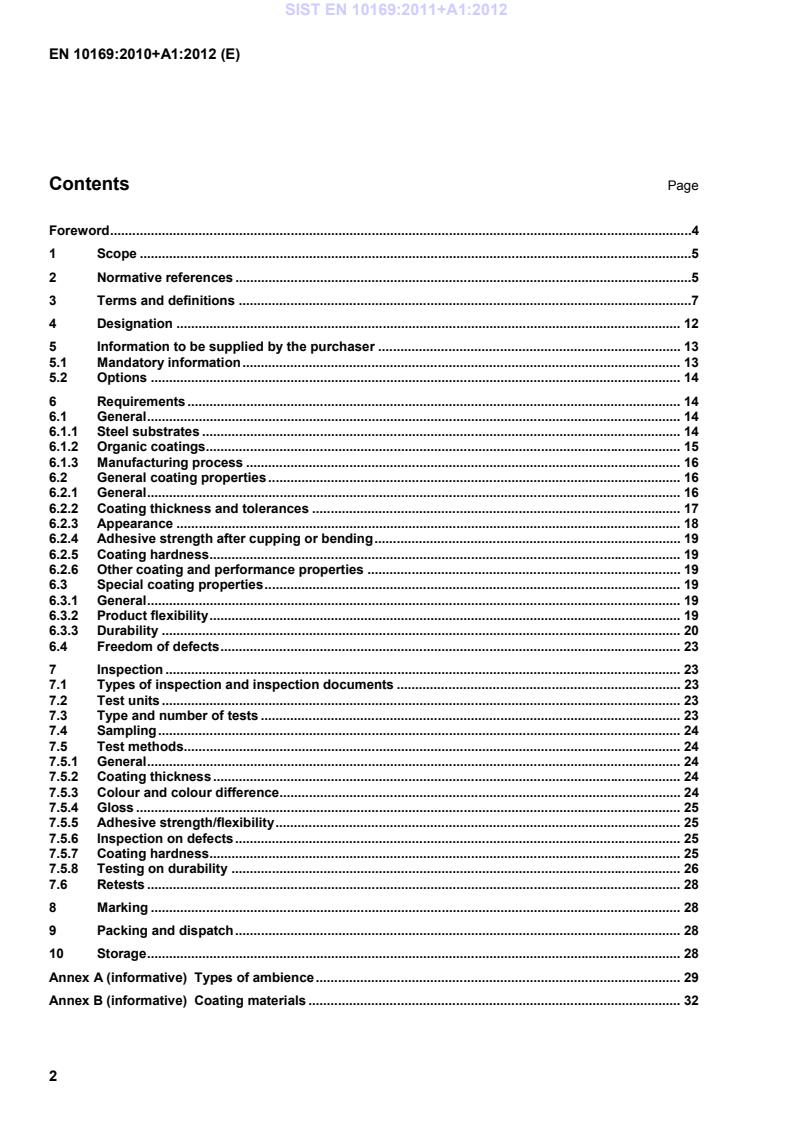
Types of ambience . 29Annex B (informative)
Coating materials . 32SIST EN 10169:2011+A1:2012
Types of atmosphere (see also EN ISO 12944-2) . 33Annex D (informative)
Outdoor exposure sites. 34Annex E (informative)
Storage . 36Bibliography . 37 SIST EN 10169:2011+A1:2012
The products covered are wide strip, sheet cut from wide strip, slit wide strip, strip rolled in widths less than 600 mm and cut lengths (from sheet or strip). NOTE This document is not applicable to continuously organic coated flat products made of: tinmill products, electrical steels. 2 Normative references The following referenced documents are indispensable for the application of this document. For dated references, only the edition cited applies. For undated references, the latest edition of the referenced document (including any amendments) applies. EN 10020:2000, Definition and classification of grades of steel
EN 10021:2006, !General technical delivery conditions for steel products"
EN 10025-1, Hot-rolled products of structural steels — Part 1: General technical delivery conditions EN 10025-2, Hot-rolled products of structural steels — Part 2: Technical delivery conditions for non-alloy structural steels EN 10048, Hot rolled narrow steel strip — Tolerances on dimensions and shape EN 10051, Continuously hot-rolled uncoated plate, sheet and strip of non-alloy and alloy steels — Tolerances on dimensions and shape EN 10079:2007, Definition of steel products EN 10111, Continuously hot rolled low carbon steel sheet and strip for cold forming — Technical delivery conditions
EN 10130, Cold rolled low carbon steel flat products for cold forming — Technical delivery conditions EN 10131, Cold rolled uncoated and zinc or zinc-nickel electrolytically coated low carbon and high yield strength steel flat products for cold forming —Tolerances on dimensions and shape EN 10139, Cold rolled uncoated mild steel narrow strip for cold forming — Technical delivery conditions
EN 10140, Cold rolled narrow steel strip — Tolerances on dimensions and shape EN 10143, Continuously hot-dip coated steel sheet and strip — Tolerances on dimensions and shape EN 10152, Electrolytically zinc coated cold rolled steel flat products for cold forming — Technical delivery conditions EN 10204:2004, Metallic products — Types of inspection documents EN 10268, Cold rolled steel flat products with high yield strength for cold forming — Technical delivery conditions
EN 13523-4, Coil coated metals — Test methods — Part 4: Pencil hardness EN 13523-5, Coil coated metals — Test methods — Part 5: Resistance to rapid deformation (impact test) EN 13523-6, Coil coated metals — Test methods — Part 6: Adhesion after indentation (cupping test) EN 13523-7, Coil coated metals — Test methods — Part 7: Resistance to cracking on bending (T-bend test) EN 13523-8, Coil coated metals — Test methods — Part 8: Resistance to salt spray (fog)
EN 13523-9, Coil coated metals — Test methods — Part 9: Resistance to water immersion EN 13523-10, Coil coated metals — Test methods — Part 10: Resistance to fluorescent UV light and water condensation
EN 13523-11, Coil coated metals — Test methods — Part 11: Resistance to solvents (rubbing test)
EN 13523-12, Coil coated metals — Test methods — Part 12: Resistance to scratching EN 13523-14, Coil coated metals — Test methods – Part 14: Chalking (Helmen method) EN 13523-15, Coil coated metals — Test methods — Part 15: Metamerism EN 13523-18, Coil coated metals — Test methods — Part 18: Resistance to staining
EN 13523-19, Coil coated metals — Test methods — Part 19: Panel design and method of atmospheric exposure testing
EN 13523-21, Coil coated metals — Test methods — Part 21: Evaluation of outdoor exposure panels EN 13523-22, Coil coated metals — Test methods — Part 22: Colour difference — Visual comparison EN 13523-23, Coil coated metals — Test methods — Part 23: Colour stability in humid atmospheres containing sulphur dioxide EN 13523-24, Coil coated metals — Test methods—– Part 24: Resistance to blocking and pressure marking EN 13523-25, Coil coated metals — Test methods — Part 25: Resistance to humidity EN 13523-26, Coil coated metals — Test methods — Part 26: Resistance to condensation of water EN 13523-27, Coil coated metals — Test methods — Part 27: Resistance to humid poultice (Cataplasm test) EN ISO 2815, Paints and varnishes — Buchholz indentation test (ISO 2815:2003) SIST EN 10169:2011+A1:2012
EN ISO 4628-2, Paints and varnishes — Evaluation of degradation of coatings — Designation of quantity and size of defects, and of intensity of uniform changes in appearance — Part 2: Assessment of degree of blistering (ISO 4628-2:2003) EN ISO 4628-4, Paints and varnishes — Evaluation of degradation of coatings — Designation of quantity and size of defects, and of intensity of uniform changes in appearance — Part 4: Assessment of degree of cracking (ISO 4628-4:2003) EN ISO 4628-5, Paints and varnishes — Evaluation of degradation of coatings — Designation of quantity and size of defects, and of intensity of uniform changes in appearance — Part 5: Assessment of the degree of flaking (ISO 4628-5:2003) EN ISO 8044:1999, Corrosion of metals and alloys — Basic terms and definitions (ISO 8044:1999) EN ISO 9227, Corrosion tests in artificial atmospheres — Salt spray tests (ISO 9227:2006)
EN ISO 12944-2:1998, Paints and varnishes — Corrosion protection of steel structures by protective paint systems — Part 2: Classification of environments (ISO 12944-2:1998) ISO 4997, Cold-reduced carbon steel sheet of structural quality 3 Terms and definitions For the purpose of this document, the terms and definitions given in EN 10020:2000, EN 10021:2006, EN 10079:2007, EN 10204:2004, EN ISO 4618:2006, EN ISO 8044:1999, EN ISO 12944-2:1998 and the following apply. 3.1 accessibility ease of access to the steel components for the purpose of inspection and maintenance without any work over and above that concerned with routine inspection 3.2 ambience environmental conditions which prevail in the interior of the building NOTE 1 These conditions determine the corrosivity category of the ambience and include different parameters such as the air temperature, the relative humidity, the operating conditions in the building (e.g. use of aggressive chemical products, refrigerated areas). NOTE 2 It should be noted that the atmosphere surrounding the building can influence the ambience. NOTE 3 Annex A gives an example of classification of types of ambience. 3.3 building interior application
application in buildings for which the concerned construction products (i.e. components of the building fabric) are submitted to the influence of interior ambiences without significant exposure of any side of the product to the influence of exterior atmospheres NOTE 1 Building products include, for example: liner trays, ribbed profiles for roofing and walling, curved profiles, brake-pressed profiles, interior wall panels for partitions, ceiling panels, suspended frames (for suspended ceilings), factory foamed (or mineral wool) sandwich panels for cold rooms or rooms with controlled ambience, interior door frames, interior metal doors, interior metal windows. SIST EN 10169:2011+A1:2012
application in buildings for which the concerned products are submitted to the influence of exterior atmospheres
NOTE 1 Building products include, for example, ribbed profiles for roofing and walling, curved profiles, brake-pressed profiles, concealed fix roofing and walling, standing seam roofing, corrugated sheeting, cladding goods, sandwich panels for roofing and walling, roof tiles, accessories (flashings, trims), rainwater goods (gutters, down pipes), metal doors and garage doors. NOTE 2 For exterior building elements, it is important that the risk of corrosive attack on internal, i.e. reverse side surfaces, should also be considered. In particular, buildings with wet or chemically polluted internal environments can require a reverse side organic coating selected to provide enhanced corrosion protection. This can be especially important in double-skin assemblies (e.g. built-up insulated cladding) where the reverse side of the exterior element is not easily accessible for maintenance and/or in situations where the exterior element is expected to provide long-term durability. NOTE 3 Besides the requirements written in this document, other international or national requirements regarding reaction to fire , safety etc. can be agreed on at the time of enquiry and order. 3.5 coating flexibility ability of a coating to follow without !damaging" the deformation !deleted text" of the substrate !to which it is applied" !NOTE 1 The flexibility is determined during cold forming of the coated product by the T-bend test." !NOTE 2" Cold forming is the process where the main forming is done without heating the working piece.
3.6 coating material material comprising organic polymers, i.e. synthetic resin or plastics, to which pigments, additives and solvents (if required) have generally been added, suitable for coil coating NOTE These may be paints (in liquid or powder form) that when applied form an opaque film or plastic film providing protective, decorative and/or specific properties. 3.7 coating systems
3.7.1 coating system, general combination of the coatings applied on either the top side or the reverse side consisting of one or more coats of one or more coating materials, the designation of which is derived from the relevant coating material 3.7.2 multiple-coat system system comprising a priming coat, possibly intermediate coat(s) and a top coat with particular requirements on appearance, corrosion protection, formability, etc. SIST EN 10169:2011+A1:2012
single coating either with requirements on appearance (see 3.17), formability, corrosion protection, subsequent painting, foam adhesion, etc., or as a priming coat with special properties regarding adhesion and corrosion protection for post-finishing applications 3.8 !!!!nominal organic coating thickness"""" thickness of the organic coating system !either" on top side !or" on reverse side !deleted text" 3.9 nominal thickness of a coil coated product thickness of the metal substrate including metallic coating and excluding thickness of organic coating system 3.10 coating types 3.10.1 backing coat coating of any type on reverse side with no particular requirements on appearance, corrosion protection, formability, etc. NOTE In the case of particular requirements, see 3.7.2.
3.10.2 film coating, permanent plastic film applied to the substrate to which generally an adhesive and, if appropriate, a priming coat has been applied beforehand
3.10.3 film coating, temporary strippable plastic film applied to the coated surface in order to afford a temporary protection against mechanical damage (see also 6.1.2.3) 3.10.4 intermediate coat coat between the priming coat and the top coat
3.10.5 priming coat first coat of a multiple-coat system !NOTE" In the case of particular requirements, see 3.7.2 and 3.7.3. !deleted text" 3.10.6 top coat (finishing coat) final (uppermost) coat of a multiple-coat system 3.11
coil coating process in which an (organic) coating material is applied on rolled metal strip in a continuous process which includes cleaning, if necessary, and chemical pre-treatment of the metal surface and either: one-side or two-side, single or multiple application of (liquid) paints or coating powders which are subsequently cured or/and SIST EN 10169:2011+A1:2012
NOTE 1
Curing processes include those by convective or inductive heating or by radiation. NOTE 2
Laminating with metal strip resulting in a sandwich system is possible. NOTE 3
A one-coat chemical pre-treatment and priming coat is possible. 3.12 colour sensation resulting from the visual perception of radiation of a given composition (related to EN 13523-22) NOTE A colour is uniquely characterized for a defined observer and a defined light source as well as illuminating and viewing geometry by the coordinates of a point in a space (colorimetric specification with tristimulous values).
3.13 colour difference magnitude and character of the visually perceived, i.e. qualitative, difference between two colours under daylight and artificial light respectively, or the magnitude and direction of the (instrumentally) measured and calculated difference of two colours (related to EN 13523-3) 3.14 corrosion protection (interior) category
CPI category of coating which presents a certain level of corrosion protection, the choice of which depends on the corrosivity category, the period of protection and the accessibility 3.15 corrosion resistance (outdoor) category
RC category of product which presents a certain level of corrosion resistance, the choice of which depends on the corrosivity category, the period of resistance and the accessibility NOTE 1 Different categories of organic coil coated products for outdoor application classified following their level of corrosion resistance are defined. Criteria of classification are related to their level of natural and artificial outdoor corrosion resistance. NOTE 2 These conditions determine the corrosivity category and include both meteorological and pollution parameters [EN ISO 12944-2]. NOTE 3 It should be recognized that in some local areas within a region, environmental conditions can apply which are not typical of the region as a whole, e.g. in a rural atmosphere close to a fossil fuel burning power generation plant, areas immediately down wind of the prevailing wind direction can be subjected to an environment closer to urban or even industrial atmospheres. Such special cases should be considered when organic coatings are chosen. 3.16 corrosivity category
C category which indicates the corrosivity of the environment taking into account both atmospheric conditions prevailing around a constituent element of a structure, and micro-environmental effects and shall be used for the selection of the appropriate product (related to EN ISO 12944-2) NOTE The relationship between corrosivity categories and types of atmospheres is given in Table 6. 3.17 gloss optical property of a surface, characterized by its ability to reflect light (related to EN 13523-2) NOTE For qualitative purposes, gloss ranges are often described by the terms "matt", "low gloss" or "semi-matt", "satin", "semi-gloss", "gloss" and "high gloss". SIST EN 10169:2011+A1:2012
organic coating
dry paint film of the coated product or the plastic film of the film/metal laminate 3.21
period of protection time between the first exposure of the steel component and the moment at which maintenance works need to be carried out to restore corrosion protection NOTE The need to restore corrosion protection is deemed to arise when failure of the coating has occurred to the point where a significant amount (for example 5 %) of the component surface exhibits corrosion of the substrate. 3.22 reverse side opposite side of the top side (see !3.26") 3.23 saturated colour colour with Chroma C* > 40
NOTE Chroma C* is defined by CIE 15:2004. 3.24 substrate base material from rolled steel flat products, with or without metallic coating 3.25
time of wetness period during which a coated surface is covered by a film of electrolyte that is capable of causing atmospheric corrosion (see EN ISO 12944-2) NOTE Guidance value for time of wetness can be calculated from the temperature and humidity relative by summing the hours where the humidity relative is above 80 % and, at the same time, the temperature is above 0 °C. 3.26 top side side of the strip with the highest decorative demand and/or corrosion protection and which, in normal production, is uppermost, respectively the exterior side of a coil 3.27 uncoated condition in which parts of the surface of the substrate (e.g. one side of the strip) remain uncoated 3.28 UV resistance category (Ruv) category of coating which presents a certain level of resistance to degradation by UV radiation NOTE Different categories of organic coil coated products for outdoor application classified following their level of UV resistance are defined. Criteria of classification are related to their level of natural and artificial outdoor UV resistance with relation to the cumulative solar energy of the outdoor exposure site. SIST EN 10169:2011+A1:2012
1) steel name or number, 2) type and nominal mass of the metal coating, 3) number of the standard for the substrate, 4) dimensions and tolerances (see 6.1.1.2). d) symbol "OC" for organic coated, when the coating material is not specified; e) symbol for the organic coating material on the top side and, if applicable, that on the reverse side (see Table B.1); f) nominal thickness, in µm, of the organic coating on the top side and, if applicable, on the reverse side. NOTE 1 The information concerning the coating on the top side is separated from that relative to the reverse side by a slash mark. NOTE 2 If the nature of the coating material on the reverse side is at the discretion of the manufacturer, it is not stated in the designation. g) product flexibility (see 6.3.2 ), h) if applicable, corrosion protection category CPI (see Table 5) or corrosion resistance category RC (see Tables 6 and 7) of the top side followed by the one of the reverse side when required, i) if applicable, UV resistance category Ruv (see Table 8) of the top side. EXAMPLE 1
Designation of sheet for building interior applications in accordance with EN 10169, substrate made of steel grade DC03 (or 1.0347) according to EN 10130, top side organic coated with epoxide (EP) with a nominal thickness of 10 µm. Sheet EN 10169 – DC03 EN 10130 – EP10 or Sheet EN 10169 – 1.0347 EN 10130 – EP10
EXAMPLE 2
Designation of strip for general engineering applications in accordance with EN 10169, substrate made of electrolytically zinc coated steel of grade DC07+ZE (or 1.0898+ZE) with a nominal thickness of 10 µm (100/100) according to EN 10152 on both sides, top side organic coated with polyamide-modified polyester (SP-PA) with a nominal thickness of 25 µm. Strip EN 10169 –DC07+ZE100/100 EN 10152 – SP-PA25 or Strip EN 10169 –1.0898+ZE100/100 EN 10152 – SP-PA25
Designation of strip for building exterior applications in accordance with EN 10169, substrate made of hot-dip zinc coated steel of grade S280GD+Z (or 1.0244+Z) with a coating mass of 275 g/m² (275) according to EN 10346, top side organic coated with polyamide-modified polyester (SP-PA) with a nominal thickness of 25 µm, product flexibility
4T, corrosion resistance category 2 (RC2), UV resistance category 2 (Ruv2). Strip EN 10169 – S280GD+Z275 EN 10346 –SP-PA25 – 4T– RC2 – Ruv2 or Strip EN 10169 – 1.0244+Z275 EN 10346 – SP-PA25 – 4T – RC2 – Ruv2
EXAMPLE 4
Designation of sheet for building exterior applications in accordance with EN 10169, substrate made of hot-dip zinc-aluminium coated steel of grade DX53D+ZA (or 1.0355+ZA) with a coating mass of 255 g/m² (255) according to EN 10346, both sides coated with polyester (SP) with a nominal coating thickness of 25 µm each, product flexibility 3T, corrosion resistance category 3 (RC3) on the top side / corrosion protection category 2 (RC2) on the reverse side, UV resistance category 2 (Ruv2). Sheet EN 10169 – DX53D+ZA255 – SP25/SP25 – EN 10346–3T– RC3/RC2 – Ruv2 or Sheet EN 10169 – 1.0355+ZA255 – SP25/SP25 – EN 10346 – 3T – RC3/RC2 – Ruv2
4.3 Where appropriate, additional information to the designation as specified in 4.2 shall be given to describe clearly the delivery requirements (see 5.1). 5 Information to be supplied by the purchaser 5.1 Mandatory information The following information is required from the purchaser so that the manufacturer can supply the products to conform with the requirements: a) complete designation of the product (see 4.2); b) where appropriate, details of the required decorative properties (colour, gloss, embossing, printing) and subsequent protection treatment (see 6.1.2.3); c) nominal dimensions of the substrate; d) quantity;
e) internal and maximum external diameter and mass limit for coils, or limit dimensions and mass limit for bundles of sheets; f) type of test and type of inspection document (see 7.1.1 and 7.1.2); g) requirement concerning marking (see Clause 8); h) requirements on packing and dispatch (see Clause 9). SIST EN 10169:2011+A1:2012
Depending on the applications, the coil coated steel flat products may be delivered with a specified organic coating: a) on either side; b) on one side only, the other one, though generally pre-treated, being uncoated; c) on one side, the other side (reverse side of the strip) being coated in any organic manner without special properties. The type of coating on either side of the product shall be agreed at the time of enquiry and order to meet the purchaser's requirements of the product flexibility, the corrosion protection/corrosion resistance category of the top and reverse sides and, where necessary, the UV resistance category of the top side. NOTE The reverse side coating should be chosen as appropriate. It is normally required to withstand handling and storage. In some circumstances, it can also be required to provide corrosion protection and/or aesthetic appearance or to be compatible with foam or adhesive bonding. For strip supplied in coil form, the top side is normally the outside of the coil; for sheets and cut lengths (in stacks or bundles) the top side is normally uppermost. If the purchaser requires an alternative arrangement, this shall be expressly stated at the time of enquiry and order. 6.1.2.3 Temporary protection treatment Coil coated products may be supplied with the additional temporary protection of a strippable film, wax or oil. Additional temporary protection is recommended, when special requirements during transportation, storage or processing are expected. Strippable films shall be removed within 3 months at the latest. The type of temporary protection shall be agreed upon at the time of enquiry and order. Type and thickness of the coating shall be taken into consideration when choosing protective films.
7.5.6 Adhesive strength/flexibility (6.2.4) Adhesion after cupping EN 13523-6 7.5.5.1 Coating flexibility (T-bend test) EN 13523-7 7.5.5.2 Adhesion and resistance to crack formation on rapid deformation (impact test) EN 13523-5 7.5.5.3 Coating hardness (6.2.5) Pencil hardness EN 13523-4 7.5.7.1 Buchholz indentation test EN ISO 2815 7.5.7.2 Resistance to scratching EN 13523-12 7.5.7.3 Durability (6.3.3) Resistance to humidity EN 13523-26, EN ISO 4628-2, EN ISO 4628-4, EN ISO 4628-5 7.5.8.1, 7.5.8.2 Behaviour on natural weathering
(outdoor exposure) EN 13523-19, EN 13523-21 7.5.8.1, 7.5.8.3
— Resistance to outdoor corrosion EN 13523-21, EN ISO 4628-4, EN ISO 4628-5 7.5.8.3.2
— Resistance to natural UV radiation EN 13523-14, EN 13523-21, EN ISO 4628-4, EN ISO 4628-5
7.5.8.3.3 Behaviour on artificial weathering
7.5.8.1, 7.5.8.4
— Resistance to neutral salt spray (fog) EN 13523-8, EN ISO 9227, EN ISO 4628-4,
EN ISO 4628-5 7.5.8.4.1
— Resistance to intensified UV radiation EN 13523-10, EN 13523-14 7.5.8.4.2 Other properties
EN 13523-9, EN 13523-11, EN 13523-18,
EN 13523-23, EN 13523-24, EN 13523-25,
EN 13523-26, EN 13523-27 6.2.6, 7.5.8
NOTE 2 Some methods of those listed in Table 1 can be used either as pass/fail tests or as classification test. 6.2.2 Coating thickness and tolerances 6.2.2.1 The coating thickness shall comply with the requirements specified at the time of enquiry and order (see 4.2.f)). 6.2.2.2 For the ranges of nominal coating thickness, the tolerances given in Table 2 shall apply. SIST EN 10169:2011+A1:2012
Dimensions in µm Range of nominal thickness > 10 ≤ 20 > 20 ≤ 25 > 25 ≤ 35 > 35 ≤ 60 > 60 ≤ 100 > 100 ≤ 150 > 150 ≤ 500 > 500 ≤ 800 Minus tolerance on the average of three measurements 3 4 6 8 15 20 30 40 Minus tolerance on single measurement 4 5 8 12 20 25 35 50
Tolerances on coating thicknesses ≤ 10 µm may be agreed at the time of enquiry and order. NOTE 1 There are normally no requirements for the plus tolerance, but these can be agreed at the time of enquiry and order. NOTE 2 There are no requirements for the backing coat. 6.2.3 Appearance
6.2.3.1 General Colour and colour tolerances and specular gloss shall comply with the specified requirements, where applicable (see 5.1 b)). Unless otherwise agreed at the time of enquiry and order, only the top side is continuously inspected. 6.2.3.2 Colour and colour difference The appropriate colour and colour tolerances, the method of measurement and the measurement device shall be agreed at the time of enquiry and order.
NOTE
Metallic structured and pearlescent paint may exhibit aspect and colour variation from one production batch to another. Metallic and pearlescent paints exhibit directionality. It is important that this directionality is maintained to ensure colour consistency.
6.2.3.3 Gloss When required, the tolerances shall be as given in Table 3. NOTE 1
Tighter tolerances may be agreed at the time of enquiry and order. NOTE 2 For limitations see note to 7.5.4. SIST EN 10169:2011+A1:2012
Tolerances on nominal gloss ≤ 10 matt ± 3 > 10
≤ 20 low gloss ±
...