

EN ISO 11197:2004
(Main)Medical supply units (ISO 11197:2004)
- Abstract
2004-07-29 (LUP): The draft is recorded for submission to FV on 2004-06-17. FV closes on 2048-08-17. Hence the corresponding WI number has to be removed from the list proposed for deletion under BT 32/2004. For details please contact responsible Programme Manager. Ludwig Paul: +3225500831 or email ludwig.paul@cenorm.be
TC215 sent the text on 9 May 2003 to CMC for parallel FV issue and it was approved by the CEN consultant on 13 June 2003. CMC who informed TC 215 that he the document had to be with ISO/CS and he would prompt ISO for action on 1 March 2004
The ISO SC has been contacte and is looking to the reason why no formal reply was given to the CMC production departement. By the mean time the CMC production confirm that they still have the draft and reinitiated the request to ISO for processing the vote (see list of questions given to STDDEV sector management for resolutions in coordination meeting with CMC production). (LP 2004-05-18)
- Status
- Withdrawn
- Publication Date
- 14-Dec-2004
- Withdrawal Date
- 14-Apr-2009
- Technical Committee
- CEN/TC 215 - Respiratory and anaesthetic equipment
- Drafting Committee
- CEN/TC 215 - Respiratory and anaesthetic equipment
- Current Stage
- 9960 - Withdrawal effective - Withdrawal
- Start Date
- 15-Apr-2009
- Completion Date
- 15-Apr-2009
- Directive
- 93/42/EEC - Medical devices

Relations
- Effective Date
- 22-Dec-2008
- Effective Date
- 22-Dec-2008
- Effective Date
- 28-Jan-2026
- Effective Date
- 28-Jan-2026
- Consolidated By
ISO 11197:2004 - Medical supply units - Effective Date
- 12-Feb-2026
Get Certified
Connect with accredited certification bodies for this standard

BSI Group
BSI (British Standards Institution) is the business standards company that helps organizations make excellence a habit.

TÜV Rheinland
TÜV Rheinland is a leading international provider of technical services.

TÜV SÜD
TÜV SÜD is a trusted partner of choice for safety, security and sustainability solutions.
Sponsored listings
Frequently Asked Questions
EN ISO 11197:2004 is a standard published by the European Committee for Standardization (CEN). Its full title is "Medical supply units (ISO 11197:2004)". This standard covers: 2004-07-29 (LUP): The draft is recorded for submission to FV on 2004-06-17. FV closes on 2048-08-17. Hence the corresponding WI number has to be removed from the list proposed for deletion under BT 32/2004. For details please contact responsible Programme Manager. Ludwig Paul: +3225500831 or email ludwig.paul@cenorm.be TC215 sent the text on 9 May 2003 to CMC for parallel FV issue and it was approved by the CEN consultant on 13 June 2003. CMC who informed TC 215 that he the document had to be with ISO/CS and he would prompt ISO for action on 1 March 2004 The ISO SC has been contacte and is looking to the reason why no formal reply was given to the CMC production departement. By the mean time the CMC production confirm that they still have the draft and reinitiated the request to ISO for processing the vote (see list of questions given to STDDEV sector management for resolutions in coordination meeting with CMC production). (LP 2004-05-18)
2004-07-29 (LUP): The draft is recorded for submission to FV on 2004-06-17. FV closes on 2048-08-17. Hence the corresponding WI number has to be removed from the list proposed for deletion under BT 32/2004. For details please contact responsible Programme Manager. Ludwig Paul: +3225500831 or email ludwig.paul@cenorm.be TC215 sent the text on 9 May 2003 to CMC for parallel FV issue and it was approved by the CEN consultant on 13 June 2003. CMC who informed TC 215 that he the document had to be with ISO/CS and he would prompt ISO for action on 1 March 2004 The ISO SC has been contacte and is looking to the reason why no formal reply was given to the CMC production departement. By the mean time the CMC production confirm that they still have the draft and reinitiated the request to ISO for processing the vote (see list of questions given to STDDEV sector management for resolutions in coordination meeting with CMC production). (LP 2004-05-18)
EN ISO 11197:2004 is classified under the following ICS (International Classification for Standards) categories: 11.040.01 - Medical equipment in general. The ICS classification helps identify the subject area and facilitates finding related standards.
EN ISO 11197:2004 has the following relationships with other standards: It is inter standard links to EN 793:1997, EN ISO 11197:2009, EN 1789:2007+A1:2010, EN 1789:2007+A2:2014, ISO 11197:2004. Understanding these relationships helps ensure you are using the most current and applicable version of the standard.
EN ISO 11197:2004 is associated with the following European legislation: EU Directives/Regulations: 93/42/EEC; Standardization Mandates: M/023. When a standard is cited in the Official Journal of the European Union, products manufactured in conformity with it benefit from a presumption of conformity with the essential requirements of the corresponding EU directive or regulation.
EN ISO 11197:2004 is available in PDF format for immediate download after purchase. The document can be added to your cart and obtained through the secure checkout process. Digital delivery ensures instant access to the complete standard document.
Standards Content (Sample)
SLOVENSKI STANDARD
01-marec-2005
Enote za oskrbo v medicini (ISO 11197:2004)
Medical supply units (ISO 11197:2004)
Medizinische Versorgungseinheiten (ISO 11197:2004)
Gaines techniques a usage médical (ISO 11197:2004)
Ta slovenski standard je istoveten z: EN ISO 11197:2004
ICS:
11.040.01 Medicinska oprema na Medical equipment in general
splošno
2003-01.Slovenski inštitut za standardizacijo. Razmnoževanje celote ali delov tega standarda ni dovoljeno.
EUROPEAN STANDARD
EN ISO 11197
NORME EUROPÉENNE
EUROPÄISCHE NORM
December 2004
ICS 11.040.01 Supersedes EN 793:1997
English version
Medical supply units (ISO 11197:2004)
Gaines techniques à usage médical (ISO 11197:2004) Medizinische Versorgungseinheiten (ISO 11197:2004)
This European Standard was approved by CEN on 23 September 2004.
CEN members are bound to comply with the CEN/CENELEC Internal Regulations which stipulate the conditions for giving this European
Standard the status of a national standard without any alteration. Up-to-date lists and bibliographical references concerning such national
standards may be obtained on application to the Central Secretariat or to any CEN member.
This European Standard exists in three official versions (English, French, German). A version in any other language made by translation
under the responsibility of a CEN member into its own language and notified to the Central Secretariat has the same status as the official
versions.
CEN members are the national standards bodies of Austria, Belgium, Cyprus, Czech Republic, Denmark, Estonia, Finland, France,
Germany, Greece, Hungary, Iceland, Ireland, Italy, Latvia, Lithuania, Luxembourg, Malta, Netherlands, Norway, Poland, Portugal, Slovakia,
Slovenia, Spain, Sweden, Switzerland and United Kingdom.
EUROPEAN COMMITTEE FOR STANDARDIZATION
COMITÉ EUROPÉEN DE NORMALISATION
EUROPÄISCHES KOMITEE FÜR NORMUNG
Management Centre: rue de Stassart, 36 B-1050 Brussels
© 2004 CEN All rights of exploitation in any form and by any means reserved Ref. No. EN ISO 11197:2004: E
worldwide for CEN national Members.
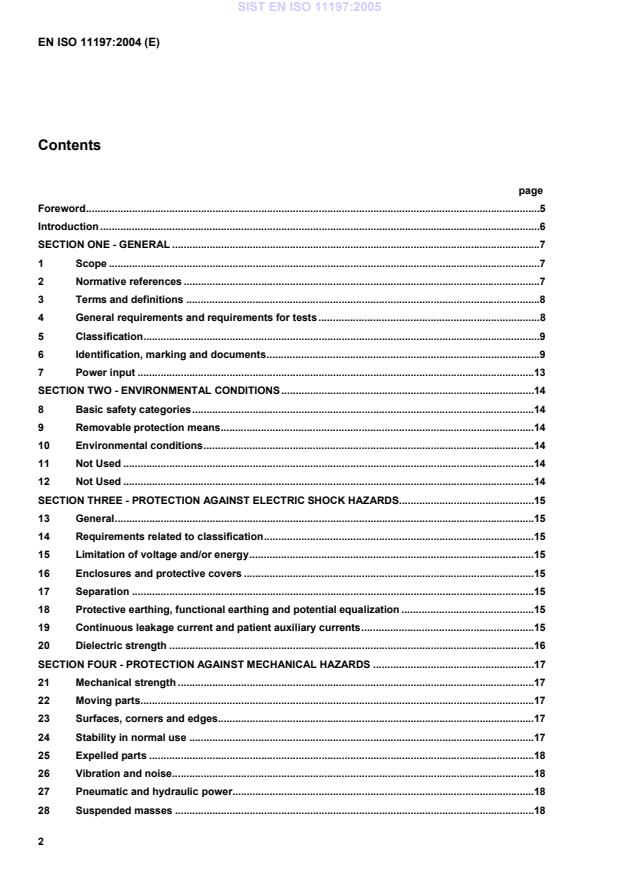
Contents
page
Foreword.5
Introduction .6
SECTION ONE - GENERAL .7
1 Scope .7
2 Normative references .7
3 Terms and definitions .8
4 General requirements and requirements for tests.8
5 Classification.9
6 Identification, marking and documents.9
7 Power input .13
SECTION TWO - ENVIRONMENTAL CONDITIONS .14
8 Basic safety categories.14
9 Removable protection means.14
10 Environmental conditions.14
11 Not Used .14
12 Not Used .14
SECTION THREE - PROTECTION AGAINST ELECTRIC SHOCK HAZARDS.15
13 General.15
14 Requirements related to classification.15
15 Limitation of voltage and/or energy.15
16 Enclosures and protective covers .15
17 Separation .15
18 Protective earthing, functional earthing and potential equalization .15
19 Continuous leakage current and patient auxiliary currents.15
20 Dielectric strength .16
SECTION FOUR - PROTECTION AGAINST MECHANICAL HAZARDS .17
21 Mechanical strength .17
22 Moving parts.17
23 Surfaces, corners and edges.17
24 Stability in normal use .17
25 Expelled parts .18
26 Vibration and noise.18
27 Pneumatic and hydraulic power.18
28 Suspended masses .18
SECTION FIVE - PROTECTION AGAINST HAZARDS FROM UNWANTED OR EXCESSIVE RADIATION.19
29 X-Radiation.19
30 Alpha, beta, gamma, neutron radiation and other particle radiation .19
31 Microwave radiation .19
32 Light radiation (including lasers).19
33 Infra-red radiation .19
34 Ultraviolet radiation.19
35 Acoustical energy (including ultrasonics).19
36 Electromagnetic compatibility .19
SECTION SIX - PROTECTION AGAINST HAZARDS OF IGNITION OF FLAMMABLE ANAESTHETIC
MIXTURES .21
37 Locations and basic requirements .21
38 Marking and accompanying documents.21
39 Common requirements for Category AP and Category APG Equipment.21
40 Requirements and tests for Category AP Equipment, parts and components thereof .21
41 Requirements and tests for Category APG Equipment, parts and components thereof.21
SECTION SEVEN - PROTECTION AGAINST EXCESSIVE TEMPERATURES AND OTHER SAFETY
HAZARDS .22
42 Excessive temperatures.22
43 R Fire prevention .22
44 Overflow, spillage, leakage, humidity, ingress of liquids, cleaning, sterilization and
disinfection.22
45 Pressure vessels and parts subject to pressure.22
46 Human errors .23
47 Electrostatic charges .23
48 Material in applied parts in contact with the body of the patient .23
49 Interruption of the power supply .23
SECTION EIGHT - ACCURACY OF OPERATING DATA AND PROTECTION AGAINST HAZARDOUS
OUTPUT .24
50 Accuracy of operating data .24
51 Protection against hazardous output.24
SECTION NINE - ABNORMAL OPERATION AND FAULT CONDITIONS, ENVIRONMENTAL TESTS.25
52 Abnormal operation and fault conditions .25
53 Environmental tests .25
SECTION TEN - CONSTRUCTIONAL REQUIREMENTS .25
54 General.25
55 Enclosures and covers .25
56 Components and general assembly.25
57 Mains parts, components and layout .25
58 Protective earthing - terminals and connections .26
59 Construction and layout .27
Annexes.39
Annex A A (normative) Special National Conditions .40
Annex B B (informative) Rationale.41
Annex ZA (Informative) Clauses of this European Standard addressing essential requirements or
other provisions of EU Directives.43
Annex ZB (Informative) Normative references to international publications with their relevant
European publications .45
Bibliography .46
Foreword
This document (EN ISO 11197:2004) has been prepared by CEN /TC 215, "Respiratory and anaesthetic
equipment", the secretariat of which is held by BSI, in collaboration with ISO/TC121/SC6 "Medical gas
systems".
This European Standard shall be given the status of a national standard, either by publication of an identical
text or by endorsement, at the latest by June 2005, and conflicting national standards shall be withdrawn at
the latest by June 2005.
This document supersedes EN 793: 1997.
This European Standard has been prepared under a mandate given to CEN by the European Commission
and the European Free Trade Association and supports essential requirements of EU Directive(s).
For special national conditions for Clauses 6.1 k), 6.1 bb), 6.2 aa) and 57.1, see Annex AA.
For relationship with EU Directives, see informative Annex ZA, which is an integral part of this standard.
For a list of International Standards identical to the European Standards referred to in this European Standard,
see informative Annex ZB.
According to the CEN/CENELEC Internal Regulations, the national standards organizations of the following
countries are bound to implement this European Standard: Austria, Belgium, Cyprus, Czech Republic,
Denmark, Estonia, Finland, France, Germany, Greece, Hungary, Iceland, Ireland, Italy, Latvia, Lithuania,
Luxembourg, Malta, Netherlands, Norway, Poland, Portugal, Slovakia, Slovenia, Spain, Sweden, Switzerland
and United Kingdom.
Introduction
This particular standard applies in conjunction with EN 60601-1 "Medical electrical equipment — Part 1:
General requirements for safety".
As stated in EN 60601-1 the requirements of this Particular Standard take priority over those of EN 60601-1.
As in EN 60601-1 the requirements are followed by the relevant tests. The structure of this particular standard
corresponds to that of EN 60601-1 and the sections, clauses and sub-clauses refer to those of EN 60601-1.
Clauses, subclauses, Tables and Figures additional to those in EN 60601-1 are numbered beginning at "101".
Additional annexes are lettered beginning at "AA" except for annexes "ZA" and "ZB".
Additional items in lettered lists are lettered beginning "aa)".
Annex BB contains rationale statements for some of the requirements of EN ISO 11197. It is included to
provide additional insight into the reasoning that led to the requirements and recommendations that have been
incorporated into EN ISO 11197. The clauses and subclauses marked with R after their number have
corresponding rationale contained in Annex BB. It is considered that knowledge of the reasons for the
requirements will not only facilitate the proper application of this standard, but will expedite any subsequent
revision.
In any health care facility it is strongly recommended that terminal units of only one type (i.e. with the same set
of specific dimensions) are used for each medical gas system, anaesthetic gas scavenging system and liquid
system.
SECTION ONE - GENERAL
1 Scope
Clause 1 of EN 60601-1:1990 applies with the following addition:
This document applies to medical supply units as defined in 3.5.
This particular document applies in conjunction with EN 60601-1.
The requirements of this particular document take priority over those of EN 60601-1.
2 Normative references
The following referenced documents are indispensable for the application of this document. For dated
references, only the edition cited applies. For undated references, the latest edition of the referenced
document (including any amendments) applies.
EN 737-1, Medical gas pipeline systems — Part 1: Terminal units for compressed medical gases and vacuum.
EN 737-2, Medical gas pipeline systems — Part 2: Anaesthetic gas scavenging disposal systems – Basic
requirements.
EN 737-3, Medical gas pipeline systems — Part 3: Pipelines for compressed medical gases and vacuum.
EN 737-4, Medical gas pipeline systems — Part 4: Terminal units for anaesthetic gas scavenging systems.
EN 739:1998, Low-pressure hose assemblies for use with medical gases.
EN ISO 3744, Acoustics — Determination of sound power levels of noise sources using sound pressure -
Engineering method in an essentially free field over a reflecting plane (ISO 3744:1994).
EN ISO 14971, Medical devices - Application of risk management to medical devices (ISO 14971:2000).
IEC 60079-4, Electrical apparatus for explosive gas atmospheres — Part 4: Method of test for ignition
temperature.
EN 60529, Degrees of protection provided by enclosures (IP code) (IEC 60529:1989).
EN 60598-1, Luminaires — Part 1: General requirements and tests (IEC 60598-1:1999, modified).
EN 60601-1:1990, Medical electrical equipment — Part 1: General requirements for safety (IEC 60601-
1:1988).
EN 60601-1-2, Medical electrical equipment - Part 1-2: General requirements for safety; Collateral standard:
Electromagnetic compatibility; Requirements and tests (IEC 60601-1-2:2001).
EN 60669-1, Switches for household and similar fixed electrical installations — Part 1: General requirements
(IEC 60669-1:1998, modified).
EN 61386-1, Conduit systems for electrical installations – Part 1: General requirements (IEC 61386-
1:1996+A1:2000).
3 Terms and definitions
For the purposes of this document, the terms and definitions given in EN 60601-1:1990 and the following
apply.
3.1
compartment
part of an enclosure with openings necessary for interconnection, control or ventilation
3.2
enclosure
surrounding case constructed to provide a degree of protection to personnel against accidental contact with
live parts and also the equipment enclosed against specified environmental conditions (IEC 61950:1997)
NOTE An enclosure can be subdivided into compartments.
3.3
junction point
connection point(s) between the medical supply unit and the system(s) already installed
3.4
medical gas
any gas or mixture of gases intended to be administered to patients for therapeutic, diagnostic or prophylactic
purposes, or for driving surgical tools
NOTE In some applications this term includes medical vacuum.
3.5
medical supply unit
fixed equipment intended to supply electric power and/or medical gases and/or liquids and anaesthetic gas
scavenging systems to medical areas of a health-care facility
NOTE Medical supply units can include medical electrical equipment or medical electrical systems or parts thereof.
Medical supply units can also consist of modular sections for electrical supply, lighting for therapy or illumination,
communication, supply of medical gases and liquids, anaesthetic gas scavenging systems. Some typical
examples of medical supply units are bed head services modules, ceiling pendants, beams, booms, columns
and pillars. Examples of configurations are given in Figures 101, 102 and 103.
4 General requirements and requirements for tests
4.1 Modifications to clause 3 of EN 60601-1:1990
Clause 3 of EN 60601-1:1990 applies with the following addition:
3.6 Add the following items:
3.6 aa) R An oxidant leak which is not detected by e.g. an alarm or periodic inspection shall be considered a
normal condition and not a single fault condition.
3.6 bb) Medical supply units shall, when transported, stored, installed, operated in normal use and maintained
according to the instructions of the manufacturer, cause no safety hazard which could be foreseen using risk
analysis procedures in accordance with EN ISO 14971 and which is connected with its intended application, in
normal condition and in single fault condition.
3.101 Equipment and components incorporated into the medical supply unit shall comply with the relevant
standard(s) for such equipment or components.
4.2 Clause 4 of EN 60601-1:1990
Clause 4 of EN 60601-1:1990 applies.
5 Classification
Clause 5 of EN 60601-1:1990 applies.
6 Identification, marking and documents
Clause 6 of EN 60601-1:1990 applies with the following amendments:
6.1 Marking on the outside of equipment or equipment parts
a) Mains-operated equipment
Replace with the following:
Mains-operated equipment, including separable components thereof which have a mains part, shall be
provided with permanent and legible marking on the outside of the major part of the equipment indicating the
origin and model or type reference.
g) Connection to the supply
Replace with the following:
Due to the possible complexity of external marking, diagrams indicating all electrical and electronic
connections to the medical supply unit shall be located at the junction point inside the equipment.
For electrical connections the diagram shall indicate voltages, number of phases and number of circuits. For
electronic connections, the diagram shall indicate connector numbers and wire identification.
k) Mains power output
Replace with the following:
Mains socket-outlets for special purposes (e.g. for x-ray equipment) shall be marked with: type of mains, rated
voltage, rated current and with a label (e.g."x-ray").
See Annex AA for Special National Conditions
NOTE 1 Mains socket-outlets for special purpose areas which are fused in a single circuit can be marked with identical
numbers.
Add the following:
When a medical supply unit is provided with socket-outlets for connection to an essential electrical supply
circuit [e.g. uninterruptable power supply (UPS)], these socket-outlets shall comply with the national
installation rules or be individually identified if not covered by those rules.
See Annex AA for Special National Conditions.
NOTE 2 If socket-outlets in the same location are supplied from different power sources, each source should be readily
identifiable.
l) Classification
Replace dash three with the following:
Medical supply units shall be designed and constructed as CLASS I, Type B equipment according to degree
of protection against electric shock. Built-in units of Type BF or CF and outlets forming part of them, contained
in medical supply units, shall be clearly marked with the relevant symbols according to appendix D, Table D II
of EN 60601-1:1990.
NOTE The term “Type B (BF, CF) equipment (unit)” used in this standard is equivalent to the term “Type B (BF, CF)
applied part” used in EN 60601-1.
y) Earth terminals
Add the following:
Facilities for the connection of supplementary equipotential earth bonding (if provided) shall be marked with
symbol 9 of appendix D, Table D I of EN 60601-1:1990.
NOTE The term "equipotential earth bonding" used in this standard is equivalent to the term "potential equalisation
conductor" used in EN 60601-1.
Add the following:
aa) Particular applications
If the medical supply unit is intended to be used in conjunction with patient monitors for electromyograph
and/or electroencephalograph and/or electrocardiograph, the medical supply unit shall be marked with the
particular application as follows:
for electromyograph EMG
for electroencephalograph EEG
for electrocardiograph ECG or EKG
bb) Terminal units
Terminal units for medical gases and vacuum shall be marked in accordance with EN 737-1 or national
regulations. Colour coding, if used, shall be in accordance with EN 737-1 or national regulations.
See Annex AA for Special National Conditions.
Terminal units for anaesthetic gas scavenging systems shall be marked in accordance with EN 737-4 or
national regulations. Colour coding, if used, shall be in accordance with EN 737-4 or national regulations.
Terminal units for liquids shall be marked with the name of the liquid in accordance with Table 101 or the
equivalent national language.
Table 101 — Marking for liquids
Name of liquid
Potable water, cold
Potable water, warm
Cooling water
Cooling water, feed-back
De-mineralized water
Distilled water
Dialysing concentrate
Dialysing permeate
6.2 Marking on the inside of equipment and equipment parts
Add the following:
aa) Junction points and pipelines for medical gases shall be marked in accordance with EN 737-3 or national
regulations. Colour coding, if used, shall be in accordance with EN 737-3 or national regulations.
See Annex AA for Special National Conditions.
bb) Junction points and pipelines for anaesthetic gas scavenging systems shall be marked in accordance with
EN 737-2 or national regulations. Colour coding, if used, shall be in accordance with EN 737-2 or national
regulations.
cc) Junction points and pipelines for liquids shall be marked with the name of the liquid in accordance with
Table 101 or the equivalent in national language.
dd) The neutral connection point within the medical supply unit shall be clearly identified using the letter N
and/or colour coded blue (See appendix D, Table D I, symbol 8 of EN 60601-1:1990, IEC 60364-5-51 and IEC
60446).
6.8 Accompanying documents
Clause 6.8 of EN 60601-1:1990 applies with the following amendments:
6.8.2 Instructions for use
a) General information
Add the following:
Instructions for use shall state which parts of the equipment are capable of bearing additional loads. The
maximum safe working load shall be stated.
If flexible hoses and hose assemblies are used for supplying medical gases, anaesthetic gas scavenging
or liquids in an operator-adjustable system (e.g. a ceiling pendant), the instructions for use shall include a
procedure for, and the recommended frequency of, inspection and replacement.
If flexible hoses are used for supplying medical gases in an operator-adjustable system (e.g. a ceiling
pendant), the instructions for use shall state that the following tests given in EN 737-3 shall be carried out
following modification or replacement of the flexible hose:
• test for leakage;
• test for obstruction;
• test for particulate contamination;
• test of gas identity.
If flexible hoses are used for supplying anaesthetic gas scavenging in an operator-adjustable system (e.g.
a ceiling pendant), the instructions for use shall state that the following tests given in EN 737-2 shall be
carried out following modification or replacement of the flexible hose:
• test for leakage;
• test of flow and pressure drop.
If flexible hoses are used for supplying liquids in an operator-adjustable system (e.g. a ceiling pendant),
the instructions for use shall state that the following test, given in clause 59.103.2 b), shall be carried out
following modification or replacement of the flexible hose:
• test for leakage
b) Responsibility of the manufacturer
Replace with the following:
The manufacturer shall provide evidence that the following production tests have been performed for each
medical supply unit and that the specified requirements are met:
i) Impedance of protective earthing in accordance with 18 f) of EN 60601-1:1990;
ii) Earth leakage current in accordance with 19.3 and 19.4 of EN 60601-1:1990;
iii) Dielectric strength in accordance with 20.3 and 20.4 of EN 60601-1:1990;
iv) The following requirements and tests:
requirements as in 59.101.1, 59.102.1 and 59.103.1;
flow and pressure drop in accordance with 59.101.2 a) and 59.102.2 a);
no cross-connections in accordance with 59.101.2 b), 59.102.2 b) and 59.103.2 a);
leakage in accordance with 59.101.2.c), 59.102.2 c) and 59.103.2.b);
pressure tests in accordance with 59.101.2.d) and 59.102.2.d).
Add the following:
aa) Specifications for installation and use
Medical supply units shall be installed, tested and used in compliance with EN 737-2, EN 737-3 and the
manufacturer's instructions.
NOTE 1 An IEC document has been prepared on this subject. (See IEC 60364-7-710)
NOTE 2 Consideration should be given to the mounting height of medical supply units in order to satisfy user
requirements for illumination and viewed luminance and access to services.
6.8.3 Technical description
Add the following:
aa) Disclosure by the manufacturer
The manufacturer shall provide evidence that the noise levels of clause 26 are not exceeded.
The manufacturer shall specify the flow and pressure drop characteristics of the medical supply unit for
both medical gases and anaesthetic gas scavenging, if fitted.
The manufacturer shall submit upon request evidence of any residual hydrocarbon content on the inner
surface of the medical gas pipes.
NOTE The maximum permissible level of residual hydrocarbon content on the inner surface of medical gas pipes is
given in EN 13348.
7 Power input
Clause 7 of EN 60601-1:1990 applies.
SECTION TWO - ENVIRONMENTAL CONDITIONS
8 Basic safety categories
Clause 8 of EN 60601-1:1990 applies.
9 Removable protection means
Not used. Replaced by sub-clause 6.1.z).
10 Environmental conditions
Clause 10 of EN 60601-1:1990 applies.
11 Not Used
12 Not Used
SECTION THREE - PROTECTION AGAINST ELECTRIC SHOCK
HAZARDS
13 General
Clause 13 of EN 60601-1:1990 applies with the following addition:
Luminaires, built in or mounted on medical supply units shall comply with EN 60598-1.
14 Requirements related to classification
Clause 14 of EN 60601-1:1990 applies.
15 Limitation of voltage and/or energy
Clause 15 of EN 60601-1:1990 applies.
16 Enclosures and protective covers
Clause 16 of EN 60601-1:1990 applies with the following addition:
All external surfaces shall conform to a degree of protection against direct contact in normal operation of at
least IP2X or IPXXB (see EN 60529).
This level of protection to live parts shall not be compromised during maintenance of medical gas, anaesthetic
gas scavenging or liquid pipeline systems, e.g. by the provision of covers, barriers or individual protection with
a degree of protection of at least IP2X or IPXXB.
17 Separation
Clause 17 of EN 60601-1:1990 applies.
18 Protective earthing, functional earthing and potential equalization
Clause 18 of EN 60601-1:1990 applies with the following additions:
aa) Terminal units for compressed medical gases and vacuum and for anaesthetic gas scavenging systems
are not required to be connected to the earth terminal.
bb) All earth conductors of circuits from the existing mains supply and additional equipotential earth bonding
shall be individually connected in the medical supply unit to a common earth bar.
19 Continuous leakage current and patient auxiliary currents
Clause 19 of EN 60601-1:1990 applies with the following amendments:
19.3 Allowable values
Add to examples of such equipment in Note 3 of Table IV of EN 60601-1:1990:
"Medical supply units"
20 Dielectric strength
Clause 20 of EN 60601-1:1990 applies.
SECTION FOUR - PROTECTION AGAINST MECHANICAL
HAZARDS
21 Mechanical strength
Clause 21 of EN 60601-1:1990 applies with the following additions:
21.101.1 Dynamic forces
Medical supply units shall be subjected to an impact as described in 21.101.2. After the impact, the live parts
shall not become accessible, terminal units shall continue to meet the requirements of EN 737-1 and existing
protective devices shall remain intact.
21.101.2 Impact resistance test
A bag of 0,50 m width approximately half-filled with sand to give a total weight of 200 N, suspended so as to
give a pendulum length of 1 m shall be released from a horizontal deflection of 0,50 m so as to hit the medical
supply unit that is mounted according to the manufacturer's instruction. The test configuration is shown in
Figure 104. The test shall be repeated so that at least one more part of the medical supply unit is impacted.
The occurrence of cracks in mouldings shall not constitute failure of the test.
21.101.3 Static forces
Parts of medical supply units designed for additional loads shall be subjected to a test load of twice the
maximum safe working load specified by the manufacturer as described in 21.101.4.
The medical supply units and their supports designed for additional loads shall not be permanently deformed
or deflected by more than 10° with reference to the load-bearing surfaces.
21.101.4 Static load test
The test load shall be uniformly distributed over the medical supply unit according to the manufacturer's
specifications.
22 Moving parts
Clause 22 of EN 60601-1:1990 applies.
23 Surfaces, corners and edges
Clause 23 of EN 60601-1:1990 applies.
24 Stability in normal use
Clause 24 of EN 60601-1:1990 applies.
25 Expelled parts
Clause 25 of EN 60601-1:1990 applies.
26 Vibration and noise
Add the following:
26.101
Within the frequency spectrum, individual peak noise levels shall not be in excess of 35 dB (A).
Except for noise caused by therapeutic or diagnostic measures or by adjustment of the medical supply unit,
(e.g. by lifting or lowering) during operation at 1,1 times the rated voltage at nominal frequency the medical
supply unit shall not produce acoustic energies in excess of 30 dB (A).
The manufacturer shall provide evidence upon request that specified sound levels are not exceeded when
measured according to EN ISO 3744.
27 Pneumatic and hydraulic power
Clause 27 of EN 60601-1:1990 applies.
28 Suspended masses
Clause 28 of EN 60601-1:1990 applies.
SECTION FIVE - PROTECTION AGAINST HAZARDS FROM
UNWANTED OR EXCESSIVE RADIATION
29 X-Radiation
Clause 29 of EN 60601-1:1990 applies.
30 Alpha, beta, gamma, neutron radiation and other particle radiation
Clause 30 of EN 60601-1:1990 applies.
31 Microwave radiation
Clause 31 of EN 60601-1:1990 applies.
32 Light radiation (including lasers)
Clause 32 of EN 60601-1:1990 applies.
33 Infra-red radiation
Clause 33 of EN 60601-1:1990 applies.
34 Ultraviolet radiation
Clause 34 of EN 60601-1:1990 applies.
35 Acoustical energy (including ultrasonics)
Clause 35 of EN 60601-1:1990 applies.
36 Electromagnetic compatibility
Replace Clause 36 with the following:
EN 60601-1-2 shall apply with the following amendments to all components incorporated into the medical
supply unit which can generate magnetic (inductive) interferences:
36.101 Magnetic (inductive) interferences
Medical supply units shall be designed to minimize the emission of magnetic flux. The peak-to-peak values of
the magnetic flux generated by the medical supply unit at a distance of 0,75 m shall not exceed the values for
specific applications as follows:
-6
electromyograph application: 0,1 x 10 T;
-6
electroencephalograph application: 0,2 x 10 T;
-6
electrocardiograph application: 0,4 x 10 T.
NOTE 1 In addition to the system components, other peripheral electrical components (e.g. nurse call systems,
computers) can be installed in medical supply units.
NOTE 2 An example of a circuit for measuring magnetic flux is given in Figure 107.
SECTION SIX - PROTECTION AGAINST HAZARDS OF IGNITION
OF FLAMMABLE ANAESTHETIC MIXTURES
37 Locations and basic requirements
Clause 37 of EN 60601-1:1990 applies.
38 Marking and accompanying documents
Clause 38 of EN 60601-1:1990 applies.
39 Common requirements for Category AP and Category APG Equipment
Clause 39 of EN 60601-1:1990 applies.
40 Requirements and tests for Category AP Equipment, parts and components
thereof
Clause 40 of EN 60601-1:1990 applies.
41 Requirements and tests for Category APG Equipment, parts and components
thereof
Clause 41 of EN 60601-1:1990 applies.
SECTION SEVEN - PROTECTION AGAINST EXCESSIVE
TEMPERATURES AND OTHER SAFETY HAZARDS
42 Excessive temperatures
Clause 42 of EN 60601-1:1990 applies with the following amendments:
Add the following:
42.101
The maximum temperatures of luminaires and their exposed components shall not exceed the maximum
temperatures stated in EN 60598-1.
43 R Fire prevention
Clause 43 of EN 60601-1:1990 applies with the following amendment:
43.2
Replace with the following:
In order to reduce the risk to patients, other persons or the surroundings due to fire, ignitable material, under
normal and single fault condition, shall not, at the same time, be subjected to conditions in which:
the temperature of the material is raised to its minimum ignition temperature and
an oxidant is present
Determine the minimum ignition temperature in accordance with IEC 60079-4 using the oxidizing conditions
present under the normal and single fault condition.
Compliance is checked by determining the temperature the material is raised to under normal and single fault
condition.
If sparking can occur under normal or single fault conditions, the material subjected to the energy dissipation
of the spark shall not ignite under the oxidising conditions present.
Compliance is checked by observing if ignition occurs under the most unfavourable combination of normal
conditions with a single fault.
44 Overflow, spillage, leakage, humidity, ingress of liquids, cleaning, sterilization
and disinfection
Clause 44 of EN 60601-1:1990 applies.
45 Pressure vessels and parts subject to pressure
Clause 45 of EN 60601-1:1990 does not apply.
46 Human errors
Not used.
47 Electrostatic charges
Not used.
48 Material in applied parts in contact with the body of the patient
Clause 48 of EN 60601-1:1990 does not apply.
49 Interruption of the power supply
Clause 49 of EN 60601-1:1990 applies.
SECTION EIGHT - ACCURACY OF OPERATING DATA AND
PROTECTION AGAINST HAZARDOUS OUTPUT
50 Accuracy of operating data
Not used.
51 Protection against hazardous output
Clause 51 of EN 60601-1:1990 applies.
SECTION NINE - ABNORMAL OPERATION AND FAULT
CONDITIONS, ENVIRONMENTAL TESTS
52 Abnormal operation and fault conditions
Clause 52 of EN 60601-1:1990 applies.
53 Environmental tests
Clause 53 of EN 60601-1:1990 applies.
SECTION TEN - CONSTRUCTIONAL REQUIREMENTS
54 General
Clause 54 of EN 60601-1:1990 applies.
55 Enclosures and covers
Clause 55 of EN 60601-1:1990 applies with the following amendment:
Add the following:
55.101
To prevent the build-up of oxidizing medical gases, the lowest part of the enclosure of the medical supply unit
shall have ventilation openings.
Compliance is checked by inspection.
56 Components and general assembly
Clause 56 of EN 60601-1:1990 applies with the following amendments:
56.1 General
Add the following:
aa) Connectors for equipotential earth bonding conductors, if provided, shall be mounted so as to prevent
physical damage to the operator or to the connector.
Compliance is checked by inspection.
57 Mains parts, components and layout
Clauses 57.1 a) to m) of EN 60601-1:1990 are replaced by the following:
57.1 Isolation from the supply mains
A medical supply unit shall not include externally accessible master switches or fuses capable of isolating a
complete electrical circuit.
Mains socket-outlets shall not be provided with mains switches.
See Annex AA for Special National Conditions
NOTE Unintentional operation of mains switches or the removal of mains fuses if integrated in the medical supply
unit could endanger the patient.
57.2 Mains connectors, appliance inlets and the like
Clause 57.2 of EN 60601-1:1990 applies.
57.6 Mains fuses and over-current releases
Clause 57.6 of EN 60601-1:1990 does not apply. See Clause 57.1 in this document.
58 Protective earthing - terminals and connections
Clause 58 of EN 60601-1:1990 applies with the following amendments:
58.2
Add the following:
Two examples are given in Figure 105.
Add the following:
58.101 Conductors
Protective earth conductors shall each have a conductance equivalent to that of the associated phase
conductor with a minimum value of conductance equivalent to 2,5 mm of copper and shall be individually
connected to a common earth bar.
Equipotential earth bonding conductors for the connection of external equipment, if provided, shall each have
a cross-section of at least 4 mm of copper and shall be individually detachable from the equipotential earth
bonding connectors.
Add the following:
58.102 Bus bar
All protective earth conductors of circuits from the existing mains supply shall be connected in the medical
supply unit to a bus bar with a conductance at least equivalent to that of 16 mm copper.
The bus bar for protective earth conductors shall also be equipped with a terminal for connection to a
protective earth conductor of at least 16 mm cross sectional area. Facilities for potential equalization
conductors shall be connected to the bus bar of the protective earth conductor if there is no bus bar for
potential equalization. See Figure 106 for an example. All terminals shall be secured against uninten
...