


EN 14253:2003
(Main)Mechanical vibration - Measurement and calculation of occupational exposure to whole-body vibration with reference to health - Practical guidance
Mechanical vibration - Measurement and calculation of occupational exposure to whole-body vibration with reference to health - Practical guidance
This European Standard provides guidelines for the measurement and evaluation of whole-body vibration at the workplace.
This European Standard describes the precautions to be taken to make representative vibration measurements and to determine the daily exposure time for each operation in order to calculate the daily exposure value standardized to an 8-h reference period. This European Standard provides a means to determine the relevant operations that should be taken into account when determining the vibration exposure.
This European Standard applies to situations where people are exposed to whole-body vibration at the workplace, transmitted through the buttocks for a seated person or through the feet for a standing person.
This European Standard is restricted to the evaluation of exposure to whole-body vibration using quantities derived from frequency-weighted root-mean-square acceleration. The frequency range considered is 0,5 Hz to 80 Hz. Where the vibration includes shocks or impacts, methods in this European Standard may underestimate the severity of the exposure. There is a need to assess the risks arising from exposure to whole-body shocks and high crest factor vibration. Methods for this are beyond the scope of this European Standard.
Mechanische Schwingungen - Messung und rechnerische Ermittlung der Einwirkung von Ganzkörper-Schwingungen auf den Menschen am Arbeitsplatz im Hinblick auf seine Gesundheit - Praxisgerechte Anleitung
Diese Europäischen Norm enthält Anleitungen zur Messung und Bewertung von Ganzkörper-Schwingungen am Arbeitsplatz.
Diese Europäischen Norm beschreibt die zu treffenden Vorkehrungen, um repräsentative Schwingungs-messungen durchzuführen und die tägliche Einwirkungsdauer jeder Tätigkeit zu bestimmen, um daraus den frequenz-bewerteten energieäquivalenten 8-h-Beschleunigungs-wert zu errechnen. Diese Europäischen Norm stellt Mittel zur Bestimmung der relevanten Tätigkeiten zur Verfügung, die bei der Ermittlung der Schwingungs-belastung einbezogen werden sollten.
Diese Europäischen Norm gilt für Situationen, in denen am Arbeitsplatz Ganzkörper-Schwingungen auf Bedien-personen beim Sitzen über das Gesäß oder beim Stehen über die Füße übertragen werden.
In dieser Europäischen Norm wird die Einwirkung von Ganzkörper-Schwingungen nur mit solchen Größen beschrieben, die aus dem Effektivwert der frequenzbewerteten Beschleunigung abgeleitet sind. Der betrachtete Frequenzbereich beträgt 0,5 Hz bis 80 Hz. Wenn die Schwingungseinwirkung stoß- oder impulshaltig ist und hohe Beschleunigungsspitzen aufweist, liefert die reine Effektivwert-bildung in der Regel einen zu kleinen Wert für die Schwingungsintensität. Es sind dann Verfahren zur Beurteilung der Risiken bei der Einwirkung von Stößen und Ganzkörper-Schwingungen mit hohem Scheitelfaktor notwendig. Solche Verfahren sind in ISO 2631-1 angegeben, werden aber in dieser Euorpäischen Norm nicht benutzt.
Einzelheiten zur Gültigkeit der Verwendung des Beschleunigungs-Effektivwertes sind in ISO 2631-1 enthalten.
Vibrations mécaniques - Mesurage et calcul de l'effet sur la santé de l'exposition professionnelle aux vibrations transmises à l'ensemble du corps - Guide pratique
La présente norme européenne fournit des principes directeurs pour le mesurage et l'évaluation des vibrations transmises à l'ensemble du corps sur le lieu de travail.
La présente norme européenne décrit les précautions à prendre pour effectuer des mesurages de vibrations représentatifs et déterminer la durée d'exposition quotidienne pour chaque opération, afin de calculer la valeur d'exposition quotidienne équivalente pour une période de référence de 8 heures. Elle offre un moyen de déterminer les opérations correspondantes qu'il convient de prendre en compte lors de la détermination de l'exposition aux vibrations.
La présente norme européenne s'applique aux situations où des personnes sont exposées à des vibrations transmises à l'ensemble du corps sur le lieu de travail, transmises par le séant pour les personnes assises ou par les pieds pour les personnes debout.
La présente norme européenne se limite à l'évaluation de l'exposition aux vibrations transmises à l'ensemble du corps utilisant des grandeurs dérivées de l'accélération efficace pondérée en fréquence. La gamme de fréquences considérée est comprise entre 0,5 Hz et 80 Hz. Lorsque les vibrations comprennent des chocs ou des impacts, les méthodes de la présente norme européenne peuvent sous-estimer la gravité de l'exposition. Il est nécessaire d'évaluer les risques engendrés par l'exposition à des chocs et des vibrations à facteur de crête élevé transmis à l'ensemble du corps. Ces méthodes d'évaluation ne relèvent pas du domaine d'application de la présente norme européenne.
Mehanske vibracije – Merjenje in računsko ugotavljanje učinkov na zdravje oseb, ki so na delovnem mestu izpostavljeni tresenju celotnega telesa – Praktično navodilo
General Information
- Status
- Withdrawn
- Publication Date
- 25-Nov-2003
- Withdrawal Date
- 27-Nov-2007
- Technical Committee
- CEN/TC 231 - Mechanical vibration and shock
- Drafting Committee
- CEN/TC 231/WG 1 - Whole-body vibration
- Current Stage
- 9960 - Withdrawal effective - Withdrawal
- Start Date
- 28-Nov-2007
- Completion Date
- 28-Nov-2007
Relations
- Effective Date
- 19-Jan-2023
- Referred By
EN 60193:1999 - Hydraulic turbines, storage pumps and pump-turbines - Model acceptance tests - Effective Date
- 09-Feb-2026
- Referred By
EN 62006:2011 - Hydraulic machines - Acceptance tests of small hydroelectric installations - Effective Date
- 09-Feb-2026
- Effective Date
- 28-Jan-2026
- Effective Date
- 28-Jan-2026
- Referred By
EN ISO 14111:1999 - Natural gas - Guidelines to traceability in analysis (ISO 14111:1997) - Effective Date
- 28-Jan-2026

Get Certified
Connect with accredited certification bodies for this standard

NSF International
Global independent organization facilitating standards development and certification.

CIS Institut d.o.o.
Personal Protective Equipment (PPE) certification body. Notified Body NB-2890 for EU Regulation 2016/425 PPE.

Kiwa BDA Testing
Building and construction product certification.
Sponsored listings
Frequently Asked Questions
EN 14253:2003 is a standard published by the European Committee for Standardization (CEN). Its full title is "Mechanical vibration - Measurement and calculation of occupational exposure to whole-body vibration with reference to health - Practical guidance". This standard covers: This European Standard provides guidelines for the measurement and evaluation of whole-body vibration at the workplace. This European Standard describes the precautions to be taken to make representative vibration measurements and to determine the daily exposure time for each operation in order to calculate the daily exposure value standardized to an 8-h reference period. This European Standard provides a means to determine the relevant operations that should be taken into account when determining the vibration exposure. This European Standard applies to situations where people are exposed to whole-body vibration at the workplace, transmitted through the buttocks for a seated person or through the feet for a standing person. This European Standard is restricted to the evaluation of exposure to whole-body vibration using quantities derived from frequency-weighted root-mean-square acceleration. The frequency range considered is 0,5 Hz to 80 Hz. Where the vibration includes shocks or impacts, methods in this European Standard may underestimate the severity of the exposure. There is a need to assess the risks arising from exposure to whole-body shocks and high crest factor vibration. Methods for this are beyond the scope of this European Standard.
This European Standard provides guidelines for the measurement and evaluation of whole-body vibration at the workplace. This European Standard describes the precautions to be taken to make representative vibration measurements and to determine the daily exposure time for each operation in order to calculate the daily exposure value standardized to an 8-h reference period. This European Standard provides a means to determine the relevant operations that should be taken into account when determining the vibration exposure. This European Standard applies to situations where people are exposed to whole-body vibration at the workplace, transmitted through the buttocks for a seated person or through the feet for a standing person. This European Standard is restricted to the evaluation of exposure to whole-body vibration using quantities derived from frequency-weighted root-mean-square acceleration. The frequency range considered is 0,5 Hz to 80 Hz. Where the vibration includes shocks or impacts, methods in this European Standard may underestimate the severity of the exposure. There is a need to assess the risks arising from exposure to whole-body shocks and high crest factor vibration. Methods for this are beyond the scope of this European Standard.
EN 14253:2003 is classified under the following ICS (International Classification for Standards) categories: 13.160 - Vibration and shock with respect to human beings. The ICS classification helps identify the subject area and facilitates finding related standards.
EN 14253:2003 has the following relationships with other standards: It is inter standard links to EN 14253:2003+A1:2007, EN 60193:1999, EN 62006:2011, CEN/TR 15172-2:2005, CEN/TS 15730:2008, EN ISO 14111:1999. Understanding these relationships helps ensure you are using the most current and applicable version of the standard.
EN 14253:2003 is available in PDF format for immediate download after purchase. The document can be added to your cart and obtained through the secure checkout process. Digital delivery ensures instant access to the complete standard document.
Standards Content (Sample)
2003-01.Slovenski inštitut za standardizacijo. Razmnoževanje celote ali delov tega standarda ni dovoljeno.QDYRGLORMechanische Schwingungen - Messung und rechnerische Ermittlung der Einwirkung von Ganzkörper-Schwingungen auf den Menschen am Arbeitsplatz im Hinblick auf seine Gesundheit - Praxisgerechte AnleitungVibrations mécaniques - Mesurage et calcul de l'effet sur la santé de l'exposition professionnelle aux vibrations transmises a l'ensemble du corps - Guide pratiqueMechanical vibration - Measurement and calculation of occupational exposure to whole-body vibration with reference to health - Practical guidance13.160Vpliv vibracij in udarcev na ljudiVibration and shock with respect to human beingsICS:Ta slovenski standard je istoveten z:EN 14253:2003SIST EN 14253:2004en01-oktober-2004SIST EN 14253:2004SLOVENSKI
STANDARD
EUROPEAN STANDARDNORME EUROPÉENNEEUROPÄISCHE NORMEN 14253November 2003ICS 13.160English versionMechanical vibration - Measurement and calculation ofoccupational exposure to whole-body vibration with reference tohealth - Practical guidanceVibrations mécaniques - Mesurage et calcul de l'effet sur lasanté de l'exposition professionnelle aux vibrationstransmises à l'ensemble du corps - Guide pratiqueMechanische Schwingungen - Messung und rechnerischeErmittlung der Einwirkung von Ganzkörper-Schwingungenauf den Menschen am Arbeitsplatz im Hinblick auf seineGesundheit - Praxisgerechte AnleitungThis European Standard was approved by CEN on 1 September 2003.CEN members are bound to comply with the CEN/CENELEC Internal Regulations which stipulate the conditions for giving this EuropeanStandard the status of a national standard without any alteration. Up-to-date lists and bibliographical references concerning such nationalstandards may be obtained on application to the Management Centre or to any CEN member.This European Standard exists in three official versions (English, French, German). A version in any other language made by translationunder the responsibility of a CEN member into its own language and notified to the Management Centre has the same status as the officialversions.CEN members are the national standards bodies of Austria, Belgium, Czech Republic, Denmark, Finland, France, Germany, Greece,Hungary, Iceland, Ireland, Italy, Luxembourg, Malta, Netherlands, Norway, Portugal, Slovakia, Spain, Sweden, Switzerland and UnitedKingdom.EUROPEAN COMMITTEE FOR STANDARDIZATIONCOMITÉ EUROPÉEN DE NORMALISATIONEUROPÄISCHES KOMITEE FÜR NORMUNGManagement Centre: rue de Stassart, 36
B-1050 Brussels© 2003 CENAll rights of exploitation in any form and by any means reservedworldwide for CEN national Members.Ref. No. EN 14253:2003 ESIST EN 14253:2004
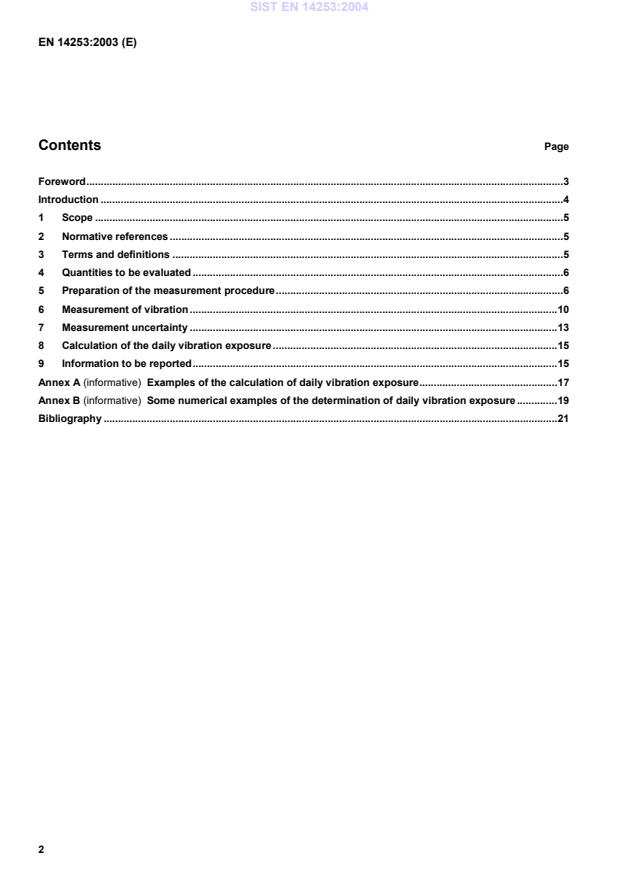
Examples of the calculation of daily vibration exposure.17Annex B (informative)
Some numerical examples of the determination of daily vibration exposure.19Bibliography.21SIST EN 14253:2004
å==NjjtT1 is the total measurement duration This procedure shall be carried out separately for vibration in each of the axes measured.b) Where the daily work consists of operations of shorter duration, which are repeated several times during aworking day, measurements for determination of the 8 h energy-equivalent vibration value can be made overcomplete work cycles. The number of work cycles over which measurements are made shall be sufficient toshow that the average value obtained is representative of the vibration from the operation throughout the day.c) Where no operations are repeated, the vibration from every operation shall be measured.d)Where there is no repeated work cycle of operations of short duration and the individual operations are shorterthan 3 min, the operations can be repeated in order to collect measurements over a minimum of 3 min, seeexample in clause A.3. As an alternative, simulated operations may be organized for making measurements of3 min duration.NOTEThe requirement of a minimum of 3 min is due to statistical reasons.5.5 Estimation of exposure timeThe total daily exposure duration shall be obtained for each operation or work cycle for which a vibration magnitudehas been established. This may be based on;a) a measurement of the actual exposure duration of a single operation or work cycle; andb) information on the number of operations or work cycles per working day.The first of these will be a measurement to determine how long an operator is exposed to vibration, and from whatsource, during a specified period. Various techniques may be used, for example:¾ use of a stopwatch;¾ analysis of video recordings;¾ activity sampling.A source of information may be work records, e.g. the number of lorries loaded and unloaded by fork-lift trucks.However, it is important to ensure that the information is compatible with the information required for an evaluationof daily vibration exposure. For example, work records might give very accurate information on the number ofcompleted work items at the end of each day, but where there is more than one operator, or unfinished work itemsat the end of a shift, this information may not be directly applicable to a vibration exposure evaluation.NOTEOperators asked for information on their typical daily vibration exposure duration will normally give an estimatewhich includes periods of time when there is no vibration (e.g. idling, lifting for a fork-lift truck). Therefore, such an approachoften results in an overestimation of the exposure duration.SIST EN 14253:2004
...
Questions, Comments and Discussion
Ask us and Technical Secretary will try to provide an answer. You can facilitate discussion about the standard in here.
Loading comments...