

FprEN 1482-3
(Main)Fertilizers, liming materials and inhibitors - Sampling and sample preparation - Part 3: Sampling of static heaps
- Abstract
This document is applicable to the sampling of solid fertilizers and liming materials that have a uniform composition and have no tendency to segregate.
NOTE 1 The term product is used throughout the body of this document and is understood to include fertilizers, liming materials and inhibitors unless otherwise indicated.
NOTE 2 Manufacturers, importers and sellers can choose to use this method to obtain samples of other products or blends as well as long as both parties to a transaction agree. The build-up of a static heap often leads to granulometric segregation, which makes the collection of a truly representative sample of many products and blends unlikely.
NOTE 3 It is the responsibility of manufacturers, importers and sellers, however, to ensure they supply a product that complies with its label declaration at the moment of delivery and fulfils the expectations of the end user at the moment of application.
NOTE 4 A method of obtaining a screening sample from a static heap can be found in Annex B.
- Status
- Not Published
- Publication Date
- 24-Feb-2027
- Technical Committee
- CEN/TC 260 - Fertilizers and liming materials
- Drafting Committee
- CEN/TC 260/WG 1 - Sampling
- Current Stage
- 5020 - Submission to Vote - Formal Approval
- Start Date
- 05-Nov-2026
- Due Date
- 27-Sep-2027
- Completion Date
- 27-Sep-2027

FprEN 1482-3 is a draft European Standard from CEN on sampling and sample preparation for fertilizers, liming materials and inhibitors. It specifies how to take representative samples from static heaps of solid fertilizers and liming materials with uniform composition and no tendency to segregate, so the batch can be checked against legal requirements and label declarations. It is mainly for manufacturers, importers, sellers and anyone who needs a defensible sample from bulk material stored as a heap.
What does FprEN 1482-3 specify?
FprEN 1482-3 applies to sampling static heaps of solid fertilizers and liming materials that are uniform and do not tend to segregate. In the document, the term product covers fertilizers, liming materials and inhibitors unless stated otherwise.
The document is organized into:
- Scope, normative references, terms and definitions
- Sampling plans and quantitative data
- Incremental sampling methods
- Final samples
- Sampling report
- Annex A and Annex B
| Annex | What it covers |
|---|---|
| Annex A | How to determine the mass or volume of a static heap |
| Annex B | An alternative screening method according to GOST |
Annex B is presented as a screening approach, not the method for showing compliance with legal requirements within the scope of this standard.
What are the key requirements of FprEN 1482-3?
FprEN 1482-3 requires the sampler to describe the batch before sampling, build a sampling plan, and take incremental samples from randomly selected sampling units across the heap. The central idea is to avoid sampling only the surface or one part of the heap, because that will not represent the batch.
Batch description and sampling plan
Clause 4.2 requires the batch to be characterized by type, texture, colour, storage conditions and foreign matter. If the whole batch carries the same description and statutory information, sampling may proceed under this document; if deterioration or contamination is evident, the batch may need to be split into parts.
Clause 4.3 says the sampling plan must define the batch boundary, the batch size, the number and location of sampling units, the units to be sampled, the sampling points and the minimum incremental sample mass. In practice, this means the sampler must plan and document where the samples come from.
Sampling units and sample masses
Clause 4.5 divides the batch into sampling units with roughly equal surface area. The minimum number of units depends on batch size: 10 units for 25 t or less, a square-root rule for batches above 25 t and up to 400 t, and 40 units above 400 t.
From those units, at least 10 are selected at random, and incremental samples are taken from random points within each selected unit. Clause 4.6 sets the minimum incremental sample mass at 250 g, or 500 g for liming materials coarser than 80 % passing 0.315 mm.
Sampling method and equipment
Clause 5 requires sampling to minimize changes in the sample, such as moisture changes, and to consider safety measures. The sampling apparatus must be clean, dry, inert and suitable for the particle size; its opening must be at least three times the size of the largest particle.
A sampling spear is the normal tool, while a tube shovel may be used for wet liming materials. Clause 5.3 says to reach into the heap at about 45° to the base or at right angles to the surface layer, and to exclude and document any visibly changed upper layer.
Combined, final samples and reporting
Clause 5.4 mixes all incremental samples into a combined sample, and Clause 6 then divides that combined sample into final samples and handles the laboratory samples according to EN 1482-1. Clause 7 requires a sampling report that follows EN 1482-1 as appropriate for bulk static heaps.
What terms does FprEN 1482-3 define?
- Sampling unit - the area of the surface of the material in the static heap from which samples are planned.
- Sampling point - a point within a sampling unit where material is actually taken.
- Static heap - a quantity of product stored in bulk as one mass.
- Uniform composition - a condition where each physical unit has the same quality traits.
- Product - the working term used in the document for fertilizers, liming materials and inhibitors.
Who uses FprEN 1482-3?
FprEN 1482-3 is used by manufacturers, importers and sellers who need to sample bulk material in storage before delivery or supply. It is also relevant to laboratories, inspectors and quality staff who assess whether a batch matches its label declaration, statutory information or expected use.
The document is especially practical when material is stored in large static heaps and moving the product for sampling is not possible or not practical.
What changed in FprEN 1482-3 from the previous edition?
FprEN 1482-3 will supersede EN 1482-3:2024. The European foreword states one significant technical change: the scope is extended to include sampling of uniform organic fertilizers and uniform organo-mineral fertilizers.
Which standards are used with FprEN 1482-3?
FprEN 1482-3 cites EN 1482-1:2024, which supplies general sampling provisions and the rules for combining, reducing, finalizing and reporting samples. It also cites prEN 12944-1 for general fertilizer vocabulary.
The foreword also places FprEN 1482-3 within the EN 1482 series:
- Part 1 - General sampling provisions
- Part 2 - General sample preparation provisions
- Part 3 - Sampling of static heaps
- Part 4 - Sampling for microbial presence
What does the FprEN 1482-3 document contain?
The document contains a worked sampling plan example for a conical heap, a table that links batch size to the minimum number of sampling units, and figures showing sampling apparatus and sampling positions. Annex A gives formulas and examples for estimating the volume or mass of a conical heap or partly filled storage box. Annex B describes an alternative GOST-based method for screening samples from static heaps.
Relations
- Effective Date
- 28-Jan-2026
- Effective Date
- 28-Jan-2026
- Effective Date
- 28-Jan-2026
- Effective Date
- 28-Jan-2026
- Effective Date
- 08-Oct-2025
Get Certified
Connect with accredited certification bodies for this standard

Control Union Certifications
Global certification for agriculture and sustainability.

ECOCERT
Organic and sustainability certification.

FSC International
Forest Stewardship Council certification.
Sponsored listings
Frequently Asked Questions
FprEN 1482-3 is a draft published by the European Committee for Standardization (CEN). Its full title is "Fertilizers, liming materials and inhibitors - Sampling and sample preparation - Part 3: Sampling of static heaps". This standard covers: This document is applicable to the sampling of solid fertilizers and liming materials that have a uniform composition and have no tendency to segregate. NOTE 1 The term product is used throughout the body of this document and is understood to include fertilizers, liming materials and inhibitors unless otherwise indicated. NOTE 2 Manufacturers, importers and sellers can choose to use this method to obtain samples of other products or blends as well as long as both parties to a transaction agree. The build-up of a static heap often leads to granulometric segregation, which makes the collection of a truly representative sample of many products and blends unlikely. NOTE 3 It is the responsibility of manufacturers, importers and sellers, however, to ensure they supply a product that complies with its label declaration at the moment of delivery and fulfils the expectations of the end user at the moment of application. NOTE 4 A method of obtaining a screening sample from a static heap can be found in Annex B.
This document is applicable to the sampling of solid fertilizers and liming materials that have a uniform composition and have no tendency to segregate. NOTE 1 The term product is used throughout the body of this document and is understood to include fertilizers, liming materials and inhibitors unless otherwise indicated. NOTE 2 Manufacturers, importers and sellers can choose to use this method to obtain samples of other products or blends as well as long as both parties to a transaction agree. The build-up of a static heap often leads to granulometric segregation, which makes the collection of a truly representative sample of many products and blends unlikely. NOTE 3 It is the responsibility of manufacturers, importers and sellers, however, to ensure they supply a product that complies with its label declaration at the moment of delivery and fulfils the expectations of the end user at the moment of application. NOTE 4 A method of obtaining a screening sample from a static heap can be found in Annex B.
FprEN 1482-3 is classified under the following ICS (International Classification for Standards) categories: 65.080 - Fertilizers. The ICS classification helps identify the subject area and facilitates finding related standards.
FprEN 1482-3 has the following relationships with other standards: It is inter standard links to EN ISO 11297-4:2018, EN ISO 11296-9:2022, CEN ISO/TS 23818-2:2022, EN ISO 11296-7:2019, EN 1482-3:2024. Understanding these relationships helps ensure you are using the most current and applicable version of the standard.
FprEN 1482-3 is associated with the following European legislation: EU Directives/Regulations: 2003/2003, 2019/1009; Standardization Mandates: M/564, M/564 Amd 1, M/564 Amd 2, M/XXX. When a standard is cited in the Official Journal of the European Union, products manufactured in conformity with it benefit from a presumption of conformity with the essential requirements of the corresponding EU directive or regulation.
FprEN 1482-3 is available in PDF format for immediate download after purchase. The document can be added to your cart and obtained through the secure checkout process. Digital delivery ensures instant access to the complete standard document.
Standards Content (Sample)
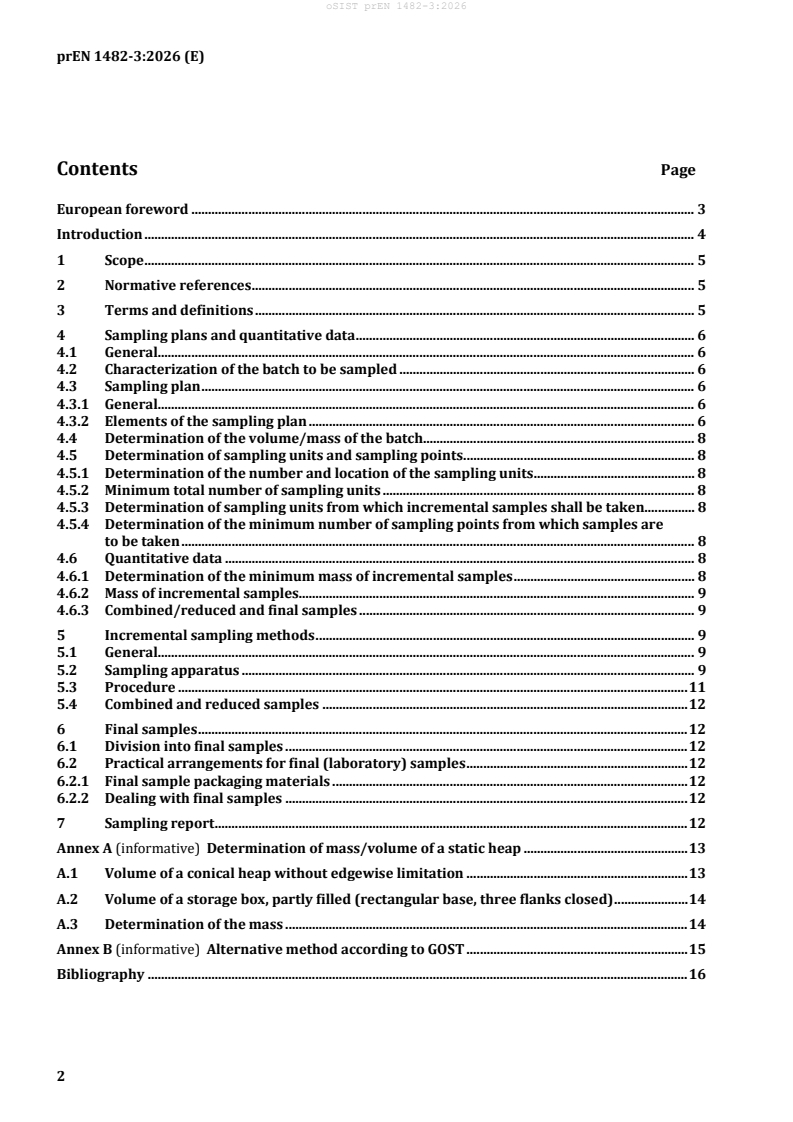
Contents
- Introduction
- 1 Scope
- 2 Normative references
- 3 Terms and definitions
- 3.1 sampling unit
- 3.2 sampling point
- 3.3 static heap
- 3.4 uniform composition
- 4 Sampling plans and quantitative data
- 4.1 General
- 4.2 Characterization of the batch to be sampled
- 4.3 Sampling plan
- 4.4 Determination of the volume/mass of the batch
- 4.5 Determination of sampling units and sampling points
- 4.6 Quantitative data
- 5 Incremental sampling methods
- 5.1 General
- 5.2 Sampling apparatus
- 5.3 Procedure
- 5.4 Combined and reduced samples
- 6 Final samples
- 6.1 Division into final samples
- 6.2 Practical arrangements for final (laboratory) samples
- 7 Sampling report
- Annex A
- Annex B
- Bibliography
Introduction
Standardized methods of sampling and analysis are essential in uniformly establishing the compliance of fertilizing products with legal requirements, as well as any information and/or declarations given on their supply or readiness for supply.
The aim of these standardized methods is to obtain a representative sample of the whole batch supplied or ready for supply. General methods to obtain such a sample are given in EN 1482-1. However, where the product is stored in large static heaps it is not always possible or practical to put the product into motion for a sampling method according to EN 1482-1 to be used. Research has found that for a limited number of types of products a representative sample can be obtained by sampling directly from the static heap.
This document describes the method to be used for sampling static heaps of the specified products within its scope.
oSIST prEN 1482-3:2026 prEN 1482-3:2026 (E)
1 Scope
This document is applicable to the sampling of solid fertilizers and liming materials that have a uniform composition and have no tendency to segregate.
NOTE 1 The term product is used throughout the body of this document and is understood to include fertilizers, liming materials and inhibitors unless otherwise indicated. NOTE 2 Manufacturers, importers and sellers can choose to use this method to obtain samples of other products or blends as well as long as both parties to a transaction agree. The build-up of a static heap often leads to granulometric segregation, which makes the collection of a truly representative sample of many products and blends unlikely.
NOTE 3 It is the responsibility of manufacturers, importers and sellers, however, to ensure they supply a product that complies with its label declaration at the moment of delivery and fulfils the expectations of the end user at the moment of application.
NOTE 4 A method of obtaining a screening sample from a static heap can be found in Annex B.
2 Normative references
The following documents are referred to in the text in such a way that some or all of their content constitutes requirements of this document. For dated references, only the edition cited applies. For undated references, the latest edition of the referenced document (including any amendments) applies. EN 1482-1:2024, Fertilizers, liming materials and inhibitors — Sampling and sample preparation — Part 1: General sampling provisions prEN 12944-1, Fertilizers, liming materials and inhibitors — Vocabulary — Part 1: General terms
3 Terms and definitions
For the purposes of this document, the terms and definitions given in EN 1482-1, prEN 12944-1 and the following apply.
ISO and IEC maintain terminology databases for use in standardization at the following addresses:
- ISO Online browsing platform: available at https://www.iso.org/obp
- IEC Electropedia: available at https://www.electropedia.org/
3.1 sampling unit
area of the surface of the material in the static heap
3.2 sampling point
point in the sampling unit
3.3 static heap
quantity of product stored in bulk in a single mass
3.4 uniform composition
composition where each physical unit has the same quality traits
oSIST prEN 1482-3:2026 prEN 1482-3:2026 (E) EXAMPLE single nutrient ingredient fertilizers; uniform compound complex fertilizers; organomineral fertilizers where each physical unit contains organic carbon (C ) and all the nutrients in their org declared content; milled, granulated or dredged liming materials
4 Sampling plans and quantitative data
4.1 General
The objective of sampling is to acquire a sample of the batch to establish its composition and properties. The methods to be used for sampling static heaps are specified in the following clauses.
4.2 Characterization of the batch to be sampled
Before a sampling plan is determined, a description of the characteristics of the batch that is intended to be sampled shall be undertaken. In particular, the following physical characteristics shall be noted:
- kind/type;
- texture;
- colour;
- storage conditions, e.g. uncovered/covered;
- foreign matters.
If the owner of the material is applying the same description and statutory information to the whole batch, sampling shall proceed in accordance with this document. Only if there is evidence of deterioration or contamination shall consideration be given to the dividing of the batch into parts from which separate samples shall be taken.
4.3 Sampling plan
4.3.1 General
The sampling plan shall be determined after the characteristics according to 4.2 have been considered. Any variations from the stated sampling plan shall be documented. The sampling plan shall define the course of the sampling process, and associated provisions, in reproducible manner.
Sampling only around the base of the heap or from a single part of the heap does not supply a representative sample.
4.3.2 Elements of the sampling plan
Within the sampling plan, the following elements shall be stated:
...