

EN 888:2026
(Main)Chemicals used for treatment of water intended for human consumption - Iron (III) chloride
- Abstract
This document is applicable to iron (III) chloride solution a) and iron (III) chloride hexahydrate b) used for treatment of water intended for human consumption. It describes the characteristics and specifies the requirements and the corresponding analytical methods for iron (III) chlorides a) and b) and gives information for their use in water treatment. It also specifies the rules relating to safe handling (Annex B) and describes the use of iron (III) chloride (Annex A).
- Status
- Not Published
- Publication Date
- 13-Dec-2026
- Technical Committee
- CEN/TC 164 - Water supply
- Drafting Committee
- CEN/TC 164/WG 9 - Drinking water treatment
- Current Stage
- 6055 - CEN Ratification completed (DOR) - Publishing
- Start Date
- 16-Nov-2026
- Due Date
- 09-Feb-2027
- Completion Date
- 09-Feb-2027

EN 888:2026 is a CEN standard for iron (III) chloride used in treatment of water intended for human consumption. It specifies the characteristics, purity criteria, test methods, labelling, transport, storage and safe handling of iron (III) chloride solution and iron (III) chloride hexahydrate for water treatment users and suppliers.
What does EN 888:2026 specify?
EN 888:2026 applies to two commercial forms of iron (III) chloride for drinking water treatment: solution and hexahydrate. It sets out how the product is identified, what purity limits apply, how it is tested, and how it should be labelled, transported, stored and handled.
| Annex | What it covers |
|---|---|
| Annex A | General information on iron (III) chloride, including origin, manufacturing process and use |
| Annex B | General rules relating to safety, including first aid, spillage and fire procedures |
The main body is organised into scope, normative references, terms and definitions, description, purity criteria, test methods, and labelling - transportation - storage. For a buyer or plant operator, this means the document is not only a product specification but also a practical guide for receiving, using and controlling the chemical.
What are the key requirements of EN 888:2026?
EN 888:2026 combines product description, quality limits and operational requirements. The most important points are the product form, the purity grades and types, the test methods, and the handling and labelling rules.
Product identification and form
Clause 4 identifies the two covered products as iron (III) chloride solution and iron (III) chloride hexahydrate. It gives their names, synonyms, molecular data, CAS Registry Numbers and commercial forms. In practice, this helps buyers and laboratories confirm they are dealing with the correct chemical form before acceptance or testing.
Physical and chemical properties
Clause 4 describes appearance, density, solubility, vapour pressure, boiling or decomposition behaviour, freezing and melting points, viscosity and chemical behaviour. It notes that both products are acidic and corrosive, and that very diluted solutions hydrolyse and can form iron hydroxide. This matters because storage, dosing and compatibility with equipment depend on these properties.
Purity criteria, grades and types
Clause 5 sets minimum purity requirements and separates them into product composition, grade and type. The standard uses three grades and three types with limits for impurities such as manganese, iron (II) and insoluble matter, and for trace metals such as arsenic, cadmium, chromium, mercury, nickel, lead, antimony and selenium. For users, this is the core purchasing control: the selected grade and type should match raw water quality, dosage and treatment objectives.
Test methods
Clause 6 directs users to EN 17215 for sampling and analysis. This means the acceptance testing is not carried out with ad hoc methods in EN 888 itself, but through the companion analytical standard. That keeps supplier and laboratory results aligned.
Delivery, labelling, transport and storage
Clause 7 requires suitable non-corrosive delivery equipment, proper labelling, and storage that avoids contamination and incompatible materials. It also gives transport classifications and marking content, including the product name, commercial form, grade, type, net mass and supplier details. For operations staff, this is the part that affects receiving checks, warehouse practice and transport documents.
Safe handling and use
Annex B gives the safety rules, including first aid for skin, eye, ingestion and inhalation exposure, spill response and fire precautions. Users are told to read the safety data sheet and follow the supplier’s current safety instructions. This is the section most relevant to site safety procedures and emergency training.
What terms does EN 888:2026 define?
EN 888:2026 does not list formal terms in Clause 3, but it uses several key identifiers and abbreviations throughout the document.
- Iron (III) chloride - the iron-based coagulant covered by the standard.
- Iron (III) chloride solution - the liquid commercial form, used as delivered or diluted.
- Iron (III) chloride hexahydrate - the crystalline granular commercial form.
- FeCl3 - the chemical formula used for the anhydrous iron (III) chloride reference in the document’s data.
- Fe(III) - the oxidation state used in the purity and grade tables.
- CAS Registry Number - the chemical registry identifier listed for each form.
- EINECS reference - the European inventory reference given for the substance.
- GHS05 / GHS07 - the hazard pictograms shown for the labelling examples.
Who uses EN 888:2026?
EN 888:2026 is used by drinking water treatment operators, chemical manufacturers, suppliers, laboratories and purchasing teams. It is also relevant to transport and warehouse staff, because it covers packaging, labelling, storage incompatibilities and transport classifications.
In practice, the standard helps users select the right grade and type, verify conformity on receipt, carry out sampling and analysis, and manage safe handling at the plant. Regulators and quality managers can also use it as a common reference for product control.
What changed in EN 888:2026 from the previous edition?
The document states that it supersedes EN 888:2023. The significant technical change identified is an update of the information related to limit values in Table 2 and Annex A.
Which standards are used with EN 888:2026?
EN 17215 is the normative reference used with EN 888:2026. It provides the analytical methods for sampling and analysis of iron-based coagulants, so it supports the test work needed to check conformity with this product standard.
What does the EN 888:2026 document contain?
The document contains identification data for the two product forms, physical and chemical property data, purity tables for grades and types, and the test-method reference to EN 17215. It also contains transport and marking information, storage guidance, and an example-based labelling section with hazard pictograms and statements.
Annex A adds background on raw materials, manufacturing routes, use as a primary coagulant, typical treatment dose, application method and removal of excess product. Annex B provides safety procedures for first aid, spillage and fire. For readers, these annexes are the most practical parts when setting up procurement, dosing, operator training and emergency response.
Relations
- Effective Date
- 28-Jan-2026
- Effective Date
- 28-Jan-2026
- Effective Date
- 04-Dec-2024
Get Certified
Connect with accredited certification bodies for this standard

ECOCERT
Organic and sustainability certification.

Eurofins Food Testing Global
Global leader in food, environment, and pharmaceutical product testing.

Intertek Bangladesh
Intertek certification and testing services in Bangladesh.
Sponsored listings
Frequently Asked Questions
EN 888:2026 is a draft published by the European Committee for Standardization (CEN). Its full title is "Chemicals used for treatment of water intended for human consumption - Iron (III) chloride". This standard covers: This document is applicable to iron (III) chloride solution a) and iron (III) chloride hexahydrate b) used for treatment of water intended for human consumption. It describes the characteristics and specifies the requirements and the corresponding analytical methods for iron (III) chlorides a) and b) and gives information for their use in water treatment. It also specifies the rules relating to safe handling (Annex B) and describes the use of iron (III) chloride (Annex A).
This document is applicable to iron (III) chloride solution a) and iron (III) chloride hexahydrate b) used for treatment of water intended for human consumption. It describes the characteristics and specifies the requirements and the corresponding analytical methods for iron (III) chlorides a) and b) and gives information for their use in water treatment. It also specifies the rules relating to safe handling (Annex B) and describes the use of iron (III) chloride (Annex A).
EN 888:2026 is classified under the following ICS (International Classification for Standards) categories: 71.100.80 - Chemicals for purification of water. The ICS classification helps identify the subject area and facilitates finding related standards.
EN 888:2026 has the following relationships with other standards: It is inter standard links to EN ISO 11296-9:2022, CEN ISO/TS 23818-2:2022, EN 888:2023. Understanding these relationships helps ensure you are using the most current and applicable version of the standard.
EN 888:2026 is available in PDF format for immediate download after purchase. The document can be added to your cart and obtained through the secure checkout process. Digital delivery ensures instant access to the complete standard document.
Standards Content (Sample)
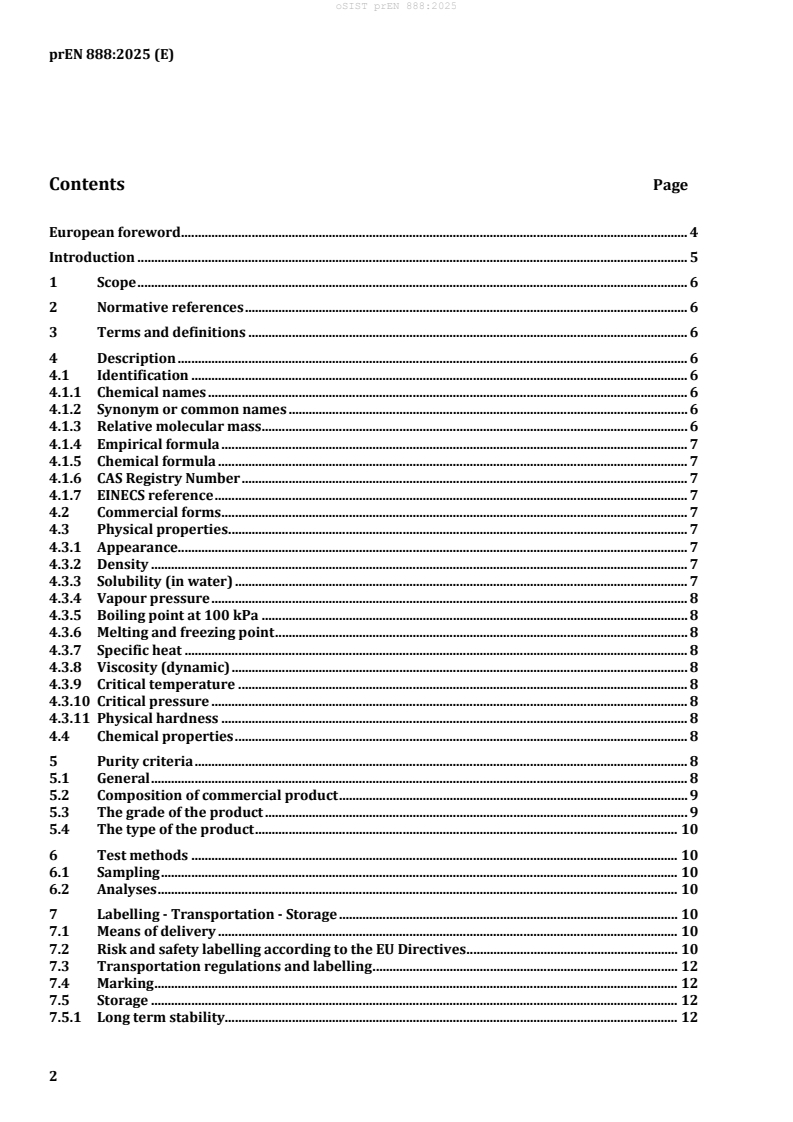
Contents
- Introduction
- 1 Scope
- 2 Normative references
- 3 Terms and definitions
- 4 Description
- 4.1 Identification
- 4.2 Commercial forms
- 4.3 Physical properties
- 4.4 Chemical properties
- 5 Purity criteria
- 5.1 General
- 5.2 Composition of commercial product
- 5.3 The grade of the product
- 5.4 The type of the product
- 6 Test methods
- 6.1 Sampling
- 6.2 Analyses
- 7 Labelling - Transportation - Storage
- 7.1 Means of delivery
- 7.2 Risk and safety labelling according to the EU Directives
- 7.3 Transportation regulations and labelling
- 7.4 Marking
- 7.5 Storage
- Annex A
- Annex B
- Bibliography
Introduction
In respect of potential adverse effects on the quality of water intended for human consumption, caused by the product covered by this document:
a) this document provides no information as to whether the product may be used without restriction in any of the Member States of the EU or EFTA; b) it should be noted that, while awaiting the adoption of verifiable European criteria, existing national regulations concerning the use and/or the characteristics of this product remain in force. NOTE Conformity with this standard does not confer or imply acceptance or approval of the product in any of the Member States of the EU or EFTA. The use of the product covered by this document is subject to regulation or control by National Authorities.
oSIST prEN 888:2025 prEN 888:2025 (E)
1 Scope
This document is applicable to iron (III) chloride solution a) and iron (III) chloride hexahydrate b) used for treatment of water intended for human consumption. It describes the characteristics and specifies the requirements and the corresponding analytical methods for iron (III) chlorides a) and b) and gives information for their use in water treatment. It also determines the rules relating to safe handling (Annex B) and use of iron (III) chloride (Annex A).
2 Normative references
The following documents are referred to in the text in such a way that some or all of their content constitutes requirements of this document. For dated references, only the edition cited applies. For undated references, the latest edition of the referenced document (including any amendments) applies. EN 17215, Chemicals used for treatment of water intended for human consumption — Iron-based coagulants — Analytical methods
3 Terms and definitions
No terms and definitions are listed in this document.
ISO and IEC maintain terminology databases for use in standardization at the following addresses:
- ISO Online browsing platform: available at https://www.iso.org/obp
- IEC Electropedia: available at https://www.electropedia.org/
4 Description
4.1 Identification
4.1.1 Chemical names
a) Iron (III) chloride solution.
b) Iron (III) chloride hexahydrate (FeCl ·6H O).
3 2
4.1.2 Synonym or common names
a) Ferric chloride, solution.
b) Ferric chloride, hexahydrate.
4.1.3 Relative molecular mass
a) 162,21 g/mol for FeCl 3.
b) 270,31 g/mol for FeCl ·6H O.
3 2
oSIST prEN 888:2025 prEN 888:2025 (E)
4.1.4 Empirical formula
a) FeCl .
b) FeCl ·6H O.
3 2
4.1.5 Chemical formula
a) FeCl .
b) FeCl ·6H O.
3 2 1)
4.1.6 CAS Registry Number
a) 7705-08-0.
b) 10025-77-1.
2)
4.1.7 EINECS reference
231-729-4.
4.2 Commercial forms
Iron (III) chloride a) is available as a solution.
Iron (III) chloride hexahydrate b) is available as crystalline granules.
4.3 Physical properties
4.3.1 Appearance
Iron (III) chloride a) solutions are dark brown in colour.
Iron (III) chloride hexahydrate b) is an hygroscopic, yellow deliquescent crystalline granular material.
4.3.2 Density
The density of solutions of iron (III) chloride a) is approximately 1,43 g/cm at 20 °C for a mass fraction of 40 % of FeCl .
The density of iron (III) chloride hexahydrate b) is approximately 1,8 g/cm at 20 °C.
The bulk density of the products b) is approximately 1,0 kg/dm .
4.3.3 Solubility (in water)
The product a) is dilutable and b) is soluble (see A.3.2).
The solubility at 20 °C for the product b) is approximately up to a mass fraction of 47 % of FeCl .
1) Chemical Abstracts Service Registry Number 2) European Inventory of Existing Commercial Chemical Substances
oSIST prEN 888:2025 prEN 888:2025 (E)
4.3.4 Vapour pressure
Not applicable.
3)
4.3.5 Boiling point at 100 kPa
For the product b) decomposition starts at 160 °C.
4.3.6 Melting and freezing point
For the product a) the freezing point depends on concentration. For the product b) melting point is 37 °C.
The freezing point of an aqueous solution is lower than −15 °C.
4.3.7 Specific heat
For the product a) not applicable.
For the product b) not known.
4.3.8 Viscosity (dynamic)
For the product a) the viscosity is about 10 mPa·s for a solution of a mass fraction of 40 % of FeCl at
20 °C.
For the product b) it is not applicable.
4.3.9 Critical temperature
Not applicable.
4.3.10 Critical pressure
Not applicable.
4.3.11 Physical hardness
Not applicable.
4.4 Chemical properties
The solutions of the liquid forms of iron (III) chloride a) and iron (III) chloride hexahydrate b) are acidic and corrosive. Very diluted solutions hydrolyse and form a precipitate of iron hydroxide.
5 Purity criteria
5.1 General
This document specifies the minimum purity requirements for iron (III) chloride used for the treatment of water intended for human consumption. Limits are given for impurities commonly present in the product. Depending on the raw material and the manufacturing process other impurities can be present and, if so, this shall be notified to the user and when necessary to relevant authorities.
3) 100 kPa = 1 bar
oSIST prEN 888:2025 prEN 888:2025 (E) NOTE Users of these products can check the national regulations in order to clarify whether it is of appropriate purity for treatment of water intended for human consumption, taking account raw water quality, required dosage, contents of other impurities and additives used in the products not stated in this product standard.
Limits have been given for impurities and chemical parameters where these are likely to be present in significant quantities from the current production process and raw materials. If the production process or raw materials lead to significant quantities of impurities, by-products or additives being present, this shall be notified to the user.
5.2 Composition of commercial product
The concentration of active matter in the product expressed as mass fraction in % of FeCl or Fe (III)
shall be within ±3 % of the manufacturer’s declared values.
...